REVIEW 4 major objections 5 minor 1 cited by
Boosted $W/Z$ Tagging with Jet Charge and Deep Learning
T0 review · 4 major / 5 minor · reviewed 2026-08-14 · deepseek-v4-flash
Pith's one-line read Including jet charge as a deep-learning input materially improves boosted W and Z tagging, with a composite CNN more than tripling background rejection for Z versus W compared with a boosted decision tree.
desk verdict Worth engaging: a genuinely new ternary W+/W-/Z tagger with a dual-branch CNN, but the headline gains are partly selected on the same test set used for the final metrics, so treat the numbers as optimistic until a clean validation/test protocol is reported. read the letter →
The pith
A machine-rendered reading of the paper's core claim, the machinery that carries it, and where it could break.
The reading
What carries the argument
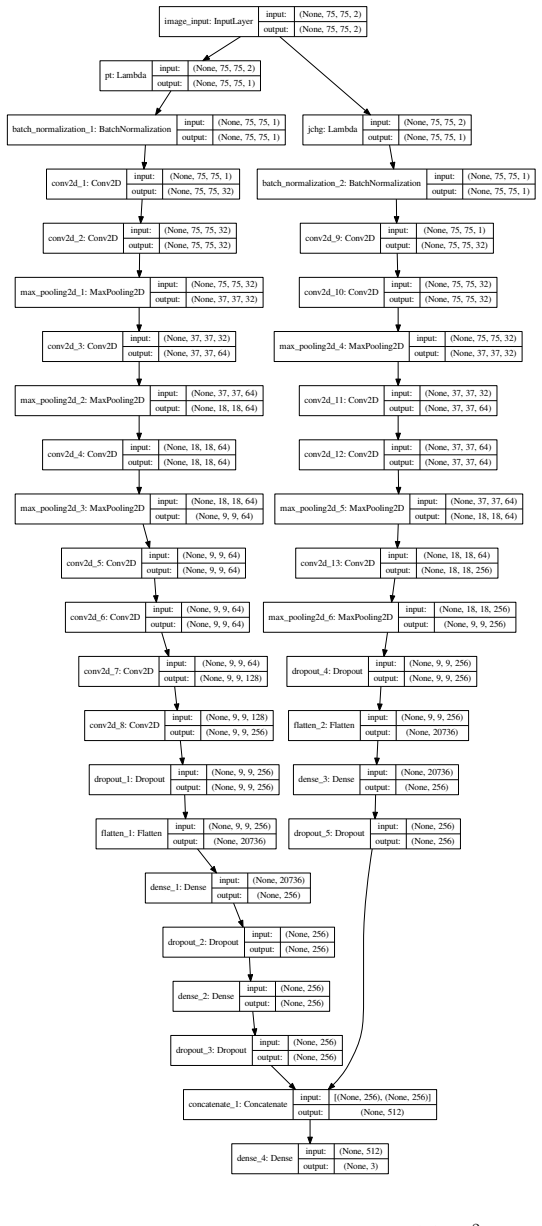
The engine is the jet charge $$Q_\kappa = \frac{1}{p_{T,J}^\kappa}\sum_{i\in J} q_i (p_{iT})^\kappa$$, a pT-weighted signed sum of constituent charges, rendered as a second image channel alongside per-pixel pT. On top of it sits CNN2, a composite convolutional network with two parallel branches: a deep stack for the pT image and a shallow stack for the charge image, merged before the final dense layers. The depth asymmetry lets the network exploit fine spatial substructure to identify Z bosons while avoiding overfitting on the charge-only W+ versus W− distinction.
What would settle it
Retrain the same taggers on jets tagged from LHC collision data through semileptonic decays and compare R50 for Z versus W; if the CNN2 advantage over a boosted decision tree shrinks toward zero, or the charge channel stops helping, the central claim would be falsified. An alternative shower model alone cannot settle this because it shares the same hard-process and detector model.
Extended reading notes
Core claim
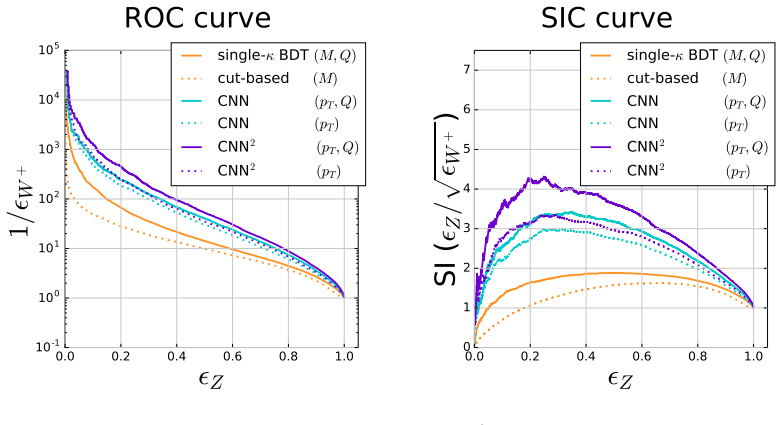
The paper's central claim is that combining jet charge with convolutional networks trained on collider images substantially improves W+/W−/Z classification. Adding a jet-charge channel lifts the plain CNN's background rejection at 50% signal efficiency from about 14 to 40 for Z versus W, and the composite CNN2, which gives the pT channel a deeper stack of convolutional layers than the charge channel, reaches 52.60. The paper further claims that a single ternary classifier, when projected onto any pair of classes, recovers or exceeds the performance of dedicated binary taggers, so one network can serve several physics tasks.
Load-bearing premise
The reported gains depend on the Monte Carlo simulation reproducing the real joint distribution of jet charge and jet substructure at the LHC closely enough that the tagger rankings and R50 values survive on collision data; the paper validates only against an alternative shower model, not against observed events.
Editorial extensions
If this is right
- A single three-way tagger can replace separate binary taggers: its pairwise projections match or beat the dedicated binary classifiers.
- Adding jet charge as an input channel raises background rejection by roughly 30–40% at fixed signal efficiency relative to cut-based and BDT baselines.
- The composite CNN2, with unequal depth per channel, is the strongest Z versus W tagger in the paper, with R50 = 52.60 compared with 40.42 for the plain CNN and 14.16 for the single-kappa BDT.
- The ordering of taggers persists, with some degradation, when an alternative parton-shower model is used for hadronization, indicating the result is not tied to one shower generator.
- Charge-sensitive W+/W− identification opens the door to LHC measurements of charge asymmetries and same-sign diboson production.
Reading between the lines
- A natural extension is a network fed raw per-track charges instead of a fixed-kappa weighted sum, which could remove the kappa tuning the paper required and further improve W+/W− separation.
- The same two-channel architecture should transfer to other charged resonances, such as distinguishing W± from H±, whenever the charge asymmetry of the decay products is informative.
- The reported gains would directly strengthen charge-asymmetry measurements and searches for doubly charged scalars, although the paper does not quantify the projected physics reach.
- Because the taggers are trained on leading-order simulated samples, deployment at the LHC would need a check of stability against higher-order corrections and pileup conditions.
Editorial analysis
A structured set of objections, weighed in public.
Referee Report
Summary. The paper studies boosted hadronic W/Z tagging using jet charge and deep learning. The authors generate VBF-like events with heavy Higgs decays to WW and ZZ, shower them with Pythia, simulate the detector with Delphes, and reconstruct anti-kT jets with R=0.7 in the pT range 350-450 GeV. They compare cut-based and BDT taggers built from (M, Q_kappa) with CNN taggers trained on two-channel jet images (pT, Q_kappa), including a composite architecture (CNN2) with separate branches for the pT and Q_kappa channels. Binary tasks (W-/W+ and Z/W+) and a ternary task (W+/W-/Z) are evaluated through AUC, accuracy, and R50. The central claim is that deep learning with jet charge improves background rejection by about 30-40% over the cut/BDT baselines, and that CNN2 yields further gains, especially for Z versus W discrimination. An appendix repeats the CNN/CNN2 analysis with Herwig showering as a cross-check.
Significance. If the numerical claims survive scrutiny, the paper provides a useful benchmark for charge-sensitive weak boson tagging at the LHC and demonstrates a concrete architectural idea (separate network depths for pT and charge channels) that could transfer to other jet classification problems. The explicit comparison across multiple methods, the projection consistency check between ternary and binary taggers, the saliency-map visualization, and the Herwig cross-check are all valuable and are executed with care. The main limitation is that the performance numbers are obtained in a Monte Carlo simulation without data validation, and, more immediately, the model-selection procedure appears to use the test set, which can inflate the reported gains.
major comments (4)
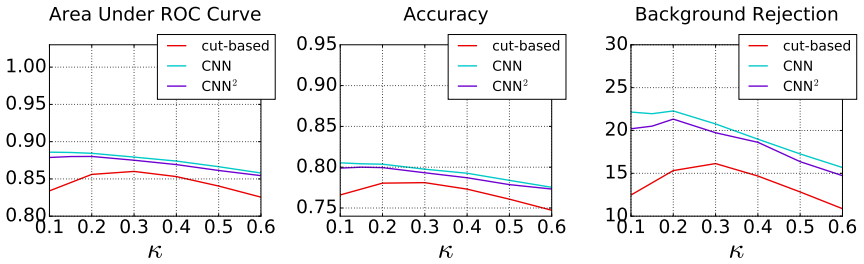
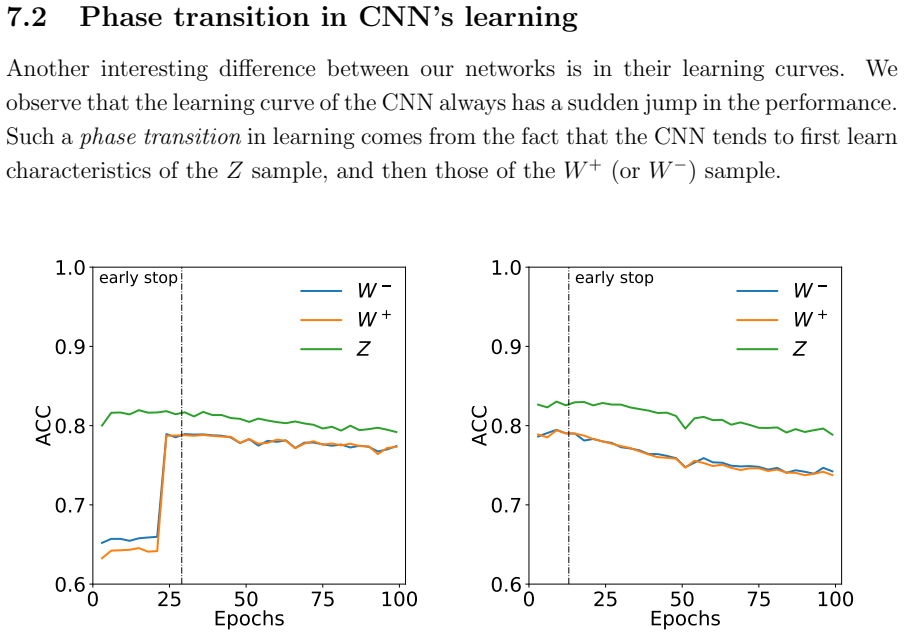
- [Secs. 2, 4.1, 5.1, 3.2, 7.2] The hyperparameters and architecture appear to be tuned on the same test sets used for the headline metrics, which is a load-bearing issue for the quantitative claims. Table 2 states that all ROC and SIC curves are evaluated using the testing sets; Figures 8 and 10 plot AUC/ACC/R50 versus kappa, and the text in Sec. 4.1 fixes kappa=0.3 for the BDT and kappa=0.15 for the CNNs based on those test-set curves. Section 3.2 says the CNN2 architecture was chosen 'after investigations on the model structure and seeing performance trends in the different classification problems,' and Sec. 7.2 evaluates checkpoints on the testing jet samples. Consequently, the R50 values in Tables 4-6, in particular the CNN2-vs-CNN advantage in the Z/W+ row (52.60 vs 40.42), may be optimistically biased. The authors should either use a strict train/validation/test split for all tuning decisions, or report validation-based curves and a final untouched test set, or perform nested cross-validation. Without this, the central 'significant boost' claim is not yet established.
- [Tables 4-6 and Appendix A] No statistical uncertainties are reported for any of the performance metrics. Given that the test samples contain only ~35k-40k jets per class, the differences between, for example, CNN R50=40.4205 and CNN2 R50=52.6028 in Table 5 need confidence intervals, bootstrap errors, or at least a repeated-initialization run. The absence of uncertainties makes it impossible to judge whether the CNN2 improvement is real or within training noise, especially since CNN2 has many more trainable parameters and a more complex architecture.
- [Appendix A] The Herwig cross-check as written does not test the robustness of the Pythia-trained taggers to a different shower model. The appendix trains CNN and CNN2 on Herwig-showered samples and compares their performance to the Pythia-trained results, but the robustness question that matters for the MC-faithfulness concern is whether a tagger trained on Pythia and then applied to Herwig retains its performance. The current statement that 'the tagging abilities of our CNN and CNN2 taggers are independent of showering and hadronization models' is stronger than what the presented test shows and should be either clarified or supplemented with a direct transfer test.
- [Secs. 5.2 and Abstract] The central 30-40% improvement claim is framed as a benefit from deep learning and jet charge, but the baseline BDT uses only (M, Q_kappa) while the CNNs see full jet images with substructure information. The paper itself acknowledges in Sec. 5.2 that the cut-based and BDT methods do not include any jet substructure variables, so part of the gain is expected from additional low-level information rather than from deep learning per se. The abstract and conclusions should qualify the claim accordingly, or the authors should add a BDT baseline with substructure variables, so that the gain attributable to deep learning is not conflated with the gain due to extra input information.
minor comments (5)
- [Sec. 2.1 and Eq. (2)] The text around Eq. (2) says the sum runs over jet constituents with pT > 500 MeV, but the jet-charge images in Sec. 2.2 are defined by summing over constituents in each pixel; it would be helpful to state explicitly whether the same pT threshold is applied in the pixelated version.
- [Table 3] The architecture strings in Table 3 are difficult to parse; a short textual description or a reference to a public model definition (for example, a Keras summary) would improve reproducibility.
- [Fig. 15 caption] The caption says 'The dashed curves are for binary classifications, and the solid curves for the projected ternary results,' but the text in Sec. 6.1 refers to 'dotted curves'; the figure/legend terminology should be made consistent.
- [Appendix A] There is a typo in the first paragraph: 'parton showing' should be 'parton showering.' Also, the table captions use 'T able' instead of 'Table' in several places.
- [Sec. 8] The conclusion mentions the pT~1 TeV scenario and says results are qualitatively the same, but no corresponding figures or tables are shown; a reference to a supporting plot or a quantitative statement would help the reader assess this claim.
Circularity Check
No significant circularity: the paper is an empirical machine-learning benchmark, not a derivation that reduces to its inputs.
full rationale
The paper's central claims are empirical comparisons of taggers on simulated jets; there is no first-principles derivation whose output is equivalent to its input by construction. The only near-miss is the selection of kappa and the CNN2 depth using the same testing sets later used for the reported metrics (Table 2 caption; Secs. 3.2 and 4.1). That is a potential optimism-bias or data-leakage concern for the numerical point estimates, but it is not circularity: the reported R50 values are not equal to the fitted parameters by construction, and the tagger comparison is not logically forced by the input definitions. The preprocessing follows Ref. [16] by a co-author, but that citation is not load-bearing; it concerns image preprocessing rather than the central claim. No self-citation chain, uniqueness theorem, or ansatz-smuggling is present, and Appendix A provides an independent Herwig showering cross-check. Therefore no circular step is exhibited.
Assumptions & free parameters
free parameters (2)
- kappa (jet charge exponent) =
0.15 for CNN/CNN2, 0.3 for single-kappa BDT, 0.2/0.3/0.4 for multi-kappa BDT
- CNN2 branch depths =
8 convolutional layers for pT branch, 3 for Q_kappa branch
assumptions (3)
- domain assumption MadGraph/Pythia/Delphes simulation is a faithful proxy for LHC jet charge and substructure.
- domain assumption Truth matching with a distance cut of 0.1 between the jet and the generated boson yields a correctly labeled sample.
- standard math Standard implementations of CNNs, BDTs, Adam, and ROC/SIC evaluation are assumed to behave as documented.
Cite this review
Pith. "Pith review of Boosted $W/Z$ Tagging with Jet Charge and Deep Learning." pith.science (2026). https://pith.science/paper/KZZQM7PA
@misc{pith2026190808256,
  author       = {Pith},
  title        = {Pith review of: Boosted $W/Z$ Tagging with Jet Charge and Deep Learning},
  year         = {2026},
  howpublished = {\url{https://pith.science/paper/KZZQM7PA}},
  note         = {Machine review of arXiv:1908.08256}
}
abstract
We demonstrate that the classification of boosted, hadronically-decaying weak gauge bosons can be significantly improved over traditional cut-based and BDT-based methods using deep learning and the jet charge variable. We construct binary taggers for $W^+$ vs. $W^-$ and $Z$ vs. $W$ discrimination, as well as an overall ternary classifier for $W^+$/$W^-$/$Z$ discrimination. Besides a simple convolutional neural network (CNN), we also explore a composite of two CNNs, with different numbers of layers in the jet $p_{T}$ and jet charge channels. We find that this novel structure boosts the performance particularly when considering the $Z$ boson as signal. The methods presented here can enhance the physics potential in SM measurements and searches for new physics that are sensitive to the electric charge of weak gauge bosons.
Figures


Figures from the paper (17 more)








Forward citations
Cited by 1 Pith paper
-
Exploring anomalous couplings in Higgs boson pair production through shape analysis
Anomalous Higgs couplings change the shape of the di-Higgs mass distribution, and an unsupervised clustering algorithm captures those shape differences more finely than a hand-defined taxonomy.
Reference graph
Works this paper leans on
-
[1]
A. J. Larkoski, I. Moult and B. Nachman, Jet Substructure at the Large Hadron Collider: A Review of Recent Advances in Theory and Machine Learning , 1709.04464
-
[2]
Asquith et al., Jet Substructure at the Large Hadron Collider : Experimental 26 Review, 1803.06991
L. Asquith et al., Jet Substructure at the Large Hadron Collider : Experimental 26 Review, 1803.06991
-
[3]
S. Marzani, G. Soyez and M. Spannowsky, Looking inside jets: an introduction to jet substructure and boosted-object phenomenology, 1901.10342
arXiv 1901
-
[4]
L. G. Almeida, M. Backovi, M. Cliche, S. J. Lee and M. Perelstein, Playing Tag with ANN: Boosted Top Identification with Pattern Recognition , JHEP 07 (2015) 086, [1501.05968]
arXiv 2015
-
[5]
L. de Oliveira, M. Kagan, L. Mackey, B. Nachman and A. Schwartzman, Jet-images — deep learning edition , JHEP 07 (2016) 069, [ 1511.05190]
arXiv 2016
-
[6]
Jet Substructure Classification in High-Energy Physics with Deep Neural Networks
P. Baldi, K. Bauer, C. Eng, P. Sadowski and D. Whiteson, Jet Substructure Classification in High-Energy Physics with Deep Neural Networks , Phys. Rev. D93 (2016) 094034, [ 1603.09349]
work page Pith review arXiv 2016
- [7]
-
[8]
P. T. Komiske, E. M. Metodiev and M. D. Schwartz, Deep learning in color: towards automated quark/gluon jet discrimination , JHEP 01 (2017) 110, [1612.01551]
arXiv 2017
Show all 46 references
-
[9]
Kasieczka, T
G. Kasieczka, T. Plehn, M. Russell and T. Schell, Deep-learning top taggers or the end of QCD? , Journal of High Energy Physics 2017 (May, 2017) 6, [1701.08784]
2017 arXiv
-
[10]
Louppe, K
G. Louppe, K. Cho, C. Becot and K. Cranmer, QCD-Aware Recursive Neural Networks for Jet Physics , JHEP 01 (2019) 057, [ 1702.00748]
2019 arXiv
-
[11]
Pearkes, W
J. Pearkes, W. Fedorko, A. Lister and C. Gay, Jet Constituents for Deep Neural Network Based Top Quark Tagging , 1704.02124
-
[12]
Butter, G
A. Butter, G. Kasieczka, T. Plehn and M. Russell, Deep-learned Top Tagging with a Lorentz Layer, SciPost Physics 5 (Sep, 2018) 028, [ 1707.08966]
2018 arXiv
-
[13]
Cheng, Recursive Neural Networks in Quark/Gluon Tagging , Comput
T. Cheng, Recursive Neural Networks in Quark/Gluon Tagging , Comput. Softw. Big Sci. 2 (2018) 3, [ 1711.02633]
2018 arXiv
-
[14]
S. Egan, W. Fedorko, A. Lister, J. Pearkes and C. Gay, Long Short-Term Memory (LSTM) networks with jet constituents for boosted top tagging at the LHC , 1711.09059. 27
-
[15]
ATLAS collaboration, Identification of Hadronically-Decaying W Bosons and Top Quarks Using High-Level Features as Input to Boosted Decision Trees and Deep Neural Networks in ATLAS at √s = 13 TeV, Tech. Rep. ATL-PHYS-PUB-2017-004, CERN, Geneva, Apr, 2017
2017
-
[16]
Macaluso and D
S. Macaluso and D. Shih, Pulling Out All the Tops with Computer Vision and Deep Learning, JHEP 10 (2018) 121, [ 1803.00107]
2018 arXiv
-
[17]
Datta, A
K. Datta, A. Larkoski and B. Nachman, Automating the Construction of Jet Observables with Machine Learning , 1902.07180
1902 arXiv
- [18]
-
[19]
Butter et al., The Machine Learning Landscape of Top Taggers , 1902.09914
A. Butter et al., The Machine Learning Landscape of Top Taggers , 1902.09914
1902 arXiv
-
[20]
B. M. Dillon, D. A. Faroughy and J. F. Kamenik, Uncovering latent jet substructure, 1904.04200
1904 arXiv
-
[21]
Bhattacherjee, S
B. Bhattacherjee, S. Mukherjee and R. Sengupta, Discrimination between prompt and long-lived particles using convolutional neural network , 1904.04811
1904 arXiv
-
[22]
Diefenbacher, H
S. Diefenbacher, H. Frost, G. Kasieczka, T. Plehn and J. M. Thompson, CapsNets Continuing the Convolutional Quest , 1906.11265
1906 arXiv
-
[23]
E. A. Moreno, O. Cerri, J. M. Duarte, H. B. Newman, T. Q. Nguyen, A. Periwal et al., JEDI-net: a jet identification algorithm based on interaction networks , 1908.05318
1908 arXiv
-
[24]
CMS collaboration, Machine learning-based identification of highly Lorentz-boosted hadronically decaying particles at the CMS experiment , Tech. Rep. CMS-PAS-JME-18-002, CERN, Geneva, 2019
2019
-
[25]
R. D. Field and R. P. Feynman, A Parametrization of the Properties of Quark Jets, Nucl. Phys. B136 (1978) 1
1978
-
[26]
Krohn, M
D. Krohn, M. D. Schwartz, T. Lin and W. J. Waalewijn, Jet Charge at the LHC , Phys. Rev. Lett. 110 (2013) 212001, [ 1209.2421]
2013 arXiv
-
[27]
Aad et al., Measurement of jet charge in dijet events from√s = 8 TeV pp collisions with the ATLAS detector , Phys
ATLAS collaboration, G. Aad et al., Measurement of jet charge in dijet events from√s = 8 TeV pp collisions with the ATLAS detector , Phys. Rev. D93 (2016) 052003, [1509.05190]. 28
2016 arXiv
-
[28]
CMS collaboration, A. M. Sirunyan et al., Measurements of jet charge with dijet events in pp collisions at √s = 8 TeV, JHEP 10 (2017) 131, [ 1706.05868]
2017 arXiv
-
[29]
Aad et al., A new method to distinguish hadronically decaying boostedZ bosons from W bosons using the ATLAS detector , Eur
ATLAS collaboration, G. Aad et al., A new method to distinguish hadronically decaying boostedZ bosons from W bosons using the ATLAS detector , Eur. Phys. J. C76 (2016) 238, [ 1509.04939]
2016 arXiv
-
[30]
ATLAS collaboration, Jet Charge Studies with the ATLAS Detector Using√s = 8 TeV Proton-Proton Collision Data , Tech. Rep. ATLAS-CONF-2013-086, Geneva, Aug, 2013
2013
-
[31]
Fraser and M
K. Fraser and M. D. Schwartz, Jet Charge and Machine Learning , JHEP 10 (2018) 093, [ 1803.08066]
2018 arXiv
-
[32]
Alwall, R
J. Alwall, R. Frederix, S. Frixione, V. Hirschi, F. Maltoni, O. Mattelaer et al., The automated computation of tree-level and next-to-leading order differential cross sections, and their matching to parton shower simulations , JHEP 07 (2014) 079, [1405.0301]
2014 arXiv
-
[33]
Hartling, K
K. Hartling, K. Kumar and H. E. Logan, GMCALC: a calculator for the Georgi-Machacek model, 1412.7387
-
[34]
Sjstrand, S
T. Sjstrand, S. Ask, J. R. Christiansen, R. Corke, N. Desai, P. Ilten et al., An Introduction to PYTHIA 8.2 , Comput. Phys. Commun. 191 (2015) 159–177, [1410.3012]
2015 arXiv
-
[35]
de Favereau, C
DELPHES 3 collaboration, J. de Favereau, C. Delaere, P. Demin, A. Giammanco, V. Lematre, A. Mertens et al., DELPHES 3, A modular framework for fast simulation of a generic collider experiment , JHEP 02 (2014) 057, [1307.6346]
2014 arXiv
-
[36]
Cacciari, G
M. Cacciari, G. P. Salam and G. Soyez, FastJet User Manual, Eur. Phys. J. C72 (2012) 1896, [ 1111.6097]
2012 arXiv
-
[37]
Cacciari, G
M. Cacciari, G. P. Salam and G. Soyez, The anti-kt jet clustering algorithm , JHEP 04 (2008) 063, [ 0802.1189]
2008 arXiv
-
[38]
Ioffe and C
S. Ioffe and C. Szegedy, Batch normalization: Accelerating deep network training by reducing internal covariate shift , CoRR abs/1502.03167 (2015) , [1502.03167]. 29
2015 arXiv
-
[39]
Pedregosa, G
F. Pedregosa, G. Varoquaux, A. Gramfort, V. Michel, B. Thirion, O. Grisel et al., Scikit-learn: Machine learning in Python , Journal of Machine Learning Research 12 (2011) 2825–2830
2011
-
[40]
D. P. Kingma and J. Ba, Adam: A Method for Stochastic Optimization , 1412.6980
-
[41]
Simonyan, A
K. Simonyan, A. Vedaldi and A. Zisserman, Deep Inside Convolutional Networks: Visualising Image Classification Models and Saliency Maps , arXiv e-prints (Dec,
-
[42]
keras-vis
R. Kotikalapudi and contributors, “keras-vis.” https://github.com/raghakot/keras-vis, 2017
2017
-
[43]
K. He, X. Zhang, S. Ren and J. Sun, Identity mappings in deep residual networks , CoRR abs/1603.05027 (2016) , [ 1603.05027]
2016 arXiv
-
[44]
W. Luo, Y. Li, R. Urtasun and R. S. Zemel, Understanding the effective receptive field in deep convolutional neural networks , CoRR abs/1701.04128 (2017) , [1701.04128]
2017 arXiv
-
[45]
Bahr et al., Herwig++ Physics and Manual , Eur
M. Bahr et al., Herwig++ Physics and Manual , Eur. Phys. J. C58 (2008) 639–707, [0803.0883]
2008 arXiv
-
[46]
Bellm et al., Herwig 7.0/Herwig++ 3.0 release note , Eur
J. Bellm et al., Herwig 7.0/Herwig++ 3.0 release note , Eur. Phys. J. C76 (2016) 196, [1512.01178]. 30
2016 arXiv
Reviewed August 14, 2026 · model on record in the stance chip above.
Discussion (0). Continue with ORCID to comment.