REVIEW 3 major objections 5 minor 49 references
Electric field control of photoinduced effect in La$_{0.7}$Sr$_{0.3}$MnO$_3$/LaTiO$_3$/SrTiO$_3$ heterostructure
T0 review · 3 major / 5 minor · reviewed 2026-08-14 · deepseek-v4-flash
Pith's one-line read Light and gate voltage together tune the resistance of an LSMO manganite film at 300 K by about ±7.5%, with the sign set by gate polarity.
desk verdict A solid experimental observation of gate-tunable photoresistivity in LSMO, with a speculative strain/orbital mechanism that needs direct probing before the 'orbital control' claim is accepted. read the letter →
The pith
A machine-rendered reading of the paper's core claim, the machinery that carries it, and where it could break.
The reading
What carries the argument
The load-bearing object is the oxygen vacancy in the SrTiO3 substrate, acting as a photoactivatable, gate-movable source of interfacial strain. Under blue light, singly ionized vacancies give up trapped electrons and become doubly ionized, with a lower diffusion barrier (activation energy 0.6 eV versus 1 eV). The gate field then migrates these vacancies; oxygen ions move in the opposite direction and pile up at the interface, expanding the out-of-plane lattice constant and compressing the MnO6 octahedra in the LSMO overlayer along the film normal. That compression is equivalent to tensile strain and lowers the $d_{x^2-y^2}$ orbital relative to $d_{3z^2-r^2}$, increasing planar hopping and conductivity. A second, injection-based mechanism, gate-controlled transfer of photoexcited electrons from SrTiO3 into LSMO, is identified by its blockade in the presence of an insulating LaTiO3 layer. Transient current measurements under space-charge-limited conditions supply mobility values ($5.0 \times 10^{-7}$ cm$^2$/Vs for blue light versus $1.5 \times 10^{-8}$ cm$^2$/Vs for UV) that tie the blue-light effect to mobile vacancies.
What would settle it
Measure the MnO6 octahedral distortion and the e_g orbital occupation of the LSMO overlayer while blue light and a negative gate voltage are applied; if the resistance drops without any detectable out-of-plane octahedral compression or shift toward $d_{x^2-y^2}$ occupation (for example, by X-ray absorption linear dichroism or scanning transmission electron microscopy), the proposed vacancy-strain-orbital chain is not what is producing the photoconductivity.
Extended reading notes
Core claim
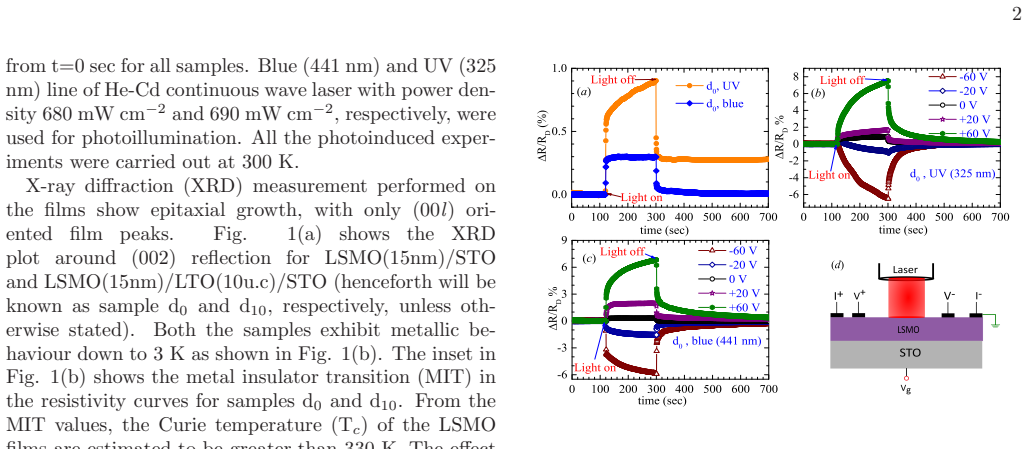
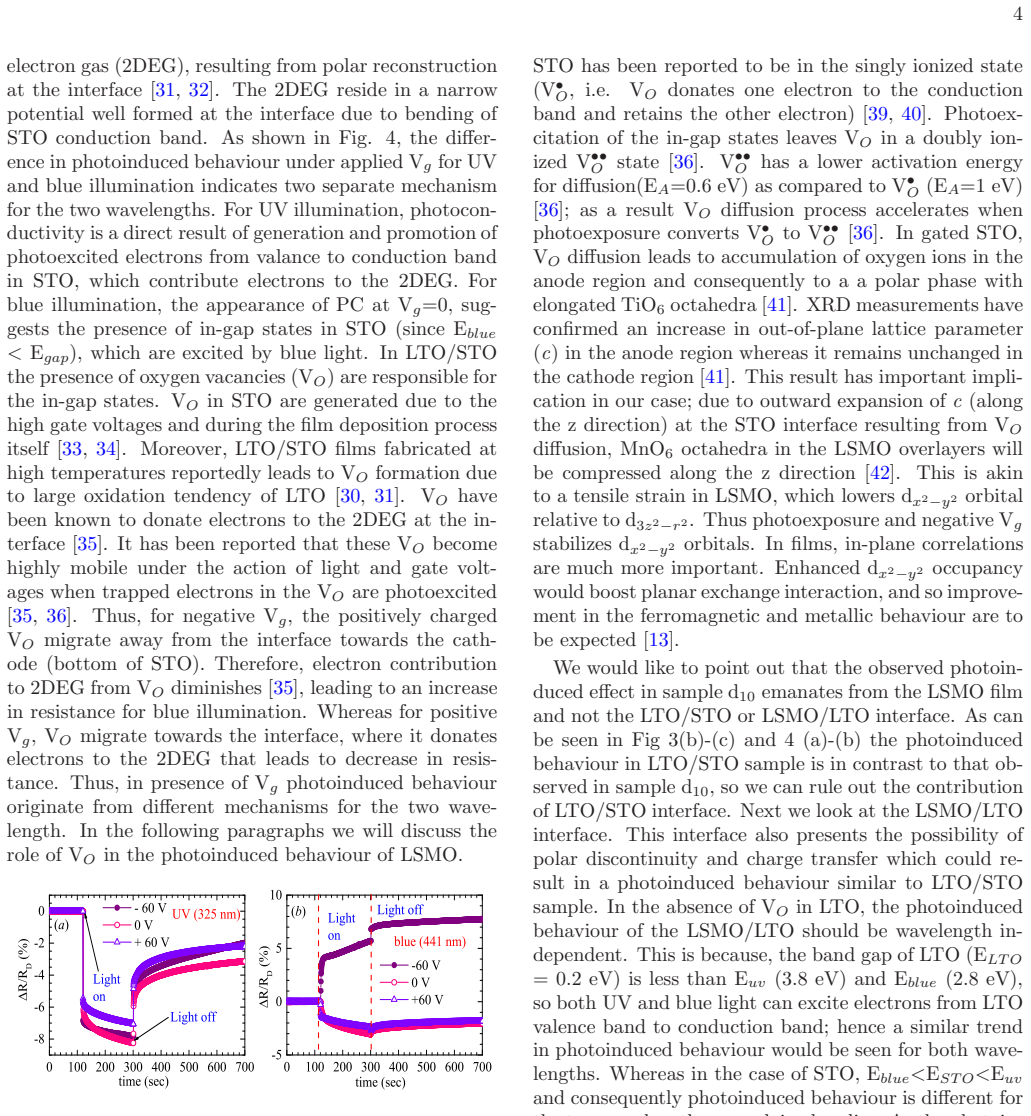
The central discovery is that the photoinduced resistance change in an LSMO heterostructure at 300 K can be switched between positive photoresistivity and negative photoconductivity by the sign of a back gate voltage, giving about ±7.5% resistance modulation. The paper identifies two wavelength-dependent routes behind this. UV light (325 nm, 3.8 eV) generates electron–hole pairs in the SrTiO3 substrate; a negative gate voltage injects those electrons into the half-metallic LSMO film, lowering resistance, while a positive gate voltage blocks injection and traps interfacial conduction electrons, raising it. Blue light (441 nm, 2.8 eV) is below the SrTiO3 band gap and instead excites in-gap oxygen-vacancy states; the doubly ionized vacancies migrate under the gate field, oxygen ions accumulate at the interface, compress MnO6 octahedra along the film normal, stabilize the $d_{x^2-y^2}$ orbital, and thereby increase in-plane hopping. The LaTiO3 interlayer experiments are the key evidence: a 10-unit-cell LTO layer suppresses the gate-dependent UV response, showing that injection is interfacial and blocked, while blue-light photoconductivity persists, pointing to vacancy diffusion rather than injection.
Load-bearing premise
The fragile link is the claim that oxygen vacancies migrating in the SrTiO3 substrate squeeze the MnO6 octahedra in the LSMO overlayer and change its orbital occupancy; this is inferred from other oxide systems and is not directly measured in this heterostructure.
Editorial extensions
If this is right
- At room temperature, an LSMO film's resistance can be modulated by about ±7.5% using light plus a back gate, with the sign of the response set by gate polarity.
- A 10-unit-cell LaTiO3 interlayer blocks the gate-dependent UV photoresponse, confirming that the UV gating channel is interfacial carrier injection from SrTiO3.
- Blue-light photoconductivity that survives the LaTiO3 barrier indicates a second, non-injection channel: light-activated oxygen-vacancy diffusion that alters orbital occupancy in the manganite.
- Transient current data show oxygen-vacancy mobility increases by about an order of magnitude under blue illumination, consistent with doubly ionized vacancies being the mobile species.
- The combination of gate voltage and wavelength selects between spin-disorder photoresistivity, interfacial electron injection, and orbital-occupancy strain, giving multiple handles on the same resistance state.
Reading between the lines
- If the vacancy-strain-orbital chain holds, the same heterostructure design should work in other strongly correlated oxide overlayers on SrTiO3, allowing orbital occupancy to be written optically at room temperature without changing chemical doping.
- The two wavelength-separated mechanisms behave like an optical AND condition: a resistance change appears only when light of the right wavelength and a gate bias are present together, which could be exploited in low-power oxide logic or memory.
- A direct extension would be to vary laser power density and film thickness to see whether the ±7.5% ceiling is set by the supply of mobile vacancies or by the orbital susceptibility of the manganite.
- Patterning the back gate could make vacancy migration lateral rather than vertical, creating locally strained metallic and insulating regions in a single LSMO film.
Signed reviews
Editorial analysis
A structured set of objections, weighed in public.
Referee Report
Summary. The manuscript reports transport measurements on La0.7Sr0.3MnO3 (LSMO) thin films grown on SrTiO3 (STO), with and without a 10 unit-cell LaTiO3 (LTO) interfacial layer, under simultaneous illumination (UV 325 nm and blue 441 nm) and back-gate voltage at 300 K. The authors observe photoresistivity at zero gate voltage, which they attribute to photoexcited down-spin eg electrons disrupting double exchange. For nonzero gate voltage, they report a sign inversion (photoconductivity) at negative Vg in the LSMO/STO sample and wavelength-dependent behavior in the LSMO/LTO/STO sample. They propose that UV-driven electron injection from STO into LSMO is blocked by the LTO layer, while blue light excites oxygen-vacancy in-gap states and makes vacancies mobile; under negative Vg, oxygen ions accumulate at the interface, strain the MnO6 octahedra, stabilize the dx2-y2 orbital, and enhance in-plane hopping. Transient current measurements on LTO/STO are used to estimate vacancy mobilities.
Significance. If the mechanism is correct, the work demonstrates simultaneous electrical and optical control of orbital occupancy and charge transport in a manganite at room temperature, which is of potential interest for oxide electronics. The experimental design is logical: the d0/d10 comparison and LTO/STO control measurements are informative, and the transient current data provide a quantitative estimate of vacancy mobility. The paper would be strengthened by direct structural or spectroscopic evidence for the orbital/octahedral changes and by statistical reproducibility of the small resistance changes; nevertheless, the core observations appear internally consistent.
major comments (3)
- [Transient current measurements, Fig. 5] The transient current experiments that provide the vacancy mobility values are performed on a bare LTO(10 u.c.)/STO sample, not on the LSMO/LTO/STO heterostructure (d10) for which the blue-light photoconductivity is observed. The metallic LSMO cap changes the electric-field distribution and the oxygen-exchange boundary conditions, so the extracted mobilities (5.0 x 10^-7 cm2/Vs for blue, 1.5 x 10^-8 for UV, 1.7 x 10^-8 for dark) cannot be directly transferred to the d10 mechanism. The authors should either perform the transient measurement on d10 or explicitly justify why the cap does not alter the ionic transport.
- [Orbital-occupancy mechanism, discussion of refs. 41 and 42] The strain-orbital chain is the load-bearing explanation for blue-light photoconductivity in d10, but no direct measurement of the orbital occupancy, MnO6 distortion, or even the c-axis change of LTO in the actual stack is provided in this manuscript. Moreover, the sign of the strain transfer is not self-evident: an increase in the LTO c parameter would, if coherently coupled, tend to stretch the LSMO overlayer along z rather than compress it, and the argument that the overlayer is compressed because the in-plane lattice is fixed by STO requires a more careful mechanical model. Direct evidence, such as X-ray diffraction of the stack during illumination, X-ray absorption spectroscopy of the Mn L-edge, or a lattice-constraint calculation, is needed to support the orbital-occupancy claim.
- [Figs. 2 and 3] The central experimental results are single-trace measurements without error bars or replicate samples. Given that the reported resistance changes are only about +/-7.5% and that gate electric fields can induce leakage or contact effects, the absence of reproducibility data makes it difficult to assess whether the sign inversion and the Vg-independence of the UV response in d10 are robust. The authors should report standard deviations over several cycles or samples, and ideally also show the raw resistance-versus-time traces for the key conditions.
minor comments (5)
- [Abstract and main text] The abstract and text contain grammatical errors: 'it's' should be 'its' in the abstract; 'Keithly' should be 'Keithley' in the experimental section; 'valance' should be 'valence' in the LTO/STO discussion; 'a a polar phase' should be 'a polar phase' in the strain discussion.
- [Definition of Delta R] The text defines Delta R = R(L) - R(D), but the figures show positive values for photoresistivity; please confirm the sign convention is consistent throughout the paper and in the figure captions.
- [Penetration depth estimate] The penetration depth argument relies on an absorption coefficient taken from ref. 27, but the specific values used are not stated; a brief note on the extracted alpha values would improve reproducibility.
- [Fig. 5, inset] The circuit diagram in the inset of Fig. 5 is not described in the text; please specify explicitly whether the transient current is measured between the gate electrode and a sample contact or through the film.
- [Thermal effects] The statement that persistent photoresistivity rules out thermal effects is reasonable, but a quantitative estimate of the laser-induced temperature rise under the stated power densities (680-690 mW/cm2) would make the argument stronger.
Circularity Check
No circularity: all central claims are direct measurements or supported by external literature; self-citations are not load-bearing.
full rationale
The central result—a gate-voltage-tunable resistance change of about ±7.5% under illumination—is a measured quantity, not the output of any model fitted to it. The only fitted intermediate is the oxygen-vacancy mobility extracted from transient-current data on the LTO/STO control sample (Fig. 5), and it uses the standard space-charge-limited formula τp = 0.78 d^2/(μ Vg) quoted from ref. 47, an external source; the extracted mobility is then used as supporting evidence for V_O dynamics, not as the basis of the resistance-change claim. The interpretation in terms of e_g↓ photoexcitation, interfacial charge injection, and V_O-diffusion-mediated orbital-occupancy change rests on external references (e.g., refs. 22–24, 27, 35–38, 41, 42, 45–47). The authors' own prior work is cited (refs. 30–32) only for background facts about the LTO/STO interface and V_O formation; the behavior of the LTO/STO control is directly measured in Fig. 4, so these self-citations are not load-bearing. No equation in the paper is equivalent by construction to another, and no fitted parameter is renamed as a prediction. The strain/orbital mechanism is underdetermined without direct orbital or lattice probes, but underdetermination is a correctness or evidence concern, not circularity.
Assumptions & free parameters
assumptions (6)
- domain assumption Double exchange and strong Hund's coupling describe the electronic and magnetic properties of LSMO.
- domain assumption The resistance increase at Vg=0 is due to photoinduced spin disorder from eg-down excitation.
- domain assumption The space-charge-limited current formula tau_p = 0.78 d^2 / (mu Vg) applies to the transient current measurements and the peak is due to oxygen vacancy diffusion.
- domain assumption Oxygen vacancy behavior (ionization states, migration, and effects on 2DEG) in STO matches the descriptions in refs 35 and 36.
- domain assumption Polar discontinuity at the LSMO/LTO interface does not cause charge transfer.
- ad hoc to paper The 10 unit cell LTO layer blocks electron injection from STO to LSMO under UV illumination but allows oxygen ion diffusion under blue illumination.
Cite this review
Pith. "Pith review of Electric field control of photoinduced effect in La$_{0.7}$Sr$_{0.3}$MnO$_3$/LaTiO$_3$/SrTiO$_3$ heterostructure." pith.science (2026). https://pith.science/paper/RMAP3TPQ
@misc{pith2026190808295,
  author       = {Pith},
  title        = {Pith review of: Electric field control of photoinduced effect in La$_0.7$Sr$_0.3$MnO$_3$/LaTiO$_3$/SrTiO$_3$ heterostructure},
  year         = {2026},
  howpublished = {\url{https://pith.science/paper/RMAP3TPQ}},
  note         = {Machine review of arXiv:1908.08295}
}
read the original abstract
In this work we have studied the effect of light and electric field on the electrical properties of La0.7Sr0.3MnO3 (LSMO) film at 300 K. Taking advantage of it's charge, spin, orbital and lattice degrees of freedom, we have successfully shown that light and electric field together can be used to tune the resistance states of the manganite system. Using applied gate voltage (Vg) and light we were able to obtain a change in resistance of about +/-7.5%. Furthermore, incorporating an ultra thin interfacial LaTiO3 (LTO) layer provides valuable insight on the origin of the photoinduced effect. The observed photoinduced effect is attributed to photoexcited down spin eg electrons, interfacial charge injection and manipulation of orbital occupancy depending on the gate voltage and wavelength of light.
Figures


Figures from the paper (2 more)

Reference graph
Works this paper leans on
-
[1]
5 × 10− 8 cm2/Vs for UV illumination and 1 . 7 × 10− 8 cm2/Vs for no light. As can be seen, while µ is of the same order for UV and for no light, it increases by an order of magnitude for blue light. Thus for blue light, generation of highly mobile V •• O due to photoexcitation of in-gap states leads to the observed photoconductivity in sample d 10. On th...
- [2]
-
[3]
On UV irradiation, sample d 10 exhibits photoresistiv- ity for V g=0 as well as V g⁄=0 (Fig. 3(a)-(b)). Another important point to take note of is the PR%; which is al- most of the same magnitude irrespective of the applied Vg (PR%≈ +0.75%) as shown in Fig. 3(b). Assuming carrier injection to be responsible for the observed pho- toinduced behaviour in sam...
-
[4]
Schilling, M
A. Schilling, M. Cantoni, J. D. Guo, and H. R. Ott, Nature 363, 56 (1993)
1993
- [5]
- [6]
-
[7]
J. G. Bednorz and K. A. M¨ uller, Zeitschrift f¨ ur Physik B Condensed Matter 64, 189 (1986)
1986
-
[8]
von Helmolt, J
R. von Helmolt, J. Wecker, B. Holzapfel, L. Schultz, and K. Samwer, Phys. Rev. Lett. 71, 2331 (1993)
1993
Show all 49 references
-
[9]
S. Jin, T. H. Tiefel, M. McCormack, R. A. Fastnacht, R. Ramesh, and L. H. Chen, Science 264, 413 (1994)
1994
-
[10]
J.-H. Park, E. Vescovo, H.-J. Kim, C. Kwon, R. Ramesh, and T. Venkatesan, Nature 392, 794 (1998)
1998
-
[11]
Haghiri-Gosnet and J.-P
A.-M. Haghiri-Gosnet and J.-P. Renard, Journal of Physics D: Applied Physics 36, R127 (2003)
2003
-
[12]
Moritomo, A
Y. Moritomo, A. Machida, K. Matsuda, M. Ichida, and A. Nakamura, Phys. Rev. B 56, 5088 (1997)
1997
-
[13]
Zener, Phys
C. Zener, Phys. Rev. 82, 403 (1951)
1951
-
[14]
Konishi, Z
Y. Konishi, Z. Fang, M. Izumi, T. Manako, M. Kasai, H. Kuwahara, M. Kawasaki, K. Terakura, and Y. Tokura, Journal of the Physical Society of Japan 68, 3790 (1999)
1999
-
[15]
Sadoc, B
A. Sadoc, B. Mercey, C. Simon, D. Grebille, W. Prellier, and M.-B. Lepetit, Phys. Rev. Lett. 104, 046804 (2010)
2010
-
[16]
B. Cui, C. Song, G. A. Gehring, F. Li, G. Wang, C. Chen, J. Peng, H. Mao, F. Zeng, and F. Pan, Advanced Functional Materials 25, 864 (2015)
2015
-
[17]
A. S. Dhoot, C. Israel, X. Moya, N. D. Mathur, and R. H. Friend, Phys. Rev. Lett. 102, 136402 (2009)
2009
-
[18]
F. A. Cuellar, Y. H. Liu, J. Salafranca, N. Nemes, E. Iborra, G. Sanchez-Santolino, M. Varela, M. G. Hernandez, J. W. Freeland, M. Zher- nenkov, M. R. Fitzsimmons, S. Okamoto, S. J. Pennycook, M. Bibes, A. Barth´ el´ emy, S. G. E. te Velthuis, Z. Sefrioui, C. Leon, and J. Sant...
2014
-
[19]
Cauro, A
R. Cauro, A. Gilabert, J. P. Contour, R. Lyonnet, M.-G. Medici, J.-C. Grenet, C. Leighton, and I. K. Schuller, Phys. Rev. B 63, 174423 (2001)
2001
-
[20]
J. M. Dai, W. H. Song, S. G. Wang, K. Y. Wang, S. L. Ye, J. J. Du, and Y. P. Sun, Journal of Applied Physics 89, 6967 (2001)
2001
-
[21]
Takubo, I
N. Takubo, I. Onishi, K. Takubo, T. Mizokawa, and K. Miyano, Phys. Rev. Lett. 101, 177403 (2008)
2008
-
[22]
K. D. Sung, T. K. Lee, and J. H. Jung, Nanoscale Research Letters 10, 125 (2015)
2015
-
[23]
X. J. Liu, Y. Moritomo, A. Machida, A. Nakamura, H. Tanaka, and T. Kawai, Phys. Rev. B 63, 115105 (2001)
2001
-
[24]
Matsuda, A
K. Matsuda, A. Machida, Y. Moritomo, and A. Naka- mura, Phys. Rev. B 58, R4203 (1998)
1998
-
[25]
X. Liu, A. Machida, Y. Morit- omo, M. Ichida, and A. Nakamura, Japanese Journal of Applied Physics 39, L670 (2000)
2000
-
[26]
Quijada, J
M. Quijada, J. ˇCerne, J. R. Simpson, H. D. Drew, K. H. Ahn, A. J. Millis, R. Shreekala, R. Ramesh, M. Rajeswari, and T. Venkatesan, Phys. Rev. B 58, 16093 (1998)
1998
-
[27]
X. J. Liu, Y. Moritomo, A. Nakamura, and H. Asano, Japanese Journal of Applied Physics 39, L1233 (2000)
2000
-
[28]
Rastogi, J
A. Rastogi, J. J. Pulikkotil, and R. C. Budhani, Phys. Rev. B 89, 125127 (2014)
2014
-
[29]
Cesaria, A
M. Cesaria, A. Caricato, G. Leggieri, M. Martino, and G. Maruccio, Thin Solid Films 545, 592 (2013)
2013
-
[30]
Katsu, H
H. Katsu, H. Tanaka, and T. Kawai, Applied Physics Letters 76, 3245 (2000)
2000
-
[31]
Bowen, M
M. Bowen, M. Bibes, A. Barthelemy, J.-P. Con- tour, A. Anane, Y. Lemaitre, and A. Fert, Applied Physics Letters 82, 233 (2003)
2003
-
[32]
Rastogi and R
A. Rastogi and R. C. Budhani, Opt. Lett. 37, 317 (2012)
2012
-
[33]
Rastogi, J
A. Rastogi, J. J. Pulikkotil, S. Auluck, Z. Hossain, and R. C. Budhani, Phys. Rev. B 86, 075127 (2012)
2012
-
[34]
Ghising, D
P. Ghising, D. Das, S. Das, and Z. Hossain, Journal of Physics: Condensed Matter 30, 285002 (2018)
2018
-
[35]
Kalabukhov, R
A. Kalabukhov, R. Gunnarsson, J. B¨ orjesson, E. Olsson, T. Claeson, and D. Winkler, Phys. Rev. B 75, 121404 (2007)
2007
-
[36]
K. T. Kang, H. Kang, J. Park, D. Suh, and W. S. Choi, Advanced Materials 29, 1700071 (2017)
2017
-
[37]
Y. Lei, Y. Li, Y. Z. Chen, Y. W. Xie, Y. S. Chen, S. H. Wang, J. Wang, B. G. Shen, N. Pryds, H. Y. Hwang, and J. R. Sun, Nature Communications 5, 5554 EP (2014) . 7
2014
-
[38]
Y. Li, Y. Lei, B. G. Shen, and J. R. Sun, Scientific Reports 5, 14576 EP (2015)
2015
-
[39]
Huijben, L
M. Huijben, L. W. Martin, Y.-H. Chu, M. B. Holcomb, P. Yu, G. Rijnders, D. H. A. Blank, and R. Ramesh, Phys. Rev. B 78, 094413 (2008)
2008
-
[40]
Aruta, G
C. Aruta, G. Ghiringhelli, A. Tebano, N. G. Boggio, N. B. Brookes, P. G. Medaglia, and G. Balestrino, Phys. Rev. B 73, 235121 (2006)
2006
-
[41]
D. D. Cuong, B. Lee, K. M. Choi, H.-S. Ahn, S. Han, and J. Lee, Phys. Rev. Lett. 98, 115503 (2007)
2007
-
[42]
Lin and A
C. Lin and A. A. Demkov, Phys. Rev. Lett. 111, 217601 (2013)
2013
-
[43]
Hanzig, M
J. Hanzig, M. Zschornak, F. Hanzig, E. Mehner, H. St¨ ocker, B. Abendroth, C. R¨ oder, A. Talkenberger, G. Schreiber, D. Rafaja, S. Gemming, and D. C. Meyer, Phys. Rev. B 88, 024104 (2013)
2013
-
[44]
H. Chen, Q. Qiao, M. S. J. Marshall, A. B. Georgescu, A. Gulec, P. J. Phillips, R. F. Klie, F. J. Walker, C. H. Ahn, and S. Ismail-Beigi, Nano Letters 14, 4965 (2014)
2014
-
[45]
Y. Z. Chen, F. Trier, T. Wijnands, R. J. Green, N. Gauquelin, R. Egoavil, D. V. Christensen, G. Koster, M. Huijben, N. Bovet, S. Macke, F. He, R. Su- tarto, N. H. Andersen, J. A. Sulpizio, M. Honig, G. E. D. K. Prawiroatmodjo, T. S. Jespersen, S. Lin- deroth, S. Ilani, J. Verb...
2015
-
[46]
Saghayezhian, S
M. Saghayezhian, S. Kouser, Z. Wang, H. Guo, R. Jin, J. Zhang, Y. Zhu, S. T. Pantelides, and E. W. Plummer, Proceedings of the National Academy of Sciences 116, 10309 (2019) , https://www.pnas.org/content/116/21/10309.full.pdf
2019
-
[47]
Liu, T.-C
H.-J. Liu, T.-C. Wei, Y.-M. Zhu, R.-R. Liu, W.-Y. Tzeng, C.-Y. Tsai, Q. Zhan, C.-W. Luo, P. Yu, J.-H. He, Y.-H. Chu, and Q. He, Advanced Functional Materials 26, 729 (2016)
2016
-
[48]
S. Wu, L. Ren, J. Qing, F. Yu, K. Yang, M. Yang, Y. Wang, M. Meng, W. Zhou, X. Zhou, and S. Li, ACS Applied Materials & Interfaces 6, 8575 (2014)
2014
-
[49]
Zafar, R
S. Zafar, R. E. Jones, B. Jiang, B. White, P. Chu, D. Taylor, and S. Gillespie, Applied Physics Letters 73, 175 (1998)
1998
Reviewed August 14, 2026 · model on record in the stance chip above.
Discussion (0). Continue with ORCID to comment.