REVIEW 1 major objections 5 minor 61 references
Conditional Teleportation of Quantum-Dot Spin States
T0 review · 1 major / 5 minor · reviewed 2026-08-14 · deepseek-v4-flash
Pith's one-line read The paper reports evidence that conditional quantum teleportation, entanglement swapping, and gate teleportation can be implemented in four gate-defined GaAs quantum-dot spin qubits using exchange-based SWAP operations and Pauli spin…
desk verdict Strong first evidence for teleportation in quantum-dot spin qubits, but the quantitative non-classicality claim rests on a 2/3 classical bound that does not apply to the restricted state ensemble used. read the letter →
The pith
A machine-rendered reading of the paper's core claim, the machinery that carries it, and where it could break.
The reading
What carries the argument
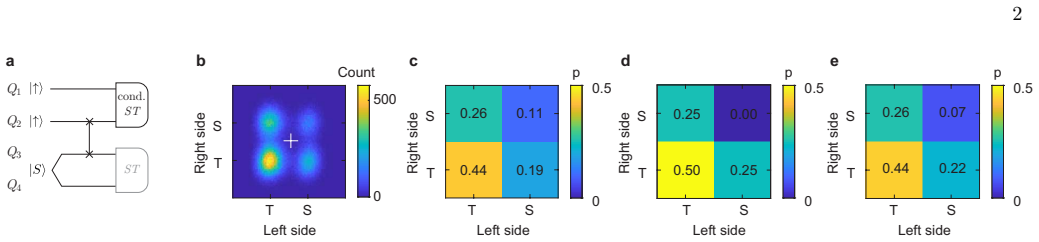
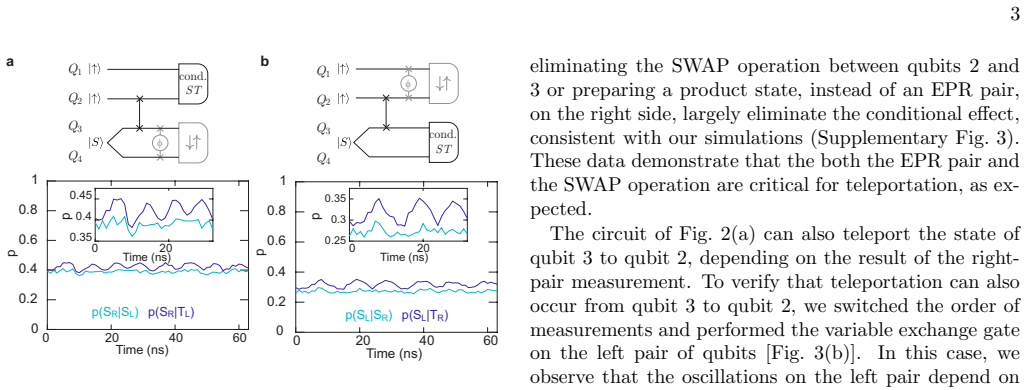
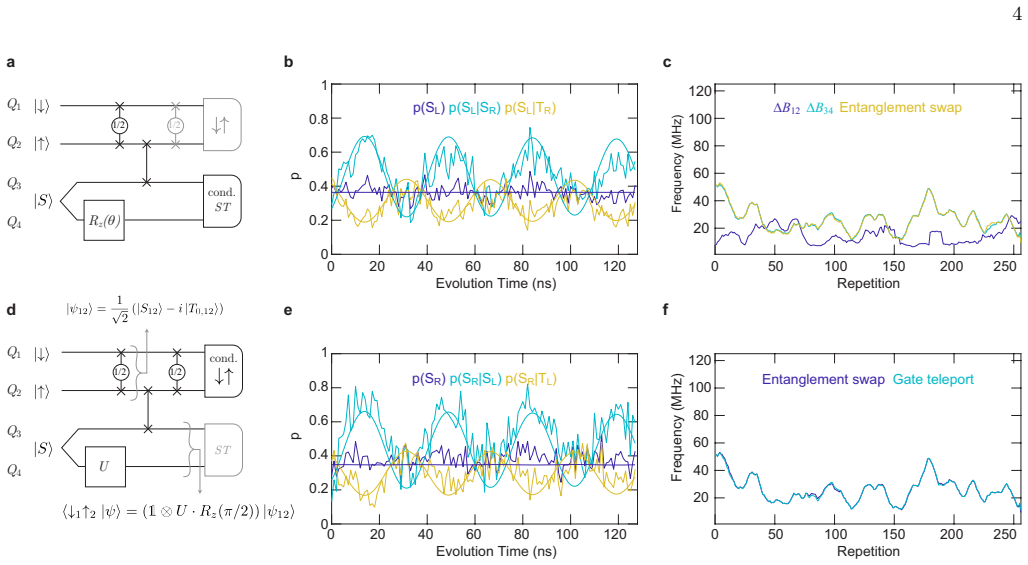
The load-bearing mechanism is the exchange-based SWAP combined with Pauli spin blockade. The SWAP is a voltage pulse that turns on Heisenberg exchange between two electrons, swapping their spin states; because exchange preserves entanglement, it lets an EPR pair generated in one dot be redistributed across the array without moving electrons. Pauli spin blockade then gives a single-shot projective measurement in the $\{|S\rangle, |T\rangle\}$ basis on each pair, which serves both as the Bell-state measurement (a singlet outcome post-selects successful teleportation) and as the verification measurement on the teleported pair. The derived signature used for entanglement swapping is the appearance of coherent singlet-triplet oscillations on the left pair only when conditioned on a right-pair singlet, with oscillation frequency equal to the far pair's hyperfine gradient $\Delta B_{34}$.
What would settle it
Perform full quantum state tomography on qubit 4 conditioned on a left-pair singlet outcome while teleporting a set of input states spanning the Bloch sphere. The central claim would be settled by comparing the reconstructed teleportation fidelity to the classical limit of 2/3 after correcting for readout and state-preparation errors: a conditioned fidelity at or below 2/3 would refute the teleportation interpretation, while a clear excess would confirm it. A complementary check is to directly measure the 2-3 SWAP fidelity; if the SWAP does not preserve entanglement, the EPR distribution step fails.
Extended reading notes
Core claim
On its own terms, the paper claims that after loading a singlet into the right-most dot, separating it into dots 3 and 4, and applying an exchange-based SWAP between dots 2 and 3, a singlet-triplet measurement on dots 1 and 2 conditionally teleports the state of dot 1 into dot 4. The decisive signatures are: a joint-measurement histogram that matches the predicted teleport correlations; exchange oscillations on the right pair that vanish when the left pair returns a singlet and appear when it returns a triplet; and, for entanglement swapping, singlet-triplet oscillations on the left pair that appear only after conditioning on the right pair, with an oscillation frequency that tracks the independently measured hyperfine gradient $\Delta B_{34}$ rather than the local gradient $\Delta B_{12}$. Control experiments omitting either the SWAP or the EPR pair remove the conditional correlations. The authors state the data are consistent with conditional teleportation of spin eigenstates, entanglement swapping, and gate teleportation, and they estimate a maximum singlet teleportation probability of $0.71\pm 0.04$, above the classical limit of $2/3$, while noting that definitive proof requires future quantum state tomography.
Load-bearing premise
The central claim rests on the premise, imported from prior work rather than re-verified here, that the exchange pulse between the two middle dots performs a high-fidelity SWAP that preserves the EPR pair's entanglement, with simulation parameters flexible enough that the fit does not by itself prove the teleportation interpretation.
Editorial extensions
If this is right
- If correct, this is the first conditional teleportation of electron spin states in gate-defined quantum dots, adding teleportation to the toolset of spin-qubit platforms.
- Because the protocol uses only exchange pulses and Pauli spin blockade, it transfers quantum information without moving electrons, simplifying long-distance coupling in spin arrays.
- The demonstration of entanglement swapping implies that measurement can entangle two spins that never interacted, a resource for distributing entanglement in a quantum network.
- Gate teleportation means a unitary applied to one member of an EPR pair can be transferred onto the teleported qubit, a step toward measurement-based quantum computation with spins.
- The protocol is compatible with silicon quantum dots, where smaller magnetic gradients should make the exchange SWAP more coherent and raise teleportation fidelity.
Reading between the lines
- Because the paper explicitly forgoes quantum state tomography, the public claim should be read as evidence consistent with teleportation, not a metrological demonstration; a tomography follow-up is the natural next test.
- The frequency-matching signature (left-pair oscillations following $\Delta B_{34}$ rather than $\Delta B_{12}$) is a transferable witness: any future all-matter teleportation experiment could use the same nonlocal oscillation fingerprint without full tomography.
- A deterministic version, which the paper sketches, would require resolving all four Bell states rather than distinguishing only singlet from triplet; combining the present exchange SWAP with single-spin readout and CNOT gates in silicon is a plausible route.
- The quantitative match depends partly on simulation choices such as hyperfine fields and a fitted 7-degree diabatic rotation angle; an independent calibration of those parameters would strengthen the teleportation interpretation.
Signed reviews
Editorial analysis
A structured set of objections, weighed in public.
Referee Report
Summary. The manuscript reports conditional teleportation of electron spin states in a four-qubit GaAs quadruple quantum dot. The protocol prepares an EPR pair in dots 3-4, applies a SWAP between dots 2 and 3, projects dots 1-2 onto the singlet/triplet basis, and conditionally prepares dot 4 in the state of dot 1. The authors also demonstrate conditional entanglement swapping and gate teleportation by letting the right pair precess in a hyperfine gradient and showing that the left-pair oscillations appear only when conditioned on the right-pair outcome, with a frequency matching the independently measured ΔB34. The paper explicitly acknowledges that no quantum state tomography was performed and frames the results as evidence consistent with conditional teleportation.
Significance. If the interpretation holds, this is the first demonstration of conditional spin-state teleportation, entanglement swapping, and gate teleportation in gate-defined quantum dots. The strongest parts of the evidence are the control experiments without the SWAP or without the EPR pair, the frequency-match test against the independently measured ΔB34, and the Supplementary Note 4 hypothesis test comparing conditional and unconditioned oscillation amplitudes. These elements are independent of the fitted simulation parameters and give the central claim real support. The main weakness is the quantitative comparison to a classical fidelity bound, which is incorrectly derived for the restricted state ensemble used here, and the presence of several explicitly fitted simulation parameters that reduces the weight of the simulated predictions.
major comments (1)
- [Main text, 'Conditional teleportation protocol'] The protocol relies on the statement that 'exchange-based spin swaps preserve entangled states,' imported from Ref. [11], to distribute the EPR pair, but no in-situ characterization of the SWAP fidelity between dots 2 and 3 is reported for this device. The no-SWAP control shows that the conditional effect disappears without the SWAP, but it does not quantify how close the SWAP is to ideal. Since the assumed SWAP fidelity directly affects the quantitative fidelity claims, the authors should explicitly state that the SWAP fidelity is assumed from Ref. [11] and not independently measured here, or provide a direct calibration.
minor comments (5)
- [Supplementary Note 3] There is a broken cross-reference in the paragraph beginning 'A first estimate of the fidelity': 'we invert Eq. ??' should refer to the specific equation number.
- [Supplementary figure captions] Several captions contain 'Fig. ??' placeholders instead of the correct figure numbers; please check Supplementary Figs. 2, 5, 7, 8, and 9.
- [Methods, Device] The word 'hetereostructure' should be 'heterostructure'.
- [Methods, Simulation] The definition of the effective S-T0 Hamiltonian used in the simulation would be clearer if explicitly written, since the 7-degree rotation about the y axis is described only verbally.
- [Data Availability] The statement that data are available 'upon reasonable request' is weaker than the reproducibility standard one would expect for a first-demonstration claim; consider depositing the raw data and simulation scripts.
Circularity Check
Core teleportation evidence is direct and control-backed; the paper's 'simulated predictions' are fitted to the data and are not independent predictions, but this does not make the central claim circular.
-
fitted input called prediction
[Methods, 'Simulation' (Fig. 4 and Supplementary Fig. 3/5 simulations); also Results Fig. 2(e) 'prediction']
"For this simulation, magnetic gradients were chosen to match the observed frequencies, and the width of the hyperfine distribution was reduced to mimic the effects of averaging for only a few seconds and to match the observed decay. For these data, exchange strengths were chosen to be 90 MHz."
The curves labeled 'Simulated predictions' in Fig. 4(b) and the 'prediction' in Fig. 2(e) are not derived from independent parameters: the magnetic gradients are set to the observed frequencies, the hyperfine width is set to match the observed decay, and the exchange strength is chosen ad hoc. The agreement of these simulations with the data is therefore enforced by construction and cannot independently confirm the teleportation signal. The central evidence—raw conditional probabilities, the no-SWAP and product-state controls, and frequency matching to the independently measured ΔB34—does not reduce to these fits, so this is a limited, non-load-bearing circularity of presentation.
full rationale
The core derivation chain is not circular. The paper's primary evidence consists of directly measured joint histograms (Fig. 2), conditional exchange oscillations (Fig. 3), conditional entanglement-swapping oscillations whose frequency matches the concurrently measured hyperfine gradient ΔB34 (Fig. 4c), and control experiments omitting the SWAP or the EPR pair (Supplementary Figs. 2 and 5). These observations stand on their own and are not outputs of the simulation. The SWAP-entanglement premise is imported from the authors' prior work [11], but the paper independently tests it with controls, so the self-citation is not load-bearing. The only circular element is that the simulations labeled 'predictions' have their free parameters (hyperfine gradients, fluctuation widths, exchange strengths, 7-degree pulse rotation) explicitly chosen to match the data, making the simulation agreement a fit rather than a prediction. The questionable 2/3 classical bound in Supplementary Note 2 is a correctness concern about the comparison to 0.71, not a circularity: the bound is cited from external work and is not defined in terms of the paper's result. Overall, the central teleportation claim has independent content and is not forced by definition or by a self-citation chain; score 2 reflects the one non-load-bearing fitted-input-called-prediction issue.
Assumptions & free parameters
free parameters (7)
- Singlet load fidelity f_s =
0.89
- Hyperfine field values B_k for qubits 1-4 =
(-1, 6, -4, 0) MHz x 2h/(g mu_B)
- Hyperfine field fluctuation widths =
12 MHz (qubits 1-2), 10 MHz (qubits 3-4)
- Diabatic pulse rotation angle =
7 degrees (and -7 degrees)
- Exchange coupling J23 =
250 MHz (classical-state sim), 90 MHz (Fig. 4 sim)
- T+ state preparation fidelity =
~0.7
- Charge noise fractional fluctuation delta J / J =
1%
assumptions (5)
- domain assumption Heisenberg exchange between two electron spins implements a SWAP operation that preserves entangled states.
- domain assumption Pauli spin blockade readout projects a spin pair onto |S> versus the triplet manifold with the quoted fidelities.
- domain assumption The relevant two-qubit states stay in the m_s=0 subspace spanned by |S> and |T0>.
- standard math The classical fidelity bound 2/3 (Massar-Popescu) applies to the y-z plane sub-ensemble of singlet-triplet qubit states.
- domain assumption Charge noise model of Ref [41] (Q = J / sqrt(2 pi delta J)) describes the SWAP dephasing.
Cite this review
Pith. "Pith review of Conditional Teleportation of Quantum-Dot Spin States." pith.science (2026). https://pith.science/paper/URQW3S55
@misc{pith2026190808306,
  author       = {Pith},
  title        = {Pith review of: Conditional Teleportation of Quantum-Dot Spin States},
  year         = {2026},
  howpublished = {\url{https://pith.science/paper/URQW3S55}},
  note         = {Machine review of arXiv:1908.08306}
}
read the original abstract
Among the different platforms for quantum information processing, individual electron spins in semiconductor quantum dots stand out for their long coherence times and potential for scalable fabrication. The past years have witnessed substantial progress in the capabilities of spin qubits. However, coupling between distant electron spins, which is required for quantum error correction, presents a challenge, and this goal remains the focus of intense research. Quantum teleportation is a canonical method to transmit qubit states, but it has not been implemented in quantum-dot spin qubits. Here, we present evidence for quantum teleportation of electron spin qubits in semiconductor quantum dots. Although we have not performed quantum state tomography to definitively assess the teleportation fidelity, our data are consistent with conditional teleportation of spin eigenstates, entanglement swapping, and gate teleportation. Such evidence for all-matter spin-state teleportation underscores the capabilities of exchange-coupled spin qubits for quantum-information transfer.
Figures

Figures from the paper (2 more)
Reference graph
Works this paper leans on
-
[11]
Coherent spin-state transfer via heisenberg exchange,
Yadav P. Kandel, Haifeng Qiao, Saeed Fallahi, Geof- frey C. Gardner, Michael J. Manfra, and John M. Nichol, “Coherent spin-state transfer via heisenberg exchange,” Nature 573, 553–557 (2019)
work page 2019
-
[1]
Teleporting an unknown quantum state via dual classi- cal and Einstein-Podolsky-Rosen channels,
Charles H. Bennett, Gilles Brassard, Claude Cr´ epeau, Richard Jozsa, Asher Peres, and William K. Wootters, “Teleporting an unknown quantum state via dual classi- cal and Einstein-Podolsky-Rosen channels,” Phys. Rev. Lett. 70, 1895–1899 (1993)
1993
-
[2]
Exper- imental quantum teleportation,
Dik Bouwmeester, Jian-Wei Pan, Klaus Mattle, Manfred Eibl, Harald Weinfurter, and Anton Zeilinger, “Exper- imental quantum teleportation,” Nature 390, 575–579 (1997)
work page 1997
-
[3]
Deterministic quantum teleportation with atoms,
M. Riebe, H. H¨ affner, C. F. Roos, W. H¨ ansel, J. Benhelm, G. P. T. Lancaster, T. W. K¨ orber, C. Becher, F. Schmidt- Kaler, D. F. V. James, and R. Blatt, “Deterministic quantum teleportation with atoms,” Nature 429, 734– 737 (2004)
work page 2004
-
[4]
Quantum teleportation between distant matter qubits,
S. Olmschenk, D. N. Matsukevich, P. Maunz, D. Hayes, L.-M. Duan, and C. Monroe, “Quantum teleportation between distant matter qubits,” Science 323, 486–489 (2009)
work page 2009
-
[5]
Deterministic quantum teleportation with feed-forward in a solid state system,
L. Steffen, Y. Salathe, M. Oppliger, P. Kurpiers, M. Baur, C. Lang, C. Eichler, G. Puebla-Hellmann, A. Fedorov, and A. Wallraff, “Deterministic quantum teleportation with feed-forward in a solid state system,” Nature 500, 319 (2013)
work page 2013
-
[6]
Uncondi- tional quantum teleportation between distant solid-state quantum bits,
W. Pfaff, B. J. Hensen, H. Bernien, S. B. van Dam, M. S. Blok, T. H. Taminiau, M. J. Tiggelman, R. N. Schouten, M. Markham, D. J. Twitchen, and R. Hanson, “Uncondi- tional quantum teleportation between distant solid-state quantum bits,” Science 345, 532–535 (2014)
work page 2014
-
[8]
Quantum computing with realistically noisy devices,
E. Knill, “Quantum computing with realistically noisy devices,” Nature 434, 39–44 (2005)
work page 2005
Show all 61 references
-
[9]
Measurement-based quantum computation on cluster states,
Robert Raussendorf, Daniel E. Browne, and Hans J. Briegel, “Measurement-based quantum computation on cluster states,” Phys. Rev. A 68, 022312 (2003)
2003
-
[10]
Demonstrat- ing the viability of universal quantum computation using teleportation and single-qubit operations,
Daniel Gottesman and Isaac L. Chuang, “Demonstrat- ing the viability of universal quantum computation using teleportation and single-qubit operations,” Nature 402, 390–393 (1999)
1999
-
[12]
‘Event-ready-detectors’ Bell experiment via en- tanglement swapping,
M. ˙Zukowski, A. Zeilinger, M. A. Horne, and A. K. Ekert, “‘Event-ready-detectors’ Bell experiment via en- tanglement swapping,” Phys. Rev. Lett. 71, 4287–4290 (1993)
1993
-
[13]
Deterministic entanglement swapping with an ion-trap quantum com- puter,
M. Riebe, T. Monz, K. Kim, A. S. Villar, P. Schindler, M. Chwalla, M. Hennrich, and R. Blatt, “Deterministic entanglement swapping with an ion-trap quantum com- puter,” Nature Physics 4, 839–842 (2008)
2008
-
[14]
Determinis- tic entanglement swapping in a superconducting circuit,
Wen Ning, Xin-Jie Huang, Pei-Rong Han, Hekang Li, Hui Deng, Zhen-Biao Yang, Zhi-Rong Zhong, Yan Xia, Kai Xu, Dongning Zheng, and Shi-Biao Zheng, “Determinis- tic entanglement swapping in a superconducting circuit,” Phys. Rev. Lett. 123, 060502 (2019)
2019
-
[15]
Coherent shuttle of electron-spin states,
Takafumi Fujita, Timothy Alexander Baart, Christian Reichl, Werner Wegscheider, and Lieven Mark Koenraad Vandersypen, “Coherent shuttle of electron-spin states,” npj Quantum Information 3, 22 (2017)
2017
-
[16]
Coher- ent transfer of electron spin correlations assisted by de- phasing noise,
Takashi Nakajima, Matthieu R. Delbecq, Tomohiro Ot- suka, Shinichi Amaha, Jun Yoneda, Akito Noiri, Kenta Takeda, Giles Allison, Arne Ludwig, Andreas D. Wieck, Xuedong Hu, Franco Nori, and Seigo Tarucha, “Coher- ent transfer of electron spin correlations assisted by de- phasing...
2018
-
[17]
Co- herent long-distance displacement of individual electron spins,
H. Flentje, P.-A. Mortemousque, R. Thalineau, A. Lud- wig, A. D. Wieck, C. B¨ auerle, and T. Meunier, “Co- herent long-distance displacement of individual electron spins,” Nature Communications 8, 501 (2017)
2017
-
[18]
Resonant microwave-mediated interactions between distant electron spins,
F. Borjans, X. G. Croot, X. Mi, M. J. Gullans, and J. R. Petta, “Resonant microwave-mediated interactions between distant electron spins,” Nature 577, 195–198 (2020)
2020
-
[19]
Coherent manipulation of coupled elec- tron spins in semiconductor quantum dots
J. R. Petta, A. C. Johnson, J. M. Taylor, E. Laird, A. Ya- coby, M. D. Lukin, C. M. Marcus, M. P. Hanson, and A. C. Gossard, “Coherent manipulation of coupled elec- tron spins in semiconductor quantum dots.” Science 309, 2180–2184 (2005)
2005
-
[20]
Universal quantum control of two- electron spin quantum bits using dynamic nuclear po- larization,
S. Foletti, H. Bluhm, D. Mahalu, Vladimir Umansky, and A. Yacoby, “Universal quantum control of two- electron spin quantum bits using dynamic nuclear po- larization,” Nature Physics 5, 903–908 (2009)
2009
-
[22]
Noise suppression using symmetric exchange gates in spin qubits,
Frederico Martins, Filip K. Malinowski, Peter D. Nis- sen, Edwin Barnes, Saeed Fallahi, Geoffrey C. Gard- ner, Michael J. Manfra, Charles M. Marcus, and Fer- dinand Kuemmeth, “Noise suppression using symmetric exchange gates in spin qubits,” Phys. Rev. Lett. 116, 116801 (2016)
2016
-
[23]
Reduced sensitivity to charge noise in semiconductor spin qubits via symmetric operation,
M. D. Reed, B. M. Maune, R. W. Andrews, M. G. Borselli, K. Eng, M. P. Jura, A. A. Kiselev, T. D. Ladd, S. T. Merkel, I. Milosavljevic, E. J. Pritchett, M. T. Rakher, R. S. Ross, A. E. Schmitz, A. Smith, J. A. Wright, M. F. Gyure, and A. T. Hunter, “Reduced sensitivity to charg...
2016
-
[24]
Optimal extraction of infor- mation from finite quantum ensembles,
S. Massar and S. Popescu, “Optimal extraction of infor- mation from finite quantum ensembles,” Phys. Rev. Lett. 74, 1259–1263 (1995)
1995
-
[25]
High-fidelity entangling gate for double-quantum-dot spin qubits,
John M. Nichol, Lucas A. Orona, Shannon P. Harvey, Saeed Fallahi, Geoffrey C. Gardner, Michael J. Man- fra, and Amir Yacoby, “High-fidelity entangling gate for double-quantum-dot spin qubits,” npj Quantum Infor- mation 3, 3 (2017). 11
2017
-
[26]
Coherent transfer of quantum informa- tion in a silicon double quantum dot using resonant swap gates,
A. J. Sigillito, M. J. Gullans, L. F. Edge, M. Borselli, and J. R. Petta, “Coherent transfer of quantum informa- tion in a silicon double quantum dot using resonant swap gates,” npj Quantum Information 5, 110 (2019)
2019
-
[27]
Composite pulses for ro- bust universal control of singlet-triplet qubits,
Xin Wang, Lev S. Bishop, J. P. Kestner, Edwin Barnes, Kai Sun, and S. Das Sarma, “Composite pulses for ro- bust universal control of singlet-triplet qubits,” Nature Communications 3, 997 (2012)
2012
-
[28]
Resonantly driven CNOT gate for electron spins,
D. M. Zajac, A. J. Sigillito, M. Russ, F. Borjans, J. M. Taylor, G. Burkard, and J. R. Petta, “Resonantly driven CNOT gate for electron spins,” Science 359, 439–442 (2018)
2018
-
[29]
Fidelity benchmarks for two-qubit gates in silicon,
W. Huang, C. H. Yang, K. W. Chan, T. Tanttu, B. Hensen, R. C. C. Leon, M. A. Fogarty, J. C. C. Hwang, F. E. Hudson, K. M. Itoh, A. Morello, A. Laucht, and A. S. Dzurak, “Fidelity benchmarks for two-qubit gates in silicon,” Nature 569, 532–536 (2019)
2019
-
[30]
A programmable two-qubit quantum processor in silicon,
T. F. Watson, S. G. J. Philips, E. Kawakami, D. R. Ward, P. Scarlino, M. Veldhorst, D. E. Savage, M. G. La- gally, Mark Friesen, S. N. Coppersmith, M. A. Eriksson, and L. M. K. Vandersypen, “A programmable two-qubit quantum processor in silicon,” Nature 555, 633 (2018)
2018
-
[31]
A quantum-dot spin qubit with coherence limited by charge noise and fidelity higher than 99.9%,
Jun Yoneda, Kenta Takeda, Tomohiro Otsuka, Takashi Nakajima, Matthieu R. Delbecq, Giles Allison, Takumu Honda, Tetsuo Kodera, Shunri Oda, Yusuke Hoshi, Nori- taka Usami, Kohei M. Itoh, and Seigo Tarucha, “A quantum-dot spin qubit with coherence limited by charge noise and fidel...
2018
-
[32]
Nielsen and Isaac L
Michael A. Nielsen and Isaac L. Chuang, Quantum Com- putation and Quantum Information: 10th Anniversary Edition, 10th ed. (Cambridge University Press, New York, NY, USA, 2011)
2011
-
[33]
Suppress- ing qubit dephasing using real-time Hamiltonian estima- tion,
M. D. Shulman, S. P. Harvey, J. M. Nichol, S. D. Bartlett, A. C. Doherty, V. Umansky, and A. Yacoby, “Suppress- ing qubit dephasing using real-time Hamiltonian estima- tion,” Nature Communications 5, 5156 (2014)
2014
-
[34]
Gate-defined quantum dots in intrinsic silicon,
Susan J. Angus, Andrew J. Ferguson, Andrew S. Dzu- rak, and Robert G. Clark, “Gate-defined quantum dots in intrinsic silicon,” Nano Letters 7, 2051–2055 (2007)
2007
-
[35]
A reconfigurable gate architecture for Si/SiGe quantum dots,
D. M. Zajac, T. M. Hazard, X. Mi, K. Wang, and J. R. Petta, “A reconfigurable gate architecture for Si/SiGe quantum dots,” Applied Physics Letters 106, 223507 (2015)
2015
-
[36]
Single- spin ccd,
T. A. Baart, M. Shafiei, T. Fujita, C. Reichl, W. Wegscheider, and L. M. K. Vandersypen, “Single- spin ccd,” Nature Nanotechnology 11, 330 (2016)
2016
-
[37]
Shuttling a single charge across a one-dimensional array of silicon quantum dots,
A. R. Mills, D. M. Zajac, M. J. Gullans, F. J. Schupp, T. M. Hazard, and J. R. Petta, “Shuttling a single charge across a one-dimensional array of silicon quantum dots,” Nature Communications 10, 1063 (2019)
2019
-
[38]
Read- out of singlet-triplet qubits at large magnetic field gradi- ents,
Lucas A. Orona, John M. Nichol, Shannon P. Harvey, Charlotte G. L. Bøttcher, Saeed Fallahi, Geoffrey C. Gardner, Michael J. Manfra, and Amir Yacoby, “Read- out of singlet-triplet qubits at large magnetic field gradi- ents,” Phys. Rev. B 98, 125404 (2018)
2018
-
[39]
Enhanced charge detection of spin qubit readout via an intermediate state,
S. A. Studenikin, J. Thorgrimson, G. C. Aers, A. Kam, P. Zawadzki, Z. R. Wasilewski, A. Bogan, and A. S. Sachrajda, “Enhanced charge detection of spin qubit readout via an intermediate state,” Applied Physics Let- ters 101, 233101 (2012)
2012
-
[40]
Demonstration of en- tanglement of electrostatically coupled singlet-triplet qubits
M. D Shulman, O. E Dial, S. P Harvey, H. Bluhm, V. Umansky, and A. Yacoby, “Demonstration of en- tanglement of electrostatically coupled singlet-triplet qubits.” Science 336, 202–205 (2012)
2012
-
[41]
Charge Noise Spec- troscopy Using Coherent Exchange Oscillations in a Singlet-Triplet Qubit,
O. E Dial, M. D Shulman, S. P Harvey, H. Bluhm, V. Umansky, and A. Yacoby, “Charge Noise Spec- troscopy Using Coherent Exchange Oscillations in a Singlet-Triplet Qubit,” Physical Review Letters 110, 146804 (2013)
2013
-
[42]
Spin-blockade spectroscopy of Si/Si-Ge quantum dots,
A.M. Jones, E.J. Pritchett, E.H. Chen, T.E. Keating, R.W. Andrews, J.Z. Blumoff, L.A. De Lorenzo, K. Eng, S.D. Ha, A.A. Kiselev, S.M. Meenehan, S.T. Merkel, J.A. Wright, L.F. Edge, R.S. Ross, M.T. Rakher, M.G. Borselli, and A. Hunter, “Spin-blockade spectroscopy of Si/Si-Ge qua...
2019
-
[43]
Measurement of valley splitting in high- symmetry si/sige quantum dots,
M. G. Borselli, R. S. Ross, A. A. Kiselev, E. T. Croke, K. S. Holabird, P. W. Deelman, L. D. Warren, I. Alvarado-Rodriguez, I. Milosavljevic, F. C. Ku, W. S. Wong, A. E. Schmitz, M. Sokolich, M. F. Gyure, and A. T. Hunter, “Measurement of valley splitting in high- symmetry si/...
2011
-
[44]
Coherent operations and screening in multielectron spin qubits,
A. P. Higginbotham, F. Kuemmeth, M. P. Hanson, A. C. Gossard, and C. M. Marcus, “Coherent operations and screening in multielectron spin qubits,” Phys. Rev. Lett. 112, 026801 (2014)
2014
-
[45]
Gate-based single-shot readout of spins in silicon,
Anderson West, Bas Hensen, Alexis Jouan, Tuomo Tanttu, Chih-Hwan Yang, Alessandro Rossi, M. Fer- nando Gonzalez-Zalba, Fay Hudson, Andrea Morello, David J. Reilly, and Andrew S. Dzurak, “Gate-based single-shot readout of spins in silicon,” Nature Nanotech- nology 14, 437–441 (2019)
2019
-
[46]
Rapid gate-based spin read-out in silicon using an on-chip res- onator,
Guoji Zheng, Nodar Samkharadze, Marc L. Noordam, Nima Kalhor, Delphine Brousse, Amir Sammak, Gior- dano Scappucci, and Lieven M. K. Vandersypen, “Rapid gate-based spin read-out in silicon using an on-chip res- onator,” Nature Nanotechnology 14, 742–746 (2019)
2019
-
[47]
Single-shot read-out of an individual electron spin in a quantum dot,
J. M. Elzerman, R. Hanson, L. H. Willems van Beveren, B. Witkamp, L. M. K. Vandersypen, and L. P. Kouwen- hoven, “Single-shot read-out of an individual electron spin in a quantum dot,” Nature 430, 431–435 (2004)
2004
-
[48]
Rapid high-fidelity spin-state readout in Si/Si-Ge quan- tum dots via rf reflectometry,
Elliot J. Connors, JJ Nelson, and John M. Nichol, “Rapid high-fidelity spin-state readout in Si/Si-Ge quan- tum dots via rf reflectometry,” Phys. Rev. Applied 13, 024019 (2020). ACKNOWLEDGMENTS We thank Lieven Vandersypen and Joseph Ciminelli for valuable discussions. This work ...
2020 arXiv
-
[49]
The fidelity computed for this sub-ensemble of states becomes, F′ = ∫ 2π 0 dφ ∫π 0 dθ sin(θ)S(θ,φ ))[δ(φ−π/2) +δ(φ− 3π/2)]∫ 2π 0 dφ ∫π 0 dθ sin(θ)[δ(φ−π/2) +δ(φ− 3π/2)] = 2
(9) We now proceed to show that the same bound holds for states |ψ⟩ in the experiment in the y−z plane containing the two poles of the Bloch sphere, |0⟩ and|1⟩. The fidelity computed for this sub-ensemble of states becomes, F′ = ∫ 2π 0 dφ ∫π 0 dθ sin(θ)S(θ,φ ))[δ(φ−π/2) +δ(φ− 3...
-
[50]
Any realistic teleportation experiment involves choosing a subset of all possible input states
(10) The above equation indicates that 2/3 is a classical bound for the fidelity with respect to states in the y−z plane. Any realistic teleportation experiment involves choosing a subset of all possible input states. A common choice is a complete set of orthogonal input states...
2000
-
[51]
Optimal extraction of information from finite quantum ensembles,
S. Massar and S. Popescu, “Optimal extraction of information from finite quantum ensembles,” Phys. Rev. Lett. 74, 1259–1263 (1995)
1995
-
[52]
Experimental quantum teleportation,
Dik Bouwmeester, Jian-Wei Pan, Klaus Mattle, Manfred Eibl, Harald Weinfurter, and Anton Zeilinger, “Experimental quantum teleportation,” Nature 390, 575–579 (1997)
1997
-
[53]
Deterministic quantum telepor- tation with atoms,
M. Riebe, H. H¨ affner, C. F. Roos, W. H¨ ansel, J. Benhelm, G. P. T. Lancaster, T. W. K¨ orber, C. Becher, F. Schmidt-Kaler, D. F. V. James, and R. Blatt, “Deterministic quantum telepor- tation with atoms,” Nature 429, 734–737 (2004)
2004
-
[54]
Quan- tum teleportation between distant matter qubits,
S. Olmschenk, D. N. Matsukevich, P. Maunz, D. Hayes, L.-M. Duan, and C. Monroe, “Quan- tum teleportation between distant matter qubits,” Science 323, 486–489 (2009)
2009
-
[55]
Deterministic quantum teleportation with feed- forward in a solid state system,
L. Steffen, Y. Salathe, M. Oppliger, P. Kurpiers, M. Baur, C. Lang, C. Eichler, G. Puebla- Hellmann, A. Fedorov, and A. Wallraff, “Deterministic quantum teleportation with feed- forward in a solid state system,” Nature 500, 319 (2013)
2013
-
[56]
Unconditional quantum teleportation between distant solid-state quantum bits,
W. Pfaff, B. J. Hensen, H. Bernien, S. B. van Dam, M. S. Blok, T. H. Taminiau, M. J. Tiggel- man, R. N. Schouten, M. Markham, D. J. Twitchen, and R. Hanson, “Unconditional quantum teleportation between distant solid-state quantum bits,” Science 345, 532–535 (2014)
2014
-
[57]
Advances in quantum teleportation,
S. Pirandola, J. Eisert, C. Weedbrook, A. Furusawa, and S. L. Braunstein, “Advances in quantum teleportation,” Nature Photonics 9, 641 (2015)
2015
-
[58]
All- photonic quantum teleportation using on-demand solid-state quantum emitters,
Marcus Reindl, Daniel Huber, Christian Schimpf, Saimon F. Covre da Silva, Michele B. Rota, Huiying Huang, Val Zwiller, Klaus D. J¨ ons, Armando Rastelli, and Rinaldo Trotta, “All- photonic quantum teleportation using on-demand solid-state quantum emitters,” Science Ad- vances ...
2018 doi
-
[59]
Suppressing qubit dephasing using real-time Hamiltonian estimation,
M. D. Shulman, S. P. Harvey, J. M. Nichol, S. D. Bartlett, A. C. Doherty, V. Umansky, and A. Yacoby, “Suppressing qubit dephasing using real-time Hamiltonian estimation,” Nature Communications 5, 5156 (2014)
2014
-
[60]
Readout of singlet-triplet qubits at large magnetic field gradients,
Lucas A. Orona, John M. Nichol, Shannon P. Harvey, Charlotte G. L. Bøttcher, Saeed Fallahi, 27 Geoffrey C. Gardner, Michael J. Manfra, and Amir Yacoby, “Readout of singlet-triplet qubits at large magnetic field gradients,” Phys. Rev. B 98, 125404 (2018)
2018
-
[61]
Tuning methods for semiconductor spin qubits,
Tim Botzem, Michael D. Shulman, Sandra Foletti, Shannon P. Harvey, Oliver E. Dial, Patrick Bethke, Pascal Cerfontaine, Robert P. G. McNeil, Diana Mahalu, Vladimir Umansky, Arne Ludwig, Andreas Wieck, Dieter Schuh, Dominique Bougeard, Amir Yacoby, and Hendrik Bluhm, “Tuning met...
2018
-
[62]
Rapid Single-Shot Measurement of a Singlet-Triplet Qubit,
C. Barthel, D. J. Reilly, C. M. Marcus, M. P. Hanson, and A. C. Gossard, “Rapid Single-Shot Measurement of a Singlet-Triplet Qubit,” Physical Review Letters 103, 160503 (2009)
2009
-
[63]
Enhanced charge detection of spin qubit readout via an intermediate state,
S. A. Studenikin, J. Thorgrimson, G. C. Aers, A. Kam, P. Zawadzki, Z. R. Wasilewski, A. Bogan, and A. S. Sachrajda, “Enhanced charge detection of spin qubit readout via an intermediate state,” Applied Physics Letters 101, 233101 (2012)
2012
Reviewed August 14, 2026 · model on record in the stance chip above.
Discussion (0). Continue with ORCID to comment.