REVIEW 2 major objections 5 minor 60 references
A parametric finite element method for solid-state dewetting problems in three dimensions
T0 review · 2 major / 5 minor · reviewed 2026-08-14 · deepseek-v4-flash
Pith's one-line read This paper proposes a parametric finite element method for 3D solid-state dewetting and proves the discrete scheme is well-posed, backing the claim with simulations of pinch-off and ring breakup.
desk verdict First full 3D PFEM for solid-state dewetting with moving contact lines; useful and mostly sound, but the topology-change treatment needs to be stated before the pinch-off results can be taken as verified. read the letter →
The pith
A machine-rendered reading of the paper's core claim, the machinery that carries it, and where it could break.
The reading
What carries the argument
The central object is the Cahn-Hoffman $\xi$-vector, defined by $\xi(n)=\nabla \hat{\gamma}(p)|_{p=n}$ with $\hat{\gamma}(p)=|p|\gamma(p/|p|)$, together with the weak form it induces through integration by parts on an open surface with boundary. This converts the fourth-order surface-diffusion problem with a moving contact line into two coupled linear equations for the new surface position and the chemical potential: one for the normal velocity and one relating $\mu$ to the $\xi$-vector. The scheme's practical workhorse is the semi-implicit PFEM with mass-lumped inner products, which distributes mesh points automatically through the variational formulation; the contact line is updated first by a forward-Euler relaxed contact-angle rule, so each time step reduces to a sparse linear solve.
What would settle it
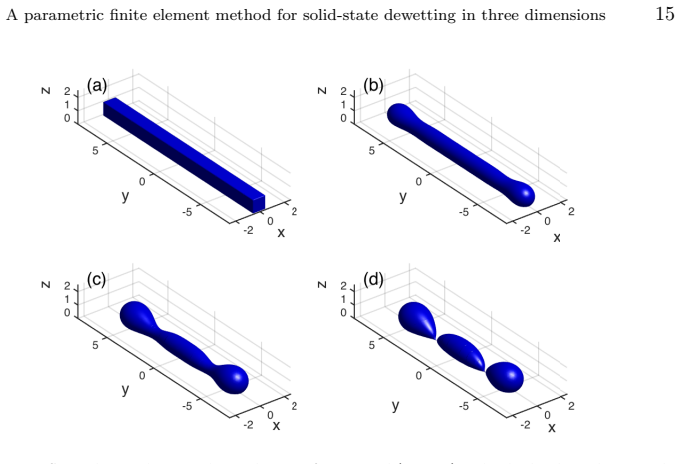
Run the pinch-off test for an initial $(1,12,1)$ cuboid with $\sigma=\cos(3\pi/4)$ under two mesh resolutions and monitor the minimum triangle area near the reported breakup time. If the code continues without a declared topology-change rule while any triangle area reaches zero or becomes negative, or if the number of resulting islands changes with mesh size, the claim that the method simulates breakup dynamics is not supported.
Extended reading notes
Core claim
The paper's central claim is that a variational formulation of the 3D sharp-interface solid-state dewetting model, written in terms of the Cahn-Hoffman $\xi$-vector, can be discretized by a semi-implicit parametric finite element method that is well-posed and practical. In the model, the film/vapor interface evolves by $\partial_t X = \Delta_S \mu$ with chemical potential $\mu = \nabla_S \cdot \xi$; the contact line moves by the relaxed contact angle condition, and the scheme first advances the boundary curve explicitly, then solves a linear system for the new surface using that curve as a Dirichlet condition. Theorem 3.1 shows the linear system admits a unique solution whenever every triangle of the discrete surface has positive area. The numerical experiments report convergence to the theoretical equilibrium shape and reproduce Rayleigh-like pinch-off, edge retraction, and ring breakup in full 3D.
Load-bearing premise
The well-posedness proof assumes that every surface triangle has positive area at every time step, yet the headline pinch-off simulations deliberately create moments where triangles collapse, so the evolution through and after breakup depends on an unstated numerical treatment that the theorem does not cover.
Editorial extensions
If this is right
- If the central claim holds, the method can track 3D dewetting morphologies for isotropic and weakly anisotropic surface energies without the severe time-step restrictions of marker-particle methods.
- The observed critical lengths imply that for a $(1,L,1)$ cuboid, the number of particles formed follows a reciprocal-linear law in $1/\sin(\arccos \sigma/2)$, enabling prediction of island counts for given film dimensions and substrate energetics.
- The method resolves the competition between radial shrinking and azimuthal Rayleigh-like instability in square rings: thick rings shrink to a torus, while thin rings break into four or more particles.
- Because each time step is a linear solve, the method is a viable candidate for large-scale 3D simulations, provided a topology-change treatment is supplied at pinch-off.
Reading between the lines
- The paper does not specify a topology-change or remeshing procedure for the moment of pinch-off, yet its headline simulations evolve through triangle collapse; a reader should infer that the credible extension is a local surgery rule that seeds new contact lines when the neck width reaches the mesh scale.
- The same $\xi$-vector weak form should transfer to other fourth-order geometric flows with moving contact lines, such as epitaxial island coarsening or thermal grain-boundary grooving, where the boundary-condition structure is analogous.
- A testable extension is quantitative: compute the first pinch-off time as a function of mesh size for a fixed $(1,12,1)$ cuboid. If the reported $t_p$ values are mesh-independent, the breakup dynamics are physically meaningful; if not, an unstated remeshing artifact is at play.
Signed reviews
Editorial analysis
A structured set of objections, weighed in public.
Referee Report
Summary. This paper proposes a parametric finite element method (PFEM) for the three-dimensional sharp-interface model (2.3)-(2.8) of solid-state dewetting, in which the film/vapor interface evolves by surface diffusion and the contact line migrates under a relaxed contact-angle condition. A variational formulation in terms of the Cahn-Hoffman xi-vector is presented (2.19), a semi-implicit PFEM with mass lumping and an explicit contact-line update is constructed (3.9)-(3.11), and well-posedness of the discrete linear system is proved in Theorem 3.1 under the non-degeneracy assumption (3.2). The paper reports convergence of numerical equilibrium shapes to Winterbottom shapes and numerous simulations of morphological evolution, including Rayleigh-like pinch-off of cuboid islands, cross-shaped island splitting, square-ring breakup, and anisotropic (cubic and ellipsoidal) equilibrium shapes.
Significance. Assuming the numerical results are reproducible and that the topology changes are handled by a sound, described procedure, the method would be a valuable contribution to the computational literature on geometric evolution equations with moving contact lines in 3D. Explicit strengths of the paper are: the discrete variational problem is proved well-posed (Theorem 3.1); the numerical equilibrium comparison in Fig. 4.2 is a parameter-free benchmark against theoretical Winterbottom shapes; the scheme leads to a linear algebra system, making it practical; and the morphological complexity reported (pinch-off, ring breakup, edge retraction) is directly relevant to experiments. The main qualification is that the proof and scheme are stated for a fixed-topology surface with positive triangle areas, while the headline pinch-off simulations go beyond that regime without a documented topology-change procedure. In addition, energy stability is explicitly not proven, so the efficiency claim rests on empirical observations only.
major comments (2)
- [Section 4.2 / Section 3, assumption (3.2)] The well-posedness theorem (Theorem 3.1) and the finite element scheme are formulated under assumption (3.2) that every triangle of S^m has positive area for 0 <= m <= M-1. The numerical demonstrations of pinch-off in Figs. 4.4-4.6, 4.9, and 4.12-4.13 require the surface to become self-touching or to split, changing the number of contact-line components. The only mesh maintenance described in Section 3 is 'mesh redistribution,' which does not alter topology, and no detection or splitting procedure is reported. The post-breakup evolution shown in these figures and the phase diagram in Fig. 4.7 is therefore produced by an undocumented numerical procedure that is outside the analyzed scheme. Please describe the topology-change algorithm and provide validation (e.g., mesh-refinement and time-step convergence of the pinch-off time and of the post-breakup shapes), or restrict the claims to evolutions that satisfy (3.2).
- [Section 2.2, after Eq. (2.21)] The text states that 'it is not easy to obtain the energy stability based on the discretization' and that stability is supported only by numerical experiments. Because the abstract and conclusions describe the method as 'efficient' and 'accurate' for complex morphological evolution, the paper should either prove a stability bound or state this limitation prominently (for example, in the abstract) and report the time-step restrictions used in the simulations. Without this, the claim of efficiency for a fourth-order geometric flow is not fully supported.
minor comments (5)
- [Section 2.2 / Section 3] The text introduces the reference domain U and the spaces H^1_alpha(U), H^1_beta(U), H^1_0(U) before Eq. (2.19), but the variational formulation is then stated with test functions on S(t) and the discrete scheme is posed on S^m. Please clarify the role of U and the relation between these spaces and the discrete surface mesh.
- [Section 4.1] The statement that 'the total volume loss (not shown here) ... is always below 0.5%' would be more convincing if a volume-versus-time plot were included for the representative runs in Figs. 4.3-4.6.
- [Section 4.1, Fig. 4.2] Fig. 4.2 demonstrates qualitative convergence to the Winterbottom shape, but no convergence rate is reported. Given that the method is new, a quantitative table (for example, the L2 difference of the interface position versus mesh size h) would strengthen the accuracy claim.
- [Section 4.2, Fig. 4.7] The phase diagram in Fig. 4.7(a) and the fitted critical-length lines are presented without details of the simulation campaign (number of runs, criterion for counting islands, and mesh/time-step settings). At least a brief description should be added.
- [Section 3, Eqs. (2.9), (3.8), (3.11)] There are small notation inconsistencies: c^gamma_Gamma in Eq. (2.9) is written as c^{gamma,m}_{Gamma,j} in Section 3, and the quantity lambda^m_j is defined before Eq. (3.11) without an equation number. Please harmonize the notation.
Circularity Check
No material circularity: the PFEM derivation is self-contained; the adopted sharp-interface model and equilibrium benchmarks come from prior work but the numerical claims are not tautological.
full rationale
The paper's core contribution is a discretization of a given sharp-interface model. The model equations (2.3)-(2.8) are adopted from the authors' earlier work [30], but the variational formulation (2.19a)-(2.19b) is obtained from those PDEs by standard integration by parts, and Theorem 3.1 establishes well-posedness of the discrete linear system under the explicitly stated non-degeneracy assumption (3.2). No fitted parameter is relabeled as a prediction: the contact-angle relaxation simulations check the scheme's consistency with the Young-law boundary condition built into the model, and the Winterbottom/ellipsoidal equilibrium comparisons are independent geometric facts about the same energy, not outputs of the scheme recycled as inputs. The phase-diagram lines in Fig. 4.7 are curve fits to the simulations' own island counts, presented as observational summaries rather than independent predictions. The one genuine weakness is that assumption (3.2), quoted as ensuring 'that vertices of polygonal surface will not merge during the evolution,' is violated at the pinch-off events in Section 4.2, and the paper does not describe its topology-change procedure; hence the post-breakup dynamics are outside the proven theorem. That is a correctness/completeness limitation, not a circularity, and it does not increase the circularity score.
Assumptions & free parameters
assumptions (4)
- domain assumption The sharp-interface model (2.3)-(2.8) with relaxed contact angle is an accurate description of solid-state dewetting.
- standard math The surface S and boundary Gamma are smooth enough for the integration-by-parts formula (2.13).
- ad hoc to paper All triangles in the discrete surface satisfy |D^m_j| > 0 (assumption (3.2)).
- domain assumption The mesh redistribution algorithm from [3] maintains mesh quality throughout the evolution.
Cite this review
Pith. "Pith review of A parametric finite element method for solid-state dewetting problems in three dimensions." pith.science (2026). https://pith.science/paper/WDRSCFCC
@misc{pith2026190808311,
  author       = {Pith},
  title        = {Pith review of: A parametric finite element method for solid-state dewetting problems in three dimensions},
  year         = {2026},
  howpublished = {\url{https://pith.science/paper/WDRSCFCC}},
  note         = {Machine review of arXiv:1908.08311}
}
read the original abstract
We propose a parametric finite element method (PFEM) for efficiently solving the morphological evolution of solid-state dewetting of thin films on a flat rigid substrate in three dimensions (3D). The interface evolution of the dewetting problem in 3D is described by a sharp-interface model, which includes surface diffusion coupled with contact line migration. A variational formulation of the sharp-interface model is presented, and a PFEM is proposed for spatial discretization. For temporal discretization, at each time step, we first update the position of the contact line according to the relaxed contact angle condition; then, by using the position of the new contact line as the boundary condition, we solve a linear algebra system resulted from the discretization of PFEM to obtain the new interface surface for the next step. The well-posedness of the solution of the PFEM is also established. Extensive numerical results are reported to demonstrate the accuracy and efficiency of the proposed PFEM and to show the complexities of the dewetting morphology evolution observed in solid-state dewetting experiments.
Figures


Figures from the paper (12 more)




Reference graph
Works this paper leans on
- [1]
-
[2]
E. B¨ansch, P. Morin, and R. H. Nochetto , Surface diffusion of graphs: variational formu- lation, error analysis, and simulation , SIAM J. Numer. Anal., 42 (2004), pp. 773–799
work page 2004
-
[3]
E. B¨ansch, P. Morin, and R. H. Nochetto , A finite element method for surface diffusion: the parametric case, J. Comput. Phys., 203 (2005), pp. 321–343
work page 2005
-
[4]
W. Bao, W. Jiang, D. J. Srolovitz, and Y. Wang , Stable equilibria of anisotropic particles on substrates: a generalized winterbottom construction , SIAM J. Appl. Math, 77 (2017), pp. 2093–2118
work page 2017
-
[5]
W. Bao, W. Jiang, Y. Wang, and Q. Zhao , A parametric finite element method for solid- state dewetting problems with anisotropic surface energies , J. Comput. Phys., 330 (2017), pp. 380–400
work page 2017
-
[6]
J. W. Barrett, H. Garcke, and R. N ¨urnberg, Numerical approximation of anisotropic geometric evolution equations in the plane , SIMA J. Numer. Anal, 28 (2007), pp. 292–330. 24 Q. Zhao, W. Jiang and W. Bao
work page 2007
-
[7]
J. W. Barrett, H. Garcke, and R. N¨urnberg, On the variational approximation of combined second and fourth order geometric evolution equations , SIAM J. Sci. Comput, 29 (2007), pp. 1006–1041
work page 2007
-
[8]
J. W. Barrett, H. Garcke, and R. N ¨urnberg, A parametric finite element method for fourth order geometric evolution equations , J. Comput. Phys, 222 (2007), pp. 441–467
work page 2007
Show all 60 references
-
[9]
J. W. Barrett, H. Garcke, and R. N ¨urnberg, On the parametric finite element approxi- mation of evolving hypersurfaces in R3, J. Comput. Phys, 227 (2008), pp. 4281–4307
2008
-
[10]
J. W. Barrett, H. Garcke, and R. N ¨urnberg, Parametric approximation of Willmore flow and related geometric evolution equations , SIAM J. Sci. Comput, 31 (2008), pp. 225–253
2008
-
[11]
J. W. Barrett, H. Garcke, and R. N ¨urnberg, A variational formulation of anisotropic geometric evolution equations in higher dimensions , Numer. Math, 109 (2008), pp. 1–44
2008
-
[12]
J. W. Barrett, H. Garcke, and R. N ¨urnberg, Finite-element approximation of coupled surface and grain boundary motion with applications to thermal grooving and sintering , Eur. J. Appl. Math, 21 (2010), pp. 519–556
2010
-
[13]
Cahn and D
J. Cahn and D. Hoffman , A vector thermodynamics for anisotropic surfaces: I. curved and faceted surfaces, Acta Metall., 22 (1974), pp. 1205–1214
1974
-
[14]
J. W. Cahn and J. E. Taylor , Surface motion by surface diffusion , Acta Metall. Mater., 42 (1994), pp. 1045–1063
1994
-
[15]
De Gennes, Wetting: statics and dynamics , Rev
P.-G. De Gennes, Wetting: statics and dynamics , Rev. Mod. Phys., 57 (1985), pp. 827–863
1985
-
[16]
Deckelnick, G
K. Deckelnick, G. Dziuk, and C. M. Elliott , Computation of geometric partial differential equations and mean curvature flow , Acta Numer., 14 (2005), pp. 139–232
2005
-
[17]
Dornel, J
E. Dornel, J. Barbe, F. De Cr´ecy, G. Lacolle, and J. Eymery, Surface diffusion dewetting of thin solid films: Numerical method and application to Si/SiO 2, Phys. Rev. B, 73 (2006), p. 115427
2006
-
[18]
P. Du, M. Khenner, and H. Wong , A tangent-plane marker-particle method for the compu- tation of three-dimensional solid surfaces evolving by surface diffusion on a substrate , J. Comput. Phys., 229 (2010), pp. 813–827
2010
-
[19]
Dziuk, An algorithm for evolutionary surfaces , Numer
G. Dziuk, An algorithm for evolutionary surfaces , Numer. Math, 58 (1990), pp. 603–611
1990
-
[20]
Dziuk and C
G. Dziuk and C. M. Elliott , Finite element methods for surface PDEs , Acta Numer., 22 (2013), pp. 289–396
2013
-
[21]
Hausser and A
F. Hausser and A. Voigt , A discrete scheme for regularized anisotropic surface diffusion: a 6th order geometric evolution equation , Interfaces Free Bound, 7 (2005), pp. 353–370
2005
-
[22]
Hausser and A
F. Hausser and A. Voigt, A discrete scheme for parametric anisotropic surface diffusion , J. Sci. Comput, 30 (2007), pp. 223–235
2007
-
[23]
Hildebrandt and H
S. Hildebrandt and H. Karcher, Geometric analysis and nonlinear partial differential equa- tions, Springer Science & Business Media, 2012
2012
-
[24]
D. W. Hoffman and J. W. Cahn, A vector thermodynamics for anisotropic surfaces: I. funda- mentals and application to plane surface junctions, Surface Science, 31 (1972), pp. 368–388
1972
-
[25]
S. Y. Hon, S. Leung, and H. Zhao , A cell based particle method for modeling dynamic interfaces, J. Comput. Phys., 272 (2014), pp. 279–306
2014
-
[26]
Huang, W
Q.-A. Huang, W. Jiang, and J. Z. Yang , An efficient and unconditionally energy stable scheme for simulating solid-state dewetting of thin films with isotropic surface energy , accepted by Commu. Comput. Phys., (2019)
2019
-
[27]
Jiang, W
W. Jiang, W. Bao, C. V. Thompson, and D. J. Srolovitz , Phase field approach for simu- lating solid-state dewetting problems , Acta Mater., 60 (2012), pp. 5578–5592
2012
-
[28]
Jiang, Y
W. Jiang, Y. Wang, Q. Zhao, D. J. Srolovitz, and W. Bao, Solid-state dewetting and island morphologies in strongly anisotropic materials , Scripta Mater., 115 (2016), pp. 123–127
2016
-
[29]
Jiang and Q
W. Jiang and Q. Zhao , Sharp-interface approach for simulating solid-state dewetting in two dimensions: a Cahn-Hoffman ξ-vector formulation, Physica D: Nonlinear Phenomena, 390 (2019), pp. 69–83
2019
-
[30]
Jiang, Q
W. Jiang, Q. Zhao, and W. Bao , Sharp-interface approach for simulating solid-state dewet- ting in three dimensions , arXiv:1902.05272, (2019)
2019 arXiv
-
[31]
Jiang, Q
W. Jiang, Q. Zhao, T. Qian, D. J. Srolovitz, and W. Bao , Application of Onsager’s variational principle to the dynamics of a solid toroidal island on a substrate , Acta Mater., 163 (2019), pp. 154–160
2019
-
[32]
G. H. Kim and C. V. Thompson , Effect of surface energy anisotropy on Rayleigh-like solid- state dewetting and nanowire stability , Acta Mater., 84 (2015), pp. 190–201
2015
-
[33]
G. H. Kim, R. V. Zucker, J. Ye, W. C. Carter, and C. V. Thompson, Quantitative analysis of anisotropic edge retraction by solid-state dewetting of thin single crystal films , J. Appl. Phys., 113 (2013), p. 043512
2013
-
[34]
Kovalenko, S
O. Kovalenko, S. Szab´o, L. Klinger, and E. Rabkin, Solid state dewetting of polycrystalline Mo film on sapphire , Acta Mater., 139 (2017), pp. 51–61. A parametric finite element method for solid-state dewetting in three dimensions 25
2017
-
[35]
Leroy, F
F. Leroy, F. Cheynis, Y. Almadori, S. Curiotto, M. Trautmann, J. Barb ´e, P. M¨uller, et al., How to control solid state dewetting: A short review , Surface Science Reports, 71 (2016), pp. 391–409
2016
-
[36]
Leung, J
S. Leung, J. Lowengrub, and H. Zhao , A grid based particle method for solving partial differential equations on evolving surfaces and modeling high order geometrical motion , J. Comput. Phys, 230 (2011), pp. 2540–2561
2011
-
[37]
Mizsei, Activating technology of SnO 2 layers by metal particles from ultrathin metal films , Sensors and Actuators B: Chemical, 16 (1993), pp
J. Mizsei, Activating technology of SnO 2 layers by metal particles from ultrathin metal films , Sensors and Actuators B: Chemical, 16 (1993), pp. 328–333
1993
-
[38]
W. W. Mullins, Theory of thermal grooving , J. Appl. Phys., 28 (1957), pp. 333–339
1957
-
[39]
Naffouti, T
M. Naffouti, T. David, A. Benkouider, L. Favre, A. Delobbe, A. Ronda, I. Berbezier, and M. Abbarchi, Templated solid-state dewetting of thin silicon films , Small, 12 (2016), pp. 6115–6123
2016
-
[40]
Pozzi, Anisotropic mean curvature flow for two-dimensional surfaces in higher codimension: a numerical scheme , Interface Free Bound., 10 (2008), pp
P. Pozzi, Anisotropic mean curvature flow for two-dimensional surfaces in higher codimension: a numerical scheme , Interface Free Bound., 10 (2008), pp. 539–576
2008
-
[41]
Qian, X.-P
T. Qian, X.-P. Wang, and P. Sheng , A variational approach to moving contact line hydro- dynamics, J. Fluids Mech., 564 (2006), pp. 333–360
2006
-
[42]
Rabkin, D
E. Rabkin, D. Amram, and E. Alster , Solid state dewetting and stress relaxation in a thin single crystalline Ni film on sapphire , Acta Mater., 74 (2014), pp. 30–38
2014
-
[43]
Randolph, J
S. Randolph, J. Fowlkes, A. Melechko, K. Klein, H. Meyer III, M. Simpson, and P. Rack, Controlling thin film structure for the dewetting of catalyst nanoparticle arrays for subsequent carbon nanofiber growth , Nanotechnology, 18 (2007), p. 465304
2007
-
[44]
Rayleigh, On the instability of jets , Proc
L. Rayleigh, On the instability of jets , Proc. Lond. Math. Soc, 1 (1878), pp. 4–13
-
[45]
Schmidt, J
V. Schmidt, J. V. Wittemann, S. Senz, and U. G ¨osele, Silicon nanowires: a review on aspects of their growth and their electrical properties , Adv. Mater, 21 (2009), pp. 2681– 2702
2009
-
[46]
D. J. Srolovitz and S. A. Safran, Capillary instabilities in thin films: I. Energetics , J. Appl. Phys., 60 (1986), pp. 247–254
1986
-
[47]
J. E. Taylor , II – mean curvature and weighted mean curvature , Acta Metall. Mater, 40 (1992), pp. 1475–1485
1992
-
[48]
C. V. Thompson , Solid-state dewetting of thin films , Annu. Rev. Mater. Res., 42 (2012), pp. 399–434
2012
-
[49]
Y. Wang, W. Jiang, W. Bao, and D. J. Srolovitz , Sharp interface model for solid-state dewetting problems with weakly anisotropic surface energies , Phys. Rev. B, 91 (2015), p. 045303
2015
-
[50]
Winterbottom, Equilibrium shape of a small particle in contact with a foreign substrate , Acta Metall., 15 (1967), pp
W. Winterbottom, Equilibrium shape of a small particle in contact with a foreign substrate , Acta Metall., 15 (1967), pp. 303–310
1967
-
[51]
H. Wong, P. Voorhees, M. Miksis, and S. Davis , Periodic mass shedding of a retracting solid film step , Acta Mater., 48 (2000), pp. 1719–1728
2000
-
[52]
Xu and X
X. Xu and X. Wang, Derivation of the Wenzel and Cassie equations from a phase field model for two phase flow on rough surface , SIAM J. Appl. Math., 70 (2010), pp. 2929–2941
2010
-
[53]
Xu and X
X. Xu and X. Wang, Analysis of wetting and contact angle hysteresis on chemically patterned surfaces, SIAM J. Appl. Math., 71 (2011), pp. 1753–1779
2011
-
[54]
Xu and C.-W
Y. Xu and C.-W. Shu, Local discontinuous Galerkin method for surface diffusion and Willmore flow of graphs , J. Sci. Comput, 40 (2009), pp. 375–390
2009
-
[55]
Ye and C
J. Ye and C. V. Thompson , Regular pattern formation through the retraction and pinch-off of edges during solid-state dewetting of patterned single crystal films , Phys. Rev. B, 82 (2010), p. 193408
2010
-
[56]
Ye and C
J. Ye and C. V. Thompson , Anisotropic edge retraction and hole growth during solid-state dewetting of single crystal nickel thin films , Acta Mater., 59 (2011), pp. 582–589
2011
-
[57]
Ye and C
J. Ye and C. V. Thompson , Templated solid-state dewetting to controllably produce complex patterns, Adv. Mater., 23 (2011), pp. 1567–1571
2011
-
[58]
Zhao, A sharp-interface model and its numerical approximation for solid-state dewetting with axisymmetric geometry , J
Q. Zhao, A sharp-interface model and its numerical approximation for solid-state dewetting with axisymmetric geometry , J. Comput. Appl. Math., 361 (2019), pp. 144–156
2019
-
[59]
Q. Zhao, W. Jiang, D. J. Srolovitz, and W. Bao , Triple junction drag effects during topological changes in the evolution of polycrystalline microstructures , Acta Mater., 128 (2017), pp. 345–350
2017
-
[60]
R. V. Zucker, G. H. Kim, J. Ye, W. C. Carter, and C. V. Thompson , The mechanism of corner instabilities in single-crystal thin films during dewetting , J. Appl. Phys., 119 (2016), p. 125306
2016
Reviewed August 14, 2026 · model on record in the stance chip above.
Discussion (0). Continue with ORCID to comment.