REVIEW 2 major objections 5 minor 56 references
Improving the dynamics of quantum sensors with reinforcement learning
T0 review · 2 major / 5 minor · reviewed 2026-08-14 · deepseek-v4-flash
Pith's one-line read The paper claims that reinforcement-learning-optimized nonlinear kick sequences on a generalized kicked top can outperform both no-control and periodic chaotic kicks for quantum sensing under superradiant damping.
desk verdict A useful and clearly written RL control study with a plausible qualitative payoff, but the headline sensitivity gains rest on an internally inconsistent periodic-kick baseline and on best-of-sample episodes, so the magnitudes need referee scrutiny. read the letter →
The pith
A machine-rendered reading of the paper's core claim, the machinery that carries it, and where it could break.
The reading
What carries the argument
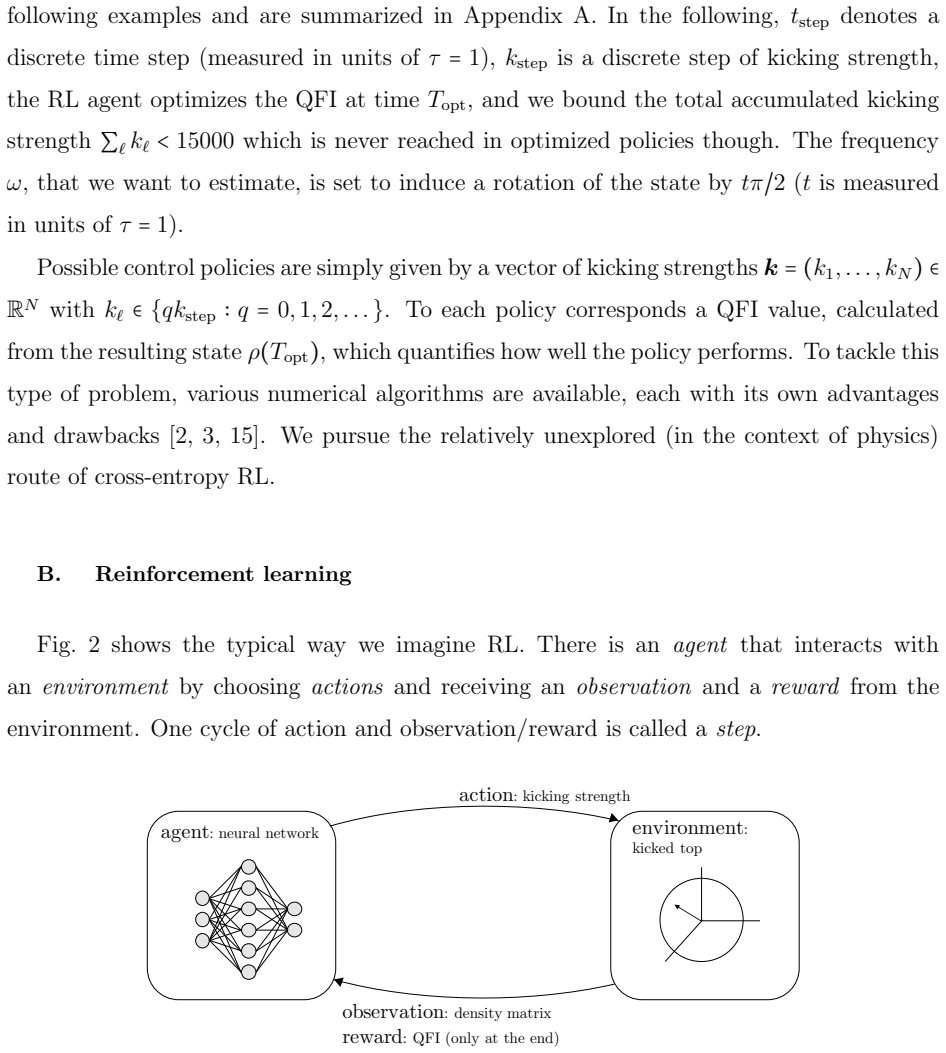
The central object is the generalized kicked top, a spin-$j$ system with Hamiltonian $H_\mathrm{KT}(t)=\omega J_z + [J_y^2/(2j+1)]\sum_\ell \kappa_\ell \tau \delta(t-t_\ell)$, where the first term is the Larmor precession encoding the unknown frequency $\omega$ and each $\delta$-kick is a torsion about $y$ with strength $k_\ell=\kappa_\ell\tau$. The control problem is discretized into two actions, increase the current kick strength or advance in time, and a neural network is trained with the cross-entropy method to maximize the QFI at a final time $T_\mathrm{opt}$. The workhorse in the simulation is the propagator $\rho(t_\ell)=U_\omega(k_\ell)[D(t_\ell-t_{\ell-1})\rho(t_{\ell-1})]U_\omega(k_\ell)^\dagger$, with $D$ the superradiant or phase-damping Lindblad propagator; this equation generates the rewards used for training and the QFI values reported.
What would settle it
Take the learned kick sequence for $j=2$, $\gamma_\mathrm{sr}=0.01$ and simulate it with finite pulse duration or with a small shift of the Larmor frequency during each kick; if the QFI advantage over the periodically kicked top is lost under either modification, the claim rests on the idealized instantaneous, parameter-independent kick assumption. In an experiment, comparing the measured sensitivity of the RL sequence with the predicted $1/\sqrt{I_\omega}$ under the same decoherence model would settle transferability.
Extended reading notes
Core claim
The central claim is that offline optimization of kicking strengths and times, rather than periodic kicks with fixed strength, turns the dissipative kicked top into a better sensor. For superradiant damping, the RL-optimized generalized kicked top reaches a quantum Fisher information at time $T_\mathrm{opt}$ that exceeds both the maximum QFI of the unkicked top and the plateau QFI of the periodically kicked top; the authors report sensitivity gains of more than an order of magnitude for $j=3$, $\gamma_\mathrm{sr}=0.01$. The mechanism, read off from Wigner distributions, is a spin-squeezing strategy: the learned kicks keep the state squeezed along the precession direction and re-squeeze it in roughly periodic cycles, counteracting the relaxation to the ground state that would otherwise erase information about the frequency $\omega$. The paper also shows improvements under phase damping, though smaller.
Load-bearing premise
The optimized kick sequences are trained on a simulated master equation that assumes Markovian noise, instantaneous parameter-independent kicks, and a known decoherence model; if the real sensor has non-Markovian noise or the kicks shift the estimated frequency, the learned policies may not transfer.
Editorial extensions
If this is right
- If the central claim holds, an atomic spin-precession magnetometer can improve sensitivity by more than an order of magnitude by adding optimized off-resonant light kicks while keeping an easy-to-prepare coherent spin state.
- The learned strategy constitutes a form of continuous, damping-adapted spin squeezing, suggesting that spin squeezing need not be limited to state preparation but can be maintained throughout the measurement.
- The optimized kick sequences remain roughly periodic with a period corresponding to a $\pi$ precession, so the control may be implementable with standard pulse hardware rather than continuous arbitrary waveforms.
- For phase damping the method still yields QFI improvements over the unkicked top, but substantially smaller than for superradiant damping, so the expected benefit depends on the decoherence model.
- The QFI gains arise while using the same classical initial state as a standard sensor, so the improvement is attributed to the control dynamics rather than to more elaborate state preparation.
Reading between the lines
- The same cross-entropy setup could be tested on other nonlinear control axes, such as $J_x^2$ kicks, or on collective spin ensembles, where the squeezing interpretation may carry over.
- A natural extension is to combine the learned open-loop kick sequences with measurement-based feedback, since the policy is learned offline but the environment is deterministic in this setting.
- A direct experimental check would compare the learned policy against a periodically kicked top on the same apparatus while deliberately varying pulse duration, revealing whether the instantaneous-kick assumption is the limiting factor.
- For non-Markovian noise, retraining on a noise-characterized simulation or on experimental trajectories would be needed; the paper's Markovian assumption is a scope condition, not a demonstrated limitation.
Signed reviews
Editorial analysis
A structured set of objections, weighed in public.
Referee Report
Summary. The paper proposes using cross-entropy reinforcement learning to optimize the kicking strengths and kicking times of a generalized kicked top in order to maximize the quantum Fisher information at a fixed final time in local parameter estimation. The dynamics are modeled with either phase damping or superradiant damping, and the control consists of instantaneous nonlinear kicks about the y-axis, while the estimated parameter enters through Larmor precession. The authors compare the RL-optimized protocol against the unkicked top and against the periodically kicked top of Ref. [33]. For superradiant damping they report examples in which the QFI of the optimized protocol continues to grow after the unkicked top has decohered and the periodically kicked top has reached a plateau, leading in some cases to sensitivity improvements (1/sqrt(QFI)) of more than an order of magnitude. Wigner-function and classical phase-space visualizations identify the optimized strategy as a spin-squeezing-like state that is refreshed periodically to counteract superradiant damping. Appendices provide training hyperparameters, pseudocode, learning curves, and classical equations of motion.
Significance. If the quantitative comparison is settled, the paper makes a useful contribution to quantum metrology: it shows that a simple, generic RL method can discover non-periodic control protocols that outperform periodic quantum-chaotic sensing in the presence of Markovian dissipation, and it interprets the discovered mechanism. The manuscript is unusually transparent about training details and includes a stability analysis of the learning algorithm, which is a strength. The main caveats are that the headline gain is defined against a periodic baseline whose kicking strength appears to be inconsistent with the value quoted for Ref. [33], and that the reported gains are based on the best sampled episode rather than on typical performance with error bars. Both points need to be resolved before the central claim can be considered quantitatively established.
major comments (2)
- [Section III and Section V / Figs. 3 and 5] Section III states that Ref. [33] investigated the kicked top in the transition regime with k=3 and omega=pi/2, but Section V and the captions of Figs. 3 and 5 use k=30 and describe this value as 'chosen as in Ref. [33]'. Since the central claim is an improvement in sensitivity over the quantum-chaotic sensor of Ref. [33], the comparison must use the actual prior-art protocol. Please reconcile the two values, update the text and captions, and recompute the Gamma_plateau ratios and the reported sensitivity gains against the correct baseline (k=3, or an explicitly justified value). The omission of j=3 from Fig. 5(b) because the periodic plateau is 'very low' makes the size of the claimed advantage particularly sensitive to the baseline choice; please also quote numerical QFI values for the j=3 example so that the 'more than an order of magnitude' improvement can be checked.
- [Section IV.C, Table I, Fig. 5] Section IV.C selects, after training, 'a few episodes' from each trained agent and keeps the episode with the largest QFI as the reported policy; Table I lists nsamples=20 for Fig. 5. The gains plotted in Fig. 5 are therefore best-of-sample quantities, not the mean performance of the learned policy, and they are shown without error bars. Appendix D reports a mean and standard deviation of the reward for one hyperparameter set, but it does not cover the quantities displayed in Fig. 5. Please report the median and spread of the gain over the sampled episodes (or equivalent confidence information) and state whether the >10x sensitivity improvement survives for typical, not best, sampled policies. This is needed to rule out selection bias as the source of the headline improvement.
minor comments (5)
- [Eq. (2)] Equation (2) as printed contains an apparent typo: the denominator should be (p_l + p_m), not (p_l + p_m)^2, and the stray 'd' should be removed. If the formula in the PDF is correct, please clarify; otherwise it is inconsistent with the standard QFI expression.
- [Section V] The statement that |r|=1 due to conservation of angular momentum is not correct as a general statement for dissipative states of a fixed-j spin, since expectation values can shrink. Please rephrase, for example as the phase-space constraint in the classical limit.
- [Fig. 3 and Fig. 9] The red vertical lines indicating kicks are described as having heights in arbitrary units and not on the left-axis scale, which makes the actual kicking strengths hard to read. Please provide a scale or a table of the kick sequences for the examples.
- [Section III / Section VI] The optimized policies are obtained for Markovian dampers and instantaneous, parameter-independent kicks. A short discussion of robustness to non-Markovian noise or to a kick-induced shift of the estimated frequency would strengthen the experimental relevance of the proposed approach.
- [Section VI and Table I] The claim in Section VI that no hyperparameter tuning was necessary is not fully supported by Table I, which lists several training parameters that vary across figures. Please clarify which choices were routine or robust and whether any systematic exploration was performed.
Circularity Check
No circularity: the RL optimization target is the reported QFI, but that is an explicit optimization objective rather than a recycled prediction, and the baselines are independently computed.
full rationale
The paper's central result is a numerical optimization demonstration, not a derivation from first principles. The RL agent's reward is explicitly the QFI at Topt (Sec. IV.B: 'reward: QFI (only at the end)'), and the reported policy is selected as the episode with largest QFI (Sec. IV.C), so reporting the QFI at Topt is transparently reporting the optimized objective, not a fitted parameter renamed as a prediction. The comparisons are against the top without kicks and the periodically kicked top, which are external baselines recomputed from the same master equation; the RL policy is not fitted to those baseline values, and the gain ratios are post-hoc evaluations. The only self-citations are Refs. [33,34], used to motivate the quantum-chaotic sensor and to define the periodic-kick baseline; Ref. [33] is a published prior protocol whose QFI behavior is recomputed here, so the citation is independent support and not load-bearing. No uniqueness theorem or ansatz is imported via self-citation. A separate factual inconsistency exists in the baseline description (Sec. III attributes k=3 to Ref. [33], while Sec. V uses k=30), but this is a correctness/external-validity concern about the comparison, not a circularity of the derivation chain.
Assumptions & free parameters
free parameters (4)
- time discretization step tstep =
0.1, 0.2, or 1.0 depending on example
- kicking strength discretization kstep =
0.05 or 0.10
- optimization horizon Topt =
50 or 100
- RL training hyperparameters =
niterations 300 to 1000, nepisodes 40 to 100, learning rate 0.001, hidden units 300
assumptions (5)
- standard math The quantum Cramer-Rao bound and the QFI formula (Eqs. 1-2) give the ultimate measurement precision.
- domain assumption The kicked-top Hamiltonian with instantaneous delta-kicks (Eq. 3) captures the physics of a spin-precession magnetometer with off-resonant light-kick control.
- domain assumption The decoherence is Markovian and described by the Lindblad generators (7) for phase damping and (8) for superradiant damping, with constant rates gamma_pd and gamma_sr.
- domain assumption The dissipator commutes with the precession about the z-axis, so the combined propagator factorizes as in Eq. (10).
- domain assumption The initial state is an SU(2) coherent state with theta = pi/2, phi = pi/2, which is a classical-like and experimentally preparable state.
Cite this review
Pith. "Pith review of Improving the dynamics of quantum sensors with reinforcement learning." pith.science (2026). https://pith.science/paper/Y7UE4G5T
@misc{pith2026190808416,
  author       = {Pith},
  title        = {Pith review of: Improving the dynamics of quantum sensors with reinforcement learning},
  year         = {2026},
  howpublished = {\url{https://pith.science/paper/Y7UE4G5T}},
  note         = {Machine review of arXiv:1908.08416}
}
read the original abstract
Recently proposed quantum-chaotic sensors achieve quantum enhancements in measurement precision by applying nonlinear control pulses to the dynamics of the quantum sensor while using classical initial states that are easy to prepare. Here, we use the cross-entropy method of reinforcement learning to optimize the strength and position of control pulses. Compared to the quantum-chaotic sensors with periodic control pulses in the presence of superradiant damping, we find that decoherence can be fought even better and measurement precision can be enhanced further by optimizing the control. In some examples, we find enhancements in sensitivity by more than an order of magnitude. By visualizing the evolution of the quantum state, the mechanism exploited by the reinforcement learning method is identified as a kind of spin-squeezing strategy that is adapted to the superradiant damping.
Figures


Figures from the paper (7 more)


Reference graph
Works this paper leans on
-
[33]
L. J. Fiderer and D. Braun, Nature communications 9, 1351 (2018)
work page 2018
-
[1]
K. P. Murphy, Machine learning: a probabilistic perspective (MIT press, 2012)
2012
-
[2]
Dunjko and H
V. Dunjko and H. J. Briegel, Reports on Progress in Physics 81, 074001 (2018)
2018
- [3]
-
[4]
Carrasquilla and R
J. Carrasquilla and R. G. Melko, Nature Physics 13, 431 (2017)
2017
-
[5]
P. Broecker, F. F. Assaad, and S. Trebst, arXiv preprint arXiv:1707.00663 (2017)
arXiv 2017
-
[6]
E. P. Van Nieuwenburg, Y.-H. Liu, and S. D. Huber, Nature Physics 13, 435 (2017)
2017
-
[7]
Carleo and M
G. Carleo and M. Troyer, Science 355, 602 (2017)
2017
Show all 56 references
-
[8]
Carleo, Y
G. Carleo, Y. Nomura, and M. Imada, Nature communications 9, 5322 (2018)
2018
-
[9]
Gao and L.-M
X. Gao and L.-M. Duan, Nature communications 8, 662 (2017)
2017
-
[10]
J. R. Leigh, Control theory, Vol. 64 (London: Institution of Electrical Engineers, 2004)
2004
-
[11]
L. P. Kaelbling, M. L. Littman, and A. W. Moore, Journal of artificial intelligence research 4, 237 (1996)
1996
-
[12]
R. S. Sutton and A. G. Barto, Reinforcement learning: An introduction (MIT press, 2018)
2018
-
[13]
R. S. Sutton, A. G. Barto, and R. J. Williams, IEEE Control Systems Magazine 12, 19 (1992)
1992
-
[14]
C. Chen, D. Dong, H.-X. Li, J. Chu, and T.-J. Tarn, IEEE transactions on neural networks and learning systems 25, 920 (2013)
2013
-
[15]
Palittapongarnpim, P
P. Palittapongarnpim, P. Wittek, E. Zahedinejad, S. Vedaie, and B. C. Sanders, Neurocom- puting 268, 116 (2017)
2017
-
[16]
F¨ osel, P
T. F¨ osel, P. Tighineanu, T. Weiss, and F. Marquardt, Physical Review X 8, 031084 (2018)
2018
-
[17]
Bukov, A
M. Bukov, A. G. Day, D. Sels, P. Weinberg, A. Polkovnikov, and P. Mehta, Physical Review X 8, 031086 (2018)
2018
-
[18]
Albarr´ an-Arriagada, J
F. Albarr´ an-Arriagada, J. C. Retamal, E. Solano, and L. Lamata, Physical Review A 98, 042315 (2018)
2018
-
[19]
M. Y. Niu, S. Boixo, V. N. Smelyanskiy, and H. Neven, npj Quantum Information 5, 33 (2019)
2019
-
[20]
A. A. Melnikov, H. P. Nautrup, M. Krenn, V. Dunjko, M. Tiersch, A. Zeilinger, and H. J. Briegel, Proceedings of the National Academy of Sciences 115, 1221 (2018). 28
2018
-
[21]
Sweke, M
R. Sweke, M. S. Kesselring, E. P. van Nieuwenburg, and J. Eisert, arXiv preprint arXiv:1810.07207 (2018)
2018 arXiv
-
[22]
Andreasson, J
P. Andreasson, J. Johansson, S. Liljestrand, and M. Granath, Quantum 3, 183 (2019)
2019
-
[23]
Hentschel and B
A. Hentschel and B. C. Sanders, in 2010 Seventh International Conference on Information Technology: New Generations (IEEE, 2010) pp. 506–511
2010
-
[24]
Hentschel and B
A. Hentschel and B. C. Sanders, Physical review letters 107, 233601 (2011)
2011
-
[25]
N. B. Lovett, C. Crosnier, M. Perarnau-Llobet, and B. C. Sanders, Physical review letters 110, 220501 (2013)
2013
-
[26]
Sergeevich and S
A. Sergeevich and S. D. Bartlett, in 2012 IEEE Congress on Evolutionary Computation (IEEE,
2012
-
[27]
M. P. Stenberg, O. K¨ ohn, and F. K. Wilhelm, Physical Review A 93, 012122 (2016)
2016
-
[28]
Palittapongarnpim, P
P. Palittapongarnpim, P. Wittek, and B. C. Sanders, in 24th European Symposium on Arti- ficial Neural Networks, Bruges, April 27–29, 2016 (2016) pp. 327–332
2016
-
[29]
Lumino, E
A. Lumino, E. Polino, A. S. Rab, G. Milani, N. Spagnolo, N. Wiebe, and F. Sciarrino, Physical Review Applied 10, 044033 (2018)
2018
-
[30]
Liu and H
J. Liu and H. Yuan, Physical Review A 96, 012117 (2017)
2017
-
[31]
Liu and H
J. Liu and H. Yuan, Physical Review A 96, 042114 (2017)
2017
-
[32]
H. Xu, J. Li, L. Liu, Y. Wang, H. Yuan, and X. Wang, npj Quantum Information 5, 82 (2019)
2019
-
[34]
L. J. Fiderer and D. Braun, in Optical, Opto-Atomic, and Entanglement-Enhanced Precision Metrology, Vol. 10934 (International Society for Optics and Photonics, 2019) p. 109342S
2019
-
[35]
C. W. Helstrom, Quantum detection and estimation theory (Academic press, 1976)
1976
-
[36]
A. S. Holevo, Probabilistic and Statistical Aspect of Quantum Theory (North-Holland, Ams- terdam, 1982)
1982
-
[37]
S. L. Braunstein and C. M. Caves, Phys. Rev. Lett. 72, 3439 (1994)
1994
-
[38]
M. G. A. Paris, International Journal of Quantum Information 7, 125 (2009)
2009
-
[39]
Peres, Quantum theory: concepts and methods , Vol
A. Peres, Quantum theory: concepts and methods , Vol. 57 (Dordrecht: Kluwer, 1993)
1993
-
[40]
Chaudhury, A
S. Chaudhury, A. Smith, B. Anderson, S. Ghose, and P. S. Jessen, Nature 461, 768 (2009)
2009
-
[41]
Krithika, V
V. Krithika, V. Anjusha, U. T. Bhosale, and T. Mahesh, Physical Review E 99, 032219 (2019). 29
2019
-
[42]
R. H. Dicke, Phys. Rev. 93, 99 (1954)
1954
-
[43]
Gross, C
M. Gross, C. Fabre, P. Pillet, and S. Haroche, Phys. Rev. Lett. 36, 1035 (1976)
1976
-
[44]
Gross and S
M. Gross and S. Haroche, Phys. Rep. 93, 301 (1982)
1982
-
[45]
Braun, Dissipative Quantum Chaos and Decoherence , Springer Tracts in Modern Physics, Vol
D. Braun, Dissipative Quantum Chaos and Decoherence , Springer Tracts in Modern Physics, Vol. 172 (Springer, 2001)
2001
-
[46]
Kossakowski, Rep
A. Kossakowski, Rep. Math. Phys. 3, 247 (1972)
1972
-
[47]
Lindblad, Math
G. Lindblad, Math. Phys. 48, 119 (1976)
1976
-
[48]
Bonifacio, P
R. Bonifacio, P. Schwendimann, and F. Haake, Physical Review A 4, 302 (1971)
1971
-
[49]
P. A. Braun, D. Braun, and F. Haake, Eur. Phys. J. D 3, 1 (1998)
1998
-
[50]
P. A. Braun, D. Braun, F. Haake, and J. Weber, Eur. Phys. J. D 2, 165 (1998)
1998
-
[51]
Giraud, P
O. Giraud, P. Braun, and D. Braun, Phys. Rev. A 78, 042112 (2008)
2008
-
[52]
Giraud, P
O. Giraud, P. Braun, and D. Braun, New Journal of Physics 12, 063005 (2010)
2010
-
[53]
De Boer, D
P.-T. De Boer, D. P. Kroese, S. Mannor, and R. Y. Rubinstein, Annals of operations research 134, 19 (2005)
2005
-
[54]
D. P. Kingma and J. Ba, arXiv preprint arXiv:1412.6980 (2014)
2014 arXiv
-
[55]
G. S. Agarwal, Quantum optics (Cambridge University Press, 2012)
2012
-
[56]
M. A. Nielsen, Neural networks and deep learning , Vol. 2018 (Determination press San Fran- cisco, CA, USA:, 2015). 30
2018
Reviewed August 14, 2026 · model on record in the stance chip above.
Discussion (0). Continue with ORCID to comment.