REVIEW 3 major objections 4 minor 121 references
Phenomenology of $keV$ sterile neutrino in minimal extended seesaw
T0 review · 3 major / 4 minor · reviewed 2026-08-14 · deepseek-v4-flash
Pith's one-line read A keV sterile neutrino can satisfy dark-matter bounds only in normal ordering, and the same minimal seesaw links double beta decay, relic abundance, and baryogenesis.
desk verdict The flavor and 0νββ/leptogenesis work is respectable, but the keV dark matter claim does not survive the paper's own equations. read the letter →
The pith
A machine-rendered reading of the paper's core claim, the machinery that carries it, and where it could break.
The reading
What carries the argument
The load-bearing structure is the minimal extended seesaw mass texture. The active neutrino mass is $m_\nu\simeq M_D M_R^{-1} M_S^{\rm T}(M_S M_R^{-1} M_S^{\rm T})^{-1} M_S(M_R^{-1})^{\rm T} M_D^{\rm T}-M_D M_R^{-1} M_D^{\rm T}$, the sterile mass is $m_s\simeq-M_S M_R^{-1} M_S^{\rm T}$, and the active–sterile mixing vector is $W=M_D M_R^{-1} M_S^{\rm T}(M_S M_R^{-1} M_S^{\rm T})^{-1}$; with a single singlet $S$ coupled only to $\nu_{R1}$ these reduce to one keV sterile state of mass $G^2/(\lambda_1 v)$ and mixing $W=(D_1/G,\,0,\,P/G)^{\rm T}$. Three numerical formulas then carry the phenomenology: the $0\nu\beta\beta$ effective mass $m_{3+1}^{\rm eff}=m_{3\nu}^{\rm eff}+m_4|\theta_S|^2$, the decay width $\Gamma_{S\to3\nu}=G_F^2 m_S^5 \sin^2\theta_S/(96\pi^3)$, and the relic abundance $\Omega_{\rm DM}h^2\simeq0.3(\sin^2 2\theta_{S\nu}/10^{-10})(m_S/100\ \mathrm{keV})^2$. The whole argument is the map from these formulas to closed contours in the $(m_S,\theta_S)$ plane.
What would settle it
Evaluate Eq. (21) at $\Omega_{\rm DM}h^2=0.119$ for $m_S=1,2,3$ keV to find the required $\sin^2\theta_S$, and compare it with the upper limit set by Eq. (18) under $\Gamma<10^{-28}\ \mathrm{s}^{-1}$; the normal-ordering dark-matter window survives only if the two ranges intersect. An independent check is to infer $\theta_S$ from the measured flux of the $E=3.55$ keV X-ray line, compute the relic abundance from Eq. (21), and compare it with the cosmologically measured dark-matter density.
Extended reading notes
Core claim
The paper's central finding is a set of parameter windows in which one keV sterile neutrino simultaneously satisfies three constraints. Using the MES formula for the $0\nu\beta\beta$ effective mass, $m_{3+1}^{\rm eff}=m_{3\nu}^{\rm eff}+m_4|\theta_S|^2$, it shows that values of $m_4|\theta_S|^2$ above $10^{-4}$ keV would push the effective mass beyond the $0.01$ eV future reach; this yields the paper's upper bound on the active–sterile mixing element. For dark matter, it combines the three-neutrino decay width $\Gamma_{S\to 3\nu}$ with the non-resonant relic formula and imposes $\Gamma<10^{-28}\ \mathrm{s}^{-1}$ together with $\Omega_{\rm DM}h^2=0.119$, which in normal ordering leaves $m_S$ around $1\text{--}3$ keV as the allowed window; in inverted ordering the decay-width and relic windows do not overlap. For baryogenesis, the decay of the lightest right-handed neutrino with masses $R_1=10^{12}$ GeV, $R_2=10^{13}$ GeV, $R_3=5\times10^{13}$ GeV produces a baryon asymmetry in agreement with observation, with normal ordering again more efficient and the Dirac CP phase constrained to $\delta\approx2\text{--}4$. The paper therefore claims a correlation between a future $0\nu\beta\beta$ measurement, a sterile-neutrino dark-matter signal, and the measured baryon asymmetry, all within one $A_4$-based MES construction; it also states explicitly that the keV sterile neutrino as dark matter within MES is still on the verge of uncertainty.
Load-bearing premise
The load-bearing premise is that a tiny, time-independent active–sterile mixing angle $\theta_S<10^{-6}$ with non-resonant production (Eq. 21) generates the observed dark-matter relic abundance; if the mixing required for $\Omega_{\rm DM}h^2=0.119$ at $m_S\sim1\text{--}10$ keV exceeds the value allowed by the decay-width bound, the claimed $1\text{--}3$ keV dark-matter window collapses.
Editorial extensions
If this is right
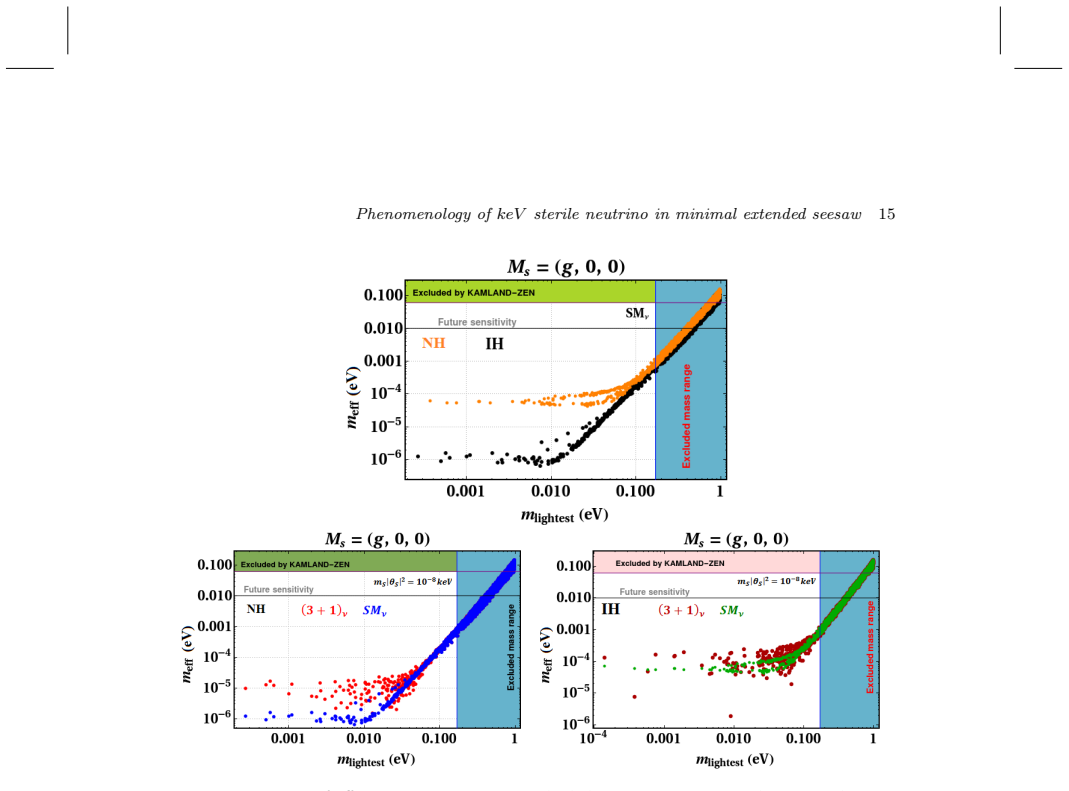
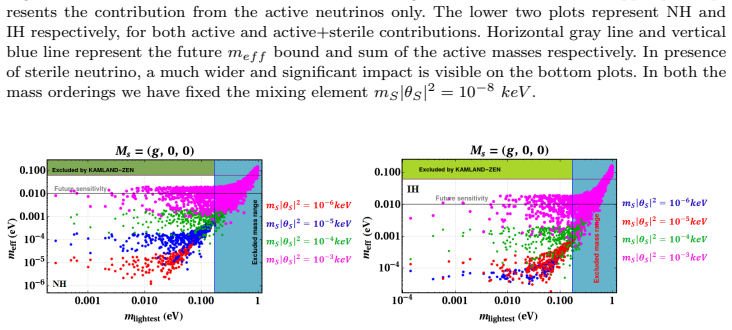
- If a future $0\nu\beta\beta$ experiment reaches $m_{\rm eff}\sim0.01$ eV and sees nothing, the model converts that null result into the bound $m_S|\theta_S|^2<10^{-4}\ \mathrm{keV}$ on the sterile sector.
- If the normal-ordering dark-matter window $m_S\approx1\text{--}3$ keV is real, the sterile neutrino is warm dark matter; Lyman-$\alpha$ bounds of $m_S\gtrsim1.8\text{--}3.3$ keV sit directly on this window, making the viability testable by structure-formation data.
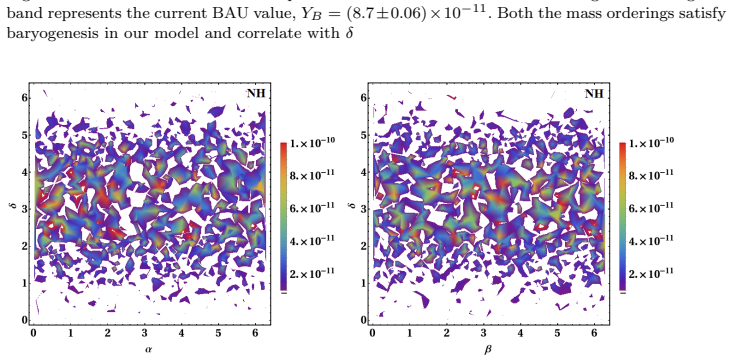
- A confirmed baryon asymmetry from leptogenesis in this setup requires the Dirac CP phase $\delta\approx2\text{--}4$ in normal ordering, so long-baseline measurements of $\delta$ can confirm or exclude the model's parameter space.
- In inverted ordering, the decay-width and relic-abundance windows do not overlap, so a confirmed keV sterile dark matter with $m_S\gtrsim3$ keV would disfavor the inverted-hierarchy version of this MES model.
- The combination of $0\nu\beta\beta$ and sterile-mass constraints gives a target for future keV sterile searches: if $m_S|\theta_S|^2$ sits near $10^{-4}$ keV, the signal lies just below the next-generation $0\nu\beta\beta$ reach.
Reading between the lines
- The non-resonant production premise deserves the closest scrutiny: evaluating the paper's own Eq. (21) at $m_S=1\text{--}10$ keV requires $\theta_S\sim10^{-5}\text{--}10^{-4}$ to reach $\Omega_{\rm DM}h^2=0.119$, while the lifetime bound $\Gamma<10^{-28}\ \mathrm{s}^{-1}$ permits substantially smaller values; a full Boltzmann treatment including resonant production would determine whether a common
- The 3.55 keV X-ray line interpretation ($m_S\approx7.1$ keV) lies above the NH window found here, so if that line is sterile-neutrino decay, this particular MES model would need a different production mechanism or a modified texture.
- Promoting the static mixing angle to a temperature-dependent one and computing the sterile momentum distribution would turn the model's warm-dark-matter prediction into a quantitative prediction for structure-formation data.
- The predicted texture $W=(D_1/G,\,0,\,P/G)^{\rm T}$ is distinctive, so future flavor-specific sterile-mixing searches could test this $A_4$ assignment against generic 3+1 models.
Editorial analysis
A structured set of objections, weighed in public.
Referee Report
Summary. The manuscript constructs an A4 x Z4 x Z3 flavor-symmetric minimal extended seesaw (MES) model with three hierarchical right-handed neutrinos and one keV-scale sterile singlet S. The model parameters D1, D2, P are matched to the 3-sigma ranges of the neutrino oscillation parameters for both normal and inverted mass ordering, and the paper then studies three observables: the 0νββ effective mass including the sterile contribution, the sterile-neutrino dark matter relic abundance and decay width, and the baryon asymmetry produced by thermal leptogenesis from the decay of the lightest right-handed neutrino. The paper reports an upper bound on active-sterile mixing from 0νββ, preferred sterile-neutrino mass ranges from dark matter considerations (NH: 1-3 keV; IH: a broader range), constrained Yukawa and CP-phase windows from baryogenesis, and correlations among meff, mS, delta, and YB.
Significance. If the simultaneous constraints were correctly derived, this would be a useful example of a flavor-symmetry-based MES model linking 0νββ, dark matter, and leptogenesis. The A4 construction is explicit, the numerical scans over CP phases are systematic, and the 0νββ and leptogenesis parts follow standard and mostly correct formalism. However, the dark matter analysis contains an internal numerical inconsistency that undermines the paper's headline claim of simultaneous viability; the reported sterile-neutrino mass ranges do not follow from the paper's own equations. Because that claim is the central result, the manuscript cannot be accepted in its present form.
major comments (3)
- [§3.2, Eq. (21)] The assumed static mixing angle theta_S < 10^-6 is incompatible with the relic-density target. Setting Omega_DM h^2 = 0.119 in Eq. (21) gives sin^2(2 theta_S) ≈ 3.97 x 10^-7 (100 keV/mS)^2, i.e., theta_S ≈ 3.2 x 10^-4 (1 keV/mS). For mS = 1-3 keV this is two to three orders of magnitude above the theta_S < 10^-6 assumption stated in Section 3.2, so the relic-abundance curves in Fig. 5 cannot be obtained with the mixing parameters the text says are being used.
- [§3.2, Eq. (18) and §4] The mixing angle required by Eq. (21) also violates the decay-width criterion. Inserting theta_S ≈ 3.2 x 10^-4 (1 keV/mS) into Eq. (18) gives Gamma_{S->3nu} ≈ 6.7 x 10^-27 s^-1 at mS = 1 keV and ≈ 1.7 x 10^-25 s^-1 at mS = 3 keV, both above the paper's stated Gamma < 10^-28 s^-1 limit in Section 4. The intersection of the relic-abundance and decay-width constraints occurs near mS ≈ 0.2 keV, below the (1-18.5) keV window quoted throughout the paper.
- [§3.2 and Fig. 5] Because of the two inconsistencies above, the Fig. 5 caption claim that 'mS around 1-3 keV is consistent with NH mode ... while satisfying both the decay width and relic abundance' does not follow from the paper's own equations. This simultaneous-satisfaction statement is the paper's central advertised result, so the dark-matter mass ranges and the subsequent correlations in Figs. 8-10 that rely on those ranges are unsupported.
minor comments (4)
- [Abstract and Introduction] There are repeated proofreading issues: 'it's influence' in the abstract should be 'its influence', and 'explicitly violets the lepton number' in Section 1 should be 'explicitly violates the lepton number'.
- [Section 3, text before Table 4] The sentence 'R1 =×10^12 GeV' is missing a numerical coefficient; it should presumably read R1 = 10^12 GeV or R1 = n x 10^12 GeV.
- [Figs. 2 and 3] The sterile contribution to the effective mass is denoted m4|theta_S|^2 in Eq. (17) but mS|theta_S|^2 in the Fig. 2 caption; please use one notation consistently and clarify whether m4 and mS are the same quantity.
- [Section 3.2, text near Eq. (20)] The sentence 'the mixing parameter, sin 2 2theta_S from eq. (20) got heavily suppressed' refers to a decay-width formula; the mixing combination sin^2(2 theta_S) appears in Eq. (20), but the sentence should be reworded to avoid implying Eq. (20) defines the mixing parameter.
Circularity Check
No significant circularity: parameters are fitted to neutrino oscillation data and outputs are checked against external bounds.
full rationale
The model parameters D1, D2, P are solved from the observed neutrino mass-squared differences and mixing angles (Sec. 3), and the CP phases are scanned over their allowed ranges; the subsequent 0νββ, dark-matter, and leptogenesis quantities are evaluated from those inputs and compared with independent external limits (KamLAND-Zen/GERDA future sensitivity, ΩDMh2=0.119, YB=(8.7±0.06)e-11). No equation in the paper defines a prediction in terms of its target observable, and no fitted parameter is renamed as a prediction. The self-citation to the authors' prior work [66] supplies the MP matrix ansatz, but that matrix is explicitly written in Eq. (4) and used as a model-building input rather than as an external uniqueness theorem, so it is not load-bearing circularity. The hand-picked values R1,R2,R3 and the keV range for mS weaken the model's independence but do not make the outputs equivalent to inputs by construction. The Fig. 5 dark-matter mass-range claim appears internally inconsistent with the stated θS<10^-6 (Eq. (21) at 1-3 keV would require θS~10^-4), but that is a correctness/consistency concern, not a circular derivation; under the hard rules it does not raise the circularity score.
Assumptions & free parameters
free parameters (5)
- R1, R2, R3 (heavy right-handed neutrino masses) =
10^12, 10^13, 5x10^13 GeV
- mS (sterile neutrino mass) =
scanned over 1-18.5 keV
- θS (active-sterile mixing) =
not fixed; scanned in Fig. 3; model-dependent via D1/G and P/G
- D1, D2, P (Dirac mass entries) =
not reported numerically
- CP phases α, β, δ =
scanned over (0, 2π)
assumptions (4)
- domain assumption A4 multiplication rules and vacuum alignments from [66], including ⟨ζ⟩=(v,0,0), ⟨ϕ⟩=(v,v,v), ⟨ϕ′⟩=(0,vp,0)
- standard math MES active mass formula Eq. (9) with the lightest active neutrino exactly massless
- domain assumption Non-resonant (Dodelson-Widrow) relic abundance formula Eq. (21)
- standard math Single-flavor thermal leptogenesis with dilution factor parametrization from [57]
invented entities (2)
-
Sterile neutrino S
-
A4 flavons ζ, ϕ, ζ′, ϕ′, ξ, ξ′, χ
Cite this review
Pith. "Pith review of Phenomenology of $keV$ sterile neutrino in minimal extended seesaw." pith.science (2026). https://pith.science/paper/TBGX2CW6
@misc{pith2026190808417,
  author       = {Pith},
  title        = {Pith review of: Phenomenology of $keV$ sterile neutrino in minimal extended seesaw},
  year         = {2026},
  howpublished = {\url{https://pith.science/paper/TBGX2CW6}},
  note         = {Machine review of arXiv:1908.08417}
}
abstract
We explore the possibility of a single generation of $keV$ scale sterile neutrino ($m_S$) as a dark matter candidate within the minimal extended seesaw (MES) framework and it's influence in neutrinoless double beta decay ($0\nu\beta\beta$) study. Three hierarchical right-handed neutrinos were considered to explain neutrino mass. We also address baryogenesis via the mechanism of thermal leptogenesis considering the decay of the lightest RH neutrino to a lepton and Higgs doublet. A generic model based on $A_4\times Z_4\times Z_3$ flavor symmetry is constructed to explain both normal and inverted hierarchy mass pattern of neutrinos. Significant results on effective neutrino masses are observed in presence of sterile mass ($m_S$) and active-sterile mixing ($\theta_{S}$) in $0\nu\beta\beta$. Results from $0\nu\beta\beta$ give stringent upper bounds on the active-sterile mixing matrix element. To establish sterile neutrino as dark matter within this model, we checked decay width and relic abundance of the sterile neutrino, which restricted sterile mass ($m_S$) within some definite bounds. Constrained regions on the CP-phases and Yukawa couplings are obtained from $0\nu\beta\beta$ and baryogenesis results. Co-relations among these observable are also established and discussed within this framework.
Figures

Figures from the paper (8 more)




Reference graph
Works this paper leans on
- [1]
-
[2]
Boger, R
J. Boger, R. Hahn, J. Rowley, A. Carter, B. Hollebone, D. Kessler, I. Blevis, F. Dalnoki-Veress, A. DeKok, J. Farine et al. , Nuclear Instruments and Methods in Physics Research Section A: Accelerators, Spectrometers, Detectors and Associated Equipment 449, 172 (2000)
2000
-
[3]
Evans, Advances in High Energy Physics 2013 (2013)
J. Evans, Advances in High Energy Physics 2013 (2013)
2013
- [4]
-
[5]
RENO Collaboration (J. K. Ahn et al. ), Phys. Rev. Lett. 108, 191802 (2012), arXiv:1204.0626 [hep-ex] , doi:10.1103/PhysRevLett.108.191802
arXiv 2012
- [6]
-
[7]
Daya Bay Collaboration (F. P. An et al. ), Phys. Rev. Lett. 108, 171803 (2012), arXiv:1203.1669 [hep-ex] , doi:10.1103/PhysRevLett.108.171803. 22 Pritam Das, Mrinal Kumar Das
arXiv 2012
-
[8]
LSND Collaboration (C. Athanassopoulos et al. ), Phys. Rev. Lett. 81, 1774 (1998), arXiv:nucl-ex/9709006 [nucl-ex] , doi:10.1103/PhysRevLett.81.1774
arXiv 1998
Show all 121 references
-
[9]
Athanassopoulos et al
LSND Collaboration (C. Athanassopoulos et al. ), Phys. Rev. Lett. 77, 3082 (1996), arXiv:nucl-ex/9605003 [nucl-ex] , doi:10.1103/PhysRevLett.77.3082
1996 arXiv
-
[10]
Aguilar-Arevalo et al
LSND Collaboration (A. Aguilar-Arevalo et al. ), Phys. Rev. D64, 112007 (2001), arXiv:hep-ex/0104049 [hep-ex] , doi:10.1103/PhysRevD.64.112007
2001 arXiv
-
[11]
J. N. Abdurashitov et al. , Phys. Rev. C73, 045805 (2006), arXiv:nucl-ex/0512041 [nucl-ex], doi:10.1103/PhysRevC.73.045805
2006 arXiv
-
[12]
Giunti and M
C. Giunti and M. Laveder, Physical Review C 83, 065504 (2011)
2011
-
[13]
Giunti, M
C. Giunti, M. Laveder, Y. Li, Q. Liu and H. Long, Physical Review D 86, 113014 (2012)
2012
-
[14]
Dodelson and L
S. Dodelson and L. M. Widrow, Phys. Rev. Lett. 72, 17 (1994), arXiv:hep-ph/9303287 [hep-ph] , doi:10.1103/PhysRevLett.72.17
1994 arXiv
-
[15]
K. N. Abazajian et al. (2012), arXiv:1204.5379 [hep-ph]
2012 arXiv
-
[16]
K. N. Abazajian, Phys. Rept. 711-712, 1 (2017), arXiv:1705.01837 [hep-ph] , doi: 10.1016/j.physrep.2017.10.003
2017 arXiv
-
[17]
Benes, A
P. Benes, A. Faessler, F. Simkovic and S. Kovalenko, Phys. Rev. D71, 077901 (2005), arXiv:hep-ph/0501295 [hep-ph] , doi:10.1103/PhysRevD.71.077901
2005 arXiv
-
[18]
Barry, W
J. Barry, W. Rodejohann and H. Zhang, JHEP 07, 091 (2011), arXiv:1105.3911 [hep-ph], doi:10.1007/JHEP07(2011)091
2011 arXiv
-
[19]
Petraki and A
K. Petraki and A. Kusenko, Phys. Rev. D77, 065014 (2008), arXiv:0711.4646 [hep-ph], doi:10.1103/PhysRevD.77.065014
2008 arXiv
-
[20]
Abada, V
A. Abada, V. De Romeri, M. Lucente, A. M. Teixeira and T. Toma, JHEP 02, 169 (2018), arXiv:1712.03984 [hep-ph] , doi:10.1007/JHEP02(2018)169
2018 arXiv
-
[21]
A. Atre, T. Han, S. Pascoli and B. Zhang, JHEP 05, 030 (2009), arXiv:0901.3589 [hep-ph], doi:10.1088/1126-6708/2009/05/030
2009 arXiv
-
[22]
F. F. Deppisch, P. S. Bhupal Dev and A. Pilaftsis, New J. Phys. 17, 075019 (2015), arXiv:1502.06541 [hep-ph] , doi:10.1088/1367-2630/17/7/075019
2015 arXiv
-
[23]
Borgohain, M
H. Borgohain, M. K. Das and D. Borah, JHEP 06, 064 (2019), arXiv:1904.02484 [hep-ph], doi:10.1007/JHEP06(2019)064
2019 arXiv
-
[24]
Barry, J
J. Barry, J. Heeck and W. Rodejohann, JHEP 07, 081 (2014), arXiv:1404.5955 [hep-ph], doi:10.1007/JHEP07(2014)081
2014 arXiv
-
[25]
Rodejohann and H
W. Rodejohann and H. Zhang, Phys. Lett. B737, 81 (2014), arXiv:1407.2739 [hep-ph], doi:10.1016/j.physletb.2014.08.035
2014 arXiv
-
[26]
P. S. Bhupal Dev and A. Pilaftsis, Phys. Rev. D87, 053007 (2013), arXiv:1212.3808 [hep-ph], doi:10.1103/PhysRevD.87.053007
2013 arXiv
-
[27]
P. O. Ludl and W. Rodejohann, JHEP 06, 040 (2016), arXiv:1603.08690 [hep-ph] , doi:10.1007/JHEP06(2016)040
2016 arXiv
-
[28]
H. J. de Vega, O. Moreno, E. M. de Guerra, M. R. Medrano and N. G. Sanchez, Nucl. Phys. B866, 177 (2013), arXiv:1109.3452 [hep-ph] , doi:10.1016/j.nuclphysb.2012. 08.019
2013 arXiv
-
[29]
W. H. Furry, Physical Review 56, 1184 (December 1939), doi:10.1103/PhysRev.56. 1184
1939 doi
-
[30]
Dell’Oro, S
S. Dell’Oro, S. Marcocci, M. Viel and F. Vissani, Adv. High Energy Phys. 2016, 2162659 (2016), arXiv:1601.07512 [hep-ph] , doi:10.1155/2016/2162659
2016 arXiv
-
[31]
J. M. Cline, Baryogenesis, in Les Houches Summer School - Session 86: Particle Physics and Cosmology: The Fabric of Spacetime Les Houches, France, July 31- August 25, 2006 , (2006). arXiv:hep-ph/0609145 [hep-ph]
2006 arXiv
-
[32]
S. M. Bilenky, A. Faessler and F. Simkovic, Phys. Rev. D70, 033003 (2004), Phenomenology of keV sterile neutrino in minimal extended seesaw 23 arXiv:hep-ph/0402250 [hep-ph] , doi:10.1103/PhysRevD.70.033003
2004 arXiv
-
[33]
S. M. Bilenky and C. Giunti, Mod. Phys. Lett. A27, 1230015 (2012), arXiv:1203.5250 [hep-ph] , doi:10.1142/S0217732312300157
2012 arXiv
-
[34]
Agostini et al
GERDA Collaboration (M. Agostini et al. ), Phys. Rev. Lett. 120, 132503 (2018), arXiv:1803.11100 [nucl-ex] , doi:10.1103/PhysRevLett.120.132503
2018 arXiv
-
[35]
Borgohain and M
H. Borgohain and M. K. Das, Phys. Rev. D96, 075021 (2017), arXiv:1709.09542 [hep-ph], doi:10.1103/PhysRevD.96.075021
2017 arXiv
-
[36]
A. Abada, . Hernndez-Cabezudo and X. Marcano, JHEP 01, 041 (2019), arXiv:1807.01331 [hep-ph] , doi:10.1007/JHEP01(2019)041
2019 arXiv
-
[37]
P´ econtal, T
E. P´ econtal, T. Buchert, P. Di Stefano, Y. Copin and K. Freese, European Astro- nomical Society Publications Series 36, 113 (2009)
2009
-
[38]
Clowe, M
D. Clowe, M. Bradaˇ c, A. H. Gonzalez, M. Markevitch, S. W. Randall, C. Jones and D. Zaritsky, The Astrophysical Journal Letters 648, L109 (2006)
2006
-
[39]
Bennett, D
C. Bennett, D. Larson, J. Weiland, N. Jarosik, G. Hinshaw, N. Odegard, K. Smith, R. Hill, B. Gold, M. Halpern et al. , The Astrophysical Journal Supplement Series 208, 20 (2013)
2013
-
[40]
Planck Collaboration (P. A. R. Ade et al. ), Astron. Astrophys. 571, A16 (2014), arXiv:1303.5076 [astro-ph.CO] , doi:10.1051/0004-6361/201321591
2014 arXiv
-
[41]
J. Yoo, J. Chaname and A. Gould, Astrophys. J. 601, 311 (2004), arXiv:astro-ph/0307437 [astro-ph] , doi:10.1086/380562
2004 arXiv
-
[42]
Pani and A
P. Pani and A. Loeb, JCAP 1406, 026 (2014), arXiv:1401.3025 [astro-ph.CO] , doi:10.1088/1475-7516/2014/06/026
2014 arXiv
- [43]
-
[44]
Kraus et al
C. Kraus et al. , Eur. Phys. J. C40, 447 (2005), arXiv:hep-ex/0412056 [hep-ex] , doi:10.1140/epjc/s2005-02139-7
2005 arXiv
-
[45]
V. M. Lobashev et al. , Nucl. Phys. Proc. Suppl. 91, 280 (2001), doi:10.1016/ S0920-5632(00)00952-X, [,280(2001)]
2001
-
[46]
E. W. Kolb and M. S. Turner, Front. Phys. 69, 1 (1990)
1990
-
[47]
Jungman, M
G. Jungman, M. Kamionkowski and K. Griest, Phys. Rept. 267, 195 (1996), arXiv:hep-ph/9506380 [hep-ph] , doi:10.1016/0370-1573(95)00058-5
1996 arXiv
-
[48]
G. B. Gelmini and P. Gondolo, Phys. Rev. D74, 023510 (2006), arXiv:hep-ph/0602230 [hep-ph], doi:10.1103/PhysRevD.74.023510
2006 arXiv
-
[49]
Servant and T
G. Servant and T. M. P. Tait, Nucl. Phys. B650, 391 (2003), arXiv:hep-ph/0206071 [hep-ph], doi:10.1016/S0550-3213(02)01012-X
2003 arXiv
-
[50]
Bonnevier, H
J. Bonnevier, H. Melbeus, A. Merle and T. Ohlsson, Phys. Rev. D85, 043524 (2012), arXiv:1104.1430 [hep-ph] , doi:10.1103/PhysRevD.85.109902,10.1103/PhysRevD. 85.043524, [Erratum: Phys. Rev.D85,109902(2012)]
2012 arXiv
-
[51]
Lopez Honorez, E
L. Lopez Honorez, E. Nezri, J. F. Oliver and M. H. G. Tytgat, JCAP 0702, 028 (2007), arXiv:hep-ph/0612275 [hep-ph] , doi:10.1088/1475-7516/2007/02/028
2007 arXiv
-
[52]
Khan, Exploring Extensions of the Scalar Sector of the Standard Model, PhD thesis, Indian Inst
N. Khan, Exploring Extensions of the Scalar Sector of the Standard Model, PhD thesis, Indian Inst. Tech., Indore (2017)
2017
-
[53]
P. Das, M. K. Das and N. Khan (2019), arXiv:1911.07243 [hep-ph]
2019 arXiv
-
[54]
Aghanim et al
Planck Collaboration (N. Aghanim et al. ) (7 2018), arXiv:1807.06209 [astro-ph.CO]
2018 arXiv
-
[55]
Fukugita and T
M. Fukugita and T. Yanagida, Phys. Lett. B174, 45 (1986), doi:10.1016/ 0370-2693(86)91126-3
1986
-
[56]
Strumia, Baryogenesis via leptogenesis, in Particle physics beyond the stan- dard model
A. Strumia, Baryogenesis via leptogenesis, in Particle physics beyond the stan- dard model. Proceedings, Summer School on Theoretical Physics, 84th Session, Les Houches, France, August 1-26, 2005 , (2006), pp. 655–680. arXiv:hep-ph/0608347 24 Pritam Das, Mrinal Kumar Das [hep-ph]
2006 arXiv
-
[57]
Davidson, E
S. Davidson, E. Nardi and Y. Nir, Phys. Rept. 466, 105 (2008), arXiv:0802.2962 [hep-ph], doi:10.1016/j.physrep.2008.06.002
2008 arXiv
-
[58]
Di Bari, Contemp
P. Di Bari, Contemp. Phys. 53, 315 (2012), arXiv:1206.3168 [hep-ph] , doi:10.1080/ 00107514.2012.701096
2012 arXiv
-
[59]
Nardi, Y
E. Nardi, Y. Nir, E. Roulet and J. Racker, JHEP 01, 164 (2006), arXiv:hep-ph/0601084 [hep-ph] , doi:10.1088/1126-6708/2006/01/164
2006 arXiv
-
[60]
Buchmuller, P
W. Buchmuller, P. Di Bari and M. Plumacher, New J. Phys. 6, 105 (2004), arXiv:hep-ph/0406014 [hep-ph] , doi:10.1088/1367-2630/6/1/105
2004 arXiv
-
[61]
Frossard, M
T. Frossard, M. Garny, A. Hohenegger, A. Kartavtsev and D. Mitrouskas, Phys. Rev. D87, 085009 (2013), arXiv:1211.2140 [hep-ph] , doi:10.1103/PhysRevD.87.085009
2013 arXiv
-
[62]
Borah, D
M. Borah, D. Borah and M. K. Das, Phys. Rev. D91, 113008 (2015), arXiv:1503.03431 [hep-ph] , doi:10.1103/PhysRevD.91.113008
2015 arXiv
-
[63]
Kalita, D
R. Kalita, D. Borah and M. K. Das, Nucl. Phys. B894, 307 (2015), arXiv:1412.8333 [hep-ph], doi:10.1016/j.nuclphysb.2015.03.007
2015 arXiv
-
[64]
Borah and M
D. Borah and M. K. Das, Phys. Rev. D90, 015006 (2014), arXiv:1303.1758 [hep-ph], doi:10.1103/PhysRevD.90.015006
2014 arXiv
-
[65]
Zhang, Phys
H. Zhang, Phys. Lett. B714, 262 (2012), arXiv:1110.6838 [hep-ph] , doi:10.1016/ j.physletb.2012.06.074
2012 arXiv
-
[66]
P. Das, A. Mukherjee and M. K. Das, Nucl. Phys. B941, 755 (2019), arXiv:1805.09231 [hep-ph] , doi:10.1016/j.nuclphysb.2019.02.024
2019 arXiv
-
[67]
Osipowicz et al
KATRIN Collaboration (A. Osipowicz et al. ) (2001), arXiv:hep-ex/0109033 [hep-ex]
2001 arXiv
-
[68]
Mertens, T
S. Mertens, T. Lasserre, S. Groh, G. Drexlin, F. Glueck, A. Huber, A. W. P. Poon, M. Steidl, N. Steinbrink and C. Weinheimer, JCAP 1502, 020 (2015), arXiv:1409.0920 [physics.ins-det] , doi:10.1088/1475-7516/2015/02/020
2015 arXiv
-
[69]
R. E. Shrock, Phys. Lett. 96B, 159 (1980), doi:10.1016/0370-2693(80)90235-X
1980 doi
-
[70]
Boyarsky, O
A. Boyarsky, O. Ruchayskiy and M. Shaposhnikov, Ann. Rev. Nucl. Part. Sci. 59, 191 (2009), arXiv:0901.0011 [hep-ph] , doi:10.1146/annurev.nucl.010909.083654
2009 arXiv
-
[71]
Benso, V
C. Benso, V. Brdar, M. Lindner and W. Rodejohann, Phys. Rev. D100, 115035 (2019), arXiv:1911.00328 [hep-ph] , doi:10.1103/PhysRevD.100.115035
2019 arXiv
-
[72]
Bulbul, M
E. Bulbul, M. Markevitch, A. Foster, R. K. Smith, M. Loewenstein and S. W. Randall, The Astrophysical Journal 789, 13 (Jun 2014), doi:10.1088/0004-637x/789/1/13
2014 doi
-
[73]
Boyarsky, O
A. Boyarsky, O. Ruchayskiy, D. Iakubovskyi and J. Franse, Phys. Rev. Lett. 113, 251301 (Dec 2014), doi:10.1103/PhysRevLett.113.251301
2014 doi
-
[74]
Boyarsky, J
A. Boyarsky, J. Franse, D. Iakubovskyi and O. Ruchayskiy, Phys. Rev. Lett. 115, 161301 (2015), arXiv:1408.2503 [astro-ph.CO] , doi:10.1103/PhysRevLett. 115.161301
2015 arXiv
-
[75]
Riemer-Srensen, Astron
S. Riemer-Srensen, Astron. Astrophys. 590, A71 (2016), arXiv:1405.7943 [astro-ph.CO], doi:10.1051/0004-6361/201527278
2016 arXiv
-
[76]
Capozzi, E
F. Capozzi, E. Lisi, A. Marrone, D. Montanino and A. Palazzo, Nucl. Phys. B908, 218 (2016), arXiv:1601.07777 [hep-ph] , doi:10.1016/j.nuclphysb.2016.02.016
2016 arXiv
-
[77]
Altarelli and F
G. Altarelli and F. Feruglio, Nucl. Phys. B720, 64 (2005), arXiv:hep-ph/0504165 [hep-ph], doi:10.1016/j.nuclphysb.2005.05.005
2005 arXiv
-
[78]
E. J. Chun, A. S. Joshipura and A. Yu. Smirnov, Phys. Rev. D54, 4654 (1996), arXiv:hep-ph/9507371 [hep-ph] , doi:10.1103/PhysRevD.54.4654
1996 arXiv
-
[79]
K. S. Babu, TASI Lectures on Flavor Physics, in Proceedings of Theoretical Ad- vanced Study Institute in Elementary Particle Physics on The dawn of the LHC era (TASI 2008): Boulder, USA, June 2-27, 2008 , (2010), pp. 49–123. arXiv:0910.2948 [hep-ph]. Phenomenology of keV steri...
2010 arXiv
-
[80]
Gonzalez Felipe, H
R. Gonzalez Felipe, H. Serodio and J. P. Silva, Phys. Rev. D88, 015015 (2013), arXiv:1304.3468 [hep-ph] , doi:10.1103/PhysRevD.88.015015
2013 arXiv
-
[81]
N. Nath, M. Ghosh, S. Goswami and S. Gupta, JHEP 03, 075 (2017), arXiv:1610.09090 [hep-ph] , doi:10.1007/JHEP03(2017)075
2017 arXiv
-
[82]
Weinberg, Phys
S. Weinberg, Phys. Rev. Lett. 43, 1566 (Nov 1979), doi:10.1103/PhysRevLett.43. 1566
1979 doi
-
[83]
E. J. Chun, A. S. Joshipura and A. Yu. Smirnov, Phys. Lett. B357, 608 (1995), arXiv:hep-ph/9505275 [hep-ph] , doi:10.1016/0370-2693(95)00967-P
1995 arXiv
-
[84]
Heeck and H
J. Heeck and H. Zhang, JHEP 05, 164 (2013), arXiv:1211.0538 [hep-ph] , doi: 10.1007/JHEP05(2013)164
2013 arXiv
-
[85]
Giganti, S
C. Giganti, S. Lavignac and M. Zito, Prog. Part. Nucl. Phys. 98, 1 (2018), arXiv:1710.00715 [hep-ex] , doi:10.1016/j.ppnp.2017.10.001
2018 arXiv
-
[86]
Antusch, C
S. Antusch, C. Biggio, E. Fernandez-Martinez, M. B. Gavela and J. Lopez-Pavon, JHEP 10, 084 (2006), arXiv:hep-ph/0607020 [hep-ph] , doi:10.1088/1126-6708/ 2006/10/084
2006 arXiv
-
[87]
Akhmedov, A
E. Akhmedov, A. Kartavtsev, M. Lindner, L. Michaels and J. Smirnov, JHEP 05, 081 (2013), arXiv:1302.1872 [hep-ph] , doi:10.1007/JHEP05(2013)081
2013 arXiv
- [88]
- [89]
-
[90]
Obara), Nucl
KamLAND-Zen Collaboration (S. Obara), Nucl. Instrum. Meth. A845, 410 (2017), doi:10.1016/j.nima.2016.06.059
2017 doi
-
[91]
CUORE Collaboration (D. R. Artusa et al. ), Adv. High Energy Phys. 2015, 879871 (2015), arXiv:1402.6072 [physics.ins-det] , doi:10.1155/2015/879871
2015 arXiv
-
[92]
Hartnell), J
SNO+ Collaboration (J. Hartnell), J. Phys. Conf. Ser. 375, 042015 (2012), arXiv:1201.6169 [physics.ins-det] , doi:10.1088/1742-6596/375/1/042015
2012 arXiv
-
[93]
NEXT Collaboration (J. J. Gomez-Cadenas et al. ), Adv. High Energy Phys. 2014, 907067 (2014), arXiv:1307.3914 [physics.ins-det] , doi:10.1155/2014/907067
2014 arXiv
-
[94]
A. S. Barabash, J. Phys. Conf. Ser. 375, 042012 (2012), arXiv:1112.1784 [nucl-ex], doi:10.1088/1742-6596/375/1/042012
2012 arXiv
-
[95]
Gando et al
KamLAND-Zen Collaboration (A. Gando et al. ), Phys. Rev. Lett. 117, 082503 (2016), arXiv:1605.02889 [hep-ex] , doi:10. 1103/PhysRevLett.117.109903,10.1103/PhysRevLett.117.082503, [Addendum: Phys. Rev. Lett.117,no.10,109903(2016)]
2016 arXiv
-
[96]
Bhang et al
H. Bhang et al. , J. Phys. Conf. Ser. 375, 042023 (2012), doi:10.1088/1742-6596/ 375/1/042023
2012 doi
-
[97]
EXO-200 Collaboration, D. Tosi, The search for neutrino-less double-beta decay: summary of current experiments, in Proceedings, 14th ICATPP Conference on As- troparticle, Particle, Space Physics and Detectors for Physics Applications (ICATPP 2013): Como, Italy, September 23-27...
2014 arXiv
-
[98]
Licciardi), J
nEXO Collaboration (C. Licciardi), J. Phys. Conf. Ser. 888, 012237 (2017), doi: 10.1088/1742-6596/888/1/012237
2017 doi
-
[99]
Berlin and D
A. Berlin and D. Hooper, Phys. Rev. D95, 075017 (2017), arXiv:1610.03849 [hep-ph], doi:10.1103/PhysRevD.95.075017
2017 arXiv
-
[100]
Drewes et al
M. Drewes et al. , JCAP 1701, 025 (2017), arXiv:1602.04816 [hep-ph] , doi:10. 1088/1475-7516/2017/01/025
2017 arXiv
-
[101]
Asaka, M
T. Asaka, M. Laine and M. Sha- poshnikov, JHEP 01, 091 (2007), arXiv:hep-ph/0612182 [hep-ph] , doi:10.1088/ 1126-6708/2007/01/091,10.1007/JHEP02(2015)028, [Erratum: JHEP02,028(2015)]
2007 arXiv
-
[102]
Shi and G
X.-D. Shi and G. M. Fuller, Phys. Rev. Lett. 82, 2832 (1999), 26 Pritam Das, Mrinal Kumar Das arXiv:astro-ph/9810076 [astro-ph] , doi:10.1103/PhysRevLett.82.2832
1999 arXiv
-
[103]
Laine and M
M. Laine and M. Shaposhnikov, JCAP 0806, 031 (2008), arXiv:0804.4543 [hep-ph], doi:10.1088/1475-7516/2008/06/031
2008 arXiv
-
[104]
G. B. Gelmini, P. Lu and V. Takhistov (2019), arXiv:1911.03398 [hep-ph]
2019 arXiv
-
[105]
C. Yche, N. Palanque-Delabrouille, J. Baur and H. du Mas des Bourboux, JCAP 1706, 047 (2017), arXiv:1702.03314 [astro-ph.CO] , doi:10.1088/1475-7516/2017/ 06/047
2017 arXiv
-
[106]
J. Baur, N. Palanque-Delabrouille, C. Yeche, A. Boyarsky, O. Ruchayskiy, . Armengaud and J. Lesgourgues, JCAP 1712, 013 (2017), arXiv:1706.03118 [astro-ph.CO], doi:10.1088/1475-7516/2017/12/013
2017 arXiv
-
[107]
B. W. Lee and R. E. Shrock, Phys. Rev. D 16, 1444 (Sep 1977), doi:10.1103/ PhysRevD.16.1444
1977
-
[108]
P. B. Pal and L. Wolfenstein, Phys. Rev. D 25, 766 (Feb 1982), doi:10.1103/ PhysRevD.25.766
1982
-
[109]
Abada, G
A. Abada, G. Arcadi and M. Lucente, JCAP 1410, 001 (2014), arXiv:1406.6556 [hep-ph], doi:10.1088/1475-7516/2014/10/001
2014 arXiv
-
[110]
K. C. Y. Ng, B. M. Roach, K. Perez, J. F. Beacom, S. Horiuchi, R. Krivonos and D. R. Wik, Phys. Rev. D99, 083005 (2019), arXiv:1901.01262 [astro-ph.HE] , doi: 10.1103/PhysRevD.99.083005
2019 arXiv
-
[111]
A. D. Linde, Phys. Lett. 70B, 306 (1977), doi:10.1016/0370-2693(77)90664-5
1977 doi
-
[112]
C. G. Callan, Jr., R. F. Dashen and D. J. Gross, Phys. Lett. B63, 334 (1976), doi: 10.1016/0370-2693(76)90277-X, [,357(1976)]
1976 doi
-
[113]
F. R. Klinkhamer and N. S. Manton, Phys. Rev. D30, 2212 (1984), doi:10.1103/ PhysRevD.30.2212
1984
-
[114]
A. S. Joshipura, E. A. Paschos and W. Rodejohann, Nucl. Phys. B 611, 227 (2001), arXiv:hep-ph/0104228, doi:10.1016/S0550-3213(01)00346-7
2001 arXiv
-
[115]
Abada, C
A. Abada, C. Biggio, F. Bonnet, M. B. Gavela and T. Hambye, JHEP 12, 061 (2007), arXiv:0707.4058 [hep-ph] , doi:10.1088/1126-6708/2007/12/061
2007 arXiv
-
[116]
Ibarra, E
A. Ibarra, E. Molinaro and S. T. Petcov, JHEP 09, 108 (2010), arXiv:1007.2378 [hep-ph], doi:10.1007/JHEP09(2010)108
2010 arXiv
-
[117]
Das and N
A. Das and N. Okada, Phys. Lett. B774, 32 (2017), arXiv:1702.04668 [hep-ph] , doi:10.1016/j.physletb.2017.09.042
2017 arXiv
-
[118]
M. Viel, J. Lesgourgues, M. G. Haehnelt, S. Matarrese and A. Riotto, Phys. Rev. Lett. 97, 071301 (2006), arXiv:astro-ph/0605706 [astro-ph] , doi:10.1103/ PhysRevLett.97.071301
2006 arXiv
-
[119]
Seljak, A
U. Seljak, A. Makarov, P. McDonald and H. Trac, Phys. Rev. Lett. 97, 191303 (2006), arXiv:astro-ph/0602430 [astro-ph] , doi:10.1103/PhysRevLett.97.191303
2006 arXiv
-
[120]
M. Viel, G. D. Becker, J. S. Bolton and M. G. Haehnelt, Phys. Rev. D88, 043502 (2013), arXiv:1306.2314 [astro-ph.CO] , doi:10.1103/PhysRevD.88.043502
2013 arXiv
-
[121]
Schultz, J
C. Schultz, J. Oorbe, K. N. Abazajian and J. S. Bullock, Mon. Not. Roy. Astron. Soc. 442, 1597 (2014), arXiv:1401.3769 [astro-ph.CO] , doi:10.1093/mnras/stu976
2014 arXiv
Reviewed August 14, 2026 · model on record in the stance chip above.
Discussion (0). Continue with ORCID to comment.