REVIEW 4 major objections 5 minor 19 references
On the geometry of magnetic Skyrmions on thin films
T0 review · 4 major / 5 minor · reviewed 2026-08-14 · deepseek-v4-flash
Pith's one-line read This paper proves that energy-minimising Skyrmion solutions exist on every compact curved thin film, with a resolved moduli space of complex dimension $2N+1-g$.
desk verdict Technically rich extension of BPS Skyrmions to curved films with exact solutions, but the moduli-space resolution rests on an unproven isomorphism and the existence proof has a degree-control gap. read the letter →
The pith
A machine-rendered reading of the paper's core claim, the machinery that carries it, and where it could break.
The reading
What carries the argument
The load-bearing objects are holomorphic sections of the projectivised rank-two spinor bundle over the film, with holomorphic structure defined by the operator $\bar\partial_A$, where $A$ is the background SO(3) connection with torsion. Solutions to the Bogomolny equation $\bar\partial_A m=0$ are exactly these sections, so existence of Skyrmions is reduced to an algebraic-geometry question: Serre vanishing guarantees non-zero sections after twisting by a line bundle of sufficiently high degree. The resolution mechanism is the vortex construction, a gauged linear $\sigma$ model with two Higgs fields and a U(1) gauge field whose strong-coupling limit recovers the Skyrmion theory; the dissolving-vortex limit $e^2\to 0$ models the vortex moduli space as the projectivisation of the pushforward of the universal twisted spinor bundle over the Picard variety.
What would settle it
Compute, for a concrete compact surface such as a torus, the actual Skyrmion numbers of the sections produced by the proof's Serre-vanishing step; if every such section has degree bounded away from the claimed unbounded values, the existence theorem fails. Alternatively, solve the finite-coupling vortex equations on a round sphere at small but non-zero $e^2$ and check whether the vortex moduli space is diffeomorphic to $\mathbb{CP}^{2N+1}$ as the resolution construction predicts.
Extended reading notes
Core claim
The central claim is that the critical-coupling chiral magnet on a curved film is a $\sigma$ model whose BPS states are holomorphic sections of a projective line bundle over the surface. The Bogomolny equation takes the local form $\bar\partial_z v = i\kappa \bar u_{\bar z}(v-n)^2$, where $n$ is the Gauss map of the embedding, so curvature acts as a source for Skyrmion and anti-Skyrmion density. Because every projective line bundle on a compact Riemann surface is the projectivisation of a rank-two holomorphic vector bundle, Serre vanishing gives non-zero sections, yielding the existence of Skyrmion solutions of Skyrmion number $N\ge N_0$ for some integer $N_0$. The moduli space of degree-$N$ solutions is a singular complex manifold of dimension $2N+1-g$, whose singularities are resolved by the moduli space of semi-local vortices; in the dissolving-vortex limit this resolution is a projective bundle over the Picard torus, reducing to $\mathbb{CP}^{2N+1}$ for genus zero.
Load-bearing premise
The central claim rests on the unproven step that the non-zero holomorphic sections guaranteed by Serre vanishing can be chosen with the prescribed large Skyrmion numbers, together with the stated expectation that the dissolving-vortex moduli space is isomorphic to the finite-coupling vortex moduli space.
Editorial extensions
If this is right
- On any compact thin film, regardless of genus or shape, stable BPS Skyrmion solutions exist for all sufficiently large Skyrmion numbers, so the continuum model allows arbitrarily dense Skyrmion configurations.
- The energy of a solution is $4\pi N$ up to boundary terms, so multi-Skyrmion configurations are degenerate and exert no net force on one another; their slow dynamics are governed by motion on the moduli space.
- On cylindrical films, axially symmetric Skyrmions are kinks tunnelling between two vacuum states, with finite energy that depends on the radius and grows like $\sqrt{R}$ for large $R$, so the wire radius controls the energy cost of a Skyrmion.
- The genus-zero resolved moduli space is $\mathbb{CP}^{2N+1}$, so the low-energy quantum dynamics of $N$ Skyrmions on a sphere can in principle be studied by geometric quantisation of this projective space.
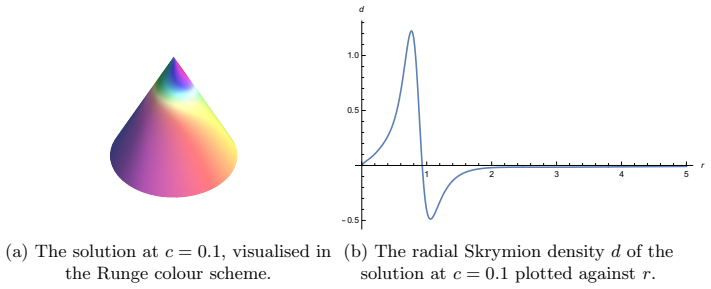
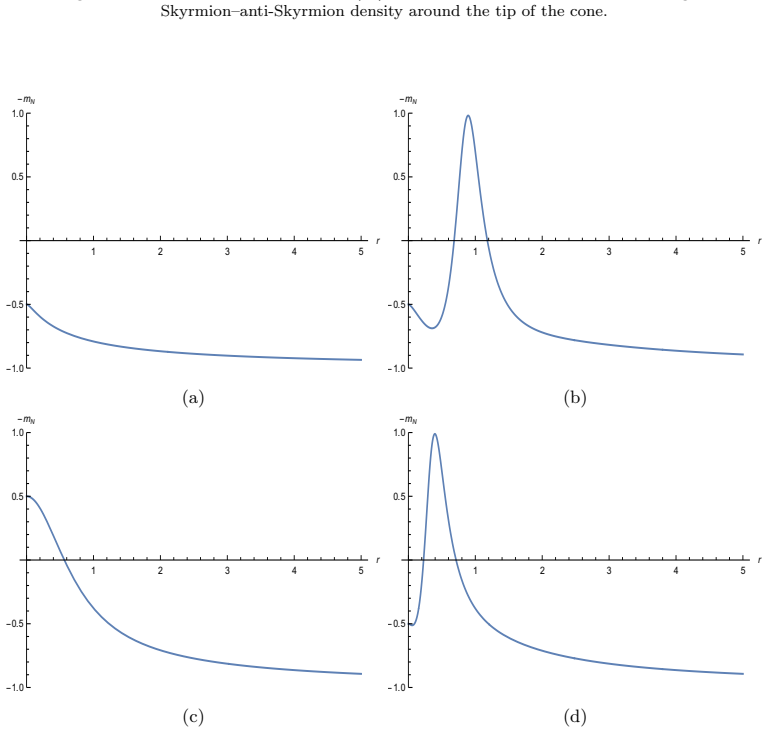
- Curvature pins Skyrmion-anti-Skyrmion density: the exact cone solutions describe a ring of such density around the tip, and the sphere solutions include a degree-zero vacuum and the degree-one hedgehog.
Reading between the lines
- Because the existence proof never uses the particular form of the torsional connection, a likely corollary is that any translation-invariant chiral connection on $\mathbb{R}^3$ gives BPS Skyrmion solutions on compact films, not just the spiral staircase.
- The infinite-energy cone solutions suggest a finite-energy analogue on smooth asymptotically flat bumps; one testable prediction is that the ring of Skyrmion-anti-Skyrmion density sits near the region of largest curvature gradient rather than exactly at the tip.
- If the conjectured isomorphism between dissolving-vortex and finite-coupling vortex moduli spaces holds, vortex quantum corrections computed at small $e^2$ would give a controlled expansion around the Skyrmion theory; this could be tested numerically on $S^2$ for small $N$.
- The cylinder result points to a nanowire experiment: a BPS wire of radius $R$ should host kink Skyrmions whose formation energy scales like $\sqrt{R}$, a scaling signature distinguishable from non-BPS models.
Signed reviews
Editorial analysis
A structured set of objections, weighed in public.
Referee Report
Summary. The paper generalizes the critically coupled BPS model of magnetic Skyrmions to curved thin films embedded in R^3. It derives the Bogomolny equation for the model, interprets solutions as holomorphic sections of a projective line bundle over the film, and claims an existence theorem for Skyrmion solutions on arbitrary compact films. It then gives explicit solutions on round spherical, conical, and cylindrical films, with the cylinder solutions interpreted as kinks between two vacua. The final part proposes a resolution of the singular Skyrmion moduli space via a moduli space of semi-local vortices in a background gauge field, constructed in a 'dissolving vortex' limit as a projective bundle over the Picard variety. An appendix recasts the BPS energy bound in equivariant cohomology.
Significance. The local BPS rearrangement and the exact solutions on the sphere and cylinder are the strongest parts of the paper; they are concrete, seemingly correct, and of genuine interest for the study of Skyrmions on curved films. The equivariant-cohomology interpretation of the topological energy is also a useful conceptual clarification. If the moduli-space resolution were established, it would be a substantial contribution connecting Skyrmion moduli to vortex moduli. However, the advertised global results are not yet fully supported: the existence proof in Section 2.4 lacks degree control, and the resolved-moduli construction in Section 4.2 rests on an explicitly unproven isomorphism. These are load-bearing gaps rather than cosmetic issues.
major comments (4)
- [2.4, Proposition 2.4.1] The proof is incomplete as written. Serre vanishing gives a non-zero holomorphic section of E tensor N for N of sufficiently high degree, hence a holomorphic line sub-bundle of E tensor N, but the passage from this line sub-bundle to a Skyrmion solution of every sufficiently large degree is not shown. The Skyrmion number is determined by the degree of the resulting section, and the written argument does not control that degree; zeros of the section can shift the topological degree. The proposition asserts existence for all N greater than or equal to N0, so an argument producing sections with prescribed degree is needed, for example via global generation or by constructing sections with controlled zeros. Without this step, the existence claim for arbitrary high Skyrmion number is not established.
- [4.2, dissolving vortex limit] The resolution of the singular Skyrmion moduli space depends on the sentence 'We expect that, as a complex manifold, the moduli space of dissolving vortices is isomorphic to the moduli space of vortices at positive e^2.' This is an explicit unproven assumption, and it is load-bearing: the projective-bundle construction over Pic^N(Σ) is then presented as the finite-coupling vortex moduli space and as a resolution of the Skyrmion moduli space. If the isomorphism fails, the geometric resolution is unsupported. The paper should either prove this isomorphism (or give a precise citation covering the present case with background connection A) or formulate the result as a conjecture and adjust the abstract and conclusions accordingly.
- [3.2, cone solutions] The exact cone solutions in Eq. (26) are not finite-energy field configurations. The paper itself states that the solutions do not tend to the normal fast enough and that there is an infinite contribution from the integrated vorticity. Yet the abstract lists 'exact Skyrmion solutions on spherical, conical and cylindrical thin films' without this caveat. Under the standard definition of a Skyrmion as a finite-energy configuration, these are formal solutions of the Bogomolny equation rather than Skyrmions. The removal of the integrated vorticity contribution, attributed to [5], must either be justified mathematically or the claims must be explicitly limited to formal/local solutions.
- [4.1 and 4.2, dimension computation] The expected complex dimension of the Skyrmion moduli space and of the vortex moduli space is quoted from an 'index theory argument' and a Riemann–Roch calculation, but no computation is shown. Since the dimension formula 2N + 1 - g is used to identify the resolving space and to compare it with the Skyrmion moduli space, the derivation should be included or a precise reference should be given so that the equality of dimensions is verifiable.
minor comments (5)
- [Throughout] There are several typos: 'funadamental' appears in the introduction, and 'Skrymion' appears in the caption of Figure 2; these should be corrected.
- [Appendix A, Eq. (A.2)] The notation F(A) is used both for the background connection and for the field strength appearing in the general Bogomolny rearrangement; the distinction between background and dynamical gauge fields should be made explicit to avoid confusion.
- [2.3] The statement that the integrated vorticity contribution 'has been argued in [5] and elsewhere that it should be removed' is not a derivation. If this removal is used later to give cone solutions finite energy, the precise regularization or boundary-condition prescription should be stated, even if only heuristically.
- [3.3] In Eq. (28), the asymptotic constants h± involve a square root of a complex number; a short remark on the chosen branch would improve reproducibility of the plots and of the energy computations.
- [References] The paper relies on [5,6] for the flat-plane BPS rearrangement and for the critical potential. It would be helpful to state explicitly which formulas are taken from those references and which are new in the curved-film setting.
Circularity Check
No significant circularity found; the model is defined independently of its outputs, and the cited prior work is external support rather than a self-citation chain.
full rationale
I find no significant circularity. The model is defined by the critical potential (13) and the energy functional (14), and the main results—the Bogomolny equation (18), existence Proposition 2.4.1, the exact sphere/cone/cylinder solutions, and the moduli-space construction—are derived consequences of that model rather than assumptions baked into its definition. The paper does rely on prior work [5,6] for the flat-plane BPS rearrangement and the local solvability statement, but those are external, independently published supports, not self-citations by the present author, and the curved-film generalisations are genuine new outputs. The two substantive weaknesses flagged by the reader are mathematical gaps rather than circular reductions: Proposition 2.4.1 cites Serre vanishing to obtain a holomorphic line sub-bundle and hence a section of P(E), but does not explicitly control the Skyrmion number of the resulting section, so the claim that every sufficiently large integer N is attained is under-supported; and Section 4.2 states, 'We expect that, as a complex manifold, the moduli space of dissolving vortices is isomorphic to the moduli space of vortices at positive e^2,' an unproven isomorphism on which the resolution construction depends. Neither step defines its conclusion into its hypotheses or renames a fitted parameter as a prediction, so these are correctness risks, not circularity. No self-definitional, fitted-input-as-prediction, or self-citation-load-bearing pattern is present.
Assumptions & free parameters
assumptions (5)
- domain assumption The DM interaction in a thin film can be modelled by an SO(3) connection with torsion on R^3, pulled back to the film.
- domain assumption The critical potential Vcrit = -2 kappa^2 m_N is chosen to make the theory BPS.
- standard math Serre vanishing gives H^0(E tensor N) non-empty for N of sufficiently high degree on a compact Riemann surface, and every holomorphic projective bundle is the projectivisation of a rank-2 vector bundle.
- ad hoc to paper The moduli space of dissolving vortices is isomorphic to the vortex moduli space at finite coupling and resolves the Skyrmion moduli space.
- ad hoc to paper The integrated vorticity contribution may be removed so that cone solutions have finite energy.
Cite this review
Pith. "Pith review of On the geometry of magnetic Skyrmions on thin films." pith.science (2026). https://pith.science/paper/QLA5CYSE
@misc{pith2026190808428,
  author       = {Pith},
  title        = {Pith review of: On the geometry of magnetic Skyrmions on thin films},
  year         = {2026},
  howpublished = {\url{https://pith.science/paper/QLA5CYSE}},
  note         = {Machine review of arXiv:1908.08428}
}
read the original abstract
We study the recently introduced 'critically coupled' model of magnetic Skyrmions, generalising it to thin films with curved geometry. The model feels keenly the extrinsic geometry of the film in three-dimensional space. We find exact Skyrmion solutions on spherical, conical and cylindrical thin films. Axially symmetric solutions on cylindrical films are described by kinks tunnelling between 'vacua'. For the model defined on general compact thin films, we prove the existence of energy minimising multi-Skyrmion solutions and construct the (resolved) moduli space of these solutions.
Figures

Figures from the paper (1 more)

Reference graph
Works this paper leans on
-
[5]
B. Barton-Singer, C. Ross, B. J. Schroers, Magnetic Skyrmions at Critical Coupling, Com- mun. Math. Phys. (online). (2020). doi:10.1007/s00220-019-03676-1
-
[1]
A. M. Polyakov, A. A. Belavin, Metastable States of Two-Dimensional Isotropic Ferromag- nets, JETP Lett. 22 (1975) 245–248
work page 1975
-
[2]
A. Bogdanov, A. Hubert, Thermodynamically stable magnetic vortex states in magnetic crystals, J. Magn. Magn. Mater. 138 (3) (1994) 255–269. doi:10.1016/0304-8853(94) 90046-9
-
[3]
S. M¨ uhlbauer, B. Binz, F. Jonietz, C. Pfleiderer, A. Rosch, A. Neubauer, R. Georgii, P. B¨ oni, Skyrmion lattice in a chiral magnet, Science 323 (5916) (2009) 915–919. doi:10.1126/ science.1166767. 26
work page 2009
-
[4]
X. Yu, Y. Onose, N. Kanazawa, J. Park, J. Han, Y. Matsui, N. Nagaosa, Y. Tokura, Real- space observation of a two-dimensional Skyrmion crystal, Nature 465 (7300) (2010) 901. doi:10.1038/nature09124
-
[6]
B. J. Schroers, Gauged Sigma Models and Magnetic Skyrmions, SciPost Phys. 7 (2019) 30. doi:10.21468/SciPostPhys.7.3.030
-
[7]
M. Hongo, T. Fujimori, T. Misumi, M. Nitta, N. Sakai, Instantons in chiral magnets, Phys. Rev. B 101 (2020) 104417. doi:10.1103/PhysRevB.101.104417
-
[8]
Y. Gaididei, V. P. Kravchuk, D. D. Sheka, Curvature effects in thin magnetic shells, Phys. Rev. Lett. 112 (2014) 257203. doi:10.1103/PhysRevLett.112.257203
Show all 19 references
-
[9]
Streubel, P
R. Streubel, P. Fischer, F. Kronast, V. P. Kravchuk, D. D. Sheka, Y. Gaididei, O. G. Schmidt, D. Makarov, Magnetism in curved geometries, J. Phys. D 49 (36) (2016) 363001. doi:10.1088/0022-3727/49/36/363001
2016 doi
-
[10]
V. P. Kravchuk, D. D. Sheka, A. K´ akay, O. M. Volkov, U. K. R¨ oßler, J. van den Brink, D. Makarov, Y. Gaididei, Multiplet of Skyrmion states on a curvilinear defect: Reconfig- urable Skyrmion lattices, Phys. Rev. Lett. 120 (2018) 067201. doi:10.1103/PhysRevLett. 120.067201
2018 doi
-
[11]
L. Hsu, R. Kusner, J. Sullivan, Minimizing the squared mean curvature integral for surfaces in space forms, Exp. Math. 1 (3) (1992) 191–207. doi:10.1080/10586458.1992.10504258
1992
-
[12]
Milde, D
P. Milde, D. K¨ ohler, J. Seidel, L. M. Eng, A. Bauer, A. Chacon, J. Kindervater, S. M¨ uhlbauer, C. Pfleiderer, S. Buhrandt, C. Sch¨ utte, A. Rosch, Unwinding of a Skyrmion lattice by magnetic monopoles, Science 340 (6136) (2013) 1076–1080. doi:10.1126/ science.1234657
2013
-
[13]
Kanazawa, Y
N. Kanazawa, Y. Nii, X. -X. Zhang, A. S. Mishchenko, G. De Filippis, F. Kagawa, Y. Iwasa, N. Nagaosa, Y. Tokura, Critical phenomena of emergent magnetic monopoles in a chiral magnet, Nat. Comm. 7 (2016) 11622. doi:https://doi.org/10.1038/ncomms1162210. 1038/ncomms11622
2016 doi
-
[14]
Wehrheim, Vortex invariants and toric manifolds
J. Wehrheim, Vortex invariants and toric manifolds. (2008). arXiv:0812.0299
2008 arXiv
-
[15]
J. M. Baptista, N. S. Manton, The dynamics of vortices on S2 near the Bradlow limit, J. Math. Phys. 44 (8) (2003) 3495–3508. doi:10.1063/1.1584526
2003 doi
-
[16]
Rold´ an-Molina, M
A. Rold´ an-Molina, M. J. Santander, A. S. Nunez, J. Fern´ andez-Rossier, Quantum fluctua- tions stabilize skyrmion textures, Phys. Rev. B 92 (2015) 245436. doi:10.1103/PhysRevB. 92.245436
2015 doi
-
[17]
Psaroudaki, S
C. Psaroudaki, S. Hoffman, J. Klinovaja, D. Loss, Quantum dynamics of skyrmions in chiral magnets, Phys. Rev. X 7 (2017) 041045. doi:10.1103/PhysRevX.7.041045
2017 doi
-
[18]
M. F. Atiyah, R. Bott, The moment map and equivariant cohomology, Topology 23 (1) (1984) 1–28. doi:10.1016/0040-9383(84)90021-1
1984 doi
-
[19]
Cieliebak, A
K. Cieliebak, A. R. Gaio, D. A. Salamon, J-holomorphic curves, moment maps, and invari- ants of Hamiltonian group actions, Internat. Math. Res. Notices 10 (16) (2000) 831–882. doi:10.1155/S1073792800000453. 27
2000 doi
Reviewed August 14, 2026 · model on record in the stance chip above.
Discussion (0). Continue with ORCID to comment.