REVIEW 3 major objections 5 minor 55 references
All-microwave holonomic control of an electron-nuclear two-qubit register in diamond
T0 review · 3 major / 5 minor · reviewed 2026-08-14 · deepseek-v4-flash
Pith's one-line read A tilted magnetic field lets microwaves alone run two-qubit gates in diamond.
desk verdict Neat idea, but the model omits the 14N spectator spin, whose hyperfine splittings are comparable to the proposed Rabi frequencies, so the gate claims are not yet supported. read the letter →
The pith
A machine-rendered reading of the paper's core claim, the machinery that carries it, and where it could break.
The reading
What carries the argument
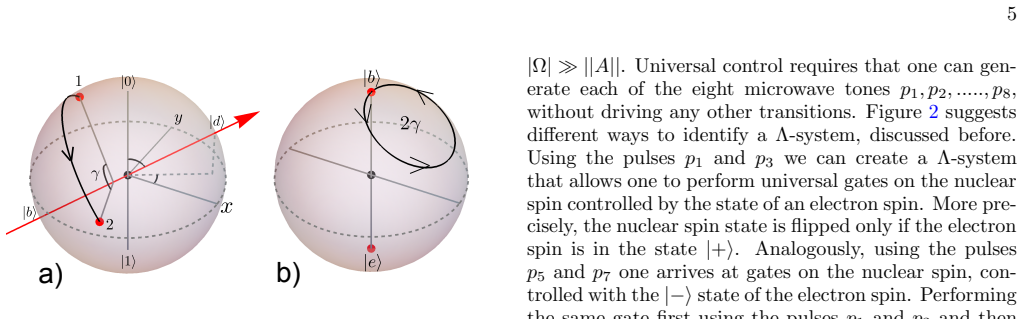
The load-bearing object is the electron-state-dependent Knight field $h^e_j = \sum_i A_{ij} \langle e| \hat S_i |e\rangle$ for $e\in\{+,-,1\}$, which encodes how the hyperfine tensor $A_{ij}$ acts on the nuclear spin in each electronic subspace when the electron states are mixed by a transverse magnetic field. Because the resulting vectors $\vec h^+$, $\vec h^-$ and $\vec h^1$ point in different directions, the nuclear quantization axis is electron-dependent, so microwaves can drive transitions between all six levels. On top of this, the control mechanism is the nonadiabatic holonomic Λ-system: two microwave tones couple a logical basis to a common excited level with a common detuning $\Delta$, generating a rotation by $\gamma = \pi - \pi\Delta/\sqrt{\Delta^2 + 4u^2}$ about an axis set by the relative amplitudes and phases. The paper also carries the error analysis with a generalized average-fidelity formula for trace-non-preserving maps, $F = (dF_e + \mathrm{Tr}(\mathcal E(\mathbb{1}/d)))/(d+1)$, which accounts for leakage out of the logical space.
What would settle it
Apply one of the proposed CNOT pulse protocols to a single NV–13C register while deliberately detuning the microwave frequency by an amount $\delta$ and measure the average gate fidelity; if the fidelity drop deviates from the quadratic dependence on $\delta$ predicted by the Λ-system model, or if the measured frequency separation between the two closest resonances differs from the calculated 36 MHz, the operating-regime assumptions fail.
Extended reading notes
Core claim
The central claim is that universal holonomic single- and two-qubit control of the NV electron–13C nuclear register can be achieved with microwave radiation alone. In the operating regime $B_z = D_{\mathrm{gs}}/\gamma_e$ and $|\Omega| \gg \|A\|$, the transverse field $B_\perp$ mixes $|0\rangle$ and $|-1\rangle$ into $|+\rangle$ and $|-\rangle$; the hyperfine interaction then acts on the nuclear spin as a Knight field $\vec h^e$ whose direction depends on the electron level $e$. Because the quantization axis of the 13C spin is different for $|+\rangle$, $|-\rangle$ and $|1\rangle$, every hyperfine transition can be addressed by a microwave field perpendicular to the NV axis. The paper constructs eight pulse protocols $p_1,\ldots,p_8$ that couple the four lower hyperfine states to the two upper states, and shows that pairwise combinations produce Λ systems whose bright and dark states give universal single-qubit rotations; two-qubit gates such as CPHASE follow from resonant pulses, for example $p_8$ applied for a time $\pi/|p_8|$. The phase acquired in each gate is geometric, since the ground-state subspace stays at zero energy expectation, and the paper evaluates gate robustness against detuning and amplitude noise, finding a lower-bound average fidelity near 0.976.
Load-bearing premise
The scheme's gates work only if the microwave frequencies and phases can be locked precisely enough for the rotating-wave picture to hold and for each tone to address its own transition without exciting the nearest neighbour; if frequency or phase errors exceed the assumed sub-MHz level, the geometric phase and the gate fidelity degrade.
Editorial extensions
If this is right
- Universal holonomic computation on the NV–13C register becomes possible with submicrosecond, microwave-only gates, avoiding the slower radio-frequency drives normally needed for nuclear spins.
- Because the same mechanism works for more distant 13C nuclei and for the nitrogen nuclear spin, the two-qubit register can be extended toward multi-qubit control in the same physical device.
- The leakage-aware fidelity formula makes the expected performance of any holonomic gate with leakage computable from just two simulations, one on an entangled state and one on the maximally mixed state.
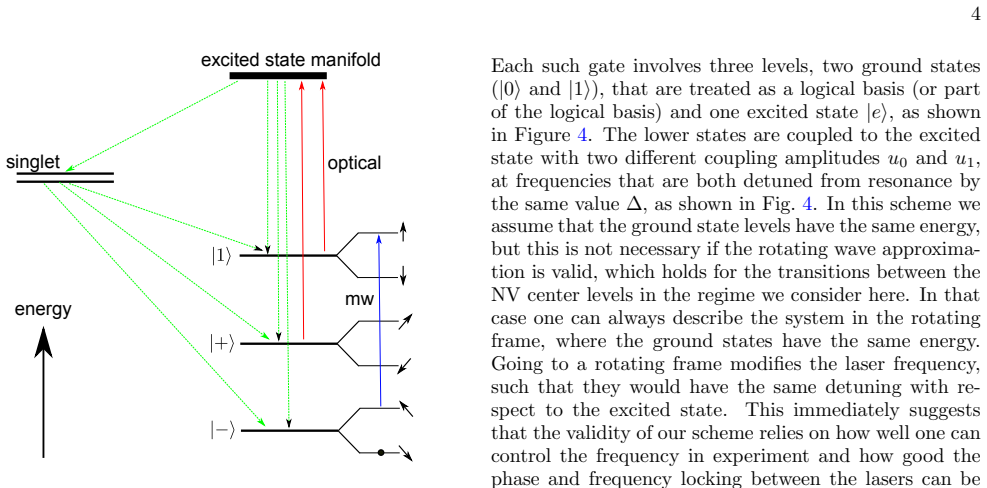
- Initialization and readout based on coherent population trapping reach about 97–98% fidelity in 100 µs, giving a complete protocol from state preparation through gate operation to measurement.
Reading between the lines
- The 28 ns inverse-frequency-separation limit suggests that pushing gate times well below 285 ns would require either larger hyperfine couplings or shaped pulses; the paper does not investigate that trade-off.
- A direct experimental test of the noise model would be to measure the CNOT fidelity while sweeping a controlled detuning offset; the paper predicts a quadratic drop with a width set by $\sigma = 0.131$ MHz, and a different scaling would indicate a missing error channel.
- The paper's neglect of Markovian noise relies on $T_1$ and $T_2$ being much longer than the 285 ns gate time; for NV centers with shorter coherence, that approximation would break down before the quoted fidelity applies.
Signed reviews
Editorial analysis
A structured set of objections, weighed in public.
Referee Report
Summary. The paper presents a theoretical scheme for universal holonomic quantum control of a two-qubit register formed by the electron spin of an NV center and a nearby 13C nuclear spin, using microwave pulses only. The key idea is to apply a transverse magnetic field that mixes the electronic |0> and |-1> states, so that the nuclear quantization axis becomes electron-state dependent and all hyperfine transitions become microwave-allowed. The authors derive an effective Hamiltonian to second order, introduce eight pulse protocols that realize Lambda systems, discuss initialization and readout via coherent population trapping, and numerically estimate gate fidelities under detuning and coupling noise. They report submicrosecond gate times and an estimated average gate fidelity around 0.976 under realistic noise.
Significance. If the proposed scheme is correct, it offers a potentially valuable all-microwave route to fast universal control of an electron-nuclear NV register, avoiding radio-frequency control of the nuclear spin. The paper contains several commendable elements: a careful second-order Schrieffer-Wolff effective Hamiltonian derivation in Appendix A, a full Lindblad simulation of the initialization protocol in Appendix B, and an explicit proof of a generalized average-fidelity formula for trace-non-preserving maps in Appendix C. The parameter estimates are grounded in established hyperfine and noise data. However, the central claim depends on the model including all relevant physical degrees of freedom of the NV center, and on the consistency of the quoted gate times and fidelity estimates.
major comments (3)
- [Section II and Section IV; Eq. (21)] The model Hamiltonian in Eq. (1) and the gate-fidelity simulations in Section IV omit the 14N nuclear spin of the NV center. The authors themselves list its hyperfine constants in Eq. (21), A_|| = -2.16 MHz and A_⊥ = -2.6 MHz. In the mixed basis used here, these constants produce state-dependent Knight fields on the 14N of order 2-3 MHz, which is comparable to the assumed 2.5 MHz microwave coupling amplitudes and to the inverse gate time of roughly 3.5 MHz. The actual physical system therefore contains three 14N sublevels per electronic state, and the Lambda-system Hamiltonian (10) and the eight pulse protocols in Fig. 2 do not, as written, describe the full driven dynamics. If the 14N state is not addressed or refocused, the gates may entangle the logical register with this spectator spin. The authors should either include the 14N spin explicitly in the numerical model and fidelity estimates, or prove that the proposed protocols act as the identity on the 14N subspace. Without this, the claim of universal control of the electron-13C two-qubit register is not established for a real NV center.
- [Section IV, Eqs. (13)-(14)] The quoted gate operation time is inconsistent with the stated coupling strength. The paper says that assuming each Lambda-system coupling to be 2.5 MHz yields a gate time of approximately 285 ns. However, Eq. (13) with t = π/ω and zero detuning gives t = π/u, which for u = 2.5 MHz is about 1.26 microseconds; even taking u = sqrt(2)*2.5 MHz for two equal couplings gives about 0.89 microseconds. A gate time of 285 ns corresponds to an effective u of roughly 11 MHz. The authors should clarify whether their amplitudes are angular frequencies or Rabi frequencies, and reconcile the gate time, because the fidelity estimates and the comparison with the 696 ns optimal-control gates of Ref. [35] depend sensitively on this timing.
- [Section IV, paragraph containing Eq. (20)] The overall gate infidelity of 0.019 and the resulting 'lower bound' of 0.976 are obtained by assuming additivity of separately computed infidelities from detuning fluctuations, coupling fluctuations, and |+>-|-> energy fluctuations. Additivity is an assumption, not a proven lower bound: the different error sources are not simultaneously simulated, and the average fidelity is a nonlinear functional of the quantum channel. The authors should either present a combined simulation in which all noise sources act together, or justify the additivity assumption more rigorously. As written, the robustness claim is weaker than the phrase 'lower bound' suggests.
minor comments (5)
- [Section III vs. Appendix B] The main text states that initialization reaches a fidelity of 98%, while Appendix B reports a probability of 97% for the same 100 microsecond procedure; these numbers should be reconciled.
- [Section IV] The text repeatedly refers to 'lasers' and 'laser locking' in the context of microwave drives; the scheme is all-microwave, so the wording should be changed to microwave sources and phase/frequency locking of microwave tones.
- [Figure 5 caption] The caption contains the typo 'Geometrix phase' and should read 'Geometric phase'.
- [Appendix A] The transformation is called 'Schrieffer-Wolf' but the standard name is 'Schrieffer-Wolff'; also, Section IV contains the typo 'preform' instead of 'perform'.
- [Section IV] The numerical simulations of gate fidelity are described only verbally; the authors should specify the Hamiltonian, pulse shapes, integration method, and convergence criteria used to obtain the reported 0.995, 0.985, and 0.976 values, so that the results are reproducible.
Circularity Check
No circular derivation: the scheme's inputs are external hyperfine and noise parameters, and the geometric-gate result is derived from a standard Lambda-system Hamiltonian.
full rationale
The paper's central derivation is self-contained against external inputs. The Hamiltonian in Eq. (1) uses hyperfine tensor values explicitly 'taken from [31]', and the noise distributions used for the fidelity estimate are taken from Ref. [35]; neither is fitted to reproduce the claimed gate fidelities or universal gate set. The operating parameters (B_perp, the 2.5 MHz couplings, and the 285 ns gate time) are stated regime choices, not parameters extracted from the target outputs. The holonomic gate construction in Eqs. (10)-(15) is a direct derivation from the Lambda-system Hamiltonian and the standard geometric-phase result, with no imported uniqueness theorem or ansatz that itself presupposes the conclusion. The self-citations present (Refs. [6], [14], [20], [51]) are either contextual examples of geometric gates, general statements about NV coupling challenges, or empirical parameter sources; none carries a load-bearing derivational step. The Discussion's note that for more distant carbon nuclei 'one also has to include the nitrogen nuclear spin into consideration' identifies a physical completeness limitation regarding the omitted 14N spectator spin, but this is a modeling-fidelity concern, not a circularity of the kind defined in this analysis. No equation reduces to its own input, no prediction is a renamed fit, and no load-bearing claim is justified only by a self-citation.
Assumptions & free parameters
free parameters (5)
- Transverse magnetic field B_perp =
500 G
- Microwave coupling amplitude u =
2.5 MHz
- Noise scaling factor for detuning fluctuations =
1.5
- Noise scaling factor for transverse field fluctuations =
sqrt(2)
- Optical and microwave Rabi frequencies for initialization =
Omega_o = 25 MHz, Omega_mw = 10 MHz
assumptions (5)
- domain assumption The Schrieffer-Wolff effective Hamiltonian (A10) is valid to second order under |Omega| << 2Dgs and ||A_ij|| << 2|Omega|.
- domain assumption The nuclear spin Zeeman splitting is negligible compared to hyperfine splitting.
- domain assumption The 13C bath noise is described by the distributions measured in Ref. [35], with sigma = 0.131 MHz and gamma = 0.0024 MHz, scaled by 1.5 and sqrt(2).
- domain assumption Rotating-wave approximation and precise frequency and phase locking of the microwave drives are valid.
- domain assumption Markovian relaxation channels (T1, T2) can be neglected during the 285 ns gates.
Cite this review
Pith. "Pith review of All-microwave holonomic control of an electron-nuclear two-qubit register in diamond." pith.science (2026). https://pith.science/paper/ZIJPRQGI
@misc{pith2026190808443,
  author       = {Pith},
  title        = {Pith review of: All-microwave holonomic control of an electron-nuclear two-qubit register in diamond},
  year         = {2026},
  howpublished = {\url{https://pith.science/paper/ZIJPRQGI}},
  note         = {Machine review of arXiv:1908.08443}
}
abstract
We present a theoretical scheme that allows to perform a universal set of holonomic gates on a two qubit register, formed by a $^{13}$C nuclear spin coupled to the electron spin of a nitrogen-vacancy center in diamond. Strong hyperfine interaction between the electron spin and the spins of the first three shells of $^{13}$C atoms allows to operate the state of the register on the submicrosecond timescale using microwave pulses only. We describe the system and the operating regime analytically and numerically, as well as simulate the initialization protocols.
Figures


Figures from the paper (2 more)
Reference graph
Works this paper leans on
- [35]
-
[1]
J. R. Maze, A. Gali, E. Togan, Y. Chu, A. Trifonov, E. Kaxiras, and M. D. Lukin, New Journal of Physics 13, 025025 (2011)
work page 2011
-
[2]
Now we add the hyper- fine interaction ˆHhf to the system. Assuming||A||≪| Ω|, we can restrict our analysis to the secular terms of the hyperfine interaction, that do not flip the electron spin. Then for each electronic level we can describe the hyper- fine interaction in terms of the Knight field hj, acting on the nuclear spin Ij, ˆ˜Hhf = ∑ e={+,−,1} ∑ j={x,y...
-
[3]
Jelezko, T
F. Jelezko, T. Gaebel, I. Popa, A. Gruber, and J. Wrachtrup, Phys. Rev. Lett. 92, 076401 (2004)
2004
-
[4]
M. S. J. Barson, P. Peddibhotla, P. Ovartchaiyapong, K. Ganesan, R. L. Taylor, M. Gebert, Z. Mielens, B. Koslowski, D. A. Simpson, L. P. McGuinness, J. Mc- Callum, S. Prawer, S. Onoda, T. Ohshima, A. C. Bleszynski Jayich, F. Jelezko, N. B. Manson, and M. W. Doherty, Nano Letters 17, 1496 (2017)
work page 2017
-
[5]
M. W. Doherty, N. B. Manson, P. Delaney, F. Jelezko, J. Wrachtrup, and L. C. Hollenberg, Physics Reports 528, 1 (2013)
2013
-
[6]
P. Udvarhelyi, V. O. Shkolnikov, A. Gali, G. Burkard, and A. P´ alyi, Phys. Rev. B98, 075201 (2018)
work page 2018
-
[7]
Balasubramanian, I
G. Balasubramanian, I. Y. Chan, R. Kolesov, M. Al- Hmoud, J. Tisler, C. Shin, C. Kim, A. Wojcik, P. R. Hem- mer, A. Krueger, T. Hanke, A. Leitenstorfer, R. Brats- chitsch, F. Jelezko, and J. Wrachtrup, Nature 455, 648 (2008)
2008
Show all 55 references
-
[8]
M. W. Doherty, F. Dolde, H. Fedder, F. Jelezko, J. Wrachtrup, N. B. Manson, and L. C. L. Hollenberg, 11 Phys. Rev. B 85, 205203 (2012)
2012
-
[9]
Barfuss, J
A. Barfuss, J. Teissier, E. Neu, A. Nunnenkamp, and P. Maletinsky, Nature Physics 11, 820 (2015)
2015
-
[10]
Mizuochi, P
N. Mizuochi, P. Neumann, F. Rempp, J. Beck, V. Jacques, P. Siyushev, K. Nakamura, D. J. Twitchen, H. Watanabe, S. Yamasaki, F. Jelezko, and J. Wrachtrup, Phys. Rev. B 80, 041201 (2009)
2009
-
[11]
J. R. Maze, P. L. Stanwix, J. S. Hodges, S. Hong, J. M. Taylor, P. Cappellaro, L. Jiang, M. V. G. Dutt, E. Togan, A. S. Zibrov, A. Yacoby, R. L. Walsworth, and M. D. Lukin, Nature 455, 644 (2008)
2008
-
[12]
Togan, Y
E. Togan, Y. Chu, A. S. Trifonov, L. Jiang, J. Maze, L. Childress, M. V. G. Dutt, A. S. Sørensen, P. R. Hem- mer, A. S. Zibrov, and M. D. Lukin, Nature 466, 730 (2010)
2010
-
[13]
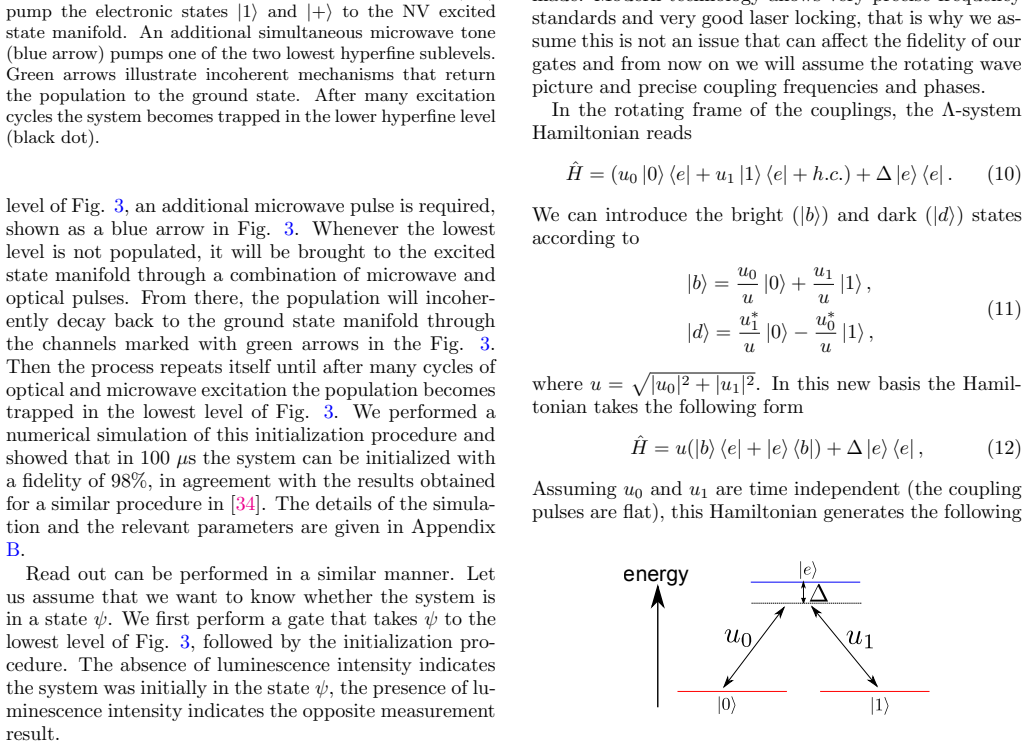
using the setup described in the previous sections. Each such gate involves three levels, two ground states (|0⟩ and|1⟩), that are treated as a logical basis (or part of the logical basis) and one excited state |e⟩, as shown in Figure 4. The lower states are coupled to the exc...
-
[14]
Hensen, H
B. Hensen, H. Bernien, A. E. Dr´ eau, A. Reiserer, N. Kalb, M. S. Blok, J. Ruitenberg, R. F. L. Vermeulen, R. N. Schouten, C. Abell´ an, W. Amaya, V. Pruneri, M. W. Mitchell, M. Markham, D. J. Twitchen, D. Elkouss, S. Wehner, T. H. Taminiau, and R. Hanson, Nature 526, 682 (2015)
2015
-
[15]
Sekiguchi, N
Y. Sekiguchi, N. Niikura, R. Kuroiwa, H. Kano, and H. Kosaka, Nature Photonics 11, 309 (2017)
2017
-
[16]
Sj¨ oqvist, Physics Letters A380, 65 (2016)
E. Sj¨ oqvist, Physics Letters A380, 65 (2016)
2016
-
[17]
B. B. Zhou, P. C. Jerger, V. O. Shkolnikov, F. J. Here- mans, G. Burkard, and D. D. Awschalom, Phys. Rev. Lett. 119, 140503 (2017)
2017
-
[18]
Dolde, I
F. Dolde, I. Jakobi, B. Naydenov, N. Zhao, S. Pezzagna, C. Trautmann, J. Meijer, P. Neumann, F. Jelezko, and J. Wrachtrup, Nature Physics 9, 139 (2013)
2013
-
[19]
Zu, W.-B
C. Zu, W.-B. Wang, L. He, W.-G. Zhang, C.-Y. Dai, F. Wang, and L.-M. Duan, Nature 514, 72 (2014)
2014
-
[20]
Arroyo-Camejo, A
S. Arroyo-Camejo, A. Lazariev, S. W. Hell, and G. Bal- asubramanian, Nature Communications 5, 4870 (2014)
2014
-
[21]
Childress, M
L. Childress, M. V. Gurudev Dutt, J. M. Taylor, A. S. Zibrov, F. Jelezko, J. Wrachtrup, P. R. Hemmer, and M. D. Lukin, Science 314, 281 (2006)
2006
-
[22]
W. Pfaff, T. H. Taminiau, L. Robledo, H. Bernien, M. Markham, D. J. Twitchen, and R. Hanson, Nature Physics 9, 29 (2012)
2012
-
[23]
Burkard, V
G. Burkard, V. O. Shkolnikov, and D. D. Awschalom, Phys. Rev. B 95, 205420 (2017)
2017
-
[24]
Waldherr, Y
G. Waldherr, Y. Wang, S. Zaiser, M. Jamali, T. Schulte- Herbr¨ uggen, H. Abe, T. Ohshima, J. Isoya, J. F. Du, P. Neumann, and J. Wrachtrup, Nature 506, 204 (2014)
2014
-
[25]
M. V. G. Dutt, L. Childress, L. Jiang, E. Togan, J. Maze, F. Jelezko, A. S. Zibrov, P. R. Hemmer, and M. D. Lukin, Science 316, 1312 (2007)
2007
-
[26]
Neumann, N
P. Neumann, N. Mizuochi, F. Rempp, P. Hemmer, H. Watanabe, S. Yamasaki, V. Jacques, T. Gaebel, F. Jelezko, and J. Wrachtrup, Science 320, 1326 (2008)
2008
-
[27]
Jiang, J
L. Jiang, J. M. Taylor, A. S. Sørensen, and M. D. Lukin, Phys. Rev. A 76, 062323 (2007)
2007
-
[28]
S. Yang, Y. Wang, D. D. B. Rao, T. Hien Tran, A. S. Momenzadeh, M. Markham, D. J. Twitchen, P. Wang, W. Yang, R. St¨ ohr, P. Neumann, H. Kosaka, and J. Wrachtrup, Nature Photonics 10, 507 (2016)
2016
-
[29]
P. C. Maurer, G. Kucsko, C. Latta, L. Jiang, N. Y. Yao, S. D. Bennett, F. Pastawski, D. Hunger, N. Chisholm, M. Markham, D. J. Twitchen, J. I. Cirac, and M. D. Lukin, Science 336, 1283 (2012)
2012
-
[30]
Cappellaro, L
P. Cappellaro, L. Jiang, J. S. Hodges, and M. D. Lukin, Phys. Rev. Lett. 102, 210502 (2009)
2009
-
[31]
Zaiser, T
S. Zaiser, T. Rendler, I. Jakobi, T. Wolf, S.-Y. Lee, S. Wagner, V. Bergholm, T. Schulte-Herbr¨ uggen, P. Neu- mann, and J. Wrachtrup, Nature Communications 7, 12279 (2016)
2016
-
[32]
Jelezko, T
F. Jelezko, T. Gaebel, I. Popa, M. Domhan, A. Gruber, and J. Wrachtrup, Phys. Rev. Lett. 93, 130501 (2004)
2004
-
[33]
and resembles the scheme used in Ref. [34]. Figure 3 shows the procedure. Here the excited state manifold consists of an orbital doublet, spin triplet and a hyper- fine doublet, thus forming a twelve-dimensional space. The exact Hamiltonian, governing the dynamics of the excite...
-
[34]
Gali, Phys
A. Gali, Phys. Rev. B 80, 241204 (2009)
2009
-
[36]
Fleischhauer, A
M. Fleischhauer, A. Imamoglu, and J. P. Marangos, Rev. Mod. Phys. 77, 633 (2005)
2005
-
[37]
Robledo, L
L. Robledo, L. Childress, H. Bernien, B. Hensen, P. F. A. Alkemade, and R. Hanson, Nature 477, 574 (2011)
2011
-
[38]
X. Rong, J. Geng, F. Shi, Y. Liu, K. Xu, W. Ma, F. Kong, Z. Jiang, Y. Wu, and J. Du, Nature Communications 6, 8748 (2015)
2015
-
[39]
Horodecki, P
M. Horodecki, P. Horodecki, and R. Horodecki, Phys. Rev. A 60, 1888 (1999)
1999
-
[40]
M. A. Nielsen, Physics Letters A 303, 249 (2002)
2002
-
[41]
J. T. Thomas, M. Lababidi, and M. Tian, Phys. Rev. A 84, 042335 (2011)
2011
-
[42]
Johansson, E
M. Johansson, E. Sj¨ oqvist, L. M. Andersson, M. Ericsson, B. Hessmo, K. Singh, and D. M. Tong, Phys. Rev. A 86, 062322 (2012)
2012
-
[43]
Zheng, C.-P
S.-B. Zheng, C.-P. Yang, and F. Nori, Phys. Rev. A 93, 032313 (2016)
2016
-
[44]
A. Gali, M. Fyta, and E. Kaxiras, Phys. Rev. B 77, 155206 (2008)
2008
-
[45]
M. Chen, M. Hirose, and P. Cappellaro, Phys. Rev. B 92, 020101 (2015)
2015
-
[46]
J. S. Hodges, J. C. Yang, C. Ramanathan, and D. G. Cory, Phys. Rev. A 78, 010303 (2008)
2008
-
[47]
Khaneja, Phys
N. Khaneja, Phys. Rev. A 76, 032326 (2007)
2007
-
[48]
M. H. Abobeih, J. Randall, C. E. Bradley, H. P. Bartling, M. A. Bakker, M. J. Degen, M. Markham, D. J. Twitchen, and T. H. Taminiau, arXiv:1905.02095 [quant-ph] (2019)
2019 arXiv
-
[49]
T. H. Taminiau, J. J. T. Wagenaar, T. van der Sar, F. Jelezko, V. V. Dobrovitski, and R. Hanson, Phys. Rev. Lett. 109, 137602 (2012)
2012
-
[50]
S. B. van Dam, J. Cramer, T. H. Taminiau, and R. Han- son, Phys. Rev. Lett. 123, 050401 (2019)
2019
-
[51]
T. H. Taminiau, J. Cramer, T. van der Sar, V. V. Do- brovitski, and R. Hanson, Nature Nanotechnology 9, 171 (2014)
2014
-
[52]
Winkler, ”Spin-orbit coupling effects in two- dimensional electron and hole systems” , Springer tracts in modern physics (Springer, Berlin, 2003)
R. Winkler, ”Spin-orbit coupling effects in two- dimensional electron and hole systems” , Springer tracts in modern physics (Springer, Berlin, 2003)
2003
-
[53]
Bravyi, D
S. Bravyi, D. P. DiVincenzo, and D. Loss, Annals of Physics 326, 2793 (2011)
2011
-
[54]
L. C. Bassett, F. J. Heremans, D. J. Christle, C. G. Yale, G. Burkard, B. B. Buckley, and D. D. Awschalom, Sci- ence 345, 1333 (2014)
2014
-
[55]
Schumacher, Phys
B. Schumacher, Phys. Rev. A 54, 2614 (1996)
1996
Reviewed August 14, 2026 · model on record in the stance chip above.
Discussion (0). Continue with ORCID to comment.