REVIEW 3 major objections 3 minor 36 references
Measuring $H_0$ with pulsar timing arrays
T0 review · 3 major / 3 minor · reviewed 2026-08-14 · deepseek-v4-flash
Pith's one-line read In an expanding universe, the effective wavenumber of a gravitational wave differs from its redshifted frequency, and the paper argues that this mismatch makes pulsar timing residuals peak at an angle determined by H0.
desk verdict An internally consistent but self-referential proposal for an H0-dependent PTA enhancement; the central wave equation is asserted, not derived, and may not be the right equation for the timing residual. read the letter →
The pith
A machine-rendered reading of the paper's core claim, the machinery that carries it, and where it could break.
The reading
What carries the argument
The load-bearing object is the first-order wave solution $h_{ij} = (e_{ij}/R)(1+H_0 T)\cos(w_{\rm eff} T - k_{\rm eff} R)$, together with the $\mathcal{O}(H_0)$ coordinate transformation $t = T + R^2 H_0/2$, $r = R(1+\Delta T H_0)$ that converts the source-frame harmonic (16) into this comoving form. The physical content is the difference between $w_{\rm eff}$ and $k_{\rm eff}$: the wave's phase velocity is no longer unity in comoving coordinates. The same solution is also obtained from the linearized FLRW wave equation (15), which at $\mathcal{O}(H_0)$ contains the single extra term $-H_0 \partial_T$. The timing residual integral (22)--(24) carries that phase mismatch along the pulsar--Earth path, and the enhancement relation (25) follows from the stationary-phase condition of that integral.
What would settle it
Substitute the proposed solution (19) into the standard linearized tensor-mode equation on an FLRW background, $h'' + 3H h' - a^{-2}\nabla^2 h = 0$: if it is not a solution at $\mathcal{O}(H_0)$, the claimed wavenumber mismatch is an artifact of Eq. (15). Observationally, for a known source at distance $Z_E$, the enhanced-residual ring must appear at the angle given by $H_0 \simeq (2c/Z_E)\sin^2(\alpha/2)$; a deep pulsar-timing search around that angle for a known single source would settle the claim.
Extended reading notes
Core claim
The central claim, stated in the paper's own terms, is that the metric perturbation of a gravitational wave in FLRW comoving coordinates, to first order in $H_0$, is $h_{ij} = (e_{ij}/R)(1+H_0 T)\cos(w_{\rm eff} T - k_{\rm eff} R)$ with $w_{\rm eff} = w(1-H_0 R)$ and $k_{\rm eff} = w(1-H_0 R/2)$. A naive harmonic wave with only a redshifted frequency is not a solution of the linearized equation; the anharmonicity induced by the coordinate transformation between the Schwarzschild--de Sitter source frame and the FLRW observer frame is needed. Because $k_{\rm eff} \neq w_{\rm eff}$, local experiments see only the usual frequency shift, but a pulsar timing residual, which accumulates over a long null geodesic, does not cancel, and its magnitude peaks sharply when the angle between source and pulsar satisfies $H_0 \simeq (2c/Z_E)\sin^2(\alpha/2)$. This is the mechanism by which the paper proposes to measure $H_0$ locally.
Load-bearing premise
The load-bearing premise is that the $\mathcal{O}(H_0)$ coordinate transformation between the Schwarzschild--de Sitter source frame and FLRW comoving coordinates, and the linearized wave equation (15) with its single $-H_0\partial_T$ term, correctly describe the physical gravitational-wave metric perturbation; the paper does not reconcile this equation with the standard FLRW tensor-mode equation, which contains a $+3H\partial_T$ friction term.
Editorial extensions
If this is right
- A single supermassive-black-hole merger observed by a pulsar timing array would produce a ring-shaped enhancement region on the sky; any pulsar inside the ring should show a residual many times larger than the rest of the signal.
- The angular radius of that ring, with the source distance known, yields a local value of $H_0$ at redshift well below 1, independent of the usual distance-ladder and CMB calibrations.
- Because the peak position is insensitive to the wave's frequency, amplitude, and polarization, the effect cannot be mimicked by changing source parameters.
- At first order all cosmological components enter only through $H_0$, so a single measurement gives the Hubble constant rather than the separate densities; the paper notes next-order corrections could separate the components.
- Stochastic-background searches that average over many pulsars and assume decorrelated signals would wash out this single-source effect, so PTA detection strategies may need to look for individual events in triplets of pulsars.
Reading between the lines
- A reader should not assume Eq. (15) is the standard FLRW tensor-mode equation: the usual comoving perturbation equation has a $+3H\partial_T$ friction term, while Eq. (15) has $-H_0 \partial_T$. Whether the proposed solution survives the standard equation is a check the paper leaves for follow-up work.
- If the wavenumber mismatch is a gauge artifact of the particular coordinate mapping, the angular peak would not persist in a fully gauge-invariant treatment; testing Eq. (19) in a gauge-invariant formulation would settle whether the predicted ring is physical.
- A practical cross-check with existing IPTA data would be to look for simultaneous anomalous residuals in pulsars whose mutual separations match a single enhancement ring for a known candidate supermassive-black-hole merger; the absence of such a ring would count against the effect.
- The relation between ring width and pulsar distance (narrower peaks for farther pulsars) could be used to confirm the effect statistically: all pulsars in the ring should show peaks centered at the same $\alpha_{\rm max}$ but with widths that follow the paper's FWHM dependence.
Signed reviews
Editorial analysis
A structured set of objections, weighed in public.
Referee Report
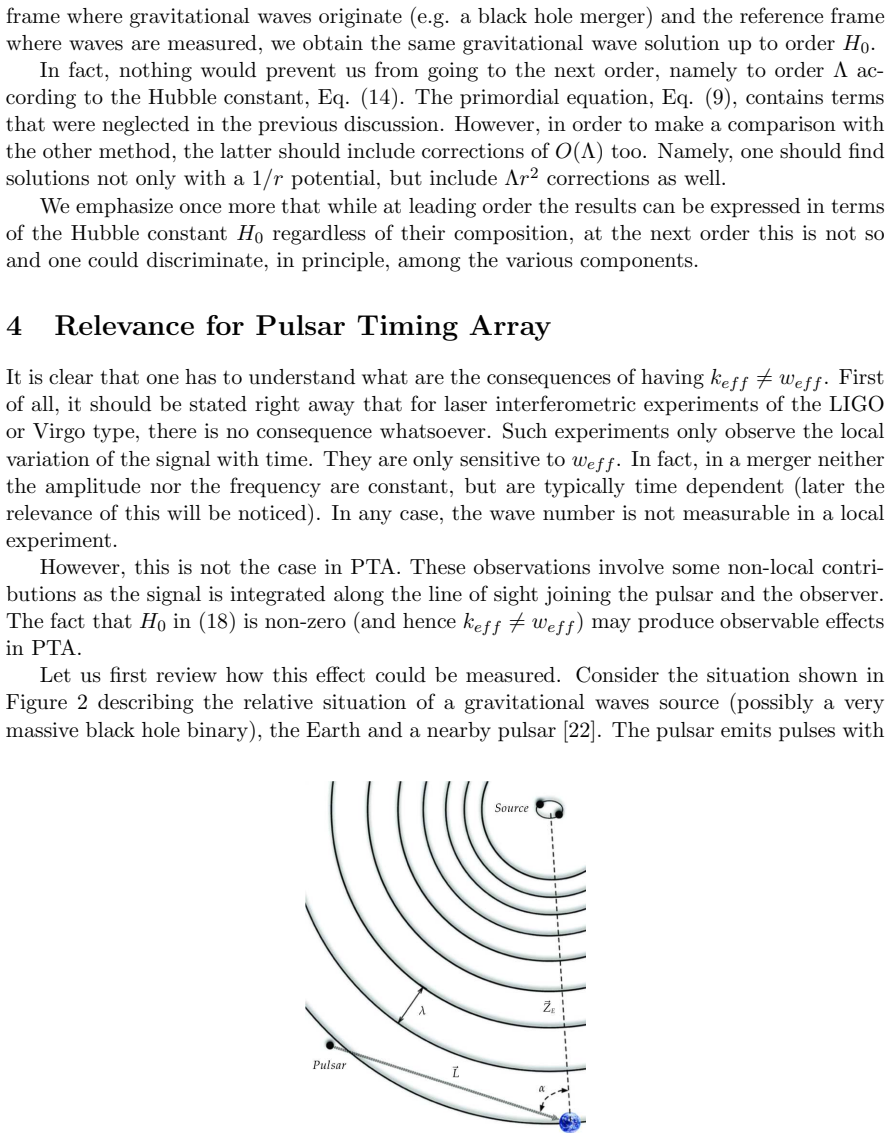
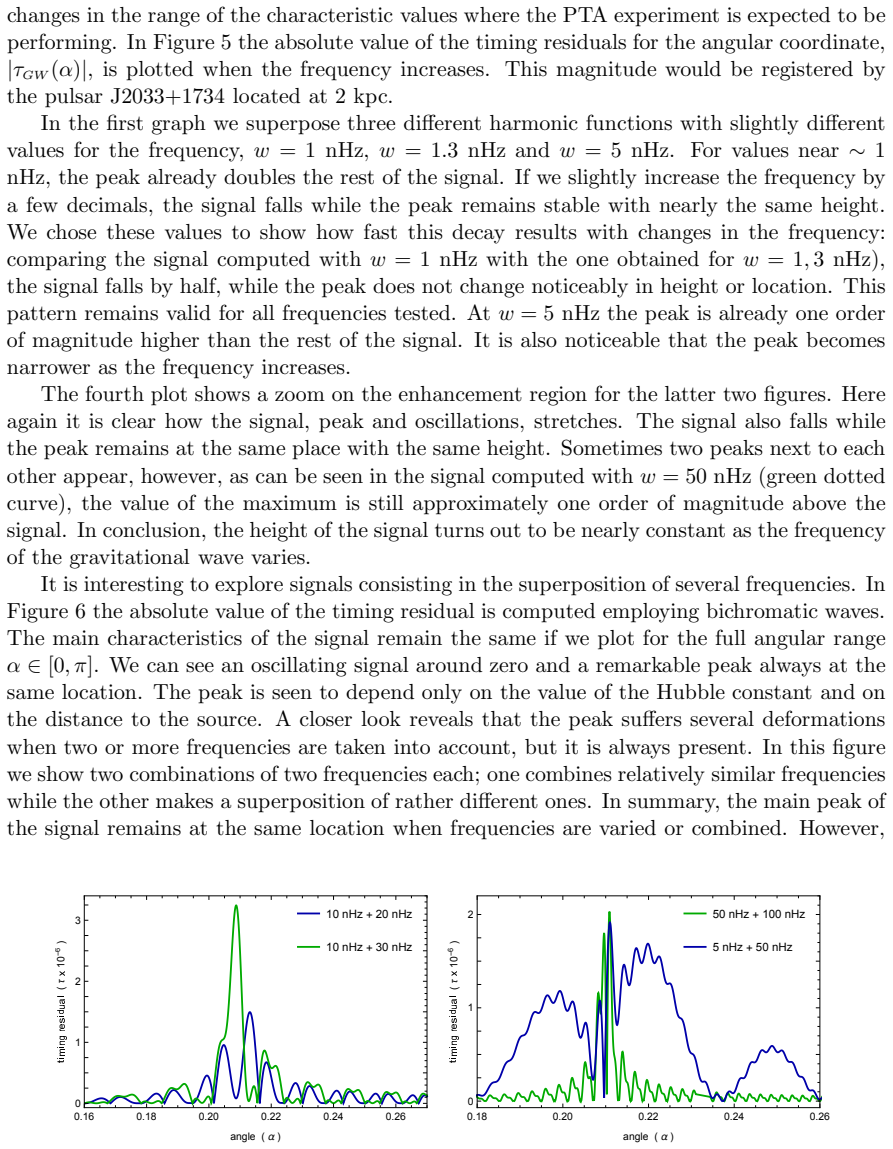
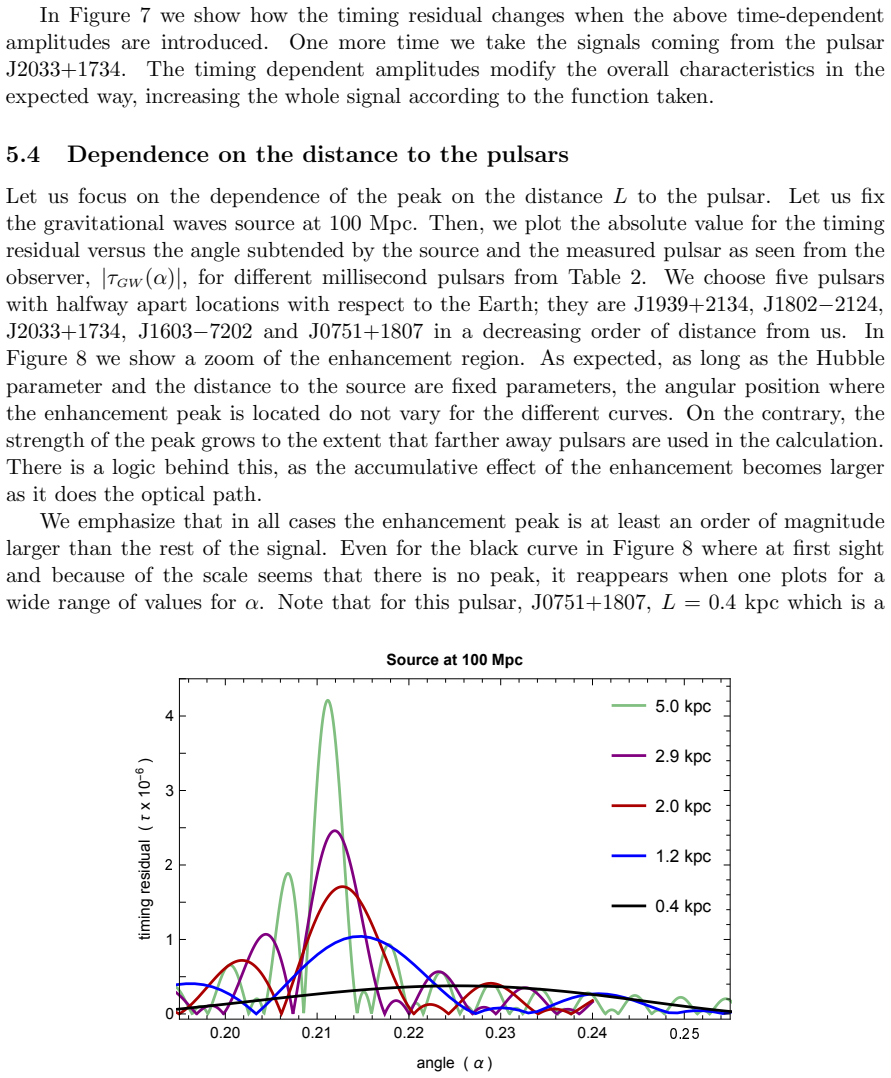
Summary. The manuscript claims that gravitational waves propagating in a Friedmann-Lemaitre-Robertson-Walker (FLRW) background have, at first order in the Hubble constant H0, an effective wavenumber that differs from the effective frequency, and that this difference produces a sharp enhancement in pulsar timing residuals for a specific angle between the source and the pulsar as seen from Earth. The paper rederives this effect by linearizing the Einstein equations around FLRW, obtains an approximate wave equation in Eq. (15), and gives a wave solution in Eq. (18) that is also obtained by transforming a Schwarzschild-de Sitter wave to comoving coordinates. It then computes the timing residual in Eq. (23), verifies the approximate enhancement relation Eq. (25) numerically in Table 1, studies the dependence of the signal on frequency, amplitude, source distance, and pulsar distance, and proposes a pulsar timing array search strategy based on 'enhancement rings.' The central physical claim is that the angular position of the enhancement can be used as a local probe of H0.
Significance. If the central wave solution and the resulting phase formula were correct, the paper would present a genuinely interesting possibility: a single-source pulsar timing array measurement of H0 from a local (z much less than 1) geometry, with a concrete observational signature that is distinctive and difficult to mimic by changing the strain amplitude or frequency. The manuscript is clearly written, uses realistic pulsar distances, and provides a useful parametric study of the proposed signal. However, the significance is conditional: the entire chain of predictions depends on the linearized wave equation Eq. (15), whose derivation is not shown and which appears inconsistent with the standard FLRW tensor-mode equation. The numerical checks in Section 5.1 are internal consistency checks rather than independent validations. Thus the paper is not yet in a publishable state; the central derivation must be established or corrected before the observational proposal can be assessed.
major comments (3)
- [Section 2, Eq. (15)] The wave equation is not derived. Equation (15) is introduced after 'one gets' and after dropping higher-order terms, but the paper never states what metric variable h_ij denotes. In the standard FLRW transverse-traceless decomposition, the dimensionless comoving strain obeys h_ddot + 3H h_dot - a^{-2} grad^2 h = 0, whereas Eq. (15) has a single term -H0 h_T. The sign and coefficient of this Hubble-friction term control the (1+H0 T) amplitude growth and the phase Theta in Eq. (24), so the chain Eq. (15) -> Eq. (18) -> Eq. (23) -> Eq. (25) is unsupported at its most load-bearing point.
- [Section 2, Eqs. (9) and (15)] The passage from Eq. (9) to Eq. (15) is also internally unclear. The radial operator in Eq. (9) as printed is -R^2/(2a^2) d/dR(1/R^2 d/dR), which expands to -1/(2a^2) partial_R^2 + 1/(a^2 R) partial_R, not the operator -1/a^2(partial_R^2 + 2/R partial_R) that appears in Eq. (15). Because Eq. (15) is the equation that the wave solution Eq. (18) is claimed to satisfy, this mismatch needs to be displayed and resolved explicitly.
- [Section 5.1 and Table 1] The numerical verification compares the integral in Eq. (23), which is built from the assumed wave form Eq. (18), with the approximate relation Eq. (25) taken from Ref. [21]. Both expressions derive from the same assumed phase structure, so Table 1 demonstrates self-consistency between an approximate stationary-phase formula and a numerical integration of the same model, but it does not validate Eq. (15) against independent physics. The Conclusion's statement that the effect is 'firmly established' therefore overstates what has been shown in this manuscript.
minor comments (3)
- [Section 3, Eq. (17)] The symbol Delta in Eq. (17) is not defined; it should be specified (presumably Delta = 1) or removed, since the coordinate transformation is central to the derivation of Eq. (18).
- [Section 5.2] There are typographical slips in the frequency discussion, e.g. 'w = 1, 3 nHz' should presumably read 'w = 1.3 nHz'.
- [Sections 5 and 6] The proposed observational protocol does not include a quantitative signal-to-noise estimate or an expected source-rate calculation; the paper appropriately notes that integration times are not addressed, but the feasibility claims in the conclusions should be softened accordingly.
Circularity Check
No circular derivation: the chain from the coordinate transformation (17) through the wave solution (18) to the peak formula (25) is a cited mathematical reduction, and the Table 1 comparison is an internal consistency check rather than a fitted prediction.
full rationale
The paper's central chain is a derivation, not a cycle. It takes the SdS harmonic wave (16), transforms to FLRW coordinates using the previously derived map (17), obtains the modified wave (18)/(19), integrates it along the pulsar line of sight to get the timing residual (23), and extracts the peak condition (25). No parameter is fitted to a data subset and then relabeled as a prediction. H0 enters as a model parameter in the wave solution and is later related to the observable peak position, which is a normal measurement formula rather than a definitional identity. The fact that Eq. (17) is imported from prior work by some of the same authors is a citation practice, not circularity: the paper does not hide the dependence, and it adds an independent-looking consistency check by verifying that the transformed solution satisfies the linearized wave equation (15). The Table 1 comparison between αgraphical and αtheoretical is a check of the numerical integral against its own stationary-phase approximation; that limits its evidential weight but is not a circular reduction of the prediction to its inputs. The more serious issue, namely that Eq. (15) is asserted with minimal derivation and is not reconciled with standard tensor-mode conventions, is a correctness or rigor concern, not a circularity concern under the criteria used here. Therefore no circular step is identified.
Assumptions & free parameters
free parameters (3)
- Representative wave strain ε =
1.2 × 10^9 m
- Source distance Z_E =
100 Mpc, 500 Mpc, 1 Gpc
- Gravitational wave frequency w =
1 nHz to 100 nHz
assumptions (6)
- domain assumption The background spacetime is FLRW with metric (1) and a perfect-fluid stress-energy containing dust, radiation, and a cosmological constant.
- domain assumption Linearized perturbation theory in the transverse-traceless gauge applies, with h_Tα = h_Rα = 0 and tracelessness (Eqs. 7-8).
- ad hoc to paper The first-order stress-energy perturbation T^(1)_μν is dropped because it is O(H0^2).
- ad hoc to paper The wave equation Eq. (15) with a single -H0 ∂_T Hubble term is the correct O(H0) approximation.
- ad hoc to paper The SdS-to-FLRW coordinate transformation (17) captures the O(H0) phase of the wave.
- domain assumption The pulsar timing residual is given by integrating the TT metric perturbation along the null geodesic (Eqs. 21-24).
Cite this review
Pith. "Pith review of Measuring $H_0$ with pulsar timing arrays." pith.science (2026). https://pith.science/paper/7VE5RVLQ
@misc{pith2026190808472,
  author       = {Pith},
  title        = {Pith review of: Measuring $H_0$ with pulsar timing arrays},
  year         = {2026},
  howpublished = {\url{https://pith.science/paper/7VE5RVLQ}},
  note         = {Machine review of arXiv:1908.08472}
}
abstract
Pulsar Timing Arrays have yet to convincingly observe gravitational waves. Some time ago it was pointed out by one of the authors that a dramatic enhancement of the signal would take place for particular values of the angle subtended by the source and the observed pulsar. This enhancement is due to the fact that waves propagate in a Friedmann-Lemaitre-Robertson-Walker metric where, contrary to some wide-spread belief, a simple harmonic function with a red-shifted frequency is not a solution of the equation of motion. At the first non-trivial order, proper solutions have an effective wave number that differs from the frequency. This leads to some interesting effects in Pulsar Timing Arrays whose most visible manifestation is the enhancement of the signal that, all other parameters kept fixed, is related in a simple manner to the value of $H_0$. In this work, we rederive in an alternative way the main results, extend the formalism to a more realistic setting where all components in the cosmological budget are included, investigate in detail the dependence of the signal on the various parameters involved and propose an observational set-up to hopefully detect this very relevant effect.
Figures


Figures from the paper (8 more)





Reference graph
Works this paper leans on
-
[21]
J. Alfaro and M. Gamonal. An alternative way to locally m easure the Hubble constant using Gravitational Waves and PTA. [arXiv:1902.04550] (20 19)
arXiv 1902
-
[1]
K.C. Wong et al. , H0LiCOW XIII. A 2.4% measurement of H0 from lensed quasars: 5.3σ tension between early and late-Universe probes (2019); [arXiv:1907.04869]. L. Verde, T. Treu and A.G. Riess, Tensions between the Early and the Late Universe (2019); [arXiv:1907.10625]
arXiv 2019
-
[2]
A.G. Riess et al. , Milky Way Cepheid Standards for Measuring Cosmic Distances an d Application to Gaia DR2: Implications for the Hubble Constant , Astrophys. J. 861, 126 (2018); [arXiv:1804.10655]
arXiv 2018
-
[3]
N. Aghanim et al. (Planck Collaboration), Planck 2018 results. VI. Cosmological param- eters, (2018); [arXiv:1807.06209]
arXiv 2018
-
[4]
B.P. Abbott et al. (LIGO Scientific Collaboration and Virgo Collaboration), P hys. Rev. Lett. 116, 061102 (2016)
work page 2016
-
[5]
B.P. Abbott et al. Multi-messenger Observations of a Binary Neutron Star Merg er. ApJ 848 L12, (2017) B.P. Abbott et al. Gravitational Waves and Gamma-Rays from a Binary Neutron St ar Merger: GW170817 and GRB 170817A. ApJ 848 L13, (2017)
work page 2017
-
[6]
B.P. Abbott et al. (LIGO Scientific Collaboration, Virgo Collaboration et al. ). A gravitational-wave standard siren measurement of the Hubb le constant. Nature 551, 85–88 (2017)
work page 2017
-
[7]
M. Soares-Santos et al. First Measurement of the Hubble Constant from a Dark Standar d Siren using the Dark Energy Survey Galaxies and the LIGO/Vir go Binary-Black-hole Merger GW170814. ApJ 876 L7, (2019)
work page 2019
Show all 36 references
-
[8]
Romani, in ¨Ogelman H., van den Heuvel E
R.W. Romani, in ¨Ogelman H., van den Heuvel E. P. J., eds, Timing Neutron Stars Timing a millisecond pulsar array . Kluwer, Dordrecht, 113 (1989). R.S. Foster and D.C. Backer, ApJ 361, 300 (1990)
1989
-
[9]
Manchester, G
R.N. Manchester, G. Hobbs, M. Bailes, W.A. Coles, W. van S traten and M.J. Keith, PASA 30, 17 (2013)
2013
-
[10]
Arzoumanian, A
Z. Arzoumanian, A. Brazier, S. Burke-Spolaor, S. Chamb erlin, S. Chatterjee, B. Christy, J. Cordes, N. Cornish, P. Demorest, X. Deng, T. Dolch, J. Elli s, R. Ferdman, E. Fonseca, N. Garver-Daniels et al., The Astrophysical Journal 821 23 (2016)
2016
-
[11]
Desvignes, R.N
G. Desvignes, R.N. Caballero, L. Lentati, J. P. W. Verbi est, D. J. Champion, B. W. Stappers, G. H. Janssen, P. Lazarus et al. , Mon. Not. Roy. Astron. Soc. 458, 3341 (2016)
2016
-
[12]
Manchester (for the IPTA), Class
R.N. Manchester (for the IPTA), Class. Quant. Grav. 30, 224010 (2013). G. Hobbs, A. Archibald, Z. Arzoumanian, D. Backer, M. Bailes , N.D.R. Bhat, M. Burgay, S. Burke-Spolaor, D. Champion, I. Cognard and W. Coles, Clas s. Quant. Grav. 27, 084013 (2010); [arXiv:0911.5206]
2013 arXiv
-
[13]
Espriu and D
D. Espriu and D. Puigdom` enech. Local measurement of Λ u sing pulsar timing arrays. Astrophys. J. 764, 163 (2013) [arXiv:1209.3724]. 22
2013 arXiv
-
[14]
Espriu, Pulsar Timing Arrays and the cosmological co nstant
D. Espriu, Pulsar Timing Arrays and the cosmological co nstant. Proceedings. Invited talk at the 2 nd Russian-Spanish meeting on particle physics at all scales, Saint Peters- burg, Russia, October 2013. AIP Conf. Proc. 1606, 86 (2014) [arXiv:1401.7925]
2014 arXiv
-
[15]
Alfaro, D
J. Alfaro, D. Espriu and L. Gabbanelli, Class. Quant. Gr av. 36, no. 2, 025006 (2019) [arXiv:1711.08315]
2019 arXiv
-
[16]
The LIGO Scientific Collaboration et al. , Class. Quantum Grav. 32, 074001 (2015); [arXiv:1411.4547]. F. Acernese et al. , Class. Quant. Grav. 32, 024001 (2015)
2015 arXiv
-
[17]
Peebles, B
P.J.E. Peebles, B. Ratra. The Cosmological Constant an d Dark Energy. Rev. Mod. Phys. 75, 559 (2003) [arXiv:astro-ph/0207347] and references ther ein
2003 arXiv
-
[18]
Riess et al
A.G. Riess et al. (Supernova Search Team Collaboration ). Observational Evidence from Supernovae for an Accelerating Universe and a Cosmological Constant. Astron. J. 116, 1009 (1998) [arXiv:astro-ph/9805201]; S. Perlmutter et al. (Supernova Cosmology Project Collabor ation). M...
1998 arXiv
-
[19]
S.M. Carroll. Spacetime and geometry: An introduction to general relativity. Addison Wesley (2004)
2004
-
[20]
Bernabeu, D
J. Bernabeu, D. Espriu and D. Puigdom` enech. Gravitati onal waves in the presence of a cosmological constant. Phys. Rev. D 84, 063523 (2011) [arXiv:1106.4511]
2011 arXiv
-
[22]
Deng and L.S
X. Deng and L.S. Finn. Pulsar timing array observations of gravitational wave source timing parallax. Mon. Not. R. Astron. Soc. 414, 50 (2011) [arXiv:1008.0320]
2011 arXiv
-
[23]
Jenet et al
F.A. Jenet et al. Upper bounds on the low–frequency stoc hastic gravitational wave back- ground from pulsar timing observations: current limits and future prospects. Astrophys. J. 653, 1571 (2006) [arXiv:astro-ph/0609013]
2006 arXiv
-
[24]
Hellings and G.S., Downs, Upper limits on the isotr opic gravitational radiation background from pulsar timing analysis, Astrophys
R.W. Hellings and G.S., Downs, Upper limits on the isotr opic gravitational radiation background from pulsar timing analysis, Astrophys. J. 265, L39 (1983)
1983
-
[25]
Anholm et al
M. Anholm et al. Optimal strategies for gravitational w ave stochastic background searches in pulsar timing data. Phys. Rev. D 79, 084030 (2009)
2009
-
[26]
Tammann, B
G.A. Tammann, B. Reindl, F. Thim, A. Saha and A. Sandage, in A New Era in Cosmol- ogy, edited by N. Metcalf and T. Shanks, Astronomical Society of the Pacific Conference Series 283, p. 258, San Francisco, 2002
2002
-
[27]
Verbiest et al., The International Pulsar Timing Array: First Data Release , Mon
J.P.W. Verbiest et al., The International Pulsar Timing Array: First Data Release , Mon. Not. Roy. Astron. Soc. 458, 1267 (2016); arXiv:1602.03640
2016 arXiv
-
[28]
Manchester, G.B
R.N. Manchester, G.B. Hobbs, A. Teoh and M. Hobbs, Astro phys. J. 129, 1993 (2005). ATNF pulsar catalogue, www.atnf.csiro.au/research/puls ar/psrcat
2005
-
[29]
Foster and D.C
R.S. Foster and D.C. Backer, ApJ 361, 300 (1990). V.M. Kaspi, J. H. Taylor and M. Ryba, ApJ 428, 713 (1994)
1990
-
[30]
Jenet, G.B
F.A. Jenet, G.B. Hobbs, K.J. Lee, R.N. Manchester, Detecting the stochastic gravita- tional wave background using pulsar timing , Astrophys. J. 625, L123 (2005); [astro- ph/0504458]
2005
-
[31]
Sesana, A
A. Sesana, A. Vecchio and M. Volonteri, MNRAS 394, 2255 (2009)
2009
-
[32]
Seto, MNRAS 400, L38 (2009); R
N. Seto, MNRAS 400, L38 (2009); R. van Haasteren and Y. Levin, MNRAS 401, 2372 (2010); M.S. Pshirkov, D. Baskaran and K. A. Postnov, MNRAS 402, 417 (2010); M. Favata, ApJ 696, L159 (2009)
2009
-
[33]
Babak, A
S. Babak, A. Petiteau, A. Sesana, P. Brem, P. A. Rosado, S .R. Taylor, A. Lassus, J.W.T. Hessels, C.G. Bassa et al. , MNRAS 455, 1665 (2015)
2015
-
[34]
Arzoumanian, A
Z. Arzoumanian, A. Brazier, S. Burke-Spolaor, S.J. Cha mberlin, S. Chatterjee, J.M. Cordes, P.B. Demorest, X. Deng, ApJ 794, 141 (2014). 24
2014
-
[35]
X.-J. Zhu, G. Hobbs, L. Wen, W.A. Coles, J.-B. Wang, R.M. Shannon, R. N. Manchester, M. Bailes, N.D.R. Bhat, S. Burke-Spolaor, S. Dai, M.J. Keith , M. Kerr, Y. Levin, D.R. Madison, S. Os lowski, V. Ravi, L. Toomey, W. van Straten, MNR AS 444, 3709 (2014)
2014
-
[36]
J.B. Wang, G. Hobbs, W. Coles, R.M. Shannon, X.J. Zhu, D. R. Madison, M. Kerr, V. Ravi, M.J. Keith, R.N. Manchester, Levin Y., Bailes M., N.D. R. Bhat, S. Burke-Spolaor, S. Dai, S. Os lowski, W. van Straten, L. Toomey, N. Wang, L. Wen , MNRAS 446, 1657 (2015). 25
2015
Reviewed August 14, 2026 · model on record in the stance chip above.
Discussion (0). Continue with ORCID to comment.