REVIEW 3 major objections 3 minor 57 references
Aspects of AdS$_2$ classification in M-theory: Solutions with mesonic and baryonic charges
T0 review · 3 major / 3 minor · reviewed 2026-08-14 · deepseek-v4-flash
Pith's one-line read This paper derives sufficient (and likely necessary) conditions for N=(1,0) AdS2 solutions of M-theory with SU(4)-structure, then uses them to construct a new AdS2×Σ_g×Q^{1,1,1} near-horizon geometry carrying both baryonic and mesonic…
desk verdict The N=(1,0) SU(4)-structure conditions are a real step forward; the advertised mesonic-charge solution is not demonstrated, and the authors mostly admit it. read the letter →
The pith
A machine-rendered reading of the paper's core claim, the machinery that carries it, and where it could break.
The reading
What carries the argument
The central object is an SU(4)-structure on the internal nine-manifold $M_9$: a real one-form $V$, a $(1,1)$-form $J$, and a $(4,0)$-form $\Omega$, with the metric $\mathrm{d}s^2(M_9)=V^2+\mathrm{d}s^2(M_8)$. The paper translates the Killing-spinor bilinears into equations on $(V,J,\Omega)$ and the fluxes $G_2,G_4$; equations (2.29a)–(2.30c) are the load-bearing conditions. The other key machinery is the family of $Q^{{1,1,1}}$ ansätze in section 3.2, where all unknown functions depend only on $x_1$ and the 4-form equation of motion reduces to the fourth-order ODE (3.8) for $U(x_1)$; solving that ODE with appropriate boundary conditions is what produces the new solutions.
What would settle it
Take the external parameters of Example 1, set n1=1, and integrate the fourth-order ODE (3.8) from x_L=0 with U(0)=0, U'(0)=2, and tunable U''(0)=u2; the claimed solution exists only if one finds u2 for which U(x_R)=0 and U'(x_R)=-2 at finite x_R>0, with $e^{{-A(x)}}$ positive throughout, and failure to find such a u2 for any n1 would falsify the new-solution claim.
Extended reading notes
Core claim
On its own terms, the paper's central result is that the whole supersymmetry of an N=(1,0) AdS2 solution of M-theory with an SU(4)-structure is encoded in the five differential conditions (2.29a)–(2.29e) and three algebraic constraints (2.30a)–(2.30c), together with the Bianchi identity and equation of motion for the four-form flux. The derivation starts from the known necessary-and-sufficient Killing-spinor geometry of eleven-dimensional supergravity, so solving the new conditions guarantees supersymmetry; whether every such solution satisfies them is left as a likely-but-unproved converse. Specializing to N=(2,0) forces the one-form V to be dual to a U(1) R-symmetry isometry, making the internal metric a warped Kähler fibration and reproducing the earlier 'transgression' solutions. For $Q^{{1,1,1}}$, the same framework reduces the flux equation of motion to a fourth-order nonlinear ODE for a single function U(x1); the paper exhibits one new polynomial solution, which lies in a branch disconnected from n1=0, and a numerical family that deforms smoothly under n1→0 and has both Betti-multiplet (baryonic) and mesonic charges.
Load-bearing premise
The load-bearing premise is that the desired near-horizon geometry is captured by an ansatz in which all warping depends on one coordinate, the circle connection has the restricted form (3.2), and the four-form flux has no self-dual parts beyond the Mij terms; if the true mesonically twisted solution needs a richer fibration or flux, it is missed.
Editorial extensions
If this is right
- Each supersymmetric AdS2 solution in this class has a symplectic, generically non-Kähler internal geometry; Kähler structure and the U(1) R-symmetry are special to N=(2,0), so magnetic flux prevents the generic enhancement to N=(2,0).
- The universal-twist solution and the deformed Betti-multiplet solutions of earlier work are recovered as special cases of the same ansatz, giving a unified classification chart for AdS2×Σ_g×Q^{1,1,1}.
- The numerical solutions with n1≠0 are the first candidates within this ansatz for AdS2 near-horizon geometries with both baryonic and mesonic charges; their smooth n1→0 limit distinguishes them from the disconnected polynomial branch.
- The Spin(7)-structure and AdS3 exclusions delineate the boundary of this classification: a complete classification of AdS2 solutions in M-theory will require going beyond SU(4)-structure.
Reading between the lines
- Beyond the paper's claims, if the numerical family passes full regularity and flux-quantization checks, its Bekenstein-Hawking entropy should match the topologically twisted index of the dual Q^{1,1,1} quiver with both baryonic and mesonic chemical potentials—an agreement that would extend the known universal-twist entropy match.
- The disconnected polynomial solution, being independent of n1 and singular in the n1→0 limit, is more plausibly a different near-horizon topology than the mesonic twist itself; the numerical family is the stronger candidate for the missing black-hole near-horizon.
- The same SU(4)-structure conditions could in principle be scanned over other Sasaki-Einstein seven-manifolds with non-trivial second Betti number to look for analogous baryonic-plus-mesonic AdS2 solutions, provided the relevant Betti multiplets are known.
Editorial analysis
A structured set of objections, weighed in public.
Referee Report
Summary. This paper studies supersymmetric AdS2 solutions of 11-dimensional supergravity with an SU(4)-structure on the internal nine-manifold. It proposes differential and algebraic conditions (2.29a)-(2.30c) for N=(1,0) supersymmetry, building on the bi-linear Killing-spinor classification of [23], and then derives a sharper Kähler-structure set (2.44a)-(2.44f) for N=(2,0). The second half specializes to AdS2 x Sigma_g x Q^{1,1,1}, recasts the known universal-twist and Betti-multiplet solutions, and presents two new branches: an analytic polynomial branch (Section 3.4.1) and a numerical branch (Section 3.4.2) intended to turn on a mesonic twist n1 together with baryonic charges. The abstract claims that a new solution with baryonic and mesonic charges turned on simultaneously is found, and that necessary and sufficient conditions are constructed.
Significance. If the classification statement is fully established, the paper would extend the N=(2,0) results of [21] to N=(1,0) and provide a framework for near-horizon geometries relevant to I-extremization and AdS4 black-hole microstate counting. The paper has several concrete strengths: the derivation is grounded in the known Killing-spinor geometry of [23]; the N=(2,0) reduction reproduces known results; the recasting of the universal-twist and Betti-multiplet solutions is careful; and the independent Killing-spinor calculation in Appendix C yields the same master ODE, providing a useful cross-check. However, the advertised new mesonic-charge solution is not supported by a charge computation: no charge integral is evaluated for the numerical backgrounds, and the paper itself calls n1 a 'would-be mesonic charge'. The lasting value of the manuscript therefore lies mainly in the classification and unification part, with the new-solution claim requiring substantial additional evidence or a significant softening.
major comments (3)
- [§2.3.2, Eqs. (2.29a)-(2.30c)] The abstract and Section 2 state that necessary and sufficient conditions for N=(1,0) supersymmetry are constructed, but the text immediately after (2.30c) only says "It seem likely that these are necessary and sufficient conditions for supersymmetry" and concedes that "we have not totally ruled out the possibility of some redundancy." Sufficiency follows from (2.12)-(2.14), but no proof is given that every N=(1,0) AdS2 solution with SU(4)-structure satisfies all of (2.29a)-(2.30c). Since the classification claim is a central advertised result, the authors should either complete the necessity argument or state the result as sufficient conditions and adjust the abstract and conclusions accordingly.
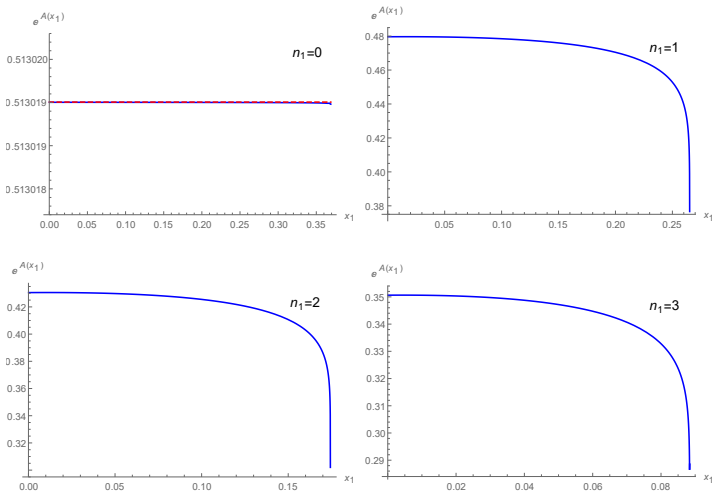
- [§3.4.2, Eqs. (3.18)-(3.21), Figures 1-3] The numerical solutions with n1 != 0 are not shown to carry mesonic or baryonic charge. The electric and magnetic charges defined in (3.18)-(3.21) are evaluated only for the analytic branch (3.19), (3.21), (3.28), (3.29), and that branch is explicitly said in footnote 5 not to be the mesonic-twist solution. For the numerical backgrounds, no Page charge, flux integral, or entropy is computed as a function of n1, so the abstract's claim of "a new solution with baryonic and mesonic charges turned on simultaneously" is not established; n1 could still be a coordinate artifact. Please compute at least one physical charge for the numerical solution and show that it is nonzero and properly quantized, or revise the claim.
- [§3.4.2, ODE (3.8) and shooting method] The numerical construction is presented with tuned values of u2 and x_R (for example, u2 = -16.12833 and x_R = 0.2651715 for n1 = 1) but without any stated numerical accuracy. The paper does not report the residual of (3.8) over the interval [x_L, x_R], the tolerance in the shooting condition U'(x_R) = -2, or the sensitivity of the solution to the truncation order Jmax in (3.42). Since this numerical solution is the only evidence for the new mesonic-charge branch, please provide residual and convergence checks or explicitly characterize the results as preliminary numerical evidence.
minor comments (3)
- [§2.3.2 and Conclusions] There are several typos and grammatical issues: "It seem likely" should be "It seems likely", "parametrixed" should be "parametrized", and "susyersymmetry" should be "supersymmetry".
- [Figures 1-3] The figure captions are terse parameter lists; captions should be self-contained and should state, for example, what is plotted, the fixed external parameters, and the consequence of the chosen u2 values.
- [§3.3.2, Eqs. (3.18), (3.20)] The charge definitions use a potential A with dA = F and iota_V A = 0, but the global existence and closure of the Page charge integrand on the internal manifold are not discussed; a brief comment on why these integrals are well defined would be helpful.
Circularity Check
No circularity: the SU(4)-structure conditions are derived from the independent Gauntlett–Pakis Killing-spinor theorem, and the numerical solutions are verified against the Bianchi identity and 4-form equation of motion.
full rationale
The paper's derivation chain is self-contained and not circular. The necessary and sufficient Killing-spinor geometry (2.12)-(2.14) is taken from the independent external result of Gauntlett and Pakis [23]; the paper then substitutes the AdS2/SU(4)-structure bilinears (2.28a)-(2.28c) into those conditions to obtain (2.29a)-(2.30c). No step equates a predicted quantity to a fitted input by construction. For the Q^{1,1,1} application, the N=(2,0) specialization is derived in section 2.4 and only afterwards cross-checked against [21], so the agreement is a consistency check, not a load-bearing self-citation. The numerical solutions in section 3.4.2 are obtained by solving the 4-form equation of motion (3.8), with u2 tuned to satisfy the boundary regularity condition U'(x_R) = -2; this is a boundary-value condition, not a fit to a target observable. The only flagged weakness is interpretive: the advertised mesonic charge is never computed, and the paper itself calls n1 the 'would-be mesonic charge' and concedes in footnote 5 that the polynomial solution 'is not the solution with a mesonic twist.' That gap affects whether the numerical solution has the claimed physical interpretation, but it is not circularity, because n1 is an input ansatz parameter rather than an output obtained by fitting a charge. Self-citations ([3], [7], [45]) appear only as contextual references and do not support any central claim. The paper even states that sufficiency of (2.29a)-(2.30c) follows from [23] while noting possible redundancy, which is an honest limitation rather than a circular move. Overall, the central derivation is independent and the analysis is not circular.
Assumptions & free parameters
free parameters (4)
- u2 =
-10.81250, -16.12833, -25.06519, -48.39740 (for n1=0,1,2,3 in Example 1)
- external warp and flux constants f0,f1,f2,f3,c1,c2 =
examples: (2,1,1,2,4,1) and (3/2,2,3,1,3,0)
- mesonic twist n1 =
0,1,2,3 in the numerical examples
- Riemann surface curvature k =
k=1 for the new regular and numerical solutions
assumptions (6)
- domain assumption The 11-dimensional supergravity equations of motion and the Killing spinor equation (2.4) are the governing physical equations.
- standard math The geometric classification of a single Killing spinor presented in [23,24] is necessary and sufficient for supersymmetry, giving (2.12)-(2.14).
- domain assumption The internal 9-manifold M9 admits an SU(4)-structure with a unit 1-form V orthogonal to the structure forms, as in (2.18)-(2.20), and the spinor ansatz (2.5) holds.
- domain assumption For N=(2,0) enhancement, the internal spinors are charged under an SO(2) R-symmetry and the solution is invariant under the dual U(1), equations (2.36)-(2.42).
- domain assumption The Q^{1,1,1} metric and flux ansatz (3.1)-(3.4) is sufficiently general to capture the desired mesonic and baryonic solutions.
- domain assumption There are no localized sources, so the Bianchi identity is dG4=0 as in (2.31a).
Cite this review
Pith. "Pith review of Aspects of AdS$_2$ classification in M-theory: Solutions with mesonic and baryonic charges." pith.science (2026). https://pith.science/paper/HN6YYT3V
@misc{pith2026190808518,
  author       = {Pith},
  title        = {Pith review of: Aspects of AdS$_2$ classification in M-theory: Solutions with mesonic and baryonic charges},
  year         = {2026},
  howpublished = {\url{https://pith.science/paper/HN6YYT3V}},
  note         = {Machine review of arXiv:1908.08518}
}
abstract
We construct necessary and sufficient geometric conditions for a class of AdS$_2$ solutions of M-theory with, at least, minimal supersymmetry to exist. We generalize previous results in the literature for ${\cal N}=(2,0)$ supersymmetry in AdS$_2$ to ${\cal N}=(1,0)$. When the solution can be locally described as AdS$_2\times \Sigma_g \times \,$SE$_7$ with $\Sigma_g$ a Riemann surface of genus $g$ and SE$_7$ a seven-dimensional Sasaki-Einstein manifold, we clarify and unify various solutions present in the literature. In the case of SE$_7=Q^{1,1,1}$ we find a new solution with baryonic and mesonic charges turned on simultaneously.
Figures


Reference graph
Works this paper leans on
-
[23]
J. P. Gauntlett and S. Pakis, The Geometry of D = 11 killing spinors , JHEP 04 (2003) 039, [ hep-th/0212008]. 38
arXiv 2003
- [21]
- [1]
- [2]
-
[3]
Microstate Counting of $AdS_4$ Hyperbolic Black Hole Entropy via the Topologically Twisted Index
A. Cabo-Bizet, V. I. Giraldo-Rivera and L. A. Pando Zayas, Microstate counting of AdS4 hyperbolic black hole entropy via the topologically twisted index , JHEP 08 (2017) 023, [ 1701.07893]
work page Pith review arXiv 2017
- [4]
-
[5]
S. M. Hosseini, K. Hristov and A. Passias, Holographic microstate counting for AdS4 black holes in massive IIA supergravity , JHEP 10 (2017) 190, [1707.06884]
arXiv 2017
-
[6]
F. Azzurli, N. Bobev, P. M. Crichigno, V. S. Min and A. Zaffaroni, A universal counting of black hole microstates in AdS 4, JHEP 02 (2018) 054, [ 1707.04257]
arXiv 2018
Show all 57 references
-
[7]
D. Gang, N. Kim and L. A. Pando Zayas, Precision Microstate Counting for the Entropy of Wrapped M5-branes, 1905.01559
1905 arXiv
-
[8]
S. M. Hosseini, Black hole microstates and supersymmetric localization . PhD thesis, Milan Bicocca U., 2018-02. 1803.01863. 37
2018 arXiv
-
[9]
Zaffaroni, Lectures on AdS Black Holes, Holography and Localization , 2019
A. Zaffaroni, Lectures on AdS Black Holes, Holography and Localization , 2019. 1902.07176
2019 arXiv
-
[10]
S. Choi, C. Hwang and S. Kim, Quantum vortices, M2-branes and black holes , 1908.02470
1908 arXiv
-
[11]
Nian and L
J. Nian and L. A. Pando Zayas, Microscopic Entropy of Rotating Electrically Charged AdS4 Black Holes from Field Theory Localization , 1909.07943
1909 arXiv
-
[12]
S. M. Hosseini and A. Zaffaroni, LargeN matrix models for 3d N = 2 theories: twisted index, free energy and black holes , JHEP 08 (2016) 064, [ 1604.03122]
2016 arXiv
-
[13]
S. M. Hosseini and N. Mekareeya, LargeN topologically twisted index: necklace quivers, dualities, and Sasaki-Einstein spaces , JHEP 08 (2016) 089, [1604.03397]
2016 arXiv
-
[14]
S. L. Cacciatori and D. Klemm, Supersymmetric AdS(4) black holes and attractors, JHEP 01 (2010) 085, [ 0911.4926]
2010 arXiv
-
[15]
Cvetic, M
M. Cvetic, M. J. Duff, P. Hoxha, J. T. Liu, H. Lu, J. X. Lu et al., Embedding AdS black holes in ten-dimensions and eleven-dimensions , Nucl. Phys. B558 (1999) 96–126, [ hep-th/9903214]
1999 arXiv
-
[16]
Cassani, P
D. Cassani, P. Koerber and O. Varela, All homogeneous N=2 M-theory truncations with supersymmetric AdS4 vacua , JHEP 11 (2012) 173, [1208.1262]
2012 arXiv
-
[17]
Halmagyi, M
N. Halmagyi, M. Petrini and A. Zaffaroni, BPS black holes in AdS4 from M-theory, JHEP 08 (2013) 124, [ 1305.0730]
2013 arXiv
-
[18]
Halmagyi, Static BPS black holes in AdS 4 with general dyonic charges , JHEP 03 (2015) 032, [ 1408.2831]
N. Halmagyi, Static BPS black holes in AdS 4 with general dyonic charges , JHEP 03 (2015) 032, [ 1408.2831]
2015 arXiv
-
[19]
Kim and J.-D
N. Kim and J.-D. Park, Comments on AdS(2) solutions of D=11 supergravity , JHEP 09 (2006) 041, [ hep-th/0607093]
2006 arXiv
-
[20]
J. P. Gauntlett, N. Kim and D. Waldram, Supersymmetric AdS(3), AdS(2) and Bubble Solutions, JHEP 04 (2007) 005, [ hep-th/0612253]
2007 arXiv
-
[22]
Donos and J
A. Donos and J. P. Gauntlett, Supersymmetric quantum criticality supported by baryonic charges, JHEP 10 (2012) 120, [ 1208.1494]
2012 arXiv
-
[24]
J. P. Gauntlett, J. B. Gutowski and S. Pakis, The Geometry of D = 11 null Killing spinors , JHEP 12 (2003) 049, [ hep-th/0311112]
2003 arXiv
-
[25]
O. A. P. Mac Conamhna and E. O Colgain, Supersymmetric wrapped membranes, AdS(2) spaces, and bubbling geometries, JHEP 03 (2007) 115, [hep-th/0612196]
2007 arXiv
-
[26]
Katmadas and A
S. Katmadas and A. Tomasiello, AdS4 black holes from M-theory , JHEP 12 (2015) 111, [ 1509.00474]
2015 arXiv
-
[27]
Prins, On flux vacua, SU (n)-structures and generalised complex geometry
D. Prins, On flux vacua, SU (n)-structures and generalised complex geometry . PhD thesis, Lyon, IPN, 2015. 1602.05415
2015 arXiv
-
[28]
Legramandi, L
A. Legramandi, L. Martucci and A. Tomasiello, Timelike structures of ten-dimensional supersymmetry, JHEP 04 (2019) 109, [ 1810.08625]
2019 arXiv
-
[29]
J. P. Gauntlett, D. Martelli and D. Waldram, Superstrings with intrinsic torsion , Phys. Rev. D69 (2004) 086002, [ hep-th/0302158]
2004 arXiv
-
[30]
Aharony, O
O. Aharony, O. Bergman, D. L. Jafferis and J. Maldacena, N=6 superconformal Chern-Simons-matter theories, M2-branes and their gravity duals , JHEP 10 (2008) 091, [ 0806.1218]
2008 arXiv
-
[31]
Martelli and J
D. Martelli and J. Sparks, Moduli spaces of Chern-Simons quiver gauge theories and AdS(4)/CFT(3), Phys. Rev. D78 (2008) 126005, [ 0808.0912]
2008 arXiv
-
[32]
Hanany and A
A. Hanany and A. Zaffaroni, Tilings, Chern-Simons Theories and M2 Branes , JHEP 10 (2008) 111, [ 0808.1244]
2008 arXiv
-
[33]
Franco, I
S. Franco, I. R. Klebanov and D. Rodriguez-Gomez, M2-branes on Orbifolds of the Cone over Q**1,1,1 , JHEP 08 (2009) 033, [ 0903.3231]
2009 arXiv
-
[34]
Benini, C
F. Benini, C. Closset and S. Cremonesi, Chiral flavors and M2-branes at toric CY4 singularities, JHEP 02 (2010) 036, [ 0911.4127]
2010 arXiv
-
[35]
Cheon, H
S. Cheon, H. Kim and N. Kim, Calculating the partition function of N=2 Gauge theories on S3 and AdS/CFT correspondence, JHEP 05 (2011) 134, [1102.5565]
2011 arXiv
-
[36]
Martelli and J
D. Martelli and J. Sparks, AdS(40 / CFT(3) duals from M2-branes at hypersurface singularities and their deformations , JHEP 12 (2009) 017, [0909.2036]
2009 arXiv
-
[37]
C. P. Herzog, I. R. Klebanov, S. S. Pufu and T. Tesileanu, Multi-Matrix Models and Tri-Sasaki Einstein Spaces, Phys. Rev. D83 (2011) 046001, [ 1011.5487]
2011 arXiv
-
[38]
Amariti, M
A. Amariti, M. Fazzi, N. Mekareeya and A. Nedelin, New 3dN = 2 SCFT’s with N 3/2 scaling, 1903.02586. 39
1903 arXiv
-
[39]
Jain and A
D. Jain and A. Ray, 3dN = 2 ˆADE Chern-Simons quivers, Phys. Rev. D100 (2019) 046007, [ 1902.10498]
2019 arXiv
-
[40]
Jain, Twisted Indices of more 3d Quivers , 1908.03035
D. Jain, Twisted Indices of more 3d Quivers , 1908.03035
1908 arXiv
-
[41]
J. P. Gauntlett, D. Martelli and J. Sparks, Toric geometry and the dual of I-extremization, JHEP 06 (2019) 140, [ 1904.04282]
2019 arXiv
-
[42]
S. M. Hosseini and A. Zaffaroni, Geometry ofI-extremization and black holes microstates, 1904.04269
1904 arXiv
-
[43]
Kim and N
H. Kim and N. Kim, Black holes with baryonic charge and I-extremization, 1904.05344
1904 arXiv
-
[44]
C. P. Herzog and I. R. Klebanov, Gravity duals of fractional branes in various dimensions, Phys. Rev. D63 (2001) 126005, [ hep-th/0101020]
2001 arXiv
-
[45]
Cabo-Bizet, U
A. Cabo-Bizet, U. Kol, L. A. Pando Zayas, I. Papadimitriou and V. Rathee, Entropy functional and the holographic attractor mechanism , JHEP 05 (2018) 155, [1712.01849]
2018 arXiv
-
[46]
Halmagyi and S
N. Halmagyi and S. Lal, On the on-shell: the action of AdS 4 black holes, JHEP 03 (2018) 146, [ 1710.09580]
2018 arXiv
-
[47]
Benetti Genolini, J
P. Benetti Genolini, J. M. P´ erez Ipi˜ na and J. Sparks,Localization of the action in AdS/CFT, 1906.11249
1906 arXiv
-
[48]
D. Gang, N. Kim and S. Lee, Holography of 3d-3d correspondence at Large N , JHEP 04 (2015) 091, [ 1409.6206]
2015 arXiv
-
[49]
Gang and N
D. Gang and N. Kim, LargeN twisted partition functions in 3d-3d correspondence and Holography, Phys. Rev. D99 (2019) 021901, [ 1808.02797]
2019 arXiv
-
[50]
I. Bah, M. Gabella and N. Halmagyi, BPS M5-branes as Defects for the 3d-3d Correspondence, JHEP 11 (2014) 112, [ 1407.0403]
2014 arXiv
-
[51]
H. Lin, O. Lunin and J. M. Maldacena, Bubbling AdS space and 1/2 BPS geometries, JHEP 10 (2004) 025, [ hep-th/0409174]
2004 arXiv
-
[52]
Lunin, 1/2-BPS states in M theory and defects in the dual CFTs , JHEP 10 (2007) 014, [ 0704.3442]
O. Lunin, 1/2-BPS states in M theory and defects in the dual CFTs , JHEP 10 (2007) 014, [ 0704.3442]
2007 arXiv
-
[53]
D’Hoker, J
E. D’Hoker, J. Estes, M. Gutperle and D. Krym, Exact Half-BPS Flux Solutions in M-theory. I: Local Solutions , JHEP 08 (2008) 028, [ 0806.0605]. 40
2008 arXiv
-
[54]
Martelli and J
D. Martelli and J. Sparks, G structures, fluxes and calibrations in M theory , Phys. Rev. D68 (2003) 085014, [ hep-th/0306225]
2003 arXiv
-
[55]
J. P. Gauntlett, D. Martelli, J. Sparks and D. Waldram, Supersymmetric AdS(5) solutions of M theory , Class. Quant. Grav. 21 (2004) 4335–4366, [hep-th/0402153]
2004 arXiv
-
[56]
I. Bena, P. Heidmann and D. Turton, AdS2 holography: mind the cap , JHEP 12 (2018) 028, [ 1806.02834]
2018 arXiv
-
[57]
Li, S.-L
Y.-Z. Li, S.-L. Li and H. Lu, Exact Embeddings of JT Gravity in Strings and M-theory, Eur. Phys. J. C78 (2018) 791, [ 1804.09742]. 41
2018 arXiv
Reviewed August 14, 2026 · model on record in the stance chip above.
Discussion (0). Continue with ORCID to comment.