REVIEW 3 major objections 6 minor 56 references
ViCo: Word Embeddings from Visual Co-occurrences
T0 review · 3 major / 6 minor · reviewed 2026-08-14 · deepseek-v4-flash
Pith's one-line read Visual co-occurrences in annotated images encode word meanings that text-only embeddings miss.
desk verdict Solid, useful paper with a genuine negative result about random embeddings; the downstream gains are too small and unreplicated to carry the 'gains on all tasks' claim. read the letter →
The pith
A machine-rendered reading of the paper's core claim, the machinery that carries it, and where it could break.
The reading
What carries the argument
The load-bearing mechanism is a multi-task log-bilinear objective. A shared word vector $w_i\in\mathbb{R}^d$ is projected through a co-occurrence-type-specific transformation $\varphi_t$ into a dedicated space, where a GloVe-style squared loss approximates the log of the observed count $X^t_{ij}$ plus a hinge-style penalty for zero-count pairs. Four count matrices corresponding to object-attribute, attribute-attribute, context, and object-hypernym co-occurrences are computed by expanding synset annotations across all member words. This formulation lets one compact embedding encode several senses of relatedness at once; the paper shows a linear $\varphi_t$ matches the concatenation of separately trained embeddings at lower dimension.
What would settle it
Train ViCo using only directly attested region labels with no synonym expansion and no WordNet hypernyms, and compare its clustering and zero-shot performance against GloVe; if the gains over GloVe disappear, the reported advantage comes from WordNet and annotation structure, not from visual co-occurrence itself. More narrowly, replacing each synset's words with its single most frequent surface form should preserve visual signal while removing synonym-expansion effects.
Extended reading notes
Core claim
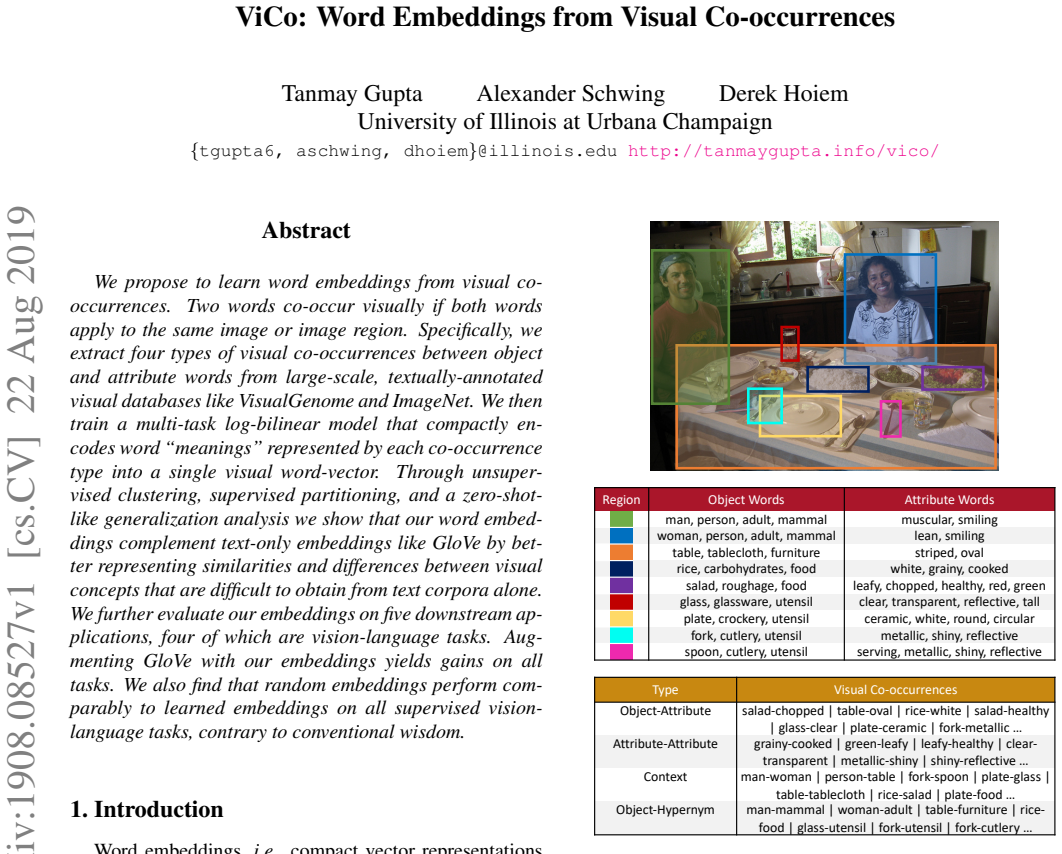
ViCo's central claim is that visual co-occurrence statistics carry genuine word-meaning signal beyond text: words that describe the same visible stuff (salad and chopped, glass and clear, fork and spoon) end up closer in the learned space even when they rarely co-occur in prose. The paper demonstrates this by training a multi-task extension of GloVe's log-bilinear objective on four co-occurrence matrices, then showing that GloVe+ViCo beats GloVe alone on clustering, zero-shot generalization, and five downstream applications. A separate claim, supported by the same experiments, is that supervised vision-language models are largely insensitive to the choice of word embeddings: random vectors match learned ones on all four vision-language tasks, while the word-only discriminative-attributes task still strongly favors learned embeddings.
Load-bearing premise
The counting pipeline assumes that every synonym listed for an annotated concept truly applies to every image region carrying that concept label and that the region annotations are exhaustive; if labels are missing or synonyms are used loosely, the co-occurrence counts encode annotation and WordNet structure rather than visual co-occurrence.
Editorial extensions
If this is right
- Using ViCo in place of or alongside GloVe should improve any task where word similarity must reflect visible properties, such as attribute-based retrieval or zero-shot object recognition.
- Because the multi-task model shares one compact embedding across co-occurrence types, adding new co-occurrence sources need not inflate embedding dimensionality.
- For supervised vision-language models, pretrained word embeddings may be replaceable by random vectors without much loss, freeing capacity or simplifying pipelines.
- Word embeddings can be obtained from image annotation alone, which matters for domains or languages with little text but available visual labels.
Reading between the lines
- If visual co-occurrence signal is as strong as reported, similar counting over other dense annotation sources (video captions, pixel-level segmentations, image tags) could produce embeddings for a much larger vocabulary without synset expansion.
- The near-parity of random and learned embeddings on vision-language tasks suggests those benchmarks may be dominated by visual features and model architecture; a clean test would sweep vocabulary coverage or embedding quality while holding everything else fixed.
- The type-specific projections could be reused as a cheap sense-disentangling tool: querying which projection gives high similarity reveals whether two words are related by appearance, function, hypernymy, or context.
Signed reviews
Editorial analysis
A structured set of objections, weighed in public.
Referee Report
Summary. The paper proposes ViCo, a method for learning word embeddings from visual co-occurrences. It formulates a multi-task extension of GloVe's log-bilinear objective (Eq. 2) in which a single shared word vector is projected through type-specific linear transforms into separate spaces for four co-occurrence types: object-attribute, attribute-attribute, context, and object-hypernym, with counts derived from VisualGenome and ImageNet annotations. The authors evaluate GloVe+ViCo against GloVe, random vectors, and vis-w2v on unsupervised clustering over manually annotated word categories, a zero-shot-like CIFAR-100 transfer protocol, five downstream tasks (discriminative attributes, caption-image retrieval, VQA, referring expression comprehension, image captioning), and qualitative analogies. The main claims are that GloVe+ViCo outperforms GloVe across these evaluations and that random embeddings perform comparably to learned embeddings on supervised vision-language tasks.
Significance. If the results hold, the paper offers a simple and scalable way to inject visual statistics into word embeddings and provides one of the first systematic demonstrations that frozen word embeddings have limited impact in several supervised vision-language models. The multi-task log-bilinear formulation is clean and the w/o WordNet ablation is a useful control. The clustering and zero-shot-like results are more substantial than the downstream results, which rest on small, unreplicated differences. The finding about random embeddings is interesting and potentially important, but the evidence for it is entangled with the same statistical reliability issues.
major comments (3)
- [Sec. 4.3, Table 5] The central claim that GloVe+ViCo outperforms GloVe on all downstream tasks rests on Table 5 differences that are mostly 0.1-0.3 absolute points, with no standard errors or significance tests. For example, VQA Overall is 67.7 vs 67.5, VQA Other is 58.4 vs 58.3, RefCOCO+ TestA is 75.5 vs 75.3, BLEU-4 is 0.291 vs 0.290, and SPICE is 0.168 vs 0.167. The image captioning row is particularly concerning: the random-embedding row alone reports BLEU-4 0.296, CIDEr 0.910, and SPICE 0.170, which are all higher than the corresponding GloVe+ViCo values (0.291, 0.894, 0.168), suggesting that captioning metrics can move around by amounts larger than the claimed gains. The authors should report multiple random seeds or bootstrap confidence intervals for every row of Table 5, or explicitly tone down the all-task claim. This is load-bearing because the abstract and conclusion claim gains on all tasks.
- [Sec. 4.2] The zero-shot-like protocol is described as 'slightly different' from typical zero-shot because images of unseen CIFAR-100 classes are used to compute the word co-occurrences used for embedding training. The paper then concludes that GloVe+ViCo 'generalizes to unseen classes better than GloVe.' This is not a genuine zero-shot transfer test, since the unseen class names and their visual co-occurrence statistics are available to the embedding. I do not see equation-level circularity, but the wording overstates what is measured. The authors should either re-frame this as a novel-class classification experiment with supervised embeddings, or add an experiment in which the embeddings are trained without any annotations from the unseen classes. At minimum, the limitations paragraph should state explicitly that the zero-shot result does not test whether ViCo can transfer to classes absent from its training data.
- [Sec. 3.3, Table 3] The co-occurrence counting expands each synset to all of its words, so a region annotated with object synset {man, person, adult, mammal} and attribute {smiling} contributes counts for (man, smiling), (person, smiling), (adult, smiling), and (mammal, smiling). This means WordNet structure is injected into the co-occurrence statistics, not only through the explicit Object-Hypernym type but also through synonym expansion in the other types. The w/o WordNet ablation in Table 3 is a good control and shows that WordNet is not the sole contributor, but it is reported only for the clustering analysis. Since the zero-shot-like and downstream claims are among the paper's main contributions, the authors should provide w/o WordNet variants for those evaluations as well, or justify why the clustering ablation is sufficient to bound the effect.
minor comments (6)
- [Sec. 4.2, Learning] The sentence 'The model is trained with a batch size of0.01 for 50 epochs' appears to contain a typo ('of0.01'); please clarify the batch size and the learning rate.
- [Sec. 4.2, Model Selection] The best model is selected using seen-class accuracy on the test set; a held-out validation split would be cleaner, since the test set is also used to compute the unseen-class accuracy.
- [Sec. 4.2, Fig. 5] The text says results are averaged over four runs and that 7x4x4=112 models were trained; the description of how the 112 models are distributed across splits, embeddings, and runs is easy to misread and should be made explicit.
- [Abstract and Table 5 caption] The abstract states that random embeddings 'perform comparably' to learned embeddings on all supervised vision-language tasks, while the Table 5 caption says GloVe+ViCo outperforms random 'for all tasks except Image Captioning.' These statements are consistent only if 'comparably' is interpreted loosely; the wording should be tightened to avoid the appearance that random embeddings match learned embeddings everywhere.
- [Sec. 4.4] The analogy evaluation is based on only 30 hand-picked pairings and is reported as a count of correct answers with no candidate-set construction details; it should be presented as qualitative evidence rather than a rigorous evaluation.
- [Sec. 3.2, Eq. (2)] The weighting function f(X) is set to 1 for all co-occurrence counts, so rare and frequent co-occurrences contribute equally in the first term; the paper should state whether this choice was evaluated, since GloVe's original weighting is designed to downweight rare pairs.
Circularity Check
No construction-level circularity: ViCo's objective fits co-occurrence counts, and all evaluations use independent labels or external tasks.
full rationale
The paper's central derivation is Eq. (2), a multi-task log-bilinear regression whose targets are the visual co-occurrence counts X_t computed in Sec. 3.3; no downstream evaluation label or clustering label enters this objective. The unsupervised clustering evaluation uses manually assigned coarse and fine categories on 495 VisualGenome words (Sec. 4.1), the zero-shot-like evaluation uses CIFAR-100 class probabilities from Eq. (4) with a classifier trained only on seen classes (Sec. 4.2), and all downstream applications are external benchmarks (Sec. 4.3). None of these quantities is the fitted log-count or a deterministic transform of the fitted parameters alone, so no prediction is equivalent by construction to the model's input. The only author self-citation ([12]) is background context about vision-language models and is not load-bearing. The paper explicitly flags the non-standard nature of its zero-shot-like setup: 'annotations associated with images of unseen categories in VisualGenome or ImageNet may be used to compute word co-occurrences while learning word embeddings' (Sec. 4.2). This is an evaluation-leakage limitation that weakens the strength of the transfer claim, but it is an acknowledged experimental nuance rather than a derivational circularity. Likewise, the small Table 5 gains over GloVe without significance tests are an evidential weakness, not a case of fitting a parameter and renaming it a prediction. Therefore no circular step is established.
Assumptions & free parameters
free parameters (5)
- Embedding dimension d =
100 (linear), 200 (select)
- Transform type phi_t =
linear(100)
- Weighting function f(X) =
1 (constant)
- Max-term coefficient =
1 (equal weight)
- Zero-shot temperature epsilon =
learned
assumptions (4)
- standard math Log-bilinear factorization of log co-occurrence counts learns useful semantic embeddings (GloVe).
- domain assumption Visual Genome and ImageNet annotations are reliable enough that the derived co-occurrence counts reflect visual co-occurrence.
- domain assumption All words in an annotated synset are mutually co-occurring and equally applicable to the region or image.
- ad hoc to paper The zero-shot-like protocol is a valid transfer measure even though unseen CIFAR-100 classes appear in the embedding training data.
Cite this review
Pith. "Pith review of ViCo: Word Embeddings from Visual Co-occurrences." pith.science (2026). https://pith.science/paper/XRKB75KI
@misc{pith2026190808527,
  author       = {Pith},
  title        = {Pith review of: ViCo: Word Embeddings from Visual Co-occurrences},
  year         = {2026},
  howpublished = {\url{https://pith.science/paper/XRKB75KI}},
  note         = {Machine review of arXiv:1908.08527}
}
read the original abstract
We propose to learn word embeddings from visual co-occurrences. Two words co-occur visually if both words apply to the same image or image region. Specifically, we extract four types of visual co-occurrences between object and attribute words from large-scale, textually-annotated visual databases like VisualGenome and ImageNet. We then train a multi-task log-bilinear model that compactly encodes word "meanings" represented by each co-occurrence type into a single visual word-vector. Through unsupervised clustering, supervised partitioning, and a zero-shot-like generalization analysis we show that our word embeddings complement text-only embeddings like GloVe by better representing similarities and differences between visual concepts that are difficult to obtain from text corpora alone. We further evaluate our embeddings on five downstream applications, four of which are vision-language tasks. Augmenting GloVe with our embeddings yields gains on all tasks. We also find that random embeddings perform comparably to learned embeddings on all supervised vision-language tasks, contrary to conventional wisdom.
Figures


Figures from the paper (2 more)


Reference graph
Works this paper leans on
-
[1]
Spice: Semantic propositional image cap- tion evaluation
Peter Anderson, Basura Fernando, Mark Johnson, and Stephen Gould. Spice: Semantic propositional image cap- tion evaluation. In ECCV, 2016. 8
work page 2016
-
[2]
Localizing mo- ments in video with natural language
Lisa Anne Hendricks, Oliver Wang, Eli Shechtman, Josef Sivic, Trevor Darrell, and Bryan Russell. Localizing mo- ments in video with natural language. In ICCV, 2017. 1
work page 2017
-
[3]
Vqa: Visual question answering
Stanislaw Antol, Aishwarya Agrawal, Jiasen Lu, Margaret Mitchell, Dhruv Batra, C Lawrence Zitnick, and Devi Parikh. Vqa: Visual question answering. In ICCV, 2015. 8
work page 2015
-
[4]
John A. Bullinaria and J. P. Levy. Extracting semantic rep- resentations from word co-occurrence statistics: a computa- tional study. Behavior research methods, 2007. 2
work page 2007
-
[5]
Microsoft coco captions: Data collection and evaluation server
Xinlei Chen, Hao Fang, Tsung-Yi Lin, Ramakrishna Vedan- tam, Saurabh Gupta, Piotr Doll ´ar, and C Lawrence Zitnick. Microsoft coco captions: Data collection and evaluation server. arXiv preprint arXiv:1504.00325, 2015. 6
arXiv 2015
-
[6]
Abhishek Das, Satwik Kottur, Khushi Gupta, Avi Singh, Deshraj Yadav, Jos´e MF Moura, Devi Parikh, and Dhruv Ba- tra. Visual dialog. In CVPR, 2017. 1
work page 2017
-
[7]
Scott C. Deerwester, Susan T. Dumais, Thomas K. Landauer, George W. Furnas, and Richard A. Harshman. Indexing by latent semantic analysis. JASIS, 1990. 2
work page 1990
-
[8]
Imagenet: A large-scale hierarchical image database
Jia Deng, Wei Dong, Richard Socher, Li-Jia Li, Kai Li, and Li Fei-Fei. Imagenet: A large-scale hierarchical image database. In CVPR, 2009. 2
2009
Show all 56 references
-
[9]
Bert: Pre-training of deep bidirectional trans- formers for language understanding.CoRR, abs/1810.04805,
Jacob Devlin, Ming-Wei Chang, Kenton Lee, and Kristina Toutanova. Bert: Pre-training of deep bidirectional trans- formers for language understanding.CoRR, abs/1810.04805,
-
[10]
Vse++: Improved visual-semantic embeddings
Fartash Faghri, David J Fleet, Jamie Ryan Kiros, and Sanja Fidler. Vse++: Improved visual-semantic embeddings. BMVC, 2018. 8
2018
-
[11]
Making the v in vqa matter: Elevating the role of image understanding in visual question answer- ing
Yash Goyal, Tejas Khot, Douglas Summers-Stay, Dhruv Ba- tra, and Devi Parikh. Making the v in vqa matter: Elevating the role of image understanding in visual question answer- ing. In CVPR, 2017. 8
2017
-
[12]
Aligned image-word representations improve induc- tive transfer across vision-language tasks
Tanmay Gupta, Kevin Shih, Saurabh Singh, and Derek Hoiem. Aligned image-word representations improve induc- tive transfer across vision-language tasks. In ICCV, 2017. 1
2017
-
[13]
Incorporating visual features into word embed- dings: A bimodal autoencoder-based approach
Mika Hasegawa, Tetsunori Kobayashi, and Yoshihiko Hayashi. Incorporating visual features into word embed- dings: A bimodal autoencoder-based approach. In IWCS,
-
[14]
Deep semantic role labeling: What works and whats next
Luheng He, Kenton Lee, Mike Lewis, and Luke Zettlemoyer. Deep semantic role labeling: What works and whats next. In ACL, 2017. 1
2017
-
[15]
Yu Jiang, Vivek Natarajan, Xinlei Chen, Marcus Rohrbach, Dhruv Batra, and Devi Parikh. Pythia. https:// github.com/facebookresearch/pythia, 2018. 8
2018
-
[16]
Deep visual-semantic align- ments for generating image descriptions
Andrej Karpathy and Li Fei-Fei. Deep visual-semantic align- ments for generating image descriptions. In CVPR, 2015. 1
2015
-
[17]
Adam: A method for stochastic optimization
Diederik P Kingma and Jimmy Ba. Adam: A method for stochastic optimization. ICLR, 2015. 2, 7
2015
-
[18]
Satwik Kottur, Ramakrishna Vedantam, Jos ´e M. F. Moura, and Devi Parikh. Visual word2vec (vis-w2v): Learning visually grounded word embeddings using abstract scenes. CVPR, 2016. 3, 6, 7
2016
-
[19]
Semeval-2018 task 10: Capturing discriminative attributes
Alicia Krebs, Alessandro Lenci, and Denis Paperno. Semeval-2018 task 10: Capturing discriminative attributes. In International Workshop on Semantic Evaluation, 2018. 8
2018
-
[20]
Learning multiple layers of features from tiny images
Alex Krizhevsky and Geoffrey Hinton. Learning multiple layers of features from tiny images. Technical report, Cite- seer, 2009. 5
2009
-
[21]
Multidimensional scaling by optimizing goodness of fit to a nonmetric hypothesis
Joseph B Kruskal. Multidimensional scaling by optimizing goodness of fit to a nonmetric hypothesis. Psychometrika,
-
[22]
Word embeddings through hellinger pca
R ´emi Lebret and Ronan Collobert. Word embeddings through hellinger pca. In EACL, 2014. 2
2014
-
[23]
End-to-end neural coreference resolution
Kenton Lee, Luheng He, Mike Lewis, and Luke Zettlemoyer. End-to-end neural coreference resolution. EMNLP, 2017. 1
2017
-
[24]
Neural word embedding as implicit matrix factorization
Omer Levy and Yoav Goldberg. Neural word embedding as implicit matrix factorization. In NIPS, 2014. 2
2014
-
[25]
Microsoft coco: Common objects in context
Tsung-Yi Lin, Michael Maire, Serge Belongie, James Hays, Pietro Perona, Deva Ramanan, Piotr Doll´ar, and C Lawrence Zitnick. Microsoft coco: Common objects in context. In ECCV, 2014. 6
2014
-
[26]
Lund and Curt Burgess
K. Lund and Curt Burgess. Producing high-dimensional se- mantic spaces from lexical co-ocurrence. 1996. 2
1996
-
[27]
Comprehension- guided referring expressions
Ruotian Luo and Gregory Shakhnarovich. Comprehension- guided referring expressions. In CVPR, 2017. 1
2017
-
[28]
Flipdial: A generative model for two-way visual dialogue
Daniela Massiceti, N Siddharth, Puneet K Dokania, and Philip HS Torr. Flipdial: A generative model for two-way visual dialogue. In CVPR, 2018. 1
2018
-
[29]
Corrado, and Jeffrey Dean
Tomas Mikolov, Kai Chen, Gregory S. Corrado, and Jeffrey Dean. Efficient estimation of word representations in vector space. CoRR, abs/1301.3781, 2013. 2
2013 arXiv
-
[30]
Cor- rado, and Jeffrey Dean
Tomas Mikolov, Ilya Sutskever, Kai Chen, Gregory S. Cor- rado, and Jeffrey Dean. Distributed representations of words and phrases and their compositionality. In NIPS, 2013. 2
2013
-
[31]
Linguis- tic regularities in continuous space word representations
Tomas Mikolov, Wen tau Yih, and Geoffrey Zweig. Linguis- tic regularities in continuous space word representations. In HLT-NAACL, 2013. 2, 8
2013
-
[32]
Wordnet: a lexical database for english
George A Miller. Wordnet: a lexical database for english. ACM, 1995. 2
1995
-
[33]
The big book of concepts
Gregory Murphy. The big book of concepts . MIT press,
-
[34]
The measurement of meaning
Charles Egerton Osgood, George J Suci, and Percy H Tan- nenbaum. The measurement of meaning. University of Illi- nois press, 1957. 2
1957
-
[35]
Bleu: a method for automatic evaluation of machine translation
Kishore Papineni, Salim Roukos, Todd Ward, and Wei-Jing Zhu. Bleu: a method for automatic evaluation of machine translation. In ACL, 2002. 8
2002
-
[36]
Parikh, Oscar T ¨ackstr¨om, Dipanjan Das, and Jakob Uszkoreit
Ankur P. Parikh, Oscar T ¨ackstr¨om, Dipanjan Das, and Jakob Uszkoreit. A decomposable attention model for natural lan- guage inference. In EMNLP, 2016. 1
2016
-
[37]
Glove: Global vectors for word representation
Jeffrey Pennington, Richard Socher, and Christopher Man- ning. Glove: Global vectors for word representation. In EMNLP, 2014. 2, 3, 5
2014
-
[38]
Semi-supervised sequence tagging with bidirectional language models
Matthew E Peters, Waleed Ammar, Chandra Bhagavatula, and Russell Power. Semi-supervised sequence tagging with bidirectional language models. ACL, 2017. 1
2017
-
[39]
Peters, Mark Neumann, Mohit Iyyer, Matt Gard- ner, Christopher Clark, Kenton Lee, and Luke S
Matthew E. Peters, Mark Neumann, Mohit Iyyer, Matt Gard- ner, Christopher Clark, Kenton Lee, and Luke S. Zettle- moyer. Deep contextualized word representations. In NAACL-HLT, 2018. 3
2018
-
[40]
Plummer, Paige Kordas, M
Bryan A. Plummer, Paige Kordas, M. Hadi Kiapour, Shuai Zheng, Robinson Piramuthu, and Svetlana Lazebnik. Con- ditional image-text embedding networks. In ECCV, 2018. 1
2018
-
[41]
Phrase local- ization and visual relationship detection with comprehensive image-language cues
Bryan A Plummer, Arun Mallya, Christopher M Cervantes, Julia Hockenmaier, and Svetlana Lazebnik. Phrase local- ization and visual relationship detection with comprehensive image-language cues. In ICCV, 2017. 1
2017
-
[42]
Improving language understanding by gener- ative pre-training
Alec Radford. Improving language understanding by gener- ative pre-training. 2018. 3
2018
-
[43]
Smith, and Yejin Choi
Hannah Rashkin, Maarten Sap, Emily Allaway, Noah A. Smith, and Yejin Choi. Event2mind: Commonsense infer- ence on events, intents, and reactions. In ACL, 2018. 1
2018
-
[44]
Se- mantic distance and the verification of semantic relations
Lance J Rips, Edward J Shoben, and Edward E Smith. Se- mantic distance and the verification of semantic relations. Journal of verbal learning and verbal behavior, 1973. 2
1973
-
[45]
Ross and Gregory L
Brian H. Ross and Gregory L. Murphy. Food for thought: Cross-classification and category organization in a complex real-world domain. Cognitive Psychology, 1999. 2
1999
-
[46]
Bidirectional attention flow for machine comprehension
Minjoon Seo, Aniruddha Kembhavi, Ali Farhadi, and Han- naneh Hajishirzi. Bidirectional attention flow for machine comprehension. ICLR, 2017. 1
2017
-
[47]
Where to look: Focus regions for visual question answering
Kevin J Shih, Saurabh Singh, and Derek Hoiem. Where to look: Focus regions for visual question answering. InCVPR,
-
[48]
Zettlemoyer, and Ido Dagan
Gabriel Stanovsky, Julian Michael, Luke S. Zettlemoyer, and Ido Dagan. Supervised open information extraction. In NAACL-HLT, 2018. 1
2018
-
[49]
Learn- ing type-aware embeddings for fashion compatibility
Mariya I Vasileva, Bryan A Plummer, Krishna Dusad, Shreya Rajpal, Ranjitha Kumar, and David Forsyth. Learn- ing type-aware embeddings for fashion compatibility. In ECCV, 2018. 1
2018
-
[50]
Cider: Consensus-based image description evalua- tion
Ramakrishna Vedantam, C Lawrence Zitnick, and Devi Parikh. Cider: Consensus-based image description evalua- tion. In CVPR, 2015. 8
2015
-
[51]
Show and tell: A neural image caption gen- erator
Oriol Vinyals, Alexander Toshev, Samy Bengio, and Du- mitru Erhan. Show and tell: A neural image caption gen- erator. In CVPR, 2015. 8
2015
-
[52]
Learning two-branch neural networks for image-text match- ing tasks
Liwei Wang, Yin Li, Jing Huang, and Svetlana Lazebnik. Learning two-branch neural networks for image-text match- ing tasks. TPAMI, 2019. 1
2019
-
[53]
Zero-shot recognition via semantic embeddings and knowledge graphs
Xiaolong Wang, Yufei Ye, and Abhinav Gupta. Zero-shot recognition via semantic embeddings and knowledge graphs. In CVPR, 2018. 1
2018
-
[54]
Mattnet: Modular at- tention network for referring expression comprehension
Licheng Yu, Zhe Lin, Xiaohui Shen, Jimei Yang, Xin Lu, Mohit Bansal, and Tamara L Berg. Mattnet: Modular at- tention network for referring expression comprehension. In CVPR, 2018. 8
2018
-
[55]
Pythia v0.1: the winning entry to the vqa challenge 2018
Yu Jiang*, Vivek Natarajan*, Xinlei Chen*, Marcus Rohrbach, Dhruv Batra, and Devi Parikh. Pythia v0.1: the winning entry to the vqa challenge 2018. arXiv preprint arXiv:1807.09956, 2018. 1, 8
2018 arXiv
-
[56]
Bringing semantics into focus using visual abstraction
C Lawrence Zitnick and Devi Parikh. Bringing semantics into focus using visual abstraction. In CVPR, 2013. 6
2013
Reviewed August 14, 2026 · model on record in the stance chip above.
Discussion (0). Continue with ORCID to comment.