REVIEW 2 major objections 5 minor 50 references
Theory of bi-linear magnetoresistance within the minimal model for surface states in topological insulators
T0 review · 2 major / 5 minor · reviewed 2026-08-14 · deepseek-v4-flash
Pith's one-line read In the minimal model of topological-insulator surface states, bi-linear magnetoresistance arises from current-induced spin polarization acting through magnetic-field-dependent spin-orbit-defect scattering, and this mechanism dominates at…
desk verdict A mostly sound new mechanism for bilinear magnetoresistance in TI surface states, with a factor-ℏ^4 typo in the headline formula that must be corrected. read the letter →
The pith
A machine-rendered reading of the paper's core claim, the machinery that carries it, and where it could break.
The reading
What carries the argument
The central object is the effective in-plane field $\mathbf{B}_{\mathrm{eff}} = \mathbf{B} + J\mathbf{S}$, where $\mathbf{S}$ is the current-induced spin polarization $S_y = \hbar^2 j_x/(2ev)$. A gauge transformation $\mathbf{k}\to\mathbf{q}-\frac{e}{\hbar}\boldsymbol\Lambda$ removes $\mathbf{B}_{\mathrm{eff}}$ from the Dirac Hamiltonian, but the spin-orbit defect scattering potential retains a residual term proportional to $B_x$ and to $B_y+J S_y$. The Born self-energy of that residual term makes the quasiparticle relaxation rate $\Gamma(\varphi)$ depend on the direction of the momentum on the Fermi circle, and the ladder vertex correction converts that angular dependence into a term in $\sigma_{xx}$ linear in $\mathbf{B}$ and $\mathbf{j}$. The mechanism is therefore field-dependent relaxation in the presence of a non-equilibrium spin polarization, not Fermi-surface warping.
What would settle it
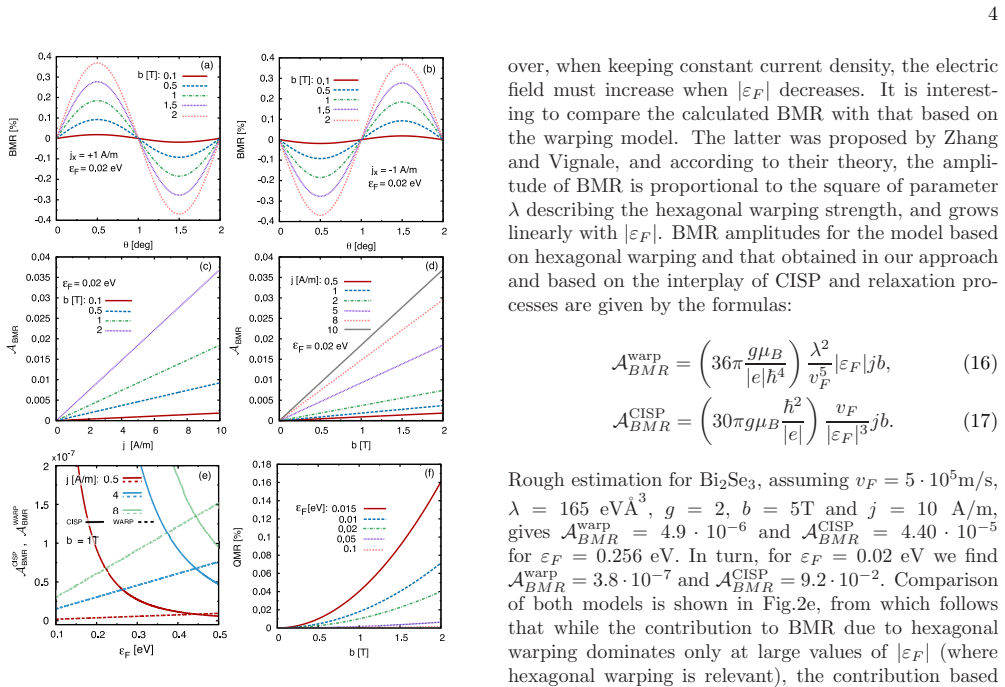
Gate-tune the Fermi energy in a topological insulator with a circular, unwarped surface Fermi surface and measure the antisymmetric magnetoresistance as a function of $b$, $j$, and Fermi energy. If the mechanism holds, the bilinear amplitude should follow $\left(\frac{30\pi g\mu_B}{\hbar^2 |e|}\right)\frac{v_F}{|\varepsilon_F|^3} j b \sin\theta$, growing steeply as $|\varepsilon_F|$ is reduced within the regime $|\varepsilon_F| \gg B, \Gamma_0$; if instead the signal scales with the hexagonal-warping parameter and grows with $|\varepsilon_F|$, the proposed mechanism is not the operative one.
Extended reading notes
Core claim
The paper establishes that in the minimal Dirac-cone model of a topological-insulator surface, described by $\hat H_0 = v(\mathbf{k}\times\hat z)\cdot\boldsymbol\sigma + \mathbf{B}\cdot\boldsymbol\sigma + J\mathbf{S}\cdot\boldsymbol\sigma$, scattering from local spin-orbit fluctuations becomes magnetic-field dependent after the gauge transformation that removes the effective field $\mathbf{B}+J\mathbf{S}$ from the band Hamiltonian. The Born self-energy then yields an angle-dependent relaxation rate $\Gamma(\varphi) = \Gamma_0\left[1 + \frac{2B_y J S_y + B^2}{\varepsilon^2} + \frac{2}{|\varepsilon|}\left((B_y+J S_y)\cos\varphi - B_x\sin\varphi\right)\right]$ at the Fermi surface. This angular dependence enters the ladder vertex correction and produces the longitudinal conductivity $\sigma_{xx} = \sigma_{0xx}\left[1 - \frac{15}{2}\frac{B_y J S_y}{\varepsilon_F^2} - 3\frac{B^2}{\varepsilon_F^2}\right]$. The corresponding magnetoresistance contains a bilinear term $\mathrm{BMR} = \left(\frac{30\pi g\mu_B}{\hbar^2 |e|}\right)\frac{v_F}{|\varepsilon_F|^3} j b \sin\theta$ (with the sign set by the current direction), linear in current and field and antisymmetric under reversal of either, plus a symmetric quadratic term $\mathrm{sMR} = 3g^2\mu_B^2 b^2/\varepsilon_F^2$. Since the bilinear amplitude decays as $|\varepsilon_F|^{-3}$ while the warping-based amplitude grows linearly with $|\varepsilon_F|$, the new mechanism dominates at low Fermi energies.
Load-bearing premise
The calculation assumes that the current-induced spin polarization keeps its zero-field value even after the magnetic field and the polarization's own feedback field are switched on; if those fields substantially change the polarization, the predicted amplitude changes, and if the polarization is not proportional to current, the effect vanishes.
Editorial extensions
If this is right
- BMR should appear on any topological-insulator surface with spin-orbit disorder even when the Fermi surface is perfectly circular.
- The bilinear signal should scale linearly with current density $j$ and magnetic field $b$ and vary as $\sin\theta$, vanishing when the field is parallel to the current.
- Gating the Fermi energy toward the Dirac point should strongly enhance the BMR amplitude as $|\varepsilon_F|^{-3}$, while the warping contribution would move in the opposite direction.
- Because the symmetric quadratic magnetoresistance is independent of field orientation, current-reversal measurements separate the two terms and can in principle extract band parameters such as $k_F$, $v_F$, and the $g$-factor.
- The mechanism explains why BMR persists in topological-insulator systems that lack hexagonal symmetry and thus cannot be described by warping alone.
Reading between the lines
- The paper keeps $S_y$ at its zero-field value even when $\mathbf{B}$ and the exchange field are present; a fully self-consistent treatment that lets $\mathbf{B}$ renormalize $S_y$ is the natural next step, and could correct the prefactor without changing the symmetry of the effect.
- Because the mechanism needs only current-induced spin polarization and spin-orbit disorder, it likely transfers to other spin-momentum-locked conductors, such as spin-split interface states, where the same gauge-shift logic would apply with a suitably generalized scattering potential.
- The steep $1/|\varepsilon_F|^3$ growth suggests BMR could serve as a quantitative local probe of current-induced spin polarization in gated devices, an application the paper points toward but does not develop.
- A direct numerical calculation of the vertex correction beyond the ladder approximation would test whether the angular relaxation rate is the only carrier of the effect, or whether higher-order impurity scattering contributes comparably.
Signed reviews
Editorial analysis
A structured set of objections, weighed in public.
Referee Report
Summary. The paper proposes a new mechanism for bilinear magnetoresistance (BMR) in topological insulator surface states. Using the minimal Dirac-cone model without hexagonal warping, the authors include the current-induced spin polarization (CISP) as an effective exchange field J S⋅σ, perform a gauge transformation that removes the combined in-plane field B + J S from the clean Hamiltonian, and study scattering by random spin-orbit defects in the Born approximation with ladder vertex corrections. The central result is the longitudinal conductivity (Eq. 13), from which they extract a BMR amplitude (Eq. 14) that grows linearly in current and magnetic field, varies as sinθ, scales as v_F/|ε_F|^3, and is independent of disorder strength. They compare this with the hexagonal-warping mechanism and argue that the CISP mechanism dominates at low Fermi energies, with numerical estimates for Bi2Se3. The derivation is presented in the main text and in supplementary sections S1–S3.
Significance. The proposed mechanism is physically interesting and timely: it offers an explanation for BMR in systems without hexagonal warping (e.g., α-Sn(001)) and makes falsifiable predictions, namely linear scaling in current and magnetic field, sinθ angular dependence, 1/|ε_F|^3 Fermi-energy scaling, and a disorder-strength-independent amplitude. The calculation is a standard Green's-function treatment with Born self-energies and ladder vertex corrections, and no BMR data are used to set constants; the coupling J and the spin polarization S_y are derived within the model, making the amplitude parameter-free apart from band-structure parameters. However, the headline formula Eq. (14) contains an internal ℏ-factor error that must be fixed, and the sign of the effect needs to be clarified. With those corrections, the central claim appears sound and the paper would be a valuable contribution to the field.
major comments (2)
- [Discussion, Eq. (14) and Eq. (17)] Eq. (14) (and the identical prefactor in Eq. (17)) is inconsistent with Eq. (13). Taking the coefficient 15h/(|e| k_F ε_F^2) j B sinθ from Eq. (13) and substituting k_F = |ε_F|/(ℏ v_F) and B = g μ_B b gives 30π g μ_B ℏ^2 v_F/(|e| |ε_F|^3) j b sinθ, i.e., a prefactor proportional to ℏ^2, not ℏ^{-2}. The numerical values quoted in the Discussion (4.40×10^{-5} for ε_F = 0.256 eV and 9.2×10^{-2} for ε_F = 0.02 eV) reproduce the ℏ^2-numerator expression, so the error is likely typographical rather than a failure of the derivation. Nevertheless, since this is the paper's headline quantitative prediction, the formula must be corrected before publication.
- [Discussion, Eq. (14) versus Eq. (13)] The sign of the BMR in Eq. (14) appears inconsistent with Eq. (13) under the paper's own conventions. With J = -8π v_F/k_F from S1 and S_y = ℏ^2 j_x/(2 e v) from S1, the linear term in Eq. (13) is positive for j_x > 0 and B_y > 0, so ρ(B)/ρ(0) - 1 ≈ -c j_x B_y with c > 0. Using the paper's definition BMR = [MR(j_x = j) - MR(j_x = -j)]/2 then gives BMR = -c j b sinθ, opposite to the sign in Eq. (14). The authors should check this sign, state their chirality and charge-sign conventions explicitly, and correct Eq. (14) accordingly.
minor comments (5)
- [S1, Eq. (22)] The assumption that S_y retains its zero-field value in the presence of B and J S is justified only by a citation to prior work; since any B-linear correction to S_y would enter the BMR at order B^2 j, not at the leading bilinear order, this assumption is safe for the leading coefficient, but it would be helpful to state this argument explicitly in S1.
- [S2, definition of Γ0] In S2 the relaxation rate Γ0 is written with λ^2, whereas the scattering strength is denoted α elsewhere; this is presumably a typographical inconsistency and should be corrected.
- [Title and text] There are several typographical and formatting errors: 'm odel' in the title, 'antysymmetric' for 'antisymmetric', inconsistent use of 'bilinear' and 'bi-linear', and garbled accents in the author affiliation.
- [References] Reference [30] is cited as a private communication for the experimental observation in α-Sn(001); a published reference would be more appropriate, and reference [48] is cited as 'to be published' and should be either published or described in enough detail for the reader to verify the claim.
- [Discussion, numerical estimates] The numerical comparison at ε_F = 0.02 eV is made deep in the low-energy regime where the minimal Dirac model may not be quantitatively reliable; the authors should state explicitly how the validity condition |ε_F| ≫ Γ0 is met for the disorder parameters used in the estimates.
Circularity Check
No circularity: the BMR is a derived transport coefficient; the only self-citation is auxiliary and not load-bearing.
full rationale
The paper's central result is an analytic transport derivation, not a fit or a renaming of an input. Starting from the explicitly stated minimal TI Hamiltonian (Eq. 2) with a current-induced spin-polarization term, the authors perform a gauge transformation, compute the Born self-energy and relaxation rate (Eqs. 8-11), solve the ladder vertex equation (Eqs. 40-53), and obtain the longitudinal conductivity in Eq. (13) with a term proportional to B_y J S_y. The BMR in Eq. (14) is then the antisymmetric part of this derived conductivity. No experimental BMR data are used to set S_y, J, Γ0, or any other parameter; the numerical estimates use literature values for Bi2Se3. The inputs S_y and J are themselves derived in the supplementary material S1 from the same model (Eqs. 18-26), and they are not defined in terms of the BMR. The only self-referential element is the statement in S1 that the current-induced spin polarization is only weakly modified by magnetic field, supported by citation to the authors' earlier published PRB work (Dyrdal et al., Phys. Rev. B 95, 245302 (2017)); this is an auxiliary physical assumption, not a circular reduction of the BMR formula to that assumption, and the cited result is an external published calculation with its own stated assumptions. The forward citation [48] to work 'to be published' is also not load-bearing. The apparent ℏ-factor discrepancy between Eqs. (13) and (14) is a typographical consistency issue, not a sign that the derivation reduces to its inputs. Therefore the derivation is self-contained and no circularity is present.
Assumptions & free parameters
free parameters (1)
- spin-orbit defect amplitude α and concentration n_i
assumptions (5)
- domain assumption Minimal model of TI surface states: single Dirac cone with linear dispersion, no hexagonal warping, no k^2 terms, and conduction only on one surface.
- domain assumption Disorder is white-noise random fluctuation of the spin-orbit velocity, with ⟨α(r)α(r')⟩ = n_i α^2 δ(r-r').
- ad hoc to paper The current-induced spin polarization Sy remains equal to its zero-field value ℏ^2 jx/(2 e v) when B and J S are present.
- standard math Standard many-body perturbation theory: Born approximation for the self-energy and ladder approximation for the vertex correction.
- domain assumption Weak field limit |εF| >> B, Γ0, so only leading terms in B/εF and J Sy/εF are retained.
Cite this review
Pith. "Pith review of Theory of bi-linear magnetoresistance within the minimal model for surface states in topological insulators." pith.science (2026). https://pith.science/paper/IU7QKVQW
@misc{pith2026190808575,
  author       = {Pith},
  title        = {Pith review of: Theory of bi-linear magnetoresistance within the minimal model for surface states in topological insulators},
  year         = {2026},
  howpublished = {\url{https://pith.science/paper/IU7QKVQW}},
  note         = {Machine review of arXiv:1908.08575}
}
read the original abstract
A new mechanism of bi-linear magnetoresistance (BMR) is studied theoretically within the minimal model describing surface electronic states in topological insulators (TIs). The BMR appears as a consequence of the second-order response to electric field, and depends linearly on both electric field (current) and magnetic field. The mechanism is based on the interplay of current-induced spin polarization and scattering processes due to peculiar spin-orbit defects. The proposed mechanism is compared to that based on a Fermi surface warping, and is shown to be dominant at lower Fermi energies. We provide a consistent theoretical approach based on the Green function formalism and show that the magnetic field dependent relaxation processes in the presence of non-equilibrium current-induced spin polarization give rise to the BMR.
Figures

Reference graph
Works this paper leans on
-
[1]
G. L. J. A. Rikken, J. Folling, and P. Wyder, Phys. Rev. Lett. 87, 236602 (2001)
work page 2001
-
[2]
due to local random Rashba-like spin-orbit field, one may write the scattering term in the form [ 39–43]: ˆV sc(r) = − i 2 {∇y, α (r)} σx + i 2 {∇x, α (r)} σy. (5) The parameter α(r) describes local deviations of the spin- orbit coupling due to local defects distributed randomly in the structure. For the white noise distribution of the defects one may writ...
- [3]
-
[4]
G. L. J. A. Rikken, P. Wyder, Phys. Rev. Lett. 94, 016601 (2005)
work page 2005
-
[5]
G. Binasch, P. Grunberg, F. Saurenbach, and W. Zinn, Phys. Rev. B 39, 4828(R) (1989)
work page 1989
-
[6]
may be written as ˆV sc qq′ = niα 2 2 [ (qy + q′ y)σx − (qx + q′ x)σy ] − niα 2 v [Bxσx + (By + J Sy)σy] . (7) To determine transport properties we use the Green’s function formalism and calculate first the self-energy which allows to find both the relaxation time and av- eraged Green function. In the Born approximation the self-energy is defined by the expr...
-
[7]
M. N. Baibich, J. M. Broto, A. Fert, F. Nguyen Van Dau, F. Petroff, P. Etienne, G. Creuzet, A. Friederich, and J. Chazelas, Phys. Rev. Lett. 61, 2472 (1988)
work page 1988
-
[8]
M.Julliere, Phys. Lett. A 54, 225 (1975)
work page 1975
Show all 50 references
-
[9]
Soumyanarayanan, N
A. Soumyanarayanan, N. Reyren, A. Fert, Ch. Panagopoulos, Nature 539, 509 (2016)
2016
-
[10]
M. I. Dyakonov and V. I. Perel, Pis. Z. Eksp. Teor. Fiz. 13, 657 (1971) [JETP Lett. 13, 467 (1971)]; Phys. Lett. A 35, 459 (1971)
1971
-
[11]
J. E. Hirsch, Phys. Rev. Lett. 83, 1834 (1999)
1999
-
[12]
H. A. Engel, E. I. Rashba, and B. I. Halperin, Theory of spin Halll effect in semiconductors , In ”Handbook of Magnetism and Advanced Magnetic Materials” , Vol. 5, edited by H. Kronmuller and S. Parkin (Wiley, New York, 2007), pp. 28582877
2007
-
[13]
Sinova, S
J. Sinova, S. O. Valenzuela, J. Wunderlich, C. H. Back, and T. Jungwirth, Spin Hall effect, Rev. Mod. Phys. 87, 1213 (2015)
2015
-
[14]
V. M. Edelstein, Sol. State Communs. 73, 233 (1990)
1990
-
[15]
A. G. Aronov and Y. B. Lynda-Geller, JETP Lett 50, 431 (1989)
1989
-
[16]
S. D. Ganichev, E. L. Ivchenko, S. N. Danilov, J. Eroms, W. Wegscheider, D. Weiss, and W. Prettl, Phys. Rev. Lett. 86, 4358 (2001)
2001
-
[17]
S. D. Ganichev, E. L. Ivchenko, V. V. Belkov, S. A. Tarasenko, M. Sollinger, D. Weiss, W. Wegscheider and W. Prettl, Nature 417, 153 (2002)
2002
-
[18]
Smit, Physica 17, 612 (1951) ; I
J. Smit, Physica 17, 612 (1951) ; I. A. Campbell, A. Fert and O. Jaoul, J. Phys. C 3 95 (1970) ; T. R. McGuire and R. I. Potter, IEEE Trans. 1018 (1975)
1951
-
[19]
Nakayama, M
H. Nakayama, M. Althammer, Y.-T. Chen, K. Uchida, Y. Kajiwara, D. Kikuchi, T. Ohtani, S. Geprags, M. Opel, S. Takahashi, R. Gross, G. E. W. Bauer, S. T. B. Goennenwein, and E. Saitoh Phys. Rev. Lett. 110, 206601 (2013)
2013
-
[20]
Y.-T. Chen, S. Takahashi, H. Nakayama, M. Althammer, S. T. B. Goennenwein, E. Saitoh, and G. E. W. Bauer, Phys. Rev. B 87, 144411 (2013)
2013
-
[21]
J. Kim, P. Sheng, S. Takahashi, S. Mitani, and M. Hayashi, Phys. Rev. Lett. 116, 097201 (2016)
2016
-
[22]
C. O. Avci, K. Garello, A. Ghosh, M. Gabureac, S. F. Al- varado and P. Gambardella, Nat. Phys. 11, 570 (2015)
2015
-
[23]
Olejnik, V
K. Olejnik, V. Novak, J. Wunderlich, and T. Jungwirth, Phys. Rev. B 91, 180402 (2015)
2015
-
[24]
C. O. Avci, K. Garello, J. Mendil, A. Ghosh, N. Blasakis, M. Gabureac, M. Trassin, M. Fiebig, and P. Gambardella Appl. Phys. Lett. 107, 192405 (2015)
2015
-
[25]
Yasuda, A
K. Yasuda, A. Tsukazaki, R. Yoshimi, K.S. Takahashi, M. Kawasaki, and Y. Tokura, Phys. Rev. Lett. 117, 127202 (2016)
2016
-
[26]
Y. Lv, J. Kelly, D. Zhang, J.S. Lee, M. Jamali, N. Samarth, and J.-P. Wang, Nature Communications 9:11 (2018)
2018
-
[27]
Zhang, and G
Stiven S.-L. Zhang, and G. Vignale, Phys. Rev. B 94, 140411(R)(2016)
2016
-
[28]
Pan He, S. S.-L. Zhang, D. Zhu, Y. Liu, Yi Wang, J. Yu, G. Vignale, and H. Yang, Nature Physics 14, 495 (2018)
2018
-
[29]
Narayanapillai, G
K. Narayanapillai, G. Go, R. Ramaswamy, K. Gopinad- han,D. Go, H.-W. Lee, T. Venkatesan, K.-J. Lee, and H. Yang, Phys. Rev. B 96, 064401 (2017)
2017
-
[30]
Zhang, G
S.S. Zhang, G. Vignale, ArXiv 2018
2018
-
[31]
Rojas-Sanchez, N
J.-C. Rojas-Sanchez, N. Reyren, P. Laczkowski, W. Savero, J.-P. Attane, C. Deranlot, M. Jamet, J.-M. George, L. Vila, and H. Jaf- fres, Phys. Rev. Lett. 112, 106602 (2014) ; J.-C. Rojas-Sanchez, S. Oyarzun, Y. Fu, A. Marty, C. Vergnaud, S. Gambarelli, L. Vila, M. Jamet, Y. Oht...
2014
-
[32]
Fert: private communication
A. Fert: private communication
-
[33]
S. Adam, E. H. Hwang, and S. Das Sarma, Phys. Rev. B 85, 235413 (2012)
2012
-
[34]
Ozturk, R
T. Ozturk, R. L. Field III, Y. S. Eo, S. Wolgast, K. Sun, and C. Kurdak, Influence of Helical Spin Structure on the Magnetoresistance of an Ideal Topological Insulator , arXiv: 1412.1007v2 (2014)
2014 arXiv
-
[35]
Manchon and S
A. Manchon and S. Zhang, Phys. Rev. B 78, 212405 (2008)
2008
-
[36]
Manchon and S
A. Manchon and S. Zhang, Phys. Rev. B 79, 094422 (2009)
2009
-
[37]
Matos-Abiague and R
A. Matos-Abiague and R. L. Rodrguez-Surez, Phys. Rev. B 80, 094424 (2009)
2009
-
[38]
M. I. Miron, K. Garello, G. Gaudin, P.-J. Zermatten, M. V. Costache, S. Auffret, S. Bandiera, B. Rodmacq, A. Schuhl, and P. Gambardella, Nature 476, 189 (2011)
2011
-
[39]
Kurebayashi, J
H. Kurebayashi, J. Sinova, D. Fang, A. C. Irvine, T. D. Skinner, J.Wunderlich, V. Novak, R. P. Cam- pion, B. L. Gallagher, E. K. Vehstedt, L. P. Zarbo, K. Vyborny, A. J. Ferguson, and T. Jungwirth Nature Nanotechnology volume 9, pages 211217 (2014)
2014
-
[40]
Chiba, S
T. Chiba, S. Takahashi, and G. E. W. Bauer, Phys. Rev. B 95, 094428 (2017)
2017
-
[41]
Winkler, Spin-Orbit Interaction Effects in Two- Di- mensional Electron and Hole Systems (Springer- Verlag, Berlin, 2003)
R. Winkler, Spin-Orbit Interaction Effects in Two- Di- mensional Electron and Hole Systems (Springer- Verlag, Berlin, 2003)
2003
-
[42]
E. Ya. Sherman, Phys. Rev. B 67, 161303(R) (2003)
2003
-
[43]
L. E. Golub and E. L. Ivchenko, Phys. Rev. B 69, 115333 (2004)
2004
-
[44]
Strom, H
A. Strom, H. Johannesson, and G.I. Japaridze, Phys. Rev. Lett. 104, 256804 (2010)
2010
-
[45]
Kimme, B
L. Kimme, B. Rosenow, and A. Brataas, Phys. Rev. B 93, 081301(R) (2016)
2016
-
[46]
A. A. Abrikosov, L. P. Gorkov, and I. E. Dzyaloshinski, Methods of Quantum Field Theory in Statistical Physics (Dover, New York, 1963)
1963
-
[47]
G. D. Mahan Many-Particle Physics , 3rd edition (Kluwer, New York, 2000)
2000
-
[48]
Vyborny, A
K. Vyborny, A. A. Kovalev, J. Sinova, and T. Jungwirth, Phys. Rev. B 79, 045427 (2009)
2009
-
[49]
Trushin, K
M. Trushin, K. Vyborny, P. Moraczewski, A. 6 A. Kovalev, J. Schliemann, and T. Jungwirth, Phys. Rev. B 80, 134405 (2009)
2009
-
[50]
Dyrdal, J
A. Dyrdal, J. Barna, A. Fert, to be published. 7 SUPPLEMENTAR Y MATERIAL S1. Nonequillibrium spin polarization We consider here the Edelstein effect in TIs in the absence of magnet ic field, and also analyze origin of the current- induced effective exchange Hamiltonian, ˆHE = J S...
2017
Reviewed August 14, 2026 · model on record in the stance chip above.
Discussion (0). Continue with ORCID to comment.