REVIEW 2 major objections 4 minor 1 cited by
An 11 Earth-Mass, Long-Period Sub-Neptune Orbiting a Sun-like Star
T0 review · 2 major / 4 minor · reviewed 2026-08-14 · deepseek-v4-flash
Pith's one-line read Kepler-538b is an 11-Earth-mass sub-Neptune on an 82-day orbit.
desk verdict A careful single-object RV mass measurement for a long-period sub-Neptune that deserves review, with one real caveat about the activity model's handling of a FWHM trend. read the letter →
The pith
A machine-rendered reading of the paper's core claim, the machinery that carries it, and where it could break.
The reading
What carries the argument
The load-bearing machinery is a quasi-periodic Gaussian process (GP) that treats stellar activity as one latent function $G(t)$, with radial velocities modeled as $\Delta\mathrm{RV} = V_c G(t) + V_r \dot{G}(t)$ and line-broadening FWHM as $\mathrm{FWHM} = F_c G(t)$. A single covariance kernel with a rotation-period hyperparameter is shared across the RV and FWHM time series, so the activity indicators absorb stellar noise while a five-parameter Keplerian model absorbs the planetary reflex motion. The GP is run jointly with a transit-photometry fit, and its assumptions are probed by removing the GP, removing transit priors, and injecting synthetic signals at 60, 70, 90, and 100 days.
What would settle it
Take additional radial-velocity measurements over several stellar rotation cycles and check whether the 1.68 m/s signal remains coherent at exactly the transit-determined period and phase; if the 82-day signal changes amplitude or phase with the activity cycle, or if a flexible long-term drift term removes it, the planetary interpretation fails.
Extended reading notes
Core claim
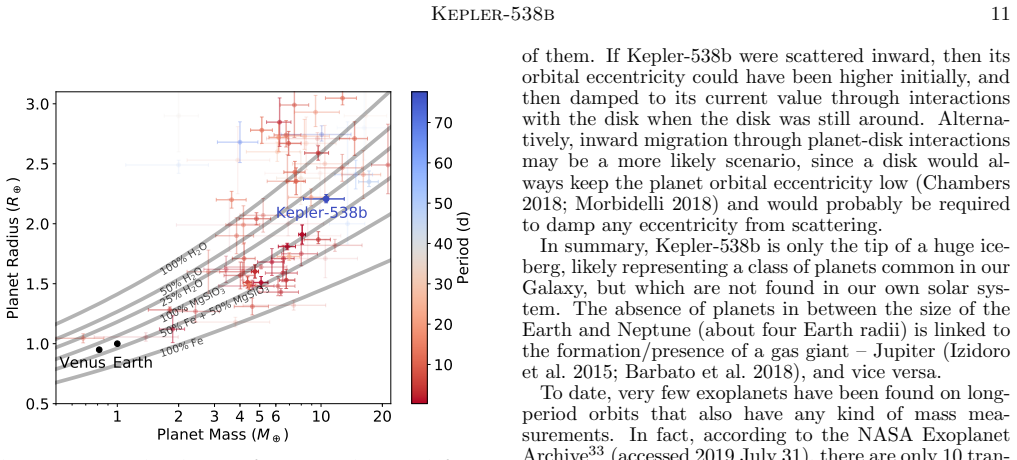
The paper's central claim is that the 81.74-day signal seen in the radial velocities is a real planet, not residual stellar activity, and that it has $M_p = 10.6^{+2.5}_{-2.4}\,M_\oplus$ and $R_p = 2.215^{+0.040}_{-0.034}\,R_\oplus$, yielding a density of $0.98 \pm 0.23$ Earth densities. The orbital eccentricity is consistent with zero, with a 95% upper limit of 0.11. The authors argue that this density places the planet on the water-ice-rich side of the mass-radius diagram, likely a mixture of ices, rocks and metals, and a modest amount of gas. They support the detection with three robustness tests: repeating the fit without photometric priors, injecting synthetic planet signals and recovering them, and dropping the Gaussian-process activity model entirely, which returns a consistent semi-amplitude of $K = 2.06^{+0.49}_{-0.46}$ m/s.
Load-bearing premise
The whole mass measurement rests on the assumption that the Gaussian-process activity model, together with the FWHM data, absorbs every non-planetary velocity signal, so the residual 81.74-day wobble is entirely caused by the planet.
Editorial extensions
If this is right
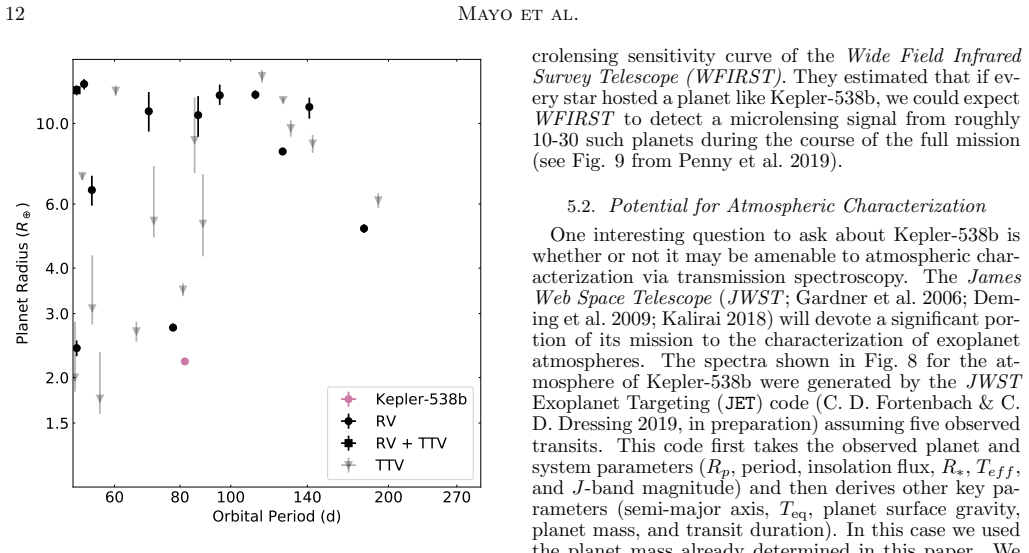
- Kepler-538b becomes the smallest known transiting planet with a period beyond 50 days and a measured radial-velocity mass, setting a new anchor for the long-period, low-mass end of the mass-radius diagram.
- Its near-Earth density combined with a sub-Neptune radius implies a volatile-rich interior dominated by water ice, with only a small gas envelope on top of a rocky or metallic core.
- The low eccentricity, less than 0.11 at 95% confidence, is consistent with disk migration or eccentricity damping, and the wide possible companion at roughly 2700 au would not disturb the planet's orbit.
- Each additional mass measurement like this one extends the rocky-to-gaseous transition and the radius-occurrence gap to lower insolation, where photoevaporation is weaker and should reshape planet compositions less aggressively.
- The system's single confirmed planet and the negligible RV signal at the 117.76-day candidate period support the conclusion that the second candidate is likely not real.
Reading between the lines
- A broader implication, not drawn by the paper: if this object is representative, long-period sub-Neptunes around Sun-like stars may commonly be ice-rich worlds with modest gas envelopes, a population that microlensing surveys could independently probe at these separations.
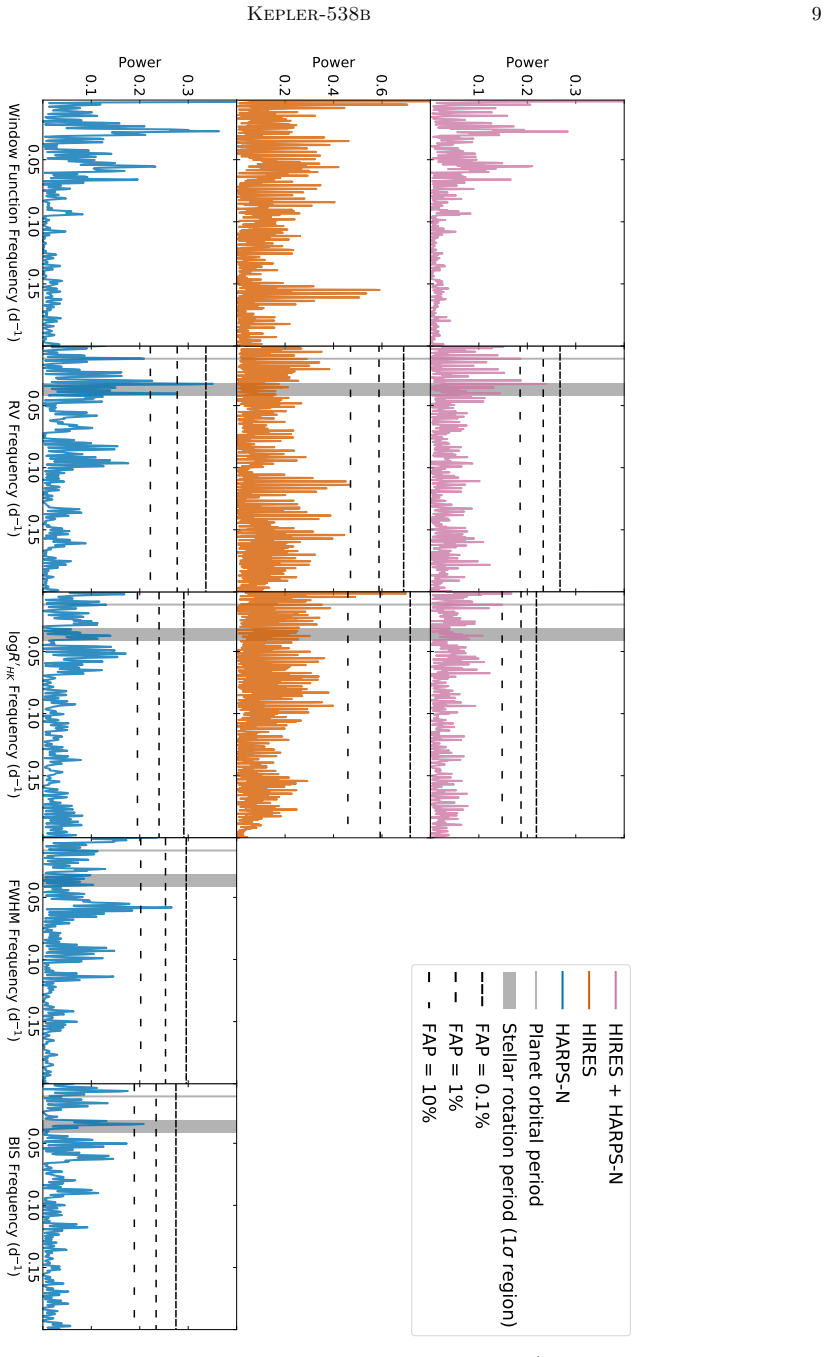
- The unexplained long-term FWHM trend the paper reports is the main avenue by which the 1.68 m/s signal could be contaminated; a longer baseline with independent activity indicators would test whether the 82-day signal stays coherent in amplitude and phase.
- Future ultra-stable spectrographs should reduce the semi-amplitude uncertainty below roughly 0.2 m/s; if the signal persists at exactly the transit-determined period and phase, the planetary interpretation would be confirmed at much higher significance.
- A testable extension would be a search for similar ice-rich compositions among other single-transit Kepler planets with periods of 60 to 120 days, checking whether density rises systematically as insolation drops.
Signed reviews
Editorial analysis
A structured set of objections, weighed in public.
Referee Report
Summary. Kepler-538b is a transiting sub-Neptune with P = 81.73778 ± 0.00013 d and radius 2.215 ± 0.040 R_Earth around a Sun-like star. This paper adds 26 HIRES and 83 HARPS-N radial-velocity measurements, together with HARPS-N FWHM activity indicators, and models them jointly with Kepler photometry using a quasi-periodic Gaussian process for stellar activity. The fit yields a semi-amplitude K = 1.68 ± 0.39 m/s and a planet mass of 10.6 ± 2.5 M_Earth, giving a mean density of 0.98 ± 0.23 Earth densities. The authors argue that Kepler-538b is the smallest transiting planet beyond 50 days with an RV mass measurement, and that its density implies a water-ice-rich composition with a small gas fraction. Three internal checks are presented: a fit without transit priors, injection-recovery tests at several periods, and a fit without the GP; all give K values consistent with the main result.
Significance. If correct, the measurement fills a genuine gap: very few planets in the 2-3 R_Earth, P > 50 d regime have both a precise radius and a dynamical mass. The radius is constrained to ~2% thanks to Gaia parallax, and the mass measurement at ~24% precision makes Kepler-538b a useful anchor for the long-period radius gap and for composition studies at moderate insolation. The paper's transparency is a strength: the full RV/FWHM tables are published, the priors are stated in Table 2, and the authors voluntarily report multiple robustness checks. The main reservation concerns the activity model, which is the one place where the central value could be biased; the paper acknowledges the issue but does not fully close it.
major comments (2)
- [Section 4.2, Eqs. (3)-(4), Table 2] The central claim (K = 1.68 ± 0.39 m/s) depends on the assumption that a single latent GP process G(t) drives both FWHM and RV through Eqs. (3) and (4). Section 4.2 reports a clear long-term FWHM trend whose stellar or instrumental origin could not be determined, and notes there is no similar trend in the RVs. Because the GP evolution timescale λ_e = 370^{+200}_{-140} d (Table 2) is comparable to the ~500-d HARPS-N baseline, the quasi-periodic kernel can absorb a slow instrumental FWHM drift into G(t), and the linear link of Eq. (3) would project that drift into the RV channel through V_c, biasing K. The no-GP fit (Section 4.4.3, K = 2.06^{+0.49}_{-0.46} m/s) shifts K by 0.38 m/s relative to the adopted value, essentially the same size as the quoted uncertainty, so the potential bias is not negligible. I request a targeted test: add a linear or quadratic trend term to the FWHM (and/or RV) model, or detrend FWHM using an independent instrumental model, and report the posterior on K and M_p. This would directly quantify the acknowledged unknown-origin trend and determine whether the result is robust.
- [Section 4.4.2] The injection-recovery tests are performed on the real observed RVs using the same GP model family as the main fit, so they demonstrate that the pipeline can recover an injected signal on top of the existing data, but they do not test the key failure mode: leakage of an instrumental FWHM trend (or activity power at the planetary period) into the RV channel. In addition, the 60-day injection - the test closest to the planetary period - recovered a semi-amplitude 1.1σ below the injected 1.7 m/s, while all longer-period tests recovered 1.7 m/s within 1σ; this behavior is not explained. A stronger validation would inject signals into synthetic data generated from the fitted GP (including a variety of FWHM trends) and verify that the posterior on K remains unbiased, or explicitly include the FWHM trend term in the injection-recovery analysis.
minor comments (4)
- [Section 6, Table 1, Abstract] The summary in Section 6 states that the host star is 0.924 M_sun, inconsistent with the abstract and Table 1, which give the combined value M_* = 0.892^{+0.051}_{-0.035} M_sun; please correct this inconsistency.
- [Section 4.4.1] The prior is written as 'BJD-2453833 = Unif(172,252)', but the rest of the paper uses BJD-2454833 as the Kepler time offset; this appears to be a typo.
- [Eq. (2), Eqs. (3)-(4)] The kernel amplitude h in Eq. (2) is not related to the amplitude parameters V_c, V_r, and F_c introduced in Eqs. (3)-(4); please state explicitly how h is normalized (e.g., fixed to unity or absorbed) so the GP parametrization is unambiguous.
- [Section 4.4.2] The text first says the injected semi-amplitude was recovered 'to within 1σ' and then immediately excepts the 60-day test, which was 1.1σ below the injected value; please rephrase to avoid the apparent contradiction.
Circularity Check
No significant circularity: the planet mass is measured from radial velocities and does not reduce to fitted inputs or to self-authored predictions.
full rationale
The paper's load-bearing result, K = 1.68 +/- 0.39 m/s and M_p = 10.6 +/- 2.5 M_Earth, is obtained by fitting a Keplerian signal to HIRES and HARPS-N radial velocities, jointly with Kepler photometry and FWHM activity indicators. Nothing in this chain defines the target quantity in terms of itself: the semi-amplitude K has a broad modified Jeffreys prior with a knee at 2.1 m/s, so the posterior at 1.68 m/s is not forced by the prior; the orbital period and ephemeris come from Kepler photometry, and the RV-only test (Section 4.4.1) independently recovers P = 82.25 +/- 0.74 days, confirming that the photometric constraint is not doing the work; the no-GP fit (Section 4.4.3) gives K = 2.06 +/- 0.49 m/s, within 1 sigma of the main result, showing the GP activity model is not constructing the signal; and the injection tests (Section 4.4.2) demonstrate that a synthetic 1.7 m/s signal is recovered at several periods, validating the error budget and recovery procedure. The Gaussian-process framework of Eqs. (2)-(4) is adopted from Rajpaul et al. (2015), which is prior published work with overlapping authorship, but it is used as a statistical activity model rather than as an external 'uniqueness theorem' that forbids alternatives; indeed, the paper explicitly tests a model without the GP. Likewise, the Zeng et al. (2016, 2018) mass-radius and composition curves are external empirical/theoretical relations used only to interpret the measured mass and radius, and the water-ice-rich conclusion is not fed back into the measurement. The acknowledged long-term FWHM trend of undetermined origin (Section 4.2) is a legitimate model-risk concern about activity contamination, but it is a question of possible bias or mis-modeling, not circularity: the paper does not define the planet signal in terms of the FWHM trend or fit a parameter that is then reported as an independent prediction. No step reduces, by construction or by self-citation, to its own input, so the appropriate finding is no significant circularity.
Assumptions & free parameters
free parameters (13)
- RV semi-amplitude K =
1.68 +/- 0.39 m/s
- Orbital eccentricity e =
0.041 +/- 0.034
- GP stellar rotation period P* =
25.2 +6.5 / -1.2 d
- GP inverse harmonic complexity lambda_p =
5.2 +2.8 / -2.5
- GP evolution timescale lambda_e =
370 +200 / -140 d
- GP RV convective blueshift amplitude Vc =
0.86 +0.75 / -0.54 m/s
- GP RV rotation modulation amplitude Vr =
4.0 +5.7 / -3.0 m/s
- GP FWHM amplitude Fc =
13.3 +5.9 / -4.9 m/s
- Stellar mass M* =
0.892 +0.051 / -0.035 Msun
- Stellar radius R* =
0.8717 +0.0064 / -0.0061 Rsun
- Planet radius ratio Rp/R* =
0.02329 +0.00039 / -0.00033
- White noise amplitudes =
HIRES RV 3.25, HARPS-N RV 2.24, FWHM 6.71 m/s; photometry 112.2 ppm
- Instrumental offsets =
HIRES RV, HARPS-N RV, and HARPS-N FWHM offsets
assumptions (8)
- standard math Bayesian posterior sampling with MultiNest gives valid parameter estimates and uncertainties.
- domain assumption The quasi-periodic GP kernel in Eq. (2) adequately describes stellar activity in the RVs and FWHM.
- domain assumption The linear relations in Eqs. (3) and (4) connect the latent activity process G(t) to the observed RV and FWHM series.
- domain assumption The Kepler photometry and the BATMAN/Mandel-Agol transit model give an unbiased radius ratio and transit ephemeris.
- domain assumption MESA/MIST and Dartmouth stellar isochrones, used through the isochrones package, give unbiased stellar mass and radius.
- domain assumption The 81.74-day RV signal is a Keplerian planet rather than a second stellar activity timescale.
- domain assumption The NASA Exoplanet Archive query correctly identifies all transiting planets with P > 50 d and RV mass measurements.
- domain assumption The mass-radius composition curves of Zeng and Sasselov (2013) and Zeng et al. (2016, 2018) correctly map density to water, rock, and iron fractions.
Cite this review
Pith. "Pith review of An 11 Earth-Mass, Long-Period Sub-Neptune Orbiting a Sun-like Star." pith.science (2026). https://pith.science/paper/QF5O3XLT
@misc{pith2026190808585,
  author       = {Pith},
  title        = {Pith review of: An 11 Earth-Mass, Long-Period Sub-Neptune Orbiting a Sun-like Star},
  year         = {2026},
  howpublished = {\url{https://pith.science/paper/QF5O3XLT}},
  note         = {Machine review of arXiv:1908.08585}
}
read the original abstract
Although several thousands of exoplanets have now been detected and characterized, observational biases have led to a paucity of long-period, low-mass exoplanets with measured masses and a corresponding lag in our understanding of such planets. In this paper we report the mass estimation and characterization of the long-period exoplanet Kepler-538b. This planet orbits a Sun-like star (V = 11.27) with M_* = 0.892 +/- (0.051, 0.035) M_sun and R_* = 0.8717 +/- (0.0064, 0.0061) R_sun. Kepler-538b is a 2.215 +/- (0.040, 0.034) R_earth sub-Neptune with a period of P = 81.73778 +/- 0.00013 d. It is the only known planet in the system. We collected radial velocity (RV) observations with HIRES on Keck I and HARPS-N on the TNG. We characterized stellar activity by a Gaussian process with a quasi-periodic kernel applied to our RV and cross correlation function full width at half maximum (FWHM) observations. By simultaneously modeling Kepler photometry, RV, and FWHM observations, we found a semi-amplitude of K = 1.68 +/- (0.39, 0.38) m s^-1 and a planet mass of M_p = 10.6 +/- (2.5, 2.4) M_earth. Kepler-538b is the smallest planet beyond P = 50 d with an RV mass measurement. The planet likely consists of a significant fraction of ices (dominated by water ice), in addition to rocks/metals, and a small amount of gas. Sophisticated modeling techniques such as those used in this paper, combined with future spectrographs with ultra high-precision and stability will be vital for yielding more mass measurements in this poorly understood exoplanet regime. This in turn will improve our understanding of the relationship between planet composition and insolation flux and how the rocky to gaseous transition depends on planetary equilibrium temperature.
Figures


Figures from the paper (5 more)



Forward citations
Cited by 1 Pith paper
-
Dynamical formation of long-period exoplanets systems in evolving binary stars
MESA+REBOUND simulations show that stellar mass loss in a wide binary destabilizes S-type multi-planet systems and pushes surviving giants to long-period orbits.
Reference graph
Works this paper leans on
-
[1]
, " * write output.state after.block = add.period write newline
ENTRY address archivePrefix author booktitle chapter doi edition editor eprint howpublished institution journal key month note number organization pages publisher school series title type volume year label extra.label sort.label short.list INTEGERS output.state before.all mid.sentence after.sentence after.block FUNCTION init.state.consts #0 'before.all :=...
-
[2]
write newline
" write newline "" before.all 'output.state := FUNCTION format.doi doi empty "" "doi:" doi * if FUNCTION format.eprint eprint empty "" archivePrefix empty "" archivePrefix ":" * if eprint field.or.null * if FUNCTION format.pid eprint empty format.doi format.eprint if FUNCTION n.dashify 't := "" t empty not t #1 #1 substring "-" = t #1 #2 substring "--" = ...
-
[3]
2018, , 615, A175
Barbato , D., Sozzetti , A., Desidera , S., et al. 2018, , 615, A175
2018
-
[4]
2019, KeplerGO/lightkurve: Lightkurve v1.0b29, doi:10.5281/zenodo.2565212
Barentsen, G., Hedges, C., Vinícius, Z., et al. 2019, KeplerGO/lightkurve: Lightkurve v1.0b29, doi:10.5281/zenodo.2565212
-
[5]
Barnes , S. A. 2010, , 722, 222
2010
-
[6]
A., & Kim , Y.-C
Barnes , S. A., & Kim , Y.-C. 2010, , 721, 675
2010
- [7]
-
[8]
E., Mandell , A., Pontoppidan , K., et al
Batalha , N. E., Mandell , A., Pontoppidan , K., et al. 2017, , 129, 064501
work page 2017
Show all 85 references
-
[9]
2017, , 599, A90
Benatti , S., Desidera , S., Damasso , M., et al. 2017, , 599, A90
2017
-
[10]
A., Huber , D., Gaidos , E., & van Saders , J
Berger , T. A., Huber , D., Gaidos , E., & van Saders , J. L. 2018, , 866, 99
2018
-
[11]
2008, in IAU Symposium, Vol
Borucki , W., Koch , D., Basri , G., et al. 2008, in IAU Symposium, Vol. 249, Exoplanets: Detection, Formation and Dynamics, ed. Y.-S. Sun , S. Ferraz-Mello , & J.-L. Zhou , 17--24
2008
-
[12]
T., Abdul-Masih , M., Batalha , N., et al
Bryson , S. T., Abdul-Masih , M., Batalha , N., et al. 2017, The Kepler Certified False Positive Table , Tech. rep
2017
-
[13]
A., Latham , D
Buchhave , L. A., Latham , D. W., Johansen , A., et al. 2012, , 486, 375
2012
-
[14]
2018, , 865, 30
Chambers , J. 2018, , 865, 30
2018
-
[15]
2012, in Society of Photo-Optical Instrumentation Engineers (SPIE) Conference Series, Vol
Cosentino , R., Lovis , C., Pepe , F., et al. 2012, in Society of Photo-Optical Instrumentation Engineers (SPIE) Conference Series, Vol. 8446, Ground-based and Airborne Instrumentation for Astronomy IV, 84461V
2012
-
[16]
2014, in Society of Photo-Optical Instrumentation Engineers (SPIE) Conference Series, Vol
Cosentino , R., Lovis , C., Pepe , F., et al. 2014, in Society of Photo-Optical Instrumentation Engineers (SPIE) Conference Series, Vol. 9147, Ground-based and Airborne Instrumentation for Astronomy V, 91478C
2014
-
[17]
M., Skrutskie , M
Cutri , R. M., Skrutskie , M. F., van Dyk , S., et al. 2003, VizieR Online Data Catalog, 2246
2003
-
[18]
2009, , 121, 952
Deming , D., Seager , S., Winn , J., et al. 2009, , 121, 952
2009
-
[19]
P., & Bridges , M
Feroz , F., Hobson , M. P., & Bridges , M. 2009, , 398, 1601
2009
-
[20]
P., Cameron , E., & Pettitt , A
Feroz , F., Hobson , M. P., Cameron , E., & Pettitt , A. N. 2013, ArXiv e-prints, arXiv:1306.2144
2013 arXiv
-
[21]
2008, PhD thesis, University of Szeged, Hungary
F u r \'e sz , G. 2008, PhD thesis, University of Szeged, Hungary
2008
-
[22]
J., & Petigura , E
Fulton , B. J., & Petigura , E. A. 2018, , 156, 264
2018
-
[23]
J., Petigura , E
Fulton , B. J., Petigura , E. A., Howard , A. W., et al. 2017, , 154, 109
2017
-
[24]
Gaia Collaboration , Prusti , T., de Bruijne , J. H. J., et al. 2016, , 595, A1
2016
-
[25]
Gaia Collaboration , Brown , A. G. A., Vallenari , A., et al. 2018, , 616, A1
2018
-
[26]
P., Mather , J
Gardner , J. P., Mather , J. C., Clampin , M., et al. 2006, , 123, 485
2006
-
[27]
R., Howard , A
Gibson , S. R., Howard , A. W., Marcy , G. W., et al. 2016, in , Vol. 9908, Ground-based and Airborne Instrumentation for Astronomy VI, 990870
2016
-
[28]
R., Howard , A
Gibson , S. R., Howard , A. W., Roy , A., et al. 2018, in Society of Photo-Optical Instrumentation Engineers (SPIE) Conference Series, Vol. 10702, Ground-based and Airborne Instrumentation for Astronomy VII, 107025X
2018
-
[29]
Gregory , P. C. 2007, , 381, 1607
2007
-
[30]
Haywood , R. D. 2015, PhD thesis, University of St Andrews, doi:10.5281/zenodo.35161
2015 doi
-
[31]
D., Collier Cameron , A., Queloz , D., et al
Haywood , R. D., Collier Cameron , A., Queloz , D., et al. 2014, , 443, 2517
2014
-
[32]
W., Johnson , J
Howard , A. W., Johnson , J. A., Marcy , G. W., et al. 2010, , 721, 1467
2010
-
[33]
N., Morbidelli , A., Hersant , F., & Pierens , A
Izidoro , A., Raymond , S. N., Morbidelli , A., Hersant , F., & Pierens , A. 2015, , 800, L22
2015
-
[34]
2012, in , Vol
Johns , M., McCarthy , P., Raybould , K., et al. 2012, in , Vol. 8444, Ground-based and Airborne Telescopes IV, 84441H
2012
-
[35]
2016, in , Vol
Jurgenson , C., Fischer , D., McCracken , T., et al. 2016, in , Vol. 9908, Ground-based and Airborne Instrumentation for Astronomy VI, 99086T
2016
-
[36]
2018, Contemporary Physics, 59, 251
Kalirai , J. 2018, Contemporary Physics, 59, 251
2018
-
[37]
M.-R., Lupu , R., Owusu-Asare , A., Slough , P., & Cale , B
Kempton , E. M.-R., Lupu , R., Owusu-Asare , A., Slough , P., & Cale , B. 2017, , 129, 044402
2017
-
[38]
Kipping , D. M. 2013 a , , 435, 2152
2013
-
[39]
2013 b , , 434, L51
---. 2013 b , , 434, L51
2013
-
[40]
2015, , 127, 1161
Kreidberg , L. 2015, , 127, 1161
2015
-
[41]
1993, ATLAS9 Stellar Atmosphere Programs and 2 km/s grid
Kurucz , R. 1993, ATLAS9 Stellar Atmosphere Programs and 2 km/s grid. Kurucz CD-ROM No. 13. Cambridge, Mass.: Smithsonian Astrophysical Observatory, 1993., 13
1993
-
[42]
Kurucz , R. L. 1992, in IAU Symposium, Vol. 149, The Stellar Populations of Galaxies, ed. B. Barbuy & A. Renzini , 225
1992
-
[43]
2018, , 616, A2
Lindegren , L., Hern \'a ndez , J., Bombrun , A., et al. 2018, , 616, A2
2018
-
[44]
2012, , 761, 122
Lithwick , Y., Xie , J., & Wu , Y. 2012, , 761, 122
2012
-
[45]
D., & Rice , K
Lopez , E. D., & Rice , K. 2018, , 479, 5303
2018
-
[46]
2010, in , Vol
Mahadevan , S., Ramsey , L., Wright , J., et al. 2010, in , Vol. 7735, Ground-based and Airborne Instrumentation for Astronomy III, 77356X
2010
-
[47]
W., Terrien , R., et al
Mahadevan , S., Ramsey , L. W., Terrien , R., et al. 2014, in , Vol. 9147, Ground-based and Airborne Instrumentation for Astronomy V, 91471G
2014
-
[48]
2017, , 153, 224
Malavolta , L., Borsato , L., Granata , V., et al. 2017, , 153, 224
2017
-
[49]
W., Louden , T., et al
Malavolta , L., Mayo , A. W., Louden , T., et al. 2018, , 155, 107
2018
-
[50]
2002, , 580, L171
Mandel , K., & Agol , E. 2002, , 580, L171
2002
-
[51]
W., Dupuy , T., Kraus , A
Mann , A. W., Dupuy , T., Kraus , A. L., et al. 2019, , 871, 63
2019
-
[52]
2010, in , Vol
M \'e gevand , D., Herreros , J.-M., Zerbi , F., et al. 2010, in , Vol. 7735, Ground-based and Airborne Instrumentation for Astronomy III, 77354Y
2010
-
[53]
2018, arXiv e-prints, arXiv:1803.06708
Morbidelli , A. 2018, arXiv e-prints, arXiv:1803.06708
2018 arXiv
-
[54]
G., Adibekyan , V
Mortier , A., Sousa , S. G., Adibekyan , V. Z., Brand \ a o , I. M., & Santos , N. C. 2014, , 572, A95
2014
-
[55]
Morton , T. D. 2015, isochrones: Stellar model grid package , Astrophysics Source Code Library, ascl:1503.010
2015
-
[56]
D., Bryson , S
Morton , T. D., Bryson , S. T., Coughlin , J. L., et al. 2016, , 822, 86
2016
-
[57]
L., Thompson , S
Mullally , F., Coughlin , J. L., Thompson , S. E., et al. 2015, , 217, 31
2015
-
[58]
W., Hartmann , L
Noyes , R. W., Hartmann , L. W., Baliunas , S. L., Duncan , D. K., & Vaughan , A. H. 1984, , 279, 763
1984
-
[59]
E., & Wu , Y
Owen , J. E., & Wu , Y. 2017, , 847, 29
2017
-
[60]
T., Gaudi , B
Penny , M. T., Gaudi , B. S., Kerins , E., et al. 2019, , 241, 3
2019
-
[61]
\'A ., & Lindegren , L
Perryman , M., Hartman , J., Bakos , G. \'A ., & Lindegren , L. 2014, , 797, 14
2014
-
[62]
A., Marcy , G
Petigura , E. A., Marcy , G. W., Winn , J. N., et al. 2018, , 155, 89
2018
-
[63]
W., Sivan , J
Queloz , D., Henry , G. W., Sivan , J. P., et al. 2001, , 379, 279
2001
-
[64]
A., Reece , S., & Roberts , S
Rajpaul , V., Aigrain , S., Osborne , M. A., Reece , S., & Roberts , S. 2015, , 452, 2269
2015
-
[65]
E., & Williams , C
Rasmussen , C. E., & Williams , C. K. I. 2006, Gaussian Processes for Machine Learning
2006
-
[66]
N., Barnes , R., Veras , D., et al
Raymond , S. N., Barnes , R., Veras , D., et al. 2009, , 696, L98
2009
-
[67]
Sanders , G. H. 2013, Journal of Astrophysics and Astronomy, 34, 81
2013
-
[68]
Scargle , J. D. 1982, , 263, 835
1982
-
[69]
2016, in , Vol
Schwab , C., Rakich , A., Gong , Q., et al. 2016, in , Vol. 9908, Ground-based and Airborne Instrumentation for Astronomy VI, 99087H
2016
-
[70]
2003, , 585, 1038
Seager , S., & Mall \'e n-Ornelas , G. 2003, , 585, 1038
2003
-
[71]
Sneden , C. A. 1973, PhD thesis, THE UNIVERSITY OF TEXAS AT AUSTIN
1973
-
[72]
Sousa , S. G. 2014, ARES + MOOG: A Practical Overview of an Equivalent Width (EW) Method to Derive Stellar Parameters , ed. E. Niemczura , B. Smalley , & W. Pych , 297--310
2014
-
[73]
G., Santos , N
Sousa , S. G., Santos , N. C., Israelian , G., et al. 2011, , 526, A99+
2011
-
[74]
G., Santos , N
Sousa , S. G., Santos , N. C., Mortier , A., et al. 2015, , 576, A94
2015
-
[75]
2007, , 664, 1190
Sozzetti , A., Torres , G., Charbonneau , D., et al. 2007, , 664, 1190
2007
-
[76]
2018, arXiv e-prints, arXiv:1809.09668
The LUVOIR Team . 2018, arXiv e-prints, arXiv:1809.09668
2018 arXiv
-
[77]
E., Coughlin , J
Thompson , S. E., Coughlin , J. L., Hoffman , K., et al. 2018, , 235, 38
2018
-
[78]
2014, ArXiv e-prints, arXiv:1412.1048
Udry , S., Lovis , C., Bouchy , F., et al. 2014, ArXiv e-prints, arXiv:1412.1048
2014 arXiv
-
[79]
S., et al
Van Eylen , V., Agentoft , C., Lundkvist , M. S., et al. 2018, , 479, 4786
2018
-
[80]
S., Allen , S
Vogt , S. S., Allen , S. L., Bigelow , B. C., et al. 1994, in , Vol. 2198, Instrumentation in Astronomy VIII, ed. D. L. Crawford & E. R. Craine , 362
1994
-
[81]
2009, , 496, 577
Zechmeister , M., & K \"u rster , M. 2009, , 496, 577
2009
-
[82]
B., & Sasselov , D
Zeng , L., Jacobsen , S. B., & Sasselov , D. D. 2017, Research Notes of the American Astronomical Society, 1, 32
2017
-
[83]
B., Sasselov , D
Zeng , L., Jacobsen , S. B., Sasselov , D. D., & Vand erburg , A. 2018, , 479, 5567
2018
-
[84]
2013, , 125, 227
Zeng , L., & Sasselov , D. 2013, , 125, 227
2013
-
[85]
D., & Jacobsen , S
Zeng , L., Sasselov , D. D., & Jacobsen , S. B. 2016, , 819, 127
2016
Reviewed August 14, 2026 · model on record in the stance chip above.
Discussion (0). Continue with ORCID to comment.