REVIEW 5 major objections 5 minor 269 references
Long-period giant exoplanets can be produced by the coupled action of a binary companion and the host star's post-main-sequence mass loss, which pushes survivors outward and concentrates them inside roughly 50 au.
Reviewed by Pith at T0; open to challenge. T0 means a machine referee read the full paper against a public rubric. the ladder, T0–T4 →
T0 review · deepseek-v4-flash
2026-08-01 13:23 UTC pith:LP3MTDQ4
load-bearing objection The evolved-vs-control experiment is the right design and the direction is robust, but the headline claim rests on one binary architecture and the statistics are under-documented. the 5 major comments →
Dynamical formation of long-period exoplanets systems in evolving binary stars
The pith
A machine-rendered reading of the paper's core claim, the machinery that carries it, and where it could break.
Core claim
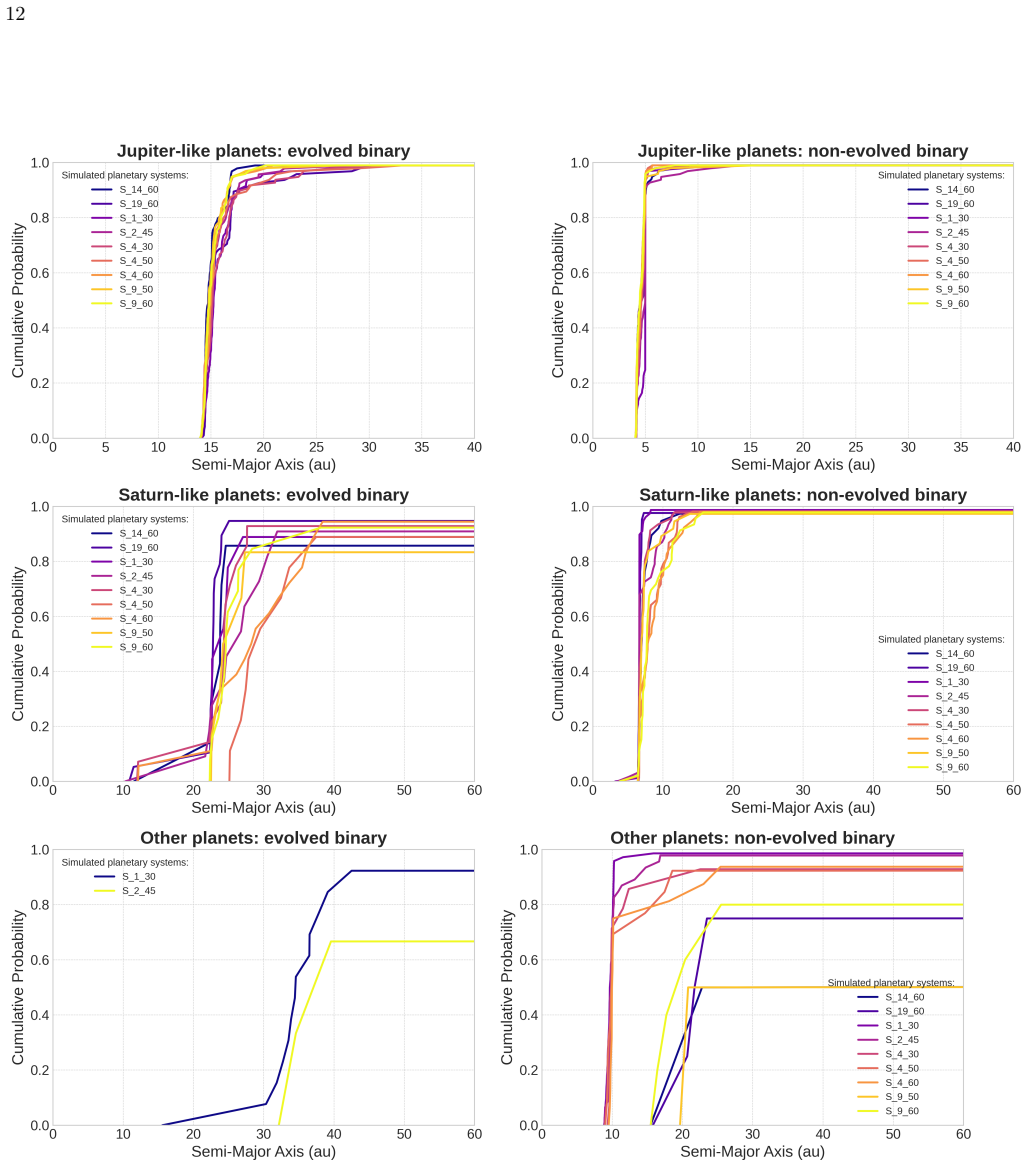
The central discovery is that post-main-sequence mass loss is not a passive background in wide binaries: it destabilizes multi-planet systems that would otherwise remain stable. In a simulated binary with a 2-solar-mass primary evolving to a white dwarf and a 0.8-solar-mass companion at 100 au, a Jupiter-Saturn pair at 5 and 6.55 au in 3:2 resonance plus ice-giant-mass planets shows higher ejection rates when stellar evolution is included (0.44 vs 0.12 in the simplest system). Survivors end up on wider orbits — Jupiter-like planets mostly 15–30 au, Saturn-like 20–40 au, lower-mass planets out to ~50 au — and the binary companion concentrates these survivors within ~50 au, whereas an evolved
What carries the argument
The mechanism that carries the argument is adiabatic orbital expansion caused by stellar mass loss, combined with secular perturbations from the secondary star. As the primary sheds most of its envelope, the gravitational potential weakens and every orbit — binary and planetary — widens by the same inverse-mass scaling; the binary separation grows from 100 to 202 au, and a single Jupiter analog drifts from 5 to about 13 au. In multi-planet systems this expansion changes period ratios and eccentricity structure that had protected the resonant 3:2 chain, re-triggering close encounters and ejections. The secondary star's continued perturbations make the instability stronger and, in the evolved
Load-bearing premise
The quantitative conclusions rest on a single hand-picked starting point — a 2 and 0.8 solar-mass binary at 100 au with circular orbit, and a planetary system packed with Jupiter at 5 au, Saturn at 6.55 au in 3:2 resonance, and additional planets at 5–10 Hill radii — and are not demonstrated to survive variation of those initial conditions.
What would settle it
Rerun the same ensemble with binary separations of 50 au and 300 au and with planets initially spaced at 10–20 Hill radii; if the ejection-rate boost and the 15–50 au survivor distribution do not persist, the mechanism is specific to the chosen architecture. Observationally, a survey of giant planets around white dwarfs in wide binaries that finds no concentration in the 15–50 au range would falsify the predicted pile-up.
If this is right
- Systems that are dynamically stable on the main sequence do not necessarily stay stable: when stellar evolution is included, only one of the nine configurations retained a fully stable system, versus 151 in the non-evolving controls.
- Ejection, not merger, dominates the instability: merge rates stay at 1–2%, while ejection rates rise substantially, so the typical outcome of mass-loss-triggered instability is a lost planet, not a collision.
- Surviving Jupiter-like planets should be found at 15–50 au with low-to-moderate eccentricity (below about 0.3), filling the currently under-sampled long-period giant region.
- Lower-mass planets (super-Earth and ice-giant analogs) are the most vulnerable; their survival rate is lowest and their final orbits are the broadest, so evolved binary systems should be preferentially depleted in these planets.
- The binary companion, not the mass loss alone, sets the final confinement: an evolved single star leaves survivors scattered to distances up to about 4,000 au, while the evolved binary keeps them inside about 50 au.
Where Pith is reading between the lines
- Because only one binary architecture (2 and 0.8 solar masses, 100 au, circular) is simulated, the specific 50 au confinement radius is not yet a robust prediction for the whole wide-binary population; varying binary separation and eccentricity in the same setup could either confirm or erase it.
- The same adiabatic-expansion logic implies that planets initially inside a few au — not included here — would also be carried outward, but they would first have to survive the red-giant envelope; systems with close-in giants might therefore show a signature of engulfment rather than outward migration.
- A testable extension: direct-imaging surveys of white dwarfs in wide binaries should find a pile-up of giant planets at 15–50 au with moderate eccentricities; if such surveys instead find planets at much wider separations, the initial condition of 5–10 Hill-radii packing would need revision.
Editorial analysis
A structured set of objections, weighed in public.
Referee Report
Summary. The manuscript couples a MESA stellar-evolution track of a 2 Msun primary (with a 0.8 Msun companion at 100 au, e=0, Z=0.02) to REBOUND N-body integrations of S-type multi-planet systems, and compares them with non-evolving controls. It reports that stellar evolution raises planetary ejection rates for all nine initial planet configurations, broadens the surviving semi-major-axis distributions of Jupiter/Saturn-like planets to roughly 15-50 au, and, from an additional set of 1,000 single-star vs binary simulations for the 19-60 configuration, that the secondary star makes systems more unstable and concentrates survivors within about 50 au. The paper concludes that long-period giant exoplanets may be a direct consequence of the coupled effects of binary dynamics and post-main-sequence stellar mass loss.
Significance. If the conclusions were robust, the paper would provide a concrete late-stage dynamical pathway for forming long-period giant planets and make a falsifiable prediction about the orbital architecture of survivors around white dwarfs in wide binaries. The design has real strengths: it uses independent, standard tools (MESA tracks and REBOUND/IAS15), isolates the effect of stellar evolution by comparing evolved and non-evolved controls, and does not fit any quantity to the observed sample shown in Fig. 10. The direction of the evolved-vs-control effect (higher ejection, outward broadening) is internally consistent. However, the population-level claim rests on a single binary architecture and one prescribed initial planet packing, and several statistical and methodological details are not reported. The quantitative central claim is therefore not yet established at the level claimed in the abstract.
major comments (5)
- [Sec. 2, Table 1; Sec. 4.3, Fig. 9] All simulations use a single binary configuration: a=100 au, e=0, M1=2 Msun, M2=0.8 Msun, Z=0.02 (Table 1), and the nine planet configurations in Table 2 also share the same initial binary. The abstract and Sec. 4.3 conclude that long-period giants may be a 'direct consequence' of binary dynamics plus mass loss and that the secondary 'concentrated the survivors within 50 au'. With one point in binary-parameter space, these population-level statements are underdetermined; the S-type stability boundary and the amplitude of the companion's secular perturbations depend strongly on a_bin, e_bin and mass ratio (Holman & Wiegert 1999). A grid over a_bin (e.g., 30-1000 au) and e_bin, or at least an explicit argument that 100 au/e=0 is representative of the relevant wide-binary population, is needed before the conclusion can be stated in this form.
- [Sec. 3.3, Table 2; Sec. 4.2, Table 3] The nine configurations vary only the number and mass of low-mass 'other' planets. Jupiter-like and Saturn-like planets are always initialized at 5.0 au and 6.55 au in the same 3:2 mean-motion resonance, with e=0. Since the paper's headline population is long-period giant planets, the instability rates and final-a distributions of Jupiter/Saturn-like planets are sensitive to this chosen spacing and resonance. Without varying the giant-planet architecture (period ratios, presence of the 3:2 resonance, number of giants), the quantitative conclusions, especially the 'direct consequence' claim, are conditional on one packing prescription.
- [Table 3; Sec. 4.2] The ejection and merge rates are quoted without error bars or sample sizes. Summing the implied planet counts per configuration (3, 4, 6, 6, 6, 11, 11, 16, 21 planets) gives 84 planets per realization, so the stated total of 8,400 corresponds to 100 realizations per tag, but this is never stated. With N=100, the uncertainty on a rate of 0.5 is about ±0.05, so differences such as 0.88 vs 0.83 for 19-60 are not statistically distinguishable. Please report N, confidence intervals or raw counts, and the test used to support the claim of a consistent trend across all configurations.
- [Eq. (1), Fig. 3; Sec. 3.2] Equation (1) uses the total binary masses and is the standard adiabatic expression for a circumbinary test particle. The simulated planets are on S-type orbits around the primary; at lowest order the adiabatic response to primary mass loss is a_f ≈ a_i M1,i/M1,f, with the companion entering as a perturbing potential rather than as part of the central mass. The factor of ~2.6 in Fig. 3 (5 au to 13 au) lies between the primary-only (3.45) and total-mass (2.03) predictions, so the claimed agreement with the magenta curve is not self-evident. Please derive the applicable S-type expression or show explicitly why Eq. (1) applies; otherwise the validation of the interpolation method in Fig. 3 is not justified.
- [Captions to Figs. 4 and 5; Sec. 4.1] The manuscript states that planets ejected before a 100-timestep are 'excluded from the simulations' and not shown. Because the initial configurations are deliberately compact and unstable, this cut could remove a substantial fraction of the sample before the evolved/control comparison begins, and the ejection rates in Table 3 and survivor counts in Sec. 4.2 are then not defined over the full initial ensemble. Please quantify how many planets are removed by this criterion and verify that the evolved-control differences are not driven by it. Since the two branches are nearly identical in the first ~100 timesteps, any early-ejection asymmetry in the random draws could bias the comparison.
minor comments (5)
- [Table 3, row 2-45] The entry '0.56−0.28 0.01' appears to have a corrupted separator; it is unclear whether the intended evolved/non-evolved ejection rates are 0.56/0.28 and what the corresponding merge rates are. Please reformat.
- [Abstract; Sec. 1] The repeated 'Although' at the start of consecutive sentences and the phrase 'we propose that their formation pathways are robust' should be rewritten for clarity. The term 'long-period' is defined as a≥5 au in the introduction but used inconsistently elsewhere.
- [Sec. 3.2] The sentence 'The winds and this planetary nebulae originating from the evolution of the primary are not considered here' has a grammar error, and it should be clarified whether the planetary-nebula mass-loss episode is included in the MESA track or removed by the envelope cut-off.
- [Sec. 4.2.1; Fig. 6] The text refers to 'simulations with 10 and 20 bodies' and 'with 2 and 3 exoplanets survived with masses of 15 M⊕'; these do not map cleanly to the tags in Table 2. Please align the nomenclature with the simulation tags.
- [Footnote 4; Fig. 10] The footnote conflates the NASA Exoplanet Archive (exoplanetarchive.ipac.caltech.edu) with exoplanet.eu. Please provide the correct catalog and a version/data reference for the observed sample used in Fig. 10.
Circularity Check
No circular derivation: evolved-binary outcomes are genuine N-body outputs against non-evolved controls.
full rationale
No specific circular step is present. The stellar mass-loss history comes from MESA (Section 2, Table 1) and is interpolated into REBOUND (Section 3.1); the reported ejection/merge rates (Table 3) and final a/e/i distributions (Figs. 6-8) are outputs of the N-body integrations, not quantities fitted to the observed exoplanet catalog used in Fig. 10, which is only a qualitative comparison. Equation (1) is a known adiabatic mass-loss scaling used as a consistency check for the N-body orbital expansion (Section 3.2), not as the source of the paper's main conclusions. The self-citations to Belloni et al. (2024) for the MESA setup (Section 2) state explicit modeling assumptions; they do not supply the central claim, and the key comparisons are controlled (evolved vs non-evolved; binary vs single-star in Section 4.3). The manuscript's own limitation that "Exoplanets ejected before a 100-timestep are excluded from the simulation and it is not shown here" (Figs. 4 and 5 captions) affects evolved and control arms equally, since significant mass loss begins only near t≈1.37 Gyr, so it is a completeness caveat rather than a circular step. The main weakness is external validity: only one binary architecture (a=100 au, e=0, 2+0.8 M_sun) is explored, so the population-level "direct consequence" and "within 50 au" statements are underdetermined, but that is a generalization gap, not internal circularity.
Axiom & Free-Parameter Ledger
free parameters (7)
- Primary initial mass =
2 M_sun
- Secondary mass =
0.8 M_sun
- Binary initial separation and eccentricity =
100 au, e=0
- Metallicity =
Z=0.02
- Reimers/Blocker wind efficiencies =
0.1 and 0.02
- Initial planet architecture =
Jupiter at 5 au, Saturn at 6.55 au 3:2 MMR; additional planets at 5-10 Hill radii; masses per Table 2
- Planet removal radius =
1 au; e>1
axioms (6)
- domain assumption Newtonian point-mass N-body dynamics (IAS15) with no tides or spin evolution captures the relevant orbital evolution.
- domain assumption Stellar mass loss is slow and isotropic; the planet's mass is unchanged and Eq. 1 gives the expected orbital response.
- ad hoc to paper Planets are fully formed at t=0 with specified masses and orbits; no gas disk or planet formation is modeled.
- ad hoc to paper The single MESA binary track (2 M_sun + 0.8 M_sun, 100 au, Z=0.02, e=0) is representative of wide binaries hosting long-period planets.
- domain assumption Removing planets with a<1 au or e>1 is a valid proxy for planet loss.
- ad hoc to paper Eq. 1 (a_f=a_i(M1,i+M2,i)/(M1,f+M2,f)) applies to an S-type planet around the primary.
read the original abstract
The dynamical formation and evolution of long-period giant exoplanets have not been well constrained due to the few observational parameters. In this study, we explore the dynamical effects in a multi-planetary system around one star of an evolving wide binary system. We used an interpolated result of a MESA stellar evolution inside REBOUND N-body integrations to perform simulations with a range of distinct planetary masses in a circumstellar configuration (S-type orbit), centered on a primary star that evolves from the main sequence star to a white dwarf. Control simulations without stellar evolution were performed to isolate the effects of mass loss. Although few exoplanets are currently known to possess long-period and moderate eccentricities, we investigated the evolution mechanisms of long-period gas giants within this specific regime. Although these exoplanets often remain undetected due to their wide orbits and long periods, we propose that their formation pathways are robust throughout the evolution of binary systems. We also simulated an evolved single star in a multi-planetary system and concluded that the secondary star made the exoplanets more unstable and concentrated the survivors within a semi-major axis of 50 au.
Figures




Reference graph
Works this paper leans on
-
[1]
, archivePrefix =. 2011 , month =. doi:10.1088/0067-0049/192/1/3 , adsurl =. 1009.1622 , primaryClass =
Pith/arXiv arXiv 2011
-
[2]
, archivePrefix =. 2013 , month =. doi:10.1088/0067-0049/208/1/4 , adsurl =. 1301.0319 , primaryClass =
Pith/arXiv arXiv 2013
-
[3]
, archivePrefix =. 2015 , month =. doi:10.1088/0067-0049/220/1/15 , adsurl =. 1506.03146 , primaryClass =
Pith/arXiv arXiv 2015
-
[4]
, archivePrefix =. 2018 , month =. doi:10.3847/1538-4365/aaa5a8 , adsurl =. 1710.08424 , primaryClass =
Pith/arXiv arXiv 2018
-
[5]
Modules for Experiments in Stellar Astrophysics (MESA): Pulsating Variable Stars, Rotation, Convective Boundaries, and Energy Conservation. , keywords =. 2019. doi:10.3847/1538-4365/ab2241 , archivePrefix =. 1903.01426 , primaryClass =
Pith/arXiv arXiv 2019
-
[6]
Modules for Experiments in Stellar Astrophysics (MESA): Time-dependent Convection, Energy Conservation, Automatic Differentiation, and Infrastructure. , keywords =. doi:10.3847/1538-4365/acae8d , archivePrefix =. 2208.03651 , primaryClass =
-
[7]
The FreeEOS Code for Calculating the Equation of State for Stellar Interiors , url =
-
[8]
Skye: A Differentiable Equation of State. , keywords =. doi:10.3847/1538-4357/abf48e , archivePrefix =. 2104.00691 , primaryClass =
- [9]
-
[10]
Updated and Expanded OPAL Equation-of-State Tables: Implications for Helioseismology. , keywords =. doi:10.1086/341894 , adsurl =
-
[14]
, archivePrefix =. 2007 , month =. doi:10.1103/PhysRevD.76.025028 , adsurl =. 0707.3500 , keywords =
Pith/arXiv arXiv 2007
-
[23]
, eprint =. 1995 , month =. doi:10.1093/mnras/274.3.964 , adsurl =
- [24]
-
[25]
Contributions to Plasma Physics , archivePrefix =. 2010 , month =. doi:10.1002/ctpp.201010017 , adsurl =. 1001.0690 , primaryClass =
Pith/arXiv arXiv 2010
-
[27]
1988 , month =
, keywords =. 1988 , month =
1988
-
[28]
Screening Factors for Nuclear Reactions. I. General Theory. , year = 1973, month = Apr, volume =. doi:10.1086/152061 , adsurl =
doi:10.1086/152061 1973
-
[29]
Australian Journal of Physics , year = 1954, month = Sep, volume =
Electrons Screening and Thermonuclear Reactions. Australian Journal of Physics , year = 1954, month = Sep, volume =. doi:10.1071/PH540373 , adsurl =
doi:10.1071/ph540373 1954
-
[30]
Nuclear reaction rate enhancement in dense stellar matter. , keywords =. doi:10.1086/156681 , adsurl =
-
[31]
Enhancement of thermonuclear reaction rate due to strong screening. II - Ionic mixtures. , keywords =. doi:10.1086/157590 , adsurl =
-
[32]
Hydrogen Burning on Accreting White Dwarfs: Stability, Recurrent Novae, and the Post-nova Supersoft Phase. , keywords =. doi:10.1088/0004-637X/777/2/136 , archivePrefix =. 1309.3375 , primaryClass =
-
[35]
Conditions for accretion-induced collapse of white dwarfs. , keywords =. doi:10.1086/185922 , adsurl =
-
[36]
Consequential angular momentum loss and the period gap of cataclysmic variables. , keywords =. doi:10.1086/175176 , adsurl =
-
[37]
123-321 models of classical novae. , keywords =. doi:10.1051/0004-6361/201936893 , archivePrefix =. 1912.08443 , primaryClass =
Pith/arXiv arXiv 1912
-
[38]
The formation of the magnetic symbiotic star FN Sgr. , keywords =. doi:10.1051/0004-6361/202449602 , archivePrefix =. 2402.08647 , primaryClass =
-
[39]
Formation of long-period post-common-envelope binaries. II. Explaining the self-lensing binary KOI 3278. , keywords =. doi:10.1051/0004-6361/202449320 , archivePrefix =. 2401.17510 , primaryClass =
-
[40]
The role of overshoot in DA white dwarfs, A-type stars, and the Sun
Hydrodynamical models of stellar convection. The role of overshoot in DA white dwarfs, A-type stars, and the Sun. , keywords =
-
[42]
, keywords =
New Grids of Stellar Models from 0.8-SOLAR-MASS to 120-SOLAR-MASSES at Z=0.020 and Z=0.001. , keywords =
-
[43]
NGC 6819: testing the asteroseismic mass scale, mass loss and evidence for products of non-standard evolution. , keywords =. doi:10.1093/mnras/stx1929 , archivePrefix =. 1707.08223 , primaryClass =
-
[45]
A Two-stage Formalism for Common-envelope Phases of Massive Stars. , keywords =. doi:10.3847/2041-8213/ac9519 , archivePrefix =. 2209.05328 , primaryClass =
Pith/arXiv arXiv 2041
-
[46]
Does Accretion Cease When a Star Approaches Breakup?. , keywords =. doi:10.1086/169847 , adsurl =
-
[47]
Presupernova Evolution of Differentially Rotating Massive Stars Including Magnetic Fields. , keywords =. doi:10.1086/429868 , archivePrefix =. astro-ph/0409422 , primaryClass =
-
[48]
Presupernova Evolution of Rotating Massive Stars. I. Numerical Method and Evolution of the Internal Stellar Structure. , keywords =. doi:10.1086/308158 , archivePrefix =. astro-ph/9904132 , primaryClass =
-
[50]
Mass-loss on the red giant branch: the value and metallicity dependence of Reimers' in globular clusters. , keywords =. doi:10.1093/mnras/stv007 , archivePrefix =. 1501.00874 , primaryClass =
-
[51]
A new technique for calculations of binary stellar evolution, with application to magnetic braking. , keywords =. doi:10.1086/161569 , adsurl =
-
[52]
Convective Boundary Mixing in Main-Sequence Stars: Theory and Empirical Constraints. Galaxies , keywords =. doi:10.3390/galaxies11020056 , archivePrefix =. 2303.12099 , primaryClass =
-
[53]
A Review of the Mixing Length Theory of Convection in 1D Stellar Modeling. Galaxies , keywords =. doi:10.3390/galaxies11030075 , archivePrefix =. 2303.09596 , primaryClass =
-
[54]
Adiabatic Mass Loss in Binary Stars. III. From the Base of the Red Giant Branch to the Tip of the Asymptotic Giant Branch. , keywords =. doi:10.3847/1538-4357/aba7b7 , archivePrefix =. 2007.09848 , primaryClass =
Pith/arXiv arXiv 2007
-
[55]
Stability of mass transfer from post-main-sequence donor stars
Coping with loss. Stability of mass transfer from post-main-sequence donor stars. , keywords =. doi:10.1051/0004-6361/202244137 , archivePrefix =. 2209.12707 , primaryClass =
-
[56]
Common Envelopes in Binary Star Evolution. , keywords =. doi:10.1086/133321 , adsurl =
-
[57]
Memoires of the Societe Royale des Sciences de Liege , keywords =
Circumstellar absorption lines and mass loss from red giants. Memoires of the Societe Royale des Sciences de Liege , keywords =
-
[58]
Common envelope evolution: where we stand and how we can move forward. , keywords =. doi:10.1007/s00159-013-0059-2 , archivePrefix =. 1209.4302 , primaryClass =
-
[60]
, keywords =
Lithium and mass loss in massive AGB stars in the Large Magellanic Cloud. , keywords =
-
[61]
Evolution of Low- and Intermediate-Mass Stars to the End of the Asymptotic Giant Branch with Mass Loss. , keywords =. doi:10.1086/173033 , adsurl =
-
[62]
Stellar evolution of low and intermediate-mass stars. I. Mass loss on the AGB and its consequences for stellar evolution. , keywords =
-
[63]
Binary star influence on post-main-sequence multi-planet stability. , keywords =. doi:10.1093/mnras/stw2699 , archivePrefix =. 1610.05307 , primaryClass =
-
[64]
Imprints of white dwarf recoil in the separation distribution of Gaia wide binaries. , keywords =. doi:10.1093/mnras/sty2186 , archivePrefix =. 1807.06011 , primaryClass =
-
[65]
Planetary Nebulae: Sources of Enlightenment. , keywords =. doi:10.1088/1538-3873/ac32b1 , archivePrefix =. 2110.13993 , primaryClass =
-
[66]
The Progenitors and Lifetimes of Planetary Nebulae. , keywords =. doi:10.1088/2041-8205/804/1/L25 , archivePrefix =. 1502.01015 , primaryClass =
Pith/arXiv arXiv 2041
-
[67]
REBOUND: an open-source multi-purpose N-body code for collisional dynamics. , keywords =. doi:10.1051/0004-6361/201118085 , archivePrefix =. 1110.4876 , primaryClass =
-
[68]
IAS15: a fast, adaptive, high-order integrator for gravitational dynamics, accurate to machine precision over a billion orbits. , keywords =. doi:10.1093/mnras/stu2164 , archivePrefix =. 1409.4779 , primaryClass =
-
[69]
WHFAST: a fast and unbiased implementation of a symplectic Wisdom-Holman integrator for long-term gravitational simulations. , keywords =. doi:10.1093/mnras/stv1257 , archivePrefix =. 1506.01084 , primaryClass =
-
[70]
Hybrid symplectic integrators for planetary dynamics. , keywords =. doi:10.1093/mnras/stz769 , archivePrefix =. 1903.04972 , primaryClass =
Pith/arXiv arXiv 1903
-
[71]
and Teukolsky, Saul a
Press, William H. and Teukolsky, Saul a. and Vetterling, William T. and Flannery, Brian P. , isbn =. 1996 , series=
1996
-
[72]
Type I Planetary Migration in a Self-Gravitating Disk. , keywords =. doi:10.1086/529487 , archivePrefix =. 0801.4413 , primaryClass =
-
[73]
Protostars and Planets VI , year = 2014, editor =
Planet-Disk Interactions and Early Evolution of Planetary Systems. Protostars and Planets VI , year = 2014, editor =. doi:10.2458/azu_uapress_9780816531240-ch029 , archivePrefix =. 1312.4293 , primaryClass =
Pith/arXiv arXiv 2014
-
[74]
Planetary Candidates Observed by Kepler. III. Analysis of the First 16 Months of Data. , keywords =. doi:10.1088/0067-0049/204/2/24 , archivePrefix =. 1202.5852 , primaryClass =
-
[75]
Orbital evolution of eccentric planets in radiative discs. , keywords =. doi:10.1051/0004-6361/201014414 , archivePrefix =. 1008.2656 , primaryClass =
-
[76]
Evolution of inclined planets in three-dimensional radiative discs. , keywords =. doi:10.1051/0004-6361/201016179 , archivePrefix =. 1104.2408 , primaryClass =
-
[77]
Stellar irradiated discs and implications on migration of embedded planets. I. Equilibrium discs. , keywords =. doi:10.1051/0004-6361/201220159 , archivePrefix =. 1211.6345 , primaryClass =
-
[78]
Stellar irradiated discs and implications on migration of embedded planets. II. Accreting-discs. , keywords =. doi:10.1051/0004-6361/201323007 , archivePrefix =. 1401.1334 , primaryClass =
-
[79]
The structure of protoplanetary discs around evolving young stars. , keywords =. doi:10.1051/0004-6361/201424964 , archivePrefix =. 1411.3255 , primaryClass =
-
[80]
Experiments on Sticking, Restructuring, and Fragmentation of Preplanetary Dust Aggregates. , keywords =. doi:10.1006/icar.1999.6234 , adsurl =
arXiv 1999
-
[81]
Speed Limit on Neptune Migration Imposed by Saturn Tilting. , keywords =. doi:10.1088/0004-637X/702/1/L19 , archivePrefix =. 0909.0332 , primaryClass =
-
[82]
A Collisionless Scenario for Uranus Tilting. , keywords =. doi:10.1088/2041-8205/712/1/L44 , archivePrefix =. 0912.0181 , primaryClass =
Pith/arXiv arXiv 2041
-
[83]
Nature Geoscience , year = 2010, month = sep, volume =
The age of the Solar System redefined by the oldest Pb-Pb age of a meteoritic inclusion. Nature Geoscience , year = 2010, month = sep, volume =. doi:10.1038/ngeo941 , adsurl =
doi:10.1038/ngeo941 2010
-
[84]
Tilting Saturn without Tilting Jupiter: Constraints on Giant Planet Migration. , keywords =. doi:10.1088/0004-6256/150/5/157 , archivePrefix =. 1509.06834 , primaryClass =
-
[85]
On the formation of planetary systems via oligarchic growth in thermally evolving viscous discs. , keywords =. doi:10.1093/mnras/stu1715 , archivePrefix =. 1408.6993 , primaryClass =
-
[86]
Convergence zones for Type I migration: an inward shift for multiple planet systems. , keywords =. doi:10.1051/0004-6361/201220853 , archivePrefix =. 1302.2627 , primaryClass =
-
[87]
, year = 2006, month = may, volume =
On the evolution of multiple protoplanets embedded in a protostellar disc. , year = 2006, month = may, volume =. doi:10.1051/0004-6361:20054551 , adsurl =
-
[88]
Three-dimensional simulations of multiple protoplanets embedded in a protostellar disc. , keywords =. doi:10.1051/0004-6361:20079178 , archivePrefix =. 0811.4322 , primaryClass =
-
[89]
Cavity opening by a giant planet in a protoplanetary disc and effects on planetary migration. , keywords =. doi:10.1111/j.1365-2966.2007.11704.x , archivePrefix =. astro-ph/0703151 , primaryClass =
arXiv 2007
-
[90]
Implications of Jupiter Inward Gas-driven Migration for the Inner Solar System. , keywords =. doi:10.3847/2041-8213/ac865c , archivePrefix =. 2208.14970 , primaryClass =
Pith/arXiv arXiv 2041
-
[92]
On the Origin of Planetary Spins. , keywords =. doi:10.1006/icar.1993.1059 , adsurl =
arXiv 1993
-
[93]
On the corotation torque for low-mass eccentric planets. , keywords =. doi:10.1093/mnras/stt1867 , archivePrefix =. 1310.0351 , primaryClass =
-
[94]
Disk-satellite interactions. , keywords =. doi:10.1086/158356 , adsurl =
-
[95]
, year = 2005, month = may, volume =
Origin of the cataclysmic Late Heavy Bombardment period of the terrestrial planets. , year = 2005, month = may, volume =. doi:10.1038/nature03676 , adsurl =
-
[96]
Disk Frequencies and Lifetimes in Young Clusters. , keywords =. doi:10.1086/320685 , archivePrefix =. astro-ph/0104347 , primaryClass =
-
[97]
Tilting Saturn. II. Numerical Model. , keywords =. doi:10.1086/424534 , adsurl =
-
[98]
Progress of Theoretical Physics Supplement , year = 1981, month = jan, volume =
Structure of the Solar Nebula, Growth and Decay of Magnetic Fields and Effects of Magnetic and Turbulent Viscosities on the Nebula. Progress of Theoretical Physics Supplement , year = 1981, month = jan, volume =. doi:10.1143/PTPS.70.35 , adsurl =
-
[99]
EPSC-DPS Joint Meeting 2011 , year = 2011, volume =
Structure and Variability of Uranus' Troposphere. EPSC-DPS Joint Meeting 2011 , year = 2011, volume =
2011
discussion (0)
Sign in with ORCID, Apple, or X to comment. Anyone can read and Pith papers without signing in.