REVIEW 4 major objections 4 minor 1 cited by
Training Optimus Prime, M.D.: Generating Medical Certification Items by Fine-Tuning OpenAI's gpt2 Transformer Model
T0 review · 4 major / 4 minor · reviewed 2026-08-14 · deepseek-v4-flash
Pith's one-line read The paper claims that a transformer language model retrained on medical abstracts can generate coherent draft vignettes and plausible distractors for certification exam items.
desk verdict A transparent proof-of-concept that fine-tuning GPT-2 on PubMed yields medical-sounding draft text, but the central claim about usefulness to item writers is asserted, not demonstrated. read the letter →
The pith
A machine-rendered reading of the paper's core claim, the machinery that carries it, and where it could break.
The reading
What carries the argument
The machinery is the transformer language model's self-attention mechanism combined with transfer learning. The model predicts the next token from a context window; pre-training on general web text gives it broad linguistic competence, and further training on domain text (the open-access medical corpus) adapts its next-token distribution to medical topics. Prompted generation, entering a patient description or a 'Q: ... A:' pattern, then steers the model to continue in the desired genre. The 345-million-parameter version is small enough to retrain on a two-GPU workstation in about six days.
What would settle it
Give a panel of medical item writers a set of model-generated draft vignettes and distractors, blinded against human-authored drafts, and ask them to rate each for accuracy, plausibility, and usefulness; if the model drafts are judged no more useful than generic prompts, or if experts cannot correct the factual errors within acceptable time, the central claim fails. A narrower check is to compile the factual claims from the samples and verify each against a medical reference, since the samples already contain apparent impossibilities and the question is whether enough usable material remains to justify the workflow.
Extended reading notes
Core claim
The central discovery is a proof-of-concept: fine-tuning the 345-million-parameter GPT-2 transformer on a large corpus of open-access medical abstracts shifts its text generation into a medical register, so that a short clinical prompt like 'A 52-year-old man complaining about chest pain and headache' continues into multi-sentence narrative that resembles a case vignette, and question-answer prompts yield responses that can pass as plausible distractors. The author states that this transformer-based approach produces higher-quality text than the character-based recurrent neural network used in prior work, and that the output, while not usable as-is, is suitable as draft input for human item writers. The evidence is a set of generated samples, including some that were not cherry-picked, from models retrained for two and three days.
Load-bearing premise
The load-bearing premise is that fluent but frequently factually unreliable generated text can productively inspire human item writers; the paper shows samples that read plausibly but provides no expert evaluation, no comparison with human drafts, and no measure of time saved.
Editorial extensions
If this is right
- Draft case vignettes can be produced from short clinical prompts, giving item writers a starting point rather than a finished item.
- Prompted question-answer generation can propose distractor options for multiple-choice items, even without medical-specific fine-tuning.
- Fine-tuning on larger and more targeted item pools should produce source material closer to human-authored exam items.
- The same approach can be extended to other assessment domains where large text corpora exist, such as patents, poems, or code.
- A practical tool could let medical experts enter a few keywords and receive a draft vignette for final editing by item writers.
Reading between the lines
- A direct test of the paper's premise would be an expert study in which item writers turn model drafts into finished items and their quality and time are compared against a human-only baseline; the paper does not run this test.
- The samples suggest the model is a fluency machine rather than a knowledge base: many generated statements are confidently wrong, so an operational tool would need a medical-review step or a fact-checking filter.
- If retraining on real, secure item pools becomes feasible, the same pipeline could generate large numbers of candidate vignettes for pretesting without releasing secure materials.
Signed reviews
Editorial analysis
A structured set of objections, weighed in public.
Referee Report
Summary. The paper describes fine-tuning OpenAI's GPT-2 345M-parameter language model on roughly 800,000 PubMed open-access articles and using the fine-tuned model to generate medical case vignettes (item stems) via prompted text generation. It also uses the base (non-fine-tuned) GPT-2 to produce distractor proposals for multiple-choice questions. The paper claims that the generated text is of higher quality than earlier character-based RNN output and that the drafts 'can be used by human item writers as input for authoring,' with distractors 'suitable' for certification exams. The evidence consists of a small set of qualitative examples in Tables 1 and 2 and Figures 2 and 3; no human expert evaluation, no quantitative text-quality metric, no baseline comparison, and no measurement of authoring productivity are reported.
Significance. If the workflow claim were demonstrated, the contribution would be practically significant: item writing for medical certification is costly and expert-intensive, and a tool that generates fluent draft stems and distractor suggestions could reduce authoring time. The paper provides a transparent description of a computational pipeline that is feasible on modest hardware, using public data and open-source tools, and it explicitly acknowledges several limitations. However, the central claim is about workflow value, and the manuscript does not test that value. Several of the displayed examples contain serious medical errors, and the paper itself concedes that the sample outputs 'would not pass as real items' and that 'the current system is fully useful as is' is not claimed. The contribution is therefore best read as an illustrative feasibility demonstration, not an established result.
major comments (4)
- [Abstract and Results, 'Automatic Item Generation'] The abstract's claims that the output 'can be used by human item writers as input for authoring' and that distractors are 'suitable' for multiple-choice certification items are not supported by the evidence in the manuscript. No human item writers were asked to use the drafts, no comparison to human-authored drafts or to an alternative authoring workflow was conducted, and no measure of editing time, acceptance rate, or productivity gain is reported. The body of the paper actually hedges this claim, stating that 'these early examples are certainly not texts that would pass as real items' and 'It is not claimed that the current system is fully useful as is.' This internal inconsistency means the central assertion about workflow value rests on an untested assumption rather than on a demonstrated result.
- [Tables 1 and 2] Several generated examples contain factual impossibilities that directly undermine the claim that the output is usable as draft medical assessment material. Table 1, Sample 1 labels a blood pressure of 143/99 as '(normal)'; Table 1, Sample 3 reports a temperature of 49.3°C and a red blood cell count of 120/16; Table 2, Sample 1 invents a disease called 'HBIH' and presents fabricated literature-review details with apparent authority. Because medical correctness is a necessary condition for certification item content, the paper must either provide evidence that such errors are rare and readily correctable, or substantially weaken the claim of usability. The paper does neither, and the examples given are among the main pieces of evidence.
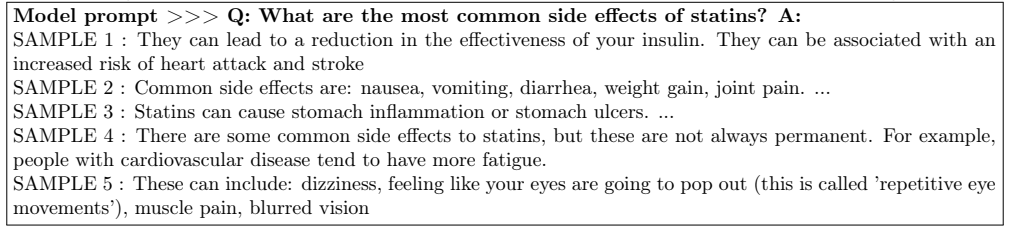
- [Results, 'Distractor Generation through Question Answering'] The claim that the base GPT-2 model can generate 'distractors suitable for multiple choice items' is supported only by a handful of displayed samples (five statin side-effect responses and eight IBS responses), with no description of the sampling procedure, no expert plausibility ratings, and no verification against a medical knowledge source. Several samples are off-target or fabricated, such as Figure 2, Sample 5 listing 'repetitive eye movements' as a statin side effect, and Figure 3, Sample 2.3 consisting of a personal narrative about buying a home. The statement that 'the selection of responses were not cherry-picked' for the IBS example cannot be verified because the full output and selection protocol are not provided.
- [Abstract and Results (comparison to [1])] The comparative claim that the transformer architecture 'allows generating higher quality text' than the character-based RNN in [1] is not substantiated by any side-by-side evaluation, blind human rating, or quantitative language-quality metric. The two studies use different prompts, domains, and training corpora, so the qualitative impression of greater fluency cannot support this comparison. This is a load-bearing point because the paper positions its contribution as an improvement over prior work in the same line of research.
minor comments (4)
- [Throughout] The manuscript contains numerous typographical errors, including 'supprt' (Abstract), 'eductaion' (Introduction), 'knowlegde' (Materials and Methods), 'quiet some time' (Background and Significance), and 'what what' (Attention is all you need). A careful proofreading pass is needed.
- [Reincarnations of the Transformers] The text reads 'The examples presented in this paper are based on experiments with the that contains 345M hyper-parameters,' which is missing a word after 'with the'; also, the term should be 'parameters,' not 'hyper-parameters.'
- [References] Reference [3] is listed as 'Gaugan tool for artists' but is cited in the text for MegatronLM, and reference [22] is also MegatronLM; the citation-reference pairing is inconsistent and should be corrected.
- [Figures 2, 3 and Tables 1, 2] The sampling parameters (e.g., temperature, top-k, random seed) and the number of generated candidates from which the displayed examples were selected are not reported, which limits the reproducibility of the examples.
Circularity Check
No circular derivation: the fine-tuning target (PubMed text) is external to the claimed output (certification item drafts), and the quality claims are qualitative judgments, not fitted-parameter predictions.
full rationale
The paper makes no formal derivation that reduces a prediction to its inputs. GPT-2 is fine-tuned on roughly 800,000 PubMed open-access articles (about 8GB of text), which is a general medical corpus, not the certification items or distractors it is used to draft. Distractor generation is explicitly attributed to the pretrained model's Q&A behavior ('The GPT-2 model was trained with material that has the structure: Q: What is X? A: X is a Y'), and the examples are sampled continuations, not quantities fitted to target data. The only self-citation ([1], von Davier 2018) is used as background for a prior Char-RNN experiment and as a comparison point; it is not invoked as a uniqueness theorem or as a formal justification that forces the current results, and it is externally published with empirical dimensionality evidence. The abstract's 'draft text that can be used by human item writers' claim is an untested qualitative assertion about workflow value; lack of expert evaluation or productivity measurement is a validity concern, not a circularity. No equation, fitted parameter, or definitional equivalence is shown to make the output equal to the input by construction.
Assumptions & free parameters
assumptions (4)
- domain assumption PubMed open-access articles are a suitable proxy for the style and content of medical certification exam vignettes.
- domain assumption The GPT-2 base model's question-answering behavior, learned from general web text, can produce plausible medical distractors when prompted in Q: A: format.
- domain assumption Human item writers can productively use low-fidelity, sometimes factually wrong model output as inspiration for authoring.
- domain assumption Syntactic fluency is a sufficient signal that generated text is useful as draft material.
Cite this review
Pith. "Pith review of Training Optimus Prime, M.D.: Generating Medical Certification Items by Fine-Tuning OpenAI's gpt2 Transformer Model." pith.science (2026). https://pith.science/paper/VIWAL27H
@misc{pith2026190808594,
  author       = {Pith},
  title        = {Pith review of: Training Optimus Prime, M.D.: Generating Medical Certification Items by Fine-Tuning OpenAI's gpt2 Transformer Model},
  year         = {2026},
  howpublished = {\url{https://pith.science/paper/VIWAL27H}},
  note         = {Machine review of arXiv:1908.08594}
}
read the original abstract
This article describes new results of an application using transformer-based language models to automated item generation (AIG), an area of ongoing interest in the domain of certification testing as well as in educational measurement and psychological testing. OpenAI's gpt2 pre-trained 345M parameter language model was retrained using the public domain text mining set of PubMed articles and subsequently used to generate item stems (case vignettes) as well as distractor proposals for multiple-choice items. This case study shows promise and produces draft text that can be used by human item writers as input for authoring. Future experiments with more recent transformer models (such as Grover, TransformerXL) using existing item pools are expected to improve results further and to facilitate the development of assessment materials.
Figures
Forward citations
Cited by 1 Pith paper
-
The Limitations of Stylometry for Detecting Machine-Generated Fake News
Stylometry successfully distinguishes human from machine text but fails to distinguish truthful from false machine-generated text when the same language model produces both.
Reference graph
Works this paper leans on
-
[1]
Automated item generation with recurrent neural networks,
M. von Davier, “Automated item generation with recurrent neural networks,”Psychometrika, vol. 83, no. 4, pp. 847–857, 2018
work page 2018
-
[2]
A. Vaswani, N. Shazeer, N. Parmar, J. Uszkoreit, L. Jones, A. N. Gomez, L. Kaiser, and I. Polosukhin, “Attention is all you need,” CoRR, vol. abs/1706.03762, 2017. [Online]. Available: http://arxiv.org/abs/1706.03762
arXiv 2017
-
[3]
Nvidia, “Gaugan tool for artists,” 2019. [Online]. Available: mingyuliu.com/gaugan
work page 2019
-
[4]
The perceptron: A probabilistic model for information storage and organization in the brain,
F. Rosenblatt, “The perceptron: A probabilistic model for information storage and organization in the brain,” Psychological Review, vol. 65, no. 6, pp. 386–408, 1958
work page 1958
-
[5]
Long short-term memory,
S. Hochreiter and J. Schmidhuber, “Long short-term memory,”Neural Computation, vol. 9, no. 8, pp. 1735– 1780, 1997
1997
-
[6]
M. von Davier, “High-performance psychometrics: The parallel-e parallel-m algorithm for generalized latent variable models,”ETS Research Report Series, pp. 1–11, 2016
work page 2016
-
[7]
L. Goldberg, “A broad-bandwidth, public domain, personality inventory measuring the lower-level facets of several five-factor models,” inPersonality Psychology in Europe, and F. Ostendorf, Ed. Tilburg: The, 1999, vol. 7, pp. 7–28
work page 1999
-
[8]
The international per- sonality item pool and the future of public-domain personality measures,
L. Goldberg, J. Johnson, H. Eber, R. Hogan, M. Ashton, C. Cloninger, , and H. Gough, “The international per- sonality item pool and the future of public-domain personality measures,”Journal of Research in Personality, vol. 40, pp. 84–96, 2006
work page 2006
Show all 35 references
-
[9]
Mit’s 1961 tv program: The thinking machine
MIT, “Mit’s 1961 tv program: The thinking machine.” [Online]. Available: https://www.youtube.com/watch
1961
-
[10]
Language models are unsupervised multitask learners,
A. Radford, J. Wu, R. Child, D. Luan, D. Amodei, , and I. Sutskever, “Language models are unsupervised multitask learners,” 2018. [Online]. Available: https://d4mucfpksywv.cloudfront.net/better-language-models/ language
2018
-
[11]
This ai-powered autocompletion software is gmail’s smart compose for coders – upgrading coding autocompleter tools with deep learning,
J. Vincent, “This ai-powered autocompletion software is gmail’s smart compose for coders – upgrading coding autocompleter tools with deep learning,” 2019. [Online]. Available: https://www.theverge.com/2019/7/24/ 20708542/coding-autocompleter-deep-tabnine-ai-deep-learning-smart-compose
2019
-
[12]
Doctor AI: predicting clinical events via recurrent neural networks,
E. Choi, M. T. Bahadori, and J. Sun, “Doctor AI: predicting clinical events via recurrent neural networks,” CoRR, vol. abs/1511.05942, 2015. [Online]. Available: http://arxiv.org/abs/1511.05942 17
2015 arXiv
-
[13]
Generative testing: from conception to implementation in item generation for test development,
I. Bejar, “Generative testing: from conception to implementation in item generation for test development,” in Item generation for test development, S.H.Irvine and P. C. Kyllonen, Eds. Mahwah, NJ: Lawrence Erlbaum Associates, 2002, pp. 199–217
2002
-
[14]
Generating items during testing: psychometric issues and models,
S. Embretson, “Generating items during testing: psychometric issues and models,”Psychometrika, vol. 64, no. 4, pp. 407–433, 1999
1999
-
[15]
A mathematical theory of communication,
C. Shannon, “A mathematical theory of communication,”Bell System Technical Journal, vol. 27, pp. 379–423, 1948
1948
-
[16]
Approximation capabilities of multilayer feedforward networks,
K. Hornik, “Approximation capabilities of multilayer feedforward networks,”Neural Networks, vol. 4, no. 2, pp. 251–257, 1991
1991
-
[17]
Universal function approximation by deep neural nets with bounded width and relu activations,
B. Hanin, “Universal function approximation by deep neural nets with bounded width and relu activations,” CoRR, vol. abs/1708.02691, 2017. [Online]. Available: http://arxiv.org/abs/1708.02691
2017 arXiv
-
[18]
Tensorflow: Large-scale machine learning on heterogeneous distributed systems,
M. Abadi, A. Agarwal, P. Barham, E. Brevdo, Z. Chen, C. Citro, G. S. Corrado, A. Davis, J. Dean, M. Devin, S. Ghemawat, I. J. Goodfellow, A. Harp, G. Irving, M. Isard, Y. Jia, R. Józefowicz, L. Kaiser, M. Kudlur, J. Levenberg, D. Mané, R. Monga, S. Moore, D. G. Murray, C. Olah...
2016 arXiv
-
[19]
char-rnn for tensorflow,
S. Ozair, “char-rnn for tensorflow,” 2016. [Online]. Available: https://github.com/sherjilozair/ char-rnn-tensorflow
2016
-
[20]
Transformer-xl: Attentive language models beyond a fixed-length context,
Z. Dai, Z. Yang, Y. Yang, J. G. Carbonell, Q. V. Le, and R. Salakhutdinov, “Transformer-xl: Attentive language models beyond a fixed-length context,”CoRR, vol. abs/1901.02860, 2019. [Online]. Available: http://arxiv.org/abs/1901.02860
1901 arXiv
-
[21]
Defending against neural fake news,
R. Zellers, A. Holtzman, H. Rashkin, Y. Bisk, A. Farhadi, F. Roesner, and Y. Choi, “Defending against neural fake news,”CoRR, vol. abs/1905.12616, 2019
1905 arXiv
-
[22]
Megatronlm press release. accessed on august 13th,
Nvidia, “Megatronlm press release. accessed on august 13th,” also https://nvidianews.nvidia.com/news/nvidia- achieves-breakthroughs-in-language-understandingto-enable-real-time-conversational-ai. [Online]. Available: https://github.com/NVIDIA/Megatron-LM
-
[23]
Models for analyzing categorical panel data,
Z. Gilula, , and S. Haberman, “Models for analyzing categorical panel data,”Journal of the American Statistical Association, vol. 89, pp. 645–656, 1994. 18
1994
-
[24]
BERT: pre-training of deep bidirectional transformers for language understanding,
J. Devlin, M. Chang, K. Lee, and K. Toutanova, “BERT: pre-training of deep bidirectional transformers for language understanding,” CoRR, vol. abs/1810.04805, 2018. [Online]. Available: http://arxiv.org/abs/1810.04805
2018 arXiv
-
[25]
Medical concept representation learning from electronic health records and its application on heart failure prediction,
E. Choi, A. Schuetz, W. F. Stewart, and J. Sun, “Medical concept representation learning from electronic health records and its application on heart failure prediction,”CoRR, vol. abs/1602.03686, 2016. [Online]. Available: http://arxiv.org/abs/1602.03686
2016 arXiv
-
[26]
The staggering cost of training sota ai models,
T. S. Peng and M., “The staggering cost of training sota ai models,” 2019. [Online]. Available: https://syncedreview.com/2019/06/27/the-staggering-cost-of-training-sota-ai-models
2019
-
[27]
Speeding up the training of neural networks with cuda technology,
D. S. Chevitarese, D. Szwarcman, and M. Vellasco, “Speeding up the training of neural networks with cuda technology,” inArtificial Intelligence and Soft Computing, L. Rutkowski, M. Korytkowski, R. Scherer, R. Tadeusiewicz, L. A. Zadeh, and J. M. Zurada, Eds. Berlin, Heidelberg:...
2012
-
[28]
Synthea: An approach, method, and software mechanism for generating synthetic patients and the synthetic electronic health care record,
J. Walonoski, M. Kramer, J. Nichols, A. Quina, C. Moesel, D. Hall, C. Duffett, K. Dube, T. Gallagher, and S. McLachlan, “Synthea: An approach, method, and software mechanism for generating synthetic patients and the synthetic electronic health care record,”Journal of the Americ...
2017 doi
-
[29]
Opportunities and challenges in developing deep learning models using electronic health records data: a systematic review,
C. Xiao, E. Choi, and J. Sun, “Opportunities and challenges in developing deep learning models using electronic health records data: a systematic review,”Journal of the American Medical Informatics Association, vol. 25, no. 10, pp. 1419–1428, 06 2018. [Online]. Available: http...
2018 doi
-
[30]
Memory-efficient backpropagation through time,
A. Gruslys, R. Munos, I. Danihelka, M. Lanctot, and A. Graves, “Memory-efficient backpropagation through time,”CoRR, vol. abs/1606.03401, 2016. [Online]. Available: http://arxiv.org/abs/1606.03401
2016 arXiv
-
[31]
Training deep nets with sublinear memory cost,
T. Chen, B. Xu, C. Zhang, and C. Guestrin, “Training deep nets with sublinear memory cost,”CoRR, vol. abs/1604.06174, 2016. [Online]. Available: http://arxiv.org/abs/1604.06174
2016 arXiv
-
[32]
Free full text articles : where to search for them?
A. Singh, M. Singh, A. Singh, D. Singh, P. Singh, and A. Sharma, “Free full text articles : where to search for them?”International Journal of Trichology, vol. 3, no. 2, pp. 75–79, 2011
2011
-
[33]
Patent claim generation by fine-tuning,
J.-S. H. Lee and J., “Patent claim generation by fine-tuning,” Department of Computer Science and Information Engineering National Taiwan Univeristy, OpenAI GPT-2 2052, 2019
2019
-
[34]
Gpt-2 neural network poetry,
gwernnet, “Gpt-2 neural network poetry,” 2019. [Online]. Available: https://www.gwern.net/GPT-2
2019
-
[35]
Ai supporting wellness,
Qualcomm, “Ai supporting wellness,” 2019. [Online]. Available: https://www.qualcomm.com/news/onq/2019/ 07/11/ai-your-supportive-wellness-companion 19
2019
Reviewed August 14, 2026 · model on record in the stance chip above.
Discussion (0). Continue with ORCID to comment.