REVIEW 4 major objections 5 minor 40 references
Adversary-resilient Distributed and Decentralized Statistical Inference and Machine Learning: An Overview of Recent Advances Under the Byzantine Threat Model
T0 review · 4 major / 5 minor · reviewed 2026-08-14 · deepseek-v4-flash
Pith's one-line read Replacing plain averaging with a screening-and-aggregation step keeps distributed and decentralized learning from breaking down under Byzantine attacks, at a measurable cost in faultless accuracy.
desk verdict A solid, useful survey of Byzantine-robust distributed and decentralized inference and learning; the experimental comparisons are weaker than the taxonomy and tables, but the review's core value stands. read the letter →
The pith
A machine-rendered reading of the paper's core claim, the machinery that carries it, and where it could break.
The reading
What carries the argument
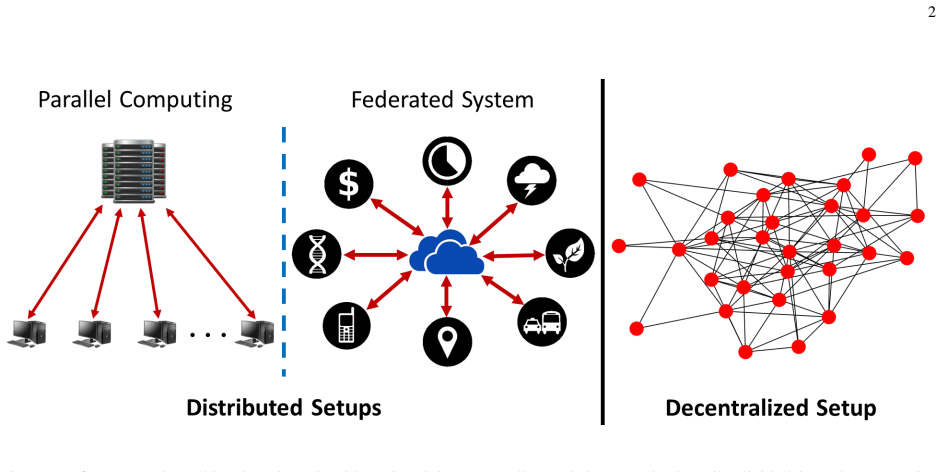
The central object is the screening-and-aggregation step, the robust aggregation rule inserted where ordinary averaging would occur. In the distributed template, the server screens local gradients using coordinate-wise median, coordinate-wise trimmed mean, geometric median, Krum or Multi-Krum, Bulyan, or Zeno's oracle-based score before averaging. In decentralized algorithms such as ByRDiE and BRIDGE, each node applies trimmed mean to neighbors' iterates before the consensus update, which is why topology constraints replace conditions such as $M \ge 2b+1$ with requirements about source components and neighborhood sizes. This screening step is the load-bearing mechanism that converts an adversarially corrupted set of messages into an approximately correct update.
What would settle it
Re-run the paper's CIFAR-10 distributed experiment with $b=4$ Byzantine nodes sending the alternating small/large random vectors described in the paper; if coordinate-wise median, trimmed mean, Krum, Bulyan, or Zeno ever falls to near-chance accuracy as fast as vanilla SGD, the claim that screening methods prevent breakdown is contradicted.
Extended reading notes
Core claim
On its own terms, the paper's contribution is taxonomic and empirical: all recent Byzantine-resilient distributed SGD methods fit the same template—workers send gradients to a server, the server screens them and aggregates the survivors, then updates the model—and differences among algorithms reduce to the choice of screening rule. For distributed inference the same pattern appears as a critical fraction of Byzantine nodes beyond which the fusion center can do no better than random guessing. In decentralized systems, where there is no server, the screening step moves into each node's consensus update, and the conditions for resilience become graph-theoretic rather than simple node counts. The survey's own experiments compare median, trimmed mean, Krum, Bulyan, Zeno, and BRIDGE on CIFAR-10 and MNIST tasks, showing that every screened method avoids the catastrophic failure of vanilla SGD while some pay more than others in the faultless regime.
Load-bearing premise
The survey's comparative picture assumes that the convergence rates, learning rates, and node-count conditions it transcribes into Tables I and II accurately match the original papers; if any transcription is wrong, the reader is trusting a false tradeoff.
Editorial extensions
If this is right
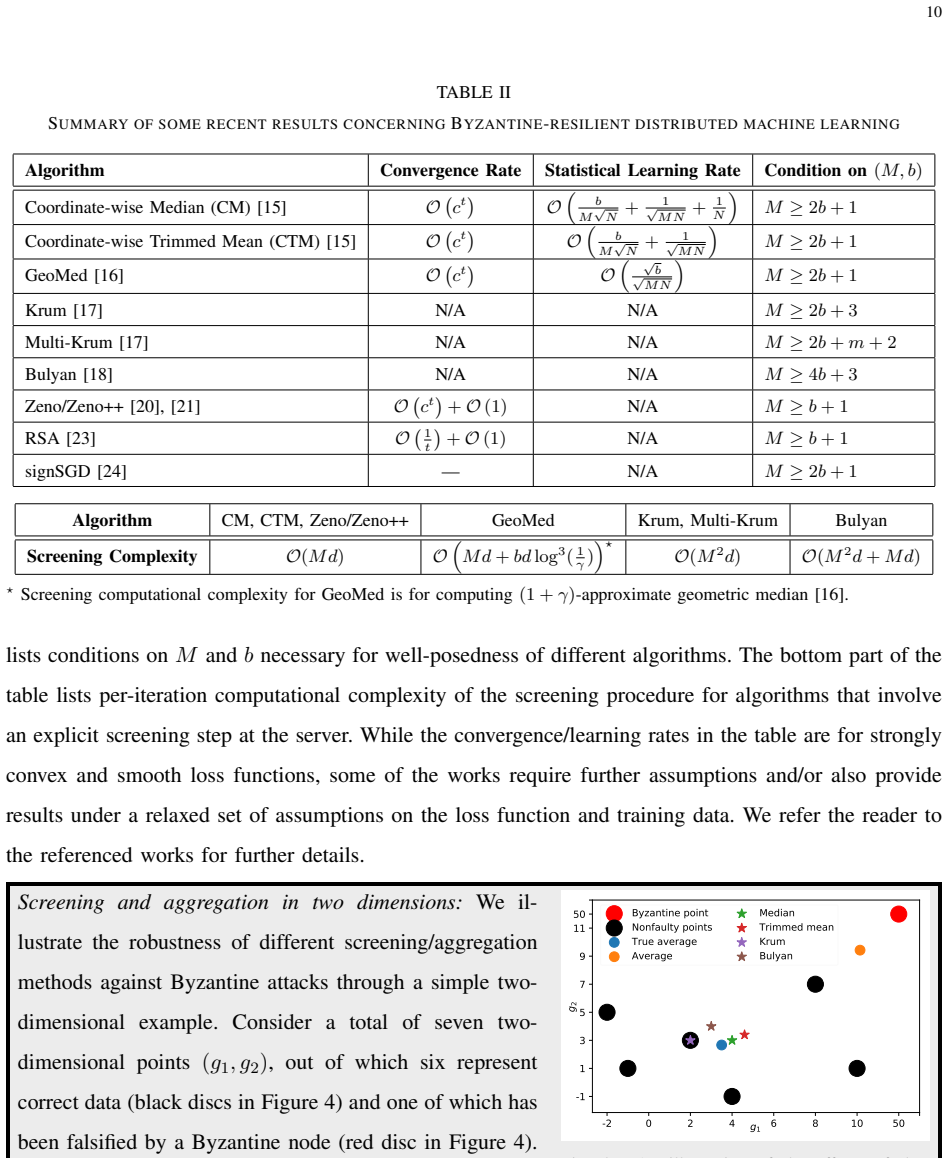
- A practitioner facing up to $b$ Byzantine nodes can select among algorithms with explicit guarantees: coordinate-wise median and trimmed mean require only $M \ge 2b+1$ and have linear per-iteration cost, while Bulyan requires $M \ge 4b+3$ and quadratic cost.
- Robustness is not a yes/no property; the same screening idea appears as coordinate-wise median, trimmed mean, geometric median, Krum, Bulyan, Zeno, and signSGD majority vote, each with a different tradeoff among cost, rate, and node budget.
- In decentralized systems, resilience is tied to network topology rather than just $M$ and $b$: conditions such as a surviving source component of size at least $b+1$, or every partition having a node with $2b+1$ outside neighbors, are necessary for trimmed-mean learning.
- Vanilla decentralized gradient descent collapses completely under Byzantine nodes, while screened variants such as ByRDiE and BRIDGE stay close to their faultless accuracy, implying that consensus-based systems need screening at every node's update.
- Even with screening, Byzantine-resilient decentralized consensus cannot reach the true average; it converges only to some convex combination of initial values, and the decentralized ERM optimum over nonfaulty nodes is provably unattainable in the Byzantine setting.
Reading between the lines
- If the screening template is as general as the survey suggests, then a natural next test is to swap BRIDGE's trimmed mean for GeoMed or coordinate-wise median in decentralized settings and measure accuracy under the same MNIST protocol; the survey's own figures hint these variants work, but no convergence analysis yet covers them.
- The experiments' Byzantine attacks are random-vector strategies selected from prior work; a topology-aware adversary that targets cut vertices or repeatedly changes the attacked set could behave worse, so the empirical robustness shown is probably an upper bound on resilience rather than a worst-case guarantee.
- The uniform finding that screened methods underperform vanilla SGD in faultless settings points to a possible conservation law: robustness may always cost some accuracy when no adversary is present, which would make the reported gap an irreducible design constraint rather than an artifact of current algorithms.
- The distributed-inference results that push the critical fraction to $1/2$ or higher, and to $1$ with audit bits, suggest that adding structured redundancy to communication rather than only screening can raise Byzantine tolerance; porting audit-bit-style redundancy into learning updates is a concrete, testable extension the paper does not pursue.
Signed reviews
Editorial analysis
A structured set of objections, weighed in public.
Referee Report
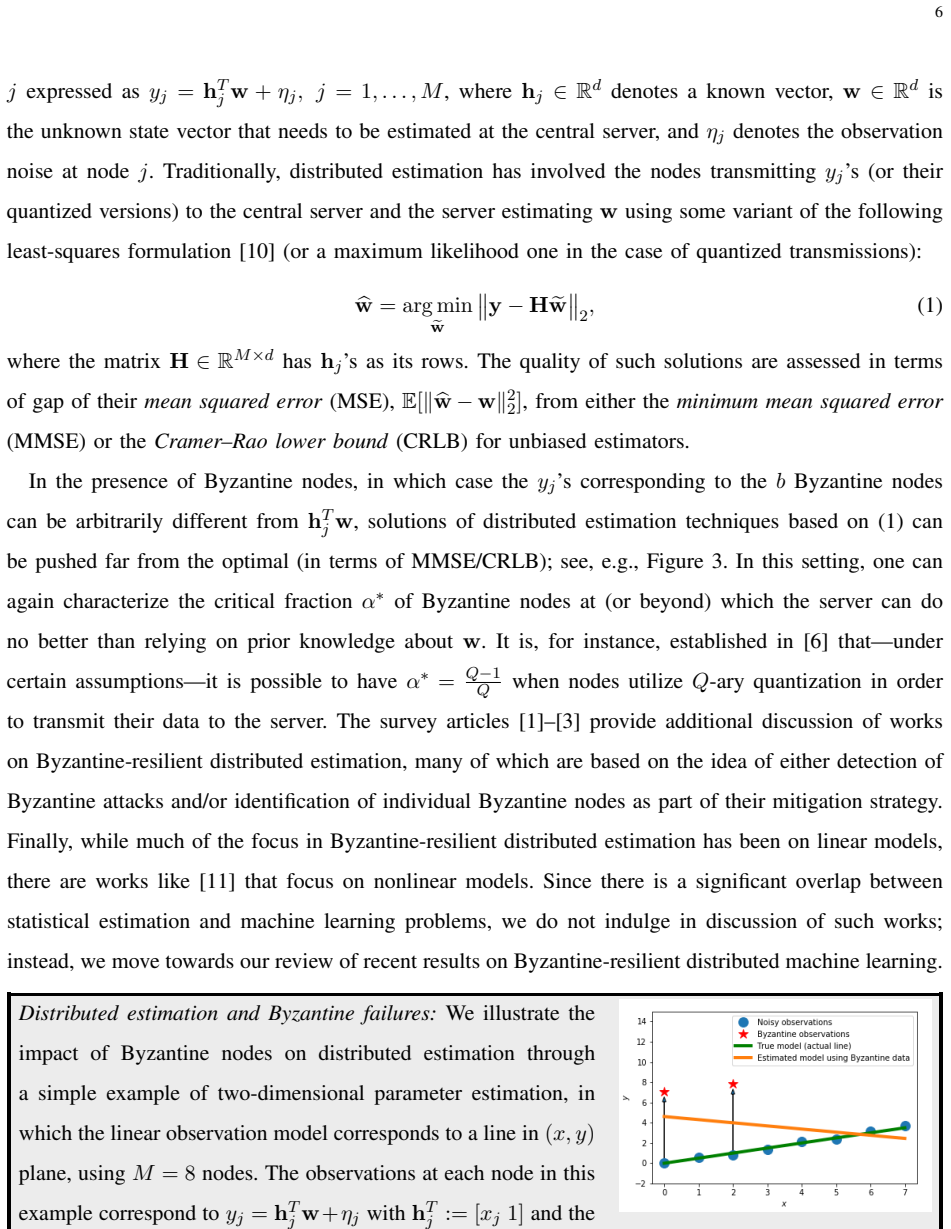
Summary. This paper is a survey of recent work (roughly 2013-2019) on Byzantine-robust statistical inference and machine learning in two settings: master-worker distributed systems and fully decentralized multi-node systems. The first half reviews distributed detection, distributed estimation, and robust distributed SGD, with Table I summarizing detection results and Table II summarizing convergence and statistical rates for screening-based aggregation methods (median, trimmed mean, GeoMed, Krum, Bulyan, Zeno, RSA, signSGD). The second half covers decentralized consensus, detection, estimation, and learning, emphasizing trimmed-mean screening and the authors' ByRDiE and BRIDGE algorithms. The paper reports original numerical experiments on CIFAR-10 and MNIST comparing these methods under specific Byzantine attack strategies, and it closes with a list of open problems.
Significance. If its claims were fully substantiated, this survey would be a useful entry point for researchers and practitioners: it organizes a scattered literature, contrasts the threat models and assumptions of different algorithms, and makes explicit the tradeoffs between robustness, faultless accuracy, communication cost, and topology constraints. The survey is honest about limitations, repeatedly noting when an attack is not optimal and when convergence rates are unknown, which is a strength. However, the paper's own contribution goes beyond surveying: the numerical sections draw strong conclusions about robustness ordering and non-breakdown under Byzantine attacks. Those conclusions are not adequately supported by the experiments as reported, for reasons detailed below. The survey content itself appears broadly consistent with the cited literature, but the empirical evidence is too narrow to establish the general claim that screening-based methods prevent breakdown under Byzantine attacks.
major comments (4)
- [Section I.B, 'Numerical Experiments' (Fig. 5)] The experiments test only a single attack family: each Byzantine node sends coordinate-wise uniform noise in (0, 1e-5) on odd iterations and (0, 20) on even iterations. The paper itself cites [12]-[14] as more sophisticated strategies and concedes that the optimal uniform attack is an open problem. Because [12] and [14] describe attacks designed to defeat median, trimmed mean, and Krum under the same M>2b assumptions, the conclusion that 'none of them breaks down to the level of distributed SGD' and the ordering that Bulyan and Zeno are most stable are not established for adversarial behavior that the survey itself identifies as relevant. Please either test additional attack strategies (at minimum the 'A Little is Enough' and 'Fall of Empires' attacks) or substantially weaken the robustness and ordering claims to the particular attack tested.
- [Section I.B and Section II.C, Figures 5 and 6] Figures 5 and 6 show only averaged accuracy curves over 10 trials with no error bars, confidence intervals, or statistical tests, and no code is released. At the present level of detail, differences such as Bulyan vs Zeno in the Byzantine panel of Figure 5 could be within trial noise. The tradeoff statements in the text ('Bulyan and Zeno ... most stable', 'Krum-based screening is the least effective' in Fig. 6) therefore need either supporting variability measures or a more cautious phrasing.
- [Section II.C, 'Numerical Experiments' (Fig. 5 overlay)] The comparison of BRIDGE and DGD with distributed learning methods in Figure 5 mixes two different experimental configurations. The distributed algorithms use the CIFAR-10 task with M=20 and b=4; the decentralized BRIDGE overlay is said to use the 'identical' setup except that the random graph connectivity is changed to 0.7, and the text later attributes BRIDGE's faster convergence partly to this higher connectivity. Since connectivity changes the task's hardness, the claim that BRIDGE has faster convergence than the distributed methods for this nonconvex problem is a confounded comparison and should be presented only as a qualitative observation or tested under matched communication and connectivity budgets.
- [Section I.B 'Numerical Experiments' and Section IV] The central claim that screening-based methods generally prevent breakdown under Byzantine attacks is supported in the nonconvex regime only by these experiments, which fall outside the strongly convex and smooth assumptions underlying Table II's theoretical rates. The theory in Table II cannot be invoked to extrapolate to the CIFAR-10 CNN experiments. Please make explicit that the non-breakdown conclusion is an empirical observation for the tested setup, not a consequence of the surveyed theorems.
minor comments (5)
- [Section II.C, 'Numerical Experiments'] The typo 'MNSIT' should be corrected to 'MNIST'.
- [Page 3 and page 7] There are small grammatical errors: 'rather then' should be 'rather than' on page 3, and 'in turns' should be 'in turn' on page 7.
- [Section I.B, 'Numerical Experiments'] The statement that the chosen attack 'appears to be the uniformly most potent strategy' cites [12], but [12] does not establish a uniform claim across the range of algorithms considered here; please soften this claim or provide supporting evidence.
- [Table II] The table uses 'N/A' for Krum, Multi-Krum, and Bulyan convergence rates; consider a footnote distinguishing 'not reported in the cited work' from 'the algorithm does not converge' to avoid misleading readers.
- [Section II.C, 'Numerical Experiments'] The x-axis of Figure 6 is 'Number of Scalars Broadcast per Node'; if this is meant to compare communication efficiency, please clarify whether all methods broadcast the same number of scalars per iteration, since coordinate-descent methods like ByRDiE may have different communication patterns.
Circularity Check
No circularity: the survey's claims are grounded in the surveyed literature rather than in any fitted output or self-referential derivation.
full rationale
This paper is a survey/review, not a derivation or prediction paper. Its central assertion—that Byzantine-resilient distributed and decentralized inference and learning methods exist based on screening and robust aggregation, with known robustness/correctness tradeoffs—is supported by citations to the external literature (e.g., [15]–[24], [39], [40]) and by self-contained numerical comparisons. The authors' own algorithms ByRDiE [39] and BRIDGE [40] are included in the survey and experiments, but this is a normal citation of prior work, not a load-bearing argument that reduces to itself. The paper does not fit a parameter and then rename it as a prediction, does not define its object in terms of its conclusion, and does not invoke an author-imported uniqueness theorem. The numerical experiments use a particular Byzantine attack strategy; whether that attack is the most potent is an empirical/validity concern (a correctness risk), not a circularity, because the attack choice is not the input from which the surveyed robustness results are derived. Any concern about the strength of the attack or about the accuracy of the Table II transcriptions is an external factual premise, not circular reasoning.
Assumptions & free parameters
assumptions (3)
- domain assumption At most b out of M nodes are Byzantine.
- domain assumption For decentralized settings, algorithms are synchronous and the network topology is static.
- domain assumption Theoretical convergence rates for distributed learning assume strongly convex and smooth loss functions.
Cite this review
Pith. "Pith review of Adversary-resilient Distributed and Decentralized Statistical Inference and Machine Learning: An Overview of Recent Advances Under the Byzantine Threat Model." pith.science (2026). https://pith.science/paper/STDI4PRD
@misc{pith2026190808649,
  author       = {Pith},
  title        = {Pith review of: Adversary-resilient Distributed and Decentralized Statistical Inference and Machine Learning: An Overview of Recent Advances Under the Byzantine Threat Model},
  year         = {2026},
  howpublished = {\url{https://pith.science/paper/STDI4PRD}},
  note         = {Machine review of arXiv:1908.08649}
}
read the original abstract
While the last few decades have witnessed a huge body of work devoted to inference and learning in distributed and decentralized setups, much of this work assumes a non-adversarial setting in which individual nodes---apart from occasional statistical failures---operate as intended within the algorithmic framework. In recent years, however, cybersecurity threats from malicious non-state actors and rogue entities have forced practitioners and researchers to rethink the robustness of distributed and decentralized algorithms against adversarial attacks. As a result, we now have a plethora of algorithmic approaches that guarantee robustness of distributed and/or decentralized inference and learning under different adversarial threat models. Driven in part by the world's growing appetite for data-driven decision making, however, securing of distributed/decentralized frameworks for inference and learning against adversarial threats remains a rapidly evolving research area. In this article, we provide an overview of some of the most recent developments in this area under the threat model of Byzantine attacks.
Figures

Figures from the paper (3 more)


Reference graph
Works this paper leans on
-
[12]
Fall of empires: Breaking Byzantine-tolerant SGD by inner product manipulation,
C. Xie, S. Koyejo, and I. Gupta, “Fall of empires: Breaking Byzantine-tolerant SGD by inner product manipulation,” arXiv preprint arXiv:1903.03936, 2019
arXiv 1903
-
[14]
A little is enough: Circumventing defenses for distributed learning,
G. Baruch, M. Baruch, and Y . Goldberg, “A little is enough: Circumventing defenses for distributed learning,” in Proc. Advances in Neural Inf. Process. Syst. (NeurIPS’19) , 2019, pp. 8632–8642
work page 2019
-
[1]
Distributed inference with Byzantine data: State-of-the-art review on data falsification attacks,
A. Vempaty, L. Tong, and P. Varshney, “Distributed inference with Byzantine data: State-of-the-art review on data falsification attacks,” IEEE Signal Process. Mag. , vol. 30, no. 5, pp. 65–75, 2013
work page 2013
-
[2]
The Internet of Things: Secure distributed inference,
Y . Chen, S. Kar, and J. M. F. Moura, “The Internet of Things: Secure distributed inference,” IEEE Signal Process. Mag. , vol. 35, no. 5, pp. 64–75, 2018
work page 2018
-
[3]
J. Zhang, R. S. Blum, and H. V . Poor, “Approaches to secure inference in the Internet of Things: Performance bounds, algorithms, and effective attacks on IoT sensor networks,” IEEE Signal Process. Mag. , vol. 35, no. 5, pp. 50–63, 2018
work page 2018
-
[4]
L. Su and N. Vaidya, “Fault-tolerant distributed optimization (Part IV): Constrained optimization with arbitrary directed networks,” arXiv preprint arXiv:1511.01821 , 2015
work page Pith review arXiv 2015
-
[5]
The Byzantine generals problem,
L. Lamport, R. Shostak, and M. Pease, “The Byzantine generals problem,” ACM Trans. Programming Languages and Syst., vol. 4, no. 3, pp. 382–401, 1982
work page 1982
-
[6]
Distributed inference with M-ary quantized data in the presence of Byzantine attacks,
V . S. S. Nadendla, Y . S. Han, and P. K. Varshney, “Distributed inference with M-ary quantized data in the presence of Byzantine attacks,” IEEE Trans. Signal Process. , vol. 62, no. 10, pp. 2681–2695, 2014
work page 2014
Show all 40 references
-
[7]
Distributed Bayesian detection in the presence of Byzantine data,
B. Kailkhura, Y . S. Han, S. Brahma, and P. K. Varshney, “Distributed Bayesian detection in the presence of Byzantine data,” IEEE Trans. Signal Process. , vol. 63, no. 19, pp. 5250–5263, 2015
2015
-
[8]
Audit bit based distributed Bayesian detection in the presence of Byzantines,
W. Hashlamoun, S. Brahma, and P. K. Varshney, “Audit bit based distributed Bayesian detection in the presence of Byzantines,” IEEE Trans. Signal Inform. Proc. over Netw. , vol. 4, no. 4, pp. 643–655, 2018
2018
-
[9]
Distributed detection in tree networks: Byzantines and mitigation techniques,
B. Kailkhura, S. Brahma, B. Dulek, Y . S. Han, and P. K. Varshney, “Distributed detection in tree networks: Byzantines and mitigation techniques,” IEEE Trans. Inf. Forens. Security , vol. 10, no. 7, pp. 1499–1512, 2015
2015
-
[10]
Compressed sensing for networked data,
J. Haupt, W. U. Bajwa, M. Rabbat, and R. Nowak, “Compressed sensing for networked data,” IEEE Signal Process. Mag., vol. 25, no. 2, pp. 92–101, 2008
2008
-
[11]
Localization in wireless sensor networks: Byzantines and mitigation techniques,
A. Vempaty, O. Ozdemir, K. Agrawal, H. Chen, and P. K. Varshney, “Localization in wireless sensor networks: Byzantines and mitigation techniques,” IEEE Trans. Signal Process. , vol. 61, no. 6, pp. 1495–1508, 2013
2013
-
[13]
Local model poisoning attacks to Byzantine-robust federated learning,
M. Fang, X. Cao, J. Jia, and N. Z. Gong, “Local model poisoning attacks to Byzantine-robust federated learning,” arXiv preprint arXiv:1911.11815, 2019
1911 arXiv
-
[15]
Byzantine-robust distributed learning: Towards optimal statistical rates,
D. Yin, Y . Chen, K. Ramchandran, and P. Bartlett, “Byzantine-robust distributed learning: Towards optimal statistical rates,” in Proc. 35th Int. Conf. Machine Learning (ICML’18) , 2018, vol. 80, pp. 5650–5659
2018
-
[16]
Distributed statistical machine learning in adversarial settings: Byzantine gradient descent,
Y . Chen, L. Su, and J. Xu, “Distributed statistical machine learning in adversarial settings: Byzantine gradient descent,” in Proc. ACM Measurement and Analysis of Computing Systems , Dec. 2017, vol. 1, pp. 44:1–44:25
2017
-
[17]
Machine learning with adversaries: Byzantine tolerant gradient descent,
P. Blanchard, R. Guerraoui, and J. Stainer, “Machine learning with adversaries: Byzantine tolerant gradient descent,” in Proc. Advances in Neural Inf. Process. Syst. (NeurIPS’17) , 2017, pp. 118–128
2017
-
[18]
The hidden vulnerability of distributed learning in Byzantium,
E. El-Mhamdi, R. Guerraoui, and S. Rouault, “The hidden vulnerability of distributed learning in Byzantium,” in Proc. 35th Int. Conf. Machine Learning (ICML’18) , 2018, vol. 80, pp. 3521–3530
2018
-
[19]
Fast and secure distributed learning in high dimension,
E. El-Mhamdi and R. Guerraoui, “Fast and secure distributed learning in high dimension,” arXiv preprint arXiv:1905.04374, 2019
1905 arXiv
-
[20]
Zeno: Byzantine-suspicious stochastic gradient descent,
C. Xie, O. Koyejo, and I. Gupta, “Zeno: Byzantine-suspicious stochastic gradient descent,” arXiv preprint arXiv:1805.10032, 2018. 24
2018 arXiv
-
[21]
Zeno++: Robust asynchronous SGD with arbitrary number of Byzantine workers,
C. Xie, O. Koyejo, and I. Gupta, “Zeno++: Robust asynchronous SGD with arbitrary number of Byzantine workers,” arXiv preprint arXiv:1903.07020, 2019
1903 arXiv
-
[22]
Generalized Byzantine-tolerant SGD,
C. Xie, O. Koyejo, and I. Gupta, “Generalized Byzantine-tolerant SGD,” arXiv preprint arXiv:1802.10116 , 2018
2018 arXiv
-
[23]
RSA: Byzantine-robust stochastic aggregation methods for distributed learning from heterogeneous datasets,
L. Li, W. Xu, T. Chen, G. Giannakis, and Q. Ling, “RSA: Byzantine-robust stochastic aggregation methods for distributed learning from heterogeneous datasets,” in Proc. AAAI Conf. on Artificial Intelligence (AAAI’19) , 2019, vol. 33, pp. 1544– 1551
2019
-
[24]
signSGD with majority vote is communication efficient and Byzantine fault tolerant,
J. Bernstein, J. Zhao, K. Azizzadenesheli, and A. Anandkumar, “signSGD with majority vote is communication efficient and Byzantine fault tolerant,” arXiv preprint arXiv:1810.05291 , 2018
2018 arXiv
-
[25]
Byzantine stochastic gradient descent,
D. Alistarh, Z. Allen-Zhu, and J. Li, “Byzantine stochastic gradient descent,” in Proc. Advances in Neural Inf. Process. Syst. (NeurIPS’18), 2018, pp. 4618–4628
2018
-
[26]
Resilient asymptotic consensus in robust networks,
H. J. LeBlanc, H. Zhang, X. Koutsoukos, and S. Sundaram, “Resilient asymptotic consensus in robust networks,” IEEE J. Sel. Areas Commun. , vol. 31, no. 4, pp. 766–781, 2013
2013
-
[27]
Matrix representation of iterative approximate Byzantine consensus in directed graphs,
N. Vaidya, “Matrix representation of iterative approximate Byzantine consensus in directed graphs,” arXiv preprint arXiv:1203.1888, 2012
2012 arXiv
-
[28]
Approximate Byzantine consensus in faulty asynchronous networks,
L. Haseltalab and M. Akar, “Approximate Byzantine consensus in faulty asynchronous networks,” in Proc. American Control Conf. (ACC’15). IEEE, 2015, pp. 1591–1596
2015
-
[29]
Stochastic and deterministic fault detection for randomized gossip algorithms,
D. Silvestre, P. Rosa, J. P. Hespanha, and C. Silvestre, “Stochastic and deterministic fault detection for randomized gossip algorithms,” Automatica, vol. 78, pp. 46–60, 2017
2017
-
[30]
An adaptive deviation-tolerant secure scheme for distributed cooperative spectrum sensing,
S. Liu, H. Zhu, S. Li, C. Chen, and X. Guan, “An adaptive deviation-tolerant secure scheme for distributed cooperative spectrum sensing,” in Proc. IEEE Global Commun. Conf. (GLOBECOM’12) , 2012, pp. 603–608
2012
-
[31]
Byzantine-resilient locally optimum detection using collaborative autonomous networks,
B. Kailkhura, P. Ray, D. Rajan, A. Yen, P. Barnes, and R. Goldhahn, “Byzantine-resilient locally optimum detection using collaborative autonomous networks,” in Proc. IEEE 7th Int. Workshop Computational Advances Multi-Sensor Adaptive Process. (CAMSAP’17), 2017, pp. 1–5
2017
-
[32]
Data falsification attacks on consensus-based detection systems,
B. Kailkhura, S. Brahma, and P. K. Varshney, “Data falsification attacks on consensus-based detection systems,” IEEE Trans. Signal Inform. Proc. over Netw. , vol. 3, no. 1, pp. 145–158, 2017
2017
-
[33]
Resilient distributed parameter estimation in heterogeneous time-varying networks,
H. J. LeBlanc and F. Hassan, “Resilient distributed parameter estimation in heterogeneous time-varying networks,” in Proc. 3rd Int. Conf. High Confidence Networked Syst. (HiCoNS’14) , 2014, pp. 19–28
2014
-
[34]
Resilient distributed estimation: Sensor attacks,
Y . Chen, S. Kar, and J. M. F. Moura, “Resilient distributed estimation: Sensor attacks,” IEEE Trans. Automat. Control , vol. 64, no. 9, pp. 3772–3779, 2018
2018
-
[35]
Resilient distributed estimation: Exponential convergence under sensor attacks,
Y . Chen, S. Kar, and J. M. F. Moura, “Resilient distributed estimation: Exponential convergence under sensor attacks,” in Proc. IEEE Conf. Decision Control (CDC’18) , 2018, pp. 7275–7282
2018
-
[36]
Resilient distributed estimation through adversary detection,
Y . Chen, S. Kar, and J. M. F. Moura, “Resilient distributed estimation through adversary detection,” IEEE Trans. Signal Process., vol. 66, no. 9, pp. 2455–2469, 2018
2018
-
[37]
Distributed subgradient methods for multi-agent optimization,
A. Nedi ´c and A. Ozdaglar, “Distributed subgradient methods for multi-agent optimization,” IEEE Trans. Automat. Control, vol. 54, no. 1, pp. 48–61, 2009
2009
-
[38]
Distributed optimization under adversarial nodes,
S. Sundaram and B. Gharesifard, “Distributed optimization under adversarial nodes,” IEEE Trans. Automat. Control , vol. 64, no. 3, pp. 1063–1076, 2019
2019
-
[39]
ByRDiE: Byzantine-resilient distributed coordinate descent for decentralized learning,
Z. Yang and W. U. Bajwa, “ByRDiE: Byzantine-resilient distributed coordinate descent for decentralized learning,” IEEE Trans. Signal Inform. Proc. over Netw. , vol. 5, no. 4, pp. 611–627, 2019
2019
-
[40]
BRIDGE: Byzantine-resilient decentralized gradient descent,
Z. Yang and W. U. Bajwa, “BRIDGE: Byzantine-resilient decentralized gradient descent,” arXiv preprint arXiv:1908.08098, 2019
1908 arXiv
Reviewed August 14, 2026 · model on record in the stance chip above.
Discussion (0). Continue with ORCID to comment.