REVIEW 2 major objections 5 minor 44 references
Nambu-Jona-Lasinio model in a sphere
T0 review · 2 major / 5 minor · reviewed 2026-08-14 · deepseek-v4-flash
Pith's one-line read Spherical confinement, not just volume, controls how far finite-size effects reach in quark matter.
desk verdict First MIT-bag mode-sum NJL calculation in a sphere, but the load-bearing mode counting in Eq. (13) is asserted rather than derived, so the quantitative comparison to the antiperiodic box is unverified. read the letter →
The pith
A machine-rendered reading of the paper's core claim, the machinery that carries it, and where it could break.
The reading
What carries the argument
The central object is the mode-sum replacement of Eq. (13), in which the continuum momentum integral in the gap equation is replaced by a sum over the discrete momentum modes allowed by the spherical MIT boundary condition, weighted by 1/(2V) over both signs of the Dirac quantum number $\kappa$. Those allowed momenta are the solutions of the spherical-cavity eigen-equation for the free Dirac equation, involving spherical Bessel functions and the sign of $\kappa$. The sum is inserted into the proper-time-regularized mean-field gap equation, so finite size enters through missing and shifted modes rather than through a momentum cutoff. This discrete spectrum is what makes M(R) recover so slowly with radius.
What would settle it
Recalculate the gap equation with the full mode multiplicity of the spherical MIT spectrum, counting each $\kappa$ level $2|\kappa|$ times, and compare M(R) with the paper's threshold; if the corrected density of states makes M saturate well before R = 14 fm, the paper's quantitative comparison with the antiperiodic box fails, while if the threshold persists, the claim is supported.
Extended reading notes
Core claim
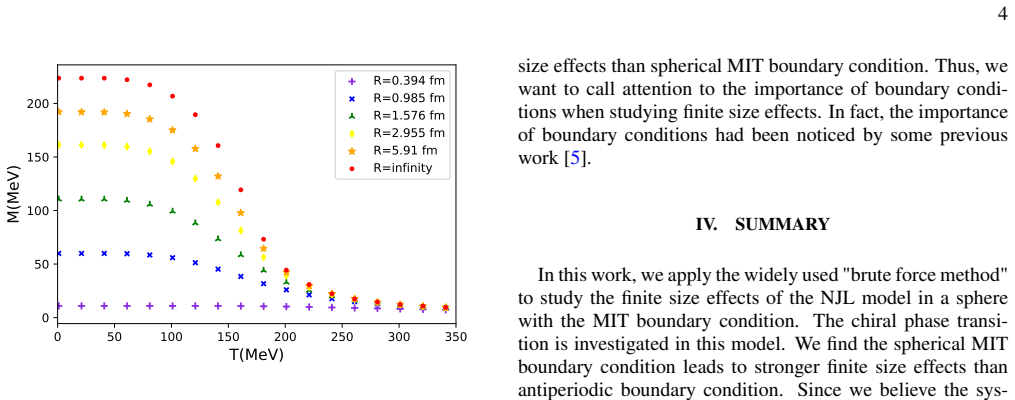
On its own terms, the paper's central discovery is that the spatial boundary condition, not just the volume, controls how strongly finite size acts on dynamical chiral symmetry breaking. With the MIT boundary condition on a sphere, the zero-temperature constituent quark mass M(R) remains well below the infinite-volume value until R ≈ 14 fm; with antiperiodic boundary conditions in a box, the mass already approaches the infinite-volume value for L > 3 fm. At finite temperature the same pattern appears: at equal volume, the spherical-MIT constituent mass is smaller, and the chiral susceptibility peak is smoothed. Since quark-gluon plasma droplets in heavy-ion collisions are estimated to be 2–10 fm in size, the paper concludes that those droplets experience considerable finite-size effects, stronger than earlier box-based estimates.
Load-bearing premise
The load-bearing premise is that the mode sum in Eq. (13) correctly counts the spherical quark states—each $\kappa$ level is summed once, without separately including its $2|\kappa|$-fold angular degeneracy—and that the chiral condensate stays uniform inside the sphere; if either assumption fails, the 14 fm threshold changes.
Editorial extensions
If this is right
- At fireball sizes of 2–10 fm, the chiral condensate is substantially suppressed compared with the infinite-volume limit, so finite-size effects should be included in heavy-ion phenomenology.
- The antiperiodic-box approximation underestimates the finite-size correction; other boundary-condition choices deserve systematic comparison in effective QCD models.
- The same brute-force mode-sum method can be applied to other confining shapes to separate shape effects from volume effects.
- Chiral-susceptibility peaks are smoothed by the spherical boundary, meaning finite-size signatures near the phase transition are visible at larger volumes than box calculations suggest.
Reading between the lines
- Editorial inference: if the correct mode multiplicity ($2|\kappa|$ per level) is included, the 14 fm threshold could shift substantially; this is the paper's most testable quantitative assumption.
- Editorial inference: the assumption of a uniform condensate inside a small confining sphere is uncontrolled; a spatially varying condensate with surface enhancement or depletion could change the effective finite-size scale.
- Editorial inference: if stronger spherical finite-size effects survive a corrected mode count, they would also affect other observables, such as pion properties and the location of the chiral critical endpoint, not just the constituent mass.
- Editorial inference: combining the spherical MIT mode sum with a gap equation that allows inhomogeneous condensates would give a sharper test of whether the 2–10 fm fireball indeed sits in the finite-size-dominated regime.
Signed reviews
Editorial analysis
A structured set of objections, weighed in public.
Referee Report
Summary. The manuscript studies the two-flavor NJL model at finite temperature and zero density inside a sphere with the MIT boundary condition. The authors replace the infinite-volume momentum integral by sums over the discrete spherical MIT bag modes, solve the mean-field gap equation with proper-time regularization, and compare the resulting constituent quark mass with the antiperiodic-boundary box result. They report that the MIT boundary condition produces much stronger finite-size effects: the constituent quark mass returns to the infinite-volume value only for a sphere radius of about 14 fm, whereas an antiperiodic box is effectively infinite for L > 3 fm. The paper also presents finite-temperature masses, chiral susceptibility, and integrated mode densities to support this claim.
Significance. If the quantitative claim is correct, the paper is valuable because it shows that the choice of spatial boundary condition can substantially change effective-model estimates of finite-size effects in heavy-ion physics, and it provides a direct mode-sum treatment of a spherical boundary rather than an asymptotic multiple-reflection expansion. The use of proper-time regularization and the standard Matsubara treatment are sound in the infinite-volume limit. However, the central numerical comparison depends on the normalization of the mode-sum replacement in Eq. (13), which is asserted rather than derived and appears to omit the 2|kappa| angular degeneracy of MIT bag modes; until this issue is resolved, the 14 fm scale and the comparison with the antiperiodic box are not established.
major comments (2)
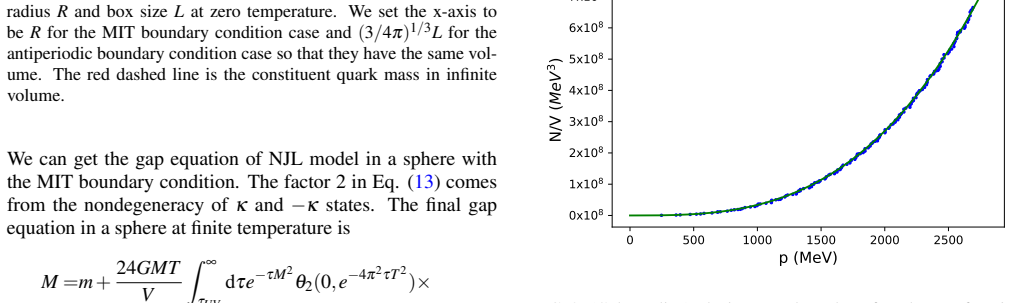
- [§2, Eq. (13)] The replacement in Eq. (13) is the load-bearing step of the paper, but its normalization is not derived and, as written, it omits the angular degeneracy of spherical MIT bag modes. For each kappa, the Dirac angular-momentum quantum number is j = |kappa|-1/2 and there are 2|kappa| magnetic substates with the same radial momentum p_{n,kappa}; a mode sum must carry this multiplicity. Equation (13) sums over kappa>0 and kappa<0 with weight one per kappa and divides by 2V, while the accompanying sentence only explains the factor 2 by 'nondegeneracy of kappa and -kappa states', which neither supplies the missing 2|kappa| nor clarifies why the two sign families are combined with a factor 1/2. If Eq. (13) is implemented literally, the integrated density of states will scale like P^2 R^2 rather than P^3 R^3 for large P, so it cannot fluctuate around the infinite-volume limit as claimed in Fig. 2, and the comparison in Fig. 1 would be invalid. The text reports no mode counts and provides no code, so the reader cannot tell whether Eq. (13) is merely badly notated or whether the numerical results are wrong. The authors must state the multiplicity explicitly, correct the replacement if needed, and repeat the numerical analysis.
- [§2, after Eq. (9)] After Eq. (9), the authors state that the condensate is inhomogeneous in a finite system in general but that they 'neglect the inhomogeneous effects' and treat <psi psi> as constant. In a small confining sphere this is an uncontrolled mean-field ansatz, and the MIT bag boundary condition in particular is known to produce strong spatial variation of scalar densities near the surface. Since the paper's central message concerns the quantitative size of finite-size effects, this approximation needs at least a quantitative estimate of its error, for example by comparing with a spatially dependent mean-field profile or with a heat-kernel/MRE estimate. Without such a check, the magnitude of the reported 14 fm scale remains uncertain even after the mode-sum normalization is corrected.
minor comments (5)
- [§2, Eq. (12)] The two angular-momentum labels in Eq. (12) are typeset with the same symbol, making the eigenvalue equation ambiguous; they should be distinguished with different notation, such as l_kappa and \bar{l}_kappa.
- [§3, Fig. 1] The statement that the constituent quark mass 'gets very close' to the infinite-volume value at R about 14 fm is not quantified; the authors should specify a tolerance (for example 1% or 5%) and plot M(R)/M(infinity) so the threshold is well defined.
- [§3] The numerical implementation is not described: there is no algorithm for finding the roots of Eq. (12), no statement of how many modes were included, and no convergence checks. A short table of the first roots for one or two radii would greatly improve reproducibility.
- [throughout] There are several typographical errors, including 'relavent' in Section I, 'intergral' after Eq. (9), and 'volumn' in the caption of Fig. 2; these should be corrected in a revised version.
- [§3] No sensitivity analysis with respect to the model parameters m, G, and tau_UV is presented; since the finite-size crossover scale may depend on the proper-time cutoff, a brief parameter scan would strengthen the quantitative claim.
Circularity Check
No significant circularity: the finite-size NJL prediction is self-contained, with only non-load-bearing self-citations.
full rationale
The derivation chain is self-contained. The infinite-volume gap equation (2)-(7) uses the standard NJL mean-field expression and proper-time regularization from Klevansky [35], and the finite-volume generalization replaces the momentum integral by the explicitly stated mode sums (9) or (13), using the MIT bag spectrum (12) quoted from Greiner's textbook [42]. The parameters m, G, and tau_UV are adopted from earlier infinite-volume fits and are not adjusted to reproduce the finite-sphere results. The antiperiodic comparison is obtained by solving the same gap equation with the mode spectrum (8), so the stronger finite-size suppression under the spherical MIT boundary condition is a numerical prediction of the model rather than an input. The self-citations to [25,36,37] are used only to point to the standard brute-force mode-sum technique and to recall qualitative expectations already established elsewhere; none of these citations carries the load of the central quantitative claim. The paper's explicit statement that it treats the condensate as spatially constant is a stated approximation and a limitation, not a circular redefinition. Possible mode-counting concerns about Eq. (13), such as the omitted 2|kappa| degeneracy, would be correctness issues rather than circularity, and therefore do not change this verdict.
Assumptions & free parameters
free parameters (3)
- current quark mass m =
5 MeV
- NJL coupling G =
3.26e-6 MeV^-2
- proper-time cutoff tau_UV =
1/1080^2 MeV^-2
assumptions (5)
- domain assumption NJL mean-field (Hartree) approximation keeping only the Hartree term in Eq. (2).
- domain assumption MIT bag boundary condition Eq. (11) confines quarks in the sphere.
- domain assumption The free Dirac spectrum with MIT BC is the correct single-particle basis for the mean-field NJL propagator, Eq. (12).
- ad hoc to paper Spatially homogeneous condensate <psi psi> in finite volume.
- domain assumption Proper-time regularization with a single UV cutoff tau_UV.
Cite this review
Pith. "Pith review of Nambu-Jona-Lasinio model in a sphere." pith.science (2026). https://pith.science/paper/GUGRICFP
@misc{pith2026190808671,
  author       = {Pith},
  title        = {Pith review of: Nambu-Jona-Lasinio model in a sphere},
  year         = {2026},
  howpublished = {\url{https://pith.science/paper/GUGRICFP}},
  note         = {Machine review of arXiv:1908.08671}
}
read the original abstract
We study the chiral phase transition of the two flavor Nambu-Jona-Lasinio (NJL) model in a sphere with the MIT boundary condition. We find that the MIT boundary condition results in much stronger finite size effects than the antiperiodic boundary condition. Our work may be helpful to study the finite size effects in heavy-ion collision in a more realistic way.
Figures

Figures from the paper (1 more)

Reference graph
Works this paper leans on
-
[1]
L. F. Palhares, E. S. Fraga, and T. Kodama, J. Phys. G: Nucl. Part. Phys. 38, 085101 (2011)
work page 2011
-
[2]
S. Bass, H. Weber, C. Ernst, M. Bleicher, M. Belkacem, L. Bravina, S. Soff, H. StÃ˝ ucker, W. Greiner, and C. Spieles, Prog. Part. Nucl. Phys. 42, 313 (1999)
work page 1999
-
[3]
G. Gräf, M. Bleicher, and Q. Li, Phys. Rev. C 85, 044901 (2012)
work page 2012
-
[4]
Gopie and M
A. Gopie and M. C. Ogilvie, Phys. Rev. D 59, 034009 (1999)
1999
- [5]
-
[6]
Kiriyama and A
O. Kiriyama and A. Hosaka, Phys. Rev. D 67, 085010 (2003)
2003
-
[7]
Finite-size effects on the QCD phase diagram
O. Kiriyama, T. Kodama, and T. Koide, arXiv:hep-ph/0602086
- [8]
Show all 44 references
-
[9]
Abreu, A
L. Abreu, A. Malbouisson, J. Malbouisson, and A. Santana, Nucl. Phys. B 819, 127 (2009)
2009
-
[10]
L. M. Abreu, A. P. C. Malbouisson, and J. M. C. Malbouisson, Phys. Rev. D 83, 025001 (2011). 5
2011
-
[11]
Braun, B
J. Braun, B. Klein, and H. J. Pirner, Phys. Rev. D 71, 014032 (2005)
2005
-
[12]
Braun, B
J. Braun, B. Klein, and H. J. Pirner, Phys. Rev. D 72, 034017 (2005)
2005
-
[13]
Braun, B
J. Braun, B. Klein, H.-J. Pirner, and A. H. Rezaeian, Phys. Rev. D 73, 074010 (2006)
2006
-
[14]
Yamamoto and T
N. Yamamoto and T. Kanazawa, Phys. Rev. Lett. 103, 032001 (2009)
2009
-
[15]
L. F. Palhares, E. S. Fraga, and T. Kodama, J. Phys. G: Nucl. Part. Phys. 37, 094031 (2010)
2010
-
[16]
Spieles, H
C. Spieles, H. Stöcker, and C. Greiner, Phys. Rev. C 57, 908 (1998)
1998
-
[17]
E. S. Fraga and R. Venugopalan, Physica A 345, 121 (2005)
2005
-
[18]
Hansen, Nucl
F. Hansen, Nucl. Phys. B 345, 685 (1990)
1990
-
[19]
P. H. Damgaard and H. Fukaya, J. High Energy Phys.2009, 052 (2009)
2009
-
[20]
Colangelo, S
G. Colangelo, S. DÃijrr, and C. Haefeli, Nucl. Phys. B 721, 136 (2005)
2005
-
[21]
Colangelo, A
G. Colangelo, A. Fuhrer, and S. Lanz, Phys. Rev. D 82, 034506 (2010)
2010
-
[22]
Luecker, C
J. Luecker, C. S. Fischer, and R. Williams, Phys. Rev. D 81, 094005 (2010)
2010
-
[23]
Li, Z.-F
B.-L. Li, Z.-F. Cui, B.-W. Zhou, S. An, L.-P. Zhang, and H.-S. Zong, Nucl. Phys. B 938, 298 (2019)
2019
-
[24]
Shi, W.-B
C. Shi, W.-B. Jia, A. Sun, L.-P. Zhang, and H.-S. Zong, Chin. Phys. C 42, 023101 (2018)
2018
-
[25]
Shi, Y .-H
C. Shi, Y .-H. Xia, W.-B. Jia, and H.-S. Zong, Sci. China Phys, Mech. 61, 082021 (2018)
2018
-
[26]
Bhattacharyya, R
A. Bhattacharyya, R. Ray, and S. Sur, Phys. Rev. D 91, 051501 (2015)
2015
-
[27]
Bhattacharyya, P
A. Bhattacharyya, P. Deb, S. K. Ghosh, R. Ray, and S. Sur, Phys. Rev. D 87, 054009 (2013)
2013
-
[28]
Pan, Z.-F
Z. Pan, Z.-F. Cui, C.-H. Chang, and H.-S. Zong, Int. J. Phys. A 32, 1750067 (2017)
2017
-
[29]
Tripolt, J
R.-A. Tripolt, J. Braun, B. Klein, and B.-J. Schaefer, Phys. Rev. D 90, 054012 (2014)
2014
-
[30]
Klein, Phys
B. Klein, Phys. Rep. 707-708, 1 (2017)
2017
-
[31]
Kiriyama, Phys
O. Kiriyama, Phys. Rev. D 72, 054009 (2005)
2005
-
[32]
Lugones, A
G. Lugones, A. G. Grunfeld, and M. A. Ajmi, Phys. Rev. C 88, 045803 (2013)
2013
-
[33]
Zhao, R.-R
Y .-P. Zhao, R.-R. Zhang, H. Zhang, and H.-S. Zong, Chin. Phys. C 43, 063101 (2019)
2019
-
[34]
Balian and C
R. Balian and C. Bloch, Ann. Phys. 60, 401 (1970)
1970
-
[35]
S. P. Klevansky, Rev. Mod. Phys. 64, 649 (1992)
1992
-
[36]
Wang, Y .-H
Q.-W. Wang, Y .-H. Xia, and H.-S. Zong, Mod. Phys. Lett. A 33, 1850232 (2018)
2018
-
[37]
Xia, Q.-W
Y .-H. Xia, Q.-W. Wang, H.-T. Feng, and H.-S. Zong, Chin. Phys. C 43, 034101 (2019)
2019
-
[38]
Alonso, S
V . Alonso, S. D. Vincenzo, and L. Mondino, Eur. J. Phys. 18, 315 (1997)
1997
-
[39]
Chodos, R
A. Chodos, R. L. Jaffe, K. Johnson, C. B. Thorn, and V . F. Weisskopf, Phys. Rev. D9, 3471 (1974)
1974
-
[40]
Chodos, R
A. Chodos, R. L. Jaffe, K. Johnson, and C. B. Thorn, Phys. Rev. D 10, 2599 (1974)
1974
-
[41]
M. N. Chernodub and S. Gongyo, J. High Energy Phys. 2017, 136 (2017)
2017
-
[42]
Greiner, S
W. Greiner, S. Schramm, and E. Stein, Quantum Chromody- namics, Third edition (Springer-Verlag, 2007)
2007
-
[43]
Leutwyler and A
H. Leutwyler and A. Smilga, Phys. Rev. D 46, 5607 (1992)
1992
-
[44]
Weinberg, The quantum theory of fields
S. Weinberg, The quantum theory of fields. Vol. 2: Modern ap- plications (Cambridge University Press, 2013)
2013
Reviewed August 14, 2026 · model on record in the stance chip above.
Discussion (0). Continue with ORCID to comment.