REVIEW 3 major objections 5 minor 47 references
Scaling theory for two-dimensional single domain growth driven by attachment of diffusing adsorbates
T0 review · 3 major / 5 minor · reviewed 2026-08-14 · deepseek-v4-flash
Pith's one-line read This paper derives a closed transcendental equation for the growth-rate constant α in the asymptotic law R²(t)=4αDt for a circular 2D domain growing by attachment of diffusing adsorbates with deposition and desorption.
desk verdict A careful Stefan-problem derivation of 2D domain growth, new in its outside-diffusion geometry with deposition/desorption, but the scaling ansatz is a quasi-static approximation whose validity is not quantified. read the letter →
The pith
A machine-rendered reading of the paper's core claim, the machinery that carries it, and where it could break.
The reading
What carries the argument
The central object is the scaling reduction of the two-dimensional Stefan problem. Assuming the adsorbate concentration depends only on $\xi = r/R(t)$, the consistency of the time-dependent diffusion equation forces $R(dR/dt) = 2\alpha D$, giving $R^2(t) = 4\alpha D t$. The spatial profile then satisfies Kummer's differential equation, with solution $C(\xi) = C_1 \exp(-\alpha\xi^2)\,U(1+q/(4\alpha),1,\alpha\xi^2) + g/k_d$, where $U$ is the confluent hypergeometric function of the second kind. The Stefan condition at the moving boundary, $[\rho - C(1)]\,dR/dt = D\,\partial C/\partial r$ evaluated at $r=R(t)$, together with the value at the boundary $C(1) = C_0$, yields the closed transcendental equation for $\alpha$. For finite attachment, the boundary condition $\partial C/\partial r = k(C - C_0)/(2\pi R D)$ is combined with the same Stefan condition to produce a second closed equation. The use of Kummer functions converts the moving-boundary problem into a single algebraic equation, which is the mechanism that makes the growth rate computable from physical parameters.
What would settle it
Run a kinetic Monte Carlo simulation of a circular island grown by diffusing adsorbates with deposition and desorption, and compare the simulated area growth constant with the solution of equation (23) for the same parameters; if the simulated $\alpha$ deviates systematically as $gt$ grows, the approximation of dropping the $gt$ term is falsified.
Extended reading notes
Core claim
This paper establishes that for an isolated circular solid domain on a two-dimensional substrate, the asymptotic growth driven by diffusing adsorbates with deposition and desorption is $R^2(t) = 4\alpha D t$, with $\alpha$ determined not by a fitting procedure but by the closed equation $\alpha(\rho - C_0)\,U(1+q/(4\alpha),1,\alpha) = [(g/k_d) - C_0]\,U(q/(4\alpha),0,\alpha)$. Here $D$ is the adsorbate diffusion constant, $\rho$ the areal density of the solid, $C_0$ the boundary concentration at local equilibrium, $g$ the deposition rate, $k_d$ the desorption rate, and $q = k_d R^2/D$. The same approach yields approximate growth laws: in the diffusion-controlled limit $R^2(t) \approx 4Dt\,[\ln(4D/(k_d R^2)) - 2\gamma]^{-1}(C_\infty - C_0)/\rho$, and in the reaction-controlled limit $R^2(t) \approx (k/\pi)(C_\infty - C_0)/\rho\, t$, where $C_\infty = g/k_d$ is the uniform far-field adsorbate concentration. For a finite attachment rate $k$, the paper shows that the Stefan boundary condition still holds and derives a companion closed equation for $\alpha$. The paper also predicts the area decrease after stopping the source gas flow, and argues that the observed smaller shrinking rate is consistent with the theory when $C_0 < g/(2k_d)$.
Load-bearing premise
The calculation assumes that the total amount of adsorbates deposited up to time $t$ is small compared with the solid density and the boundary concentration, and it does not specify when this neglect of the accumulation term $gt$ in the Stefan condition becomes invalid at long times.
Editorial extensions
If this is right
- The linear area-versus-time growth observed in graphene chemical vapour deposition is a direct consequence of the Stefan condition, which makes the area growth rate independent of the domain radius.
- Because $\alpha$ is a function of $D$, $k_d$, $g$, $C_0$, $\rho$, and $k$, simultaneous measurements of the growth constant at different temperatures and source-gas flow rates can separate the activation energies of diffusion and attachment.
- In the reaction-limited regime, $R^2(t)$ is proportional to the attachment rate $k$, so the theory predicts that the growth rate is linearly controlled by the attachment process, not by diffusion.
- Stopping the source gas makes $g=0$, and the theory then predicts a decreasing area whose rate is smaller than the growth rate when $C_0 < g/(2k_d)$, matching the reported asymmetry in experiments.
- The same scaling analysis is transferable to other near-circular two-dimensional domains, such as transition-metal dichalcogenide islands grown by chemical vapour deposition.
Reading between the lines
- The theory implies that fitting $R(t)$ versus $t$ alone cannot reliably distinguish the $R(t)\propto t$ and $R^2(t)\propto t$ regimes, because the Stefan-derived linear-area law and the constant-concentration law can both appear linear over short time windows; measuring the boundary concentration gradient would settle the mechanism.
- The least-controlled step is the neglect of the accumulated deposition $gt$ in the Stefan condition; retaining this term would produce a time-dependent growth constant, so a direct testable extension is to check whether the growth law becomes sub-linear at long times when $gt$ grows.
- If the single-domain theory is embedded in a population of domains, the effective $\alpha$ will decrease when diffusive crowding sets in; the paper's isolated-domain law thus serves as the early-time limit of a coarsening theory, not the full surface-coverage kinetics.
Signed reviews
Editorial analysis
A structured set of objections, weighed in public.
Referee Report
Summary. The paper develops a Stefan-problem theory for the growth of a single circular two-dimensional solid domain fed by diffusing adsorbates, including deposition and desorption on the substrate. The central result is Eq. (23), a closed transcendental equation for the growth-rate constant α defined by R²(t)=4αDt, together with approximate closed-form expressions for R²(t) in the small-α, small-q regime [Eqs. (28) and (37)-(38)] and a generalization to finite attachment rate k. The theory is benchmarked against numerical solution of the exact transcendental equations in Figs. 2-4, and the results are compared with graphene chemical-vapor-deposition growth data. The paper also discusses the shrinking of domains when deposition is stopped.
Significance. If the derivation is valid, the paper provides a useful, parameter-free (up to physical constants) closed equation for the area-growth constant of a single 2D domain, and it clarifies the crossover between diffusion-limited and reaction-limited growth. The numerical benchmark of the approximate formulas against the exact Eq. (23) is a genuine strength, as is the explicit treatment of desorption to regularize the two-dimensional diffusion problem. The finite-attachment-rate extension in Sec. 3 is a natural and valuable generalization. The comparison with graphene CVD is suggestive, though the experimental uncertainties are acknowledged.
major comments (3)
- [§2, Eqs. (5)-(6)] The neglect of the cumulative deposition term gt in the Stefan boundary condition is unquantified and is load-bearing because Eq. (6) determines α through Eq. (23). At time t this term is of order (g/ρ)t = (C∞/ρ)kd t. Using the paper's own estimate C∞/ρ ≈ 10⁻³, the term is O(0.1-1) when kd t ≈ 10³, which is precisely the regime in which the digamma expansion leading to Eq. (28) requires q/(4α)=kd t to be large. The paper should state the validity window for dropping gt (e.g., kd t << ρ/C∞) and demonstrate that the experimental and benchmark regimes lie inside it; otherwise the α obtained from Eq. (23) is not the growth constant of the original problem.
- [§2, Eqs. (11)-(23)] The scaling solution assumes that α is a constant, but q = kdR²/D = 4αkd t is time-dependent. Therefore Eq. (23) is an equation for α(q(t)), not for a fixed constant, and R²(t)=4αDt is an adiabatic approximation rather than an exact asymptotic scaling relation. The paper does not state or justify this approximation. The actual growth law would be dR²/dt = 4D α(kdR²/D), and Eq. (28) is an implicit equation for R²(t) rather than a direct statement that area is proportional to time. The author should either quantify the adiabatic error or reformulate the central result as the solution of this differential equation.
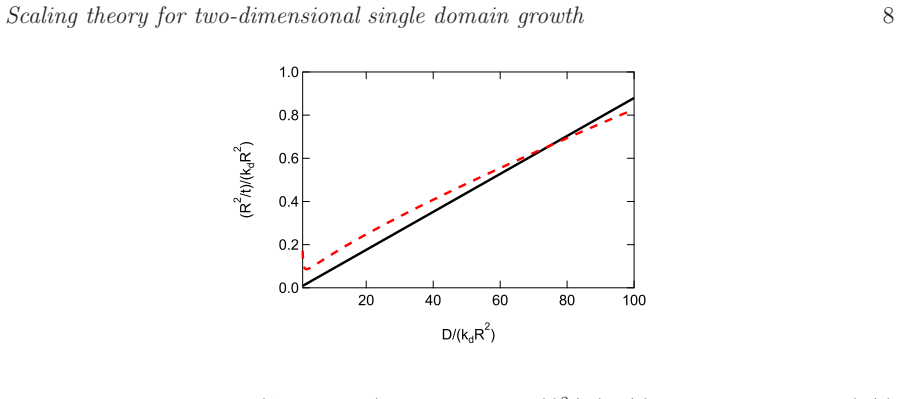
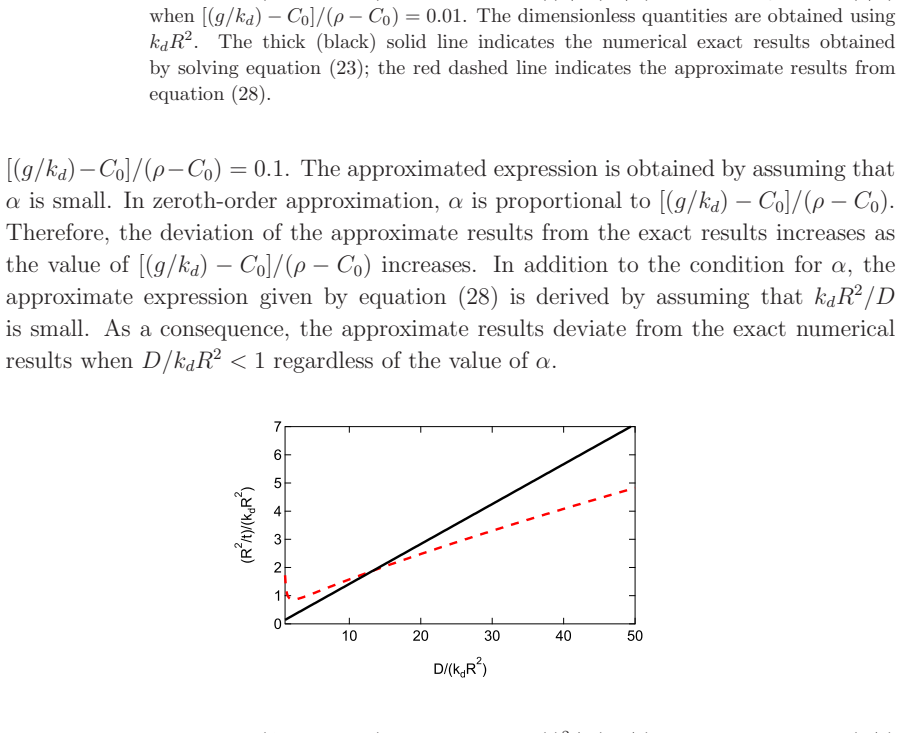
- [§2 and Figs. 2-4] The numerical benchmarks in Figs. 2-4 compare approximate and exact expressions by plotting 4α/q versus 1/q, treating q as an independent parameter. In the physical problem, however, q and α are linked through q = 4αkd t. The figures therefore demonstrate agreement of the algebraic formulas at fixed q, but they do not validate the time-dependent trajectory R(t) predicted by the theory, which is the quantity used in the experimental comparison. The author should provide a benchmark of the full time evolution, or state explicitly that only the instantaneous algebraic relation is being tested.
minor comments (5)
- [Eq. (24)] Equation (24) has a sign error as printed: the standard small-z form is U(a,1,z) ≈ [ln z - ψ(a) - 2γ]/Γ(a). The subsequent Eq. (26) uses the corrected sign, so this appears typographical, but it should be fixed.
- [§4, numerical estimate] The statement that 'the right-hand side of equation (28) yields an estimate 10⁻⁹ m²/s whereas the left-hand side of equation (28) is 10⁻¹² m²/s' is confusing because Eq. (28) is an implicit equation for R²(t), so the two sides are not independent estimates. Please clarify the intended comparison.
- [Eq. (10) and throughout] The symbol q is defined as the dimensionless desorption rate kdR²/D, but R depends on time, so q is time-dependent. This should be stated explicitly at first use to avoid the impression that q is a constant parameter.
- [Figure captions] The figure captions contain apparent label corruption (e.g., '/s32/s33/s34'), which makes the figures difficult to read. The figures should be regenerated with proper axis labels.
- [Reference [16]] Reference [16] is incomplete; the publisher, year, and place of publication for the Gupta book should be added.
Circularity Check
No significant circularity: the growth-rate constant is solved from a self-consistent Stefan problem rather than fitted, and no self-citations carry the derivation.
full rationale
The central derivation is self-contained. Equation (23) follows by combining the Stefan boundary condition (18) with the boundary condition (7) and the explicit Kummer-function solution (15)–(16); α is the unknown determined by that transcendental equation, and it is not fitted to the growth data that the paper aims to predict. The scaling law R^2(t) = 4αDt is obtained from the consistency requirement (11) that (R/D)dR/dt be time-independent, and α is then fixed by the Stefan condition, so the scaling law is not imported from the experimental data as an input. The later closed-form approximations leading to equations (28), (38), and (39) are mathematical expansions of standard special functions (Kummer functions and digamma functions), not parameter fits. The paper contains no significant self-citations: the cited prior work is external and primarily concerns analogous Stefan problems or experimental observations. The assumption that the accumulated deposition term gt is negligible in passing from Eq. (5) to Eq. (6), and the implicit time dependence of q in Eq. (23), are potential correctness or regime concerns, but they do not make the derivation circular: dropping a term is an approximation, not a reduction of the output to the input. Overall, no step was found in which a prediction is equivalent by construction to a fitted parameter or to a self-citation chain.
Assumptions & free parameters
free parameters (1)
- C0 =
not measured
assumptions (5)
- domain assumption Scaling ansatz: C(r,t)=C(ξ) with ξ=r/R(t), and consistency requires (R/D)dR/dt = 2α, implying R^2=4αDt.
- ad hoc to paper Stefan condition Eq. (6) with the gt term neglected.
- domain assumption Boundary condition C(R,t)=C0 for infinitely fast attachment, and linear kinetics Eq. (32) for finite attachment rate k.
- domain assumption Approximations α << 1 and q = kd R^2/D << 1 to derive the simplified formulas (28) and (38).
- domain assumption Desorption is necessary to render the 2D diffusion problem well-posed at r → ∞.
Cite this review
Pith. "Pith review of Scaling theory for two-dimensional single domain growth driven by attachment of diffusing adsorbates." pith.science (2026). https://pith.science/paper/EAMQTMTQ
@misc{pith2026190808780,
  author       = {Pith},
  title        = {Pith review of: Scaling theory for two-dimensional single domain growth driven by attachment of diffusing adsorbates},
  year         = {2026},
  howpublished = {\url{https://pith.science/paper/EAMQTMTQ}},
  note         = {Machine review of arXiv:1908.08780}
}
read the original abstract
Epitaxial growth methods are a key technology used in producing large-area thin films on substrates but as a result of various factors controlling growth processes the rational optimization of growth conditions is rather difficult. Mathematical modeling is one approach used in studying the effects of controlling factors on domain growth. The present study is motivated by a recently found scaling relation between the domain radius and time for chemical vapor deposition of graphene. Mathematically, we need to solve the Stefan problem; when the boundary moves, its position should be determined separately from the boundary conditions needed to obtain the spatial profile of diffusing adsorbates. We derive a closed equation for the growth rate constant defined as the domain area divided by the time duration. We obtain approximate analytical expressions for the growth rate; the growth rate constant is expressed as a function of the two-dimensional diffusion constant and the rate constant for the attachment of adsorbates to the solid domain. In experiments, the area is decreased by stopping the source gas flow. The rate of decrease of the area is obtained from theory. The theoretical results presented provide a foundation to study controlling factors for domain growth.
Figures

Figures from the paper (1 more)

Reference graph
Works this paper leans on
-
[1]
Li X, Cai W, An J, Kim S, Nah J, Yang D, Piner R, Velamakanni A, Jun g I, Tutuc E, Banerjee S K, Colombo L and Ruoff R S 2009 Science 324 1312–1314 ISSN 0036-8075
work page 2009
-
[2]
Ago H, Ito Y, Mizuta N, Yoshida K, Hu B, Orofeo C M, Tsuji M, Iked a K i and Mizuno S 2010 ACS Nano 4 7407–7414 ISSN 1936-0851
work page 2010
-
[3]
Petrone N, Dean C R, Meric I, van der Zande A M, Huang P Y, Wang L , Muller D, Shepard K L and Hone J 2012 Nano Letters 12 2751–2756
work page 2012
-
[4]
Chen X, Zhang L and Chen S 2015 Synth. Met. 210 95 – 108 ISSN 0379-6779
work page 2015
-
[5]
Seah C M, Chai S P and Mohamed A R 2014 Carbon 70 1 – 21 ISSN 0008-6223
work page 2014
-
[6]
Tetlow H, de Boer J P, Ford I J, Vvedensky D D, Coraux J and Kant orovich L 2014 Phys. Rep. 542 195 – 295 ISSN 0370-1573
work page 2014
-
[7]
Dong J, Zhang L and Ding F 2019 Adv. Mater. 31 1801583 Scaling theory for two-dimensional single domain growth 15
work page 2019
-
[8]
Kim H, Saiz E, Chhowalla M and Mattevi C 2013 New J. Phys. 15 053012
work page 2013
Show all 47 references
-
[9]
E W and Yip N K 2001 J. Stat. Phys. 104 221–253
2001
-
[10]
Crank J 1987 Free and Moving Boundary Problems Oxford science publications (Clarendon Press) ISBN 9780198533702
1987
-
[11]
Krapivsky P L 2012 Phys. Rev. E 85(3) 031124
2012
-
[12]
Larralde H, Lereah Y, Trunfio P, Dror J, Havlin S, Rosenbaum R a nd Stanley H E 1993 Phys. Rev. Lett. 70(10) 1461–1464
1993
-
[13]
Burlatsky S F, Oshanin G, Cazabat A M and Moreau M 1996 Phys. Rev. Lett. 76(1) 86–89
1996
-
[14]
Oshanin G, De Coninck J, Cazabat A M and Moreau M 1998 Phys. Rev. E 58(1) R20–R23
1998
-
[15]
A 206 349 – 361 ISSN 0927-7757
Pesheva N and Oshanin G 2002 Colloids Surf. A 206 349 – 361 ISSN 0927-7757
2002
-
[16]
Gupta S The Classical Stefan Problem (Second Edition) (Elsevier) ISBN 978-0-444-63581-5
-
[17]
41 065001
Forsberg K and Massih A R 2008 J Phys A Math Theor. 41 065001
2008
-
[18]
S´ anchez A D, Bouzat S and Wio H S 1999 Phys. Rev. E 60(3) 2677–2683
1999
-
[19]
Havlin S, Araujo M, Lereah Y, Larralde H, Shehter A, Stanley H E , Trunfio P and Vilensky B 1995 Physica A Stat . Mech. Appl. 221 1 – 14 ISSN 0378-4371
1995
-
[20]
Larralde H, Trunfio P, Havlin S, Stanley H E and Weiss G H 1992 Nature 355 423–426 ISSN 1476-4687
1992
-
[21]
Abraham D B, Cuerno R and Moro E 2002 Phys. Rev. Lett. 88(20) 206101
2002
-
[22]
Kim H, Mattevi C, Calvo M R, Oberg J C, Artiglia L, Agnoli S, Hirjibeh edin C F, Chhowalla M and Saiz E 2012 ACS Nano 6 3614–3623
2012
-
[23]
Terasawa T o and Saiki K 2015 Nat. Commun. 6 6834–1–6834–6
2015
-
[24]
Kato R, Minami S, Koga Y and Hasegawa M 2016 Carbon 96 1008 – 1013
2016
-
[25]
Freeman D L and Doll J D 1983 J. Chem. Phys. 78 6002–6009
1983
-
[26]
Eres G, Regmi M, Rouleau C M, Chen J, Ivanov I N, Puretzky A A a nd Geohegan D B 2014 ACS Nano 8 5657–5669 ISSN 1936-0851
2014
-
[27]
Wu X, Zhong G, D’Arsi´ e L, Sugime H, Esconjauregui S, Robert son A W and Robertson J 2016 Sci. Rep. 6 21152 EP – article
2016
-
[28]
Traytak S D, Barzykin A V and Tachiya M 2007 J. Chem. Phys. 126 144507
2007
-
[29]
Taira T, Obata S and Saiki K 2017 Appl. Phys. Express 10 075503
2017
-
[30]
McCarty K F, Feibelman P J, Loginova E and Bartelt N C 2009 Carbon 47 1806 – 1813
2009
-
[31]
Losurdo M, Giangregorio M M, Capezzuto P and Bruno G 2011 Phys. Chem. Chem. Phys. 13(46) 20836–20843
2011
-
[32]
13 967–974
Celebi K, Cole M T, Choi J W, Wyczisk F, Legagneux P, Rupesinghe N, Robertson J, Teo K B K and Park H G 2013 Nano Lett. 13 967–974
2013
-
[33]
McLean J G, Krishnamachari B, Peale D R, Chason E, Sethna J P a nd Cooper B H 1997 Phys. Rev. B 55(3) 1811–1823
1997
-
[34]
Zinke-Allmang M, Feldman L C and Grabow M H 1992 Surf. Sci. Rep. 16 377 – 463 ISSN 0167-5729
1992
-
[35]
Olver F W J, Lozier D W, Boisvert R F and Clark C W (eds) 2010 NIST Handbook of Mathematical Functions (New York, NY: Cambridge University Press)
2010
-
[36]
Schwoebel R L 1969 J. Appl. Phys. 40 614–618
1969
-
[37]
Ohta T 1997 Mathematical science of interfacial dynamics (Nippon Hyouron Sha (In Japanese)) ISBN 4535782466
1997
-
[38]
Jiang H and Hou Z 2015 J. Chem. Phys. 143 084109
2015
-
[39]
Li C, Yamaguchi Y, Kaneko T and Kato T 2017 Appl. Phys. Express 10 075201
2017
-
[40]
Khare S V and Einstein T L 1998 Phys. Rev. B 57(8) 4782–4797
1998
-
[41]
Khare S V and Einstein T L 1996 Phys. Rev. B 54(16) 11752–11761
1996
-
[42]
Einstein T L, Pimpinelli A and Gonz´ alez D L 2014 J. Cryst. Growth. 401 67 – 71 ISSN 0022-0248 proceedings of 17th International Conference on Crystal Grow th and Epitaxy (ICCGE-17)
2014
-
[43]
Stroscio J A and Pierce D T 1994 Phys. Rev. B 49(12) 8522–8525
1994
-
[44]
Bartelt M C and Evans J W 1992 Phys. Rev. B 46(19) 12675–12687
1992
-
[45]
Amar J G, Family F and Lam P M 1994 Phys. Rev. B 50(12) 8781–8797 Scaling theory for two-dimensional single domain growth 16
1994
-
[46]
Evans J W, Thiel P A and Bartelt M C 2006 Surf. Sci. Rep. 61 1 – 128 ISSN 0167-5729
2006
-
[47]
Das S and Drucker J 2018 J. Appl. Phys. 123 205306
2018
Reviewed August 14, 2026 · model on record in the stance chip above.
Discussion (0). Continue with ORCID to comment.