REVIEW 2 major objections 5 minor 1 references
Quantum dot optomechanics in suspended nanophononic strings
T0 review · 2 major / 5 minor · reviewed 2026-08-14 · deepseek-v4-flash
Pith's one-line read The paper reports that quantum dots embedded in a suspended nanophononic string show a 15-fold enhancement of their optomechanical modulation compared with dots strained by a Rayleigh surface acoustic wave, with the enhancement explained…
desk verdict The 15-fold enhanced QD modulation in suspended nanophononic strings is a credible and interesting new result, but the quantitative shear-strain coupling claim needs a revision that quantifies mid-plane offset and piezoelectric corrections. read the letter →
The pith
A machine-rendered reading of the paper's core claim, the machinery that carries it, and where it could break.
The reading
What carries the argument
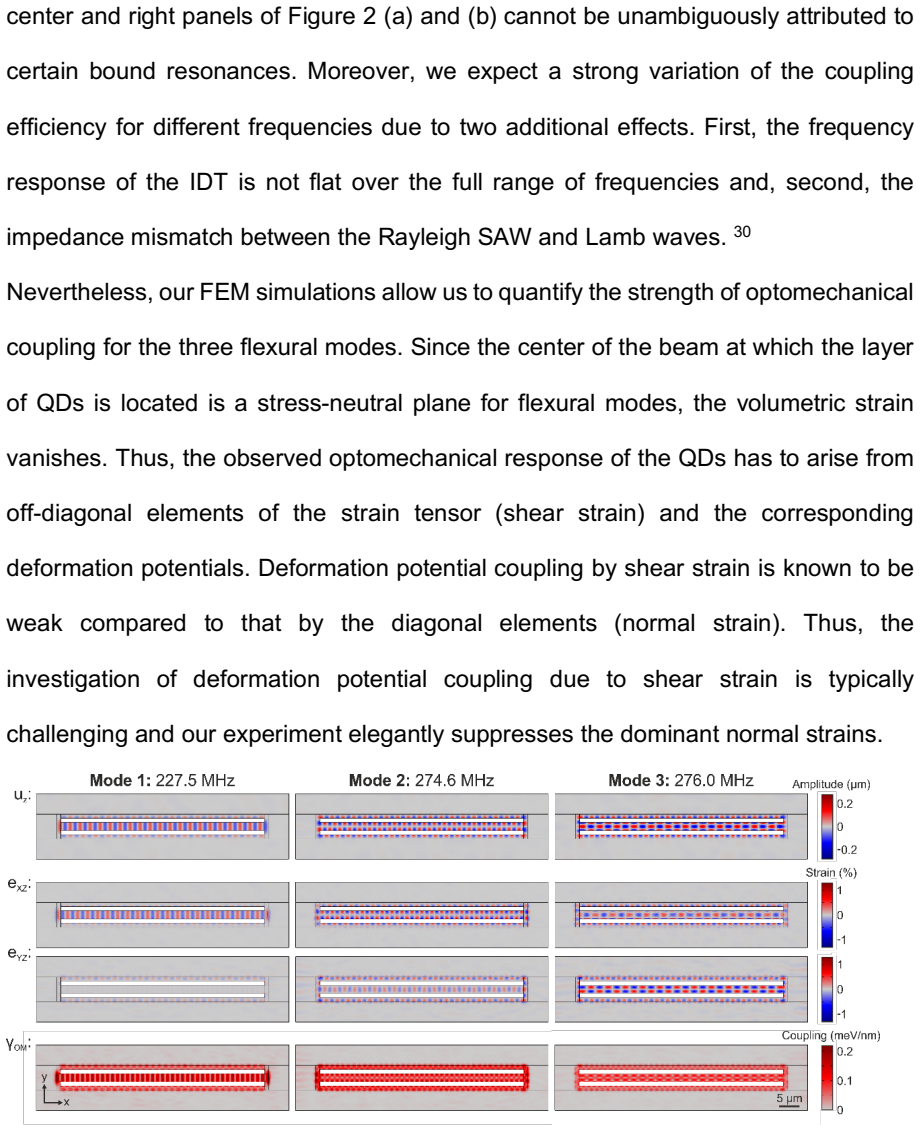
The load-bearing object is the suspended nanophononic string's flexural (antisymmetric Lamb) modes, whose displacement profiles create shear strain components $e_{xy}$ and $e_{xz}$ in the quantum-dot layer while the volumetric strain vanishes at the string's stress-neutral mid-plane. The paper evaluates the optomechanical coupling parameter $\gamma = d \sqrt{e_{xy}^2 + e_{xz}^2}$ using the Pikus-Bir strain Hamiltonian with the bulk GaAs valence-band deformation potential $d = -4.8$ eV, and obtains mode-resolved $\gamma$ maps from finite element simulations. This reduction isolates a normally weak coupling channel, valence-band shear strain, and lets the experiment convert measured spectral shifts into mechanical displacement amplitudes.
What would settle it
Measure the modulation of identical quantum dots in strings where the dot layer is deliberately grown a few nanometres off the mid-plane: if the optomechanical response does not grow according to the simulated normal-strain component, or if an on-mid-plane dot still shows strong modulation at a frequency where the finite-element shear strain at the dot layer vanishes, the shear-only origin of the enhancement is falsified.
Extended reading notes
Core claim
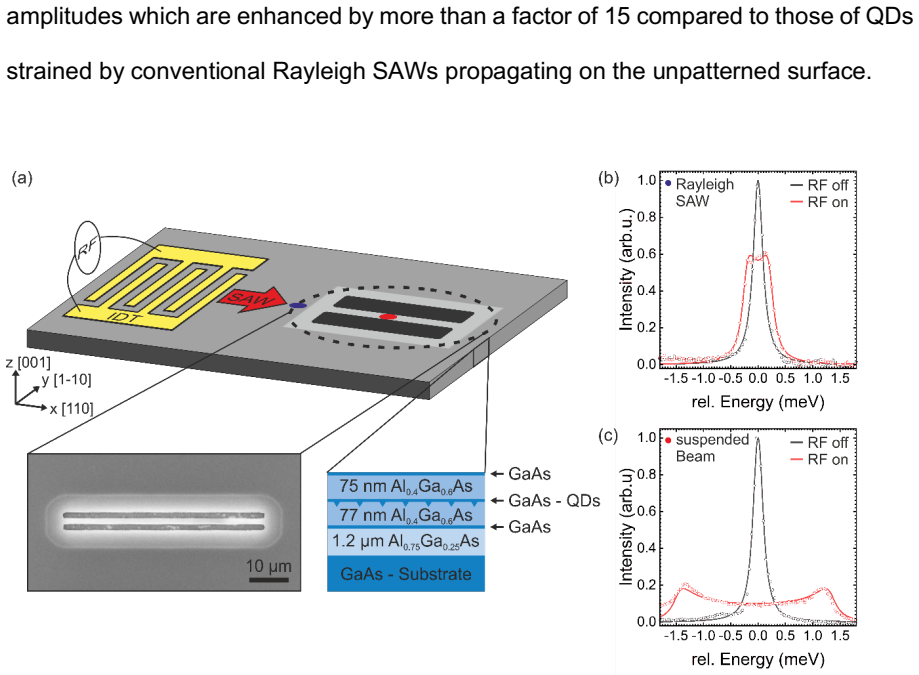
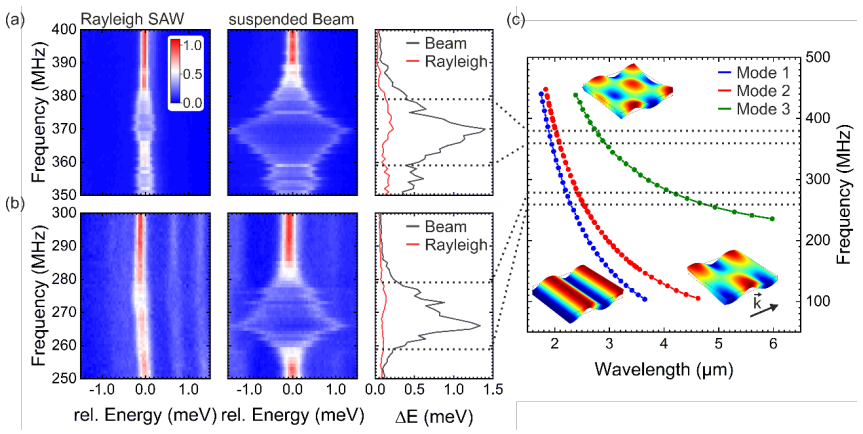
On the paper's own terms, the discovery is that flexural Lamb modes of a suspended nanophononic string couple to embedded GaAs quantum dots chiefly through shear strain, and that this coupling is strong enough to produce spectral modulation amplitudes of $\Delta E = 1.40$ meV at $f = 370$ MHz and $1.336$ meV at $f = 266$ MHz, which are 10- and 15-fold larger than the modulations measured on Rayleigh surface acoustic waves in the unpatterned region ($0.23$ meV at $f = 370$ MHz). Finite element simulations of the three lowest flexural modes, combined with the Pikus-Bir strain Hamiltonian and the bulk GaAs valence-band deformation potential, give a shear-strain optomechanical coupling parameter of about $0.15$ meV/nm, roughly an order of magnitude larger than reported for vibrating nanorods at much higher frequencies. From this parameter the authors infer vertical displacements of $10.5 \pm 3.5$ nm and $10.0 \pm 3.4$ nm at the two resonance peaks, versus $0.08$ nm and $0.04$ nm for the Rayleigh-wave case. The essential assertion is that the observed enhancement is quantitative evidence for pure shear-strain deformation-potential coupling, made visible by placing the dots exactly in the stress-neutral plane of the string.
Load-bearing premise
The load-bearing premise is that the 2 nm quantum-dot layer sits exactly in the stress-neutral mid-plane of the string, so the volumetric (normal) strain is zero and the measured modulation comes entirely from shear strain; if the dots are even slightly off-centre, or piezoelectric or acoustoelectric fields contribute, the extracted coupling parameter and displacements would change.
Editorial extensions
If this is right
- Quantum dots in nanophononic strings become local, radio-frequency-driven optical modulators with sub-meV to above-1-meV tuning at 250–400 MHz, without displacing the dots from the neutral plane.
- The measured coupling parameter $\gamma \approx 0.15$ meV/nm turns single-dot photoluminescence into a calibrated mechanical displacement sensor: a 1 meV shift corresponds to roughly 10 nm of vertical flexural motion.
- Because the coupling is shear-only, the geometry offers a clean experimental test of valence-band shear deformation potentials, a channel usually masked by stronger normal-strain coupling.
- Operating above 400 MHz moves the system toward the resolved-sideband regime, where parametric transduction and hybrid quantum-dot optomechanical control schemes become accessible.
Reading between the lines
- If the shear-only picture is correct, the phase and amplitude of the modulation should follow mode symmetry: for instance, Mode 1 (with only one shear component) should produce a different spatial pattern of shifts than Mode 2 or Mode 3, so stroboscopic imaging across the string could test the mode assignment.
- The same mid-plane design could be transferred to other optically active defects and nanowire quantum dots, where shear-strain-only coupling might suppress unwanted charging or piezoelectric cross-talk.
- A further implication is that the quantitative $\gamma$ extracted from each mode should agree with the same bulk deformation potential $d$; comparing values obtained from Mode 1, 2, and 3 is a simple internal consistency check of the whole analysis.
Signed reviews
Editorial analysis
A structured set of objections, weighed in public.
Referee Report
Summary. The paper reports an experimental study of quantum dot (QD) optomechanics in suspended nanophononic strings. The authors fabricate a 50-µm-long, 2-µm-wide suspended (Al)GaAs string with embedded GaAs QDs and inject Rayleigh surface acoustic waves (SAWs) from an adjacent transducer at 250-400 MHz. Photoluminescence measurements show that QDs on the string exhibit spectral modulation amplitudes up to about 1.4 meV, roughly one order of magnitude larger than QDs on the unpatterned substrate. Finite element simulations identify three flexural modes of the string, and the authors argue that, because the QD layer lies at the stress-neutral mid-plane, only shear strain couples to the valence band via the deformation potential. From the FEM strain profiles and the bulk GaAs deformation potential d = -4.8 eV, they extract an optomechanical coupling parameter γ ≈ 0.15 meV/nm and infer vertical displacements u_z ≈ 10 nm from the measured modulation amplitudes. The central claims are (i) a 15-fold enhancement of optomechanical modulation compared to Rayleigh SAWs and (ii) quantitative agreement with an exclusively shear-strain deformation-potential coupling model.
Significance. If the quantitative shear-strain interpretation is correct, this is a valuable demonstration of a suspended optomechanical platform for QDs, achieving large spectral modulation at radio frequencies and potentially enabling sideband-resolved QD optomechanics. The paper's strengths include direct PL measurements with time-modulated Lorentzian fits, stroboscopic phase-resolved spectroscopy showing mode propagation, careful FEM identification of the mode spectrum, and comparison with literature deformation-potential values. The 15-fold enhancement observation is directly supported by the PL data. However, the quantitative values of γ and u_z depend on the exclusive shear-strain assumption, which is not fully verified, as detailed in the major comments.
major comments (2)
- [p.8, Eq. (2)] The claim that the QD layer is at a stress-neutral plane is quantitatively unverified. The layer stack is asymmetric (77 nm AlGaAs above and 75 nm below the 2 nm QD layer), placing the QD layer about 1 nm from the geometric mid-plane. For the inferred u_z ≈ 10 nm and a typical flexural wavelength of about 1.8 µm at 370 MHz, the flexural curvature produces a normal strain at this offset of roughly 1×10^-4, which is comparable to the shear strain of about 3×10^-4 implied by ΔE = 1.4 meV and d = -4.8 eV. Because the hydrostatic deformation potential is of similar magnitude to d, volumetric strain could shift the extracted γ and u_z by tens of percent. Please report the FEM-calculated strain components, including the volumetric strain, at the actual QD layer position for each mode, and quantify the resulting correction to γ and u_z.
- [p.8, Fig. 3] The manuscript does not quantify the piezoelectric fields generated by shear strain in the zincblende lattice. With the piezoelectric constant e14 ≈ 0.16 C/m^2 and a shear strain of about 3×10^-4, the induced internal electric field is of order 0.4 V/µm, which for a typical QD exciton dipole moment yields a Stark shift of about 0.1-0.3 meV, a non-negligible fraction of the measured ΔE = 1.4 meV. The statement that acoustoelectric charging is suppressed does not exclude this strain-induced Stark contribution. Please estimate the piezoelectric field for the simulated modes and demonstrate explicitly that its contribution to the spectral modulation is small compared with the deformation-potential shift.
minor comments (5)
- [Abstract and p.3] The abstract and introduction state a '15-fold enhanced' modulation, but the values quoted in Fig. 1 give ΔE = 1.40/0.23 ≈ 6.1. Please clarify which comparison yields the factors of 10 and 15 quoted in the text and Fig. 2.
- [Eq. (2)] Equation (2) appears garbled in the manuscript text; please ensure the expression for γ is typeset correctly so that the relation between γ, d, the shear strains, and u_z is unambiguous.
- [Abstract] In the abstract, the sentence 'Using this value, a derive vertical displacements...' should be corrected to 'we derive vertical displacements...'.
- [p.9, displacements] When reporting u_z = 10.5±3.5 nm and 10.0±3.4 nm, please specify the point along the string (or the averaging procedure) at which the displacement is evaluated, since γ and the strain profile vary along the mode.
- [Experimental Section] Please state whether the FEM strain values are evaluated at the center of the 2 nm QD layer or averaged over its thickness; the finite thickness is relevant to the neutral-plane assumption.
Circularity Check
No significant circularity: the coupling parameter is computed from FEM strains and a literature deformation potential, not fitted to the measured ΔE.
full rationale
The derivation chain is self-contained against external, non-fitted inputs. The measured inputs are the optomechanical modulation amplitudes ΔE extracted from time-modulated Lorentzian fits (Eq. 1), and the simulated inputs are the flexural mode displacements and shear strains obtained from COMSOL FEM using the nominal heterostructure geometry and bulk elastic constants. The optomechanical coupling parameter γ is evaluated from Eq. 2 using only the FEM shear-strain components and the bulk GaAs valence-band deformation potential d = -4.8 eV taken from the external literature (Vurgaftman et al.), so γ is not adjusted to match any measured ΔE. The vertical displacements are then derived as ΔE/γ, a dependent quantity, not a forced reproduction of the input. No fitted parameter is renamed as a prediction, and no quantity is defined in terms of the result it is used to explain. The only self-citation (ref. 20, prior work by the same group showing QD tuning in a membrane center) serves as background motivation and is not load-bearing for the present derivation; the central claim rests on the independent FEM calculation and the spectroscopic measurements. The stress-neutral-plane assumption is a physical modeling assumption about the structure rather than a circular reuse of the measured outcome; its validity (finite 2 nm QD layer thickness, possible piezoelectric fields) affects accuracy but is a correctness or robustness concern, not a circularity.
Assumptions & free parameters
assumptions (5)
- domain assumption The QD layer lies exactly in the stress-neutral mid-plane of the string, so normal strain vanishes and only shear strain couples to the QD exciton.
- domain assumption The FEM model (COMSOL, bulk elastic properties, geometry from SEM) faithfully reproduces the real mode shapes, strain amplitudes, and resonance frequencies of the fabricated string.
- domain assumption The bulk GaAs valence band deformation potential d = -4.8 eV applies to the QDs, and the conduction band is negligibly affected by shear strain.
- ad hoc to paper The optomechanical modulation of the QD emission is caused solely by strain (deformation potential), with negligible contributions from acoustoelectric fields or quantum-confined Stark effect.
- domain assumption The measured Delta E is directly proportional to the simulated gamma so that u_z = Delta E / gamma yields the vertical displacement.
Cite this review
Pith. "Pith review of Quantum dot optomechanics in suspended nanophononic strings." pith.science (2026). https://pith.science/paper/XDAXXVQG
@misc{pith2026190808804,
  author       = {Pith},
  title        = {Pith review of: Quantum dot optomechanics in suspended nanophononic strings},
  year         = {2026},
  howpublished = {\url{https://pith.science/paper/XDAXXVQG}},
  note         = {Machine review of arXiv:1908.08804}
}
abstract
The optomechanical coupling of quantum dots and flexural mechanical modes is studied in suspended nanophononic strings. The investigated devices are designed and monolithically fabricated on an (Al)GaAs heterostructure. Radio frequency elastic waves with frequencies ranging between $f$=250 MHz to 400 MHz are generated as Rayleigh surface acoustic waves on the unpatterned substrate and injected as Lamb waves in the nanophononic string. Quantum dots inside the nanophononic string exhibit a 15-fold enhanced optomechanical modulation compared to those dynamically strained by the Rayleigh surface acoustic wave. Detailed finite element simulations of the phononic mode spectrum of the nanophononic string confirm, that the observed modulation arises from valence band deformation potential coupling via shear strain. The corresponding optomechanical coupling parameter is quantified to $0.15 \mathrm{meV nm^{-1}}$. This value exceeds that reported for vibrating nanorods by approximately one order of magnitude at 100 times higher frequencies. Using this value, a derive vertical displacements in the range of 10 nm is deduced from the experimentally observed modulation. The results represent an important step towards the creation of large scale optomechanical circuits interfacing single optically active quantum dots with optical and mechanical waves.
Figures
Reference graph
Works this paper leans on
-
[1]
A frequency-tunable nanomembrane mechanical oscillator with embedded quantum dots
1 Quantum dot optomechanics in suspended nanophononic strings Anja Vogele1, Maximilian M. Sonner1,3, Benjamin Mayer1, Xueyong Yuan1,2, Matthias Weiß1,3, Emeline D. S. Nysten1,3, Saimon F. Covre da Silva2, Armando Rastelli2, Hubert J. Krenner1,3,4* 1 Lehrstuhl für Experimentalphysik 1 and Augsburg Centre for Innovative Technologies (ACIT), Universität Augs...
work page Pith review arXiv 2015
Reviewed August 14, 2026 · model on record in the stance chip above.
Discussion (0). Continue with ORCID to comment.