REVIEW 4 major objections 5 minor 3 references
Automated Generation of Test Models from Semi-Structured Requirements
T0 review · 4 major / 5 minor · reviewed 2026-08-14 · deepseek-v4-flash
Pith's one-line read This paper claims that a two-step pipeline—machine-learning detection of pseudo-code-like requirement lines followed by a grammar-based translation into Cause-Effect-Graphs—cuts test-model creation time by about 86 percent without…
desk verdict A useful, partially reproducible pipeline for turning pseudo-code requirements into Cause-Effect-Graphs, but the headline 86% savings number rests on a fixed manual-first case study that mostly demonstrates memory, not automation value. read the letter →
The pith
A machine-rendered reading of the paper's core claim, the machinery that carries it, and where it could break.
The reading
What carries the argument
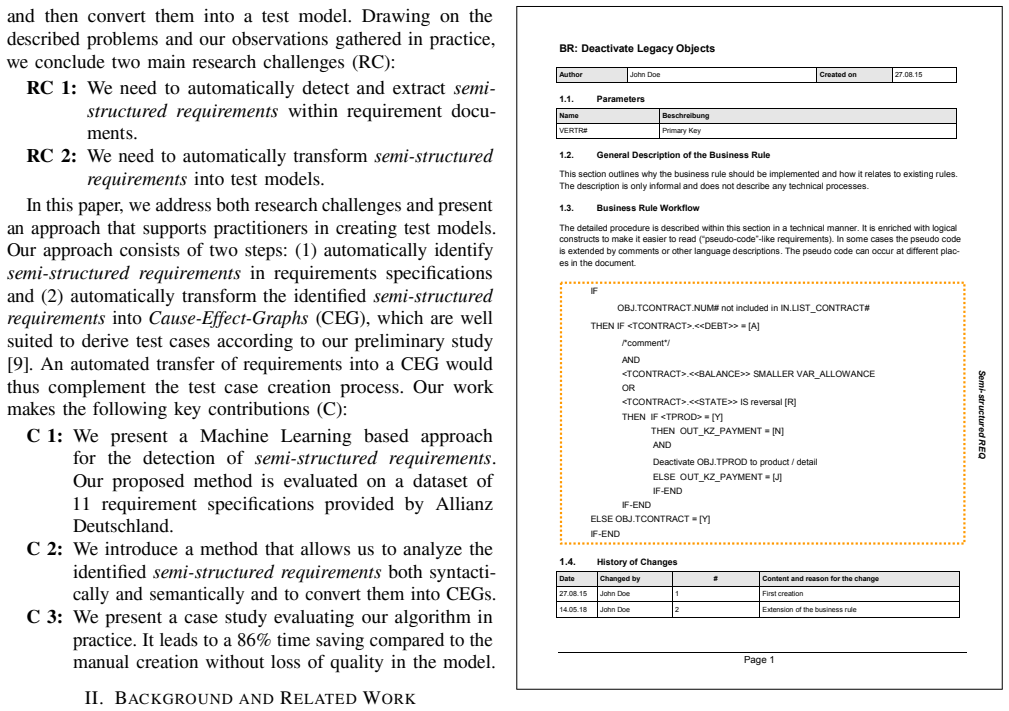
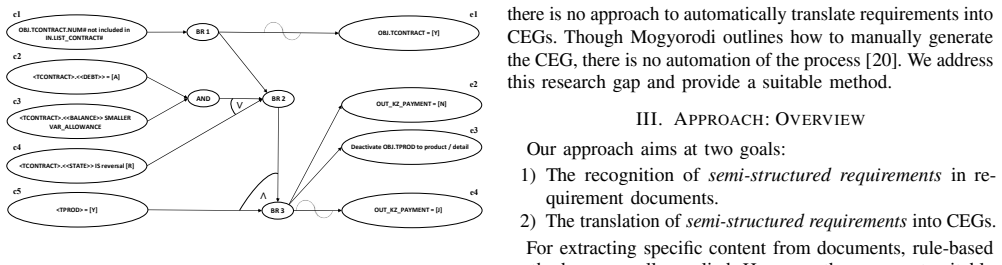
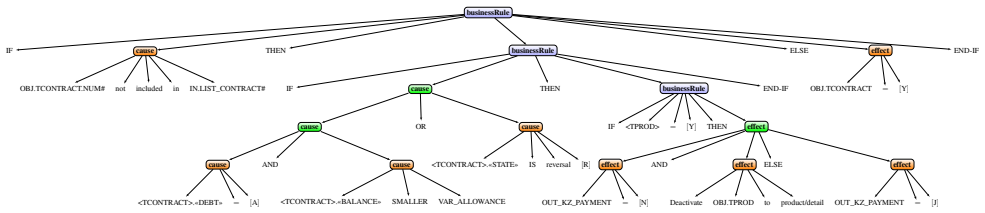
The machinery is a two-stage classifier-plus-parser pipeline. The detection stage maps each line via $f:\mathbb{R}^4 \to \{C_0, C_1\}$ using special-character count, word count, indentation degree, and capital-letter ratio, with Random Forest and random under-sampling chosen for the best recall/precision balance; it finds the pseudo-code lines without needing exact spellings. The translation stage uses an ANTLR grammar tolerant of loose notation to build an Abstract Syntax Tree, distinguishes assignment nodes (conjunction/disjunction), content nodes (cause/effect), and business-rule nodes (If/Then/Else), and traverses post-order to emit CEG nodes and connections, with nested rules becoming intermediate business-rule nodes and Else blocks linked through negation. This combination converts a document-scope search problem into a line-level classification plus a local logic translation, which is what makes automation feasible.
What would settle it
Take a fresh set of requirement documents from a different organization or domain, run the detector and translator, and count how many detected pseudo-code blocks produce syntactically valid Cause-Effect-Graphs; if that count is low while detection recall stays high, the grammar assumption fails and the 86 percent savings will not transfer. A second concrete check is to compare tool-generated and manual CEGs on a larger sample than three documents, measuring structural equality and missed causes or effects; any systematic mismatches would put the no-quality-loss claim at risk.
Extended reading notes
Core claim
The central claim is that going from natural-language requirements to a test model does not require full natural-language understanding; it requires finding the structured lines and interpreting their logical scaffolding. The authors treat pseudo-code detection as a binary line classification problem over four cheap features, and they report that Random Forest with random under-sampling detects about 90 percent of pseudo-code lines. The identified lines are parsed with a loosely defined ANTLR grammar into an abstract syntax tree whose nodes mark causes, effects, AND/OR assignments, and If-Then-Else business rules; a post-order traversal with fixed connection rules (implication for normal effects, negation for Else effects) yields the Cause-Effect-Graph. The paper's study evidence is that this pipeline produces CEGs equal in content to manual ones while reducing creation time by 86 percent on average.
Load-bearing premise
The load-bearing premise is that the pseudo-code lines in real documents have a consistent enough syntax for the ANTLR grammar to parse; the authors state in their limitations that spelling and grammar errors make the translation fail.
Editorial extensions
If this is right
- For the studied class of semi-structured requirements, test designers no longer build CEGs from scratch; they verify and repair machine output, and the reported equal content supports replacing manual creation in this setting.
- Because detection is learned rather than rule-based, variations in pseudo-code spelling and missing delimiters do not break the detection stage, though they can still break translation.
- Nested If/Then/Else requirements, which the study participants found error-prone to translate manually, are handled by the algorithm's business-rule nodes and negation links, so the largest benefit appears on complex documents.
- The time saving is a saving in the full workflow, not just in parsing, so the benefit is measured where it matters for daily test design.
- The process remains semi-automated: around 10 percent of pseudo-code lines had to be added manually and irrelevant lines removed due to low precision, so the model is a decision-support accelerator rather than a fully autonomous replacement.
Reading between the lines
- An implication the authors leave implicit: the same line-classification trick could apply to other structured templates, such as user-story acceptance criteria or Gherkin scenarios; the paper itself names Gherkin as future work, and the four features would likely transfer with minor adaptation.
- The study bundles detection and translation, so the 86 percent figure does not say how much each stage contributes; a separate timing of detection-only versus translation-only would tell practitioners which stage is worth investing in.
- A natural testable extension is to check transfer across domains: because the classifier was trained on 11 documents from one industry partner, sampling documents from other business areas and measuring recall and precision would reveal whether the 14 percent prevalence and the feature distribution are general or peculiar to that corpus.
- If the pipeline is re-run after each requirements change, the maintenance cost of test models could drop beyond the initial creation saving, since updating a CEG would become a re-execution plus review rather than a manual re-model.
Signed reviews
Editorial analysis
A structured set of objections, weighed in public.
Referee Report
Summary. The paper proposes a two-stage pipeline for creating Cause-Effect-Graph (CEG) test models from semi-structured requirements. Stage one is a machine-learning line classifier that uses four handcrafted features and a Random Forest with random under-sampling to distinguish pseudo-code-like lines from natural-language lines in requirements documents. Stage two is an ANTLR-based grammar that parses the detected pseudo-code into an abstract syntax tree, which is then traversed to produce a CEG. The approach is evaluated in three ways: a 10-fold cross-validation over 4,450 manually labeled lines from 11 industrial documents, a worked example, and a case study with three test designers who created CEGs manually and then with tool support for three documents, yielding a reported mean time saving of 86%.
Significance. If substantiated, the work would fill a real gap: it addresses the full pipeline from requirements document to test model, whereas prior work focuses on either detection or translation into other notations. The detection comparison is systematic across six classifiers and five balancing methods, and the source code is made available. The main novelty, translating pseudo-code into CEGs via a reusable grammar, is plausible and demonstrated in a detailed example. However, the headline quantitative claim (C3) rests on three participants using a fixed manual-first design, so the 86% figure cannot currently be taken as an unbiased estimate of practical savings. The detection evaluation also lacks document-level separation, and the translation step is not evaluated at corpus level. These concerns are addressable, but they affect the central claims as stated.
major comments (4)
- [§VI.A, Table III] The case study uses a fixed manual-first protocol: for each document, every participant first performs the manual procedure (1a: search for pseudo-code sections, 1b: translate) and then repeats the task on the same document with tool support (2a–2c). The first pass necessarily exposes the locations of the pseudo-code sections and the expected graph structure, so the second pass measures recognition and confirmation of already-known content rather than the full search-and-translation task. The maturation defense in Section VII addresses only the automatic part (2c) and the brevity of the comparison (2b); it does not account for the asymmetry between the open-ended search in 1a and the confirmation in 2b. With n=3 and no confidence intervals or significance test, the 86% mean saving is not an unbiased estimate. A between-subjects design, counterbalanced document order, or at least separate recording of 1a and 2b times would be needed.
- [§VI.B] The claim that the automated CEGs are created without loss of quality is supported only by the informal statement that their content is the same. There is no check-list, no independent expert comparison, and no blind evaluation; because each participant produced both graphs in immediate succession, confirmation bias cannot be excluded. The paper should either provide a structured quality comparison (e.g., counting missing or misplaced causes and effects, verifying graph equivalence) or restrict the claim to time savings.
- [§IV.D] The 10-fold cross-validation is applied to individual lines, not documents. Since lines from the same document can appear in both training and test folds, the reported recall and precision values may overestimate performance on new requirements documents, which is the stated practical use case. A leave-one-document-out or grouped cross-validation would give a more credible estimate; the authors should report this alongside the current numbers.
- [§V and §VII] The translation step is evaluated only on one worked example and on the three case-study documents, with the case study's quality assessment being informal. Given the paper's own limitation that the approach depends on a consistent syntax of the pseudo code and that translation fails in case of spelling and grammar errors, the paper should report how many pseudo-code sections (e.g., in the 11-document corpus) were successfully parsed and translated without manual repair. Without such a corpus-level check, C2 is demonstrated as a proof-of-concept rather than as a robust algorithm.
minor comments (5)
- [§IV] The text says "a algorithm"; it should be "an algorithm."
- [§VII] "Levensthein Distance" is a misspelling; it should be "Levenshtein Distance."
- [§II.A] The relationship between "semi-formal" and "semi-structured" is confusing: controlled natural language is called semi-formal in II.A, while the paper's own approach is said to lie between informal and semi-formal. Please clarify the terminology to avoid ambiguity.
- [Table II] The table reports only point estimates for recall and precision; reporting standard deviations or confidence intervals across the 10 folds would help the reader judge the stability of the classifier comparison.
- [Throughout] The spellings "pseudo code" and "pseudo-code" are used inconsistently; please unify them.
Circularity Check
No circularity found; the detection, translation, and time-saving claims are each empirical or rule-based and do not reduce to their inputs.
full rationale
The paper's central claims do not reduce to their inputs. C1 is a supervised ML classifier evaluated with 10-fold cross-validation on 11 manually labeled Allianz documents; the labels are human annotations and the folds are held out, so detection performance is an empirical measurement, not an identity. C2 is a fixed ANTLR grammar and traversal rules that translate pseudo-code syntax trees into CEGs; there is no indication that the grammar or decision rules were fitted to the case-study documents or to the reported time savings. C3's 86% figure is a direct arithmetic comparison of measured manual vs tool-supported times in Table III, not a fitted parameter relabeled as a prediction. The only self-citation, [9] (Specmate), supports the background claim that CEGs generate a minimum test set; this is a utility argument and is not load-bearing for the detection/translation contributions or for the time-saving study. The manual-first experimental order noted by a skeptical reader is a maturation threat to validity, acknowledged in Section VII, but it is a confound in evaluation design, not a circular derivation: the tool-supported time is not by construction equal to the manual time or to any fitted value. The informal 'content is the same' quality comparison is a validity weakness, but it is not a circular step. Consequently, no circular step can be exhibited with the required specificity; the derivation chain is self-contained.
Assumptions & free parameters
free parameters (1)
- Random Forest classification model (including balancing choice RUS) =
not reported
assumptions (5)
- domain assumption Manual line labels by the first author are correct enough for supervised training; the second author's random inspection ensures validity.
- domain assumption The four features (special characters, word count, indentation, capital-letter ratio) are sufficient to separate pseudo-code from natural language in the target documents.
- domain assumption The ANTLR grammar covers the logical constructs (IF, THEN, ELSE, AND, OR) and expression forms that appear in the targeted pseudo-code.
- ad hoc to paper Prioritizing recall over precision is the correct cost trade-off for CEG completeness.
- domain assumption The three test designers and three test documents are representative enough to estimate practical time savings.
Cite this review
Pith. "Pith review of Automated Generation of Test Models from Semi-Structured Requirements." pith.science (2026). https://pith.science/paper/TYJHAURI
@misc{pith2026190808810,
  author       = {Pith},
  title        = {Pith review of: Automated Generation of Test Models from Semi-Structured Requirements},
  year         = {2026},
  howpublished = {\url{https://pith.science/paper/TYJHAURI}},
  note         = {Machine review of arXiv:1908.08810}
}
read the original abstract
[Context:] Model-based testing is an instrument for automated generation of test cases. It requires identifying requirements in documents, understanding them syntactically and semantically, and then translating them into a test model. One light-weight language for these test models are Cause-Effect-Graphs (CEG) that can be used to derive test cases. [Problem:] The creation of test models is laborious and we lack an automated solution that covers the entire process from requirement detection to test model creation. In addition, the majority of requirements is expressed in natural language (NL), which is hard to translate to test models automatically. [Principal Idea:] We build on the fact that not all NL requirements are equally unstructured. We found that 14 % of the lines in requirements documents of our industry partner contain "pseudo-code"-like descriptions of business rules. We apply Machine Learning to identify such semi-structured requirements descriptions and propose a rule-based approach for their translation into CEGs. [Contribution:] We make three contributions: (1) an algorithm for the automatic detection of semi-structured requirements descriptions in documents, (2) an algorithm for the automatic translation of the identified requirements into a CEG and (3) a study demonstrating that our proposed solution leads to 86 % time savings for test model creation without loss of quality.
Figures
Reference graph
Works this paper leans on
-
[2]
Cost-sensitive Methods: ClassWeighting (CL). C. ClassificationAlgorithms We benchmarked 6 different algorithms, which are widely employed for binary classification in research and practice: Decision Tree , Logistic Regression , SupportVector Machines , Random Forest , NaiveBayes and K-Nearest Neighbor . D. Evaluation Strategy andMetrics We follow the idea o...
work page 2005
-
[13]
Cause-effect graphs in functional testing,
G. J. Myers, TheArt ofSoftware Testing . Wiley, 1979. [14] W. R. Elmendorf, “Cause-effect graphs in functional testing,” IBM Systems Development Division, Tech. Rep., 1973. [15] S. Tuarob, S. Bhatia, P. Mitra, and C. L. Giles, “Automatic detection of pseudocodes in scholarly documents using machine learning,” in ICDAR , 2013. [16] G. Carvalho, F. Barros, ...
work page 1979
-
[20]
What is requirements-based testing?
G. Mogyorodi, “What is requirements-based testing?” in STC , 2003. [21] G. James, D. Witten, T. Hastie, and R. E. Tibshirani, An Introductionto StatisticalLearning , 1st ed. Springer, 2013
work page 2003
Reviewed August 14, 2026 · model on record in the stance chip above.
Discussion (0). Continue with ORCID to comment.