REVIEW 2 major objections 4 minor 43 references
Elastic avalanches reveal marginal behaviour in amorphous solids
T0 review · 2 major / 4 minor · reviewed 2026-08-14 · deepseek-v4-flash
Pith's one-line read Even deep in the elastic regime, amorphous solids deform through scale-free avalanches with a universal exponent τ ≈ 1, the mean-field signature of marginal stability.
desk verdict Systematic numerical study of elastic-regime avalanches in Lennard-Jones glasses claims universal τ≈1, but the paper's own tables show α and df/d are inconsistent with τ≈1 for poorly annealed states, leaving the marginal-stability conclusion unproven. read the letter →
The pith
A machine-rendered reading of the paper's core claim, the machinery that carries it, and where it could break.
The reading
What carries the argument
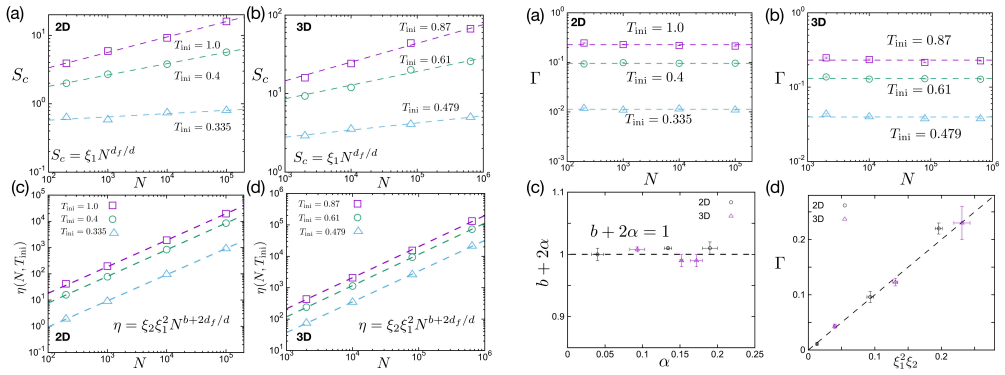
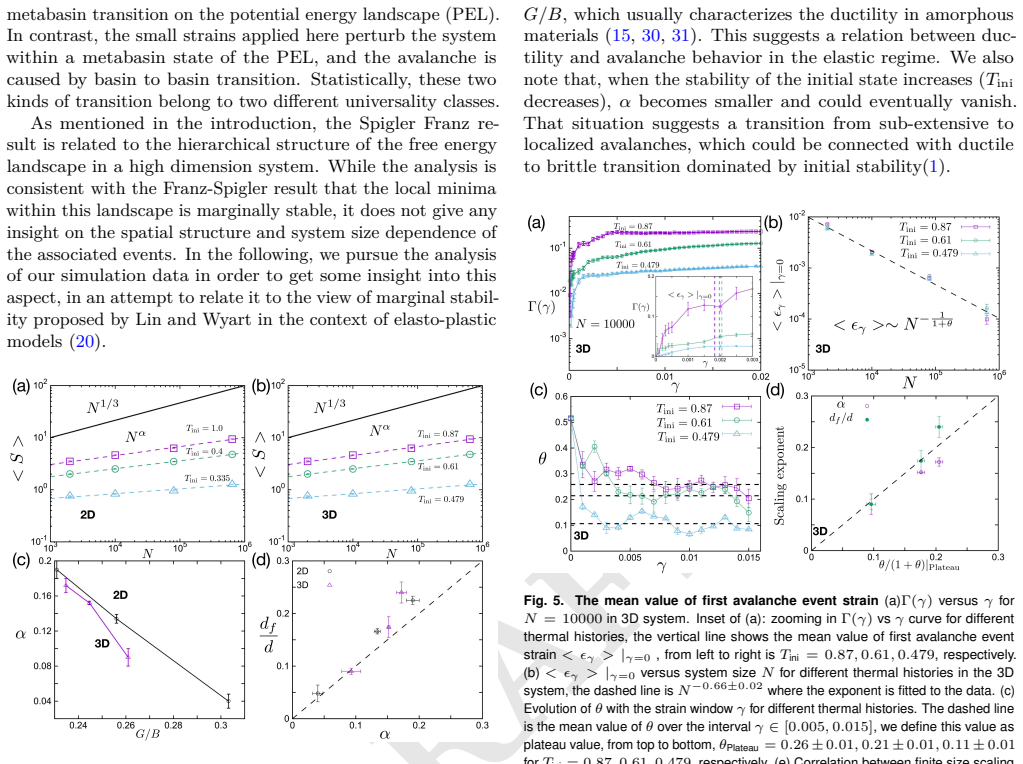
The load-bearing object is the avalanche number density $R(S,N,T_{\mathrm{ini}})$, defined as the number of energy-drop avalanches of size $S$ per unit avalanche size and per unit strain. The argument is carried by a scaling ansatz that factors out system-size and thermal-history dependences: $S_c \sim \xi_1 N^{d_f/d}$ and $R \sim \xi_2 N^b \chi^{-\tau} f(\chi)$, so that the exponent $\tau$ is extracted from a data collapse. Three identities anchor the interpretation: energy balance gives $b + 2d_f/d = 1$; extreme-value statistics of the strain to the first plastic event gives $\langle \epsilon_\gamma \rangle \sim N^{-1/(1+\theta)}$, yielding $\theta \approx 1/2$; and the elasto-plastic relation $\alpha = \theta/(1+\theta)$ links the mean-avalanche-size exponent $\alpha$ to the pseudo-gap exponent $\theta$.
What would settle it
Measure the elastic-regime avalanche distribution in a qualitatively different glass former, e.g. a polymer glass or a metallic-glass model, using the same athermal quasistatic protocol; a value of $\tau$ clearly different from 1 would falsify the claim of a universal marginal-stability signature. Alternatively, check the zero-strain pseudo-gap prediction directly: if the first-avalanche strain in a deeply annealed sample does not scale as $N^{-2/3}$, the extreme-value link to $\theta = 1/2$ fails.
Extended reading notes
Core claim
The central claim is that amorphous solids respond to arbitrarily small shear strain through scale-free avalanche activity whose statistics are those of a marginally stable phase, not the localized, history-dependent events usually assumed for the elastic regime. In athermal quasistatic simple shear over strain interval $\gamma \in [0, 0.02]$, well below the yield strain, the avalanche number density obeys $R(S,N,T_{\mathrm{ini}}) \sim \xi_2 N^b \chi^{-\tau} f(\chi)$ with $\chi = S/S_c$, $S_c \sim \xi_1 N^{d_f/d}$, and $\tau = 0.98\pm0.01$ (2D) and $1.01\pm0.01$ (3D). The same scaling is compatible with the mean-field result that local minima in a hierarchical energy landscape are marginally stable, and with predictions of an elasto-plastic model in which marginal stability appears as a pseudo-gap with exponent $\theta \approx 1/2$ at zero strain. The paper further shows that the scalar exponents satisfy $b + 2d_f/d = 1$, $d_f/d = \alpha$, and $\alpha = \theta/(1+\theta)$, where $\alpha$ governs the subextensive growth of the mean avalanche size with $N$. From the limit ordering $N\to\infty$ versus $\gamma\to0$ it infers that the thermodynamic-limit solid is intrinsically dissipative.
Load-bearing premise
The interpretation assumes that the mean-field result for marginally stable jammed packings in infinite dimensions transfers to dense, attractive Lennard-Jones glasses; if that transfer fails, the measured exponent $\tau \approx 1$ could have a different cause.
Editorial extensions
If this is right
- Elastic avalanches belong to a universality class distinct from steady plastic flow: $\tau \approx 1$ here versus the larger exponents found in stationary shearing, so transient and steady-state plasticity must be analysed separately.
- The energy-balance identity $b + 2d_f/d = 1$ holds in the elastic regime, providing a consistency check for any future simulation or experiment that measures avalanche cutoffs.
- The pseudo-gap exponent starts at a universal $\theta \approx 1/2$ for the first event and falls to a thermal-history-dependent plateau, linking the brittle-to-ductile behaviour of a glass to its preparation.
- In the thermodynamic limit the amorphous solid is intrinsically dissipative: taking $N\to\infty$ before $\gamma\to0$ leaves a finite dissipation per unit strain, so the purely elastic regime is a finite-size artefact.
Reading between the lines
- If the $\tau \approx 1$ law is universal, acoustic-emission or micro-mechanical experiments on metallic glasses in the pre-yield regime should observe the same exponent, giving a laboratory test beyond simulation.
- The clean decrease of $\alpha$ and $\theta_{\mathrm{plateau}}$ with annealing leaves open the possibility of a sharp ductile-to-brittle transition at a finite preparation temperature; testing this would require ultrastable samples at larger sizes than those studied here.
- The master-curve collapse implies that avalanche statistics in the thermodynamic limit can be extrapolated from small systems once $\xi_1$, $\xi_2$, and $d_f/d$ are known, which could make experimental finite-sample data predictive.
Signed reviews
Editorial analysis
A structured set of objections, weighed in public.
Referee Report
Summary. The paper studies athermal quasistatic shear in two- and three-dimensional Lennard-Jones glasses, focusing on avalanche statistics in the elastic regime (strain intervals up to 0.02, well below yielding). For several system sizes and thermal histories, the authors measure the avalanche number density R(S,N,T_ini) and propose a scaling form with system-size-dependent cutoff S_c ~ N^{d_f/d} and amplitude N^b. They report a universal avalanche exponent τ ≈ 1 in both 2D (0.98 ± 0.01) and 3D (1.01 ± 0.01), compatible with the Franz–Spigler mean-field prediction for marginally stable systems. They further report energy-balance scaling b + 2d_f/d = 1, a mean-size exponent α that they claim equals d_f/d, and a pseudo-gap exponent θ that evolves from an initial value near 1/2 to a plateau correlated with α. The authors interpret the results as evidence that marginal stability is systematic in the thermodynamic limit, despite the common view that such behavior is restricted to jammed systems with short-range repulsions.
Significance. If the central claim holds, the paper would significantly extend the phenomenology of marginal stability from jammed soft spheres in infinite dimensions to finite-dimensional, high-density Lennard-Jones glasses with attractions, suggesting a universal avalanche exponent in the elastic regime. The manuscript is strengthened by direct numerical evidence, a scaling collapse, an energy-balance check (Fig. 3), and internal consistency checks relating exponents (Figs. 4 and 5). The data availability statement permits independent verification. However, the central claim rests on the validity of the scaling collapse and on the transfer of the mean-field prediction to this system class; the latter is an assumption that the authors acknowledge, and the former is challenged by an inconsistency in the reported fit parameters, as detailed in the major comments.
major comments (2)
- [Tables S1-S2 and Fig. 4(d)] The tabulated exponents do not satisfy the consistency relation that the paper relies on. For 3D, T_ini = 0.87, the table gives d_f/d = 0.24 ± 0.02 and α = 0.172 ± 0.008. Using the relation α = (2 − τ) d_f/d quoted in the text, one obtains τ = 2 − α/(d_f/d) = 1.28 ± 0.07, several standard deviations above the collapsed value τ = 1.01 ± 0.01. For 2D, T_ini = 1.0, the analogous calculation gives τ = 1.16 ± 0.06. Only the most stable states (e.g., 3D T_ini = 0.479) are consistent with τ ≈ 1. The text claims that Fig. 4(d) confirms α = d_f/d, but the paper's own fit tables contradict this. This is a load-bearing issue: either the collapse-derived τ is biased by the choice of cutoff function or fitting range, or the reported α values do not correspond to the mean size defined in Eqs. (1)–(2), or the relation α = (2 − τ) d_f/d is misapplied. Please resolve this discrepancy explicitly.
- [Eqs. (4)–(5) and the relation α = (2−τ) d_f/d] The scaling form (4) directly implies ⟨S⟩ = η/M ∼ N^{d_f/d} for any τ < 2, because M ~ N^{b+d_f/d} and η ~ N^{b+2d_f/d}. The text instead cites Lin et al. for α = (2 − τ) d_f/d and then reduces it to α = d_f/d when τ ≈ 1. These two statements are inconsistent with each other under the paper's own definitions. The relation α = (2 − τ) d_f/d may apply to a different observable (for instance the total dissipated energy per unit strain rather than the mean avalanche size), but as written the manuscript does not define whether α in Fig. 4 and Tables S1-S2 is the exponent of ⟨S⟩ or of another moment. This matters because the paper presents Fig. 4(d) as a consistency check; please derive the relation used, state precisely which observable α governs, and reconcile it with Eq. (4).
minor comments (4)
- [Eq. (7)] Equation (7) has a typesetting issue: the terms 'Nγ−1' and 'Nγ−1ρ−1' are ambiguous. They should be written as N^{-1} and N^{-1} ρ^{-1} respectively, or with explicit parentheses, so that the energy-balance identity is readable.
- [Fig. 1 caption] The caption states 'The dashed line shows the avalanche exponent −1 predicted by mean field theory (7) near the ground state.' It is unclear whether this line is a fit to the collapsed data or the predicted slope drawn for comparison; please clarify the role of the line in the figure.
- [Methods / Eq. (10)] The avalanche size definition S = N(ΔU + Δγ τ_θ / ρ) uses a threshold S > 0.01 without stating the units. Since the system uses reduced units, please specify the unit convention and confirm that the chosen threshold does not affect the reported exponents, beyond the statement that thresholds from 0.01 to 0.1 give 'qualitatively similar results'.
- [Scaling analysis text] The text says the parameters are fitted from Fig. 2 and then 'both for 2D and 3D systems', but the fit parameters are given in Tables S1 and S2, not in the main text. Please refer to the tables at first mention and include the fit ranges used for the power-law fits in Fig. 2.
Circularity Check
No significant circularity: the avalanche exponent is measured and compared to an external mean-field benchmark, and the scaling checks are not self-referential.
full rationale
The central claim, that the elastic-regime avalanche number density follows a power law with exponent τ ≈ 1 compatible with the Franz–Spigler mean-field prediction, is not circular. The exponent is extracted from the shape of the rescaled avalanche distribution after separately fitting the cutoff and amplitude parameters (df/d, b, ξ1, ξ2) from Sc(N) and η(N); none of those fitted inputs fixes τ by construction, and the result is explicitly distinguished from the stationary-flow exponent (≈1.3). The scaling relations b + 2df/d = 1, Γ = ξ1²ξ2, α ≈ df/d, and α = θ/(1+θ) are presented as consistency checks between independently measured quantities — stress-strain dissipation, mean avalanche size, and first-event strain statistics — rather than as predictions that reduce to the fitted inputs. The fact that the collapse in Fig. 1(c,d) uses exponents fitted from the same datasets is a standard finite-size-scaling procedure, not a self-definitional reduction: the reported τ is a fitting output that could in principle differ from unity. The internal tension between Tables S1–S2 and the Lin et al. relation α = (df/d)(2−τ) — e.g., inverting the 3D Tini = 0.87 values gives τ ≈ 1.28 rather than 1.01 — is a statistical robustness and correctness concern about how well the collapse determines τ, but it does not make the derivation circular. No load-bearing self-citation or imported uniqueness claim was found; refs. 7, 20, 28, and 29 are external theoretical benchmarks.
Assumptions & free parameters
free parameters (6)
- df/d (fractal dimension ratio) =
0.225(8), 0.166(5), 0.050(2) (2D); 0.24(2), 0.17(2), 0.090(6) (3D)
- b (size-scaling exponent of avalanche number density) =
Not listed separately; fixed via b = 1 - 2df/d from energy balance
- ξ1, ξ2 (thermal-history prefactors) =
Tables S1 and S2
- τ (avalanche exponent) =
0.98±0.01 (2D), 1.01±0.01 (3D)
- α (mean avalanche size exponent) =
0.19(1), 0.134(5), 0.040(8) (2D); 0.172(8), 0.152(2), 0.09(1) (3D)
- θPlateau (pseudo-gap exponent plateau) =
0.26±0.01, 0.21±0.01, 0.11±0.01 (3D)
assumptions (5)
- domain assumption The avalanche number density obeys the scaling ansatz R(S,N,Tini) ~ ξ2 N^b χ^{-τ} f(χ) with cutoff Sc ~ ξ1 N^{df/d} (Eqs. 3-4).
- domain assumption The first plastic event strain follows <εγ> ~ N^{-1/(1+θ)} from extreme value statistics of a pseudogap P(x) ~ x^θ (ref. 33).
- ad hoc to paper The Franz-Spigler mean-field prediction (τ=1 for marginally stable packings) transfers from infinite-dimensional jammed spheres to finite-dimensional Lennard-Jones glasses with attractions.
- standard math Energy balance: the dissipated energy NΓ is extensive and equals the total avalanche energy ηN, giving the identity b + 2df/d = 1 (Eqs. 7-8).
- domain assumption The relations α = (df/d)(2-τ) and α = θ/(1+θ) from elasto-plastic descriptions (Lin et al., Lin-Wyart) hold in the transient elastic regime.
Cite this review
Pith. "Pith review of Elastic avalanches reveal marginal behaviour in amorphous solids." pith.science (2026). https://pith.science/paper/6V5AB7AE
@misc{pith2026190808820,
  author       = {Pith},
  title        = {Pith review of: Elastic avalanches reveal marginal behaviour in amorphous solids},
  year         = {2026},
  howpublished = {\url{https://pith.science/paper/6V5AB7AE}},
  note         = {Machine review of arXiv:1908.08820}
}
read the original abstract
Mechanical deformation of amorphous solids can be described as consisting of an elastic part in which the stress increases linearly with strain, up to a yield point at which the solid either fractures or starts deforming plastically. It is well established, however, that the apparent linearity of stress with strain is actually a proxy for a much more complex behavior, with a microscopic plasticity that is reflected in diverging nonlinear elastic coefficients. Very generally, the complex structure of the energy landscape is expected to induce a singular response to small perturbations. In the athermal quasistatic regime, this response manifests itself in the form of a scale free plastic activity. The distribution of the corresponding avalanches should reflect, according to theoretical mean field calculations (Franz and Spigler, Phys. Rev. E., 2017, 95, 022139), the geometry of phase space in the vicinity of a typical local minimum. In this work, we characterize this distribution for simple models of glass forming systems, and we find that its scaling is compatible with the mean field predictions for systems above the jamming transition. These systems exhibit marginal stability, and scaling relations that hold in the stationary state are examined and confirmed in the elastic regime. By studying the respective influence of system size and age, we suggest that marginal stability is systematic in the thermodynamic limit.
Figures
Reference graph
Works this paper leans on
-
[1]
Random critical point separates brittle and ductile yielding transitions in amorphous materials
Misaki Ozawa, Ludovic Berthier, Giulio Biroli, Alberto Rosso, and Gilles Tarjus. Random critical point separates brittle and ductile yielding transitions in amorphous materials. Proc. Natl. Acad. Sci. U.S.A. , 115(26):6656–6661, 2018. ISSN 0027-8424
work page 2018
-
[2]
Growing timescales and lengthscales characterizing vibrations of amor- phous solids
Ludovic Berthier, Patrick Charbonneau, Yuliang Jin, Giorgio Parisi, Beatriz Seoane, and Francesco Zamponi. Growing timescales and lengthscales characterizing vibrations of amor- phous solids. Proceedings of the National Academy of Sciences , 113(30):8397–8401, 2016
work page 2016
-
[3]
Glass and jamming transitions: From exact results to finite-dimensional descrip- tions
Patrick Charbonneau, Jorge Kurchan, Giorgio Parisi, Pierfrancesco Urbani, and Francesco Zamponi. Glass and jamming transitions: From exact results to finite-dimensional descrip- tions. Annu. Rev. Condens. Matter Phys., 8:265–288, 2017
work page 2017
-
[4]
Marginally stable phases in mean-field structural glasses
Camille Scalliet, Ludovic Berthier, and Francesco Zamponi. Marginally stable phases in mean-field structural glasses. Phys. Rev. E , 99:012107, Jan 2019. . URL https://link.aps. org/doi/10.1103/PhysRevE.99.012107
-
[5]
Rejuvenation and memory effects in a structural glass
Camille Scalliet and Ludovic Berthier. Rejuvenation and memory effects in a structural glass. Phys. Rev. Lett., 122:255502, 2019
work page 2019
-
[6]
Hierarchical landscape of hard disk glasses
Qinyi Liao and Ludovic Berthier. Hierarchical landscape of hard disk glasses. Phys. Rev. X, 9:011049, Mar 2019. . URL https://link.aps.org/doi/10.1103/PhysRevX.9.011049
-
[7]
S. Franz and S. Spigler. Mean-field avalanches in jammed spheres. Phys. Rev. E, 95:022139, 2017
work page 2017
-
[9]
James Antonaglia, Wendelin J. Wright, Xiaojun Gu, Rachel R. Byer, Todd C. Hufnagel, Michael LeBlanc, Jonathan T. Uhl, and Karin A. Dahmen. Bulk metallic glasses deform via slip avalanches. Phys. Rev. Lett., 112:155501, 2014
work page 2014
Show all 43 references
-
[10]
Universal slip dynamics in metallic glasses and granular matter–linking frictional weakening with inertial effects
Dmitry V Denisov, Kinga A L ˝orincz, Wendelin J Wright, Todd C Hufnagel, Aya Nawano, Xi- aojun Gu, Jonathan T Uhl, Karin A Dahmen, and Peter Schall. Universal slip dynamics in metallic glasses and granular matter–linking frictional weakening with inertial effects. Sci. Rep., 7...
2017
-
[11]
Plastic avalanches in the so-called elastic regime of metallic glasses
Alexandra E Lagogianni, Chen Liu, Kirsten Martens, and Konrad Samwer. Plastic avalanches in the so-called elastic regime of metallic glasses. Eur. Phys. J. B, 91(6):104, 2018
2018
-
[12]
A stability- reversibility map unifies elasticity, plasticity, yielding, and jamming in hard sphere glasses
Yuliang Jin, Pierfrancesco Urbani, Francesco Zamponi, and Hajime Y oshino. A stability- reversibility map unifies elasticity, plasticity, yielding, and jamming in hard sphere glasses. Sci. Adv., 4(12), 2018
2018
-
[13]
Subextensive scaling in the athermal, quasistatic limit of amorphous matter in plastic shear flow
Craig Maloney and Anaël Lemaître. Subextensive scaling in the athermal, quasistatic limit of amorphous matter in plastic shear flow. Phys. Rev. Lett., 93:016001, 2004
2004
-
[14]
Statistical physics of the yielding transition in amorphous solids
Smarajit Karmakar, Edan Lerner, and Itamar Procaccia. Statistical physics of the yielding transition in amorphous solids. Phys. Rev. E, 82:055103, 2010
2010
-
[15]
Shattuck, and Corey S
Meng Fan, Minglei Wang, Kai Zhang, Y anhui Liu, Jan Schroers, Mark D. Shattuck, and Corey S. O’Hern. Effects of cooling rate on particle rearrangement statistics: Rapidly cooled glasses are more ductile and less reversible. Phys. Rev. E, 95:022611, 2017
2017
-
[16]
Crossover from random three-dimensional avalanches to correlated nano shear bands in metallic glasses
Jon-Olaf Krisponeit, Sebastian Pitikaris, Karina E Avila, Stefan Küchemann, Antje Krüger, and Konrad Samwer. Crossover from random three-dimensional avalanches to correlated nano shear bands in metallic glasses. Nat. Commun., 5:3616, 2014
2014
-
[17]
Premkumar Leishangthem, Anshul D. S. Parmar, and Srikanth Sastry. The yielding transition in amorphous solids under oscillatory shear deformation. Nat. Commun., 8:14653, 2017
2017
-
[18]
Re- versibility and criticality in amorphous solids
Ido Regev, John Weber, Charles Reichhardt, Karin A Dahmen, and Turab Lookman. Re- versibility and criticality in amorphous solids. Nat. Commun., 6:8805, 2015
2015
-
[19]
Anomalous nonlinear damping in metallic glasses: Signature of elasticity break- down
Si-Xu Peng, Cheng Zhang, Chong Y ang, Ran Li, Tao Zhang, Lin Liu, Hai-Bin Yu, and Konrad Samwer. Anomalous nonlinear damping in metallic glasses: Signature of elasticity break- down. J. Chem. Phys., 150(11):111104, 2019
2019
-
[20]
Mean-field description of plastic flow in amorphous solids
Jie Lin and Matthieu Wyart. Mean-field description of plastic flow in amorphous solids. Phys. Rev. X, 6:011005, 2016
2016
-
[21]
Salerno, Craig Maloney, and Mark Robbins
K. Salerno, Craig Maloney, and Mark Robbins. Avalanches in strained amorphous solids: Does inertia destroy critical behavior? Phys. Rev. Lett., 109:105703, 2012
2012
-
[22]
Yunfeng Shi and Michael L. Falk. Strain localization and percolation of stable structure in amorphous solids. Phys. Rev. Lett., 95:095502, 2005
2005
-
[23]
Michael Salerno and Mark O
K. Michael Salerno and Mark O. Robbins. Effect of inertia on sheared disordered solids: Critical scaling of avalanches in two and three dimensions. Phys. Rev. E, 88:062206, 2013
2013
-
[24]
Residual stress distributions in athermally deformed amor- phous solids from atomistic simulations
Céline Ruscher and Jörg Rottler. Residual stress distributions in athermally deformed amor- phous solids from atomistic simulations. arXiv preprint arXiv:1908.01081 , 2019
1908 arXiv
-
[25]
Avalanches, pre- cursors, and finite-size fluctuations in a mesoscopic model of amorphous plasticity
Mehdi Talamali, Viljo Petäjä, Damien Vandembroucq, and Stéphane Roux. Avalanches, pre- cursors, and finite-size fluctuations in a mesoscopic model of amorphous plasticity. Phys. Rev. E, 84:016115, 2011
2011
-
[26]
A simple analytic theory for the statistics of avalanches in sheared granular materials
Karin A Dahmen, Y ehuda Ben-Zion, and Jonathan T Uhl. A simple analytic theory for the statistics of avalanches in sheared granular materials. Nat. Phys., 7(7):554–557, 2011
2011
-
[27]
Universal scaling of the stress-strain curve in amorphous solids
Jie Lin and Wen Zheng. Universal scaling of the stress-strain curve in amorphous solids. Phys. Rev. E, 96:033002, 2017
2017
-
[28]
Scaling description of the yielding transition in soft amorphous solids at zero temperature
Jie Lin, Edan Lerner, Alberto Rosso, and Matthieu Wyart. Scaling description of the yielding transition in soft amorphous solids at zero temperature. Proc. Natl. Acad. Sci. U.S.A. , 111 (40):14382–14387, 2014
2014
-
[29]
Criticality in the approach to failure in amorphous solids
Jie Lin, Thomas Gueudré, Alberto Rosso, and Matthieu Wyart. Criticality in the approach to failure in amorphous solids. Phys. Rev. Lett., 115:168001, 2015
2015
-
[30]
Intrinsic plasticity or brittleness of metallic glasses
JJ Lewandowski, WH Wang, and AL Greer. Intrinsic plasticity or brittleness of metallic glasses. Philos. Mag. Lett. , 85(2):77–87, 2005
2005
-
[31]
Critical fictive temperature for plasticity in metallic glasses
Golden Kumar, Pascal Neibecker, Y an Hui Liu, and Jan Schroers. Critical fictive temperature for plasticity in metallic glasses. Nat. Commun., 4:1536, 2013
2013
-
[32]
On the density of shear transformations in amorphous solids
Jie Lin, Alaa Saade, Edan Lerner, Alberto Rosso, and Matthieu Wyart. On the density of shear transformations in amorphous solids. EPL, 105(2):26003, 2014
2014
-
[33]
Marginal stability in structural, spin, and electron glasses
Markus Müller and Matthieu Wyart. Marginal stability in structural, spin, and electron glasses. Annu. Rev. Condens. Matter Phys., 6(1):177–200, 2015
2015
-
[34]
H. G. E. Hentschel, Prabhat K. Jaiswal, Itamar Procaccia, and Srikanth Sastry. Stochastic approach to plasticity and yield in amorphous solids. Phys. Rev. E, 92:062302, 2015
2015
-
[35]
Local yield stress statistics in model amorphous solids
Armand Barbot, Matthias Lerbinger, Anier Hernandez-Garcia, Reinaldo García-García, Michael L Falk, Damien Vandembroucq, and Sylvain Patinet. Local yield stress statistics in model amorphous solids. Phys. Rev. E, 97(3):033001, 2018
2018
-
[36]
Protocol dependence of plasticity in ultrastable amorphous solids
Edan Lerner, Itamar Procaccia, Corrado Rainone, and Murari Singh. Protocol dependence of plasticity in ultrastable amorphous solids. Phys. Rev. E, 98:063001, 2018
2018
-
[37]
Breakdown of elasticity in amorphous solids
Giulio Biroli and Pierfrancesco Urbani. Breakdown of elasticity in amorphous solids. Nat. Phys., 12(12):1130, 2016
2016
-
[38]
H. G. E. Hentschel, Smarajit Karmakar, Edan Lerner, and Itamar Procaccia. Do athermal amorphous solids exist? Phys. Rev. E, 83:061101, 2011
2011
-
[39]
Andersen
Walter Kob and Hans C. Andersen. Scaling behavior in the β-relaxation regime of a super- cooled lennard-jones mixture. Phys. Rev. Lett., 73:1376–1379, 1994
1994
-
[40]
Communication: Shifted forces in molecular dynamics
Søren Toxvaerd and Jeppe C Dyre. Communication: Shifted forces in molecular dynamics. J. Chem. Phys., 134:081102, 2011
2011
-
[41]
A unified formulation of the constant temperature molecular dynamics methods
Shuichi Nosé. A unified formulation of the constant temperature molecular dynamics methods. 6 | 10.1103/PhysRevE.77.041502 Shang et al. DRAFT J. Chem. Phys., 81:511, 1984
1984 doi
-
[42]
Andersen
Walter Kob and Hans C. Andersen. Testing mode-coupling theory for a supercooled binary lennard-jones mixture. ii. intermediate scattering function and dynamic susceptibility. Phys. Rev. E, 52:4134–4153, 1995
1995
-
[43]
Fast parallel algorithms for short-range molecular dynamics
Steve Plimpton. Fast parallel algorithms for short-range molecular dynamics. J. Comput. Phys, 117(1):1–19, 1995
1995
-
[44]
Shear transformation zones: State determined or protocol dependent? EPL, 109 (1):16002, 2015
Oleg Gendelman, Prabhat K Jaiswal, Itamar Procaccia, Bhaskar Sen Gupta, and Jacques Zylberg. Shear transformation zones: State determined or protocol dependent? EPL, 109 (1):16002, 2015. Shang et al. PNAS | November 22, 2019 | vol. XXX | no. XX | 7 DRAFT Supplamentary Informat...
2015
Reviewed August 14, 2026 · model on record in the stance chip above.
Discussion (0). Continue with ORCID to comment.