REVIEW 5 major objections 5 minor 13 references
A Robust Regression Approach for Robot Model Learning
T0 review · 5 major / 5 minor · reviewed 2026-08-14 · deepseek-v4-flash
Pith's one-line read This paper claims that a residual-based reweighting rule can identify outliers while a regression model is being learned, keeping robot models accurate even when sensor data are corrupted, without assuming a particular data distribution.
desk verdict An IRLS variant with a hard threshold weight that works on synthetic outlier examples but overclaims distribution-freeness and is under-specified on the loss and metrics. read the letter →
The pith
A machine-rendered reading of the paper's core claim, the machinery that carries it, and where it could break.
The reading
What carries the argument
The load-bearing object is the weight function $W_{i,j} = e^{-7 v^8}$ applied to the normalized residual $v = (r_{i,j} - m_i)/(\gamma\,\mathrm{MAD}_i)$. The eighth power makes the weight almost exactly one for inliers and drives it rapidly toward zero once the residual passes the threshold, giving a smooth downweighting rather than a hard cut. The median and the median absolute deviation play the role of robust location and scale estimates, so the threshold adapts to each output dimension without knowing the noise distribution. The iterative loop—train, compute residuals, reweight, retrain—is what turns the static formula into a regression procedure.
What would settle it
Build a regression dataset in which 15% of the points are leverage points—inputs far outside the bulk of the data—with output values deliberately set so that their residuals after a first unweighted fit stay below $2\,\mathrm{MAD}$; if the final model is pulled toward those points, the residual-only detection rule is not sufficient, and the paper's claim that outliers are identified during regression would fail for input-space outliers.
Extended reading notes
Core claim
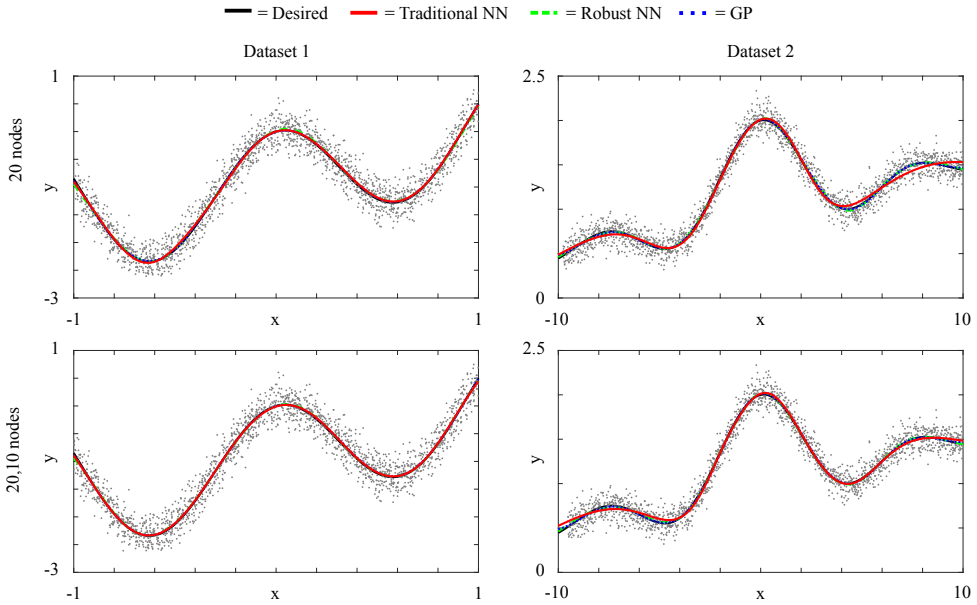
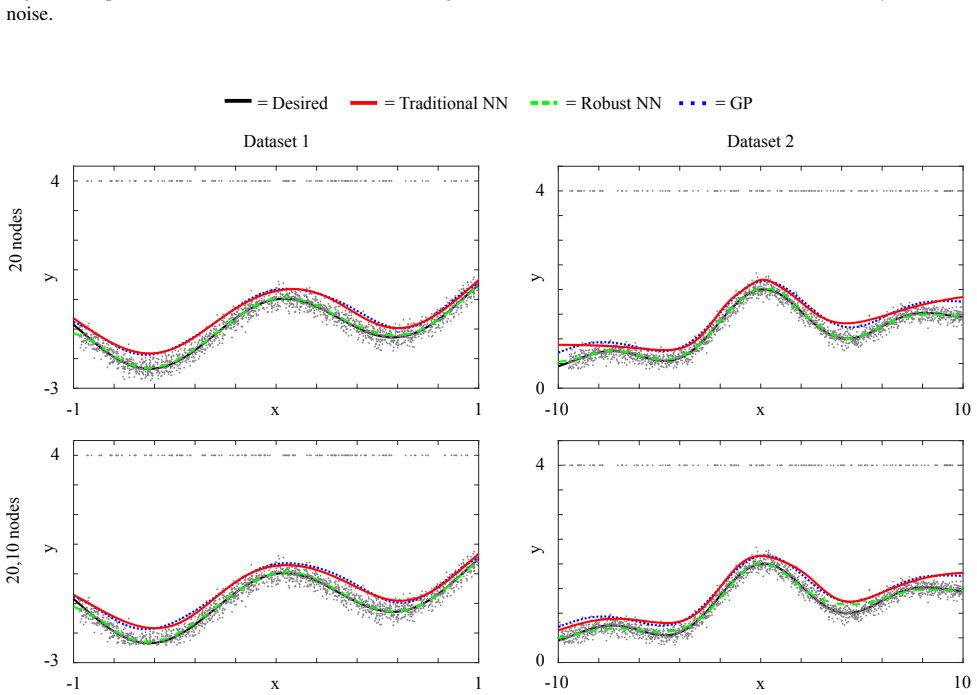
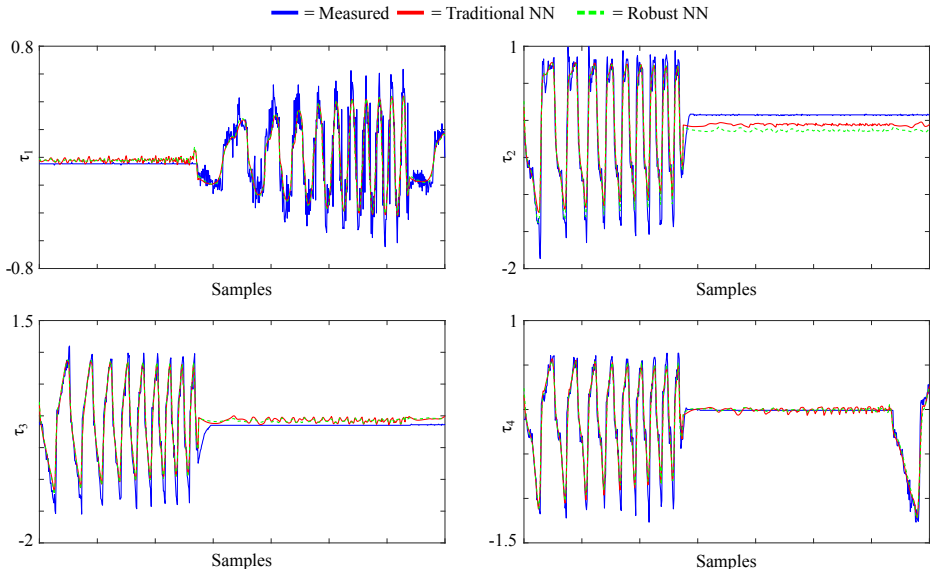
The central discovery is that a single reweighting formula, applied iteratively while training a regressor, is enough to make the learned model robust to output outliers. For each output component the paper computes residuals $r_{i,j}$, their median $m_i$, and the median absolute deviation $\mathrm{MAD}_i$; the threshold is $t_i = \gamma\,\mathrm{MAD}_i$ with $\gamma=2$ in the experiments. Each sample's weight is $W_{i,j} = e^{-7 v^8}$, where $v = (r_{i,j} - m_i)/t_i$, so points whose residual is far from the median are heavily downweighted. Re-estimating the model with these weights over several refinements yields models that, in the reported simulations, stay close to the true mapping even when 150 of 2000 nonlinear-regression points are injected outliers, while traditional neural networks and Gaussian process regression are visibly degraded. On the robot inverse-dynamics data the robust model tracks the measured torques with similar $R^2$ to the traditional network but produces a smoother mapping, which the paper interprets as being less influenced by unwanted measurements.
Load-bearing premise
The method assumes that outliers are visible as large output residuals after an initial fit and that the median plus twice the median absolute deviation of those residuals reliably separates bad points from good ones.
Editorial extensions
If this is right
- The same weighting rule can be attached to any regression estimator, not just neural networks, turning ordinary model fitting into an outlier-robust procedure without changing the underlying learner.
- Separate preprocessing for outlier removal becomes unnecessary: detection happens during training, which simplifies pipelines for learned robot models.
- Robot inverse-dynamics models trained on tendon-driven systems can be smoothed against transient sensor glitches, which matters for control applications that differentiate or integrate the learned torques.
- The price is computation: the robust models required more training time than plain neural networks, comparable to Gaussian process regression in the nonlinear experiments.
Reading between the lines
- The simulations only corrupt outputs; a natural next test would be leverage points in the input space, since residual-based reweighting is blind to an outlier that manages to keep its residual small.
- The fixed multiplier $\gamma=2$ and the fixed number of refinements are not tuned to contamination level; users facing heavier or asymmetric outlier distributions would likely need a rule for adjusting them, which the paper leaves open.
- The per-output-component weighting suggests a direct extension to multi-output regression with heterogeneous noise: each output keeps its own median and MAD threshold, and the same iteration scheme should carry over.
Signed reviews
Editorial analysis
A structured set of objections, weighed in public.
Referee Report
Summary. The paper proposes an iterative reweighting scheme for robust regression with neural networks. For each output dimension, residuals from an initial fit are converted into sample weights via w_{i,j} = exp(-7 v^8), where v = (r_{i,j} - m_i) / t_i, m_i is the residual median, and t_i = gamma * MAD_i with gamma = 2; the model is retrained over a fixed number of refinements. The authors claim that the method identifies and rejects outliers during regression without any assumption on the data distribution. The method is tested on synthetic linear and nonlinear regression problems with Gaussian noise and injected output outliers, and on a real tendon-driven surgical robot dynamics dataset, comparing against traditional neural networks, RANSAC, and Gaussian process regression.
Significance. If the central claims were fully supported, the paper would offer a simple plug-in robustification for neural-network regression that requires no preprocessing, which would be practically useful in robot model learning. The paper has genuine strengths: it evaluates on external synthetic data and real sensory data, it includes comparisons to RANSAC and Gaussian process regression, and the proposed reweighting idea is simple and potentially generalizable to other regressors. However, as written, the method is not fully specified, the 'no distribution assumption' claim is questionable, and the real-data experiments do not demonstrate an advantage over the traditional neural network. The contribution is therefore plausible but not yet established.
major comments (5)
- [Section II, Eq. (2)] The paper never states the loss function that the weights W_{i,j} actually enter. The text says only that 'the model is refined with the new weights,' but it does not specify whether the weights multiply the squared error in a weighted mean-squared-error objective, whether they are used to resample the training data, or whether they scale the gradient in some other way. Without this equation, the experiments are not reproducible, and the reader cannot verify that the reported improvement is due to Eq. (2) rather than to some implementation detail. Please provide the exact weighted training objective and the stopping criterion for the iterative refinements.
- [Section II and Section IV] The claim that the method 'doesn't make any assumption on the data distribution' is not supported by the mechanism. With gamma = 2 and MAD as the scale, the threshold is t = 2 * MAD. For Gaussian inlier residuals, MAD is approximately 0.6745 sigma, so the threshold is roughly 1.349 sigma; combined with the near-hard weight e^{-7 v^8}, any point with residual more than about one median absolute deviation from the median receives a weight near 0.0009. On clean Gaussian data, this effectively discards a substantial fraction of genuine inliers at every iteration (about 18% for a Gaussian if the residuals are exactly Gaussian). This is a strong implicit scale and distribution assumption. The paper provides no sensitivity analysis for the free parameters gamma = 2, coefficient 7, exponent 8, or the number of refinements, so the robustness claim is not demonstrated across inlier distributions. Please either add such an analysis or substantially soften the distribution-free claim.
- [Table III and Section III.B] The real-robot results do not support the claimed practical advantage. In Table III, the robust NN has worse R2 and RMSE than the traditional NN for all four outputs on train, test, and validation (e.g., output 4: R2 0.969 vs 0.972 and RMSE 0.0649 vs 0.0609). The text states that the robust method 'allows to have smoother mapping, being less influenced by unwanted data,' but the reported metrics contradict any improvement. Please discuss this discrepancy directly, report a quantitative measure of smoothness if that is the intended advantage, and consider adding a real-data experiment with injected outliers to show where the robust method helps.
- [Tables I and II captions] The metric definitions are ambiguous and the reported numbers are internally hard to interpret. The captions say 'R2 and RMSE between the computed models and the desired mapping,' but for the nonlinear case with outliers, the robust NN has RMSE 0.0521 yet R2 0.1722, while the traditional NN has RMSE 0.3825 yet R2 0.2302. If both metrics are computed against the same clean desired mapping, the R2 ordering is counterintuitive given the RMSE ordering. Please state precisely what target each metric is computed against (contaminated observations, clean mapping, or held-out data), give the formulas used, and ensure that all methods are compared on the same target. This is essential because the headline comparisons in the abstract and conclusions rest on these numbers.
- [Section III.A] The experimental comparison omits the most natural baseline for an iteratively reweighted method, namely iteratively reweighted least squares (IRLS), even though IRLS is cited in the introduction. Since the proposed scheme is essentially a robust reweighting scheme, a comparison with IRLS on the linear problems, and with a robust-loss neural network on the nonlinear problems, would be needed to quantify the claimed improvement over existing robust regression approaches. Without such a baseline, it is difficult to assess the novelty and practical value of the contribution.
minor comments (5)
- [Section II, Eq. (2)] The notation is inconsistent: r_i is defined as a vector, but Eq. (2) uses r_{i,j}, and the expression should be parenthesized as v = (r_{i,j} - m_i) / t_i to avoid ambiguity about operator precedence.
- [Section III.A] The text says the dataset is 'divided randomly into train set (80%,10%, 10%)' but the two 10% portions are not labeled; please specify which is validation and which is test.
- [Section III.A and Figures 1-3] There are several typos and unclear figure labels: 'datset', 'mange', 'Guassian', 'therms', and 'nolinearities' should be corrected, and the figure legends such as '10 nodes20 nodes' should be made readable.
- [Table II] The row labels '10 nodes' and '20,10 nodes' in the nonlinear tables do not match the text's description of 'one single hidden layer with 20 nodes and a two-hidden-layer structure with 20 and 10 nodes'; please make the architecture naming consistent.
- [Section II] The introduction says outlier detection methods 'rely on only one particular method, or on the knowledge of the data statistical distribution,' but the proposed method also relies on a threshold and a fixed weight function; the distinction should be stated more carefully.
Circularity Check
No load-bearing circularity; the only self-definitional element is that 'outliers' are defined by the same residual threshold used for down-weighting, while the core robustness claims are validated on external data.
-
self definitional
[Section II, Eq. (2) and the sentence immediately after it]
"Once the medians and the thresholds have been retrieved, each data sample is assigned an output weight as follows: v = ri. j− mi / ti , Wi, j = e−7v8 . (2) ... A data point for a certain output component is thus an outlier if its residual is too far from the median of the residuals."
The paper defines an outlier as exactly the condition under which Eq. (2) assigns a near-zero weight: both the outlier label and the weight are the same function of the same residual relative to the same median/MAD threshold. The conclusion's claim that the method 'allows to have outliers identification' therefore restates the definition rather than deriving an independent detection result. However, this is a conventional definitional property of residual-based robust estimators, not a fitted parameter renamed as a prediction, and the paper's robustness claims are tested on synthetic data with known injected outliers and on held-out real data, giving the central empirical claim independent support.
full rationale
The paper's derivation chain is short: fit an initial model, compute residuals, obtain the median and MAD of those residuals, set t_i = gamma*MAD_i, assign weights W_{i,j} = exp(-7 v^8), and re-fit iteratively. No prediction is derived from the fitting inputs; the method is evaluated by comparing the resulting models to ground-truth mappings on synthetic datasets and to measured torques on a real robot. No fitted parameter is renamed as a prediction, and no load-bearing self-citation is used (reference [13] only describes the robot hardware, not the method). The stated 'no distribution assumption' claim is questionable because gamma=2 and the near-hard weight e^{-7 v^8} implicitly assume a residual scale, and Table III shows the robust method does not outperform the traditional NN on the real data; however, these are correctness/validity concerns, not circularity. The only circularity-adjacent element is the definitional sentence that labels as 'outliers' the very points that Eq. (2) down-weights; this is a tautology rather than a derived result, and it does not drive the empirical contribution. Accordingly, the score is 2: one minor self-definitional step, while the central empirical claim remains independently supported.
Assumptions & free parameters
free parameters (4)
- gamma (threshold multiplier) =
2
- weight exponent coefficient 7 =
7
- weight exponent 8 =
8
- number of reweighting refinements =
5
assumptions (4)
- domain assumption Inlier residuals are approximately symmetrically distributed around zero, so the median and MAD are reliable location and scale estimates.
- ad hoc to paper The iterative reweighting scheme converges to the desired robust model.
- ad hoc to paper The fixed hyperparameters (gamma=2, exponent 8, coefficient 7) generalize across datasets.
- standard math The neural network can represent the target mapping and the training procedure is well-behaved.
Cite this review
Pith. "Pith review of A Robust Regression Approach for Robot Model Learning." pith.science (2026). https://pith.science/paper/VXXEXE5Y
@misc{pith2026190808855,
  author       = {Pith},
  title        = {Pith review of: A Robust Regression Approach for Robot Model Learning},
  year         = {2026},
  howpublished = {\url{https://pith.science/paper/VXXEXE5Y}},
  note         = {Machine review of arXiv:1908.08855}
}
read the original abstract
Machine learning and data analysis have been used in many robotics fields, especially for modelling. Data are usually the result of sensor measurements and, as such, they might be subjected to noise and outliers. The presence of outliers has a huge impact on modelling the acquired data, resulting in inappropriate models. In this work a novel approach for outlier detection and rejection for input/output mapping in regression problems is presented. The robustness of the method is shown both through simulated data for linear and nonlinear regression, and real sensory data. Despite being validated by using artificial neural networks, the method can be generalized to any other regression method
Figures

Figures from the paper (1 more)
Reference graph
Works this paper leans on
-
[1]
K. P. Murphy, Machine learning : a probabilistic perspective . MIT Press, 2012
work page 2012
-
[2]
Model learning for robot control: a survey,
D. Nguyen-Tuong and J. Peters, “Model learning for robot control: a survey,” Cognitive Processing, vol. 12, no. 4, pp. 319– 340, 11 2011
work page 2011
-
[3]
On-line regression al- gorithms for learning mechanical models of robots: A survey,
O. Sigaud, C. Sala ¨un, and V . Padois, “On-line regression al- gorithms for learning mechanical models of robots: A survey,” Robotics and Autonomous Systems , vol. 59, no. 12, pp. 1115– 1129, 12 2011
work page 2011
-
[4]
D. M. Hawkins, Identification of Outliers. Springer Netherlands, 1980
1980
-
[5]
P. J. Rousseeuw and A. M. Leroy, Robust regression and outlier detection. Wiley-Interscience, 2003
2003
-
[6]
C. C. Aggarwal, Outlier analysis. Springer, 2017
work page 2017
-
[7]
A Note on Computing Robust Regression Estimates Via Iteratively Reweighted Least Squares,
J. O. Street, R. J. Carroll, and D. Ruppert, “A Note on Computing Robust Regression Estimates Via Iteratively Reweighted Least Squares,” The American Statistician , vol. 42, no. 2, p. 152, 5 1988
work page 1988
-
[8]
M. A. Fischler and R. C. Bolles, “Random sample consensus: a paradigm for model fitting with applications to image analy- sis and automated cartography,” Communications of the ACM , vol. 24, no. 6, pp. 381–395, 6 1981
work page 1981
Show all 13 references
-
[9]
Approximation capabilities of multilayer feedfor- ward networks,
K. Hornik, “Approximation capabilities of multilayer feedfor- ward networks,” Neural Networks, vol. 4, no. 2, pp. 251–257, 1 1991
1991
-
[10]
The Ef- fects of Outliers Data on Neural Network Performance,
A. Khamis, Z. Ismail, K. Haron, and A. Mohammed, “The Ef- fects of Outliers Data on Neural Network Performance,” Journal of Applied Sciences , vol. 8, no. 5, pp. 1394–1398, 2005
2005
-
[11]
Robust error measure for supervised neural network learning with outliers,
K. Liano, “Robust error measure for supervised neural network learning with outliers,” IEEE Transactions on Neural Networks , vol. 7, no. 1, pp. 246–250, 1996
1996
-
[12]
M. P. Allen, Understanding regression analysis. Plenum Press, 1997
1997
-
[13]
A Single-Port Robotic System for Transanal MicrosurgeryDe- sign and Validation,
J. Shang, K. Leibrandt, P. Giataganas, V . Vitiello, C. A. Seneci, P. Wisanuvej, J. Liu, G. Gras, J. Clark, A. Darzi, and G.-Z. Yang, “A Single-Port Robotic System for Transanal MicrosurgeryDe- sign and Validation,” IEEE Robotics and Automation Letters , vol. 2, no. 3, pp. 151...
2017
Reviewed August 14, 2026 · model on record in the stance chip above.
Discussion (0). Continue with ORCID to comment.