REVIEW 3 major objections 5 minor 25 references
Evolving roles and dynamics for catch and slip bonds during adhesion cluster maturation
T0 review · 3 major / 5 minor · reviewed 2026-08-14 · deepseek-v4-flash
Pith's one-line read A mixed cluster of catch and slip integrins makes the diffusivity of unbound integrins a force-dependent readout of the load on a focal adhesion.
desk verdict Honest, internally consistent catch-slip cluster model whose diffusivity-as-force-readout claim depends on an acknowledged but load-bearing equal-rebinding assumption. read the letter →
The pith
A machine-rendered reading of the paper's core claim, the machinery that carries it, and where it could break.
The reading
What carries the argument
The central machinery is a mean-field model of a two-species bond cluster: a two-variate master equation for the number of bound catch ($i$) and slip ($j$) bonds reduces to two coupled equations, Eqs. (13), in which the two bond types interact only through the shared total force divided uniformly over bound bonds. The load-bearing result is Eq. (17), $D_{c/s}(\Phi)=D_0\left(1-n_{c/s}(\Phi)\right)\left[1-\frac{N_{ct}n_c(\Phi)+N_{st}n_s(\Phi)}{N_{ct}+N_{st}}\right]$, which expresses the effective diffusion coefficient of unbound integrins as the product of the fraction of mobile bonds and the availability of unbound neighbours on a square lattice. The mean-field predictions are tested with stochastic simulations of cluster binding, unbinding, and lateral hopping, and with a recursive lifetime equation for cluster unbinding times.
What would settle it
Track two fluorescently tagged integrin species in a living cell while applying a known force to a focal adhesion and measure their diffusion coefficients; the claim predicts a crossover in which slip integrins become more mobile and catch integrins become less mobile as force rises, so the absence of such a crossover would falsify Eq. (17). A second check is to measure the rebinding rates of catch versus slip integrins directly; unequal or force-dependent rates would invalidate the model's simplifying assumption in Eq. (9).
Extended reading notes
Core claim
The central claim is that a mixed catch-slip adhesion cluster is a force-controlled two-species system: the equilibrium fractions of bound catch and slip bonds are both functions of the total applied force, so the two bond types are differentially engaged as the load grows. Because bound integrins are immobilized while unbound ones diffuse by hopping between lattice sites, the equilibrium shift changes the effective diffusivity of each species, summarized in Eq. (17). The paper shows numerically and with stochastic simulations that this force-dependent diffusivity is measurable and that mixed clusters combine the low-force stability of slip bonds with the high-force load-bearing capacity of catch bonds, organizing integrin engagement in time as an adhesion matures.
Load-bearing premise
The model assumes that unbound catch and slip integrins rebind to the matrix at the same rate and that this rate does not depend on force; if real rebinding differs by integrin type or responds to load, the predicted bound fractions and force-dependent diffusivities could change.
Editorial extensions
If this is right
- Mixed adhesions stay mechanically engaged at all force levels: slip bonds provide low-force adhesion while catch bonds provide high-force stability, eliminating the weakly bound regime of catch-only clusters.
- Force-dependent engagement organizes integrin activity in time: young adhesions carry mostly bound slip bonds, mature adhesions mostly bound catch bonds, even if the total integrin composition stays constant.
- The average diffusivity of unbound integrins inside a focal adhesion is a force-dependent quantity that reports the force exerted on the adhesion and, by extension, its maturation stage.
- The two bond types need no direct molecular crosstalk; coupling through the shared load is sufficient to produce the predicted composition shift and diffusivity response.
Reading between the lines
- A testable extension beyond the paper: if Eq. (17) holds quantitatively, single-molecule tracking of unbound integrins could be calibrated as a non-invasive force sensor for focal adhesions, complementing tension-probe methods that require genetic tags.
- A neighboring-problem connection: the same excluded-volume coupling between binding state and mobility should apply to any cluster of mobile and immobile receptors sharing a load, so a diffusivity-force relation may appear in other adhesion and signaling systems.
- A caution grounded in the paper's own caveat: because catch and slip integrins likely rebind at different rates, measuring those rebinding rates separately is the readiest way to test whether the quantitative diffusivity curves remain valid or need revision.
Signed reviews
Editorial analysis
A structured set of objections, weighed in public.
Referee Report
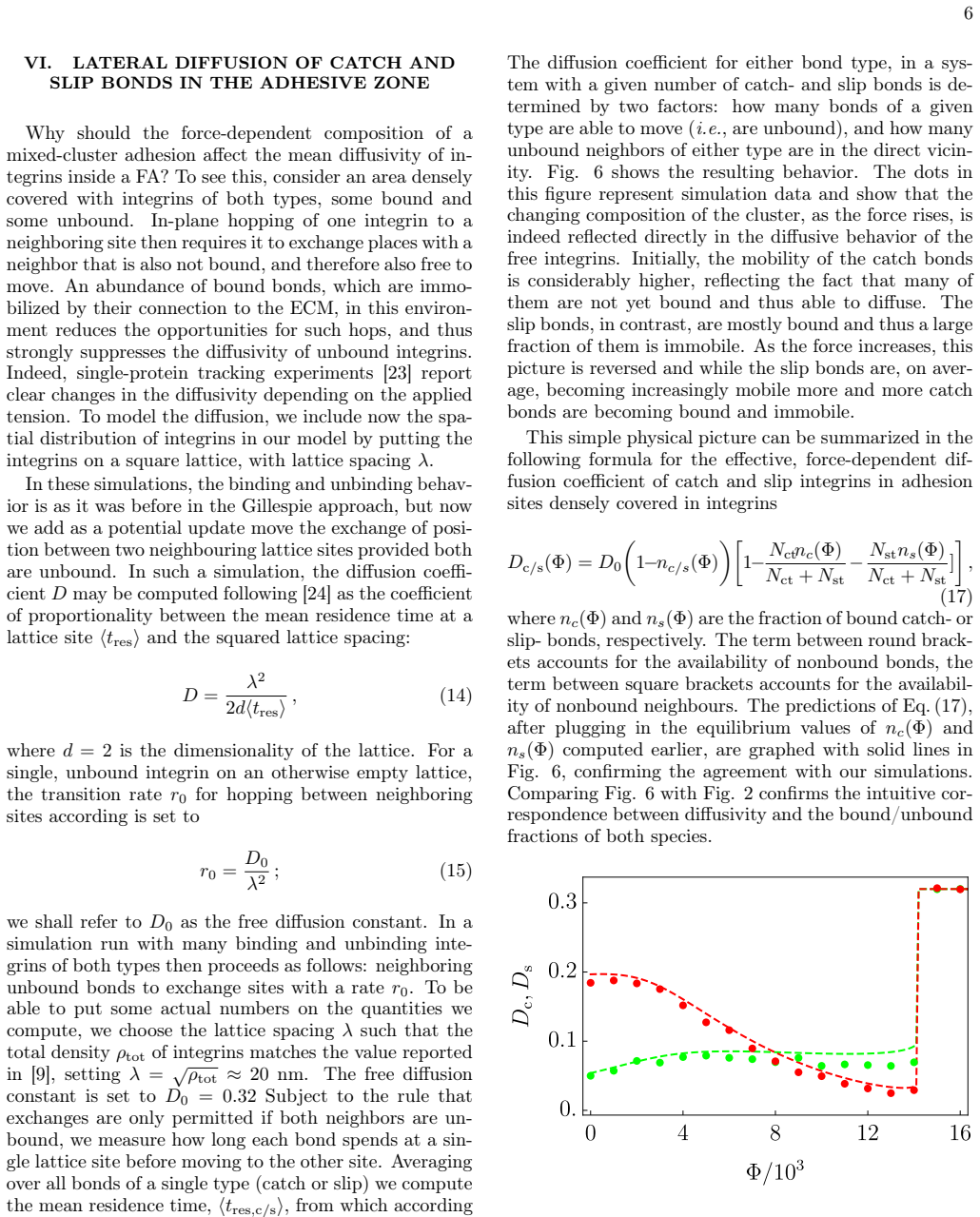
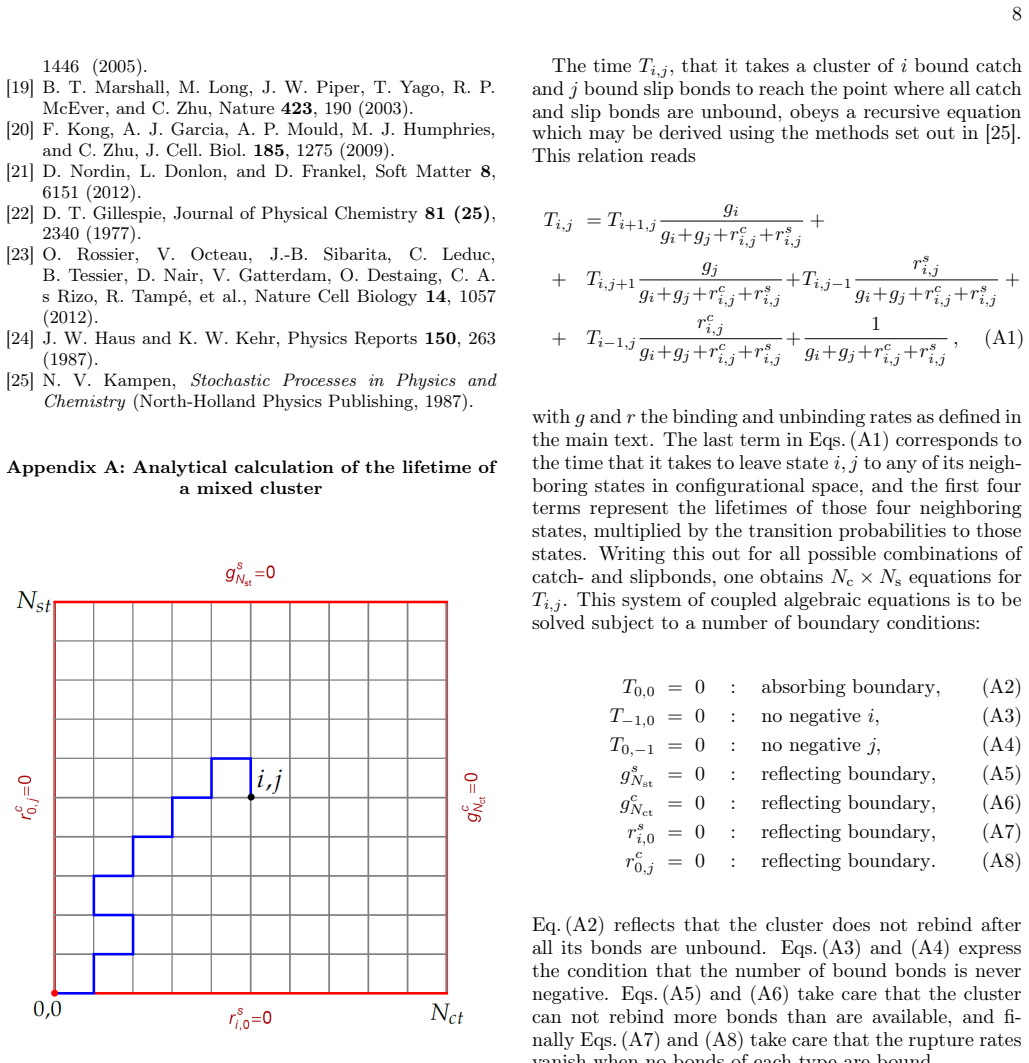
Summary. Novikova and Storm study a minimal stochastic model of a focal adhesion containing two integrin species, one with catch-bond and one with slip-bond dissociation kinetics. They write mean-field equations (Eq. 13) for the mean numbers of bound catch and slip bonds under uniform load sharing, validate these against Gillespie simulations (Figs. 2 and 3), derive and validate a first-passage-time solution for cluster lifetime (Appendix A and Fig. 5), and then introduce lateral diffusion with excluded-volume interactions to obtain an effective force-dependent diffusivity D_c/s(Phi) for unbound integrins (Eq. 17), reproduced by lattice simulations (Fig. 6). The central claim is that the force dependence of bound fractions produces a measurable, force-dependent diffusivity of free integrins, providing a non-invasive readout of the force on a focal adhesion and a mechanism by which maturing adhesions shift from slip-dominated to catch-dominated engagement.
Significance. If the main prediction survives closer scrutiny, it is a valuable, experimentally testable connection between single-molecule bond kinetics and integrin mobility in focal adhesions, and the suggestion that slip bonds provide low-force stability while catch bonds support maturation is plausible and consistent with the simulations shown. Strengths of the paper include the explicit validation of the mean-field equations against stochastic Gillespie simulations, the analytical first-passage calculation of cluster lifetimes checked against simulations, and the lattice simulation check of the excluded-volume diffusivity formula. The model intentionally uses several uncontrolled simplifications, so the quantitative force-readout claim is not yet established.
major comments (3)
- [III, Eq. (9)] The equal, force-independent rebinding assumption is load-bearing rather than cosmetic. From Eq. (13) at equilibrium, n_c = gamma/(gamma + k_c^u(Phi/(n_c N_ct + n_s N_st))) and n_s = gamma/(gamma + k_s^u(...)): the entire force dependence of the bound fractions, and therefore of D_c/s(Phi) in Eq. (17), enters through the unbinding rates. If gamma_c and gamma_s differ, the zero-force baselines shift independently (catch-dominated low-force adhesion for gamma_c of order 100, for example), and if gamma is force-dependent, the predicted slip-to-catch crossover can be masked or reversed. The authors explicitly state 'there is no reason for this to hold in real life'; because the force-readout proposal requires a known, stable mapping from force to diffusivity, the paper should either test unequal and force-dependent rebinding or explicitly restrict the claim to the equal-gamma case.
- [VI, Eq. (17), and Discussion] The proposed diffusivity-based force readout requires D_c/s(Phi) to be single-valued, but the model itself produces non-monotonic diffusivities. The catch-bond unbinding rate in Eq. (4) has a minimum at phi=(phi1+phi2)/2, so n_c(Phi) increases as force rises and then decreases once the mean per-bond load exceeds this optimum; by Eq. (17), D_c(Phi) correspondingly falls and then rises. The paper does not state the usable force range, analyze invertibility, or discuss how a non-monotonic D could be used to infer force in an experiment. Without this, the statement that the diffusivity 'reports directly on' the force is stronger than the prediction supports.
- [V, Fig. 4] The functional-advantage argument is presented in a self-contradictory way. The text first says the mixed cluster provides 'additional functionality' and that 'the blue curve is above the green curve', then states 'the lifetime of the mixed cluster is nowhere longer than either the pure catch or the pure slip system'. Since a cluster whose lifetime is never longer than both pure systems cannot simultaneously improve on both, the manuscript should state precisely in which sense mixing helps (e.g., avoiding the catch-only low-force failure while retaining high-force stability) and correct the corresponding sentence.
minor comments (5)
- [Abstract and §VI] The abstract contains 'm low-force mechanical integrity' (missing word) and §VI contains 'cas a function' (should be 'as'); Eq. (17) also has an extra closing bracket on the right-hand side.
- [§IV] The sentence describing Fig. 2 swaps the labels for the bound fractions: it defines ns as the bound catch fraction and nc as the bound slip fraction; use n_c and n_s consistently with Eq. (17).
- [Figs. 2, 3, and 6] Please report the number of independent trajectories used for the stochastic and lattice simulations and provide error bars or standard errors; the reader cannot assess the strength of the agreement from the points as plotted.
- [§II] The slip-bond parameters usb=1 and the varied rho_xi values are described as demonstrational, but the quantitative diffusivity prediction in Eq. (17) depends on them; a short sensitivity discussion or a summary table of all parameter values would help.
- [Discussion] The claim that cells invest equal energy in every focal adhesion and hence that diffusivity depends on ECM stiffness is not derived from the model; it should be flagged explicitly as speculation.
Circularity Check
No significant circularity: the diffusivity prediction is derived from the model's bound fractions rather than fitted to diffusivity data, and the self-citations point to parameters fitted to external experiments.
full rationale
The paper derives a mixed catch-slip cluster model from a master equation and mean-field approximation (Eqs. 7-13), then proposes Eq. (17) as an analytic expression for the effective diffusivity of free integrins in terms of the equilibrium bound fractions. This is a genuine prediction: the diffusivity formula is not fitted to diffusivity measurements, and the bound fractions feeding into it are outputs of the model's own rate equations. The agreement between Eq. (17) and the lattice simulations is a self-consistency check, not a circular reduction, because the simulations share the same binding/unbinding kinetics but independently track spatial diffusion via residence times. The catch-bond parameters (phi1, phi2) are taken from a previous paper by the authors [15], but that prior work fits the two-pathway model to external AFM data [20], so the self-citation is not load-bearing and does not import an unverified premise. The slip-bond parameters (rho_xi, usb) are hand-set for demonstration, again without circularity. The paper explicitly acknowledges that the assumption of force-independent, type-independent rebinding (gamma) is unrealistic, but an explicit simplifying assumption is not equivalent to using the conclusion as an input; it is a limitation of the model's realism, not a circularity in the derivation. No step reduces by construction to its own inputs, and no uniqueness theorem or ansatz is smuggled in via self-citation. Therefore no circularity is present.
Assumptions & free parameters
free parameters (5)
- phi1, phi2 (catch bond dissociation barriers) =
phi1 = 7.78, phi2 = 4.02
- rho_xi (ratio of catch to slip dissociation lengths) =
varied: 1, 3.8, 6.6
- usb (zero-force slip unbinding rate, dimensionless) =
1
- gamma (rebinding rate, in units of k0) =
1 (or 0.2 in Fig. 4)
- f* (force scaling) =
5.38
assumptions (6)
- domain assumption Single-bond kinetics follow Kramers slip-bond rate (Eq. 1) and the two-pathway catch-bond model (Eq. 3).
- ad hoc to paper Rebinding rate is force-independent and equal for catch and slip bonds (Eq. 9).
- domain assumption Total load is shared uniformly among all bound bonds (Eq. 11).
- standard math Mean-field approximation: rates evaluated at equilibrium mean occupancies (Eq. 13).
- domain assumption Cluster composition Nct, Nst is fixed and conserved.
- domain assumption Diffusion occurs only via exchanges between neighboring unbound integrins on a square lattice.
Cite this review
Pith. "Pith review of Evolving roles and dynamics for catch and slip bonds during adhesion cluster maturation." pith.science (2026). https://pith.science/paper/BALAZY3S
@misc{pith2026190808934,
  author       = {Pith},
  title        = {Pith review of: Evolving roles and dynamics for catch and slip bonds during adhesion cluster maturation},
  year         = {2026},
  howpublished = {\url{https://pith.science/paper/BALAZY3S}},
  note         = {Machine review of arXiv:1908.08934}
}
read the original abstract
Focal adhesions are the loci of cellular adhesion to the extracellular matrix. At these sites, various integrins forge connections between the intracellular cytoskeleton and the outside world: large patches of multiple types of integrins together grip hold of collagen, fibronectin and other extracellular matrix components. The mixture of integrins composing the FA will, in general, contain both slip bond integrins and catch bond integrins---bonds whose lifetime increases with applied load and bonds for whom it decreases when forced. Prior work suggests that catch bonds are essential for proper FA stability and mechanosensory functionality. In the present work, we investigate, numerically, the interplay between the two distinct types of bonds and ask how the presence, in the same FA cluster, of slip bonds augments the behavior of the catch bonds. We show, that mixing the two components m low-force mechanical integrity, lacking in purely catch systems, while preserving the potential to strengthen the FA bond by force as well as the mechanosensory qualities of the catch bonds. We investigate the spatial distribution in mixed-integrin FA's and show that the differential response to loading leads, via an excluded volume interaction, to a dependence of the individual integrin diffusivities on the applied load, an effect that has been reported in experiments.
Figures


Figures from the paper (3 more)

Reference graph
Works this paper leans on
- [1]
- [2]
-
[3]
H. J. Kong, J. Liu, K. Riddle, T. Matsumoto, K. Leach, and D. J. Mooney, Nature Materials4, 460 (2005)
work page 2005
-
[4]
P. Kanchanawong, G. Shtengel, A. M. Pasapera, E. B. Ramko, M. W. Davidson, H. F. Hess, and C. M. Water- man, Nature 468, 580 (2010)
work page 2010
- [5]
-
[6]
D. P. White, P. T. Caswell, and J. C. Norman, The Jour- nal of Cell Biology177, 515 (2007)
work page 2007
-
[7]
P. Roca-Cusachs, N. C. Gauthier, A. del Rio, and M. P. Sheetz, Proceedings of the National Academy of Sciences 106, 16245 (2009)
work page 2009
-
[8]
H. E. Balcioglu, H. van Hoorn, D. M. Donato, T. Schmidt, and E. H. J. Danen, Journal of Cell Science 128, 1316 (2015), ISSN 0021-9533
work page 2015
Show all 25 references
-
[9]
Elosegui-Artola, E
A. Elosegui-Artola, E. Bazelliares, M. D. Allen, I. An- dreu, R. Oria, R. Sunyer, J. J. Gomm, J. F. Marshall, J. L. Jones, X. Trepat, et al., Nature Materials14(2014), ISSN 1476-4660
2014
-
[10]
Walcott and S
S. Walcott and S. X. Sun, Proceedings of the National Academy of Sciences USA107, 7757 (2010)
2010
-
[11]
Marcq, N
Ph. Marcq, N. Yoshinaga, and J. Prost, Biophysical Jour- nal 101, L33 (2011)
2011
-
[12]
U. S. Schwarz, T. Erdmann, and I. Bischofs, Biosystems 83, 225 (2006)
2006
-
[13]
Erdmann and U
T. Erdmann and U. S. Schwarz, Physical Review Letters 92, 108102 (2004)
2004
-
[14]
U. S. Schwarz and T. Erdmann, European Physical Jour- nal E 22, 123 (2007)
2007
-
[15]
E. A. Novikova and C. Storm, Biophysical Journal105, 1336 (2013), ISSN 0006-3495
2013
-
[16]
H. A. Kramers, Physica VII4, 284 (1940)
1940
-
[17]
Dembo, D
M. Dembo, D. Torney, K. Saxman, and D. Hammer, Pro- ceedings of the Royal Society B: Biological Sciences234, 55 (1988)
1988
-
[18]
Y. V. Pereverzev, O. V. Prezhdo, M. Forero, E. V. Sokurenko, and W. E. Thomas, Biophysical Journal89, 8 1446 (2005)
2005
-
[19]
B. T. Marshall, M. Long, J. W. Piper, T. Yago, R. P. McEver, and C. Zhu, Nature423, 190 (2003)
2003
-
[20]
F. Kong, A. J. Garcia, A. P. Mould, M. J. Humphries, and C. Zhu, J. Cell. Biol.185, 1275 (2009)
2009
-
[21]
Nordin, L
D. Nordin, L. Donlon, and D. Frankel, Soft Matter8, 6151 (2012)
2012
-
[22]
D. T. Gillespie, Journal of Physical Chemistry81 (25), 2340 (1977)
1977
-
[23]
Rossier, V
O. Rossier, V. Octeau, J.-B. Sibarita, C. Leduc, B. Tessier, D. Nair, V. Gatterdam, O. Destaing, C. A. s Rizo, R. Tampé, et al., Nature Cell Biology14, 1057 (2012)
2012
-
[24]
J. W. Haus and K. W. Kehr, Physics Reports150, 263 (1987)
1987
-
[25]
N. V. Kampen, Stochastic Processes in Physics and Chemistry (North-Holland Physics Publishing, 1987). Appendix A: Analytical calculation of the lifetime of a mixed cluster FIG. 7: Sketch of the configurational space that cluster with twotypesofbondsexplores. Theparametersofthes...
1987
Reviewed August 14, 2026 · model on record in the stance chip above.
Discussion (0). Continue with ORCID to comment.