REVIEW 3 major objections 5 minor 7 cited by
Probing the theory of gravity with gravitational lensing of gravitational waves and galaxy surveys
T0 review · 3 major / 5 minor · reviewed 2026-08-14 · deepseek-v4-flash
Pith's one-line read The paper shows that weak gravitational lensing of gravitational waves can be measured by cross-correlating LIGO/Virgo sources with galaxy surveys, forecasting detection at z<0.5 within a decade.
desk verdict A plausible forecast paper for a genuinely new observable—GW lensing cross-correlations—whose central unbiasedness assumption is asserted, not proven, and whose 'testing gravity' claim is overstated. read the letter →
The pith
A machine-rendered reading of the paper's core claim, the machinery that carries it, and where it could break.
The reading
What carries the argument
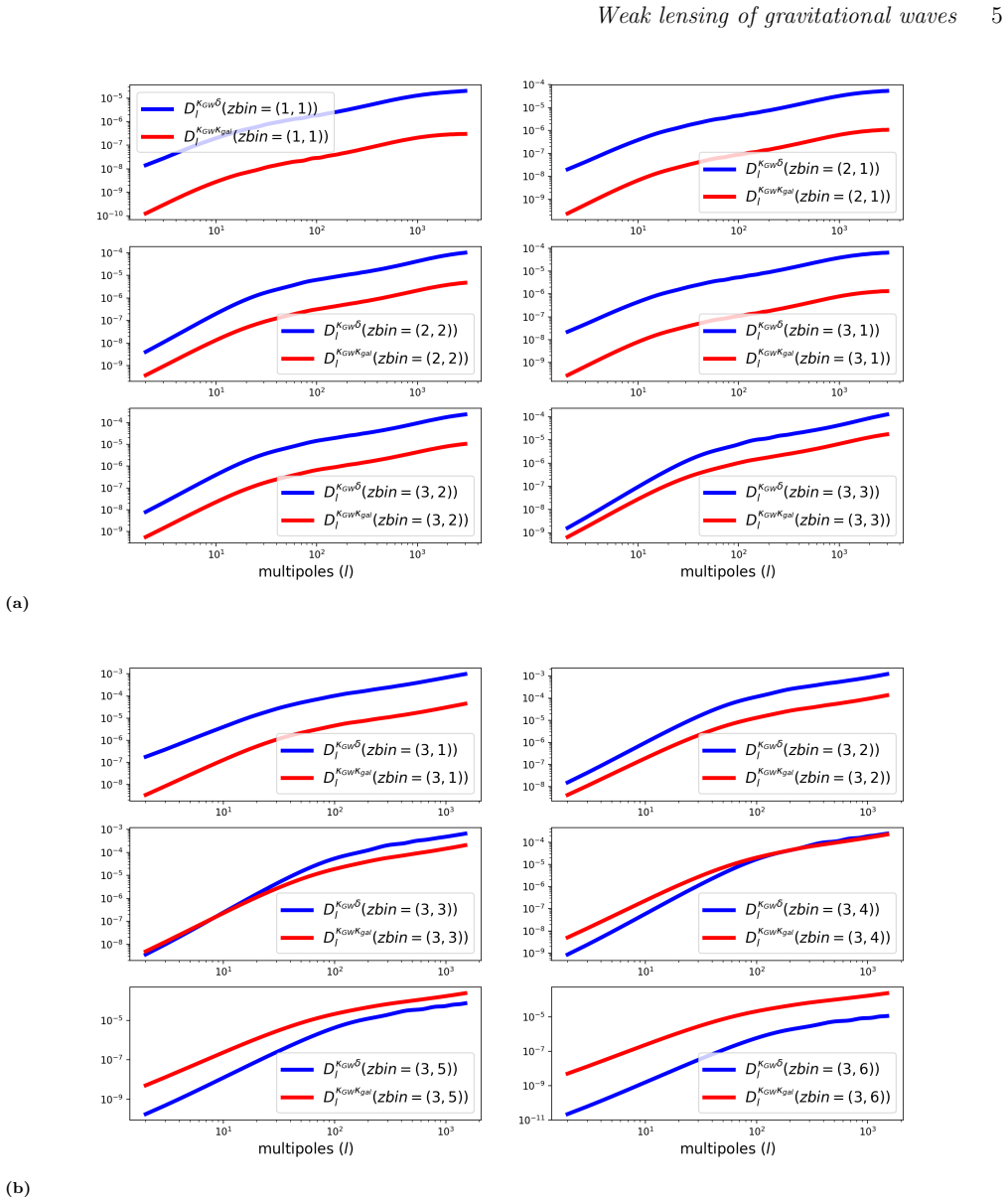
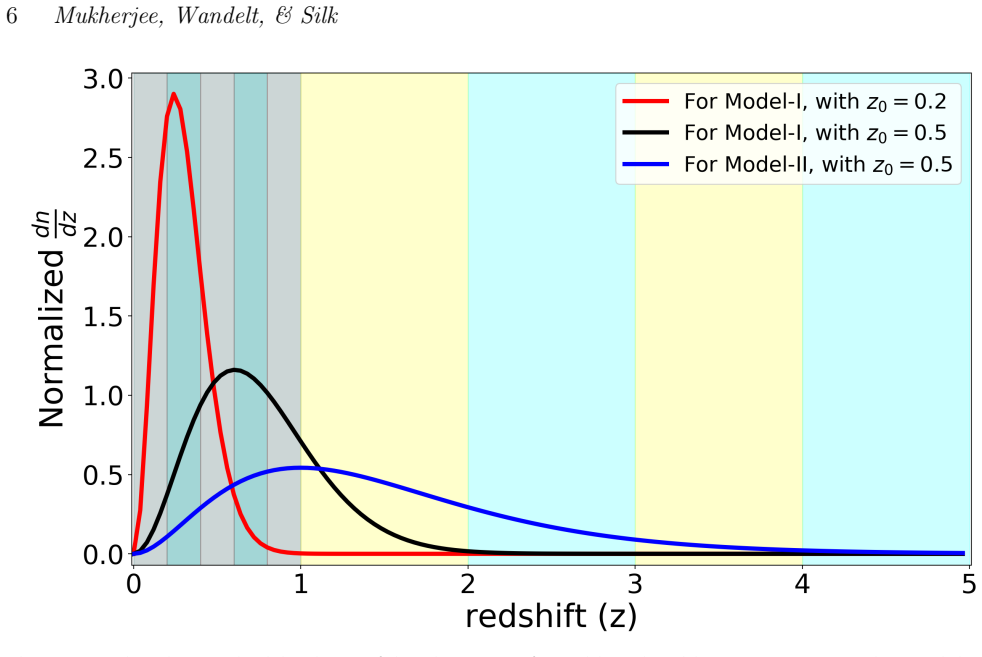
The load-bearing object is the estimator $\hat{D}_L(\hat{n})$, the fractional deviation of the gravitational-wave-inferred luminosity distance from the electromagnetic-based expected distance, along with its cross-correlation against galaxy overdensity $\delta_g$ and galaxy lensing convergence $\kappa_g$. The lensing kernel $W_{\kappa_{\rm gw}}(\chi(z)) = (1/H(z))\int_z^\infty dz'\, (dn_{\rm gw}/dz')(\chi(z')-\chi(z))/\chi(z')$ projects the matter power spectrum along the line of sight, so the theory spectra $C^{\kappa_{\rm gw}\kappa_g}_\ell$ and $C^{\kappa_{\rm gw}\delta}_\ell$ follow from the same Limber-approximation machinery used in galaxy weak lensing. The estimator converts a per-event multiplicative distortion $(1+\kappa_{\rm gw})$ into an additive field whose mean can be extracted: detector noise, redshift error, and sky-localization uncertainty enter as additive noise terms in the covariance, and averaging over many sources suppresses them. This same comparison of gravitational-wave lensing with light lensing is what tests gravity, because modified theories alter either the gravitational-wave propagation equation or the relation between metric potentials and matter density.
What would settle it
Run the proposed estimator on a forward simulation that assigns photometric redshifts to gravitational-wave sources with realistic environmental correlations and source--lens clustering: if $\langle\epsilon_s\delta\rangle$ or $\langle\epsilon_s\kappa\rangle$ does not vanish, the recovered $\hat{C}^{\kappa_{\rm gw}\delta}_\ell$ will be biased at the level of the signal. On real data, split the galaxy catalog by redshift-error properties and check that the measured cross-correlation is stable between subsamples.
Extended reading notes
Core claim
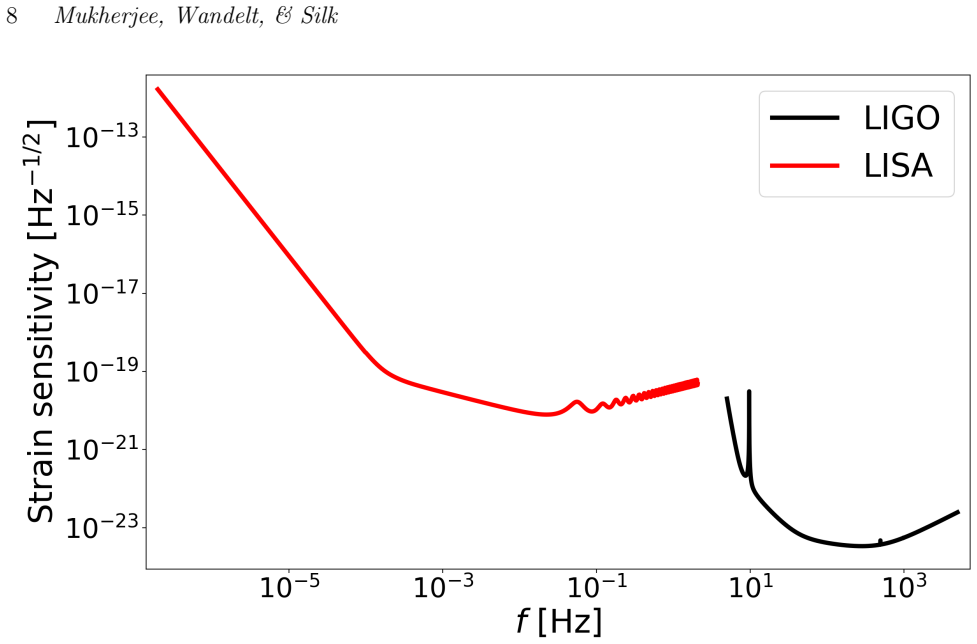
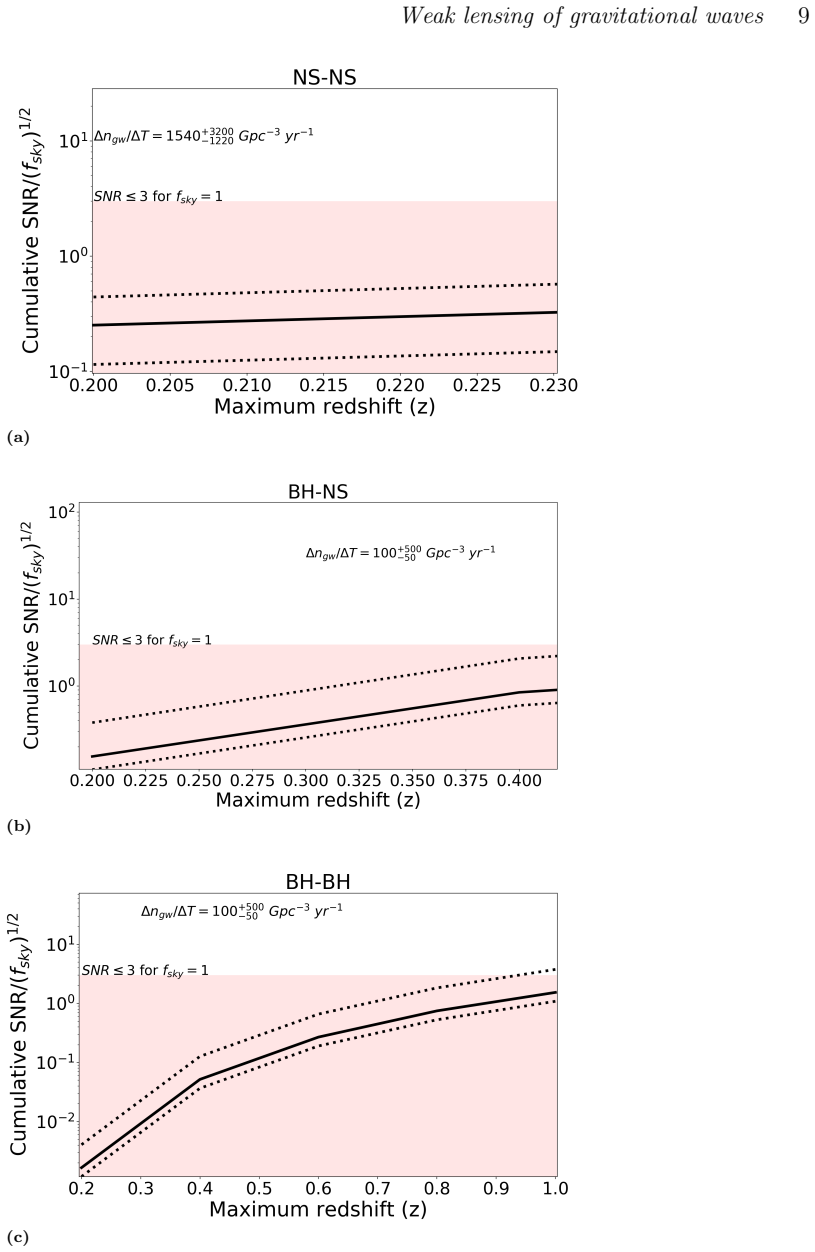
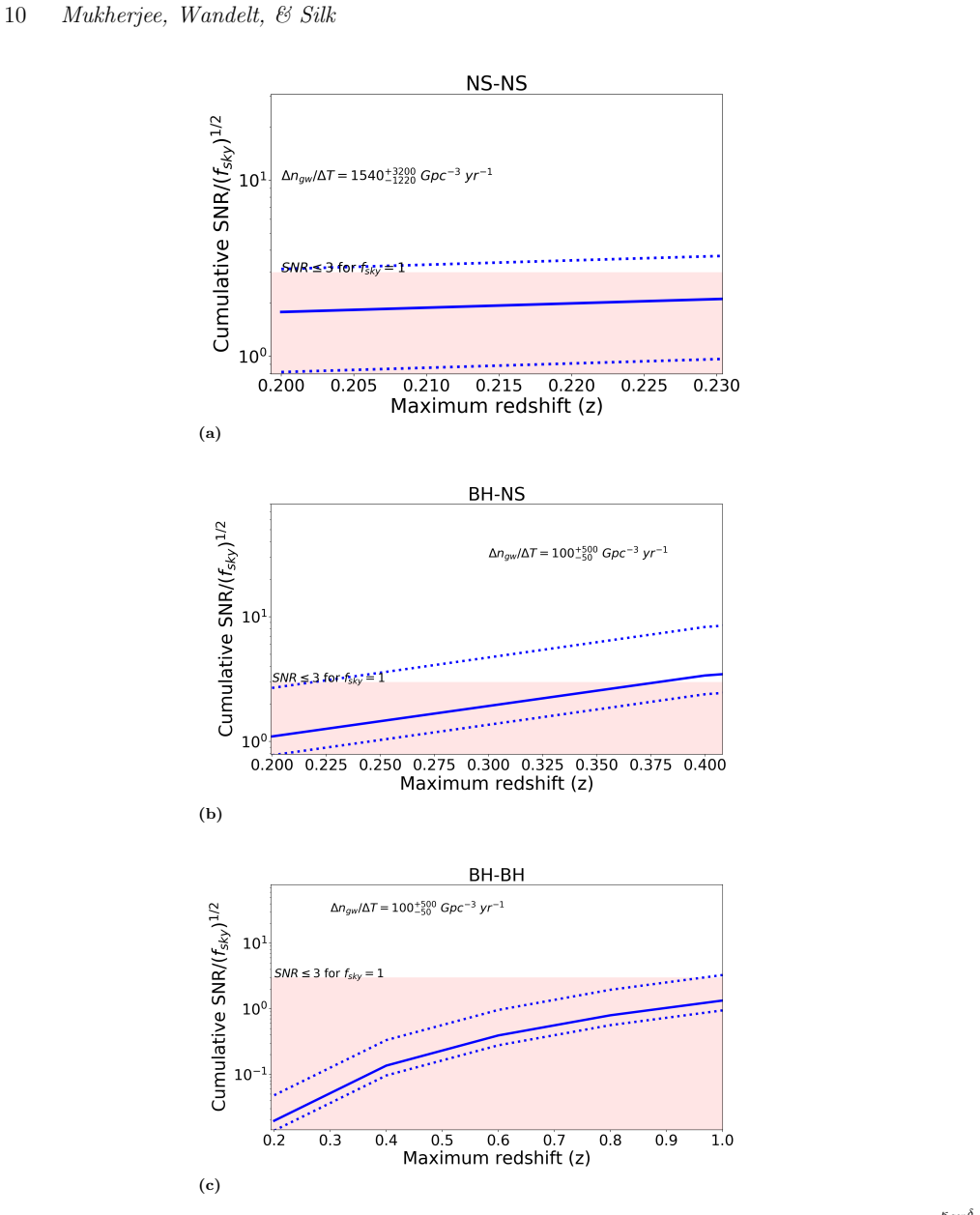
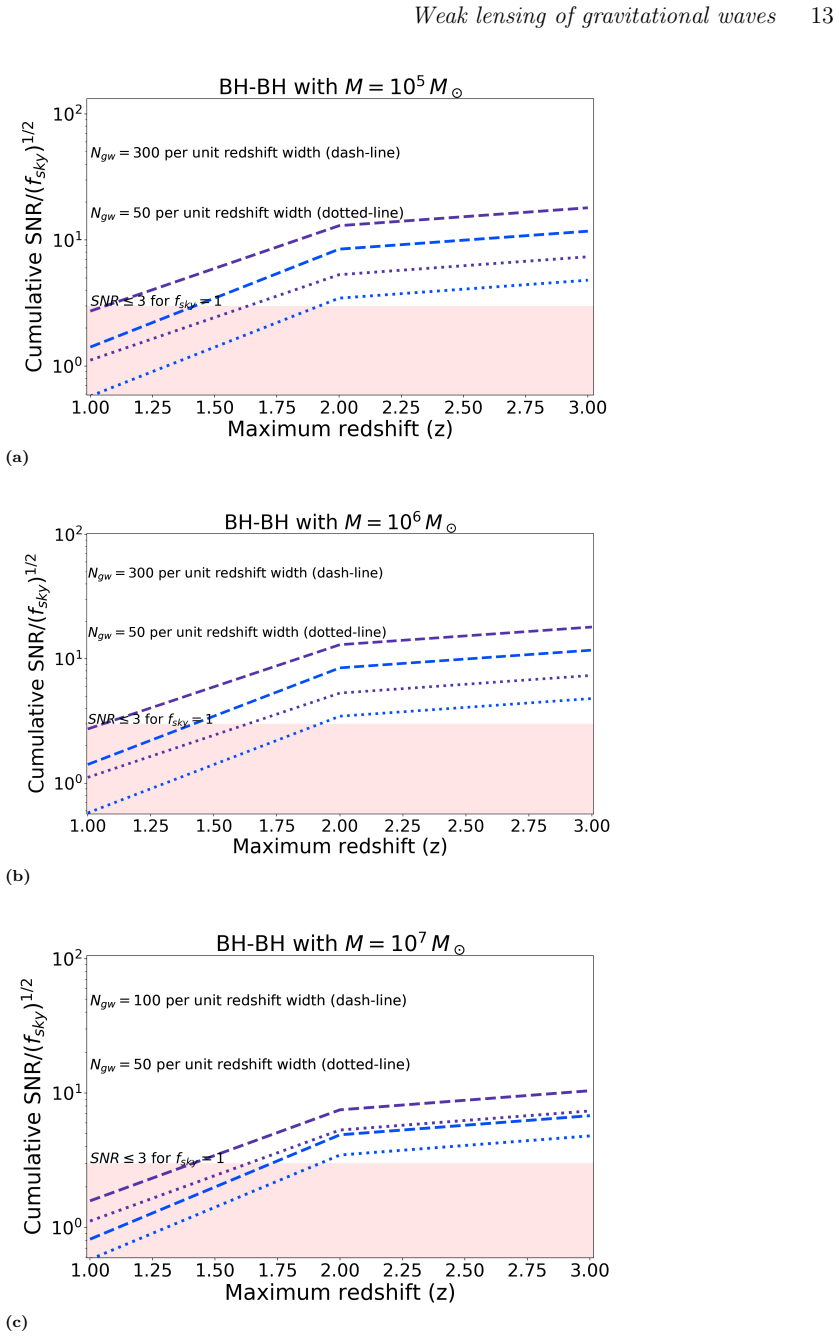
The paper's central claim is that the weak-lensing convergence of gravitational waves, $\kappa_{\rm gw}$, is observable as a statistical signal rather than only as a source of noise. The observed strain is written as $\tilde{h} = h(f_z)[1 + \kappa_{\rm gw}(\hat{n})]$, which makes the apparent luminosity distance $D_L = d_L/(1 + \kappa_{\rm gw}) + \epsilon_{\rm gw}$. For sources with electromagnetic counterparts, the authors build $\hat{D}_L \equiv 1 - D_L/d_L^{\rm es}$, with $d_L^{\rm es}$ the luminosity distance computed from the electromagnetic redshift and best-fit cosmological parameters, and show that to first order $\hat{D}_L \approx \kappa_{\rm gw} - \epsilon_{\rm gw}/d_L + \epsilon_s - \epsilon_s \kappa_{\rm gw}$. Cross-correlating $\hat{D}_L$ with the galaxy convergence $\hat{C}^{\kappa_{\rm gw}\kappa_g}_\ell$ and with the galaxy overdensity $\hat{C}^{\kappa_{\rm gw}\delta}_\ell$ recovers the lensing signal, provided the redshift-error term $\epsilon_s$ averages to zero. The forecasts place the strongest LIGO-era signal in the black-hole--neutron-star channel: $\hat{C}^{\kappa_{\rm gw}\delta}_\ell$ from these mergers exceeds $3\sigma$ at $z>0.35$ within five years, making it the most promising avenue for Advanced LIGO, and the multi-detector network plus galaxy surveys detects gravitational-wave lensing at $z<0.5$ within a decade. For LISA, the same estimator yields high-signal-to-noise measurements for supermassive black hole binaries of $10^4$--$10^7\,M_\odot$, extending the probe to high redshift.
Load-bearing premise
The entire measurement rests on one assumption: the fractional error in the luminosity distance calculated from an electromagnetic redshift and the assumed cosmology is uncorrelated with the galaxy density or lensing field, so that it averages to zero. If redshift errors are tied to environment, the measured cross-correlation is biased at the level of the lensing signal itself.
Editorial extensions
If this is right
- Within about ten years, Advanced LIGO, Virgo, and planned galaxy surveys should detect weak lensing of gravitational waves at $z<0.5$, giving a new multi-messenger view of cosmic structure.
- Black-hole--neutron-star mergers with electromagnetic counterparts are the most promising Advanced-LIGO source: their cross-correlation with galaxy overdensity should exceed $3\sigma$ at $z>0.35$ after roughly five years.
- For LISA, the same cross-correlation estimator gives high signal-to-noise measurements across supermassive black hole masses $10^4$--$10^7\,M_\odot$, extending gravity tests to large redshift.
- A measured $\kappa_{\rm gw}$ would probe the growth of the gravitational potential and the gravitational distribution of dark matter, and comparing the gravitational-wave and galaxy lensing signals tests whether gravitational waves propagate exactly as general relativity predicts.
Reading between the lines
- The paper does not quantify what happens if photometric redshift errors correlate with environment; a simulation with realistic magnification and source--lens clustering could test whether the claimed unbiased estimator survives, since the lensing signal is only about $10^{-3}$ while per-source redshift error is an order of magnitude larger.
- If modified gravity changes the distance--redshift relation, the 'true' distance used in $\hat{D}_L$ is itself theory-dependent; recovering $\kappa_{\rm gw}$ and testing gravity would then require fitting cosmological parameters jointly with the lensing signal rather than fixing them to the standard model.
- The same cross-correlation approach can be pointed at CMB lensing or 21-cm intensity maps at $z>3$, where galaxy surveys lose sensitivity; the paper gestures toward CMB lensing, and this would be a direct extension of the forecast.
Signed reviews
Editorial analysis
A structured set of objections, weighed in public.
Referee Report
Summary. The paper proposes a new observational probe: measuring the weak lensing convergence of gravitational waves (GWs) by cross-correlating GW-derived luminosity distances with galaxy density and galaxy-lensing fields. The authors derive analytic estimators for the cross-spectra C^{κgwκg}_l and C^{κgwδ}_l, including separate treatments for GW sources with and without electromagnetic counterparts, and forecast signal-to-noise ratios for Advanced LIGO/Virgo, LISA, and various galaxy surveys. Their central forecast is that black-hole--neutron-star mergers with EM counterparts, cross-correlated with galaxy overdensity, can yield a >3σ detection at z>0.35 within about five years, and that the method tests general relativity and modified-gravity theories by probing GW propagation and the relation between metric perturbations and matter.
Significance. If the estimator is unbiased as claimed, this is a genuinely novel and timely multi-messenger cosmological probe. The analytic signal equations are standard and internally consistent, and the forecasts are concrete, falsifiable predictions rather than post-hoc fits; the BH-NS result is a specific, testable claim for the LIGO/Virgo era. The paper also usefully lays out the combined covariance of GW lensing, galaxy clustering, and galaxy lensing. However, the central gravity-testing framing is not backed by quantitative forecasts for any modified-gravity model, and the unbiasedness of the estimator rests on an unverified correlation assumption that is load-bearing because the signal is orders of magnitude smaller than per-source distance errors. The paper's value as a forecast is solid, but its stronger claim to 'probe the theory of gravity' is not yet established.
major comments (3)
- [Sec. 4.2.1, Eq. (17)] The unbiasedness of the EM-counterpart estimator is asserted rather than demonstrated. The estimator is unbiased only if the correlators ⟨ϵ_s κ_g⟩ and ⟨ϵ_s δ⟩ vanish, where ϵ_s is the fractional error in the 'true' luminosity distance computed from the EM redshift and best-fit cosmological parameters. This is load-bearing because the lensing signal is at the few×10^-3 level at z~0.5, while ϵ_s from a 3% photometric redshift is an order of magnitude larger per source and is suppressed only by 1/√N_gw. Realistic photo-z errors can correlate with environment through magnification bias or source-lens clustering, and modified-gravity deviations in the distance--redshift relation would appear in ϵ_s. The authors provide no derivation, simulation, or bound on residual ⟨ϵ_s δ⟩ and ⟨ϵ_s κ_g⟩; without such a bound, the claimed unbiasedness and the resulting SNR forecasts are not fully supported.
- [Sec. 3 and Eq. (16)] The paper's central claim to 'probe the theory of gravity' is not operationalized. The 'true' luminosity distance in Eq. (16) is defined using the fiducial ΛCDM distance–redshift relation, so any modified-gravity effect on d_L(z) is absorbed by construction into ϵ_s and removed from the estimator. The cross-correlation signal is therefore sensitive only to modifications in the lensing kernels and the Poisson/GR relation, not to the distance-redshift modifications listed in Sec. 3. The forecasts in Sec. 5 are computed entirely from GR + ΛCDM inputs with no modified-gravity model, no predicted signal difference, and no distinguishability criterion. The title and abstract oversell what is currently demonstrated; the paper needs either a quantitative modified-gravity forecast or a careful statement of which gravity modifications the proposed estimator can actually constrain.
- [Sec. 5, Eq. (21)] The noise model in Eq. (21) treats σ_b, the error from 'uncertain values of cosmological parameters,' as an additional variance term, but a common shift in cosmological parameters induces a correlated error in d_L^est across all sources. Such a correlated error enters ϵ_s and will not average down like independent noise; depending on how the source redshift distribution overlaps the galaxy survey, it can bias C^{κgwδ}_l coherently rather than merely inflating its variance. The same issue affects the no-EM-counterpart estimator in Eq. (18), where the multiplicative factor ⟨1/(1+ϵ_s)⟩ is assumed removable once the GW source redshift distribution N_gw(z) is known from clustering, but clustering redshifts do not remove a cosmology-dependent or environment-correlated ϵ_s. The paper should quantify this correlated-bias contribution to the SNR or explicitly justify why it is subdominant.
minor comments (5)
- [Abstract] The sentence 'The cross-correlation ... probe theories of gravity' has a subject-verb agreement issue; also, the abstract says 'within 10 years' while the BH-NS forecast in Sec. 5 is quoted for five years, so the time-line wording should be made consistent.
- [Sec. 4.2.1, Eq. (17)] The notation ⟨·⟩ in Eq. (17) is used for an average over source–galaxy pairs, but the distinction between ensemble average and survey average is not defined; please specify how the estimator is computed in practice over a finite sky area and finite N_gw.
- [Fig. 4 caption] The caption says the detection threshold for NS-NS at z>0.2 'is going to be less than 10−σ'; this phrase appears garbled and should be rewritten to state whether the events are below the detection threshold or the SNR is below 10.
- [Eq. (21)] The parameter θ_min is described as the sky localization area, but it appears in the exponential as an angle; please clarify whether θ_min is an angular radius or a solid angle and give its units consistently.
- [Sec. 5] The text states C=0 for spectroscopic redshifts for some EM-counterpart cases but later uses photometric redshifts for LISA sources; please state explicitly which source classes are assigned C=0 and which use C=0.03, and discuss the implication for the claimed unbiasedness.
Circularity Check
No significant circularity: the paper is a forward-model SNR forecast computed from GR+ΛCDM inputs, and the self-citations are auxiliary and non-load-bearing.
full rationale
The paper is a forward-modeling forecast. The theoretical signals C^{κgwκg} and C^{κgwδ} in Eq. (10) are computed from the standard GR lensing kernels, a linear galaxy bias bg=1.6, and the CLASS nonlinear matter power spectrum; no parameter is fitted to the quantity being predicted. The SNR estimates in Figs. 4–7 use detector noise curves, assumed event rates, and assumed redshift errors, with sensitivity reported as a function of these inputs. The estimator in Eqs. (15)–(17) defines a statistic from the GW distance and an EM-redshift-based 'true' distance, but the predicted C_l is not recovered from data in this paper, so the forecast is not forced by construction. The main caveat is methodological rather than circular: Sec. 4.2.1 states that ϵ_s is uncorrelated with δ and κ_gw, but this is asserted, not derived; if redshift or cosmological-parameter errors correlate with environment, or if modified gravity changes d_L(z) relative to the fiducial ΛCDM relation, the proposed estimator could be biased at the signal level. That is a validity risk for the advertised 'test of gravity,' not a circular derivation. The self-citations (Mukherjee & Wandelt 2018; Mukherjee & Silk 2019; Mukherjee et al. 2019) are auxiliary: clustering redshifts are invoked for EM-counterpart-free sources, but the main BH-NS forecast explicitly uses EM counterparts, and the BH-BH forecast treats redshift as unknown. No load-bearing self-citation chain or imported uniqueness theorem is present.
Assumptions & free parameters
free parameters (7)
- GW event rate, NS-NS =
range; mean and upper/lower in Figs. 4-5
- GW event rate, BH-NS =
range; mean and upper/lower in Figs. 4-5
- GW event rate, BH-BH =
range; mean and upper/lower in Figs. 4-5
- LISA event rate per unit redshift =
50, 100, and 300 per unit redshift
- Sky localization error θ_min =
10 sq deg (ground, no EM), <1 arcsec (with EM), 0.2-1 deg (LISA)
- Galaxy bias b_g =
1.6
- Redshift error coefficient C =
0.03 (photometric) or 0 (spectroscopic)
assumptions (5)
- domain assumption Gravitational waves propagate on the perturbed FLRW metric in the geometric optics limit, with lensing convergence given by Eq. 6.
- domain assumption Galaxy density is a linear, scale-independent, biased tracer of dark matter: δ_g(k) = b_g δ_DM(k) with b_g = 1.6.
- ad hoc to paper The error ϵ_s in the estimated true luminosity distance is zero-mean and uncorrelated with galaxy density and lensing fields.
- standard math The Limber approximation k = (l+1/2)/χ(z) is valid for these cross-spectra.
- domain assumption For sources without EM counterparts, the redshift distribution N_gw(z) can be recovered from clustering with galaxies.
Cite this review
Pith. "Pith review of Probing the theory of gravity with gravitational lensing of gravitational waves and galaxy surveys." pith.science (2026). https://pith.science/paper/HJHKW4SS
@misc{pith2026190808951,
  author       = {Pith},
  title        = {Pith review of: Probing the theory of gravity with gravitational lensing of gravitational waves and galaxy surveys},
  year         = {2026},
  howpublished = {\url{https://pith.science/paper/HJHKW4SS}},
  note         = {Machine review of arXiv:1908.08951}
}
abstract
The cross-correlation of gravitational wave strain with upcoming galaxy surveys probe theories of gravity in a new way. This method enables testing the theory of gravity by combining the effects from both gravitational lensing of gravitational waves and the propagation of gravitational waves in spacetime. We find that within 10 years, the combination of the Advanced-LIGO and VIRGO detector networks with planned galaxy surveys should detect weak gravitational lensing of gravitational waves in the low redshift Universe ($z<0.5$). With the next generation gravitational wave experiments such as Voyager, LISA, Cosmic-Explorer and Einstein Telescope, we can extend this test of the theory of gravity to larger redshifts by exploiting the synergies between electromagnetic wave and gravitational wave probes.
Figures
Figures from the paper (4 more)

Forward citations
Cited by 7 Pith papers
-
Forecasting Constraints on Cosmology and Modified Gravitational-wave Propagation by Combining Strongly Lensed Gravitational Waves and Galaxy Surveys
Simulated doubly lensed gravitational-wave events matched to galaxy surveys give a forecasted H0 precision of 0.42% with next-generation detectors.
-
Can Eccentric Binary Black Hole Signals Mimic Gravitational-Wave Microlensing?
Eccentric BBH signals can masquerade as wave-optics microlensing in quasicircular analyses, but eccentric recovery templates break the degeneracy.
-
Modeling Gravitational Wave Bias from 3D Power Spectra of Spectroscopic Surveys
Using mock gravitational wave catalogs built from the SDSS DR7 galaxy survey, the clustering bias of GW sources is most sensitive to host stellar mass, secondarily to star formation rate, and nearly insensitive to met...
-
Weak deflection angle of charged signal in magnetic fields
Weak deflection of charged signals in magnetized black hole spacetimes can be split into gravitational and electromagnetic parts, with magnetic dipole effects entering one order higher than electrostatic effects.
-
The Gravitational Wave Bias Parameter from Angular Power Spectra: Bridging Between Galaxies and Binary Black Holes
The gravitational wave bias of mock binary black holes increases with the pivot mass of the assumed host galaxy mass selection, and can exceed the galaxy bias by up to about 30 percent only for steep host probability slopes.
-
Multi-Messenger Cosmology: A Route to Accurate Inference of Dark Energy Beyond CPL Parametrization from XG Detectors
A simulation forecast claims CE+ET bright standard sirens can measure dark energy EoS parameters with sigma(w0)=0.010, sigma(wa)=0.049, sigma(wb)=0.072, better than other planned probes.
-
A robust cosmic standard ruler from the cross-correlations of galaxies and dark sirens
Cross-correlating dark siren distances with galaxy redshifts, the 'Peak Sirens' method traces the Hubble diagram, forecasting 7% H0 precision for LVK O5 and sub-percent for next-generation detectors.
Reference graph
Works this paper leans on
-
[1]
Abbott B. P., et al., 2016a, @doi [Phys. Rev. Lett.] 10.1103/PhysRevLett.116.061102 , 116, 061102
-
[2]
P., et al., 2016b, @doi [Astrophys
Abbott B. P., et al., 2016b, @doi [Astrophys. J.] 10.3847/2041-8205/833/1/L1 , 833, L1
-
[3]
Abbott B. P., et al., 2016c, @doi [Phys. Rev.] 10.1103/PhysRevD.93.112004, 10.1103/PhysRevD.97.059901 , D93, 112004
-
[4]
P., et al., 2017a, @doi [Class
Abbott B. P., et al., 2017a, @doi [Class. Quant. Grav.] 10.1088/1361-6382/aa51f4 , 34, 044001
-
[5]
Abbott B. P., et al., 2017b, @doi [Phys. Rev. Lett.] 10.1103/PhysRevLett.119.161101 , 119, 161101
-
[6]
Abbott T. M. C., et al., 2018, @doi [Phys. Rev.] 10.1103/PhysRevD.98.043526 , D98, 043526
-
[7]
Abbott T. M. C., et al., 2019, @doi [Astrophys. J.] 10.3847/2041-8213/ab04fa , 872, L30
-
[8]
Acernese F., et al., 2015, @doi [Class. Quant. Grav.] 10.1088/0264-9381/32/2/024001 , 32, 024001
Show all 80 references
-
[9]
Aghamousa A., et al., 2016, arXiv
2016
-
[10]
Aghanim N., et al., 2018, arXiv
2018
-
[11]
Astron.] 10.1038/s41550-018-0658-y , 3, 35
Akutsu T., et al., 2019, @doi [Nat. Astron.] 10.1038/s41550-018-0658-y , 3, 35
2019 doi
-
[13]
Alam S., et al., 2017b, @doi [Mon. Not. Roy. Astron. Soc.] 10.1093/mnras/stx721 , 470, 2617
-
[14]
Amaro-Seoane P., et al., 2017, preprint, http://adsabs.harvard.edu/abs/2017arXiv170200786A ( @eprint arXiv 1702.00786 )
2017 arXiv
-
[15]
Anderson L., et al., 2012, @doi [ ] 10.1111/j.1365-2966.2012.22066.x , http://adsabs.harvard.edu/abs/2012MNRAS.427.3435A 427, 3435
2012
-
[16]
J., Natarajan P., 2002, @doi [Astrophys
Armitage P. J., Natarajan P., 2002, @doi [Astrophys. J.] 10.1086/339770 , 567, L9
2002 doi
-
[17]
J.] 10.1088/0004-637X/811/2/116 , 811, 116
Baker T., Bull P., 2015, @doi [Astrophys. J.] 10.1088/0004-637X/811/2/116 , 811, 116
2015 doi
-
[18]
J.] 10.1088/0004-637X/802/1/63 , 802, 63
Baker T., Psaltis D., Skordis C., 2015, @doi [Astrophys. J.] 10.1088/0004-637X/802/1/63 , 802, 63
2015 doi
-
[19]
Bartelmann M., Schneider P., 2001, @doi [ ] 10.1016/S0370-1573(00)00082-X , https://ui.adsabs.harvard.edu/abs/2001PhR...340..291B 340, 291
2001 doi
-
[20]
Rev.] 10.1103/PhysRevD.75.064020 , D75, 064020
Bean R., Bernat D., Pogosian L., Silvestri A., Trodden M., 2007, @doi [Phys. Rev.] 10.1103/PhysRevD.75.064020 , D75, 064020
2007 doi
-
[21]
Dark Univ.] 10.1016/j.dark.2018.03.001 , 20, 32
Bertacca D., Raccanelli A., Bartolo N., Matarrese S., 2018, @doi [Phys. Dark Univ.] 10.1016/j.dark.2018.03.001 , 20, 32
2018 doi
-
[22]
Bhattacharya M., Kumar P., Smoot G., 2019, @doi [Mon. Not. Roy. Astron. Soc.] 10.1093/mnras/stz1147 , 486, 5289
2019 doi
-
[23]
Blas D., Lesgourgues J., Tram T., 2011, @doi [ ] 10.1088/1475-7516/2011/07/034 , http://adsabs.harvard.edu/abs/2011JCAP...07..034B 7, 034
2011 doi
-
[24]
Camera S., Nishizawa A., 2013, @doi [Phys. Rev. Lett.] 10.1103/PhysRevLett.110.151103 , 110, 151103
2013 doi
-
[25]
Cardoso V., Dias O. J. C., Lemos J. P. S., 2003, @doi [Phys. Rev.] 10.1103/PhysRevD.67.064026 , D67, 064026
2003 doi
-
[26]
M., Sawicki I., Silvestri A., Trodden M., 2006, @doi [New J
Carroll S. M., Sawicki I., Silvestri A., Trodden M., 2006, @doi [New J. Phys.] 10.1088/1367-2630/8/12/323 , 8, 323
2006 doi
-
[27]
Rev.] 10.1103/PhysRevD.99.083526 , D99, 083526
Congedo G., Taylor A., 2019, @doi [Phys. Rev.] 10.1103/PhysRevD.99.083526 , D99, 083526
2019 doi
-
[28]
E., 1994, @doi [Phys
Cutler C., Flanagan E. E., 1994, @doi [Phys. Rev.] 10.1103/PhysRevD.49.2658 , D49, 2658
1994 doi
-
[29]
E., 2009, @doi [Phys
Cutler C., Holz D. E., 2009, @doi [Phys. Rev.] 10.1103/PhysRevD.80.104009 , D80, 104009
2009 doi
-
[30]
Rept.] 10.1016/j.physrep.2017.12.002 , 733, 1
Desjacques V., Jeong D., Schmidt F., 2018, @doi [Phys. Rept.] 10.1016/j.physrep.2017.12.002 , 733, 1
2018 doi
-
[31]
Dore O., et al., 2018a, arXiv
-
[32]
Dore O., et al., 2018b, preprint ( @eprint arXiv 1804.03628 )
-
[33]
D., Duffell P., MacFadyen A
Farris B. D., Duffell P., MacFadyen A. I., Haiman Z., 2015, @doi [Mon. Not. Roy. Astron. Soc.] 10.1093/mnrasl/slu184 , 447, L80
2015 doi
-
[34]
G., Miller M
Giacomazzo B., Baker J. G., Miller M. C., Reynolds C. S., van Meter J. R., 2012, The Astrophysical Journal Letters, 752, L15
2012
-
[35]
L., Etienne Z
Gold R., Paschalidis V., Ruiz M., Shapiro S. L., Etienne Z. B., Pfeiffer H. P., 2014, @doi [Phys. Rev.] 10.1103/PhysRevD.90.104030 , D90, 104030
2014 doi
-
[36]
Phys.] 10.1007/s10701-018-0201-0 , 48, 1430
Haiman Z., 2018, @doi [Found. Phys.] 10.1007/s10701-018-0201-0 , 48, 1430
2018 doi
-
[37]
W., Israel W., 1987, Three hundred years of gravitation
Hawking S. W., Israel W., 1987, Three hundred years of gravitation . Cambridge University Press
1987
-
[38]
Hild S., et al., 2011, @doi [Class. Quant. Grav.] 10.1088/0264-9381/28/9/094013 , 28, 094013
2011 doi
-
[39]
M., Holz D
Hirata C. M., Holz D. E., Cutler C., 2010, @doi [ ] 10.1103/PhysRevD.81.124046 , https://ui.adsabs.harvard.edu/abs/2010PhRvD..81l4046H 81, 124046
2010 doi
-
[40]
Rev.] 10.1103/PhysRevD.76.104043 , D76, 104043
Hu W., Sawicki I., 2007, @doi [Phys. Rev.] 10.1103/PhysRevD.76.104043 , D76, 104043
2007 doi
-
[41]
D., 2007, @doi [Computing In Science & Engineering] 10.1109/MCSE.2007.55 , 9, 90
Hunter J. D., 2007, @doi [Computing In Science & Engineering] 10.1109/MCSE.2007.55 , 9, 90
2007 doi
- [42]
-
[43]
Jones E., Oliphant T., Peterson P., et al., 2001--, SciPy : Open source scientific tools for Python , http://www.scipy.org/
2001
-
[44]
J.] 10.1086/305515 , 498, 26
Kaiser N., 1998, @doi [Astrophys. J.] 10.1086/305515 , 498, 26
1998 doi
-
[45]
Kaiser N., Squires G., 1993, @doi [ ] 10.1086/172297 , https://ui.adsabs.harvard.edu/abs/1993ApJ...404..441K 404, 441
1993 doi
-
[46]
Klein A., et al., 2016, @doi [Phys. Rev. D] 10.1103/PhysRevD.93.024003 , 93, 024003
2016 doi
-
[47]
LSST Science Collaboration et al., 2009, preprint, http://adsabs.harvard.edu/abs/2009arXiv0912.0201L ( @eprint arXiv 0912.0201 )
2009 arXiv
-
[48]
L., Spergel D., Yunes N., 2010, @doi [Astrophys
Laguna P., Larson S. L., Spergel D., Yunes N., 2010, @doi [Astrophys. J.] 10.1088/2041-8205/715/1/L12 , 715, L12
2010 doi
-
[49]
L., Hiscock W
Larson S. L., Hiscock W. A., Hellings R. W., 2000, @doi [Phys. Rev. D] 10.1103/PhysRevD.62.062001 , 62, 062001
2000 doi
-
[50]
L., Hellings R
Larson S. L., Hellings R. W., Hiscock W. A., 2002, @doi [Phys. Rev. D] 10.1103/PhysRevD.66.062001 , 66, 062001
2002 doi
-
[51]
Lesgourgues J., 2011, preprint, http://adsabs.harvard.edu/abs/2011arXiv1104.2932L ( @eprint arXiv 1104.2932 )
2011 arXiv
-
[52]
A., 2017, @doi [Phys
Lombriser L., Lima N. A., 2017, @doi [Phys. Lett.] 10.1016/j.physletb.2016.12.048 , B765, 382
2017 doi
-
[53]
Lombriser L., Taylor A., 2016, @doi [JCAP] 10.1088/1475-7516/2016/03/031 , 1603, 031
2016 doi
-
[54]
Gravitational Waves, OUP Oxford, https://books.google.com/books?id=AqVpQgAACAAJ
Maggiore M., 2008, Gravitational Waves: Volume 1: Theory and Experiments. Gravitational Waves, OUP Oxford, https://books.google.com/books?id=AqVpQgAACAAJ
2008
-
[55]
Menard B., Scranton R., Schmidt S., Morrison C., Jeong D., Budavari T., Rahman M., 2013, arXiv:1303.4722
2013 arXiv
-
[56]
Micic M., Holley-Bockelmann K., Sigurdsson S., Abel T., 2007, @doi [ ] 10.1111/j.1365-2966.2007.12162.x , http://adsabs.harvard.edu/abs/2007MNRAS.380.1533M 380, 1533
2007
-
[57]
Mukherjee S., Silk J., 2019, @doi [MNRAS] 10.1093/mnras/stz3226
2019 doi
- [58]
-
[59]
D., Silk J., 2019, arXiv: 1908.08950
Mukherjee S., Wandelt B. D., Silk J., 2019, arXiv: 1908.08950
2019 arXiv
-
[60]
Rev.] 10.1103/PhysRevD.97.104037 , D97, 104037
Nishizawa A., 2018, @doi [Phys. Rev.] 10.1103/PhysRevD.97.104037 , D97, 104037
2018 doi
-
[61]
E., Hughes S
Nissanke S., Holz D. E., Hughes S. A., Dalal N., Sievers J. L., 2010, @doi [ ] 10.1088/0004-637X/725/1/496 , http://adsabs.harvard.edu/abs/2010ApJ...725..496N 725, 496
2010 doi
-
[62]
J.] 10.1088/0004-637X/739/2/99 , 739, 99
Nissanke S., Sievers J., Dalal N., Holz D., 2011, @doi [Astrophys. J.] 10.1088/0004-637X/739/2/99 , 739, 99
2011 doi
-
[63]
J.] 10.1088/0004-637X/767/2/124 , 767, 124
Nissanke S., Kasliwal M., Georgieva A., 2013, @doi [Astrophys. J.] 10.1088/0004-637X/767/2/124 , 767, 124
2013 doi
-
[64]
Oguri M., 2016, @doi [Phys. Rev. D] 10.1103/PhysRevD.93.083511 , 93, 083511
2016 doi
-
[65]
L., 2010, @doi [Science] 10.1126/science.1191766 , 329, 927
Palenzuela C., Lehner L., Liebling S. L., 2010, @doi [Science] 10.1126/science.1191766 , 329, 927
2010 doi
-
[66]
A., Coughlin S., Zevin M., Kalogera V., 2018, @doi [Astrophys
Pankow C., Chase E. A., Coughlin S., Zevin M., Kalogera V., 2018, @doi [Astrophys. J.] 10.3847/2041-8213/aaacd4 , 854, L25
2018 doi
-
[67]
E., 2007, @doi [Computing in Science and Engineering] 10.1109/MCSE.2007.53 , 9, 21
P\'erez F., Granger B. E., 2007, @doi [Computing in Science and Engineering] 10.1109/MCSE.2007.53 , 9, 21
2007 doi
-
[68]
M., 1995, @doi [Phys
Poisson E., Will C. M., 1995, @doi [Phys. Rev.] 10.1103/PhysRevD.52.848 , D52, 848
1995 doi
-
[69]
D., Rassat A., Scaramella R., Weller J., Euclid Imaging Consortium f
Refregier A., Amara A., Kitching T. D., Rassat A., Scaramella R., Weller J., Euclid Imaging Consortium f. t., 2010, preprint, http://adsabs.harvard.edu/abs/2010arXiv1001.0061R ( @eprint arXiv 1001.0061 )
2010 arXiv
-
[70]
D., Sawicki I., Amendola L., Kunz M., 2014, @doi [Phys
Saltas I. D., Sawicki I., Amendola L., Kunz M., 2014, @doi [Phys. Rev. Lett.] 10.1103/PhysRevLett.113.191101 , 113, 191101
2014 doi
-
[71]
S., et al., 2019, arXiv
Sathyaprakash B. S., et al., 2019, arXiv
2019
-
[72]
Rev.] 10.1103/PhysRevD.78.043002 , D78, 043002
Schmidt F., 2008, @doi [Phys. Rev.] 10.1103/PhysRevD.78.043002 , D78, 043002
2008 doi
-
[73]
F., 1986, @doi [ ] 10.1038/323310a0 , http://adsabs.harvard.edu/abs/1986Natur.323..310S 323, 310
Schutz B. F., 1986, @doi [ ] 10.1038/323310a0 , http://adsabs.harvard.edu/abs/1986Natur.323..310S 323, 310
1986 doi
-
[74]
V., 2013, @doi [Phys
Silvestri A., Pogosian L., Buniy R. V., 2013, @doi [Phys. Rev.] 10.1103/PhysRevD.87.104015 , D87, 104015
2013 doi
-
[75]
Slosar A., et al., 2019, arXiv:1903.12016
2019 arXiv
-
[76]
L., Caldwell R., 2019, @doi [Phys
Smith T. L., Caldwell R., 2019, @doi [Phys. Rev.] 10.1103/PhysRevD.100.104055 , D100, 104055
2019 doi
-
[77]
J.] 10.1086/503323 , 644, 80
Takahashi R., 2006, @doi [Astrophys. J.] 10.1086/503323 , 644, 80
2006 doi
-
[78]
S., 2013, @doi [Int
Unnikrishnan C. S., 2013, @doi [Int. J. Mod. Phys.] 10.1142/S0218271813410101 , D22, 1341010
2013 doi
-
[79]
C., Varoquaux G., 2011, @doi [Computing in Science and Engineering] 10.1109/MCSE.2011.37 , https://ui.adsabs.harvard.edu/abs/2011CSE....13b..22V 13, 22
van der Walt S., Colbert S. C., Varoquaux G., 2011, @doi [Computing in Science and Engineering] 10.1109/MCSE.2011.37 , https://ui.adsabs.harvard.edu/abs/2011CSE....13b..22V 13, 22
2011 doi
-
[80]
write newline
" write newline "" before.all 'output.state := FUNCTION fin.entry write newline FUNCTION new.block output.state before.all = 'skip after.block 'output.state := if FUNCTION new.sentence output.state after.block = 'skip output.state before.all = 'skip after.sentence 'output.stat...
-
[81]
write newline
" write newline "" before.all 'output.state := FUNCTION fin.entry write newline FUNCTION new.block output.state before.all = 'skip after.block 'output.state := if FUNCTION new.sentence output.state after.block = 'skip output.state before.all = 'skip after.sentence 'output.stat...
Reviewed August 14, 2026 · model on record in the stance chip above.
Discussion (0). Continue with ORCID to comment.