REVIEW 3 major objections 4 minor 2 cited by
Unlensed eccentric binary black hole signals can be misclassified as microlensed when analyzed with quasicircular templates; the degeneracy disappears when eccentricity is included in recovery.
Reviewed by Pith at T0; open to challenge. T0 means a machine referee read the full paper against a public rubric. the ladder, T0–T4 →
T0 review · deepseek-v4-flash
2026-08-03 18:52 UTC pith:QGE3ANOL
load-bearing objection A solid, timely false-positive warning for microlensing searches, but the abstract overstates the cure for precessing-eccentric systems. the 3 major comments →
Can Eccentric Binary Black Hole Signals Mimic Gravitational-Wave Microlensing?
The pith
A machine-rendered reading of the paper's core claim, the machinery that carries it, and where it could break.
Core claim
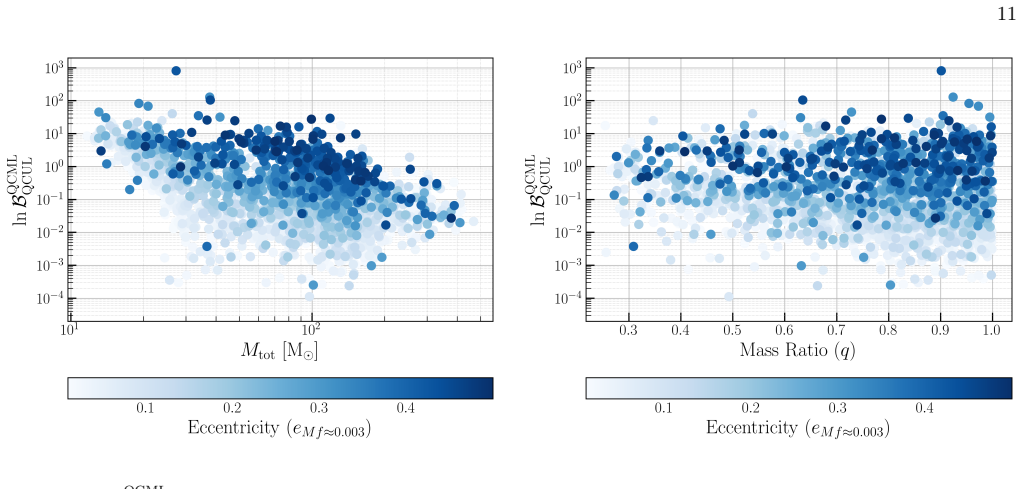
The paper establishes that, in the wave-optics regime, the frequency-dependent amplification produced by an isolated point-mass lens—specified by a redshifted lens mass and a dimensionless impact parameter—can mimic the amplitude and phase oscillations of orbital eccentricity in gravitational-wave signals. Using numerical-relativity eccentric injections at high SNR and a broader population of eccentric injections at SNR 30, it finds that quasicircular microlensed models are strongly favored over quasicircular unlensed models (log10 Bayes factors above 1, and ≳8 for the high-SNR cases) for low total masses and high eccentricities, yielding well-localized but unphysical lens-parameter posterio
What carries the argument
The central object is the wave-optics lensing kernel: a complex, frequency-dependent amplification factor F(f; M_L^z, y) that multiplies the unlensed frequency-domain strain, parameterized by the redshifted lens mass and dimensionless impact parameter y. Eccentricity also imprints oscillatory modulations in the strain's amplitude and unwrapped phase, so the analysis reduces to asking whether a Bayesian model with F applied to a quasicircular waveform can explain an eccentric signal. The paper compares three hypotheses—quasicircular unlensed, quasicircular microlensed, and eccentric unlensed—using Bayesian evidence, supported by a fitting-factor/mismatch population study, showing that the mic
Load-bearing premise
The load-bearing premise is that the eccentric waveform model used for injections and recovery faithfully represents real eccentric black-hole signals in the detector band, especially without spin-precession; if real signals carry strong precession, the paper's own conclusion that the degeneracy can be fully removed may not hold.
What would settle it
Analyze a real or simulated high-SNR (network SNR ~100), low-mass (≲100 solar masses), eccentric (e≳0.3) merger with a full precessing-eccentric waveform model alongside the microlensed model: if the microlensed hypothesis remains decisively favored over the eccentric one rather than losing by roughly an order of magnitude, the claim that the degeneracy is a modeling artifact would be refuted.
If this is right
- Any event showing strong Bayesian evidence for microlensing under a quasicircular model must be re-analyzed with eccentric templates; if the eccentric hypothesis wins, the lens claim is not robust.
- Well-localized posteriors on microlens parameters are not evidence of lensing: false positives produce tightly constrained but physically meaningless lens masses and impact parameters.
- The degeneracy strengthens with higher SNR and lower-frequency sensitivity, so next-generation and space-based observatories will need eccentric models as a standard part of microlensing searches.
- The same logic runs in reverse: microlensing might masquerade as eccentricity, so eccentricity claims should also be checked against lens models before being accepted.
- Because the quasicircular unlensed model is nested inside the microlensed model, the microlensed model can always do no worse on missing physics; only the Occam penalty suppresses false support, which is why the effect appears selectively in high-SNR, low-mass, high-eccentricity regimes.
Where Pith is reading between the lines
- The 'fully broken degeneracy' result is demonstrated for non-spinning or aligned-spin systems; realistic eccentric formation channels often involve precession, and the paper itself notes that the lack of faithful precessing-eccentric models may leave a residual degeneracy in real analyses.
- A practical screening rule follows: any candidate with log10 B_QCML^QCUL > 1 and inferred lens mass in the roughly 10–1000 solar-mass range should trigger an eccentric re-analysis before being reported as a lensing event.
- A mirror-image bias is likely: microlensed signals analyzed with eccentric templates may produce spurious eccentricity estimates. The paper identifies this reverse degeneracy as future work, but it can be tested directly by injecting lensed signals and checking whether eccentric recovery finds false eccentricity.
- Because the degeneracy grows with the number of gravitational-wave cycles, low-frequency detectors will amplify the problem; one could derive an explicit SNR-and-eccentricity threshold beyond which lensing searches must switch to eccentric waveform banks.
Editorial analysis
A structured set of objections, weighed in public.
Referee Report
Summary. The paper studies whether unlensed eccentric binary black hole (BBH) signals can be misclassified as wave-optically microlensed signals when analyzed with quasicircular templates. Injections are made with three SXS numerical-relativity waveforms (non-spinning, q=1,2,3, e_gw ~ 0.29 at 20 Hz, network SNR 100) and with TEOBResumS-Dalí (Mtot 30-90 M_sun, q=1,3, eccentricity up to 0.4 at Mf ~ 0.003, SNR 30). Bayesian model comparison between quasicircular microlensed (QCML) and quasicircular unlensed (QCUL) models shows strong spurious support for microlensing at high eccentricity, low total mass, and high SNR, with well-localized lens posteriors. Recovery with eccentric TEOBResumS-Dalí strongly favors eccentric unlensed (EccUL) over microlensed models, leading the authors to claim that the degeneracy is completely removed when eccentric waveforms are used. A mismatch-based population study in Appendix A supports the qualitative trends. The paper concludes with a practical prescription to analyze any strong microlensing candidate also with eccentric models.
Significance. If the main result holds, it is an important systematic warning for LVK and third-generation gravitational-wave microlensing searches: a significant fraction of high-SNR, low-mass, eccentric unlensed events could be misreported as lensed if analyzed only with quasicircular templates. The use of NR injections as independent ground truth, the public GWMAT implementation, and the direct Bayesian model comparison are strengths, and the false-positive half of the claim is well supported. The paper is therefore of clear interest to the gravitational-wave data-analysis community. However, the resolution half of the claim is weaker than the abstract suggests: the demonstration of 'complete removal' covers only non-spinning/aligned-spin systems, and the injection campaign's EccUL recovery uses the injection model itself, so it does not by itself establish faithfulness to real precessing-eccentric signals. These gaps are acknowledged at least partly in Sec. IV but are not reflected in the abstract.
major comments (3)
- [Sec. IV and Abstract] The statement that the degeneracy is 'completely removed' when eccentric waveform models are used is not supported for the full parameter space claimed. The EccUL recovery in Secs. IIIA and IIIB2 fixes in-plane spin components to zero, and all injections are non-spinning. The paper's own Sec. IV states that the 'current lack of faithful precessing-eccentric waveform models may, therefore, pose challenges to fully breaking this degeneracy in realistic analyses' and that models incorporating both microlensing and precession could outperform aligned-spin eccentric models. Since high-eccentricity formation channels (dynamical interactions, hierarchical triples) can produce significant in-plane spins, the abstract and conclusion should be qualified to non-precessing or aligned-spin eccentric systems, or the precessing-eccentric case must be explicitly tested. As written, the unqualified claim
- [Sec. IIIB2 / Fig. 5] The central demonstration that eccentric recovery breaks the degeneracy is partially circular for the TEOBResumS-Dalí injection campaign. The EccUL hypothesis is evaluated with the same TEOBResumS-Dalí model used to generate the injections, so log10 B_EccUL^QCUL >> log10 B_QCML^QCUL in Fig. 5 is partly an artifact of exact template-family consistency; it does not test how the model performs against waveforms it cannot represent. This is offset by the NR injections in Sec. IIIA, which are independent, but those cover only three non-spinning configurations at SNR 100. The claim in Sec. IIIB2 that eccentric templates 'correctly capture all relevant physics of the signal' is therefore overstated. I recommend presenting the NR EccUL recovery as the primary evidence for breaking the degeneracy, or adding independent-model eccentric injections, or explicitly labeling the Sec. IIIB2 result as a
- [Appendix A, Eq. (A2)] The population-level Bayes factor estimate neglects the Occam factor, but the main text repeatedly argues that the Occam/prior-volume penalty is important and suppresses false microlensing support (Sec. IIC and Sec. IIIB1). ln B_QCML^QCUL = (FF_QCML^2 - FF_QCUL^2) rho^2/2 therefore overstates the evidence for the larger QCML model and is not a conservative bound; it is an upper bound. The appendix concludes that the fitting-factor analysis is 'consistent with the full Bayesian model-comparison results,' but this comparison is not quantitative because the full evidences include the prior term that Eq. A2 drops. Please state this limitation in the text and, if possible, calibrate Eq. A2 against a subset of full evidence computations to show the bias is small.
minor comments (4)
- [Sec. II] There are several typos: 'microlesned' near Eq. (1), 'frequency-dpendent' in Sec. IIA, 'Markov-Chain Monto-Carlo' in Sec. IIB, and 'taken from with [136]' in Appendix A. Please copyedit.
- [Sec. IIC] The sentence 'Such fluctuations can increase the uncertainty in the Bayes factor and may drive it to even higher values' is not generally true: a specific noise realization can also lower the Bayes factor. Please rephrase to avoid implying that the zero-noise results are a lower bound.
- [Appendix A] The population study uses only one detector (Hanford) and a single-detector SNR threshold of 8. Please state clearly that these are single-detector quantities and explain how they relate to the network SNRs used in Sec. III, since the magnitude of log B depends on the number of detectors.
- [Sec. IIIA] The NR injection study uses only the (2,2) mode and face-on inclination. This is a reasonable choice, but it should be stated explicitly as a limitation, since higher-order modes at these mass ratios could affect both the eccentricity and microlensing signatures in real searches.
Circularity Check
No significant circularity: the central misclassification and degeneracy-breaking results are anchored by independent NR injections, with only a minor self-consistency caveat in the TEOBResumS-Dalí recovery campaign.
full rationale
The paper's core claim — that unlensed eccentric BBH signals can be misclassified as microlensed under quasicircular recovery — is established using independent SXS numerical-relativity injections rather than waveforms drawn from the recovery model. The complementary TEOBResumS-Dalí injection campaign is a controlled parameter-space study; although the eccentric-recovery step in Sec. IIIB2 uses the same model for injection and recovery ('which is the same model used for the injections'), this is a self-consistency check that can inflate EccUL evidence by construction, and the paper does not rely on it alone: the NR injections in Sec. IIIA independently show log10 B_EccUL/QCUL ≫ 1 and log10 B_EccUL/QCUL ≫ log10 B_QCML/QCUL. The microlensing kernel and priors are standard externally published results, and the self-citations by the authors are incidental rather than load-bearing. No equation-level reduction, fitted-parameter-as-prediction, or self-citation chain is present, so no circular step meeting the stated criteria is identified.
Axiom & Free-Parameter Ledger
free parameters (2)
- Microlens mass prior range =
log10(M_L/M_sun) ~ Uniform(-1, 5)
- Impact parameter prior p(y) =
p(y) ∝ y for y ∈ (1e-3, 5)
axioms (5)
- domain assumption Wave-optics point-mass lens amplification factor F(ω, y) of Takahashi & Nakamura (2003) is valid for isolated compact-object microlensing.
- domain assumption TEOBResumS-Dalí is faithful for eccentric BBHs up to e ~ 0.3 at 10 Hz for 60 Msun (per Chiaramello & Nagar 2020) and beyond for this study's range.
- domain assumption Zero-noise injections isolate systematic waveform-modeling effects without noise-induced fluctuations.
- standard math Jeffreys’ criterion is a meaningful scale for interpreting Bayes factors in model comparison.
- ad hoc to paper The Laplace approximation for Bayes factors (Eq. A2) with the Occam factor neglected approximates the full nested-sampling evidence.
read the original abstract
Gravitational lensing in the wave-optics regime imprints characteristic frequency-dependent amplitude and phase modulations on gravitational-wave (GW) signals, yet to be detected by ground-based interferometers. Similar modulations may also arise from orbital eccentricity, raising the possibility of degeneracies that could lead to false microlensing claims. We investigate the extent to which eccentric binary black hole (BBH) signals can mimic microlensing signatures produced by an isolated point-mass lens. With a simulated population of eccentric signals using numerical relativity simulations and \texttt{TEOBResumS-Dal\'i} waveform model, we perform a Bayesian model-comparison study, supported by a complementary \textit{mismatch} analysis. We find a strong degeneracy for high eccentricities, low total masses, and high signal-to-noise ratios (SNRs): under these conditions, quasicircular microlensed model can be strongly favored over quasicircular unlensed model, even when the true signal is unlensed. For moderate SNRs ($\sim 30$), binaries with $M_\mathrm{tot}\lesssim 100\,M_\odot$ and eccentricity $e \gtrsim 0.4$ are particularly susceptible to misclassifications. In such cases, inferred microlens parameters exhibit well-constrained posteriors despite being unphysical. Crucially, the degeneracy is completely removed when the recovery uses waveform models that incorporate eccentricity, which overwhelmingly favors the eccentric hypothesis over microlensing. Our results demonstrate that any event exhibiting strong Bayesian evidence for microlensing should also be analyzed with eccentric waveform models and vice-versa to avoid false positives and biased astrophysical inference. This work contributes to developing robust strategies for interpreting signals in the era of precision GW astronomy.
Figures


Forward citations
Cited by 2 Pith papers
-
Accurate waveforms for generic planar-orbit binary black holes: The multipolar effective-one-body model SEOBNRv6EHM
SEOBNRv6EHM is a multipolar EOB model for eccentric planar-orbit BBHs calibrated to NR simulations, showing low waveform mismatches up to eccentricity 0.9.
-
Probing globular clusters parameters through gravitational wave lensing with stellar-mass black hole binaries
Simulations of wave-optics lensing of GW150914-like signals by globular clusters recover injected velocity dispersion values for favorable alignments when lens and source parameters are jointly estimated.
Reference graph
Works this paper leans on
-
[1]
In this setup, the in-plane spin components, eccentricity, and true anomaly are all fixed to zero
Inference with quasicircular templates for Eccentric Injections To isolate the effect of ignoring eccentricity in microlens- ing searches, we first analyze the signals using the qua- sicircular, aligned-spin version of theTEOBResumS-Dalí waveform model, thereby avoiding possible waveform sys- tematics. In this setup, the in-plane spin components, eccentri...
-
[2]
We analyze the injections using theTEOBResumS-Dalí waveform model under the EccUL hypothesis, which is the same model used for the injections
Breaking the Degeneracy: Eccentric Inference for Eccentric Injections In this section, we investigate whether the degeneracy between eccentricity-induced and microlensing-induced features can be broken when analyzing eccentric injections with eccentric templates, i.e., templates that include all relevant physical effects present in the injections. We anal...
-
[3]
Specifically, this degeneracy strengthens with (i) increasing eccentricity, (ii) decreasing total mass, and (iii) increasing SNR
Bayesian model comparison analyses of both NR and TEOBResumS-Dalí EccUL injections demon- strate that ignoring eccentricity can bias microlens- ing searches in certain regions of the parameter space. Specifically, this degeneracy strengthens with (i) increasing eccentricity, (ii) decreasing total mass, and (iii) increasing SNR. Consequently,HQCML can be s...
-
[4]
For NR injections with a gauge-independent eccen- tricity measured at20 Hz to beegw 20 Hz∼ 0.3, total mass Mtot≈ 80M⊙, and mass ratiosq∈{ 1, 2, 3}, we find that theHQCML is very strongly preferred over theHQCUL, yielding log10BQCML QCUL ≳ 10, when the true injected optimal network SNR is around
-
[5]
How- ever, introducing additional parameters inHQCML also incurs a penalty owing toOccam’s razor, which suppresses false microlensing support except in the regimes identified above
SinceHQCUL is a subset ofHQCML (because mi- crolensing effects are added on top of the unlensed waveform, in the weak microlensing regime both hypotheses produce similar, orfaithful, signals), we expectHQCML to perform at least as well asHQCUL when the true signal is EccUL (or, more generally, when any physics is missing from the model). How- ever, introd...
-
[6]
For a network optimal SNR of30, binaries with Mtot ≲ 100M⊙ and high eccentricities (≳ 0.4, de- fined at apastron atMf≈ 0.003), almost always favor theH QCML, havinglog 10BQCML QCUL ≳1
-
[7]
In cases where the HQCML is strongly favored over theHQCUL, the inferred microlens parameters, log10Mz L andy, exhibit well-localized posteriors and large Jensen-Shannon divergence values between the priors and the inferred 1D marginalized posteriors for the lens parameters
-
[8]
Abbottet al.(LIGO Scientific, Virgo), Phys
R. Abbottet al.(LIGO Scientific, Virgo), Phys. Rev. X11, 021053 (2021), arXiv:2010.14527 [gr-qc]
Pith/arXiv arXiv 2021
-
[9]
In such cases, log10BEccUL QCUL ≫ log10BQCML QCUL, typically by an order of magnitude
For both NR andTEOBResumS-Dalí EccUL injec- tions, the degeneracy is always broken when the recovery uses eccentric templates containing the correct physics. In such cases, log10BEccUL QCUL ≫ log10BQCML QCUL, typically by an order of magnitude. Thus, events which are prone to showing strong, but spurious, support for microlensing are expected to show even...
-
[10]
Aasiet al.(LIGO Scientific), Class
J. Aasiet al.(LIGO Scientific), Class. Quant. Grav.32, 074001 (2015), arXiv:1411.4547 [gr-qc]
Pith/arXiv arXiv 2015
-
[11]
F. Acerneseet al.(VIRGO), Class. Quant. Grav.32, 024001 (2015), arXiv:1408.3978 [gr-qc]
Pith/arXiv arXiv 2015
-
[12]
K. Somiya (KAGRA), Class. Quant. Grav.29, 124007 (2012), arXiv:1111.7185 [gr-qc]
Pith/arXiv arXiv 2012
-
[13]
Y. Aso, Y. Michimura, K. Somiya, M. Ando, O. Miyakawa, T. Sekiguchi, D. Tatsumi, and H. Yamamoto (KAGRA), Phys. Rev. D88, 043007 (2013), arXiv:1306.6747 [gr-qc]
Pith/arXiv arXiv 2013
-
[14]
Akutsuet al.(KAGRA), Nature Astron.3, 35 (2019), arXiv:1811.08079 [gr-qc]
T. Akutsuet al.(KAGRA), Nature Astron.3, 35 (2019), arXiv:1811.08079 [gr-qc]
arXiv 2019
-
[15]
Akutsuet al.(KAGRA), PTEP2021, 05A101 (2021), arXiv:2005.05574 [physics.ins-det]
T. Akutsuet al.(KAGRA), PTEP2021, 05A101 (2021), arXiv:2005.05574 [physics.ins-det]
arXiv 2021
-
[16]
B. P. Abbottet al.(LIGO Scientific, Virgo), Phys. Rev. X9, 031040 (2019), arXiv:1811.12907 [astro-ph.HE]
Pith/arXiv arXiv 2019
-
[17]
Amaro-Seoaneet al., arXiv:1702.00786 (2017), arXiv:1702.00786 [astro-ph.IM]
P. Amaro-Seoaneet al., arXiv:1702.00786 (2017), arXiv:1702.00786 [astro-ph.IM]
Pith/arXiv arXiv 2017
-
[18]
Abbottet al.(LIGO Scientific, VIRGO), Phys
R. Abbottet al.(LIGO Scientific, VIRGO), Phys. Rev. D 109, 022001 (2024), arXiv:2108.01045 [gr-qc]
Pith/arXiv arXiv 2024
-
[19]
Abbottet al.(KAGRA, VIRGO, LIGO Scientific), Phys
R. Abbottet al.(KAGRA, VIRGO, LIGO Scientific), Phys. Rev. X13, 041039 (2023), arXiv:2111.03606 [gr-qc]
Pith/arXiv arXiv 2023
-
[20]
A. G. Abacet al.(LIGO Scientific, VIRGO, KAGRA), arXiv:2508.18082 (2025), arXiv:2508.18082 [gr-qc]
Pith/arXiv arXiv 2025
-
[21]
Punturoet al., Class
M. Punturoet al., Class. Quant. Grav.27, 194002 (2010)
2010
-
[22]
S. Hildet al., Class. Quant. Grav.28, 094013 (2011), arXiv:1012.0908 [gr-qc]
Pith/arXiv arXiv 2011
-
[23]
D. Reitzeet al., Bull. Am. Astron. Soc.51, 035 (2019), arXiv:1907.04833 [astro-ph.IM]
Pith/arXiv arXiv 2019
-
[24]
B. P. Abbottet al.(LIGO Scientific), Class. Quant. Grav.34, 044001 (2017), arXiv:1607.08697 [astro-ph.IM]
Pith/arXiv arXiv 2017
-
[25]
T. Regimbau, M. Evans, N. Christensen, E. Katsavounidis, B. Sathyaprakash, and S. Vitale, Phys. Rev. Lett.118, 151105 (2017), arXiv:1611.08943 [astro-ph.CO]
Pith/arXiv arXiv 2017
-
[26]
L. Dai, B. Zackay, T. Venumadhav, J. Roulet, and M. Zal- 12 darriaga, arXiv:2007.12709 (2020), arXiv:2007.12709 [astro- ph.HE]
Pith/arXiv arXiv 2007
-
[27]
Kawamuraet al., Class
S. Kawamuraet al., Class. Quant. Grav.23, S125 (2006)
2006
-
[28]
Einstein, Science84, 506 (1936)
A. Einstein, Science84, 506 (1936)
1936
-
[29]
Zwicky, Phys
F. Zwicky, Phys. Rev.51, 290 (1937)
1937
-
[30]
Walsh, R
D. Walsh, R. F. Carswell, and R. J. Weymann, Nature279, 381 (1979)
1979
-
[31]
Soucail, Y
G. Soucail, Y. Mellier, B. Fort, G. Mathez, and M. Cailloux, Astronomy and Astrophysics191, L19 (1988)
1988
-
[32]
O. A. Hannuksela, K. Haris, K. K. Y. Ng, S. Kumar, A. K. Mehta, D. Keitel, T. G. F. Li, and P. Ajith, Astrophys. J. Lett.874, L2 (2019), arXiv:1901.02674 [gr-qc]
Pith/arXiv arXiv 2019
-
[33]
Abbottet al.(LIGO Scientific, VIRGO), Astrophys
R. Abbottet al.(LIGO Scientific, VIRGO), Astrophys. J. 923, 14 (2021), arXiv:2105.06384 [gr-qc]
Pith/arXiv arXiv 2021
-
[34]
Abbottet al.(LIGO Scientific, KAGRA, VIRGO), Astro- phys
R. Abbottet al.(LIGO Scientific, KAGRA, VIRGO), Astro- phys. J.970, 191 (2024), arXiv:2304.08393 [gr-qc]
Pith/arXiv arXiv 2024
-
[35]
O. A. Hannuksela, T. E. Collett, M. Çalışkan, and T. G. F. Li, Mon. Not. Roy. Astron. Soc.498, 3395 (2020), arXiv:2004.13811 [astro-ph.HE]
Pith/arXiv arXiv 2020
-
[36]
X. Liu, I. Magana Hernandez, and J. Creighton, Astrophys. J.908, 97 (2021), arXiv:2009.06539 [astro-ph.HE]
Pith/arXiv arXiv 2021
-
[37]
J. Janquartet al., Mon. Not. Roy. Astron. Soc.526, 3832 (2023), arXiv:2306.03827 [gr-qc]
Pith/arXiv arXiv 2023
-
[38]
S. Mukherjee, B. D. Wandelt, and J. Silk, Mon. Not. Roy. As- tron. Soc.494, 1956 (2020), arXiv:1908.08951 [astro-ph.CO]
Pith/arXiv arXiv 1956
-
[39]
S. Goyal, K. Haris, A. K. Mehta, and P. Ajith, Phys. Rev. D 103, 024038 (2021), arXiv:2008.07060 [gr-qc]
Pith/arXiv arXiv 2021
-
[40]
T. Baker and M. Trodden, Phys. Rev. D95, 063512 (2017), arXiv:1612.02004 [astro-ph.CO]
Pith/arXiv arXiv 2017
-
[41]
K. Liao, X.-L. Fan, X.-H. Ding, M. Biesiada, and Z.-H. Zhu, Nature Commun.8, 1148 (2017), [Erratum: Nature Commun. 8, 2136 (2017)], arXiv:1703.04151 [astro-ph.CO]
Pith/arXiv arXiv 2017
-
[42]
S. Jana, S. J. Kapadia, T. Venumadhav, and P. Ajith, Phys. Rev. Lett.130, 261401 (2023), arXiv:2211.12212 [astro- ph.CO]
Pith/arXiv arXiv 2023
-
[43]
S. Mukherjee, T. Broadhurst, J. M. Diego, J. Silk, and G. F. Smoot, Mon. Not. Roy. Astron. Soc.506, 3751 (2021), arXiv:2106.00392 [gr-qc]
Pith/arXiv arXiv 2021
-
[44]
S.-S. Li, S. Mao, Y. Zhao, and Y. Lu, Mon. Not. Roy. Astron. Soc.476, 2220 (2018), arXiv:1802.05089 [astro-ph.CO]
Pith/arXiv arXiv 2018
-
[45]
J. K. Lawrence, Nuovo Cimento B Serie6B, 225 (1971)
1971
-
[46]
H. C. Ohanian, Int. J. Theor. Phys.9, 425 (1974)
1974
-
[47]
Bernardeau, arXiv:astro-ph/9901117 (1999), arXiv:astro- ph/9901117
F. Bernardeau, arXiv:astro-ph/9901117 (1999), arXiv:astro- ph/9901117
Pith/arXiv arXiv 1999
-
[48]
R. Takahashi, Astrophys. J.835, 103 (2017), arXiv:1606.00458 [astro-ph.CO]
Pith/arXiv arXiv 2017
-
[49]
L. Dai and T. Venumadhav, arXiv:1702,04724 (2017), arXiv:1702.04724 [gr-qc]
Pith/arXiv arXiv 2017
-
[50]
G. P. Smithet al., IAU Symp.338, 98 (2017), arXiv:1803.07851 [astro-ph.CO]
Pith/arXiv arXiv 2017
-
[51]
K. Haris, A. K. Mehta, S. Kumar, T. Venumadhav, and P. Ajith, arXiv:1807.07062 (2018), arXiv:1807.07062 [gr-qc]
Pith/arXiv arXiv 2018
-
[52]
M. Oguri, Mon. Not. Roy. Astron. Soc.480, 3842 (2018), arXiv:1807.02584 [astro-ph.CO]
Pith/arXiv arXiv 2018
-
[53]
Deguchi and W
S. Deguchi and W. D. Watson, Astrophys. J.307, 30 (1986)
1986
-
[54]
T. Broadhurst, J. M. Diego, and G. Smoot, arXiv:1802.05273 (2018), arXiv:1802.05273 [astro-ph.CO]
Pith/arXiv arXiv 2018
-
[55]
T. Broadhurst, J. M. Diego, and G. F. Smoot, arXiv:1901.03190 (2019), arXiv:1901.03190 [astro-ph.CO]
Pith/arXiv arXiv 1901
-
[56]
T. Broadhurst, J. M. Diego, and G. F. Smoot, arXiv:2006.13219 (2020), arXiv:2006.13219 [astro-ph.CO]
Pith/arXiv arXiv 2006
-
[57]
J. M. Ezquiaga, D. E. Holz, W. Hu, M. Lagos, and R. M. Wald, Phys. Rev. D103, 064047 (2021), arXiv:2008.12814 [gr-qc]
Pith/arXiv arXiv 2021
-
[58]
A. More and S. More, Mon. Not. Roy. Astron. Soc.515, 1044 (2022), arXiv:2111.03091 [astro-ph.CO]
Pith/arXiv arXiv 2022
-
[59]
M. Çalışkan, J. M. Ezquiaga, O. A. Hannuksela, and D. E. Holz, Phys. Rev. D107, 063023 (2023), arXiv:2201.04619 [astro-ph.CO]
Pith/arXiv arXiv 2023
-
[60]
A. Barsode, S. Goyal, and P. Ajith, Astrophys. J.980, 258 (2025), arXiv:2412.01278 [gr-qc]
Pith/arXiv arXiv 2025
-
[61]
A. Vijaykumar, A. K. Mehta, and A. Ganguly, Phys. Rev. D 108, 043036 (2023), arXiv:2202.06334 [gr-qc]
Pith/arXiv arXiv 2023
-
[62]
A. Mishra, A. K. Meena, A. More, and S. Bose, Mon. Not. Roy. Astron. Soc.531, 764 (2024), arXiv:2306.11479 [astro-ph.CO]
Pith/arXiv arXiv 2024
-
[63]
T. T. Nakamura, Phys. Rev. Lett.80, 1138 (1998)
1998
-
[64]
T. T. Nakamura and S. Deguchi, Prog. Theor. Phys. Suppl. 133, 137 (1999)
1999
-
[65]
R. Takahashi and T. T. Nakamura, Astrophys. J.595, 1039 (2003), arXiv:astro-ph/0305055 [astro-ph]
Pith/arXiv arXiv 2003
-
[66]
S. Jung and C. S. Shin, Phys. Rev. Lett.122, 041103 (2019), arXiv:1712.01396 [astro-ph.CO]
Pith/arXiv arXiv 2019
-
[67]
X. Shan, C. Wei, and B. Hu, Mon. Not. Roy. Astron. Soc. 508, 1253 (2021), arXiv:2012.08381 [astro-ph.CO]
Pith/arXiv arXiv 2021
-
[68]
A. Mishra, A. K. Meena, A. More, S. Bose, and J. S. Bagla, Mon. Not. Roy. Astron. Soc.508, 4869 (2021), arXiv:2102.03946 [astro-ph.CO]
Pith/arXiv arXiv 2021
-
[69]
A. K. Meena, A. Mishra, A. More, S. Bose, and J. S. Bagla, Mon. Not. Roy. Astron. Soc.517, 872 (2022), arXiv:2205.05409 [astro-ph.GA]
Pith/arXiv arXiv 2022
-
[70]
R. Bondarescu, H. Ubach, O. Bulashenko, and A. P. Lundgren, Phys. Rev. D108, 084033 (2023), arXiv:2211.13604 [gr-qc]
Pith/arXiv arXiv 2023
-
[71]
H. L. Iglesiaset al., Astrophys. J.972, 65 (2024), arXiv:2208.01766 [gr-qc]
Pith/arXiv arXiv 2024
-
[72]
A. Mishra, N. V. Krishnendu, and A. Ganguly, Phys. Rev. D 110, 084009 (2024), arXiv:2311.08446 [gr-qc]
Pith/arXiv arXiv 2024
-
[73]
P. Cremonese, J. M. Ezquiaga, and V. Salzano, Phys. Rev. D 104, 023503 (2021), arXiv:2104.07055 [astro-ph.CO]
Pith/arXiv arXiv 2021
-
[74]
P. Cremonese, D. F. Mota, and V. Salzano, Annalen Phys. 535, 2300040 (2023), arXiv:2111.01163 [astro-ph.CO]
Pith/arXiv arXiv 2023
-
[75]
X. Shan, X. Chen, B. Hu, and R.-G. Cai, arXiv:2301.06117 (2023), arXiv:2301.06117 [astro-ph.IM]
Pith/arXiv arXiv 2023
-
[76]
N. Rao, A. Mishra, A. Ganguly, and A. More, arXiv:2510.17787 (2025), arXiv:2510.17787 [gr-qc]
Pith/arXiv arXiv 2025
-
[77]
S. Basak, A. Ganguly, K. Haris, S. Kapadia, A. K. Mehta, and P. Ajith, Astrophys. J.926, L28 (2022), arXiv:2109.06456 [gr-qc]
Pith/arXiv arXiv 2022
-
[78]
A. K. Lenon, A. H. Nitz, and D. A. Brown, Mon. Not. Roy. As- tron. Soc.497, 1966 (2020), arXiv:2005.14146 [astro-ph.HE]
Pith/arXiv arXiv 1966
-
[79]
I. M. Romero-Shaw, P. D. Lasky, and E. Thrane, Astrophys. J.940, 171 (2022), arXiv:2206.14695 [astro-ph.HE]
Pith/arXiv arXiv 2022
-
[80]
H. A. Bethe and G. E. Brown, Astrophys. J.506, 780 (1998), arXiv:astro-ph/9802084
Pith/arXiv arXiv 1998
discussion (0)
Sign in with ORCID, Apple, or X to comment. Anyone can read and Pith papers without signing in.