REVIEW 4 major objections 5 minor 22 references
Gradient Weighted Superpixels for Interpretability in CNNs
T0 review · 4 major / 5 minor · reviewed 2026-08-14 · deepseek-v4-flash
Pith's one-line read A proposed method approximates LIME's superpixel explanations by summing absolute gradient-based pixel scores within each superpixel, matching LIME run with 50-75 samples while needing only one forward and backward pass through the network.
desk verdict Useful idea, overreaching claim: gradient-weighted superpixels can roughly match LIME at a fraction of the cost, but the headline result is weakened by post-hoc method selection and weak evaluation. read the letter →
The pith
A machine-rendered reading of the paper's core claim, the machinery that carries it, and where it could break.
The reading
What carries the argument
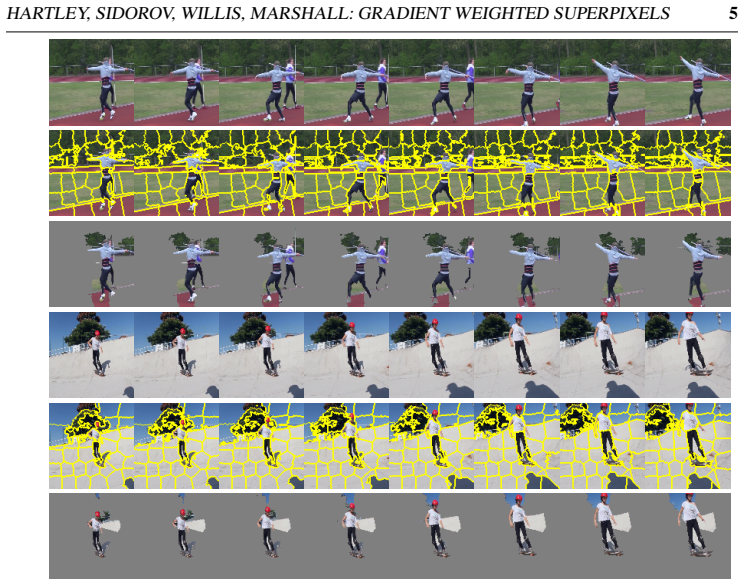
The central object is superpixel-weighted saliency: first segment the input into superpixels using QuickShift for images or SLIC for video volumes, then compute a per-pixel attribution map with one backward pass from the class of interest, and finally assign each superpixel a weight equal to the sum of absolute pixel scores within it. This replaces LIME's repeated perturbation of the input and its surrogate linear model with a single deterministic aggregation, which is the mechanism that carries the speedup.
What would settle it
Take a fixed set of images, compute the gradient-weighted superpixel ranking and the LIME-1000 ranking for each image, and measure per-image rank correlation such as Kendall's tau; if the correlation is no better than LIME with 50 samples, or if it drops sharply when the number of superpixels changes, the claim that the method approximates LIME is falsified. A human study in which LIME-1000 explanations are rated as clearly more useful than the one-pass explanations would also undercut the practical claim.
Extended reading notes
Core claim
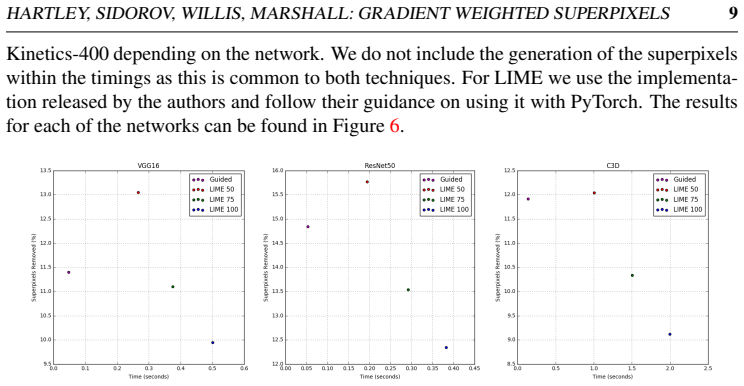
The paper's central claim is that superpixels can be weighted by aggregating per-pixel attribution scores from standard gradient-based visualization techniques, and that this aggregation approximates LIME's superpixel rankings. For each superpixel, the weight is the sum of the absolute values of the pixel scores inside it; the scores come from methods such as vanilla backpropagation, guided backpropagation, input-gradient products, Grad-CAM, Grad-CAM++, and guided combinations. Quantitatively, on top-k agreement with LIME run with 1000 samples, several of these one-pass variants perform between LIME with 50 samples and LIME with 75 samples, and in superpixel-removal tests they are consistently better than random ranking and sometimes beat LIME with 100 samples. For the C3D action recognition network, the method explains a 16-frame temporal volume in 0.13 seconds on average, compared with 1.0 and 1.5 seconds for LIME with 50 and 75 samples, so the paper positions the technique as a fast alternative that keeps LIME's interpretable superpixel output.
Load-bearing premise
The load-bearing premise is that LIME's superpixel rankings, computed with 1000 samples, are the correct reference for explanation quality; if LIME can be unreliable or if the top-k and removal proxies do not track what humans find interpretable, then matching LIME at 50 to 75 samples does not by itself establish that the one-pass method is truly interpretable.
Editorial extensions
If this is right
- For image classifiers, the one-pass method can produce LIME-like explanations at near-interactive speeds, since ranking quality matches LIME at 50 to 75 samples while costing only one forward and backward pass.
- The same recipe extends to 3D spatiotemporal inputs, allowing action recognition networks to be explained in well under a second per 16-frame clip.
- Because explanations are generated by backpropagating from a chosen class, the method can highlight different classes in the same image or video, not just the predicted class.
- The superpixel-removal results suggest the method is particularly good at identifying low-importance regions, which is useful for debugging when a network relies on unexpected or spurious evidence.
- If LIME's ranking is taken as the reference, the method offers a practical speed-quality trade-off point for any deployment where LIME's default 1000 samples is too slow.
Reading between the lines
- A natural extension, not explored in the paper, is to test whether a different aggregation rule, such as the maximum or mean of absolute pixel scores, would push agreement with LIME-1000 higher than the sum does.
- The one-pass ranking could be used as a cheap pre-filter that selects candidate superpixels for a subsequent LIME run, potentially reducing the number of perturbations LIME needs while keeping its exact behavior.
- The paper's evaluation on C3D, an older action recognition model, leaves open whether the method transfers cleanly to modern 3D architectures; the single-pass property suggests it should, but temporal resolution issues could reappear.
- If the top-k agreement metric is a valid proxy for explanation quality, then this style of evaluation could become a general benchmark for any fast explainer claiming to approximate a slower reference method.
Signed reviews
Editorial analysis
A structured set of objections, weighed in public.
Referee Report
Summary. The paper proposes Gradient Weighted Superpixels: superpixels are scored by summing the absolute values of gradient-based pixel attribution maps within each segment, yielding a single-pass alternative to LIME's perturbation-based ranking. The authors evaluate nine pixel-scoring methods (vanilla gradients, guided backpropagation, input-times-gradient, Grad-CAM variants, and activation maps) on VGG16 and ResNet50 with ImageNet, and on C3D with Kinetics-400, using two quantitative protocols: superpixel removal until misclassification and top-k agreement with LIME using 1000 samples. A qualitative extension to 3D spatio-temporal superpixels for action recognition is also presented. The central claim is that the proposed technique approximates LIME with 50 to 75 samples while requiring only a single forward and backward pass, and that it does so faster on video inputs.
Significance. If the central claim holds, the method is practically useful because it replaces LIME's repeated forward passes with a single-pass computation, which is especially valuable for video inputs where each perturbation is expensive. The paper covers a broad set of attribution baselines, two large-scale datasets, and three architectures including a video model, which is a strength. The main weakness is that the headline claim is not yet pinned down as a property of one fixed algorithm: the best attribution method is selected per network after seeing LIME agreement, and no error bars or significance tests are reported. The contribution is therefore promising but needs a sharper evaluation protocol before it can support the stated approximation claim.
major comments (4)
- [§4.2, Table 2 and §4.3, Figure 6] The headline claim that the proposed technique approximates LIME with 50 to 75 samples is tested by reporting, for each network, the best performing pixel-scoring method. In Table 2 at k=5, the best method is Act⊙Grad-CAM for VGG16, Guided Grad-CAM for ResNet50, and Guided Vanilla for C3D. However, the timing experiment in Figure 6 and the text of §4.3 use guided backpropagation throughout, so the method whose speed is advertised is not the method that produced the best approximation numbers on VGG16 and ResNet50. Moreover, because the best method is selected after observing LIME agreement, the reported agreement is an upper bound over a family of nine methods rather than a property of a single reproducible algorithm. To make the central claim falsifiable, the authors should either commit to a fixed scoring method across all networks or provide a principled rule for selecting the method without accessing LIME's output, and they should report timing for the method that actually achieves the claimed agreement.
- [Tables 1 and 2] All quantitative results are reported as single averages over validation sets, without standard deviations, confidence intervals, or significance tests. Differences between the proposed methods and LIME at 50 or 75 samples are often only a few percentage points; for example, in Table 2, k=1, ResNet50 Guided Grad-CAM is 48.71% versus LIME50 at 49.27%, and in Table 1 several entries differ from LIME by less than one percentage point. Without repeated runs (or uncertainty estimates) and a paired test, the claimed equivalence between the single-pass method and LIME at 50-75 samples is not established. The authors should add error bars and statistical comparisons, particularly for the VGG16 and C3D cases where the proposed method is claimed to fall between LIME50 and LIME100.
- [§4.1, Table 1 and surrounding text] The text states 'For each model we are able to find a weighting method that beats LIME with 100 samples.' This is contradicted by the 'Best' columns of Table 1, where a lower percentage is preferable: for VGG16 the best proposed method removes 67.28% before misclassification versus 66.15% for LIME100, for ResNet50 74.35% versus 73.59%, and for C3D 51.19% versus 47.93%. If the intended claim concerns the 'Worst' columns (removal of the lowest-ranked superpixels), that should be stated explicitly. As written, the sentence is internally inconsistent with the reported data and needs correction.
- [§4.2 and §5] The top-k experiment takes LIME with 1000 samples as the reference explanation, and the superpixel-removal experiment uses misclassification as a proxy for explanation quality. The paper does not discuss the validity of either as ground truth, despite resting its central claim ('approximate LIME') entirely on these proxies. Because disagreement with LIME could mean the proposed method is wrong, LIME is wrong, or both are partially wrong, the authors should add at least a small human-subject evaluation or an alternative faithfulness metric (e.g., occlusion sensitivity or point-game-style localization against ground-truth object regions) to justify that approximating LIME is a meaningful goal. At minimum, the limitation should be acknowledged explicitly in the experimental section.
minor comments (5)
- [§3, paragraph after the method list] The sentence 'Other methods of distilling the pixel values into superpixel scores were investigated, however the sum of absolute values was found to be superior' gives no details of the alternatives considered or the criterion used. An ablation table comparing aggregation rules would make this design choice reproducible.
- [§4.2, first paragraph] There is a typo: 'the most import superpixel' should be 'the most important superpixel.'
- [Figure 5 and Figure 6 captions] Figure 5 uses 'LIME5000' while the text and other figures refer to LIME with 5000 samples inconsistently, and Figure 6 shows only guided backpropagation even though the surrounding text discusses 'a number of the better performing methods.' The captions should specify exactly which methods and sample counts are displayed.
- [§4, experimental setup] The superpixel generation methods (QuickShift for images, SLIC for video) are named, but their parameter settings (number of segments, compactness, and so on) are not given. Since all comparisons depend on the segmentation, these parameters should be reported.
- [References and related work] The sentence in §2, 'This work also introduced gradient ⊙ input as a visualisation method,' is attached to reference [12], which is the DeepLIFT paper; the gradient-times-input visualization is more commonly attributed to the Integrated Gradients paper [16]. The citation should be corrected or re-worded.
Circularity Check
No circularity: gradient-weighted superpixels are independently evaluated against LIME, not derived from it.
full rationale
The paper's central claim is that summing gradient-based pixel scores within superpixels approximates LIME rankings at lower computational cost. This claim is tested against LIME as an external baseline, not constructed from it. No equation defines the proposed score in terms of LIME's output, and no parameter is fitted to LIME agreement and then reported as a prediction. The superpixel segmentation is shared between methods, and the timing comparison explicitly excludes superpixel generation, so the speed advantage is not an artifact of differing segmentation. The choice of summing absolute pixel values is asserted without comparative support, and the best-performing gradient method varies by network, which weakens the generality of the approximation claim; however, these are correctness and robustness concerns, not circularity. The paper cites LIME, Grad-CAM, and other standard external techniques; there is no load-bearing self-citation chain. The evaluation metrics use LIME 1000 as a reference because approximating LIME is the stated goal, which is a legitimate external benchmark rather than a self-justifying definition. Overall, the derivation is self-contained and the central claim has independent empirical content.
Assumptions & free parameters
assumptions (4)
- domain assumption Pixel-level gradient scores are meaningful indicators of input importance for CNNs
- domain assumption LIME's superpixel rankings are a valid reference for interpretability
- domain assumption Removal of high-ranked superpixels until misclassification measures ranking quality
- ad hoc to paper The sum of absolute pixel scores within a superpixel is the best aggregation
Cite this review
Pith. "Pith review of Gradient Weighted Superpixels for Interpretability in CNNs." pith.science (2026). https://pith.science/paper/DT544GJF
@misc{pith2026190808997,
  author       = {Pith},
  title        = {Pith review of: Gradient Weighted Superpixels for Interpretability in CNNs},
  year         = {2026},
  howpublished = {\url{https://pith.science/paper/DT544GJF}},
  note         = {Machine review of arXiv:1908.08997}
}
read the original abstract
As Convolutional Neural Networks embed themselves into our everyday lives, the need for them to be interpretable increases. However, there is often a trade-off between methods that are efficient to compute but produce an explanation that is difficult to interpret, and those that are slow to compute but provide a more interpretable result. This is particularly challenging in problem spaces that require a large input volume, especially video which combines both spatial and temporal dimensions. In this work we introduce the idea of scoring superpixels through the use of gradient based pixel scoring techniques. We show qualitatively and quantitatively that this is able to approximate LIME, in a fraction of the time. We investigate our techniques using both image classification, and action recognition networks on large scale datasets (ImageNet and Kinetics-400 respectively).
Figures


Figures from the paper (3 more)

Reference graph
Works this paper leans on
-
[1]
Slic superpixels compared to state-of-the-art superpixel methods
Radhakrishna Achanta, Appu Shaji, Kevin Smith, Aurelien Lucchi, Pascal Fua, and Sabine Süsstrunk. Slic superpixels compared to state-of-the-art superpixel methods. IEEE transactions on pattern analysis and machine intelligence , 34(11):2274–2282, 2012
2012
-
[2]
On pixel-wise explanations for non-linear clas- sifier decisions by layer-wise relevance propagation
Sebastian Bach, Alexander Binder, Grégoire Montavon, Frederick Klauschen, Klaus- Robert Müller, and Wojciech Samek. On pixel-wise explanations for non-linear clas- sifier decisions by layer-wise relevance propagation. PLoS ONE , 10(7):e0130140, 07 2015. doi: 10.1371/journal.pone.0130140. URL http://dx.doi.org/10. 1371%2Fjournal.pone.0130140
-
[3]
Quo vadis, action recognition? A new model and the kinetics dataset
Joao Carreira and Andrew Zisserman. Quo vadis, action recognition? A new model and the kinetics dataset. In proceedings of the IEEE Conference on Computer Vision and Pattern Recognition, pages 6299–6308, 2017
work page 2017
-
[4]
Aditya Chattopadhyay, Anirban Sarkar, Prantik Howlader, and Vineeth N. Balasubra- manian. Grad-cam++: Generalized gradient-based visual explanations for deep con- volutional networks. In 2018 IEEE Winter Conference on Applications of Computer Vision, WACV 2018, Lake Tahoe, NV , USA, March 12-15, 2018, pages 839–847, 2018. doi: 10.1109/W ACV .2018.00097. U...
arXiv 2018
-
[5]
Interpretable explanations of black boxes by mean- ingful perturbation
Ruth C Fong and Andrea Vedaldi. Interpretable explanations of black boxes by mean- ingful perturbation. In The IEEE International Conference on Computer Vision (ICCV), Oct 2017
work page 2017
-
[6]
Deep residual learning for image recognition
Kaiming He, Xiangyu Zhang, Shaoqing Ren, and Jian Sun. Deep residual learning for image recognition. In The IEEE Conference on Computer Vision and Pattern Recogni- tion (CVPR), June 2016
work page 2016
-
[7]
The kinetics human action video dataset
Will Kay, Joao Carreira, Karen Simonyan, Brian Zhang, Chloe Hillier, Sudheendra Vi- jayanarasimhan, Fabio Viola, Tim Green, Trevor Back, Paul Natsev, et al. The kinetics human action video dataset. arXiv preprint arXiv:1705.06950, 2017
arXiv 2017
-
[8]
Explaining nonlinear classification decisions with deep taylor decomposition
Grégoire Montavon, Sebastian Lapuschkin, Alexander Binder, Wojciech Samek, and Klaus-Robert Müller. Explaining nonlinear classification decisions with deep taylor decomposition. Pattern Recognition, 65:211–222, 2017
work page 2017
Show all 22 references
-
[9]
Automatic differentiation in pytorch
Adam Paszke, Sam Gross, Soumith Chintala, Gregory Chanan, Edward Yang, Zachary DeVito, Zeming Lin, Alban Desmaison, Luca Antiga, and Adam Lerer. Automatic differentiation in pytorch. In NIPS-W, 2017
2017
-
[10]
Why should I trust you?
Marco Tulio Ribeiro, Sameer Singh, and Carlos Guestrin. "Why should I trust you?": Explaining the predictions of any classifier. In Proceedings of the 22nd ACM SIGKDD International Conference on Knowledge Discovery and Data Mining, San Francisco, CA, USA, August 13-17, 2016 , p...
2016
-
[11]
Selvaraju, Michael Cogswell, Abhishek Das, Ramakrishna Vedantam, Devi Parikh, and Dhruv Batra
Ramprasaath R. Selvaraju, Michael Cogswell, Abhishek Das, Ramakrishna Vedantam, Devi Parikh, and Dhruv Batra. Grad-CAM: Visual explanations from deep networks HARTLEY , SIDOROV , WILLIS, MARSHALL: GRADIENT WEIGHTED SUPERPIXELS 11 via gradient-based localization. In The IEEE In...
2017
-
[12]
Learning important fea- tures through propagating activation differences
Avanti Shrikumar, Peyton Greenside, and Anshul Kundaje. Learning important fea- tures through propagating activation differences. In Doina Precup and Yee Whye Teh, editors, Proceedings of the 34th International Conference on Machine Learn- ing, volume 70 of Proceedings of Mach...
2017
-
[13]
Simonyan and A
K. Simonyan and A. Zisserman. Very deep convolutional networks for large-scale image recognition. In International Conference on Learning Representations , 2015
2015
-
[14]
Deep inside convolutional networks: Visualising image classification models and saliency maps
Karen Simonyan, Andrea Vedaldi, and Andrew Zisserman. Deep inside convolutional networks: Visualising image classification models and saliency maps. arXiv preprint arXiv:1312.6034, 2013
2013 arXiv
-
[15]
Striving for simplicity: The all convolutional net
Jost Tobias Springenberg, Alexey Dosovitskiy, Thomas Brox, and Martin Riedmiller. Striving for simplicity: The all convolutional net. arXiv preprint arXiv:1412.6806 , 2014
2014 arXiv
-
[16]
Axiomatic attribution for deep net- works
Mukund Sundararajan, Ankur Taly, and Qiqi Yan. Axiomatic attribution for deep net- works. In Proceedings of the 34th International Conference on Machine Learning - V olume 70, ICML’17, pages 3319–3328. JMLR.org, 2017. URL http://dl.acm. org/citation.cfm?id=3305890.3306024
2017
-
[17]
Learning spatiotemporal features with 3d convolutional networks
Du Tran, Lubomir Bourdev, Rob Fergus, Lorenzo Torresani, and Manohar Paluri. Learning spatiotemporal features with 3d convolutional networks. In Proceedings of the 2015 IEEE International Conference on Computer Vision (ICCV), ICCV ’15, pages 4489–4497, Washington, DC, USA, 201...
2015 doi
-
[18]
A closer look at spatiotemporal convolutions for action recognition
Du Tran, Heng Wang, Lorenzo Torresani, Jamie Ray, Yann LeCun, and Manohar Paluri. A closer look at spatiotemporal convolutions for action recognition. In CVPR, 2018
2018
-
[19]
Quick shift and kernel methods for mode seeking
Andrea Vedaldi and Stefano Soatto. Quick shift and kernel methods for mode seeking. In European conference on computer vision, pages 705–718. Springer, 2008
2008
-
[20]
Visualizing and understanding convolutional net- works
Matthew D Zeiler and Rob Fergus. Visualizing and understanding convolutional net- works. In European conference on computer vision, pages 818–833. Springer, 2014
2014
-
[21]
Top-down neural attention by excitation backprop
Jianming Zhang, Sarah Adel Bargal, Zhe Lin, Jonathan Brandt, Xiaohui Shen, and Stan Sclaroff. Top-down neural attention by excitation backprop. International Journal of Computer Vision, 126(10):1084–1102, 2018
2018
-
[22]
B. Zhou, A. Khosla, Lapedriza. A., A. Oliva, and A. Torralba. Learning Deep Features for Discriminative Localization. CVPR, 2016
2016
Reviewed August 14, 2026 · model on record in the stance chip above.
Discussion (0). Continue with ORCID to comment.