REVIEW 3 major objections 6 minor 39 references
EyeNet: A Multi-Task Network for Off-Axis Eye Gaze Estimation and User Understanding
T0 review · 3 major / 6 minor · reviewed 2026-08-14 · deepseek-v4-flash
Pith's one-line read A single multi-task network, EyeNet, estimates every intermediate geometric quantity for off-axis eye tracking—pupil, glints, and cornea center—along with blinks and expressions, and with a short geometric refinement step matches a…
desk verdict A solid multi-task eye-tracking system paper whose robustness claim holds up, but whose cornea supervision is self-referential and whose closed dataset limits verification. read the letter →
The pith
A machine-rendered reading of the paper's core claim, the machinery that carries it, and where it could break.
The reading
What carries the argument
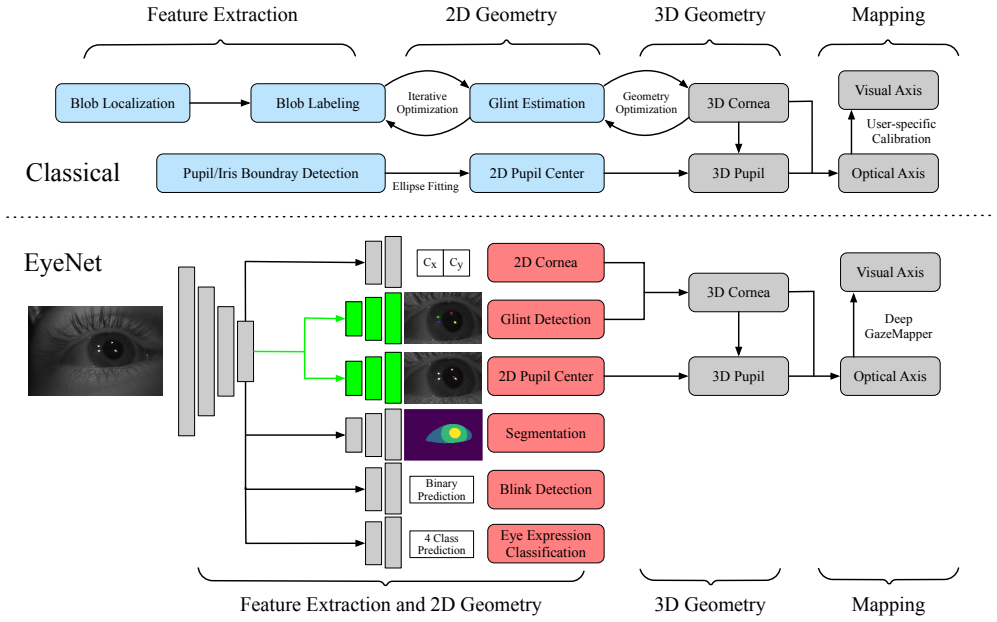
The load-bearing object is the shared encoder (ResNet-50 with a feature pyramid) feeding six task decoders, combined with a model-based supervision scheme that converts known LED positions and detected glints into a training signal for the 3D cornea center. The geometric core is the law of reflection: for each LED–glint pair, the LED, the glint point on the cornea, the camera center, and the cornea center are co-planar; intersecting the planes from multiple LEDs yields a ray on which the cornea lies, and projecting that ray to the image plane gives a 'cornea 2D' target. A fixed-radius spherical cornea model (r = 8 mm) lifts the 2D cornea to 3D by a one-dimensional search that reflects glint rays and minimizes distance to the known LEDs; EyeNet-Opt performs the same reflection loss as per-frame gradient descent on glint and cornea 2D positions. The DeepGazeMapper, a five-layer network trained on calibration frames, then maps the resulting optical axis to the visual axis.
What would settle it
Measure gaze and cornea error on subjects or synthetic eyes with known corneal radius spanning, say, 7.0–9.0 mm (e.g., from keratometry or a rendered eye with controlled radius). If the fixed 8 mm assumption is load-bearing, EyeNet's cornea 2D and final gaze error should increase monotonically as the true radius moves away from 8 mm; if instead the network learns a radius-independent mapping, error should stay flat. A second check: compare the network's 3D cornea center against an independent ground-truth measurement (MRI/ultrasound of the eye, or a synthetic renderer with known geometry) rather than against the classical pipeline's estimate.
Extended reading notes
Core claim
The paper's central claim is that a single convolutional network can jointly solve the appearance-based and geometric subproblems of off-axis eye tracking: eye-part segmentation (background, sclera, iris, pupil), detection and association of four IR-LED glints, pupil center localization, blink detection, emotive expression classification, and 2D cornea-center estimation—the last trained by model-based supervision derived from specular-reflection geometry rather than manual labels. The authors argue that the shared representation regularizes the tasks and eliminates hand-designed heuristics. On the MagicEyes test set, EyeNet's gaze estimates have higher mean angular error than the classical baseline but far lower standard deviation; adding 100 steps of gradient descent on a geometric projection loss (EyeNet-Opt) brings mean error close to classical (186.41 vs 204.98 arcmin) while keeping the error distribution concentrated. The paper concludes that accurate cornea estimation is the most sensitive link in the pipeline and that robust learned cornea 2D estimates, refined by geometry, are what make the approach viable.
Load-bearing premise
The entire cornea supervision chain assumes the human cornea is a sphere of one fixed radius (8 mm) and that the LED positions and glint reflections obey the idealized specular-reflection geometry; if a user's corneal radius differs, the LED calibration is off, or glints are mislabeled, the generated 'ground truth' for the cornea branch is systematically biased—and because the same geometric model is used to score cornea accuracy, the comparison is not independent.
Editorial extensions
If this is right
- EyeNet's feed-forward predictions can replace the hand-tuned segmentation, blob detection, glint labeling, and presence gating modules of a classical eye tracker, running all tasks at about 83 fps on a single GPU.
- Using EyeNet estimates as initialization for a short gradient-descent refinement (EyeNet-Opt) yields a gaze error distribution with a much shorter tail than the classical pipeline, so the system trades a small amount of mean accuracy for substantially reduced jitter and peripheral-field robustness.
- Robust glint presence/absence prediction (98.06% average, vs 91.72% classical) prevents wrong glint-LED association, one of the main ways classical trackers fail under reflections or extreme gaze angles.
- Blink detection at 1.24% false positive and 4.01% false negative rates, and emotive expression classification at 92.75% accuracy from eye-only images, make the same network usable for focal-depth switching and avatar animation in VR/MR.
- The MagicEyes dataset, with 87,000 manually annotated frames across 587 subjects, provides the first off-axis eye-tracking benchmark with dense intermediate ground truth (segmentation, glints, pupil, blink) for diverse demographics.
Reading between the lines
- Because the paper's cornea 'ground truth' is itself produced by the geometric model, the reported 0.99 mm post-optimization agreement measures consistency with that model, not anatomical truth; an independent 3D ground truth could separate the two.
- If corneal radius varies by person, a natural extension is to estimate or personalize the radius per subject from the same glint geometry instead of fixing 8 mm; that could improve both the supervised training targets and the final gaze accuracy.
- The shared encoder's features are trained mostly on appearance tasks; adding a direct gaze loss or using the geometric reflection loss as a differentiable training signal (the paper notes direct training on the projection loss did not work) is a testable route to end-to-end accuracy without out-of-network optimization.
- The same architecture and supervision recipe should transfer to synthetic anatomically-informed eye renderers, which would supply exact cornea ground truth and avoid the circularity noted above, while also greatly expanding the demographic coverage of the training set.
Signed reviews
Editorial analysis
A structured set of objections, weighed in public.
Referee Report
Summary. The paper introduces EyeNet, a single multi-task convolutional network for off-axis eye images captured by head-mounted VR/MR devices. The network jointly predicts eye-part segmentation, pupil center, IR-LED glint locations and presence, cornea-center 2D projection, blink state, and emotive expression class. Training combines human-annotated labels (segmentation, keypoints, presence) with model-based supervision derived from a spherical-cornea reflection geometry: glints detected by the network are used with known LED positions to solve for a cornea ray, whose intersection with the image plane provides the cornea 2D training target. A variant, EyeNet-Opt, performs per-frame gradient-descent refinement of cornea 2D and glint positions using the same geometric model. Gaze is obtained by lifting 2D pupil/cornea estimates to 3D using a fixed 8 mm corneal radius, forming the optical axis, and mapping to the visual axis with a small network, DeepGazeMapper, trained on per-subject calibration frames. The method is evaluated on MagicEyes, a private dataset of 587 subjects, against a classical geometric pipeline that also uses the EyeNet segmentation branch.
Significance. If the results hold, the paper makes a useful engineering contribution to off-axis gaze tracking and semantic user understanding for VR/MR, showing that a single shared representation can drive both appearance-based and geometric tasks, and that a learned initializer plus small optimization can improve robustness over a classical tracker. Strengths of the work include the large subject pool (587 subjects) with reported demographic diversity, the explicit use of geometric supervision for a quantity that cannot be hand-labeled, the mix-and-match ablations (Table 4) that isolate component contributions, per-target-direction error reporting (Table 5), and the low runtime (12 ms/frame, 83 fps). The main limitations are that the dataset is private, the cornea-center supervision and its evaluation are both derived from the same geometric model, and no error bars or significance tests are provided for the headline gaze comparisons. These limitations mean the strongest contribution is the robustness evidence and the engineering architecture, while the claim of providing a dataset with 'all intermediate ground truth' is overstated.
major comments (3)
- [Section 5.4 and Section 5.5.3] The cornea 2D supervision is not independent ground truth: Section 5.4 states 'we generate glint predictions for all frames in MagicEyes and use these along with known LED locations to generate cornea 2D GT', so EyeNet's own glint predictions are used to generate the training target for the cornea branch. The evaluation in Section 5.5.3 then compares EyeNet's cornea prediction to the classical pipeline's cornea estimate, which is obtained from the same spherical-cornea reflection model and the same back-projection losses described in Section 4.3.2. The reported distances (1.77 mm before optimization, 0.99 mm after) therefore measure agreement between two implementations of the same geometric model, not accuracy relative to a true cornea center. This weakens contribution 4 ('the first eye tracking dataset with all intermediate ground truth') and the text should explicitly label the cornea labels as model-generated pseudo-labels that inherit any bias in the assumed corneal radius (8 mm), LED calibration, or glint predictions.
- [Table 4, Section 5.5.4] The claim of competitive gaze accuracy is sensitive to which classical baseline is used. EyeNet-Opt with DeepGazeMapper (model 4) has mean error 186.41 arcmin, which is higher than Classical-DeepGazeMapper (model 2) at 183.43 arcmin, although model 4 has lower standard deviation (105.81 vs 153.11 arcmin). The paper states that results are averaged over five training runs, but Table 4 reports only frame-level standard deviations, not run-to-run variation, and no confidence intervals are given. Given that the mean difference between model 2 and model 4 is only about 3 arcmin, the paper should provide error bars or a paired significance test over the five runs to support the conclusion that the robustness improvement is not accompanied by a statistically meaningful accuracy difference.
- [Section 4.3.2 and Section 5.4.1] The 3D lifting of the cornea and pupil centers assumes a fixed corneal radius r = 8 mm for all subjects (Eq. 3 and Eq. 6), while Section 5.4.1 explicitly acknowledges that corneal physiology, including radius, differs across subjects and responds by personalizing only the 2D cornea branch. A systematic mismatch between the assumed and true radius biases the 3D cornea position, the 3D pupil center, and hence the optical axis that is fed into the DeepGazeMapper. Although the per-subject gaze mapper can partially absorb this bias, the paper should state this limitation explicitly and report a sensitivity analysis (e.g., the change in gaze error when r is varied by ±1 mm) to show the effect on the headline results.
minor comments (6)
- [Section 3 and Section 5.5.1] The 'classical' baseline in Table 4 uses the EyeNet segmentation network to detect pupil/iris boundaries (Section 3), so the comparison is against a hybrid pipeline rather than a fully hand-engineered tracker. This should be stated clearly in the comparison section to avoid reader confusion about what is being isolated.
- [Table 3 caption] The caption says 'The first two columns are localization LEE of EyeNet and classical predictions', but the table's first two data columns are Classical and EyeNet, in that order. Please reorder the columns or reword the caption to match the actual ordering.
- [Section 5.5.5] The blink detection comparison to [23] (false positive rate 1.24% vs 8.3%, false negative 4.01% vs 16.7%) is performed on different datasets and protocols; the text should note that this is not a same-benchmark comparison.
- [Section 5.5.6] The expression classification results are based on only 15 subjects, are personalized per subject, and are not evaluated on a standard benchmark; the 92.75% accuracy should therefore be presented as preliminary evidence rather than a general claim.
- [Throughout] There are several typos and grammar issues that should be fixed: 'muti-task' and 'Als' in Section 7, 'maintanability' in Section 7, 'accomodation' in Section 2, 'outliners' in the Figure 11 caption, and 'EyeNet predictions are have' in the Table 5 caption.
- [References] Reference [7] appears malformed (it contains an IEEE DOI in the reference text). Please verify the citation format.
Circularity Check
Cornea branch is trained and evaluated through the same geometric model, so its 'ground truth' and accuracy metric are not independent; final gaze targets remain independent.
-
self definitional
[Section 5.4, Training and Testing Procedures; see also Section 4.3 (Model Based Learning for Cornea Center Estimation)]
"After this step, we generate glint predictions for all frames in MagicEyes and use these along with known LED locations to generate cornea 2D GT for training the cornea branch as discussed in Section 4.3."
The cornea branch's supervision is not an independent measurement: it is obtained by applying the geometric model of Section 4.3 to EyeNet's own glint predictions. The linear system 'solution' that defines the cornea target is a function of 'estimated glint normal' vectors, and those glints come from EyeNet. Any bias in the glint branch is therefore baked into the cornea label, and the cornea branch is trained to reproduce a quantity defined by another output of the same network. The paper's contribution 4 ('first eye tracking dataset with all intermediate ground truth') thus overstates independence: the cornea ground truth is model-generated from the network's own estimates, not a separately measured quantity.
-
other
[Section 5.5.3, Cornea Center Estimation]
"It is hard to obtain ground truth for the cornea center. Therefore we compare the Euclidean distance of the EyeNet predicted cornea center to the cornea center obtained by the classical pipeline."
The classical pipeline's cornea center is estimated by the same spherical-cornea reflection model used to generate EyeNet's supervision and to lift EyeNet's 2D cornea prediction to 3D (Sections 4.3 and 4.3.2, including the assumed 8 mm corneal radius). Agreement between the two is therefore a consistency check between two implementations of the same geometric model, not evidence of absolute accuracy. The reported 1.77 mm and 0.99 mm distances cannot validate the cornea branch against the true cornea center, a limitation the paper itself concedes by noting that ground truth is hard to obtain.
full rationale
The paper's central gaze-accuracy claim is not circular: the final angular error (Section 5.5.4, Table 4) is measured against independently specified 3D gaze targets, and DeepGazeMapper is trained on those targets. No load-bearing self-citation or uniqueness-imported-from-authors pattern appears. However, the cornea-center component is partially self-referential. The cornea 2D supervision is generated by applying the spherical-reflection model to EyeNet's own glint predictions (Section 5.4), so the 'ground truth' is a function of a network output rather than an independent measurement. The cornea accuracy metric (Section 5.5.3) then compares EyeNet's cornea estimate to the classical pipeline's cornea estimate, which is produced by the same geometric model with the same assumed 8 mm corneal radius; agreement there is a consistency check, not validation. The paper explicitly concedes 'It is hard to obtain ground truth for the cornea center,' and the first-dataset-with-all-intermediate-ground-truth claim is therefore overstated. Because the final gaze result is anchored to independent targets and the other tasks (segmentation, blink, expression) have independent human labels, the circularity is partial, so a moderate score rather than a high one is appropriate.
Assumptions & free parameters
free parameters (4)
- Corneal radius r =
8 mm (assumed constant for all subjects)
- Per-subject DeepGazeMapper weights =
30K parameters, trained per subject on 9 calibration targets at 0.5 m
- Per-subject cornea branch fine-tuning =
Fine-tuned weights using model-based supervision on calibration frames
- Blink threshold =
50% pupil coverage
assumptions (5)
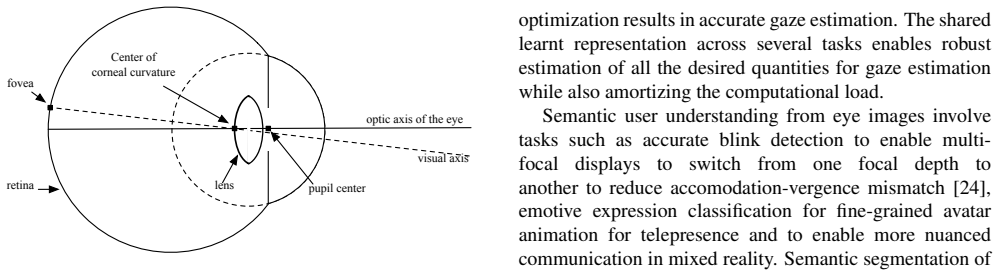
- domain assumption The human cornea can be modeled as a sphere of fixed radius r, and the pupil center, cornea center, and camera center obey the optical geometry in Fig. 2.
- standard math Specular reflection from an LED off the cornea is such that incident ray, reflected ray, and surface normal are co-planar, and the cornea center lies on the line OC.
- domain assumption Camera intrinsics/extrinsics and LED positions in 3D are known and accurately calibrated for the HMD.
- domain assumption Human annotations for segmentation, pupil, glints, blinks, and expressions are accurate enough to train the network.
- domain assumption The 9 calibration targets at 0.5 m are sufficient to personalize cornea and gaze mapping for all other depths and directions.
Cite this review
Pith. "Pith review of EyeNet: A Multi-Task Network for Off-Axis Eye Gaze Estimation and User Understanding." pith.science (2026). https://pith.science/paper/J2WXIMXD
@misc{pith2026190809060,
  author       = {Pith},
  title        = {Pith review of: EyeNet: A Multi-Task Network for Off-Axis Eye Gaze Estimation and User Understanding},
  year         = {2026},
  howpublished = {\url{https://pith.science/paper/J2WXIMXD}},
  note         = {Machine review of arXiv:1908.09060}
}
read the original abstract
Eye gaze estimation and simultaneous semantic understanding of a user through eye images is a crucial component in Virtual and Mixed Reality; enabling energy efficient rendering, multi-focal displays and effective interaction with 3D content. In head-mounted VR/MR devices the eyes are imaged off-axis to avoid blocking the user's gaze, this view-point makes drawing eye related inferences very challenging. In this work, we present EyeNet, the first single deep neural network which solves multiple heterogeneous tasks related to eye gaze estimation and semantic user understanding for an off-axis camera setting. The tasks include eye segmentation, blink detection, emotive expression classification, IR LED glints detection, pupil and cornea center estimation. To train EyeNet end-to-end we employ both hand labelled supervision and model based supervision. We benchmark all tasks on MagicEyes, a large and new dataset of 587 subjects with varying morphology, gender, skin-color, make-up and imaging conditions.
Figures

Figures from the paper (9 more)


Reference graph
Works this paper leans on
-
[1]
Opencv simpleblobdetector. https://docs. opencv.org/3.4/d0/d7a/classcv_1_ 1SimpleBlobDetector.html
-
[2]
Pupil capture is an open source eye tracking tool from pupil- labs: https://github.com/pupil-labs/pupil
-
[3]
Tobii is the world leader in eye tracking, Apr 2015
work page 2015
-
[4]
V . Badrinarayanan, A. Kendall, and R. Cipolla. Segnet: A deep convolutional encoder-decoder architecture for image segmentation. IEEE Transactions on Pattern Analysis & Machine Intelligence, (12):2481–2495, 2017
work page 2017
-
[5]
A. Borji and L. Itti. Cat2000: A large scale fixation dataset for boosting saliency research. CVPR 2015 Workshop on ”Future of Datasets”, 2015
work page 2015
-
[6]
D. Eberly. Computing a point of reflection on a sphere, Feb 2008
work page 2008
-
[8]
R. Garg, V . K. BG, G. Carneiro, and I. Reid. Unsupervised cnn for single view depth estimation: Geometry to the rescue. In ECCV, pages 740–756. Springer, 2016
work page 2016
- [9]
Show all 39 references
-
[10]
Guenter, M
B. Guenter, M. Finch, S. Drucker, D. Tan, and J. Snyder. Foveated 3d graphics. ACM Transactions on Graphics (TOG), 31(6):164, 2012
2012
-
[11]
E. D. Guestrin and M. Eizenman. General theory of remote gaze estimation using the pupil center and corneal reflections. IEEE Transactions on Biomedical Engineering, 53(6):1124–1133, 2006
2006
-
[12]
Handa, M
A. Handa, M. Bloesch, V . P ˘atr˘aucean, S. Stent, J. McCormac, and A. Davison. gvnn: Neural network library for geometric computer vision. In ECCV, pages 67–82. Springer, 2016
2016
-
[13]
D. W. Hansen and A. E. Pece. Eye tracking in the wild. Computer Vision and Image Understanding, 98(1):155–181, 2005
2005
-
[14]
K. He, X. Zhang, S. Ren, and J. Sun. Deep residual learning for image recognition. In CVPR, pages 770–778, 2016
2016
-
[15]
Hennessey, B
C. Hennessey, B. Noureddin, and P. Lawrence. A single camera eye-gaze tracking system with free head motion. In Proceedings of the 2006 symposium on Eye tracking research & applications, pages 87–94. ACM, 2006. 15
2006
-
[16]
Hickson, N
S. Hickson, N. Dufour, A. Sud, V . Kwatra, and I. Essa. Eyemotion: Classifying facial expressions in vr using eye- tracking cameras. IEEE 10.1109/WACV .2019.00178, 2019
2019
-
[17]
Huang, M
Y . Huang, M. Cai, Z. Li, and Y . Sato. Predicting gaze in egocentric video by learning task-dependent attention transition. arXiv preprint arXiv:1803.09125, 2018
2018 arXiv
-
[18]
T. Judd, F. Durand, and A. Torralba. A benchmark of computational models of saliency to predict human fixations. In MIT Technical Report, 2012
2012
-
[19]
J. Kim, M. Stengel, A. Majercik, S. De Mello, D. Dunn, S. Laine, M. McGuire, and D. Luebke. Nvgaze: An anatomically-informed dataset for low-latency, near-eye gaze estimation. In Proceedings of the 2019 CHI Conference on Human Factors in Computing Systems , page 550. ACM, 2019
2019
-
[20]
M. Kim, O. Wang, and N. Ng. Convolutional neural network architectures for gaze estimation on mobile devices
-
[21]
Krafka, A
K. Krafka, A. Khosla, P. Kellnhofer, H. Kannan, S. Bhandarkar, W. Matusik, and A. Torralba. Eye tracking for everyone. In CVPR, pages 2176–2184, 2016
2016
-
[22]
S. S. Kruthiventi, K. Ayush, and R. V . Babu. Deepfix: A fully convolutional neural network for predicting human eye fixations. arXiv preprint arXiv:1510.02927, 2015
2015 arXiv
-
[23]
Langbehn, F
E. Langbehn, F. Steinicke, M. Lappe, G. F. Welch, and G. Bruder. In the blink of an eye - leveraging blink-induced suppression for imperceptible position and orientation redirection in virtual reality. 2018
2018
-
[24]
D. Lanman. Reactive displays: Unlocking next-generation vr/ar visuals with eye tracking, June 2018
2018
-
[25]
D. H. Lee and A. K. Anderson. Reading what the mind thinks from how the eye sees. Psychological Science https://doi.org/10.1177/0956797616687364, 2017
2017 doi
-
[26]
Li and W
S. Li and W. Deng. Deep facial expression recognition: A survey. arXiv preprint arXiv:1804.08348, 2018
2018 arXiv
-
[27]
T.-Y . Lin, P. Doll ´ar, R. B. Girshick, K. He, B. Hariharan, and S. J. Belongie. Feature pyramid networks for object detection
-
[28]
Lind ´en, J
E. Lind ´en, J. Sj¨ostrand, and A. Proutiere. Appearance-based 3d gaze estimation with personal calibration. arXiv preprint arXiv:1807.00664, 2018
2018 arXiv
-
[29]
Ronneberger, P
O. Ronneberger, P. Fischer, and T. Brox. U-net: Convolutional networks for biomedical image segmentation. In International Conference on Medical Image Computing and Computer-assisted Intervention , pages 234–241. Springer, 2015
2015
-
[30]
Shrivastava, T
A. Shrivastava, T. Pfister, O. Tuzel, J. Susskind, W. Wang, and R. Webb. Learning from simulated and unsupervised images through adversarial training
-
[31]
´Swirski, A
L. ´Swirski, A. Bulling, and N. Dodgson. Robust real-time pupil tracking in highly off-axis images. In Proceedings of the Symposium on Eye Tracking Research and Applications, pages 173–176. ACM, 2012
2012
-
[32]
Y . Tong, J. Chen, and Q. Ji. A unified probabilistic framework for spontaneous facial action modeling and understanding. IEEE Transactions on Pattern Analysis and Machine Intelligence, 32(2):258–273, 2010
2010
-
[33]
Villanueva, J
A. Villanueva, J. J. Cerrolaza, and R. Cabeza. Geometry issues of gaze estimation. In Advances in Human Computer Interaction. InTech, 2008
2008
-
[34]
Wood and A
E. Wood and A. Bulling. Eyetab: Model-based gaze estimation on unmodified tablet computers. In Proceedings of the Symposium on Eye Tracking Research and Applications, pages 207–210. ACM, 2014
2014
-
[35]
J. Wu, T. Xue, J. J. Lim, Y . Tian, J. B. Tenenbaum, A. Torralba, and W. T. Freeman. Single image 3d interpreter network. In ECCV, pages 365–382. Springer, 2016
2016
-
[36]
D. H. Yoo and M. J. Chung. A novel non-intrusive eye gaze estimation using cross-ratio under large head motion. Computer Vision and Image Understanding , 98(1):25–51, 2005
2005
-
[37]
A. R. Zamir, A. Sax, W. Shen, L. J. Guibas, J. Malik, and S. Savarese. Taskonomy: Disentangling task transfer learning. In Proceedings of the IEEE Conference on Computer Vision and Pattern Recognition , pages 3712– 3722, 2018
2018
-
[38]
Zhang, M
X. Zhang, M. X. Huang, Y . Sugano, and A. Bulling. Training person-specific gaze estimators from user interactions with multiple devices. In Proceedings of the 2018 CHI Conference on Human Factors in Computing Systems , page
2018
-
[39]
T. Zhou, M. Brown, N. Snavely, and D. G. Lowe. Unsupervised learning of depth and ego-motion from video. In CVPR, volume 2, page 7, 2017
2017
-
[40]
Z. Zhu, Q. Ji, et al. Novel eye gaze tracking techniques under natural head movement. IEEE Transactions on Biomedical Engineering BME, 54(12):2246, 2007. A. Appendix A.1. Encoder Architecture We emplot a ResNet50 with a feature pyramid network (FPN) as the encoder architecture...
2007
Reviewed August 14, 2026 · model on record in the stance chip above.
Discussion (0). Continue with ORCID to comment.