REVIEW 4 major objections 6 minor 41 references
Situational Fusion of Visual Representation for Visual Navigation
T0 review · 4 major / 6 minor · reviewed 2026-08-14 · deepseek-v4-flash
Pith's one-line read Action-level fusion of diverse visual representations doubles zero-shot navigation success.
desk verdict A clean, plausible paper on action-level fusion of 25 pretrained visual representations for navigation, but the headline gain over majority voting comes almost entirely from an under-tested affinity regularizer and the evaluation lacks error bars. read the letter →
The pith
A machine-rendered reading of the paper's core claim, the machinery that carries it, and where it could break.
The reading
What carries the argument
The load-bearing mechanism is action-level fusion: each of 25 frozen visual representations is paired with its own action-prediction module, so every branch emits a full action candidate $\tilde{a}^i_t$; a situational fusion network $f(o_t)$ outputs softmax weights $g_t$, and the final action is $a_t = \sum_i g^i_t \tilde{a}^i_t$. Because every branch is trained to produce a valid action, no representation is undertrained, and the weighted combination behaves as an ensemble. The second mechanism is the inter-task affinity regularizer $L_g(g_t) = g_t^T F g_t$, where $F_{ij}$ is the pairwise affinity of tasks $i$ and $j$; minimizing this bilinear form penalizes giving high weight to two high-affinity, redundant representations.
What would settle it
Re-run the same training with the task-affinity matrix shuffled (random permutation of its entries) and again with it set to zero. If success rates stay at roughly 44% in both altered runs, the regularizer's benefit does not come from the affinity information. Conversely, a test set of environments that require two high-affinity representations in every episode should cause the regularizer to hurt; observing that would also count against the paper's generalization claim.
Extended reading notes
Core claim
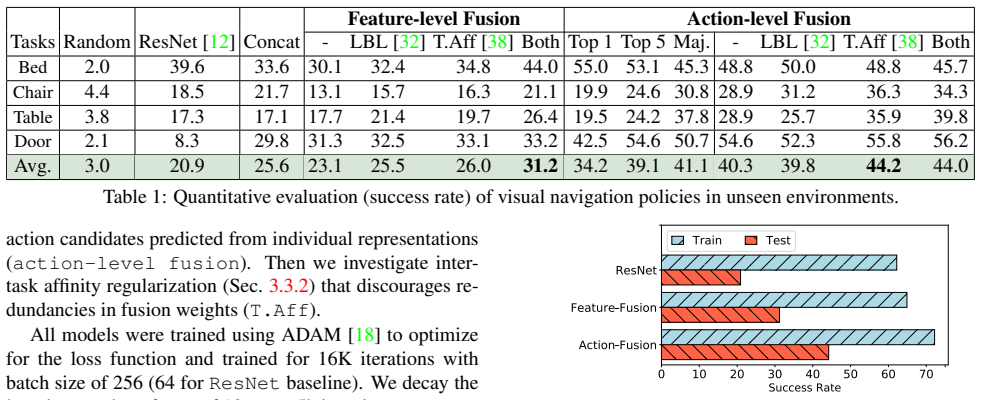
The paper's central claim is that a navigation policy generalizes to unseen environments when it fuses many frozen, task-specific visual representations at the action level and regularizes the fusion weights with a data-driven task-affinity matrix. The authors show that each representation can be trained to emit a plausible action, and that the weighted ensemble of those action candidates substantially outperforms raw-pixel learning, feature concatenation, and feature-level gating. The best model reports 44.2% average success in environments never seen during training, versus 20.9% for a standard pretrained network and 41.1% for majority voting among branches. The regularizer shifts gating toward complementary skills, and the learned weights are situational—geometric representations are trusted in narrow spaces, semantic ones near object clusters.
Load-bearing premise
The load-bearing premise is that the paper's pairwise task-affinity scores, measured by transfer between static image tasks, correctly measure how redundant two representations are when both feed a dynamic navigation policy.
Editorial extensions
If this is right
- In unseen environments, action-level fusion with the affinity regularizer reaches 44.2% average success, about double the 20.9% of a standard pretrained network.
- Feature-level fusion and simple concatenation barely beat the raw-pixel baseline, so where fusion happens is the decisive design choice.
- The affinity regularizer outperforms a load-balancing loss that only encourages uniform weights, showing that modeling redundancy between representations helps.
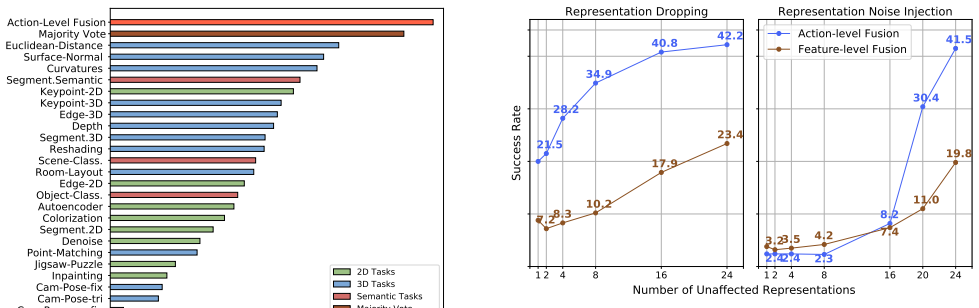
- Action-level fusion keeps working when some representations are dropped or corrupted, because each branch already outputs a usable action.
- Learned gating is situational: geometric representations dominate in corridors, semantic representations near object clusters.
Reading between the lines
- The action-level fusion recipe should transfer to other embodied tasks with frozen perception banks, such as active perception or manipulation, where a wrong feature is costlier; this is an untested extrapolation.
- If the regularizer is truly capturing redundancy, an online estimate of representation redundancy during deployment could outperform the static affinity matrix; the paper does not explore this.
- Because individual branch performance ranges widely, pruning the weakest branches and re-measuring would reveal whether the full 25-representation bank or the regularizer drives the gain.
- The robustness results imply the architecture could be deployed in real systems where perception modules fail or are attacked, since per-branch action outputs allow graceful degradation.
Editorial analysis
A structured set of objections, weighed in public.
Referee Report
Summary. The paper proposes a visual navigation policy that fuses 25 Taskonomy visual representations at the action level via a gating network, with a bilinear regularizer (Eq. 1) that penalizes co-selection of representation pairs with high Taskonomy affinity. The method is evaluated on four semantic navigation tasks in Gibson, and Table 1 reports 44.2% average success in unseen environments versus 20.9% for an ImageNet-pretrained ResNet baseline and 41.1% for majority voting among the 25 action branches. The central claims are that action-level fusion generalizes better than feature-level fusion or end-to-end residual networks, and that the task-affinity regularizer further improves zero-shot generalization by reducing redundancy among fused representations.
Significance. If the results are robust, the paper offers a practical recipe for reusing diverse frozen perception modules in interactive navigation and demonstrates a useful interaction between an action-level mixture-of-experts style architecture and a data-driven redundancy penalty. The paper includes a plausible experimental setup, multiple baselines, ablations of the proposed components, and a qualitative analysis of the learned fusion weights. The main strengths are the breadth of the representation set, the clean action-level fusion formulation, and the use of a standard simulation benchmark. However, the central quantitative contribution over the majority-voting baseline is small (3.1 percentage points), and the paper provides no variance estimates; the specific role of the Taskonomy affinity prior is not directly validated.
major comments (4)
- [Table 1, Avg row] The proposed method (action-level fusion with T.Aff) reaches 44.2% average success, while the majority-voting baseline is 41.1% and action-level fusion without the regularizer is 40.3%. The reported advantage over majority voting is therefore 3.1 percentage points, and the advantage of the full method over its own ablation is 3.9 points. Since every number in Table 1 appears to be a point estimate from a single training run with no error bars, seed variance, or confidence intervals over the fixed 1024 test episodes, the paper currently provides no way to assess whether these differences are statistically significant. This is a load-bearing issue because the paper's claims about both the situational-fusion scheme and the affinity regularizer rest on these margins.
- [Sec. 3.3.2, Eq. (1)] The regularizer Lg(g_t) = g_t^T F g_t assumes that the Taskonomy pairwise affinity matrix, estimated from transfer performance on static image tasks, is a valid proxy for redundancy among representations in a dynamic navigation policy. The paper does not provide a direct test of this assumption. The qualitative weight visualizations in Sec. 4.3 show that weights change with scene geometry, but they do not distinguish the effect of the affinity structure from a generic diversity or balance penalty. A controlled ablation with a scrambled or shuffled affinity matrix (or with an identity matrix) is needed to establish that the specific Taskonomy affinity values, rather than any quadratic penalty on the weights, are responsible for the improvement from 40.3% to 44.2%.
- [Sec. 4.2, Table 1] The action-level fusion without regularization achieves 40.3%, which is slightly worse than uniform majority voting at 41.1%. This means the situational gating mechanism alone does not outperform a non-situational ensemble; the reported benefit of the proposed method over majority voting comes entirely from adding the T.Aff regularizer. The paper's narrative that situational fusion drives the gain is therefore only supported when the regularizer is present. To substantiate the situational-fusion story, the paper should additionally compare against a fixed-weight action-level fusion (for example, a single learned softmax vector applied at all time steps) and against majority voting over a subset selected by the regularizer. Without such a comparison, the contribution of the situational weighting itself is unclear.
- [Sec. 4.3, Fig. 5] The claim that the fusion network exhibits situational behavior (e.g., 3D representations receiving higher weights in corridors and semantic representations in object-cluttered spaces) is supported only by qualitative heatmaps and a bar chart that appears to lack error bars or statistical tests. A quantitative analysis with confidence intervals, or a direct correlation between the openness measure and the gating weights across environments, would strengthen this part of the paper. As it stands, the situational claim is plausible but not firmly demonstrated.
minor comments (6)
- [Table 1] The table caption is missing from the text, and the column structure is not fully described. In particular, the meaning of the 'Both' columns (for feature-level and action-level fusion) should be stated explicitly in the main text or a caption.
- [Sec. 4.1] The sentence 'we use on average 28 environments for training and 14 for testing' is imprecise; please specify the exact train/test split for each of the four tasks or explain why the number varies.
- [Fig. 7] The robustness curves report performance for a single model run; adding error bars or multiple seeds would make the robustness comparison between action-level and feature-level fusion more convincing.
- [Sec. 4.1, Baselines] Calling ResNet 'state-of-the-art pretrained ResNet model' is misleading, as ResNet is a standard backbone rather than a navigation-specific state-of-the-art method; please adjust the wording.
- [Sec. 3.2] Please clarify that the Taskonomy representations are frozen and are not fine-tuned during navigation policy training, since this is important for understanding the fixed-prior aspect of the method.
- [Sec. 3.3.2, Eq. (1)] Please specify the range or normalization of the affinity values aff(i,j) and whether the matrix F is symmetric; this information is useful for interpreting the magnitude of the regularizer.
Circularity Check
No significant circularity: the Taskonomy representations and affinity matrix are fixed external inputs, and none of the navigation success numbers are fed back into them.
full rationale
The paper's derivation chain is self-contained with respect to its central claim. The 25 visual representations and the pairwise affinity matrix come from Taskonomy [38], a prior published and code-released system, and the paper treats them as fixed external inputs: the navigation policy is trained on Gibson environments and evaluated on unseen environments, while the representations and affinities are not refit to navigation success. The T.Aff regularizer in Eq. 1 uses the Taskonomy affinities as a surrogate for redundancy, but this is an explicit modeling assumption rather than a circular reduction, since the affinities were estimated from static-image transfer experiments and do not incorporate the navigation policy's outputs. The closest thing to a concern is that action-level fusion without regularization (40.3%) is slightly below uniform majority voting (41.1%), so the reported gain over the non-situational ensemble comes from adding T.Aff; however, that regularizer is still an independently supplied prior, not a fitted parameter renamed as a prediction. The self-citation to Taskonomy is real external evidence under the stated rules, and no equation or evaluation metric is defined in terms of the quantity it is claimed to predict. Correctness risks about the suitability of static-image affinity as a proxy for dynamic navigation redundancy belong to the validity domain, not to circularity.
Assumptions & free parameters
free parameters (4)
- Taskonomy affinity matrix F (25x25) =
fixed values from Taskonomy paper
- Number of visual representations n =
25
- Training setup (batch size, iterations, LR schedule) =
256, 16K iterations, 10x LR decay every 5K
- Learned parameters of gating network and 25 action predictors =
trained on navigation data
assumptions (4)
- domain assumption Taskonomy representations pretrained on static image tasks transfer their information to navigation decision-making.
- domain assumption Taskonomy pairwise affinity is a valid surrogate for redundancy between representations in a navigation policy.
- domain assumption Shortest-path action labels from ground-truth object annotations are sufficient supervision for learning a navigable policy.
- domain assumption Held-out Matterport3D scenes are a valid measure of zero-shot generalization.
Cite this review
Pith. "Pith review of Situational Fusion of Visual Representation for Visual Navigation." pith.science (2026). https://pith.science/paper/2QAHCQCX
@misc{pith2026190809073,
  author       = {Pith},
  title        = {Pith review of: Situational Fusion of Visual Representation for Visual Navigation},
  year         = {2026},
  howpublished = {\url{https://pith.science/paper/2QAHCQCX}},
  note         = {Machine review of arXiv:1908.09073}
}
read the original abstract
A complex visual navigation task puts an agent in different situations which call for a diverse range of visual perception abilities. For example, to "go to the nearest chair", the agent might need to identify a chair in a living room using semantics, follow along a hallway using vanishing point cues, and avoid obstacles using depth. Therefore, utilizing the appropriate visual perception abilities based on a situational understanding of the visual environment can empower these navigation models in unseen visual environments. We propose to train an agent to fuse a large set of visual representations that correspond to diverse visual perception abilities. To fully utilize each representation, we develop an action-level representation fusion scheme, which predicts an action candidate from each representation and adaptively consolidate these action candidates into the final action. Furthermore, we employ a data-driven inter-task affinity regularization to reduce redundancies and improve generalization. Our approach leads to a significantly improved performance in novel environments over ImageNet-pretrained baseline and other fusion methods.
Figures



Figures from the paper (3 more)

Reference graph
Works this paper leans on
-
[1]
Vi- sual navigation for mobile robots: A survey
Francisco Bonin-Font, Alberto Ortiz, and Gabriel Oliver. Vi- sual navigation for mobile robots: A survey. Journal of in- telligent and robotic systems, 53(3):263–296, 2008. 2
work page 2008
-
[2]
A robust layered control system for a mobile robot
Rodney Brooks. A robust layered control system for a mobile robot. IEEE journal on robotics and automation , 2(1):14–23, 1986. 4
work page 1986
-
[3]
Matterport3D: Learning from RGB- D data in indoor environments
Angel Chang, Angela Dai, Thomas Funkhouser, Maciej Hal- ber, Matthias Niessner, Manolis Savva, Shuran Song, Andy Zeng, and Yinda Zhang. Matterport3D: Learning from RGB- D data in indoor environments. International Conference on 3D Vision (3DV), 2017. 5
work page 2017
-
[4]
Abhishek Das, Samyak Datta, Georgia Gkioxari, Stefan Lee, Devi Parikh, and Dhruv Batra. Embodied question answer- ing. arXiv preprint arXiv:1711.11543, 2017. 2
arXiv 2017
-
[5]
Language modeling with gated convolutional net- works
Yann N Dauphin, Angela Fan, Michael Auli, and David Grangier. Language modeling with gated convolutional net- works. In Proceedings of the 34th International Conference on Machine Learning-Volume 70 , pages 933–941. JMLR. org, 2017. 4
work page 2017
-
[6]
Imagenet: A large-scale hierarchical image database
Jia Deng, Wei Dong, Richard Socher, Li-Jia Li, Kai Li, and Li Fei-Fei. Imagenet: A large-scale hierarchical image database. 2009. 1, 2, 5
work page 2009
-
[7]
Carl Doersch, Abhinav Gupta, and Alexei A. Efros. Unsu- pervised visual representation learning by context prediction. In International Conference on Computer Vision (ICCV) ,
-
[8]
Fast r-cnn
Ross Girshick. Fast r-cnn. In Proceedings of the IEEE inter- national conference on computer vision , pages 1440–1448,
Show all 41 references
-
[9]
Iqa: Visual question answering in interactive environments
Daniel Gordon, Aniruddha Kembhavi, Mohammad Raste- gari, Joseph Redmon, Dieter Fox, and Ali Farhadi. Iqa: Visual question answering in interactive environments. In IEEE Conference on Computer Vision and Pattern Recogni- tion (CVPR). IEEE, 2018. 2
2018
-
[10]
Cognitive mapping and plan- ning for visual navigation
Saurabh Gupta, James Davidson, Sergey Levine, Rahul Suk- thankar, and Jitendra Malik. Cognitive mapping and plan- ning for visual navigation. InIEEE Conference on Computer Vision and Pattern Recognition (CVPR) , pages 2616–2625,
-
[11]
Efficient quadratic reg- ularization for expression arrays
Trevor Hastie and Robert Tibshirani. Efficient quadratic reg- ularization for expression arrays. Biostatistics, 5(3):329– 340, 2004. 5
2004
-
[12]
Deep residual learning for image recognition
Kaiming He, Xiangyu Zhang, Shaoqing Ren, and Jian Sun. Deep residual learning for image recognition. In IEEE Conference on Computer Vision and Pattern Recognition (CVPR), 2016. 5, 6
2016
-
[13]
Grounded language learning in a simulated 3d world
Karl Moritz Hermann, Felix Hill, Simon Green, Fumin Wang, Ryan Faulkner, Hubert Soyer, David Szepesvari, Wo- jtek Czarnecki, Max Jaderberg, Denis Teplyashin, et al. Grounded language learning in a simulated 3d world. arXiv preprint arXiv:1706.06551, 2017. 2
2017 arXiv
-
[14]
Virtual-to-real: Learning to control in visual semantic segmentation
Zhang-Wei Hong, Chen Yu-Ming, Shih-Yang Su, Tzu-Yun Shann, Yi-Hsiang Chang, Hsuan-Kung Yang, Brian Hsi-Lin Ho, Chih-Chieh Tu, Yueh-Chuan Chang, Tsu-Ching Hsiao, et al. Virtual-to-real: Learning to control in visual semantic segmentation. arXiv preprint arXiv:1802.00285, 2018. 2
2018 arXiv
-
[15]
What makes imagenet good for transfer learning? arXiv preprint arXiv:1608.08614, 2016
Minyoung Huh, Pulkit Agrawal, and Alexei A Efros. What makes imagenet good for transfer learning? arXiv preprint arXiv:1608.08614, 2016. 2
2016 arXiv
-
[16]
Learning visual features from large weakly supervised data
Armand Joulin, Laurens van der Maaten, Allan Jabri, and Nicolas Vasilache. Learning visual features from large weakly supervised data. In European Conference on Com- puter Vision, pages 67–84, 2016. 2
2016
-
[17]
Generalization through simulation: In- tegrating simulated and real data into deep reinforcement learning for vision-based autonomous flight
Katie Kang, Suneel Belkhale, Gregory Kahn, Pieter Abbeel, and Sergey Levine. Generalization through simulation: In- tegrating simulated and real data into deep reinforcement learning for vision-based autonomous flight. arXiv preprint arXiv:1902.03701, 2019. 2
1902 arXiv
-
[18]
Adam: A method for stochastic optimization
Diederik Kingma and Jimmy Ba. Adam: A method for stochastic optimization. arXiv preprint arXiv:1412.6980 ,
-
[19]
Shamma, Michael S
Ranjay Krishna, Yuke Zhu, Oliver Groth, Justin Johnson, Kenji Hata, Joshua Kravitz, Stephanie Chen, Yannis Kalan- tidis, Li-Jia Li, David A. Shamma, Michael S. Bernstein, and Li Fei-Fei. Visual genome: Connecting language and vision using crowdsourced dense image annotations. ...
2016
-
[20]
Imagenet classification with deep convolutional neural net- works
Alex Krizhevsky, Ilya Sutskever, and Geoffrey E Hinton. Imagenet classification with deep convolutional neural net- works. In Advances in neural information processing sys- tems, pages 1097–1105, 2012. 1
2012
-
[21]
End-to-end training of deep visuomotor policies
Sergey Levine, Chelsea Finn, Trevor Darrell, and Pieter Abbeel. End-to-end training of deep visuomotor policies. The Journal of Machine Learning Research , 17(1):1334– 1373, 2016. 1
2016
-
[22]
Understanding deep image representations by inverting them
Aravindh Mahendran and Andrea Vedaldi. Understanding deep image representations by inverting them. In IEEE Conference on Computer Vision and Pattern Recognition (CVPR), 2015. 2
2015
-
[23]
Adversarially robust policy learning: Active construction of physically-plausible perturbations
Ajay Mandlekar, Yuke Zhu, Animesh Garg, Li Fei-Fei, and Silvio Savarese. Adversarially robust policy learning: Active construction of physically-plausible perturbations. In Intel- ligent Robots and Systems (IROS), 2017 IEEE/RSJ Interna- tional Conference on, pages 3932–3939. I...
2017
-
[24]
Neural autonomous navigation with riemannian motion pol- icy
Xiangyun Meng, Nathan Ratliff, Yu Xiang, and Dieter Fox. Neural autonomous navigation with riemannian motion pol- icy. In IEEE International Conference on Robotics and Au- tomation. IEEE, 2019. 2
2019
-
[25]
Learning to navigate in cities without a map
Piotr Mirowski, Matthew Koichi Grimes, Mateusz Ma- linowski, Karl Moritz Hermann, Keith Anderson, Denis Teplyashin, Karen Simonyan, Koray Kavukcuoglu, Andrew Zisserman, and Raia Hadsell. Learning to navigate in cities without a map. arXiv preprint arXiv:1804.00168, 2018. 2
2018 arXiv
-
[26]
Learn- ing to navigate in complex environments
Piotr Mirowski, Razvan Pascanu, Fabio Viola, Hubert Soyer, Andrew J Ballard, Andrea Banino, Misha Denil, Ross Goroshin, Laurent Sifre, Koray Kavukcuoglu, et al. Learn- ing to navigate in complex environments. arXiv preprint arXiv:1611.03673, 2016. 2
2016 arXiv
-
[27]
Driving policy transfer via modularity and abstraction
Matthias M ¨uller et al. Driving policy transfer via modularity and abstraction. arXiv preprint arXiv:1804.09364, 2018. 2
2018 arXiv
-
[28]
Neural map: Structured memory for deep reinforcement learning
Emilio Parisotto and Ruslan Salakhutdinov. Neural map: Structured memory for deep reinforcement learning. arXiv preprint arXiv:1702.08360, 2017. 2
2017 arXiv
-
[29]
Context encoders: Feature learn- ing by inpainting
Deepak Pathak, Philipp Kr ¨ahenb¨uhl, Jeff Donahue, Trevor Darrell, and Alexei Efros. Context encoders: Feature learn- ing by inpainting. In IEEE Conference on Computer Vision and Pattern Recognition (CVPR), 2016. 2
2016
-
[30]
Epopt: Learning robust neural network policies using model ensembles
Aravind Rajeswaran, Sarvjeet Ghotra, Balaraman Ravin- dran, and Sergey Levine. Epopt: Learning robust neural network policies using model ensembles. arXiv preprint arXiv:1610.01283, 2016. 2
2016 arXiv
-
[31]
Universal value function approximators
Tom Schaul, Daniel Horgan, Karol Gregor, and David Sil- ver. Universal value function approximators. In Interna- tional Conference on Machine Learning , pages 1312–1320,
-
[32]
Outra- geously large neural networks: The sparsely-gated mixture- of-experts layer
Noam Shazeer, Azalia Mirhoseini, Krzysztof Maziarz, Andy Davis, Quoc Le, Geoffrey Hinton, and Jeff Dean. Outra- geously large neural networks: The sparsely-gated mixture- of-experts layer. arXiv preprint arXiv:1701.06538, 2017. 4, 5, 6
2017 arXiv
-
[33]
Very deep convo- lutional networks for large-scale image recognition
Karen Simonyan and Andrew Zisserman. Very deep convo- lutional networks for large-scale image recognition. arXiv preprint arXiv:1409.1556, 2014. 1
2014 arXiv
-
[34]
Horde: A scalable real-time architecture for learning knowledge from unsupervised sensorimotor interaction
Richard S Sutton, Joseph Modayil, Michael Delp, Thomas Degris, Patrick M Pilarski, Adam White, and Doina Pre- cup. Horde: A scalable real-time architecture for learning knowledge from unsupervised sensorimotor interaction. In The 10th International Conference on Autonomous Age...
2011
-
[35]
Proba- bilistic Robotics
Sebastian Thrun, Wolfram Burgard, and Dieter Fox. Proba- bilistic Robotics. MIT Press, 2005. 2
2005
-
[36]
Domain randomization for transferring deep neural networks from simulation to the real world
Josh Tobin, Rachel Fong, Alex Ray, Jonas Schneider, Woj- ciech Zaremba, and Pieter Abbeel. Domain randomization for transferring deep neural networks from simulation to the real world. In Intelligent Robots and Systems (IROS), 2017 IEEE/RSJ International Conference on, pages 2...
2017
-
[37]
Gibson env: Real-world percep- tion for embodied agents
Fei Xia, Amir R Zamir, Zhiyang He, Alexander Sax, Jitendra Malik, and Silvio Savarese. Gibson env: Real-world percep- tion for embodied agents. In IEEE Conference on Computer Vision and Pattern Recognition (CVPR), 2018. 2, 3, 5
2018
-
[38]
Zamir, Alexander Sax, William B
Amir R. Zamir, Alexander Sax, William B. Shen, Leonidas J. Guibas, Jitendra Malik, and Silvio Savarese. Taskonomy: Disentangling task transfer learning. In IEEE Conference on Computer Vision and Pattern Recognition (CVPR). IEEE,
-
[39]
Visualizing and under- standing convolutional networks
Matthew D Zeiler and Rob Fergus. Visualizing and under- standing convolutional networks. InEuropean conference on computer vision, pages 818–833. Springer, 2014. 2
2014
-
[40]
Sim-to-real transfer of visuo-motor policies for reaching in clutter: Domain randomization and adaptation with modular networks
Fangyi Zhang, J ¨urgen Leitner, Michael Milford, and Pe- ter Corke. Sim-to-real transfer of visuo-motor policies for reaching in clutter: Domain randomization and adaptation with modular networks. world, 7:8, 2017. 2
2017
-
[41]
Target-driven vi- sual navigation in indoor scenes using deep reinforcement learning
Yuke Zhu, Roozbeh Mottaghi, Eric Kolve, Joseph J Lim, Ab- hinav Gupta, Li Fei-Fei, and Ali Farhadi. Target-driven vi- sual navigation in indoor scenes using deep reinforcement learning. In IEEE International Conference on Robotics and Automation, pages 3357–3364. IEEE, 2017. 1, 2, 3
2017
Reviewed August 14, 2026 · model on record in the stance chip above.
Discussion (0). Continue with ORCID to comment.