REVIEW 4 major objections 5 minor 12 references
Unsupervised Recalibration
T0 review · 4 major / 5 minor · reviewed 2026-08-14 · deepseek-v4-flash
Pith's one-line read Unsupervised recalibration corrects a trained classifier's label-shift bias using only its predictions on unlabeled field data, without retraining.
desk verdict Clean prior-shift correction with a useful local variant; the math under Axiom 3 holds, but the headline experiment violates that axiom and the abstract overclaims. read the letter →
The pith
A machine-rendered reading of the paper's core claim, the machinery that carries it, and where it could break.
The reading
What carries the argument
The load-bearing object is the partition-conditioned confusion matrix $M_A = (P_{dev}(C \in A_j \mid Y=i))_{i,j}$, estimated once on the training set, paired with the field prediction histogram $\vec v_A = (P_{app}(C \in A_j))_j$. The identity $M_A \vec p_y = \vec v_A$ links unobservable class prevalence to observable predictions; because Axiom 3 lets the conditional rows transfer from training to field, solving, or more stably likelihood-optimizing with a regularizer, for $\vec p_y$ and then applying the Lemma 5 reweighting factor $C_i \cdot P_{app}(Y=i)/P_{dev}(Y=i)$ with normalization recalibrates each individual prediction. The partition into quantile intervals is a hyperparameter, and using more cells than classes makes the system overdetermined and shifts the method from direct solving to optimization.
What would settle it
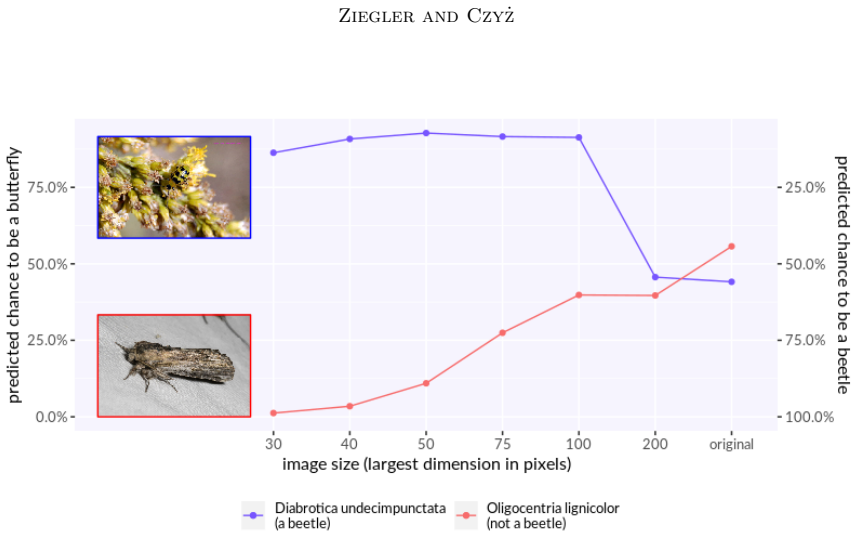
Take a classifier calibrated on a training set, then apply it to field data with known true class proportions while deliberately altering the class-conditional distribution of its prediction vector, for example by downsampling images at test time as the paper's own image experiment does; under such conditional shift URC will not converge to the true prevalence, and the paper itself reports a 17% estimate for an actual 11% prevalence, so measuring this gap directly would falsify the general claim that URC removes label-shift bias.
Extended reading notes
Core claim
The paper's central claim is that if a classifier is calibrated on the training distribution and the class-conditional distribution of its prediction vector is the same in training and field (Axiom 3), then the field class-prior vector $\vec p_y$ solves the linear system $M_A \vec p_y = \vec v_A$, where $M_A$ is a partition-conditioned confusion matrix estimated on training data and $\vec v_A$ is the histogram of field predictions. URC estimates $\vec p_y$ by minimizing the negative multinomial log-likelihood with a regularization penalty, then reweights each sample's prediction according to Lemma 5, $\bar p_i = C_i \cdot P_{app}(Y=i)/P_{dev}(Y=i)$ followed by normalization, to obtain $P_{app}(Y\mid C)$. The paper claims this removes label-shift bias without any field ground truth, and that applying the procedure separately to subpopulations recovers base rates that naive averaging systematically underestimates.
Load-bearing premise
The load-bearing premise is that, within each class, the model's predictions are distributed the same way in the field as in training; if the field changes how classes map to features or predictions, the estimated base rates and recalibrated probabilities will be biased.
Editorial extensions
If this is right
- A deployed classifier can be kept calibrated when the population changes, without collecting ground truth, provided the class-conditional behavior of the model is stable.
- Applied per subpopulation, URC recovers base rates that naive averaging underestimates, making group comparisons trustworthy without retraining the model.
- The regularized likelihood minimization is consistent: as the field sample size grows, the estimated prevalence converges to the true value, and the recalibrated classifier becomes well calibrated for each subpopulation with enough data.
- The same procedure extends to regression models by discretizing the predicted distribution into intervals and recalibrating the induced interval classifier.
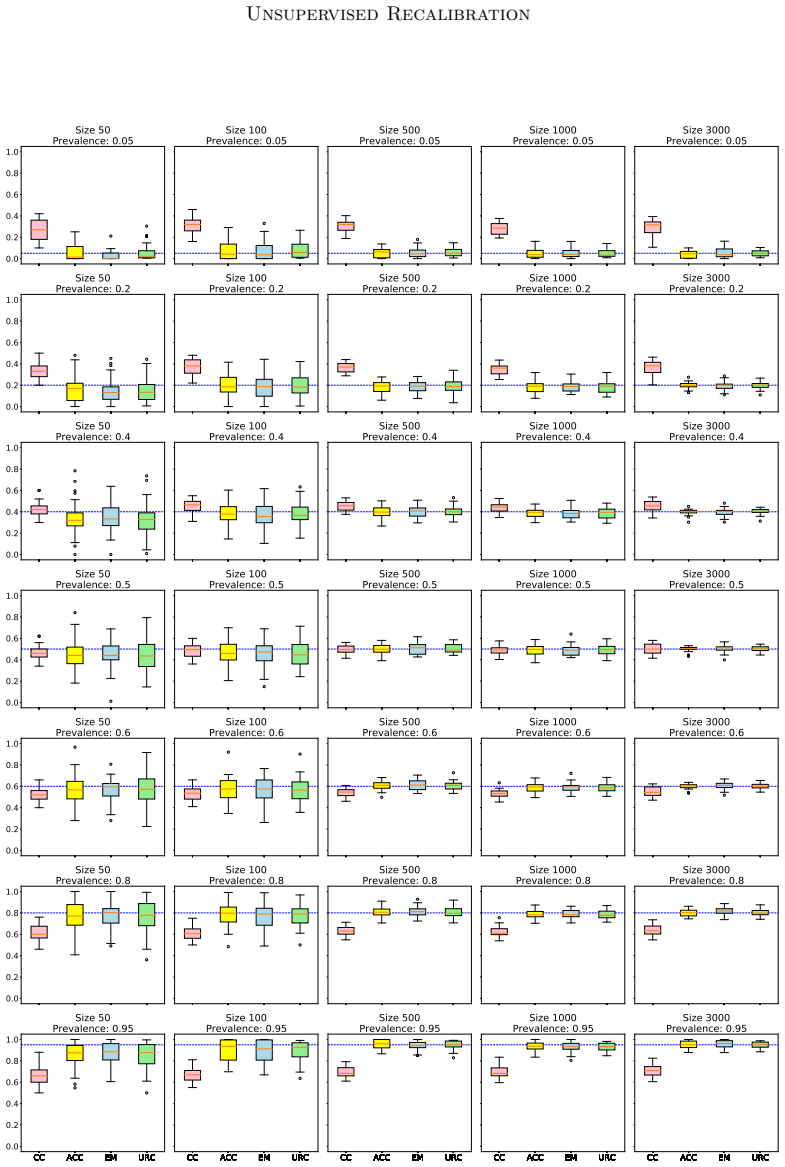
- URC's quantification performance is comparable to expectation-maximization, and it tracks true prevalence even under large training-test prevalence mismatch where adjusted classify-and-count fails.
- The paper cautions against URC when the original classifier has its own bias across subpopulations or when bias-free classification is desired, since local recalibration would amplify such bias.
Reading between the lines
- Because URC turns a shift in the field prediction histogram into an estimate of prevalence change, the same partition-and-solve machinery could be run on sliding time windows to convert a drift alarm into a quantitative measure of how the class mix is changing.
- The per-sample reweighting step is what distinguishes URC from plain quantification: even when only class counts are wanted, URC simultaneously yields recalibrated individual probabilities, which standard quantification baselines do not provide.
- The paper's own global image experiment is a partial stress-test of Axiom 3, since training at full resolution and field-testing on downsampled images violates the assumption; the reported 17% versus 11% prevalence gap outlines how URC errors scale when class-conditional prediction distributions shift.
- A targeted test that artificially perturbs class-conditional feature distributions while keeping true prevalence fixed would isolate how sensitive URC's recovered base rate and recalibrated probabilities are to violations of Axiom 3.
Signed reviews
Editorial analysis
A structured set of objections, weighed in public.
Referee Report
Summary. The paper proposes unsupervised recalibration (URC), a post-processing procedure that uses only classifier predictions on unlabeled field data to correct for a change in class prevalence between the training and application distributions. Under a consistency assumption (Axiom 3) and the assumption that the classifier is calibrated on the training set, the method estimates field class prevalences from the system M_A p_y = v_A and then rescales predictions via Lemma 5. The paper proves supporting results (Theorem 7, Lemma 9, Proposition 11, Theorem 12), extends the idea to subpopulations and to regression, and reports experiments on low-resolution insect images and on synthetic quantification benchmarks.
Significance. If the central claims hold under Axiom 3, the paper provides a clean formalization of prior-probability-shift correction tied to calibration, with explicit attribution to Saerens et al. The local recalibration application to subpopulations is practically useful, and the paper is transparent in providing open-source code and comparing with standard quantification algorithms (CC, ACC, EM). The main weakness is that the flagship real-data experiment does not satisfy Axiom 3, so the empirical support for the abstract's claim that URC removes any introduced bias is missing; this is fixable by reframing or redesigning the experiment.
major comments (4)
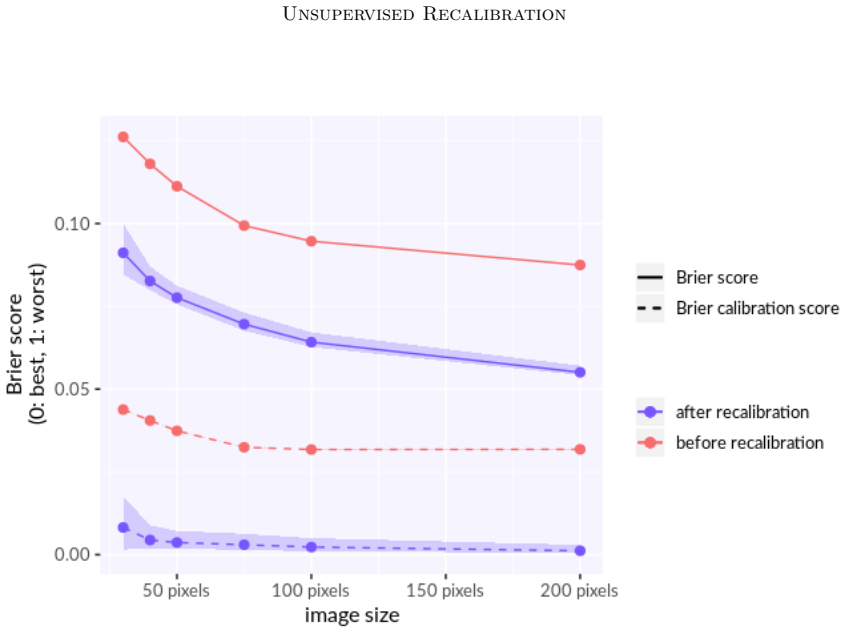
- [§6.1 and Abstract] The global image experiment violates Axiom 3, so it cannot support the abstract's claim that URC removes any introduced bias. The matrix M_A is estimated from 200 full-resolution images while the field data are downsampled to 30–200 pixels; because resolution changes the feature distribution, P_dev(C∈A|Y=i) need not equal P_app(C∈A|Y=i), and Axiom 3 is false. The paper's own numbers show the consequence: the estimated beetle prevalence is at most 17% when the true value is 11%, and the reported accuracy drops with resolution. To support the central claim, either estimate M_A from labeled data at the same resolution as the field data, or present this experiment as a robustness check under covariate shift and revise the abstract accordingly.
- [Theorem 12 in §3.4] The proof of Theorem 12 is incomplete as written. The objective being minimized is Lnll(p) = -log B(|S|, predS, M_A p), but the proof asserts a lower bound on the second derivative of the multinomial density B; a bound on B's second derivative does not establish convexity of -log B. A direct computation gives the Hessian of Lnll as Σ_j k_j (m_j·u)^2/(M_A p)_j^2 for a direction u, which is not uniformly bounded below by |S| without additional assumptions on the counts and on M_A p staying away from zero. The existence, uniqueness, and convergence claims therefore need a rigorous concentration argument or a precise reference.
- [Proposition 11 in §3.4] The proof of Proposition 11 is only a sketch and is imprecise in a load-bearing place. The statement that 'the minimum of B is attained at p = k/m' is not directly applicable because the optimization variable p enters the multinomial probabilities through M_A p, not as the free parameter of a multinomial distribution. The limiting statement requires an identifiability argument using the full rank of M_A and a continuity argument for the argmin; please expand this proof.
- [§6 and §7] The paper's empirical validation does not include any real-data global experiment in which Axiom 3 is actually satisfied: the only real-data global experiment violates it, while the synthetic quantification experiments in §6.3 respect the assumption but use simulated data. Given that Axiom 3 is the key assumption behind Lemmas 5 and 9, the paper should either add a real-data experiment with a genuine class-prior shift (e.g., stratified sampling at constant resolution) or explicitly state that the real-data demonstration is not a test of the method's assumptions.
minor comments (5)
- [§1.2 and Example 2] There are small textual errors: 'where where the cases' in §1.2 and 'eq. (2) is does not hold' in Example 2 should be corrected.
- [Equation (11)] Equation (11) would be clearer if it stated explicitly that in the binary case C_2 = 1 - C_1 and that the partition is defined by quantiles of C_1 on the training distribution, rather than leaving the notation to be inferred.
- [Definition 10] Definition 10 should state explicitly that M_A maps the probability simplex to the simplex, so that M_A·p is a valid multinomial probability vector; otherwise the notation B(|S|, predS, M_A·p) is ambiguous.
- [§7] The contraindications section lists cases where local recalibration should not be applied, but it does not give a practical diagnostic for whether Axiom 3 holds. A short discussion of how a practitioner could test or reason about this assumption would strengthen the paper.
- [§5] The regression extension is described only at a high level and is not validated experimentally; it should be clearly labeled as a sketch or extended with at least a small empirical demonstration.
Circularity Check
No significant circularity: the core recalibration identity is imported from Saerens et al., the consistency assumption is stated as an explicit Axiom, and the empirical claims are checked against held-out labels and independent quantification baselines.
full rationale
The derivation chain is not circular. Lemma 5 is explicitly credited to Saerens et al. (2001), and Lemma 9 follows from Axiom 3 by the law of total probability; neither theorem is defined in terms of the quantity it is used to predict. The unknown prevalence p_y is solved from the observed field histogram v_A and the development-time matrix M_A, which are independent inputs measured from different data (training/calibration images versus field images), and the recovered prevalence is then compared with true held-out labels. The only self-citations are to the authors' GitHub repository for reproducing the experiments; they are not load-bearing and no uniqueness claim or fitted value is imported from them. The paper also openly situates itself among existing quantification techniques and attributes the key adjustment formula to Saerens et al. The most serious limitation is experimental validity, not circularity: in §6.1 the matrix M_A is estimated from full-resolution images while the field data are downsampled, so Axiom 3 is questionable and the reported 17% versus 11% beetle prevalence is residual bias from assumption failure. That is a scope or correctness concern, not a reduction of the prediction to its own inputs.
Assumptions & free parameters
free parameters (3)
- Partition size |A| =
4 in global/local image experiments; 2 in quantification experiments
- KL regularization weight =
Not specified in manuscript
- Platt scaling parameters for initial calibration =
Not reported
assumptions (4)
- domain assumption Axiom 3 consistency: P_dev(C in A | Y=i) = P_app(C in A | Y=i)
- domain assumption Classifier is calibrated on the training set: C_i = P_dev(Y=i|C)
- standard math P_app is absolutely continuous with respect to P_dev
- domain assumption Overfitting or feature-induced shift is not a major problem
Cite this review
Pith. "Pith review of Unsupervised Recalibration." pith.science (2026). https://pith.science/paper/XY7CDM4T
@misc{pith2026190809157,
  author       = {Pith},
  title        = {Pith review of: Unsupervised Recalibration},
  year         = {2026},
  howpublished = {\url{https://pith.science/paper/XY7CDM4T}},
  note         = {Machine review of arXiv:1908.09157}
}
read the original abstract
Unsupervised recalibration (URC) is a general way to improve the accuracy of an already trained probabilistic classification or regression model upon encountering new data while deployed in the field. URC does not require any ground truth associated with the new field data. URC merely observes the model's predictions and recognizes when the training set is not representative of field data, and then corrects to remove any introduced bias. URC can be particularly useful when applied separately to different subpopulations observed in the field that were not considered as features when training the machine learning model. This makes it possible to exploit subpopulation information without retraining the model or even having ground truth for some or all subpopulations available. Additionally, if these subpopulations are the object of study, URC serves to determine the correct ground truth distributions for them, where naive aggregation methods, like averaging the model's predictions, systematically underestimate their differences.
Figures

Figures from the paper (5 more)



Reference graph
Works this paper leans on
-
[1]
Martin Arjovsky, L´ eon Bottou, Ishaan Gulrajani, and David Lopez-Paz. Invariant Risk Minimization. arXiv e-prints, art. arXiv:1907.02893, Jul
arXiv 1907
-
[6]
Detecting and correcting for label shift with black box predictors
21 Ziegler and Czy ˙z Zachary C Lipton, Yu-Xiang Wang, and Alex Smola. Detecting and correcting for label shift with black box predictors. arXiv preprint arXiv:1802.03916 ,
-
[11]
URL https: //doi.org/10.1088%2F1742-6596%2F1168%2F2%2F022022
doi: 10.1088/1742-6596/1168/2/022022. URL https: //doi.org/10.1088%2F1742-6596%2F1168%2F2%2F022022. Albert Ziegler and Pawe l Czy˙ z. Unsupervised recalibration experiments.https://github. com/albert-ziegler/unsupervised-calibration,
-
[1995]
using scikit-learn (Pedregosa et al., 2011), SciPy ecosystem (Virtanen et al., 2020), and pytorch (Paszke et al., 2019). For Unsupervised Recalibration we used a partition into two intervals, split by the median of the predictions on the validation data set. Every training and validation data set we generated consisted of 2,000 data samples. We generated ...
work page 2011
-
[2009]
doi: 10.1145/1557019. 1557117. Xue Ying. An overview of overfitting and its solutions. Journal of Physics: Conference Series, 1168:022022, feb
-
[2011]
Identifying and correcting label bias in machine learning
Heinrich Jiang and Ofir Nachum. Identifying and correcting label bias in machine learning. arXiv preprint arXiv:1901.04966 ,
arXiv 1901
-
[2012]
doi: https://doi.org/10.1016/j.patcog.2011.06.019
ISSN 0031-3203. doi: https://doi.org/10.1016/j.patcog.2011.06.019. URL http://www.sciencedirect.com/science/article/pii/S0031320311002901. Adam Paszke, Sam Gross, Francisco Massa, Adam Lerer, James Bradbury, Gregory Chanan, Trevor Killeen, Zeming Lin, Natalia Gimelshein, Luca Antiga, Alban Des- maison, Andreas Kopf, Edward Yang, Zachary DeVito, Martin Rai...
-
[2013]
Fisher consistency for prior probability shift
Dirk Tasche. Fisher consistency for prior probability shift. arXiv e-prints , art. arXiv:1701.05512, January
Show all 12 references
-
[2016]
doi: 10.18653/v1/S16-1025
Association for Computational Linguistics. doi: 10.18653/v1/S16-1025. URL https://www.aclweb.org/anthology/S16-1025. Meelis Kull, Telmo Silva Filho, and Peter Flach. Beta calibration: a well-founded and easily implemented improvement on logistic calibration for binary classifie...
-
[2017]
Jos´ e Hern´ andez-Orallo, Peter A Flach, and C` esar Ferri Ramirez
doi: 10.1145/3117807. Jos´ e Hern´ andez-Orallo, Peter A Flach, and C` esar Ferri Ramirez. Brier curves: a new cost-based visualisation of classifier performance. In ICML, pages 585–592,
-
[2019]
NRU-HSE at SemEval-2016 task 4: Comparative analysis of two iterative methods using quantification library
Nikolay Karpov, Alexander Porshnev, and Kirill Rudakov. NRU-HSE at SemEval-2016 task 4: Comparative analysis of two iterative methods using quantification library. In Proceed- ings of the 10th International Workshop on Semantic Evaluation (SemEval-2016) , pages 171–177, San Die...
2016
-
[2020]
Stephen Wolfram
doi: https://doi.org/10.1038/s41592-019-0686-2. Stephen Wolfram. Wolfram ImageIdentify Net V1. https://resources.wolframcloud. com/NeuralNetRepository/resources/Wolfram-ImageIdentify-Net-V1,
Reviewed August 14, 2026 · model on record in the stance chip above.
Discussion (0). Continue with ORCID to comment.