REVIEW 3 major objections 6 minor 102 references
Canonical Scalar Field Inflation with a Woods-Saxon Potential
T0 review · 3 major / 6 minor · reviewed 2026-08-14 · deepseek-v4-flash
Pith's one-line read A canonical scalar field with a Woods-Saxon potential—a smooth step from one plateau to another—can produce slow-roll inflation whose spectral index and tensor-to-scalar ratio agree with Planck data, and the same parameter choices also…
desk verdict The reader's Eq. (18) objection is wrong; the inflation calculation is sound, but the reheating section's V0 normalization and Nre=0 misidentification make the paper's reheating claim unestablished. read the letter →
The pith
A machine-rendered reading of the paper's core claim, the machinery that carries it, and where it could break.
The reading
What carries the argument
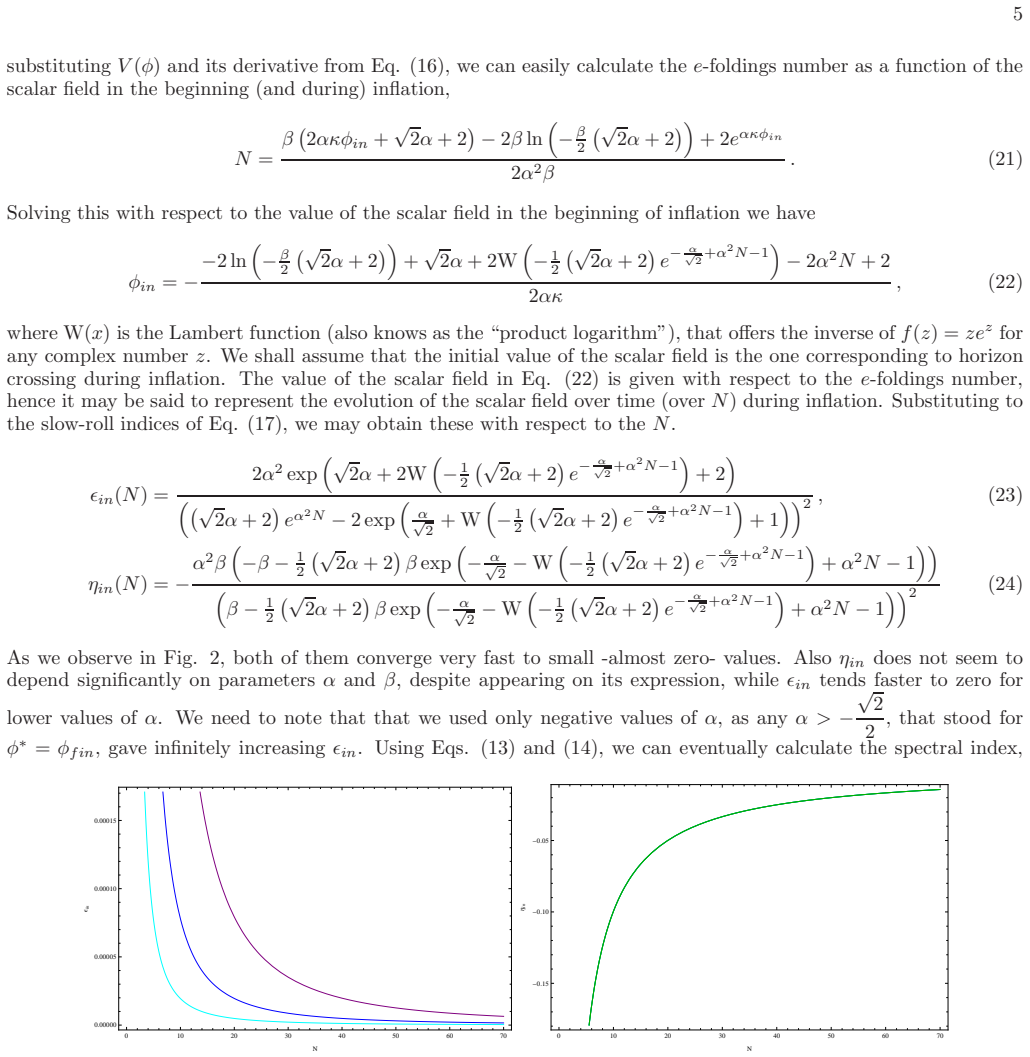
The central object is the Woods-Saxon potential $V(\varphi)=V_0/(1+\beta e^{-\alpha\kappa\varphi})$, a smooth step that is flat on two plateaus and drops between them. Its role is to provide the flat region needed for slow-roll inflation and the slope needed for graceful exit. The argument is carried by the slow-roll approximation: requiring the first slow-roll parameter $\varepsilon$ to equal one fixes the field value at the end of inflation, then inverting the e-folding integral $N=\int V/V'\,d\varphi$ expresses the initial field value—and hence $\varepsilon$ and $\eta$ at horizon crossing—in terms of $N$ through the Lambert W function. Those expressions feed into $n_S=1-6\varepsilon+2\eta$ and $r=16\varepsilon$, making Planck compatibility a direct consequence of the potential's shape parameters.
What would settle it
Numerically integrate the full scalar-field equation of motion without the slow-roll approximation for the same potential and parameter values, compute the primordial spectra from the exact background, and compare $n_S$ and $r$ with the paper's Lambert-W formulas; any deviation larger than the Planck error bars would settle the central claim.
Extended reading notes
Core claim
On the paper's own terms, the discovery is that the Woods-Saxon potential $V(\varphi)=V_0/(1+\beta e^{-\alpha\kappa\varphi})$ yields a complete inflationary history: slow-roll inflation with observables $n_S$ and $r$ compatible with Planck, a graceful exit when the first slow-roll parameter reaches one, and a reheating phase whose duration and temperature satisfy observational bounds for the same parameter values. The paper derives $n_S$ and $r$ as explicit functions of the e-foldings number $N$ using the Lambert W function, and finds that with large enough $|\alpha|$ they approach $n_S\simeq0.9667$ and $r\ll0.064$, inside the Planck window. It also finds that the field value at the end of inflation coincides with an inflection point of the potential for a particular $\alpha$, and that instantaneous reheating ($N_k=0$) is excluded for all equations of state considered.
Load-bearing premise
The central assumption is that inflation ends exactly when the first slow-roll parameter reaches one, and that the e-folding formula used to invert for the field value at horizon crossing is correct; if either fails, the claimed Planck compatibility is not established.
Editorial extensions
If this is right
- If the central claim is right, the Woods-Saxon potential becomes a theoretically motivated plateau model whose inflationary predictions are stable for a wide range of $\alpha$.
- Because $V_0$ drops out of $n_S$ and $r$, the overall energy scale of the potential can be adjusted to fit reheating constraints without disturbing the inflationary observables.
- The same parameter choices that satisfy Planck also keep the reheating temperature below the inflationary upper bound and give a finite reheating duration, so the model is internally consistent across both eras.
- The exclusion of instantaneous reheating means the model predicts a maximum reheating temperature that is strictly below the inflationary scale, a feature future observations could test.
- The coincidence of the graceful-exit field value with the potential's inflection point offers a simple geometric handle for extending the model to other plateau potentials.
Reading between the lines
- If the slow-roll formulas for $n_S$ and $r$ remain accurate when higher-order corrections are included, one could use the same Lambert-W machinery to predict the running of the spectral index and the non-Gaussianity parameter, giving tests beyond the current Planck window.
- The near-insensitivity of the observables to $\beta$ suggests a family of potentials parameterized by $\beta$ may share the same inflationary predictions; checking whether that family is closed under simple deformations could reveal a broader class of viable plateau models.
- The paper's reheating analysis assumes a constant equation-of-state parameter $w_{\rm re}$ during reheating; a testable extension would be to let $w_{\rm re}$ vary and see whether instantaneous reheating remains excluded.
- Because the potential has no minimum but an inflection point, the model's reheating mechanism must rely on the field's kinetic energy and eventual decay; if the field couples to other particles, the reheating temperature could change, which would directly test the parameter region allowed here.
Editorial analysis
A structured set of objections, weighed in public.
Referee Report
Summary. The manuscript studies single-field slow-roll inflation with the Woods-Saxon potential V(φ)=V0/(1+βe^{-ακφ}). It solves ε=1 for the field value at the end of inflation, inverts the e-fold integral to express the slow-roll parameters in terms of N, and derives the spectral index nS and tensor-to-scalar ratio r. The authors report nS≈0.9667 and r≪0.064 for α<−√2 and N=60, and compare these with Planck data. They then use a standard reheating formalism to compute the reheating duration N_re and temperature T_re for selected values of V0, and conclude that the model gives a viable reheating phase but excludes instantaneous reheating. The abstract also highlights that the graceful-exit field value coincides with the inflection point of the potential.
Significance. If the slow-roll part is taken at face value, the paper adds one more plateau-type single-field model to the catalog of potentials consistent with Planck: the nS and r predictions are nearly independent of β and V0, and for large |α| the predicted nS is within the correct 1σ Planck range. The paper does not provide machine-checked algebra or reproducible code, and the reheating section as it stands is not a valid test of the model because V0 is scanned while the curvature amplitude As is fixed. The reheating claims in the abstract and conclusions are therefore unestablished, although the problems appear fixable by a re-analysis rather than by a change of the model. I also note that the attached reader's algebraic objection to Eq. (18) is not supported: solving ε=1 with the printed ε gives exactly Eq. (18) for α<−√2; the load-bearing difficulties are located elsewhere.
major comments (3)
- [III (Eqs. (31)-(35), Figs. 5-6)] The reheating analysis is inconsistent with the adopted value of As. Once As is fixed, the pivot-scale Hubble rate H_k is fixed by Eq. (35), and the Friedmann equation H_k^2 = κ^2 V_k/3 then fixes V0 through V0 = 3H_k^2(1+βe^{-ακφ_k})/κ^2. The values V0 = 10^2, 10^-10, 10^-60 eV^4 used in Figs. 5 and 6 are incompatible with As = 1.90461×10^-9; they change V_fin^{1/4}/H_k, N_re, and T_re by many orders of magnitude. Consequently the statement that the same parameter set produces a viable reheating era and that instantaneous reheating is excluded is not supported by the calculation as presented.
- [II A (Eqs. (21)-(22))] Equation (22) as printed is not the inversion of Eq. (21). Writing S=√2α+2, C=−βS/2, and W=W(−(S/2)e^{α^2N−S/2}), Eq. (21) is solved by ακφ_in = ln C + α^2N − S/2 − W. The printed Eq. (22) contains an extra '+2' in the numerator, giving ακφ_in = ln C + α^2N − S/2 − 1 − W. Substituting the printed expression into Eq. (17) does not reproduce Eqs. (23) or (25), so the derivation chain as written cannot be verified; the typo must be removed and the subsequent expressions re-checked.
- [II A (Eq. (18) and following text)] The claim that φ_fin coincides with the inflection point for α=√2/2 is not correct. Setting e^{ακφ_fin} = −β(2+√2α)/2 equal to the inflection-point value e^{ακφ_*} = β gives −(2+√2α)/2 = 1, hence √2α = −4 and α = −2√2. The subsequent condition 'α > −√2/2' also conflicts with the requirement 2+√2α<0 for a real φ_fin, which is α<−√2.
minor comments (6)
- [II (Eq. (12))] The sentence 'From Eq. (12) we have that ε ≃ 2η' is not a general slow-roll relation; it holds only for special potentials such as exponential potentials. This statement is not used in the later derivation, but as written it is incorrect and should be removed or qualified.
- [II (Eq. (15))] The quoted 1σ uncertainty nS = 0.9649 ± 0.042 is an order of magnitude too large; the Planck 2018 value is nS = 0.9649 ± 0.0042. The 95% bands in Figs. 3, 4, 5, and 6 should be recomputed with the correct uncertainty.
- [II A (Eq. (20))] Equation (20) omits the κ^2 factor (or the implied field normalization) and the absolute value of V/V'; as printed it is dimensionally inconsistent and has the wrong sign for α<0. Equation (21) appears to use the correctly normalized integral, so Eq. (20) should be corrected to match.
- [II A (Eqs. (16)-(26))] The statement that α has dimensions eV is inconsistent with its use as a dimensionless parameter in the exponent ακφ and in Eqs. (17)-(26); the units of φ, α, and κ should be clarified throughout.
- [References] Reference [52] is incomplete: it has no title and no journal or preprint data.
- [Figs. 5 and 6 captions] The caption of Fig. 5 labels the ordinate 'Nk' while the text and the figure show N_re; this should be corrected for consistency.
Circularity Check
No significant circularity: the inflationary observables are direct slow-roll consequences of the assumed Woods-Saxon potential, tested against external Planck data; the reheating inconsistency is a correctness issue, not a circular derivation.
full rationale
The paper's central derivation is self-contained and non-circular. The potential in Eq. (16) is assumed, the slow-roll parameters in Eq. (17) are computed by direct differentiation, the end-of-inflation condition epsilon=1 is solved algebraically to give Eq. (18), and the e-foldings integral is inverted with Lambert-W to give Eq. (22). The spectral index and tensor-to-scalar ratio in Eqs. (25)-(26) are obtained by substituting these expressions into the standard formulas nS = 1 - 6epsilon + 2eta and r = 16epsilon. The Planck constraints in Eq. (15) are used only as an external comparison standard, not as an input in the derivation; the parameters alpha, beta, V0, and N are scanned rather than fitted to nS or r. In the reheating section, the curvature amplitude As from Planck is used to set Hk in Eq. (35), and the potential amplitude V0 is then treated as a free parameter taking the values 10^2, 10^-10, and 10^-60 eV^4. One can object that those V0 choices are not consistent with the observed As once H^2 = kappa^2 V/3 is imposed, but that is a physical consistency or correctness problem, not circularity: the reheating predictions are not fed back into the derivation, and no target observable is used to define the model. The paper's self-citations (e.g., Refs. [5], [43], [45]-[48], [75]) are contextual or supporting references and are not load-bearing for the Woods-Saxon calculation. No step reduces by construction to its own input, so the appropriate circularity score is 0.
Assumptions & free parameters
free parameters (5)
- alpha =
negative values, nominally |alpha| > sqrt(2)/2 in plots; exact values not tabulated
- beta =
arbitrary positive values, e.g. 6 and 12 in Fig. 1
- V0 =
10^2, 10^-10, 10^-60 eV^4 in reheating plots
- N (e-foldings number) =
N=60 for inflation observables; N_k varies in reheating
- w_re (reheating barotropic index) =
-1/3, -1/5, 0, 1/5
assumptions (6)
- domain assumption Canonical scalar field with FRW metric and standard Einstein gravity, Eq. (2).
- domain assumption Slow-roll approximation: V much larger than the kinetic term and slow-roll parameters small, Eqs. (8)-(12).
- ad hoc to paper The inflaton potential has the Woods-Saxon form, Eq. (16), with free V0, alpha, beta.
- standard math Standard slow-roll perturbation relations nS=1-6*epsilon+2*eta and r=16*epsilon, Eqs. (13)-(14).
- domain assumption Reheating formulas of Refs. [63-68], Eqs. (27)-(32), including instantaneous transition to radiation and fixed g_re about 100.
- domain assumption N=60 e-folds at horizon crossing for the Planck comparison.
Cite this review
Pith. "Pith review of Canonical Scalar Field Inflation with a Woods-Saxon Potential." pith.science (2026). https://pith.science/paper/CILFEZBI
@misc{pith2026190809218,
  author       = {Pith},
  title        = {Pith review of: Canonical Scalar Field Inflation with a Woods-Saxon Potential},
  year         = {2026},
  howpublished = {\url{https://pith.science/paper/CILFEZBI}},
  note         = {Machine review of arXiv:1908.09218}
}
read the original abstract
This paper focuses on the realization of an inflationary model from a canonical scalar field theory with a Woods-Saxon potential, in the slow-roll approximation. Our analysis indicates that the observable quantities derived theoretically from our model, namely the spectral index of the primordial scalar curvature perturbations and the tensor-to-scalar ratio, are compatible with the latest Planck collaboration data. We also discuss the qualitative features of the potential, and we show that the value of the scalar field for which the graceful exit occurs, coincides with the inflection point of the scalar potential. We also attempt to study the post-inflation reheating phase of the model, in order to further examine the viability of the Woods-Saxon scalar field model, and as we demonstrate the results indicate viability of the model for this era too, however the instantaneous reheating is not allowed for the model at hand.
Figures


Figures from the paper (3 more)


Reference graph
Works this paper leans on
-
[1]
Department of Physics, Aristotle University of Thessaloni ki, Thessaloniki 54124, Greece
-
[2]
Laboratory for Theoretical Cosmology, Tomsk State Univers ity of Control Systems and Radioelectronics, 634050 Tomsk, Russi a (TUSUR)
-
[3]
Tomsk State Pedagogical University, 634061 Tomsk, Russia
-
[4]
stickiness
Theoretical Astrophysics, IAAT, University of T¨ ubingen, Germany This paper focuses on the realization of an inflationary mode l from a canonical scalar field theory with a Woods-Saxon potential, in the slow-roll approximati on. Our analysis indicates that the ob- servable quantities derived theoretically from our model, namely the spectral index of the pr...
2016
-
[5]
A. D. Linde, Lect. Notes Phys. 738 (2008) 1 doi:10.1007/978-3-540-74353-8 1 [arXiv:0705.0164 [hep-th]]
arXiv 2008
-
[6]
Introduction to the the ory of the early universe: Cosmological perturbations and inflationary theory,
D. S. Gorbunov and V. A. Rubakov,“Introduction to the the ory of the early universe: Cosmological perturbations and inflationary theory,” Hackensack, USA: World Scientific (20 11) 489 p
-
[7]
D. H. Lyth and A. Riotto, Phys. Rept. 314 (1999) 1 doi:10.1016/S0370-1573(98)00128-8 [hep-ph/980 7278]
- [8]
Show all 102 references
-
[9]
Nojiri, S
S. Nojiri, S. D. Odintsov and V. K. Oikonomou, Phys. Rept. 692 (2017) 1 doi:10.1016/j.physrep.2017.06.001 [arXiv:1705.11098 [gr-qc]]
2017 arXiv
-
[10]
R. H. Brandenberger, arXiv:1206.4196 [astro-ph.CO]
- [11]
-
[12]
Battefeld and P
D. Battefeld and P. Peter, Phys. Rept. 571 (2015) 1 [arXiv:1406.2790 [astro-ph.CO]]
2015 arXiv
-
[13]
Novello and S
M. Novello and S. E. P. Bergliaffa, Phys. Rept. 463 (2008) 127 [arXiv:0802.1634 [astro-ph]]
2008 arXiv
-
[14]
Y. F. Cai, Sci. China Phys. Mech. Astron. 57 (2014) 1414 doi:10.1007/s11433-014-5512-3 [arXiv:1405. 1369 [hep-th]]
2014 doi
-
[15]
de Haro and Y
J. de Haro and Y. F. Cai, Gen. Rel. Grav. 47 (2015) no.8, 95 [arXiv:1502.03230 [gr-qc]]
2015 arXiv
-
[16]
J. L. Lehners, Class. Quant. Grav. 28 (2011) 204004 [arXiv:1106.0172 [hep-th]]
2011 arXiv
-
[17]
J. L. Lehners, Phys. Rept. 465 (2008) 223 [arXiv:0806.1245 [astro-ph]]
2008 arXiv
-
[18]
Y. K. E. Cheung, C. Li and J. D. Vergados, arXiv:1611.040 27 [astro-ph.CO]
-
[19]
Y. F. Cai, A. Marciano, D. G. Wang and E. Wilson-Ewing, Un iverse 3 (2016) no.1, 1 doi:10.3390/universe3010001 [arXiv:1610.00938 [astro-ph.CO]]
2016 arXiv
- [20]
-
[21]
P. A. R. Ade et al. [BICEP2 and Keck Array Collaborations], Phys. Rev. Lett. 116 (2016) 031302 doi:10.1103/PhysRevLett.116.031302 [arXiv:1510.09217 [astro-ph.CO]]
2016 arXiv
-
[22]
Nojiri, S.D
S. Nojiri, S.D. Odintsov, Phys. Rept. 505, 59 (2011)
2011
-
[23]
Nojiri, S.D
S. Nojiri, S.D. Odintsov, eConf C0602061, 06 (2006) [Int. J. Geom. Meth. Mod. Phys. 4, 115 (2007)]. [arXiv:hep-th/0601213]
2006 arXiv
-
[24]
Capozziello, M
S. Capozziello, M. De Laurentis, Phys. Rept. 509, 167 (2011) [arXiv:1108.6266 [gr-qc]]. V. Faraoni and S. Ca pozziello, Fundam. Theor. Phys. 170 (2010). doi:10.1007/978-94-007-0165-6
2011 arXiv
-
[25]
de la Cruz-Dombriz and D
A. de la Cruz-Dombriz and D. Saez-Gomez, Entropy 14 (2012) 1717 doi:10.3390/e14091717 [arXiv:1207.2663 [gr- qc]]
2012 arXiv
-
[26]
G. J. Olmo, Int. J. Mod. Phys. D 20 (2011) 413 doi:10.1142/S0218271811018925 [arXiv:1101.3 864 [gr-qc]]
2011 doi
-
[27]
Nojiri and S
S. Nojiri and S. D. Odintsov, Phys. Rev. D 68 (2003) 123512 doi:10.1103/PhysRevD.68.123512 [hep-th/0 307288]
2003 doi
-
[28]
A. A. Starobinsky, Phys. Lett. B 91 (1980) 99 [Phys. Lett. 91B (1980) 99] [Adv. Ser. Astrophys. Cosmol. 3 (1987) 130]. doi:10.1016/0370-2693(80)90670-X 12
1980 doi
-
[29]
Nojiri and S
S. Nojiri and S. D. Odintsov, Phys. Rev. D 74 (2006) 086005 doi:10.1103/PhysRevD.74.086005 [hep-th/0 608008]
2006 doi
-
[30]
Capozziello, S
S. Capozziello, S. Nojiri, S. D. Odintsov and A. Troisi, Phys. Lett. B 639 (2006) 135 doi:10.1016/j.physletb.2006.06.034 [astro-ph/0604431]
2006 arXiv
-
[31]
Capozziello, V
S. Capozziello, V. F. Cardone and A. Troisi, Phys. Rev. D 71 (2005) 043503 doi:10.1103/PhysRevD.71.043503 [astro-ph/0501426]
2005 arXiv
-
[32]
Carloni, P
S. Carloni, P. K. S. Dunsby, S. Capozziello and A. Troisi , Class. Quant. Grav. 22 (2005) 4839 doi:10.1088/0264- 9381/22/22/011 [gr-qc/0410046]
2005 arXiv
- [33]
-
[34]
J. D. Barrow and S. Cotsakis, Phys. Lett. B 214 (1988) 515. doi:10.1016/0370-2693(88)90110-4
1988 doi
-
[35]
A. R. Liddle, P. Parsons and J. D. Barrow, Phys. Rev. D 50 (1994) 7222 doi:10.1103/PhysRevD.50.7222 [astro-ph/940 8015]
1994 doi
-
[36]
J. c. Hwang and H. r. Noh, Phys. Rev. D 65 (2002) 023512 doi:10.1103/PhysRevD.65.023512 [astro-ph /0102005]
2002 doi
-
[37]
J. c. Hwang and H. Noh, Phys. Lett. B 506 (2001) 13 doi:10.1016/S0370-2693(01)00404-X [astro-ph/ 0102423]
2001 doi
-
[38]
J. C. Hwang, Class. Quant. Grav. 7 (1990) 1613. doi:10.1088/0264-9381/7/9/013
1990 doi
-
[39]
Ferraro and F
R. Ferraro and F. Fiorini, Phys. Rev. D 75 (2007) 084031 doi:10.1103/PhysRevD.75.084031 [gr-qc/06 10067]
2007 doi
-
[40]
Nojiri and S
S. Nojiri and S. D. Odintsov, Phys. Rev. D 77 (2008) 026007 doi:10.1103/PhysRevD.77.026007 [arXiv:07 10.1738 [hep-th]]
2008 doi
-
[41]
Q. G. Huang, JCAP 1402 (2014) 035 doi:10.1088/1475-7516/2014/02/035 [arXiv:13 09.3514 [hep-th]]
2014 doi
-
[42]
J. c. Hwang, Phys. Rev. D 53 (1996) 762 doi:10.1103/PhysRevD.53.762 [gr-qc/9509044]
1996 arXiv
-
[43]
Artymowski and Z
M. Artymowski and Z. Lalak, JCAP 1409 (2014) 036 doi:10.1088/1475-7516/2014/09/036 [arXiv:14 05.7818 [hep-th]]
2014 doi
-
[44]
M. Amin, S. Khalil and M. Salah, JCAP 1608 (2016) no.08, 043 doi:10.1088/1475-7516/2016/08/043 [ar Xiv:1512.09324 [hep-th]]
2016 arXiv
-
[45]
D. J. Brooker, S. D. Odintsov and R. P. Woodard, Nucl. Phy s. B 911 (2016) 318 doi:10.1016/j.nuclphysb.2016.08.010 [arXiv:1606.05879 [gr-qc]]
2016 arXiv
-
[46]
Sebastiani and R
L. Sebastiani and R. Myrzakulov, Int. J. Geom. Meth. Mod . Phys. 12 (2015) no.9, 1530003 doi:10.1142/S0219887815300032 [arXiv:1506.05330 [gr-qc]]
2015 arXiv
-
[47]
S. D. Odintsov and V. K. Oikonomou, Class. Quant. Grav. 33 (2016) no.12, 125029 doi:10.1088/0264-9381/33/12/12502 9 [arXiv:1602.03309 [gr-qc]]
2016 arXiv
-
[48]
V. K. Oikonomou, Int. J. Geom. Meth. Mod. Phys. 13 (2016) no.03, 1650033 doi:10.1142/S021988781650033X [arXiv:1512.04095 [gr-qc]]
2016 arXiv
-
[49]
S. D. Odintsov and V. K. Oikonomou, Phys. Rev. D 92 (2015) no.12, 124024 doi:10.1103/PhysRevD.92.124024 [arXiv:1510.04333 [gr-qc]]
2015 arXiv
-
[50]
Nojiri, S
S. Nojiri, S. D. Odintsov and V. K. Oikonomou, Class. Qua nt. Grav. 34 (2017) no.24, 245012 doi:10.1088/1361-6382/aa92a4 [arXiv:1704.05945 [gr-qc]]
2017 arXiv
-
[51]
S. D. Odintsov and V. K. Oikonomou, Phys. Rev. D 92 (2015) no.2, 024016 doi:10.1103/PhysRevD.92.024016 [arXiv:1504.06866 [gr-qc]]
2015 arXiv
-
[52]
S. D. Odintsov and V. K. Oikonomou, Int. J. Mod. Phys. D 26 (2017) no.08, 1750085 doi:10.1142/S0218271817500857 [arXiv:1512.04787 [gr-qc]]
2017 arXiv
-
[53]
A. D. Linde, Phys. Lett. 108B (1982) 389 [Adv. Ser. Astrophys. Cosmol. 3 (1987) 149]. doi:10.1016/0370-2693(82)91219-9
1982 doi
-
[54]
A. D. Linde, Phys. Lett. 129B (1983) 177. doi:10.1016/0370-2693(83)90837-7
1983 doi
-
[55]
A. D. Linde, Phys. Rev. D 49 (1994) 748 doi:10.1103/PhysRevD.49.748 [astro-ph/93070 02]
1994 doi
-
[56]
S. G. Zhou, J. Meng and P. Ring,
-
[57]
Kofman, A
L. Kofman, A. D. Linde and A. A. Starobinsky, Phys. Rev. D 56 (1997) 3258 doi:10.1103/PhysRevD.56.3258 [hep-ph/9704452]
1997 arXiv
-
[58]
Albrecht, P
A. Albrecht, P. J. Steinhardt, M. S. Turner and F. Wilcze k, Phys. Rev. Lett. 48 (1982) 1437. doi:10.1103/PhysRevLett.48.1437
1982 doi
-
[59]
Shtanov, J
Y. Shtanov, J. H. Traschen and R. H. Brandenberger, Phys . Rev. D 51 (1995) 5438 doi:10.1103/PhysRevD.51.5438 [hep-ph/9407247]
1995 arXiv
-
[60]
Kofman, A
L. Kofman, A. D. Linde and A. A. Starobinsky, Phys. Rev. L ett. 73 (1994) 3195 doi:10.1103/PhysRevLett.73.3195 [hep-th/9405187]
1994 arXiv
-
[61]
A. D. Linde, Contemp. Concepts Phys. 5 (1990) 1 [hep-th/0503203]
1990 arXiv
-
[62]
Rinaldi and L
M. Rinaldi and L. Vanzo, Phys. Rev. D 94 (2016) no.2, 024009 doi:10.1103/PhysRevD.94.024009 [arX iv:1512.07186 [gr-qc]]
2016 arXiv
-
[63]
M. A. Amin, M. P. Hertzberg, D. I. Kaiser and J. Karouby, I nt. J. Mod. Phys. D 24 (2014) 1530003 doi:10.1142/S0218271815300037 [arXiv:1410.3808 [hep-p h]]
2014 arXiv
-
[64]
S. M. Choi and H. M. Lee, Eur. Phys. J. C 76 (2016) no.6, 303 doi:10.1140/epjc/s10052-016-4150-5 [ar Xiv:1601.05979 [hep-ph]]
2016 arXiv
-
[65]
Dimopoulos and L
K. Dimopoulos and L. Donaldson-Wood, arXiv:1906.0964 8 [gr-qc]
1906
-
[66]
Q. Fei, Y. Gong, J. Lin and Z. Yi, JCAP 1708 (2017) no.08, 018 doi:10.1088/1475-7516/2017/08/018 [ar Xiv:1705.02545 [gr-qc]]
2017 arXiv
-
[67]
Martin, C
J. Martin, C. Ringeval and V. Vennin, Phys. Rev. Lett. 114 (2015) no.8, 081303 doi:10.1103/PhysRevLett.114.081303 [arXiv:1410.7958 [astro-ph.CO]]
2015 arXiv
-
[68]
J. O. Gong, S. Pi and G. Leung, JCAP 1505 (2015) no.05, 027 doi:10.1088/1475-7516/2015/05/027 [ar Xiv:1501.03604 [hep-ph]]
2015 arXiv
-
[69]
R. G. Cai, Z. K. Guo and S. J. Wang, Phys. Rev. D 92 (2015) 063506 doi:10.1103/PhysRevD.92.063506 [arXiv:15 01.07743 [gr-qc]]
2015 doi
-
[70]
J. L. Cook, E. Dimastrogiovanni, D. A. Easson and L. M. Kr auss, JCAP 1504 (2015) 047 doi:10.1088/1475- 13 7516/2015/04/047 [arXiv:1502.04673 [astro-ph.CO]]
2015 arXiv
-
[71]
Rehagen and G
T. Rehagen and G. B. Gelmini, JCAP 1506 (2015) no.06, 039 doi:10.1088/1475-7516/2015/06/039 [ar Xiv:1504.03768 [hep-ph]]
2015 arXiv
-
[72]
R. C. de Freitas and S. V. B. Gongalves, arXiv:1509.0850 0 [astro-ph.CO]
-
[73]
de Haro and E
J. de Haro and E. Elizalde, Gen. Rel. Grav. 48 (2016) no.6, 77 doi:10.1007/s10714-016-2072-z [arXiv:16 02.03433 [gr-qc]]
2016 doi
-
[74]
Ueno and K
Y. Ueno and K. Yamamoto, Phys. Rev. D 93 (2016) no.8, 083524 doi:10.1103/PhysRevD.93.083524 [arX iv:1602.07427 [astro-ph.CO]]
2016 arXiv
-
[75]
Eshaghi, M
M. Eshaghi, M. Zarei, N. Riazi and A. Kiasatpour, Phys. R ev. D 93 (2016) no.12, 123517 doi:10.1103/PhysRevD.93.123517 [arXiv:1602.07914 [astro-ph.CO]]
2016 arXiv
- [76]
-
[77]
Tambalo and M
G. Tambalo and M. Rinaldi, Gen. Rel. Grav. 49 (2017) no.4, 52 doi:10.1007/s10714-017-2217-8 [arXiv:16 10.06478 [gr-qc]]
2017 doi
-
[78]
De Haro and L
J. De Haro and L. Arestao Sala, Phys. Rev. D 95 (2017) no.12, 123501 doi:10.1103/PhysRevD.95.123501 [ar Xiv:1702.04212 [gr-qc]]
2017 arXiv
-
[79]
V. K. Oikonomou, Mod. Phys. Lett. A 32 (2017) no.33, 1750172 doi:10.1142/S0217732317501723 [ar Xiv:1706.00507 [gr-qc]]
2017 arXiv
- [80]
-
[81]
Artymowski, O
M. Artymowski, O. Czerwinska, Z. Lalak and M. Lewicki, J CAP 1804 (2018) no.04, 046 doi:10.1088/1475- 7516/2018/04/046 [arXiv:1711.08473 [astro-ph.CO]]
2018 arXiv
-
[82]
German, J
G. German, J. C. Hidalgo and A. Montiel, arXiv:1811.093 31 [astro-ph.CO]
- [83]
-
[84]
Freese, E
K. Freese, E. I. Sfakianakis, P. Stengel and L. Visinell i, JCAP 1805 (2018) no.05, 067 doi:10.1088/1475-7516/2018/05/067 [arXiv:1712.03791 [hep-ph]]
2018 arXiv
-
[85]
Fonseca, E
N. Fonseca, E. Morgante and G. Servant, JHEP 1810 (2018) 020 doi:10.1007/JHEP10(2018)020 [arXiv:1805.045 43 [hep- ph]]
2018 doi
-
[86]
Dimopoulos and T
K. Dimopoulos and T. Markkanen, JCAP 1806 (2018) no.06, 021 doi:10.1088/1475-7516/2018/06/021 [ar Xiv:1803.07399 [gr-qc]]
2018 arXiv
-
[87]
S. Koh, B. H. Lee and G. Tumurtushaa, Phys. Rev. D 98 (2018) no.10, 103511 doi:10.1103/PhysRevD.98.103511 [arXiv:1807.04424 [astro-ph.CO]]
2018 arXiv
-
[88]
Turzynski and M
K. Turzynski and M. Wieczorek, Phys. Lett. B 790 (2019) 294 doi:10.1016/j.physletb.2019.01.020 [arXiv:1 808.00835 [astro- ph.CO]]
2019 doi
-
[89]
Germani and T
C. Germani and T. Prokopec, Phys. Dark Univ. 18 (2017) 6 doi:10.1016/j.dark.2017.09.001 [arXiv:1706.04 226 [astro- ph.CO]]
2017 doi
-
[90]
Assadullahi, H
H. Assadullahi, H. Firouzjahi, M. Noorbala, V. Vennin a nd D. Wands, JCAP 1606 (2016) no.06, 043 doi:10.1088/1475- 7516/2016/06/043 [arXiv:1604.04502 [hep-th]]
2016 arXiv
-
[91]
Abedi and A
H. Abedi and A. M. Abbassi, JCAP 1707 (2017) no.07, 049 doi:10.1088/1475-7516/2017/07/049 [ar Xiv:1606.05894 [gr-qc]]
2017 arXiv
-
[92]
A. V. Iyer, S. Pi, Y. Wang, Z. Wang and S. Zhou, JCAP 1801 (2018) no.01, 041 doi:10.1088/1475-7516/2018/01/041 [arXiv:1710.03054 [hep-th]]
2018 arXiv
-
[93]
Achucarro, R
A. Achucarro, R. Kallosh, A. Linde, D. G. Wang and Y. Well ing, JCAP 1804 (2018) no.04, 028 doi:10.1088/1475- 7516/2018/04/028 [arXiv:1711.09478 [hep-th]]
2018 arXiv
-
[94]
Carrilho, D
P. Carrilho, D. Mulryne, J. Ronayne and T. Tenkanen, JCA P 1806 (2018) no.06, 032 doi:10.1088/1475-7516/2018/06/032 [arXiv:1804.10489 [astro-ph.CO]]
2018 arXiv
-
[95]
Christodoulidis, D
P. Christodoulidis, D. Roest and E. I. Sfakianakis, arX iv:1803.09841 [hep-th]
-
[96]
M. P. DeCross, D. I. Kaiser, A. Prabhu, C. Prescod-Weins tein and E. I. Sfakianakis, Phys. Rev. D 97 (2018) no.2, 023528 doi:10.1103/PhysRevD.97.023528 [arXiv:1610.08916 [ast ro-ph.CO]]
2018 arXiv
-
[97]
M. P. DeCross, D. I. Kaiser, A. Prabhu, C. Prescod-Weins tein and E. I. Sfakianakis, Phys. Rev. D 97 (2018) no.2, 023527 doi:10.1103/PhysRevD.97.023527 [arXiv:1610.08868 [ast ro-ph.CO]]
2018 arXiv
-
[98]
M. P. DeCross, D. I. Kaiser, A. Prabhu, C. Prescod-Weins tein and E. I. Sfakianakis, Phys. Rev. D 97 (2018) no.2, 023526 doi:10.1103/PhysRevD.97.023526 [arXiv:1510.08553 [ast ro-ph.CO]]
2018 arXiv
-
[99]
Schutz, E
K. Schutz, E. I. Sfakianakis and D. I. Kaiser, Phys. Rev. D 89 (2014) no.6, 064044 doi:10.1103/PhysRevD.89.064044 [arXiv:1310.8285 [astro-ph.CO]]
2014 arXiv
-
[100]
D. I. Kaiser and E. I. Sfakianakis, Phys. Rev. Lett. 112 (2014) no.1, 011302 doi:10.1103/PhysRevLett.112.011302 [arXiv:1304.0363 [astro-ph.CO]]
2014 arXiv
-
[101]
Rudelius, JCAP 1902 (2019) 044 doi:10.1088/1475-7516/2019/02/044 [arXiv:18 10.05159 [hep-th]]
T. Rudelius, JCAP 1902 (2019) 044 doi:10.1088/1475-7516/2019/02/044 [arXiv:18 10.05159 [hep-th]]
2019 doi
- [102]
Reviewed August 14, 2026 · model on record in the stance chip above.
Discussion (0). Continue with ORCID to comment.