REVIEW 4 major objections 5 minor 11 references
Effect of the transfer reactions for 16O+10B elastic scattering
T0 review · 4 major / 5 minor · reviewed 2026-08-14 · deepseek-v4-flash
Pith's one-line read The backward-angle enhancement in 16O+10B elastic scattering at 36.58–64 MeV is attributed to one-step 6Li elastic transfer, with the spectroscopic amplitude extracted as 1.34 ± 0.091.
desk verdict New 24 MeV data point is worth having, but the SA=1.34 6Li-transfer extraction is a normalization fit that never excludes compound-elastic contributions. read the letter →
The pith
A machine-rendered reading of the paper's core claim, the machinery that carries it, and where it could break.
The reading
What carries the argument
The central mechanism is the coherent addition of the elastic and elastic-transfer amplitudes, with the transfer amplitude computed in DWBA using the same double-folding optical potential for both entrance and exit channels. The real potential is built by double folding the DDM3Y1 density-dependent nucleon-nucleon interaction into 16O and 10B ground-state densities, with a Woods-Saxon imaginary term; the bound state of 6Li relative to the 10B core is a Woods-Saxon well with fixed radius 1.25($A_p^{{1/3}}$+$A_t^{{1/3}}$) fm and diffuseness 0.65 fm, with depth adjusted to reproduce the 30.874 MeV binding energy. The node number is fixed by the Talmi–Moshinsky formula, and the transfer calculations are performed with the FRESCO code. The spectroscopic amplitude is the only free parameter in the transfer part of the fit, and the coherence between the two amplitudes is what turns a small transfer contribution into a large backward-angle enhancement.
What would settle it
A coupled-reaction-channels calculation that includes multi-step transfer paths or a statistical compound-elastic term alongside the DWBA transfer amplitude would settle the claim: if either addition changes the fitted spectroscopic amplitude by more than the quoted ±0.091, or removes the need for the transfer term altogether, the single-step attribution is contradicted.
Extended reading notes
Core claim
The paper establishes that the enhanced cross-sections at backward angles in 16O+10B elastic scattering at 36.58, 41.99, 48.49, and 64.0 MeV can be reproduced by adding a single coherent 6Li-transfer DWBA amplitude to the double-folding optical-model elastic amplitude. The differential cross-section is written as dσ/dΩ = |f_el(θ) + S $e^{{iπ}}$ f_DWBA(π−θ)|², where S is the product of the spectroscopic amplitudes of the transferred cluster in the initial and final states. Varying S to minimize χ²/N at each energy gives values between 1.22 and 1.44, with a combined average of 1.34 ± 0.091. The authors also present the 24 MeV angular distribution, which shows no backward-angle rise, consistent with the Coulomb-barrier picture and with earlier low-energy data. They further compare reaction cross-sections with prior results and check the real and imaginary volume integrals against a dispersion relation, supporting the potentials used in the transfer analysis.
Load-bearing premise
The load-bearing premise is that the backward-angle rise comes entirely from one coherent 6Li-transfer DWBA amplitude added to the optical elastic amplitude, with the same optical potentials and a fixed bound-state geometry, leaving no significant compound-elastic or multi-step contribution.
Editorial extensions
If this is right
- If the claim holds, the backward-angle rise in 16O+10B scattering is diagnostic of 6Li cluster transfer, not of compound-elastic or multi-step processes, at least for the energies studied.
- The extracted spectroscopic amplitude implies a spectroscopic factor C²S ≈ 1.80 for the 10B+6Li configuration in 16O, a quantitative statement about cluster preformation in that nucleus.
- The new 24 MeV data extend the known low-energy behavior and show that no transfer enhancement appears near the Coulomb barrier, so the transfer mechanism switches on only above roughly 30 MeV.
- The coherent-sum method with a single free amplitude should be applicable to other heavy-ion systems with mass-symmetric cluster exchange, where backward-angle rises are observed.
Reading between the lines
- Editorial inference: If the extracted spectroscopic amplitude is truly a nuclear-structure quantity, it should be independent of beam energy; the observed spread (1.22–1.44) suggests either residual reaction mechanisms or normalization uncertainties are still present.
- Editorial inference: A direct cross-check could come from an independent reaction that populates the 10B+6Li configuration, such as a pickup or knockout measurement, to see whether it yields the same SA rather than relying solely on elastic-transfer fitting.
- Editorial inference: Fitting all four energies simultaneously with the global average SA fixed at 1.34 would be a sharper test of the single-step transfer hypothesis; if the combined fit degrades noticeably, multi-step or compound contributions are likely playing a role.
- Editorial inference: The same coherent-transfer approach could be extended to neighboring systems such as 16O+11B or 12C+16O, where analogous backward-angle enhancements have been reported, to see whether a consistent cluster-transfer interpretation emerges.
Signed reviews
Editorial analysis
A structured set of objections, weighed in public.
Referee Report
Summary. The paper reports a new measurement of 16O+10B elastic scattering at Elab(16O)=24 MeV and analyzes this system at that energy and at previously measured energies (21.37–64 MeV) within a double-folding optical model with a Woods-Saxon imaginary term. For the four higher-energy data sets that show a backward-angle rise, the authors supplement the optical amplitude with a one-step 6Li-cluster elastic-transfer DWBA amplitude, writing the cross section as the coherent sum described in Section IV.B. By adjusting the spectroscopic amplitude S in that sum, they extract SA=1.34±0.091 for the 16O→10B+6Li configuration and conclude that this cluster structure successfully reproduces the backward-angle enhancement. The paper also reports reaction cross sections, their energy dependence, and a dispersion-relation check of potential volume integrals.
Significance. The 24 MeV angular distribution is a new experimental data point for a system for which data in this energy range were previously scarce, and the forward-angle double-folding analysis with a consistent imaginary-potential parameter set is a useful systematic addition. If the extracted spectroscopic amplitude were robust, the claim that 6Li elastic transfer explains the backward-angle rise in 16O+10B would be an interesting alternative to the compound-elastic interpretation of Anjos et al. [9]. The paper also provides a helpful tabulation of potential parameters and volume integrals over a range of energies. However, the significance is substantially reduced by the circularity of the SA extraction: the same backward-angle data that are to be explained are used to fix S, and no independent observable is predicted.
major comments (4)
- [Section IV.B, Eq. (4)] The spectroscopic amplitude S is varied to minimize χ2/N on the backward-angle cross sections that the transfer amplitude is then invoked to explain. Because the same data both determine and test the amplitude, the agreement in Fig. 6 cannot by itself establish that the 6Li cluster configuration is responsible for the rise. The reported uncertainty ±0.091 is the scatter of the four fitted values (1.22–1.44 in Table II), not a fit uncertainty, and the bound-state geometry (R=1.25(Ap^(1/3)+At^(1/3)) fm, a=0.65 fm) is fixed without any sensitivity study. To make the central claim load-bearing, the authors should predict an observable not used in the fit (for example, a new angle or energy, or the shape of the transfer angular distribution) and should test the dependence of SA on the bound-state geometry and on the optical potentials.
- [Section IV.B and Section V] The manuscript does not quantify the compound-elastic contribution, although Anjos et al. [9] previously described the same backward-angle enhancements in this mass region as compound-elastic processes. Since both mechanisms populate the same angular region, the fitted S in the amplitude budget dσ/dΩ=|f_el + S f_DWBA|² absorbs any compound-elastic yield, so SA=1.34±0.091 cannot be identified as the true 16O→10B+6Li spectroscopic amplitude unless competing mechanisms are shown to be negligible. The authors should either compute or estimate the compound-elastic contribution and multi-step couplings, or clearly state that the extracted S is an effective transfer normalization rather than a spectroscopic amplitude.
- [Table II and Fig. 5] The extracted reaction cross sections are 1.2–2.5 times larger than those reported by Anjos et al. [9], and the authors note that no other reported values match their results. Since the same double-folding potentials are used as the distorted waves in the DWBA transfer calculation, this large discrepancy in the reaction budget raises doubt about whether those potentials accurately describe the full channel coupling that determines the backward-angle amplitude. The manuscript should address this discrepancy directly and show that the extracted SA remains stable when potentials that reproduce the accepted σR values are used.
- [Table II] The quality of the full DWBA fits is poor, with χ2/N values of 8.34, 11.67, 17.61, and 24.85 at 36.58, 41.99, 48.49, and 64.0 MeV, respectively, whereas the forward-angle elastic fits at the same energies have χ2/N of 0.49–17.4. The increase in χ2/N with energy and the systematically high values indicate that the one-step transfer amplitude plus optical model does not actually reproduce the magnitude and shape of the backward-angle data at a level that supports the quoted 2% precision on SA. Presenting the χ2/N curves in Fig. 7 without the corresponding data–model residuals makes it difficult to judge where the disagreement lies; the authors should show residuals or split χ2 into forward and backward angular regions.
minor comments (5)
- [Experimental section, p. 4] The text states that the systematic error is no larger than 10% and that statistical errors nowhere exceed 10%, but also that the error bars on the cross sections are smaller than the size of the experimental points; these statements should be reconciled because the plotted data appear without visible error bars.
- [Section III, Eq. (4)] The cross-section formula in Section IV.B is presented as an unnumbered equation, while the density-dependence function in Section III is numbered Eq. (4); renumbering and numbering the cross-section formula would improve readability and avoid confusion when referring to the model.
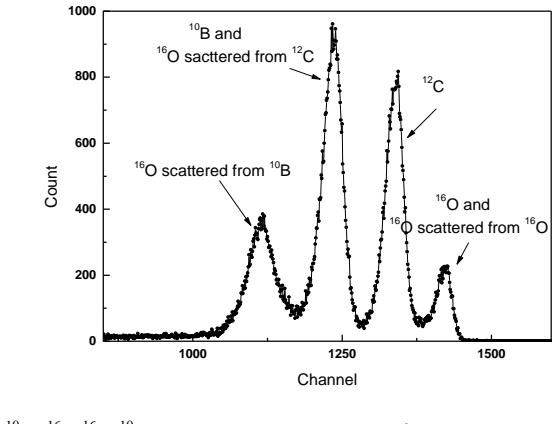
- [Fig. 2] The caption of Fig. 2 lists several contaminants but does not identify which peak corresponds to 16O scattered from 10B; a clearer marker or description would help the reader verify the elastic identification.
- [Introduction, [8]] The paper states that Koide et al. [8] claimed that including 6Li cluster transfer does not reveal good agreement with the backward-angle data, but the present work does not explain why a different treatment (different bound-state geometry, different potentials, or a different number of nodes) is expected to change that conclusion; a brief discussion of the difference in methodology would clarify the novelty claim.
- [Throughout] There are several typographical artifacts, including 'anomalous matrix' for the S-matrix notation and repeated sentences in the experimental section (the detector description appears twice). A careful proofreading pass is needed.
Circularity Check
Backward-angle 'reproduction' of the rise is a fit: free S is varied against the same data, so the SA=1.34±0.091 claim is partially circular.
-
fitted input called prediction
[Section IV.B (dσ/dΩ = |f_el + e^{iα} S f_DWBA|², Table II, Fig. 7) and Section V Summary]
"The spectroscopic amplitude was taken as a free parameter that was varied in order to give the best agreement between the theoretical calculations and the experimental data and consequently the least χ2/N value. ... The extracted spectroscopic amplitude for the configuration 16O→10B+6Li is 1.34 ±0.091 ... Furthermore, the cluster structure of 16O as a core (10B) plus a valence particle (6Li) orbiting the core is observed to successfully reproduce the significant rise in cross-sections at backward angles."
In the amplitude budget dσ/dΩ = |f_el + e^{iα} S f_DWBA|², S is the only transfer strength. The paper varies S freely against the same backward-angle data that are later said to be 'successfully reproduce[d]'. A parameter minimized against a data set will, by construction, improve the fit to that data set; the rise is therefore not an independent test of the 6Li-cluster hypothesis. Moreover, the alternative compound-elastic mechanism cited from Ref. [9] is not included in the amplitude budget, so the fitted S absorbs any missing non-elastic contribution and the quoted SA=1.34±0.091 is an effective renormalization rather than a uniquely determined spectroscopic amplitude.
full rationale
The paper contains one substantial circular element. In Sec. IV.B the elastic-transfer cross section is written with S as a multiplicative strength in the coherent amplitude, and S is explicitly varied to minimize χ2/N on the backward-angle data at 36.58–64 MeV. The same data are then invoked in the Summary as evidence that the 16O→10B+6Li cluster structure 'successfully reproduce[s]' the backward rise. That is not an independent prediction; it is the outcome of fitting S. The paper also does not compute the compound-elastic contribution of Ref. [9], despite noting that this alternative explained the same enhancement. With that contribution absent, the fitted S is an effective normalization absorbing any missing amplitude, so its interpretation as the spectroscopic amplitude is not uniquely established. The reported ±0.091 is the scatter of four fitted values, not a propagation of experimental uncertainties. Non-circular parts remain: the new 24 MeV measurement, the DFOP forward-angle fits, the energy dependence of σ_R, and the dispersion-relation check are self-contained and do not reduce to the fitted S. Hence the central transfer claim is partially circular but the paper is not wholly reducible to its inputs.
Assumptions & free parameters
free parameters (5)
- NR (real renormalization factor) =
varies with energy: 0.925 to 1.0; 0.959 at 24 MeV
- W (imaginary Woods-Saxon depth) =
varies with energy: 6.89 to 13.73 MeV; 7.48 MeV at 24 MeV
- rw (imaginary radius parameter) =
1.35 fm
- aw (imaginary diffuseness) =
0.466 fm
- SA (spectroscopic amplitude for 16O to 10B+6Li) =
1.22, 1.34, 1.36, 1.44 at the four high energies; average 1.34±0.091
assumptions (5)
- domain assumption The optical model plus a coherent superposition of elastic and one-step 6Li-transfer DWBA amplitudes describes the scattering cross section.
- domain assumption The DDM3Y1 effective nucleon-nucleon interaction with density dependence F(rho) is valid for 16O+10B at these energies.
- domain assumption The 16O and 10B ground-state densities used in the folding are accurate.
- ad hoc to paper The 16O = 10B + 6Li cluster configuration with N=3 nodes is the relevant transfer mechanism.
- ad hoc to paper The bound-state Woods-Saxon geometry R = 1.25(Ap^(1/3)+At^(1/3)) fm, a = 0.65 fm is a valid choice for the 6Li-10B overlap.
Cite this review
Pith. "Pith review of Effect of the transfer reactions for 16O+10B elastic scattering." pith.science (2026). https://pith.science/paper/HXJZTFMD
@misc{pith2026190809276,
  author       = {Pith},
  title        = {Pith review of: Effect of the transfer reactions for 16O+10B elastic scattering},
  year         = {2026},
  howpublished = {\url{https://pith.science/paper/HXJZTFMD}},
  note         = {Machine review of arXiv:1908.09276}
}
read the original abstract
In this study, the angular distribution of the 16O+10B elastic scattering was measured at Elab (16O)= 24 MeV. In addition to our experimental data, this nuclear system was theoretically analyzed at different energies to study the dynamics of scattering for this system. The data were analyzed within the framework of the double-folding optical potential model.
Figures


Figures from the paper (2 more)


Reference graph
Works this paper leans on
-
[1]
[ 1] J. Cook, K. W. Kemper, Phys. Lett., 123B (1983)
work page 1983
-
[5]
[ 2] J. Cook, Nucl. Phys. A417(1984)477. [ 3] J. E. Bowsher, T. B. Clegg, H. J. Karwowski, E. J. Ludwig, W. J. Thompson, and J. A. Tostevin, Phys. Rev. C 45 (1992)
work page 1984
- [6]
- [7]
- [29]
- [133]
-
[160]
[ 25] G. R. Satchler, Phys. Rep. 199(1991)147
work page 1991
-
[168]
[ 15] G. R. Satchler and W. G. Love, Phys. Rep. 55 (1979)
work page 1979
Show all 11 references
-
[183]
[ 16] Awad A Ibraheem, Brazilian Journal of Physics 46 (2016) 746 [ 17] Awad A Ibraheem, Physics of Atomic Nuclei 79 (2016)
2016
-
[686]
T Khoa and W von Oertzen Phys
[ 18] D. T Khoa and W von Oertzen Phys. Lett.B 342 (1995) 6 [ 19] D. T Khoa, G. R. Satchler and W von Oertzen, Phys. Rev. C56 (1997) 954 [ 20] S Qing-biao, F Da-chun and Z Yi-Zhong, Phys. Rev. C43 (1991) 2773 [ 21] H. De Vries, C. W. De Jager, and C. De Vries Atomic data and n...
1995
-
[2824]
[ 4] K. D. Veal et al., Phys. Rev. C 60 (1999) 0640003. [ 5] A. Belhout, Nucl. Phys. A793 (2007)178. [ 6] A. Mondal , S. Adhikari and C. Basu, Phys. Lett. B772 (2017) 216 17 [ 7] Y. Okuma, J. of the physical society of Japan 24 (1968) 677 [ 8] K. Koide and O. Dietzsch, Phys. R...
1999
Reviewed August 14, 2026 · model on record in the stance chip above.
Discussion (0). Continue with ORCID to comment.