REVIEW 3 major objections 5 minor 38 references
Stringent Test on Power Spectrum of Quantum Integrable and Chaotic Systems
T0 review · 3 major / 5 minor · reviewed 2026-08-14 · deepseek-v4-flash
Pith's one-line read The factor-of-two dispute over the integrable quantum power spectrum is resolved by the unfolding protocol: both rival formulas are correct.
desk verdict A convincing resolution of the 2004/2017 power-spectrum discrepancy as an unfolding-protocol artifact, with a useful GOE realizability threshold—but the integrable universality claim leans on an unstated exponential-spacing assumption. read the letter →
The pith
A machine-rendered reading of the paper's core claim, the machinery that carries it, and where it could break.
The reading
What carries the argument
The central object is the reunfolded spacing, s̃_i = N s_i / Σ_{k=1}^N s_k, the exact normalization that finite unfolded spectra satisfy. Its correlation function, ⟨s̃_i s̃_j⟩ = N(δ_{ij} + 1)/(N + 1), replaces the uncorrelated-spacing input and converts the naive integrable power spectrum 1/(2 sin²(πk/N)) into the half-size formula 1/(4 sin²(πk/N)) after summing the double series. For the chaotic case, the analogous load-bearing object is the two-point GOE spectral form factor substituted into the power-spectrum expression, which is then tested against numerical averages using a central-limit-based p-value criterion.
What would settle it
Measure ⟨δ²_n⟩ in an exactly unfoldable Poisson spectrum, such as the Gaussian diagonal ensemble, at moderate N: parabolic behavior nN/(N+1) − n²/(N+1) confirms the reunfolded model, while linear growth ⟨δ²_n⟩ = n contradicts it and favors the all-orders result.
Extended reading notes
Core claim
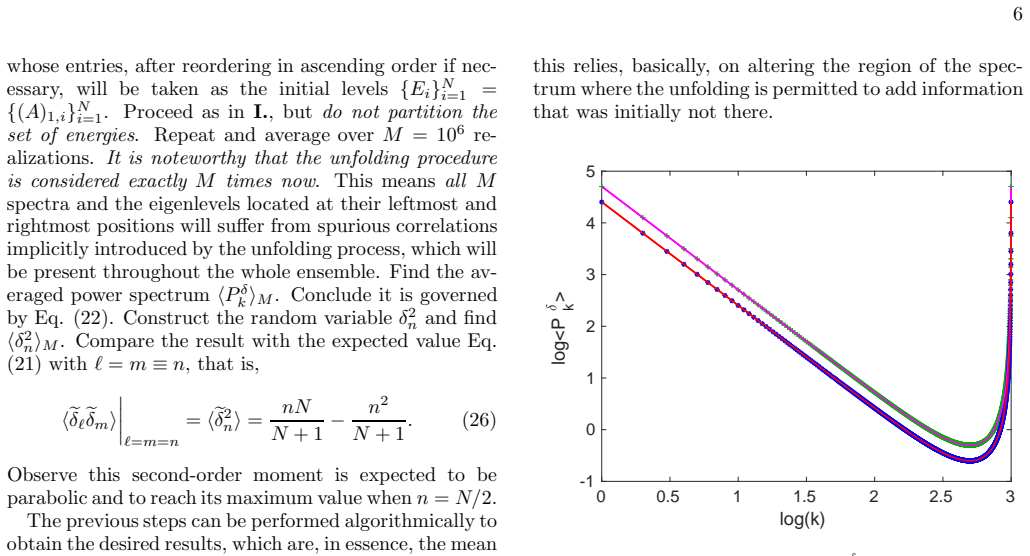
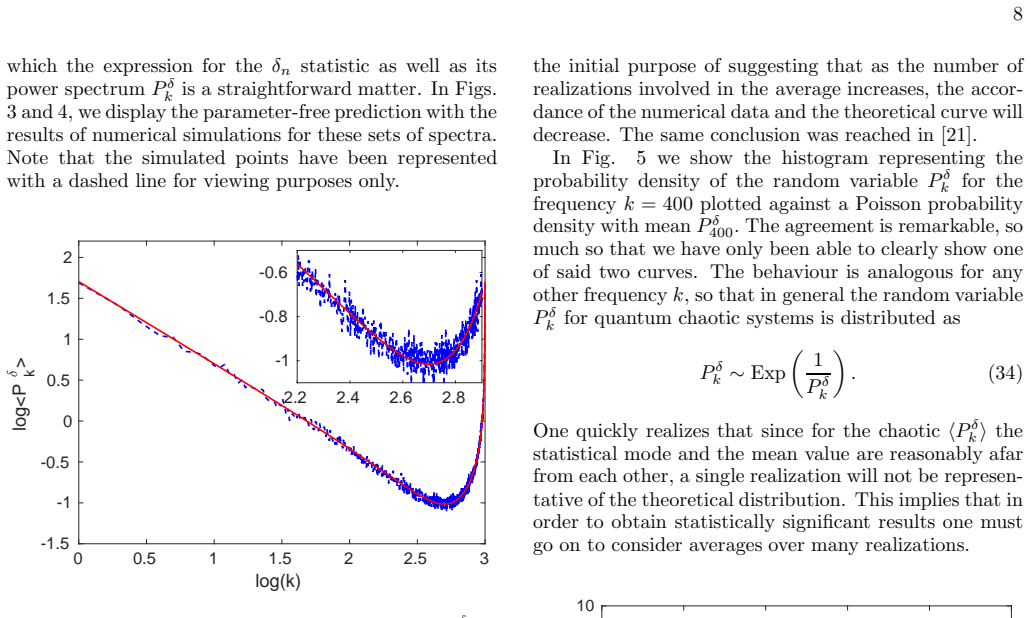
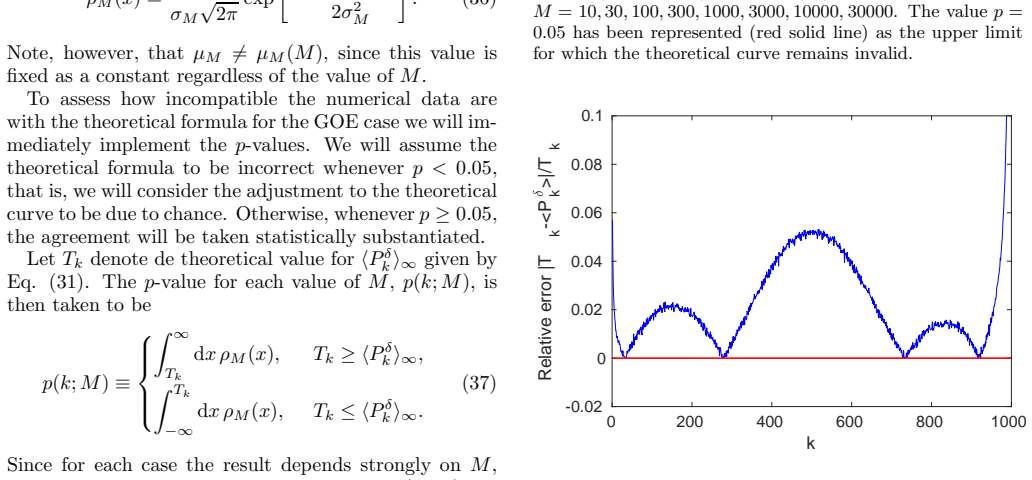
The paper's central claim is that the factor of two between the integrable power spectrum derived from two-point spectral correlations and the one derived from all-orders correlations is caused by the unfolding step, not by a failure of either approximation. When a spectrum is unfolded with its own smooth density, the endpoint constraint forces the spacings to satisfy Σs_i = N. Absorbing this constraint through the reassigned spacings s̃_i = N s_i / Σ_k s_k gives the correlation ⟨δ̃_ℓ δ̃_m⟩ = (N min{ℓ,m} − ℓm)/(N + 1), whose Fourier transform yields ⟨P̃δ_k⟩ = 1/(4 sin²(πk/N)) + O(1/N), exactly the older result. The newer all-orders formula, 1/(2 sin²(πk/N)), is recovered when a single long spectrum is unfolded once and then partitioned into shorter segments, diluting the spurious endpoint correlations. For GOE spectra, the paper's p-value analysis maintains that the two-point formula is statistically indistinguishable from averages over about 1000 realizations, whereas averages over $10^{6}$ realizations reveal deviations concentrated at low and very high frequencies. The same framework is applied to a disordered Heisenberg spin chain, where the standard formula tracks the ergodic-to-MBL crossover and the Gaussian β-ensemble fails to reproduce the long-range δn power spectrum.
Load-bearing premise
The argument collapses if the only unfolding artifact is not a uniform rescaling of all spacings, or if integrable systems' spacings are not exponentially distributed, because then the derived correlation formula does not necessarily describe every integrable spectrum.
Editorial extensions
If this is right
- For spectra unfolded one by one, the averaged δn power spectrum of an integrable system follows 1/(4 sin²(πk/N)), not 1/(2 sin²(πk/N)).
- The all-orders integrable expression is observable only under the special protocol of partitioning one globally unfolded long spectrum; using it as the default comparison for ordinary spectra would misclassify regular systems.
- The textbook linear forms for Σ2(L) and Δ3(L) in integrable spectra are also modified by unfolding, so comparisons against L and L/15 require the same correction reasoning.
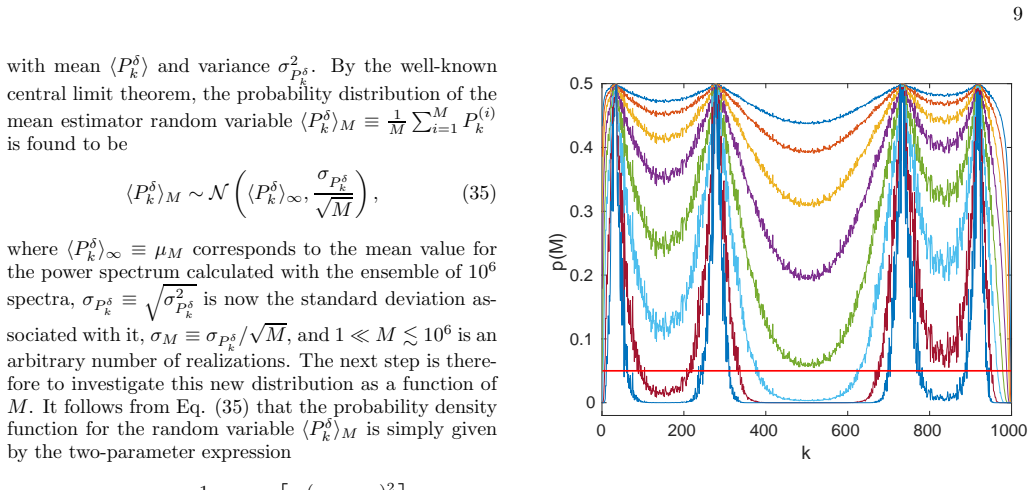
- The GOE two-point formula can safely be used as a chaos indicator when ensemble averages involve ≲1000 realizations; with much larger statistics its deviations become statistically visible.
- For the disordered Heisenberg chain, the protocol assigns the ergodic and many-body-localized phases to the expected curves, while the Gaussian β-ensemble matches short-range ratio statistics but fails for long-range correlations.
Reading between the lines
- A natural extension not pursued here is to derive the analogous finite-N corrections for Σ2(L) and Δ3(L) from the reunfolded correlation function; if the mechanism is universal, their curvature should mirror the parabolic bend of ⟨δ²_n⟩ and could be checked in the same Gaussian diagonal ensemble simulations.
- The M ≈ 1000 threshold suggests a practical reporting rule: studies of long-range spectral statistics should state the number of realizations, because beyond roughly that number small systematic deviations from the GOE formula become visible and could be mistaken for new physics.
- Since the reunfolded model starts from exponentially distributed spacings, integrable systems with non-Poisson short-range statistics would be a sharper test of the factor-of-two mechanism than the Gaussian diagonal ensemble itself.
Signed reviews
Editorial analysis
A structured set of objections, weighed in public.
Referee Report
Summary. The paper addresses the discrepancy between two published formulas for the power spectrum of the δ_n statistic in quantum integrable systems: Faleiro et al. (2004), giving a 1/f^2 spectrum proportional to 1/[4 sin^2(πk/N)], and Riser et al. (2017), giving twice that value. The authors claim that both are correct and correspond to different unfolding protocols: Eq. (22) is the correct expression for the usual per-spectrum unfolding, while Eq. (9) applies to a protocol where spectra are partitioned before unfolding. This is supported by an analytic calculation for the Gaussian Diagonal Ensemble (GDE) in the Appendix and by numerical simulations with M=10^6 realizations. For the chaotic GOE case, the paper performs a central-limit-based p-value test showing that the two-point formula Eq. (31) is statistically acceptable for averages over M≲10^3 realizations, with deviations appearing only for larger M. The protocol is then applied to a disordered Heisenberg spin chain, and the authors show that the Gaussian β-ensemble, although matching short-range ratio statistics, fails to describe the long-range power-spectrum correlations across the many-body localization crossover.
Significance. If the reconciliation is correct, the paper resolves a controversy in the spectral-statistics literature and gives practitioners a clear protocol: for the usual unfolding of complete spectra, the Faleiro et al. formula is the appropriate integrable prediction. The GOE p-value test is a valuable contribution because it provides a concrete, falsifiable threshold—averages over more than about 1000 realizations are needed for the corrections of Riser et al. to become statistically significant—and the comparison is parameter-free. The application to the MBL crossover is timely and demonstrates that long-range statistics can discriminate between models that agree in short-range statistics. The Appendix contains a detailed analytic derivation for the GDE, and the numerical evidence for the GDE limit is strong (M=10^6 spectra of size N=10^3). The main weakness, detailed below, is that the universality of the integrable result for arbitrary non-Poisson integrable systems is assumed rather than proven, because the derivation in Appendix A.2 explicitly relies on exponentially distributed spacings.
major comments (3)
- [Sec. III.A / Appendix A.2, Eq. (21)] The derivation of the reunfolded correlation ⟨~δ_ℓ~δ_m⟩, Eq. (21), explicitly assumes that the raw spacings are independent Exp(1) random variables; see Eqs. (A.7)–(A.11), where the joint density e^{-(s_1+...+s_N)} is used. This contradicts the statement in Sec. III.A that "the definition of the probability density is not needed." The identities E[~s_i]=1 and E[~s_i~s_j]=N(δ_ij+1)/(N+1) are special to exponential spacings, because only then are the normalized spacings Dirichlet-distributed. For a general integrable spectrum satisfying only the weak conditions Eqs. (5a)–(5b), the global rescaling Eq. (16) does not generally preserve the mean exactly, and the O(1/N) correction in Eq. (21) picks up contributions from higher moments of the spacing distribution. Thus the central claim that the usual protocol "exactly recovers" the Faleiro et al. result is established only for the GDE (and asymptotically for systems with exponentially distributed spacings), not for generic quantum integrable systems. This should either be proven or the claim should be restricted to the cases where the exponential assumption holds.
- [Sec. III.C, Eqs. (27)–(30)] The corollary that the number variance Σ^2(L) and the Dyson–Mehta statistic Δ_3(E0,L) suffer analogous spurious corrections is asserted without derivation. These statistics involve sliding intervals and additional boundary terms that are not present in the δ_n calculation, so the statement does not follow directly from Eq. (21). The authors should either provide the corrected forms for Σ^2 and Δ_3 or explicitly label this as a conjecture rather than a corollary of the power-spectrum calculation.
- [Sec. III.B, Eq. (16)] The effect of unfolding is modeled by the global rescaling ~s_i = N s_i / Σ_k s_k, introduced as "a simple way to account for this effect." This is an ansatz, not derived from the actual unfolding map ǫ_i = N(E_i). The exact bound [δ_N]_max = 1 motivates but does not uniquely determine the rescaling. Since the reconciliation of the Faleiro et al. and Riser et al. results rests on this model, the manuscript should justify why the global rescaling captures the spurious correlations induced by the actual unfolding procedure for general integrable systems, or state explicitly that the protocol is intended for cases where this rescaling applies (e.g., the GDE). As written, the numerical evidence in Sec. III.C is GDE-only, so the universal applicability claimed in the introduction and conclusions is not fully supported.
minor comments (5)
- [Sec. III.B, Eq. (18)] The summation upper limit in the definition of ~δ_n is written as N, but by analogy with Eq. (4) it should be n. This typo makes the definition inconsistent with the subsequent correlation calculation, which uses sums up to ℓ and m.
- [Appendix A.2, Eq. (A.9)] The denominator in the second expression for ⟨~s_i~s_j⟩ should involve s_k s_ℓ, not s_j s_ℓ; as written it is dimensionally inconsistent and does not match the intended double sum over the normalization.
- [Appendix A.2] The sentence "This integral can be evaluated by chaning to hyperspherical coordinates" contains a typo: "chaning" should be "changing."
- [Sec. IV.B, Eqs. (35)–(37)] The p-value test fixes μ_M equal to the empirical mean from the M=10^6 ensemble and does not propagate the uncertainty in that estimate into the central-limit distribution (35). Given the large M this is probably acceptable, but the text should state that the p-values are conditional on the particular empirical mean obtained.
- [Fig. 8 caption] The caption repeats "from panels (a) to (j)" without indicating that the axes labels and theoretical curves are common to all panels; clarifying this would improve readability.
Circularity Check
No significant circularity: the central derivations are self-contained from stated assumptions and checked numerically, and the paper's self-citations are not load-bearing.
full rationale
The paper's central derivations are not circular. The integrable power-spectrum result Eq. (9) follows from the stated moment assumptions (5a)-(5b) through Eqs. (6)-(8) and Appendix A.1, and the reunfolded result Eq. (22) follows from the explicit exponential-spacing model used in Appendix A.2 (Eqs. (A.7)-(A.11)), not from the target power spectrum. Eq. (21) is derived rather than fitted, and the numerical GDE tests in Sec. III.C compare parameter-free formulas with simulated data, so there is no fitted input renamed as a prediction. The GOE test in Sec. IV uses the parameter-free expression Eq. (31) with a p-value analysis, and the beta-ensemble comparison fits beta to short-range ratio statistics but tests the independent long-range power spectrum, so the observed mismatch is a genuine falsification rather than a construction. Although the authors cite their earlier work (e.g., [11] and [7]), those citations are not the load-bearing justification: the contested factor-of-2 reconciliation is re-derived here from the stated spacing model. The main caveat is a scope/correctness issue rather than circularity: Appendix A.2 explicitly assumes exponential spacings even though Sec. III.A suggests the probability density is not needed, so the universality of Eq. (22) beyond the GDE is not fully established; this is an overgeneralization concern, not a reduction of the prediction to its input.
Assumptions & free parameters
free parameters (2)
- β values of the Gaussian β-ensemble =
β = 0.99398, 0.21067, 0.06732 for ω = 1.4, 3, 4
- Unfolding polynomial degree 6 coefficients =
not reported
assumptions (5)
- domain assumption Spacings of integrable quantum systems are uncorrelated with unit mean: ⟨s_i⟩=1, ⟨s_i s_j⟩=δ_ij+1 (Eq. 5b).
- ad hoc to paper The effect of unfolding on finite spectra is modeled by the global rescaling ~s_i = N s_i / Σ_k s_k (Eq. 16), with ~s_i distributed as Exp(1) in the GDE case (Appendix A.2).
- domain assumption The chaotic power spectrum is dominated by two-point correlations, as encoded in the spectral form factor formula Eq. (31) from [11].
- standard math GOE eigenvalues follow Wigner's semicircle law, Eq. (33), used for exact unfolding in Sec. IV.
- domain assumption The spin-1/2 chain (Eq. 40) undergoes a many-body localization crossover around ω_c ≈ 3.6, so its spectral statistics interpolate between GOE and Poisson.
invented entities (1)
-
Reunfolded spacings ~s_i and corrected statistic ~δ_n
Cite this review
Pith. "Pith review of Stringent Test on Power Spectrum of Quantum Integrable and Chaotic Systems." pith.science (2026). https://pith.science/paper/AVANQKEW
@misc{pith2026190809285,
  author       = {Pith},
  title        = {Pith review of: Stringent Test on Power Spectrum of Quantum Integrable and Chaotic Systems},
  year         = {2026},
  howpublished = {\url{https://pith.science/paper/AVANQKEW}},
  note         = {Machine review of arXiv:1908.09285}
}
abstract
Quantum chaotic and integrable systems are known to exhibit a characteristic $1/f$ and $1/f^{2}$ noise, respectively, in the power spectrum associated to their spectral fluctuations. A recent work [R. Riser, V. A. Osipov, and E. Kanzieper, \textit{Power Spectrum of Long Eigenlevel Sequences in Quantum Chaotic Systems}, Phys. Rev. Lett. \textbf{118}, 204101 (2017)] calls into question the approximations used to derive these results from random matrix theory. In this paper we show that such approximations do remain valid under almost any circumstances. For the integrable limit, we devise a protocol to exactly recover the original results. As a corollary, we show that the theoretical predictions for other statistics are bound for failure regarding long-range correlations, due to unavoidable spurious effects emerging from the analysis. By means of a rigorous statistical test, we also show that the corrections for the chaotic case introduced in the aforementioned paper require huge statistics to become relevant ---averages over more than $1000$ realizations are mandatory. As an application, we study a paradigmatic model for the crossover from the thermal to the many-body localized phase. We show that our protocol succeeds in describing the crossover. Furthermore, it also succeeds in proving that the Gaussian $\beta$-ensemble fails to account for long-range correlations between the energy levels of this paradigmatic model.
Figures

Figures from the paper (7 more)




Reference graph
Works this paper leans on
-
[1]
St¨ ockmann,Quantum Chaos (Cambridge University Press, Cambridge, 1999)
H.J. St¨ ockmann,Quantum Chaos (Cambridge University Press, Cambridge, 1999)
work page 1999
-
[2]
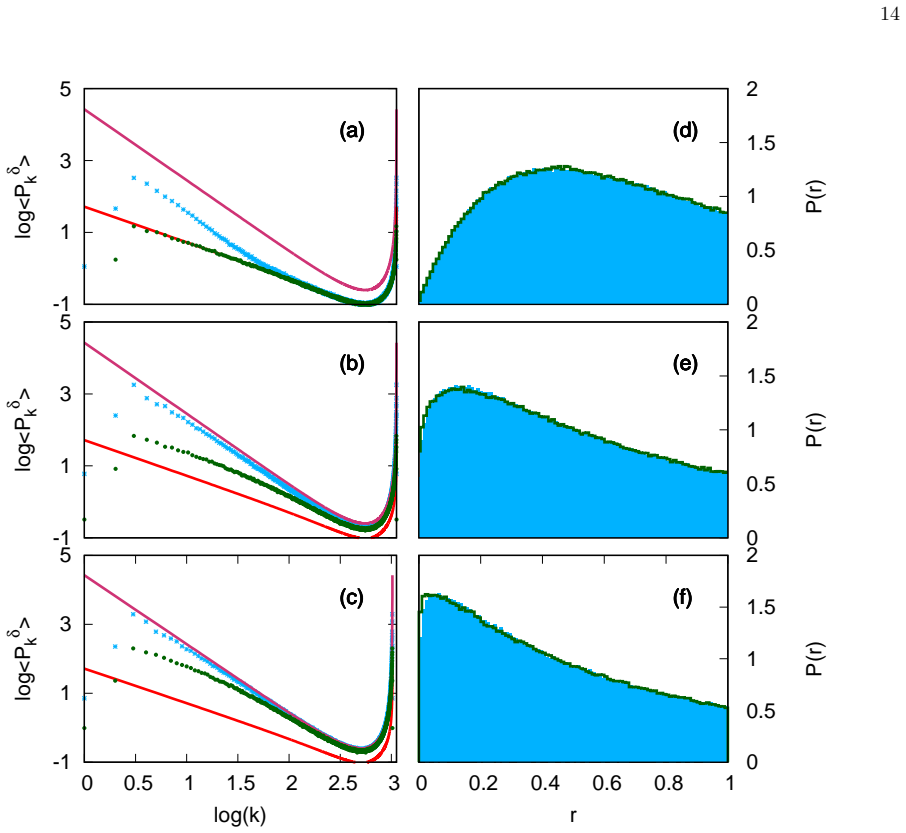
Numerical simulations carried with M = 10 6 spectra of N = 103 levels each. B. Significance test on two-point power spectrum result We wish to obtain an upper bound for the number of realizations for which the numerical discrepancy cannot be substantiated in terms of statistical significance. This can be accomplished by making use of standard proba- bility ...
-
[3]
0 200 400 600 800 1000 k -0.02 0 0.02 0.04 0.06 0.08 0.1 Relative error |T k-<P k>|/T k FIG
05 has been represented (red solid line) as the upper limit for which the theoretical curve remains invalid. 0 200 400 600 800 1000 k -0.02 0 0.02 0.04 0.06 0.08 0.1 Relative error |T k-<P k>|/T k FIG. 7. (Color online) Relative error with respect to the the - oretical values for the case in which M = 106. values M /greaterorsimilar103 this is not guarant...
-
[4]
(40), allow us to obtain the ratios Eq
The eigen- levels yielded by the diagonalization of H, Eq. (40), allow us to obtain the ratios Eq. (41), from which its expres- sion in the form of Eq. (42) follows directly. We then perform an average over the total number of ratios for each value of the transition inducing parameter ω, and end up with the mean estimators ⟨~r⟩ ≡ ⟨~r⟩(ω). These are shown ...
-
[5]
Y. Y. Atas, E. Bogomolny, O. Giraud, and G. Roux, Distribution of the ratio of consecutive level spacings in random matrix ensembles , Phys. Rev. Lett. 110, 084101 (2013)
work page 2013
-
[6]
M.V. Berry and M. Tabor, Level clustering in the regular spectrum, Proc. R. Soc. London A 356, 375 (1977)
work page 1977
-
[7]
M. L. Mehta, Random Matrices (Academic Press, New York, 1991)
1991
-
[8]
O. Bohigas, M.J. Giannoni, and C. Schmit, Characteriza- tion of chaotic quantum spectra and universality of level fluctuation laws , Phys. Rev. Lett. 52, 1 (1984)
work page 1984
Show all 38 references
-
[9]
Bia/suppress lous, V
M. Bia/suppress lous, V. Yunko, S. Bauch, M. /suppress Lawniczak, B. Dietz, and L. Sirko, Power spectrum analysis and missing level statistics of microwave graphs with violated time reversal invariance, Phys. Rev. Lett. 117, 144101 (2016)
2016
-
[10]
G´ omez, R.A
J.M.G. G´ omez, R.A. Molina, A. Rela˜ no, and J. Reta- mosa, Misleading signatures of quantum chaos , Phys. Rev. E 66, 036209 (2002)
2002
-
[11]
Rela˜ no, J.M.G
A. Rela˜ no, J.M.G. G´ omez, R.A. Molina, J. Retamosa, and E. Faleiro,Quantum chaos and 1/f noise, Phys. Rev. Lett. 89, 244102 (2002)
2002
-
[12]
Faleiro, U
E. Faleiro, U. Kuhl, R.A. Molina, L. Mu˜ noz, A. Rela˜ no, and J. Retamosa, Power spectrum analysis of experi- mental sinai quantum billiards , Phys. Lett. A 358, 251 (2006)
2006
-
[13]
Dietz, V
B. Dietz, V. Yunko, M. Bialous, S. Bauch, M. Lawniczak, and L. Sirko, Nonuniversality in the spectral properties of time-reversal-invariant microwave networks and quan- 16 tum graphs, Phys. Rev. E 95, 052202 (2017)
2017
-
[14]
G´ omez, A
J.M.G. G´ omez, A. Rela˜ no, J. Retamosa, E. Faleiro, L. Salasnich, M. Vranicar, and M. Robnik, 1 /f α noise in spectral fluctuations of quantum systems , Phys. Rev. Lett. 94, 084101 (2005); A. Rela˜ no,Chaos-assisted tun- neling and 1/f α spectral fluctuations in the order-chao...
2005
-
[15]
Faleiro, J.M.G
E. Faleiro, J.M.G. G´ omez, R.A. Molina, L. Mu˜ noz, A. Rela˜ no and J. Retamosa, Theoretical derivation of 1/f noise in quantum chaos , Phys. Rev. Lett. 93, 244101 (2004)
2004
-
[16]
J. M. G. G´ omez, K. Kar, V. K. B. Kota, R. A. Molina, A. Rela˜ no, and J. Retamosa,Many-body quantum chaos: Recent developments and applications to nuclei , Phys. Rep. 499, 103 (2011)
2011
-
[17]
R. A. Molina, J. Retamosa, L. Mu˜ noz, A. Rela˜ no, and E. Faleiro, Power spectrum of nuclear spectra with miss- ing levels and mixed symmetries , Phys. Lett. B 644, 25 (2007)
2007
-
[18]
A. Chan, A. De Luca, and J. T. Chalker, Spectral statis- tics in spacially extended chaotic quantum many-body systems, Phys. Rev. Lett. 121, 060601 (2018)
2018
-
[19]
Bertini, P
B. Bertini, P. Kos, and T. Prosen, Exact spectral form factor in a minimal model of many-body quantum chaos , Phys. Rev. Lett. 121, 264101 (2018)
2018
-
[20]
P. Kos, M. Ljubotina, and T. Prosen. Many-body quan- tum chaos: analytic connection to random matrix theory , Phys. Rev. X 8, 021062 (2018)
2018
-
[21]
Riser, V
R. Riser, V. A. Osipov, and E. Kanzieper, Power spec- trum of long eigenlevel sequences in quantum chaotic sys- tems, Phys. Rev. Lett. 118, 204101 (2017)
2017
-
[22]
Mur-Petit and R
J. Mur-Petit and R. A. Molina, Spectral statistics of molecular resonances in erbium isotopes: How chaotic are they?, Phys. Rev. E 92, 042906 (2015)
2015
-
[23]
Bialous, V
M. Bialous, V. Yunko, S. Bauch, M. Lawniczak, B. Dietz, and L. Sirko, Power spectrum analysis and missing level statistics of microwave graphs with violated time reversal invariance, Phys. Rev. Lett. 117, 144101 (2016)
2016
-
[24]
Lawniczak, M
M. Lawniczak, M. Bialous, V. Yunko, S. Bauch, and L. Sirko, Missing-level statistics and analysis of the power spectrum of level fluctuations of three-dimensional chaotic mircowave cavities , Phys. Rev. E 98, 012206 (2018)
2018
-
[25]
Santos, Integrability of a disordered Heisenberg spin- 1/ 2 chain, J
L.F. Santos, Integrability of a disordered Heisenberg spin- 1/ 2 chain, J. Phys. A: Math. Gen. 37 (2004) 4723-4729
2004
-
[26]
Buijsman, V
W. Buijsman, V. Cheianov, and V. Gritsev, Random ma- trix ensemble for the level statistics of many-body local- ization, Phys. Rev. Lett. 122, 180601 (2019)
2019
-
[27]
Dumitriu and A
I. Dumitriu and A. Edelman, Global spectrum fluctua- tions for the β -Hermite and β -Laguerre ensembles via matrix models, J. Math. Phys. (N. Y.) 47, 063302 (2006)
2006
-
[28]
Drozdz and J
S. Drozdz and J. Speth, Near-ground-state spectral fluctu- ations in multidimensional separable systems , Phys Rev Lett 67, 529 (1991)
1991
-
[29]
D. J. Luitz, N. Laflorencie, and F. Alet, Many-body local- ization edge in the random-field Heissenberg chain , Phys. Rev. B 91, 081103 (2015)
2015
-
[30]
Chavda, H.N
N.D. Chavda, H.N. Deota, and V.K.B. Kota, Poisson to GOE transition in the distribution of the ratio of consec- utive level spacings , Physics Letters A 378 (2014) 3012- 3017
2014
-
[31]
Pal and D
A. Pal and D. A. Huse, Many-body localization phase transition, Phys. Rev. B 82, 174411 (2010)
2010
-
[32]
Serbyn and J
M. Serbyn and J. E. Moore, Spectral statistics across the many-body localization transition , Phys. Rev. B 93, 041424 (2016)
2016
-
[34]
Forrester, Log-gases and random matrices , London Mathematical Society Monographs, Vol
P.J. Forrester, Log-gases and random matrices , London Mathematical Society Monographs, Vol. 34 (Princeton University Press, Princeton and Oxford, 2010)
2010
-
[35]
Le Ca¨ er, C
G. Le Ca¨ er, C. Male, and R. Delannay,Nearest-neighbour spacing distributions of the β -Hermite ensemble of ran- dom matrices, Physica (Amsterdam) 383A, 190 (2007)
2007
-
[36]
Rela˜ no, L
A. Rela˜ no, L. Mu˜ noz, J. Retamosa, E. Faleiro, and R.A. Molina, Power spectrum characterization of the continu- ous Gaussian ensemble , Phys. Rev. E, 77, 031103 (2008). Appendix: Calculation of the theoretical power spectrum fo r the integrable case In this section we give ...
2008
-
[37]
(6) the first step is to find the value of ⟨δℓδm⟩
Derivation for the unfolded spacings In evaluating Eq. (6) the first step is to find the value of ⟨δℓδm⟩. One expands this term to obtain ⟨δℓδm⟩ = ℓ∑ i=1 m∑ j=1 ⟨(si − 1)(sj − 1)⟩ = ℓ∑ i=1 m∑ j=1 (⟨sisj⟩ − ⟨si⟩ − ⟨sj ⟩ + 1). (A.1) Concentrating on each of the terms separately yi...
-
[38]
Derivation for the reunfolded spacings We now consider Eq. (19). The calculation that follows is analogous to the previous one, but caution must be exercised since it becomes more tedious. First one considers as sta rting point the equation ⟨~δℓ~δm⟩ = ℓ∑ i=1 m∑ j=1 ⟨(~si − 1)(...
-
[400]
The behaviour is analogous for any other frequency k, so that in general the random variable P δ k for quantum chaotic systems is distributed as P δ k ∼ Exp ( 1 P δ k )
The agreement is remarkable, so much so that we have only been able to clearly show one of said two curves. The behaviour is analogous for any other frequency k, so that in general the random variable P δ k for quantum chaotic systems is distributed as P δ k ∼ Exp ( 1 P δ k ) ...
Reviewed August 14, 2026 · model on record in the stance chip above.
Discussion (0). Continue with ORCID to comment.