REVIEW 3 major objections 4 minor 69 references
The Critical Current of Disordered Superconductors near T=0
T0 review · 3 major / 4 minor · reviewed 2026-08-14 · deepseek-v4-flash
Pith's one-line read This paper claims that the sharp resistance jump at the critical current in disordered superconducting amorphous indium oxide at millikelvin temperatures and high magnetic fields is caused by Joule self-heating and thermal bistability…
desk verdict A solid experimental case for electron self-heating as the origin of critical-current jumps in a:InO, but the quantitative 'prediction' of Jc is weaker than claimed because heat balance only fixes the bistability bounds, not where switching occurs. read the letter →
The pith
A machine-rendered reading of the paper's core claim, the machinery that carries it, and where it could break.
The reading
What carries the argument
The central object is the heat-balance equation $P = \Gamma\Omega(T_{\mathrm{el}}^\beta - T_{\mathrm{ph}}^\beta)$, where $P = I^2 R(T_{\mathrm{el}})$ is the Joule power, $T_{\mathrm{el}}$ is the electron temperature, $T_{\mathrm{ph}}$ is the phonon temperature, and $\Gamma\Omega$ and $\beta$ are sample-dependent parameters of the electron-phonon thermal bottleneck. Because $R(T)$ rises steeply as $T_{\mathrm{el}}$ increases, the Joule-heating curve $I^2 R(T_{\mathrm{el}})$ can intersect the cooling curve three times; the middle intersection is unstable, and the critical current is the value at which the heating and cooling curves are tangent, so the low-temperature stable solution disappears. The paper solves this graphically using the measured zero-bias $R(T)$ as a thermometer, and it is the tangency condition that produces the predicted $I_c$.
What would settle it
Measure the electron temperature directly, for example with noise thermometry, while sweeping current through the same films: the heat-balance picture predicts the electron temperature is already well above the lattice before the jump and jumps discontinuously at $I_c$, while intrinsic depairing or depinning predicts the lattice and electrons stay together until the resistance onset.
Extended reading notes
Core claim
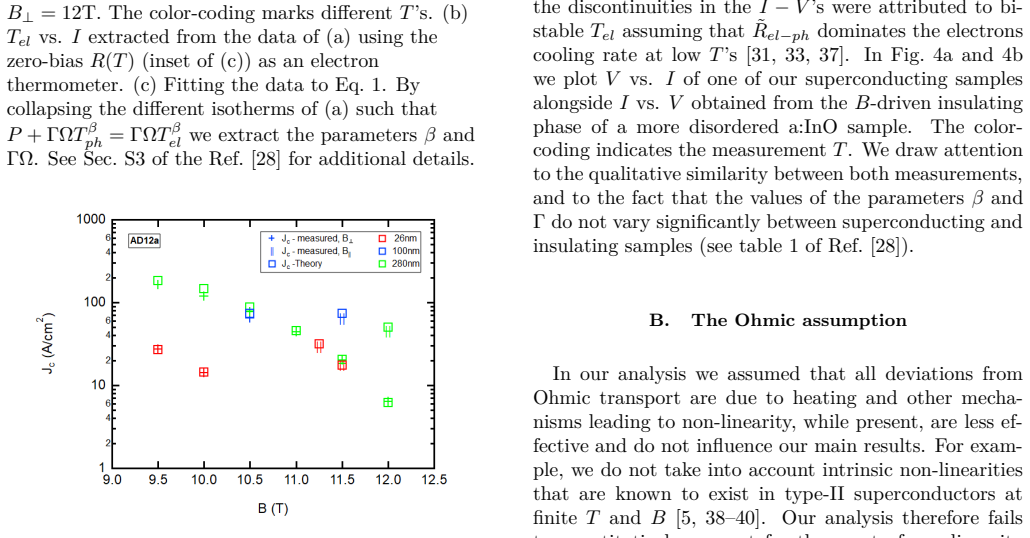
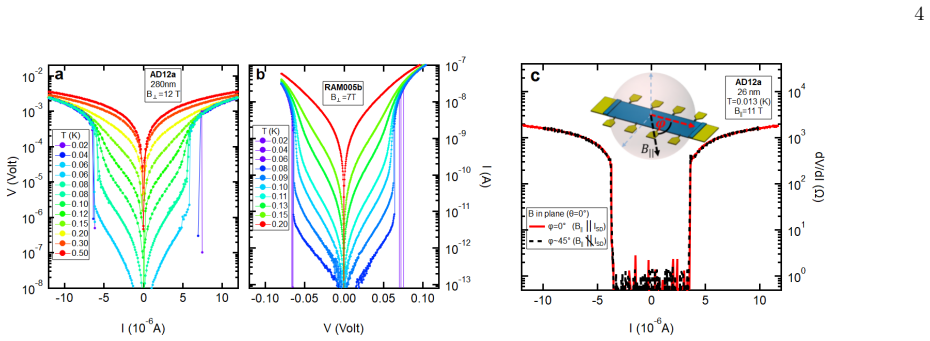
The paper's central claim is that the current-induced jump in resistance of superconducting amorphous indium oxide films near $T=0$ is a thermal bistability. The electrons decouple from the phonons, so Joule heating raises $T_{\mathrm{el}}$ well above the lattice temperature; the heat-balance equation $I^2R(T_{\mathrm{el}}) = \Gamma\Omega(T_{\mathrm{el}}^\beta - T_{\mathrm{ph}}^\beta)$ then has two stable solutions, and the measured discontinuity at $I_c$ is the system switching between them. Using only the zero-bias $R(T)$ as an electron thermometer and the parameters $\beta$ and $\Gamma\Omega$ extracted from high-power data, the authors predict the measured critical current density for four film thicknesses and both field orientations without using the measured $I_c$ in the fit. They further argue that the observed $I_c$ is inconsistent with both Cooper-pair depairing (the predicted magnitude is 10$-$400 times larger, and the exponent is sample dependent) and vortex depinning (the jump is independent of the angle between in-plane field and current).
Load-bearing premise
The argument assumes that every non-linear bend in the measured current-voltage curves is caused by the electrons heating up, so the resistance measured at zero current can be used as a thermometer; if intrinsic effects such as vortex creep also bend the curves, the inferred electron temperatures and the predicted critical current are wrong.
Editorial extensions
If this is right
- The discontinuous rise in differential resistance at $I_c$ in these films is the switch between two stable electron-temperature solutions of the heat-balance equation, so $I_c$ is a thermal switching threshold rather than a depairing or depinning threshold.
- The same heat-balance fit, with no use of the measured $I_c$, reproduces the measured critical current density for film thicknesses 26$-$280 nm and for both perpendicular and in-plane fields.
- The critical-current exponent measured near $B_{c2}$ is sample dependent ($\alpha\approx 1.2$-$2.14$), which the paper argues is inconsistent with the universal mean-field depairing value $3/2$.
- The insensitivity of $I_c$ to the angle between in-plane field and current indicates vortex depinning does not set the observed jump.
- A complete description of the full current-voltage curve below $I_c$ requires combining self-heating with intrinsic nonlinear effects such as vortex creep.
Reading between the lines
- If this picture generalizes, reported critical currents in other strongly disordered or granular superconductors at millikelvin temperatures may also be partly thermal switching currents; comparing samples with identical superconducting parameters but different electron-phonon coupling would separate the two contributions.
- A testable extension: intentionally improving electron-phonon cooling, for example with thinner films or better acoustic matching to the substrate, should raise the measured jump current if it is thermal, while an intrinsic depairing limit should remain unchanged.
- Because the heat-balance equation has the same form in very different systems, the prediction method could be transferred to any system whose zero-bias resistance is a steep function of temperature, such as superconducting nanowires or Josephson junction arrays with reported switching currents.
- The paper's limited-hysteresis observation suggests that the escape transition is triggered near the lower limit of stability, so the full stochastic switching dynamics, not just the static heat-balance solution, may be the next object to model.
Signed reviews
Editorial analysis
A structured set of objections, weighed in public.
Referee Report
Summary. The paper proposes that the discontinuous current-voltage characteristics of disordered superconducting amorphous indium oxide films at millikelvin temperatures and high magnetic fields are caused by electron self-heating and thermal bistability, not by Cooper-pair depairing or vortex depinning. The authors model the experiment with the heat-balance equation P = ΓΩ(T_el^β − T_ph^β), extract the electron-phonon cooling parameters β and ΓΩ by converting measured I-V curves into electron temperatures using the zero-bias R(T) as a thermometer, and show that the data collapse onto the heat-balance form over several decades. They then graphically solve the heat-balance equation for the critical current and report, in Fig. 3, quantitative agreement with measured critical currents for samples of several thicknesses and both field orientations. They also present arguments against depairing and depinning mechanisms, including a field-angle insensitivity test for in-plane fields.
Significance. If the claim holds, this would substantially reinterpret the critical current in disordered superconductors near T=0 as a macroscopic thermal-switching phenomenon rooted in energy conservation, with implications for how depairing and depinning estimates are used in this regime. The paper's main strengths are the breadth of the data, the independent Kapitza-resistance measurement in Sec. S5, the honest statement of limitations, and the fact that the measured Jc is not itself a fit parameter in the heat-balance analysis. The central claim is plausible and the experimental evidence is suggestive, but the present analysis does not fully establish the quantitative prediction because the connection between the measured switching current and the computed stability limit is assumed rather than derived.
major comments (3)
- [Sec. IV.D, Sec. S4, Sec. S6] The stress-test concern lands: the heat-balance equation alone predicts only the bounds of the bistable interval, not the current at which the system actually switches. In Sec. IV.D the authors state that "the actual transition occurs stochastically within this interval," and in Sec. S6 they quote Altshuler et al. that heat-balance theory "can predict only their bounds." Despite this, the central comparison in Fig. 3 equates the measured Jc with the tangency solution of Sec. S4, i.e., the lower stability limit, without deriving or systematically demonstrating that the switching events occur at that bound. The inference from the rounding of log V (Sec. IV.D) is empirical and does not follow from Eq. (1). A revision should either provide a switching model or switching statistics that locate the transition within the bistable window, or explicitly reframe Fig. 3 as a consistency check rather than a parameter-free prediction.
- [Sec. IV.B, Sec. S3, Sec. S6] The Ohmic assumption is load-bearing because all extracted electron temperatures, and therefore β, ΓΩ, and the predicted Jc, rely on attributing every deviation from Ohm's law to heating. The authors admit in Sec. IV.B that the analysis fails to account for onset of nonlinearity below Ic, and in Sec. S6 they concede that the ln(dV/dI) ∝ I observation of Ref. [9], suggestive of vortex creep, is not answered. If intrinsic nonlinearity contributes below Ic, the zero-bias R(T) is not a valid electron thermometer in that regime and the fitted values of β and ΓΩ are contaminated. The manuscript should quantify this contamination, for example by testing the sensitivity of the predicted Jc to the inclusion or exclusion of low-current data, or by using an independent electron-temperature probe.
- [Sec. S4, Sec. S7, Fig. 3] The computed quantity in Sec. S4, IHL_c, is the retrapping current at which the high-resistance branch disappears, while the abstract and the discontinuous increase in differential resistance describe the escape transition from the low-resistance to the high-resistance state. The measured mean relative hysteresis of 4.4% in Sec. S7 means that the escape and trapping currents do not coincide exactly. The manuscript should clarify which experimental quantity is plotted in Fig. 3 for each sample and should show that the 4.4% hysteresis is negligible compared with the spread of the comparison, or it should compare theory and experiment for the same transition direction with an explicit uncertainty estimate.
minor comments (4)
- [Sec. III, Fig. 2c] The heat-balance collapse in Fig. 2c is presented without error bars or a goodness-of-fit statistic; because β and ΓΩ are later used for the central prediction, reporting their statistical uncertainty would strengthen the comparison in Fig. 3.
- [Sec. S2] The authors note that the exponent α is extracted over only a factor of 4–6 in δB_c2; this should be stated more prominently when using the non-universality of α as an argument against the depairing interpretation.
- [Abstract and Sec. II] The abstract says the critical current is predicted "using only measurements done at I→0 and at I≫Ic," but β and ΓΩ are extracted from the same current-voltage datasets that contain the transition; the wording should be refined to avoid overstating the independence of the input data.
- [Sec. S6] The response to Ref. [9]'s fifth argument explicitly says "we do not have an answer to" the vortex-creep observation; this unresolved issue should be acknowledged in the main text near the discussion of the Ohmic assumption rather than only in the supplemental material.
Circularity Check
Heat-balance 'prediction' of Ic is partly in-sample: β and ΓΩ are fit to the same I-V branch whose endpoint is then reported as the predicted critical current.
-
fitted input called prediction
[Sec. III (Fig. 2c and Fig. 3); Secs. S3 and S4 of Supplemental Material]
"Finally we plot, in Fig. 2c, P + ΓΩTβ ph vs. ΓΩ Tβ el alongside the fit to Eq. 1 (dashed black line), which our data follow for more than 4 decades, and we extract β= 5.1 and ΓΩ = 1.48·10−5W·K−β. ... Using the sample-dependent β and ΓΩ, together with the measured R(T), we graphically solve Eq. 1 ... and obtain Ic for our B and T range ... For all samples and B values there is a remarkable quantitative agreement between theory and experiment."
The free parameters β and ΓΩ are obtained by fitting Eq. 1 to P(T_el) derived from the I-V curves (Sec. S3). The predicted critical current is then obtained by graphically solving the same Eq. 1 (Sec. S4) with those fitted parameters; in Fig. S4b the predicted IHL_c is the tangency point at which the fitted high-resistance branch of those same curves ceases to have a stable high-Tel solution. Hence the reported Ic is the low-current endpoint of the branch that fixed the model, not an independently constrained quantity. The zero-bias R(T) thermometer and the fact that Jc is not a fit parameter give the comparison some content, but because separate β, Γ are fitted at each B (Table I), the Fig. 3 agreement is an in-sample test, not an out-of-sample prediction.
full rationale
The derivation has one genuinely circular strand: the thermal parameters (β, ΓΩ) that enter the purported Ic prediction are obtained by fitting Eq. 1 to the same current-voltage data whose switching endpoint is then presented as the predicted critical current (main-text Fig. 2c vs. Fig. 3; Secs. S3–S4). In particular, the graphical construction in Sec. S4 solves the same Eq. 1 with the fitted β, ΓΩ and the measured R(T); the predicted IHL_c is the tangency at which the fitted high-resistance branch ceases to exist. That quantity is the lower endpoint of the very branch used to determine the model, so the agreement in Fig. 3 is partly an in-sample consistency check rather than an out-of-sample prediction. The paper's statement that 'the measured value of Jc was not used' is true but does not remove the in-sample character, because the fit already uses the shape of the I-V curves up to the jump region; Table I also supplies separate β and Γ for each B, so no cross-condition validation is performed. Offsetting this, the zero-bias R(T) electron thermometer is an external input, the measured Ic is not itself a fit parameter, and the collapse of the data onto the heat-balance form over four decades is a nontrivial constraint, so the circularity is partial and the central claim is not merely a restatement of the input. The admitted gaps—the Ohmic assumption (Sec. IV.B), the theory's inability to fix where in the bistable interval switching occurs (Sec. IV.D, quoting Ref. [31] that 'we can predict only their bounds'), and the unexplained premature triggering (Sec. S7)—are correctness and validity limitations that reduce the strength of the quantitative prediction but are not themselves identity reductions, so they are not scored as circular steps on top of the above. The self-citations are used for methodology and do not carry the central claim by themselves.
Assumptions & free parameters
free parameters (2)
- β =
5.1 to 9.8 (sample and field dependent, Table I)
- ΓΩ =
0.355 to 4.018 nW K^-β µm^-3 × 1K^β (Table I)
assumptions (5)
- domain assumption P = ΓΩ(T_el^β − T_ph^β) describes cooling of electrons to phonons
- domain assumption Each subsystem (electrons, film phonons, substrate phonons, helium) is in local equilibrium at a single temperature
- domain assumption The electron-phonon coupling is the thermal bottleneck
- domain assumption Zero-bias R(T) acts as an electron thermometer: all nonlinearity is due to heating
- ad hoc to paper The measured switching current corresponds to the lower limit of stability of the heat-balance equation
Cite this review
Pith. "Pith review of The Critical Current of Disordered Superconductors near T=0." pith.science (2026). https://pith.science/paper/FFXCBTH2
@misc{pith2026190809303,
  author       = {Pith},
  title        = {Pith review of: The Critical Current of Disordered Superconductors near T=0},
  year         = {2026},
  howpublished = {\url{https://pith.science/paper/FFXCBTH2}},
  note         = {Machine review of arXiv:1908.09303}
}
read the original abstract
An increasing current through a superconductor can result in a discontinuous increase in the differential resistance at the critical current. This critical current is typically associated either with breaking of Cooper-pairs (de-pairing) or with a collective motion of vortices (de-pinning). In this work we measure superconducting amorphous indium oxide films at low temperatures and high magnetic fields. Using heat-balance considerations we demonstrate that the current-voltage characteristics are well explained by electron overheating that occurs due to the thermal decoupling of the electrons from the host phonons. As a result the electrons overheat to a significantly higher temperature than that of the lattice. By solving the heat-balance equation we are able to accurately predict the critical currents in a variety of experimental conditions. The heat-balance approach stems directly from energy conservation. As such it is universal and applies to diverse situations from critical currents in superconductors to climate bi-stabilities that can initiate another ice-age. One disadvantage of the universal nature of this approach is that it is insensitive to the microscopic details of the system, which limits our ability to draw conclusions regarding the initial departure from equilibrium.
Figures


Figures from the paper (1 more)
Reference graph
Works this paper leans on
-
[23]
We neglect other thermal links between subsystems. For example, a:InO phonons can transfer heat directly to the liquid helium via Kapitza resistance (marked in Fig. 1a by a dashed purple line), we omit this process as the boundary area between the substrate and liquid helium is 20 times larger than that of the a:InO and liquid helium
-
[28]
See supplemental material for sample properties, calcu- lation of de-pairing Jc, detailed heat-balance analysis, Kapitza resistance measurements, response to arguments against the bi-stability picture made in reference [9] and an analysis of the hysteresis
-
[29]
1 is general and also applies to the other ˜R’s illustrated in Fig
The functional form of Eq. 1 is general and also applies to the other ˜R’s illustrated in Fig. 1a, therefore we can write the terms of Eq. 1 as if ˜Rel−ph is the thermal bottleneck and not lose generality
-
[30]
It is sufficient that P increases faster than Tβ el where in our experiment P =I 2R(Tel) and R(Tel) ≈R0e−T0/Tel
-
[40]
H. Van der Zant, F. Fritschy, T. Orlando, and J. Mooij, Physical review letters 66, 2531 (1991)
work page 1991
-
[42]
Similar insensitivity to ϕwas reported in high Tc super- conductors [43–46]. While these results were interpreted in terms of vortex motion, the theoretical models rely on the large anisotropy in high Tc’s. The contrast between the ϕdependence of high Tc’s and a conventional type- II superconductor (amorphous MoGe alloy) is demon- strated in Ref. [46]
-
[46]
Y. Iye, A. Watanabe, S. Nakamura, T. Tamegai, T. Terashima, K. Yamamoto, and Y. Bando, Physica C: Superconductivity 167, 278 (1990). Supplemental Material for The Critical Current of Disordered Superconductors near T=0 A. Doron, 1,∗T. Levinson, 1 F. Gorniaczyk, 1 I. Tamir, 1, 2 and D. Shahar 1 1Department of Condensed Matter Physics, The Weizmann Institut...
work page Pith review arXiv 1990
-
[47]
[9] Ic was defined as the ”escape” critical current
We defined Ic as the trapping critical current while in Ref. [9] Ic was defined as the ”escape” critical current. As the hysteresis is very limited this dif- ference in definition should not be significant
Show all 69 references
-
[48]
To properly measure critical exponents one should have a scaling relation that spans over many orders of magnitude in the scaling parameter δBjc c2. In Fig. S2 the scaling is only over a factor of 4-6 in δBjc c2 and in Ref. [9] it spans over a slightly larger but still unremar...
-
[49]
[9] αis extracted for samples of a single thickness of 30nm
In Ref. [9] αis extracted for samples of a single thickness of 30nm. Here αis extracted for samples of various thicknesses. Note that although our ex- tracted αis not monotonic in the thickness, αof the 26nm thick film is 1.76 which is not significantly different than the 30nm fil...
-
[50]
Larbalestier, A
D. Larbalestier, A. Gurevich, D. M. Feldmann, and A. Polyanskii (World Scientific, 2011), pp. 311–320
2011
-
[51]
S. Kang, A. Goyal, J. Li, A. A. Gapud, P. M. Martin, L. Heatherly, J. R. Thompson, D. K. Christen, F. List, M. Paranthaman, et al., Science 311, 1911 (2006)
2006
-
[52]
W. V. Hassenzahl, D. W. Hazelton, B. K. Johnson, P. Ko- marek, M. Noe, and C. T. Reis, Proceedings of the IEEE 92, 1655 (2004)
2004
-
[53]
Dew-Hughes, Low temperature physics 27, 713 (2001)
D. Dew-Hughes, Low temperature physics 27, 713 (2001)
2001
-
[54]
Tinkham, Introduction to superconductivity (Courier Corporation, 2004)
M. Tinkham, Introduction to superconductivity (Courier Corporation, 2004)
2004
-
[55]
Blatter, M
G. Blatter, M. V. Feigel’man, V. B. Geshkenbein, A. I. Larkin, and V. M. Vinokur, Reviews of Modern Physics 66, 1125 (1994)
1994
-
[56]
Larkin and Y
A. Larkin and Y. Ovchinnikov, Sov. Phys. JETP 41, 960 (1975)
1975
-
[57]
Tsuei, J
C. Tsuei, J. Mannhart, and D. Dimos, in AIP Conference Proceedings (AIP, 1989), vol. 182, pp. 194–205
1989
-
[58]
Sac´ ep´ e, J
B. Sac´ ep´ e, J. Seidemann, F. Gay, K. Davenport, A. Ro- gachev, M. Ovadia, K. Michaeli, and M. V. Feigel’man, Nature physics p. 1 (2018)
2018
-
[59]
Tenhover, W
M. Tenhover, W. Johnson, and C. Tsuei, Solid State Communications 38, 53 (1981)
1981
-
[60]
Hebard and M
A. Hebard and M. Paalanen, Physical Review B 30, 4063 (1984)
1984
-
[61]
A. V. Gurevich and R. Mints, Reviews of modern physics 59, 941 (1987)
1987
-
[62]
Bezuglyj and V
A. Bezuglyj and V. Shklovskij, Physica C: Superconduc- tivity 202, 234 (1992)
1992
-
[63]
Little, Canadian Journal of Physics 37, 334 (1959)
W. Little, Canadian Journal of Physics 37, 334 (1959)
1959
-
[64]
Kaganov, E
M. Kaganov, E. Lifshitz, and L. Tanatarov, Journal of Experimental and Theoretical Physics 4, 173 (1957)
1957
-
[65]
Wellstood, C
F. Wellstood, C. Urbina, and J. Clarke, Physical Review B 49, 5942 (1994)
1994
-
[66]
M. N. Kunchur and J. M. Knight, Modern Physics Let- ters B 17, 549 (2003)
2003
-
[67]
M. N. Kunchur, Physical review letters 89, 137005 (2002)
2002
-
[68]
J. M. Knight and M. N. Kunchur, Physical Review B 74, 064512 (2006)
2006
-
[69]
Courtois, M
H. Courtois, M. Meschke, J. Peltonen, and J. P. Pekola, Physical review letters 101, 067002 (2008)
2008
-
[70]
Golubkov and G
M. Golubkov and G. Tsydynzhapov, Journal of Experi- mental and Theoretical Physics Letters 71, 516 (2000)
2000
-
[71]
S. V. Postolova, A. Y. Mironov, and T. I. Baturina, JETP letters 100, 635 (2015)
2015
-
[72]
For example, a:InO phonons can transfer heat directly to the liquid helium via Kapitza resistance (marked in Fig
We neglect other thermal links between subsystems. For example, a:InO phonons can transfer heat directly to the liquid helium via Kapitza resistance (marked in Fig. ??a by a dashed purple line), we omit this process as the boundary area between the substrate and liquid helium ...
-
[73]
E. T. Swartz and R. O. Pohl, Reviews of modern physics 61, 605 (1989)
1989
-
[74]
Kapitza, J
P. Kapitza, J. Phys.(Moscow) 4, 181 (1941)
1941
-
[75]
R. C. Johnson and W. Little, Physical review 130, 596 (1963)
1963
-
[76]
G. L. Pollack, Reviews of Modern Physics 41, 48 (1969)
1969
-
[77]
See supplemental material at URL for sample properties, calculation of de-pairing Jc, detailed heat-balance anal- ysis, Kapitza resistance measurements, our response to arguments against the bi-stability picture made in refer- ence [9] and a quantitative analysis of the hysteresis
-
[78]
S4 is general and also applies to the other ˜R’s illustrated in Fig
The functional form of Eq. S4 is general and also applies to the other ˜R’s illustrated in Fig. ??a, therefore we can write the terms of Eq. S4 as if ˜Rel−ph is the thermal bottleneck and not lose generality
-
[79]
It is sufficient that P increases faster than Tβ el where in our experiment P =I 2R(Tel) and R(Tel)≈R0e−T0/Tel
-
[80]
B. L. Altshuler, V. E. Kravtsov, I. V. Lerner, and I. L. Aleiner, Phys. Rev. Lett. 102, 176803 (2009)
2009
-
[81]
When comparing samples of different dimensions we use intensive parameters such as J, E and ρ. As our a:InO films are homogeneously disordered, they are homoge- neous on the relevant length-scales of the sample: length (l), width (w) and thickness (t) and we can define E = V/l, ρ...
-
[82]
Ovadia, B
M. Ovadia, B. Sac´ ep´ e, and D. Shahar, Physical review letters 102, 176802 (2009)
2009
-
[83]
W. D. Sellers, Journal of Applied Meteorology 8, 392 (1969)
1969
-
[84]
D. S. Abbot, J. Bloch-Johnson, J. Checlair, N. X. Farahat, R. Graham, D. Plotkin, P. Popovic, and F. Spaulding-Astudillo, The Astrophysical Journal 854, 3 (2018)
2018
-
[85]
Sambandamurthy, L
G. Sambandamurthy, L. W. Engel, A. Johansson, E. Peled, and D. Shahar, Phys. Rev. Lett. 94, 017003 (2005)
2005
-
[86]
Levinson, A
T. Levinson, A. Doron, I. Tamir, G. C. Tewari, and D. Shahar, Physical Review B 94, 174204 (2016)
2016
-
[87]
Anderson, Physical Review Letters 9, 309 (1962)
P. Anderson, Physical Review Letters 9, 309 (1962)
1962
-
[88]
Rzchowski, S
M. Rzchowski, S. Benz, M. Tinkham, and C. Lobb, Phys- ical Review B 42, 2041 (1990)
1990
-
[89]
Van der Zant, F
H. Van der Zant, F. Fritschy, T. Orlando, and J. Mooij, xi Physical review letters 66, 2531 (1991)
1991
-
[90]
Sac´ ep´ e, J
B. Sac´ ep´ e, J. Seidemann, M. Ovadia, I. Tamir, D. Shahar, C. Chapelier, C. Strunk, and B. A. Piot, Physical Review B 91, 220508 (2015)
2015
-
[91]
While these results were still interpreted in terms of vortex motion, the different theoretical models rely heavily on the large anisotropy in high Tc’s
Similar insensitivity of transport properties to ϕwas re- ported in high Tc superconductors [43–46]. While these results were still interpreted in terms of vortex motion, the different theoretical models rely heavily on the large anisotropy in high Tc’s. The contrast between th...
-
[92]
Y. Iye, S. Nakamura, and T. Tamegai, Physica C: Super- conductivity 159, 433 (1989)
1989
-
[93]
Tinkham, IEEE Transactions on Magnetics 27, 828 (1991)
M. Tinkham, IEEE Transactions on Magnetics 27, 828 (1991)
1991
-
[94]
P. Kes, J. Aarts, V. Vinokur, and C. Van der Beek, Phys- ical review letters 64, 1063 (1990)
1990
-
[95]
Y. Iye, A. Watanabe, S. Nakamura, T. Tamegai, T. Terashima, K. Yamamoto, and Y. Bando, Physica C: Superconductivity 167, 278 (1990)
1990
-
[96]
R. B. Dinner, A. P. Robinson, S. C. Wimbush, J. L. MacManus-Driscoll, and M. G. Blamire, Superconductor Science and Technology 24, 055017 (2011)
2011
-
[97]
M. V. Private communication with Feigel’man, Private communication
-
[98]
Misra, L
S. Misra, L. Urban, M. Kim, G. Sambandamurthy, and A. Yazdani, Physical review letters 110, 037002 (2013)
2013
-
[99]
Crane, N
R. Crane, N. P. Armitage, A. Johansson, G. Samban- damurthy, D. Shahar, and G. Gr¨ uner, Physical Review B 75, 184530 (2007)
2007
-
[100]
It was shown in reference [9] thatBjc c2 is a good candidate for the definition of Bc2
-
[101]
We scaled Iac for different samples according to the sam- ple thickness maintaining a constant current density of Jac≈0.1 A/cm2
-
[102]
Doron, I
A. Doron, I. Tamir, S. Mitra, G. Zeltzer, M. Ovadia, and D. Shahar, Phys. Rev. Lett. 116, 057001 (2016), URL http://link.aps.org/doi/10.1103/PhysRevLett.116. 057001
2016 doi
-
[103]
To visualize that one can track the lowest intersection between the red and green curves while raising the green curve further and further (increasing |I|)
Increasing I further will eventually result in an increase in the lowestTel solution aboveTel =Tph and eventually with the complete disappearance of the low Tel solution. To visualize that one can track the lowest intersection between the red and green curves while raising the...
-
[104]
Pobell, Matter and methods at low temperatures, vol
F. Pobell, Matter and methods at low temperatures, vol. 2 (Springer, 2007)
2007
-
[105]
O. V. Lounasmaa, Experimental principles and methods below 1K (academic Press, 1974)
1974
-
[106]
S3 and S5b of the supplemental material of Ref
We estimate dTel∼3mK from Figs. S3 and S5b of the supplemental material of Ref. [9]. Although the zero bias R(T ) they present has an impressive activated behav- ior, there are still almost unavoidable deviations that are manifested in the noise in R at low T in Figs. S3
-
[107]
Doron, I
A. Doron, I. Tamir, T. Levinson, M. Ovadia, B. Sac´ ep´ e, and D. Shahar, Physical review letters 119, 247001 (2017)
2017
-
[108]
Kravtsov, Private communication
V. Kravtsov, Private communication
Reviewed August 14, 2026 · model on record in the stance chip above.
Discussion (0). Continue with ORCID to comment.