REVIEW 4 major objections 6 minor 1 cited by
Multilingual Neural Machine Translation with Language Clustering
T0 review · 4 major / 6 minor · reviewed 2026-08-14 · deepseek-v4-flash
Pith's one-line read If languages are grouped by embeddings learned from a universal translation model instead of by family tree, translation quality improves for most of 23 languages.
desk verdict Real problem, clean idea, and a quantitative claim that needs error bars and a fixed-K comparison before it can be trusted. read the letter →
The pith
A machine-rendered reading of the paper's core claim, the machinery that carries it, and where it could break.
The reading
What carries the argument
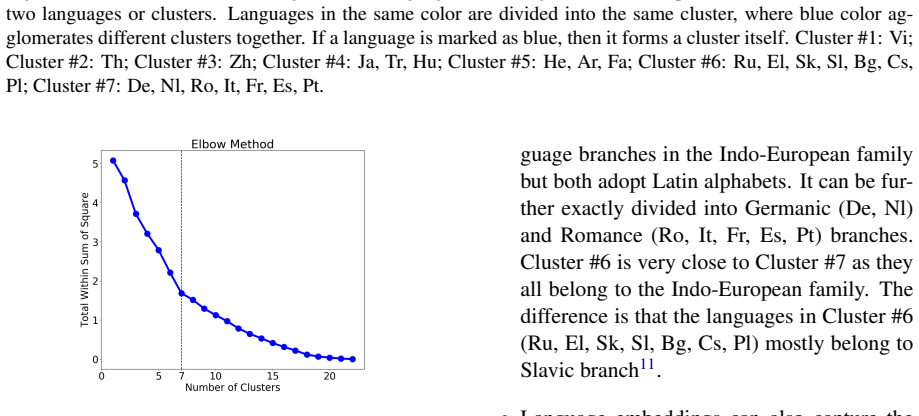
The mechanism is the language representation: each source language gets a vector that is learned end-to-end when a universal translation model is trained with a language tag added to every source token. After training, hierarchical clustering runs on those vectors, and the elbow method chooses the number of clusters; then a separate multilingual model, using the same tag mechanism, is trained for each cluster. The vector does double duty: it is the representation used to decide which languages belong together, and it is the input signal that tells each cluster model which language it is processing. Because the representations are optimized for translation rather than taken from a linguistic inventory, the clustering is grounded in the task the models will perform.
What would settle it
Measure the translation gain for many pairs of languages trained together versus separately and compare it with the distance between their learned representations in the universal model; if close-pair languages do not on average gain more than distant-pair languages, the central mechanism is false.
Extended reading notes
Core claim
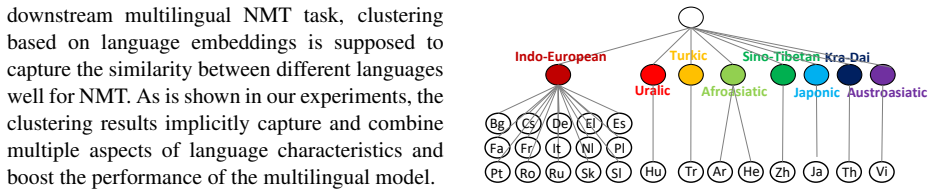
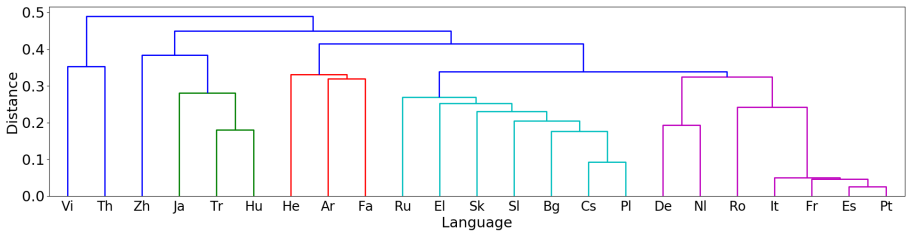
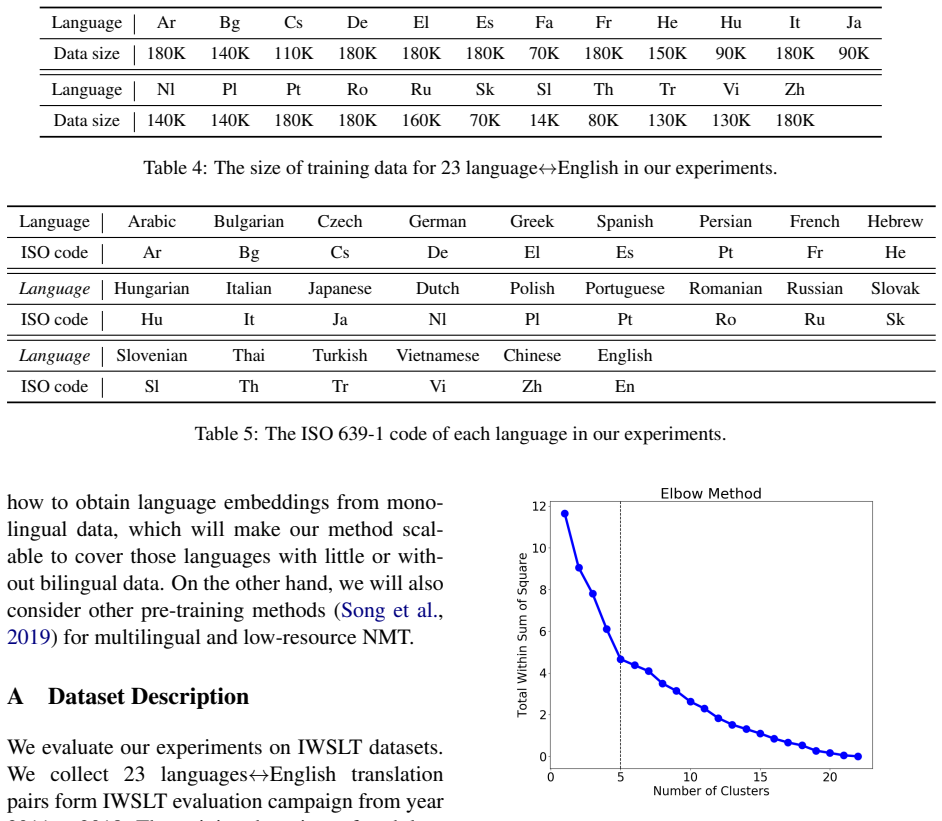
The paper's central claim is that language representations learned inside a universal neural machine translation model are a better basis for deciding which languages should be trained together than the expert-built language family tree. In the many-to-one direction (23 languages to English) the representation vectors cluster the languages into seven groups; in the one-to-many direction, into five. The clusters reproduce some family-tree structure, separating Germanic, Romance, and Slavic branches, but also merge languages from different families, such as Japanese, Turkish, and Hungarian, or Hebrew, Arabic, and Persian, on the basis of features the translation task reveals. Measured by BLEU, the learned-representation grouping outperforms family-based grouping for all but two languages in the many-to-one setting and for most languages in the one-to-many setting; it also beats the universal model for nearly every language and beats one model per language pair on twelve low- to mid-resource languages while using only seven models.
Load-bearing premise
The load-bearing premise is that languages the model represents as similar are exactly the languages that help each other when trained together, but the paper never measures that link directly—it only shows cluster pictures and a handful of examples.
Editorial extensions
If this is right
- A multilingual system with a fixed budget of K models can assign languages to models empirically: run a short universal-model pass for representations, cluster them, then train one model per cluster, and expect better accuracy than family-based assignment.
- Low-resource languages gain most from cluster-based grouping, because sharing a model with similar languages acts as data augmentation and can beat a dedicated per-language model.
- Learned clusters expose cross-family similarities, such as agglutinative morphology in Japanese, Turkish, and Hungarian and regional contact among Hebrew, Arabic, and Persian, that a family-tree grouping would not exploit.
- The same representation-and-cluster recipe works in both directions of translation, producing similar branch-level groupings in many-to-one and one-to-many settings.
Reading between the lines
- A natural next test, not carried out in the paper, is to correlate pairwise distances between learned language representations with pairwise translation gains from co-training; a strong correlation would turn the observed clustering benefit into a quantitative mechanism.
- The same cluster-then-train recipe transfers in principle to other multilingual sequence tasks, such as multilingual speech recognition or language pretraining, where choosing which languages share parameters is the same resource-allocation problem.
- Because the elbow method selects the cluster count from representation geometry, optimizing the count directly on validation BLEU would expose the accuracy-versus-model-count trade-off more explicitly.
- At the smallest data scale tested, 5% of the original training data, the cluster assignments begin to shift, so a plausible extension is to regularize the representations or seed them with typological features to keep low-resource languages grouped reliably.
Signed reviews
Editorial analysis
A structured set of objections, weighed in public.
Referee Report
Summary. The paper addresses the problem of deciding which languages should share a single multilingual NMT model under a fixed model budget. It proposes two clustering strategies: one based on the linguistic taxonomy of language families, and one based on language embeddings learned by first training a universal many-to-one or one-to-many NMT model and then hierarchically clustering the resulting language tag vectors. The experimental study on 23 IWSLT languages↔English compares random, family-based, and embedding-based clustering, reporting that embedding-based clustering improves BLEU for most languages over the language-family baseline and random clustering, while also outperforming individual models on several low-resource languages.
Significance. If the empirical claim were rigorously established, the paper would make a practical contribution: it gives a principled way to choose which languages should share a translation model without relying on expert linguistic taxonomy, and it shows that embedding-based grouping can be learned end-to-end from the translation task itself. The paper also contains useful descriptive analyses: the learned embeddings reproduce much of the known family structure (Figures 3 and 5), the clusters are reasonably stable when training data is reduced to 50% or 20% (Figure 5), and the low-resource gains of cluster co-training (e.g., Hu and Ja in Table 2) are an interesting finding. However, the central quantitative claim currently rests on single-run BLEU differences, many of which are below one point, with no significance testing or confidence intervals.
major comments (4)
- [Section 5.2, Table 1] The central claim that Embedding outperforms Family for most languages is not statistically supported. The table reports single training runs for Family and Embedding (Random is averaged over 3 runs but no variance is shown), and IWSLT test sets are small enough that per-language differences such as El +0.06, Fa +0.05, Ro +0.06, Th/Vi/Zh 0.00, and Bg -0.23 are within typical run-to-run noise; Sl -1.85 goes in the opposite direction. Paired bootstrap confidence intervals over the test set or multiple random seeds with standard deviations should be reported before a 21/23 (or similar) superiority claim is made. The same issue affects the one-to-many results in Table 3.
- [Section 5.1, Figures 2-4] The comparison confounds clustering method with the number of clusters: Family uses 8 clusters while Embedding and Random use 7. Because the number of models affects per-model capacity and data proportions, the observed BLEU gaps in Table 1 could be caused by K rather than by the quality of the language grouping. The authors should evaluate Family (and Random) at the same K as Embedding, or demonstrate that the ordering of methods is stable across a range of K values.
- [Section 5.1, Figure 4] The elbow method selects K by minimizing within-cluster sum of squares, an intrinsic clustering-quality criterion, not translation BLEU. The paper offers no evidence that the elbow-derived K is optimal or even adequate for the downstream translation objective. A sensitivity analysis reporting BLEU at several K values (e.g., K=5,6,7,8,9) is needed to rule out the possibility that the advantage of Embedding over Family is an artifact of the particular K chosen by the elbow heuristic.
- [Section 3.2 and Section 5.2] The paper's explanatory mechanism - that distances between learned language embeddings predict beneficial co-training - is supported only by qualitative dendrogram inspection and selected examples (Hu/Ja, He/Ar/Fa). There is no quantitative correlation between pairwise embedding distance and measured BLEU transfer gains, so it remains unclear whether the method will generalize to new language sets or low-resource settings. Reporting such a correlation, or explicitly reframing the mechanism as a hypothesis for future work, would strengthen the paper.
minor comments (6)
- [Figure 3] The caption is confusing: it says 'blue color agglomerates different clusters together' and then says 'if a language is marked as blue, it forms a cluster itself.' Please redraw the figure or clarify the color convention.
- [Section 5.2, Table 1] Footnote 13 says Embedding is worse than Family on only 2 languages, but Table 1 also shows ties (Th, Vi, Zh) and several near-zero differences. Please report explicit win/tie/loss counts and define the threshold for 'worse'.
- [Abstract and Section 5.4] The abstract claims improvement 'for almost all the languages over baseline methods,' but Table 3 shows Embedding below Family on Ar, El, He, Sl, and Zh. The claim should be qualified by setting, or the per-setting counts should be stated.
- [Section 4] For Bg, El, Hu, and Ja, validation and test sets are obtained by a single random split of the training data. Please state whether this split is fixed, and briefly discuss sensitivity to the split choice.
- [Appendix A] There is a typo: 'translation pairs form IWSLT evaluation campaign' should be 'from IWSLT evaluation campaign'.
- [Sections 4 and 5] The paper motivates language clustering by computational budgets but does not report training time or GPU-hours for the different numbers of models. A rough cost comparison would make the resource-budget argument quantitative.
Circularity Check
No circularity: language embeddings are extracted from a separately trained universal model, clustered by an elbow heuristic on within-cluster variance, and evaluated with freshly trained per-cluster models on held-out test sets.
full rationale
None of the load-bearing claims reduces to its inputs. The language embeddings in Section 3.2 are produced by training a universal NMT model; the resulting embedding vectors are then clustered using hierarchical clustering with the number of clusters K chosen by the elbow method applied to intra-cluster variation, not to BLEU. After clustering, the paper trains fresh multilingual models for each cluster and reports BLEU on held-out IWSLT test sets (Tables 1–3). Thus 'Embedding outperforms Family' is an independent empirical comparison rather than a fitted quantity renamed as a prediction. The paper's self-citations (e.g., Tan et al. 2019, He et al. 2019, Leng et al. 2019) appear only in related-work surveys and are not invoked to justify the central clustering claim. Footnote 4 defends the stability of the embeddings, but this is an empirical robustness check, not a definitional shortcut. The absence of significance tests or error bars is a correctness or evidence concern, not circularity. The mechanism explanation (embedding proximity predicts transfer) is under-validated, but that is a separate weakness from circularity.
Assumptions & free parameters
free parameters (1)
- Number of clusters K =
7 (many-to-one), 5 (one-to-many)
assumptions (3)
- domain assumption Languages that are close in the learned embedding space benefit from being trained together in a multilingual NMT model.
- domain assumption Language embeddings from the universal NMT model are stable and meaningful for clustering.
- ad hoc to paper The elbow method selects a good number of clusters for translation performance.
Cite this review
Pith. "Pith review of Multilingual Neural Machine Translation with Language Clustering." pith.science (2026). https://pith.science/paper/JOHRNX35
@misc{pith2026190809324,
  author       = {Pith},
  title        = {Pith review of: Multilingual Neural Machine Translation with Language Clustering},
  year         = {2026},
  howpublished = {\url{https://pith.science/paper/JOHRNX35}},
  note         = {Machine review of arXiv:1908.09324}
}
read the original abstract
Multilingual neural machine translation (NMT), which translates multiple languages using a single model, is of great practical importance due to its advantages in simplifying the training process, reducing online maintenance costs, and enhancing low-resource and zero-shot translation. Given there are thousands of languages in the world and some of them are very different, it is extremely burdensome to handle them all in a single model or use a separate model for each language pair. Therefore, given a fixed resource budget, e.g., the number of models, how to determine which languages should be supported by one model is critical to multilingual NMT, which, unfortunately, has been ignored by previous work. In this work, we develop a framework that clusters languages into different groups and trains one multilingual model for each cluster. We study two methods for language clustering: (1) using prior knowledge, where we cluster languages according to language family, and (2) using language embedding, in which we represent each language by an embedding vector and cluster them in the embedding space. In particular, we obtain the embedding vectors of all the languages by training a universal neural machine translation model. Our experiments on 23 languages show that the first clustering method is simple and easy to understand but leading to suboptimal translation accuracy, while the second method sufficiently captures the relationship among languages well and improves the translation accuracy for almost all the languages over baseline methods
Figures

Figures from the paper (4 more)


Forward citations
Cited by 1 Pith paper
-
Investigating Multilingual NMT Representations at Scale
SVCCA analysis of a 103-language translation model shows encoder representations cluster by linguistic family, diverge by target language, and high-resource or related languages are more robust to fine-tuning.
Reference graph
Works this paper leans on
-
[1]
URL: " 'urlintro :=
ENTRY address author booktitle chapter edition editor howpublished institution journal key month note number organization pages publisher school series title type volume year eprint doi pubmed url lastchecked label extra.label sort.label short.list INTEGERS output.state before.all mid.sentence after.sentence after.block STRINGS urlintro eprinturl eprintpr...
-
[2]
write newline
" write newline "" before.all 'output.state := FUNCTION n.dashify 't := "" t empty not t #1 #1 substring "-" = t #1 #2 substring "--" = not "--" * t #2 global.max substring 't := t #1 #1 substring "-" = "-" * t #2 global.max substring 't := while if t #1 #1 substring * t #2 global.max substring 't := if while FUNCTION word.in bbl.in capitalize " " * FUNCT...
-
[3]
Dzmitry Bahdanau, Kyunghyun Cho, and Yoshua Bengio. 2015. Neural machine translation by jointly learning to align and translate. ICLR 2015
work page 2015
-
[4]
Dik Bakker, Andr \'e M \"u ller, Viveka Velupillai, S ren Wichmann, Cecil H Brown, Pamela Brown, Dmitry Egorov, Robert Mailhammer, Anthony Grant, and Eric W Holman. 2009. Adding typology to lexicostatistics: A combined approach to language classification. Linguistic Typology, 13(1):169--181
work page 2009
-
[5]
Xinying Chen and Kim Gerdes. 2017. Classifying languages by dependency structure. typologies of delexicalized universal dependency treebanks. In Proceedings of the Fourth International Conference on Dependency Linguistics (Depling 2017), September 18-20, 2017, Universit \`a di Pisa, Italy , 139, pages 54--63. Link \"o ping University Electronic Press
work page 2017
-
[6]
Bernard Comrie. 1989. Language universals and linguistic typology: Syntax and morphology. University of Chicago press
work page 1989
-
[7]
Daxiang Dong, Hua Wu, Wei He, Dianhai Yu, and Haifeng Wang. 2015. Multi-task learning for multiple language translation. In Proceedings of the 53rd Annual Meeting of the Association for Computational Linguistics and the 7th International Joint Conference on Natural Language Processing (Volume 1: Long Papers), volume 1, pages 1723--1732
work page 2015
-
[8]
Orhan Firat, Kyunghyun Cho, and Yoshua Bengio. 2016. http://aclweb.org/anthology/N/N16/N16-1101.pdf Multi-way, multilingual neural machine translation with a shared attention mechanism . In NAACL HLT 2016, The 2016 Conference of the North American Chapter of the Association for Computational Linguistics: Human Language Technologies, San Diego California, ...
work page 2016
Show all 40 references
-
[9]
Jonas Gehring, Michael Auli, David Grangier, Denis Yarats, and Yann N. Dauphin. 2017. http://proceedings.mlr.press/v70/gehring17a.html Convolutional sequence to sequence learning . In Proceedings of the 34th International Conference on Machine Learning, ICML 2017, Sydney, NSW,...
2017
-
[10]
Thanh - Le Ha, Jan Niehues, and Alexander H. Waibel. 2016. http://arxiv.org/abs/1611.04798 Toward multilingual neural machine translation with universal encoder and decoder . CoRR, abs/1611.04798
2016 arXiv
-
[11]
Hany Hassan, Anthony Aue, Chang Chen, Vishal Chowdhary, Jonathan Clark, Christian Federmann, Xuedong Huang, Marcin Junczys - Dowmunt, William Lewis, Mu Li, Shujie Liu, Tie - Yan Liu, Renqian Luo, Arul Menezes, Tao Qin, Frank Seide, Xu Tan, Fei Tian, Lijun Wu, Shuangzhi Wu, Yin...
2018 arXiv
-
[12]
Tianyu He, Jiale Chen, Xu Tan, and Tao Qin. 2019. Language graph distillation for low-resource machine translation. arXiv preprint arXiv:1908.06258
2019 arXiv
-
[13]
Tianyu He, Xu Tan, Yingce Xia, Di He, Tao Qin, Zhibo Chen, and Tie-Yan Liu. 2018. Layer-wise coordination between encoder and decoder for neural machine translation. In Advances in Neural Information Processing Systems, pages 7944--7954
2018
-
[14]
Eric W Holman, S ren Wichmann, Cecil H Brown, Viveka Velupillai, Andr \'e M \"u ller, and Dik Bakker. 2008. Explorations in automated language classification. Folia Linguistica, 42(3-4):331--354
2008
-
[15]
Geoffrey Horrocks. 2009. Greek: A History of the Language and its Speakers. John Wiley & Sons
2009
-
[16]
Le, Maxim Krikun, Yonghui Wu, Zhifeng Chen, Nikhil Thorat, Fernanda B
Melvin Johnson, Mike Schuster, Quoc V. Le, Maxim Krikun, Yonghui Wu, Zhifeng Chen, Nikhil Thorat, Fernanda B. Vi \' e gas, Martin Wattenberg, Greg Corrado, Macduff Hughes, and Jeffrey Dean. 2017. https://transacl.org/ojs/index.php/tacl/article/view/1081 Google's multilingual n...
2017
-
[17]
Diederik Kingma and Jimmy Ba. 2014. Adam: A method for stochastic optimization. arXiv preprint arXiv:1412.6980
2014 arXiv
-
[18]
Yichong Leng, Xu Tan, Tao Qin, Xiang-Yang Li, and Tie-Yan Liu. 2019. Unsupervised pivot translation for distant languages. arXiv preprint arXiv:1906.02461
2019 arXiv
-
[19]
Levin, Patrick Littell, David R
Lori S. Levin, Patrick Littell, David R. Mortensen, Ke Lin, Katherine Kairis, and Carlisle Turner. 2017. https://aclanthology.info/papers/E17-2002/e17-2002 URIEL and lang2vec: Representing languages as typological, geographical, and phylogenetic vectors . In Proceedings of the...
2017
-
[20]
Haitao Liu and Wenwen Li. 2010. Language clusters based on linguistic complex networks. Chinese Science Bulletin, 55(30):3458--3465
2010
-
[21]
Yichao Lu, Phillip Keung, Faisal Ladhak, Vikas Bhardwaj, Shaonan Zhang, and Jason Sun. 2018. http://arxiv.org/abs/1804.08198 A neural interlingua for multilingual machine translation . CoRR, abs/1804.08198
2018 arXiv
-
[22]
Le, Ilya Sutskever, Oriol Vinyals, and Lukasz Kaiser
Minh - Thang Luong, Quoc V. Le, Ilya Sutskever, Oriol Vinyals, and Lukasz Kaiser. 2015 a . http://arxiv.org/abs/1511.06114 Multi-task sequence to sequence learning . CoRR, abs/1511.06114
2015 arXiv
-
[23]
Thang Luong, Hieu Pham, and Christopher D. Manning. 2015 b . http://aclweb.org/anthology/D/D15/D15-1166.pdf Effective approaches to attention-based neural machine translation . In Proceedings of the 2015 Conference on Empirical Methods in Natural Language Processing, EMNLP 201...
2015
-
[24]
Chaitanya Malaviya, Graham Neubig, and Patrick Littell. 2017. https://aclanthology.info/papers/D17-1268/d17-1268 Learning language representations for typology prediction . In Proceedings of the 2017 Conference on Empirical Methods in Natural Language Processing, EMNLP 2017, C...
2017
-
[25]
Tomas Mikolov, Kai Chen, Greg Corrado, and Jeffrey Dean. 2013. Efficient estimation of word representations in vector space. arXiv preprint arXiv:1301.3781
2013 arXiv
-
[26]
Kishore Papineni, Salim Roukos, Todd Ward, and Wei - Jing Zhu. 2002. http://www.aclweb.org/anthology/P02-1040.pdf Bleu: a method for automatic evaluation of machine translation . In Proceedings of the 40th Annual Meeting of the Association for Computational Linguistics, July 6...
2002
-
[27]
Lewis M Paul, Gary F Simons, Charles D Fennig, et al. 2009. Ethnologue: Languages of the world. Dallas, TX: SIL International. Available online at www. ethnologue. com/. Retrieved June, 19:2011
2009
-
[28]
Emmanouil Antonios Platanios, Mrinmaya Sachan, Graham Neubig, and Tom Mitchell. 2018. Contextual parameter generation for universal neural machine translation. In Proceedings of the 2018 Conference on Empirical Methods in Natural Language Processing, pages 425--435
2018
-
[29]
Lior Rokach and Oded Maimon. 2005. Clustering methods. In Data mining and knowledge discovery handbook, pages 321--352. Springer
2005
-
[30]
Rico Sennrich, Barry Haddow, and Alexandra Birch. 2016. http://aclweb.org/anthology/P/P16/P16-1162.pdf Neural machine translation of rare words with subword units . In ACL 2016, August 7-12, 2016, Berlin, Germany, Volume 1: Long Papers
2016
-
[31]
Yanyao Shen, Xu Tan, Di He, Tao Qin, and Tie-Yan Liu. 2018. Dense information flow for neural machine translation. In Proceedings of the 2018 Conference of the North American Chapter of the Association for Computational Linguistics: Human Language Technologies, Volume 1 (Long ...
2018
-
[32]
Kaitao Song, Xu Tan, Tao Qin, Jianfeng Lu, and Tie-Yan Liu. 2019. Mass: Masked sequence to sequence pre-training for language generation. arXiv preprint arXiv:1905.02450
2019 arXiv
-
[33]
Ilya Sutskever, Oriol Vinyals, and Quoc V. Le. 2014. http://papers.nips.cc/paper/5346-sequence-to-sequence-learning-with-neural-networks Sequence to sequence learning with neural networks . In NIPS 2014, December 8-13 2014, Montreal, Quebec, Canada, pages 3104--3112
2014
-
[34]
Xu Tan, Yi Ren, Di He, Tao Qin, and Tie-Yan Liu. 2019. https://openreview.net/forum?id=S1gUsoR9YX Multilingual neural machine translation with knowledge distillation . In International Conference on Learning Representations
2019
-
[35]
Robert L Thorndike. 1953. Who belongs in the family? Psychometrika, 18(4):267--276
1953
-
[36]
o rg Tiedemann and Robert \
J \" o rg Tiedemann and Robert \" O stling. 2017. https://aclanthology.info/papers/E17-2102/e17-2102 Continuous multilinguality with language vectors . In Proceedings of the 15th Conference of the European Chapter of the Association for Computational Linguistics, EACL 2017, Va...
2017
-
[37]
Gomez, Stephan Gouws, Llion Jones, ukasz Kaiser, Nal Kalchbrenner, Niki Parmar, Ryan Sepassi, Noam Shazeer, and Jakob Uszkoreit
Ashish Vaswani, Samy Bengio, Eugene Brevdo, Francois Chollet, Aidan N. Gomez, Stephan Gouws, Llion Jones, ukasz Kaiser, Nal Kalchbrenner, Niki Parmar, Ryan Sepassi, Noam Shazeer, and Jakob Uszkoreit. 2018. http://arxiv.org/abs/1803.07416 Tensor2tensor for neural machine transl...
2018 arXiv
-
[38]
Gomez, Lukasz Kaiser, and Illia Polosukhin
Ashish Vaswani, Noam Shazeer, Niki Parmar, Jakob Uszkoreit, Llion Jones, Aidan N. Gomez, Lukasz Kaiser, and Illia Polosukhin. 2017. http://papers.nips.cc/paper/7181-attention-is-all-you-need Attention is all you need . In NIPS 2017, 4-9 December 2017, Long Beach, CA, USA , pag...
2017
-
[39]
Lijun Wu, Xu Tan, Di He, Fei Tian, Tao Qin, Jianhuang Lai, and Tie-Yan Liu. 2018. Beyond error propagation in neural machine translation: Characteristics of language also matter. In Proceedings of the 2018 Conference on Empirical Methods in Natural Language Processing, pages 3...
2018
-
[40]
Yonghui Wu, Mike Schuster, Zhifeng Chen, Quoc V. Le, Mohammad Norouzi, Wolfgang Macherey, Maxim Krikun, Yuan Cao, Qin Gao, Klaus Macherey, Jeff Klingner, Apurva Shah, Melvin Johnson, Xiaobing Liu, Lukasz Kaiser, Stephan Gouws, Yoshikiyo Kato, Taku Kudo, Hideto Kazawa, Keith St...
2016 arXiv
Reviewed August 14, 2026 · model on record in the stance chip above.
Discussion (0). Continue with ORCID to comment.