REVIEW 4 major objections 4 minor 32 references
Tutorial and Survey on Probabilistic Graphical Model and Variational Inference in Deep Reinforcement Learning
T0 review · 4 major / 4 minor · reviewed 2026-08-14 · deepseek-v4-flash
Pith's one-line read This tutorial derives deep reinforcement learning from probabilistic graphical models and variational inference.
desk verdict A survey with a useful taxonomy but unreliable central derivations; useful as a pointer, not as a teaching text. read the letter →
The pith
A machine-rendered reading of the paper's core claim, the machinery that carries it, and where it could break.
The reading
What carries the argument
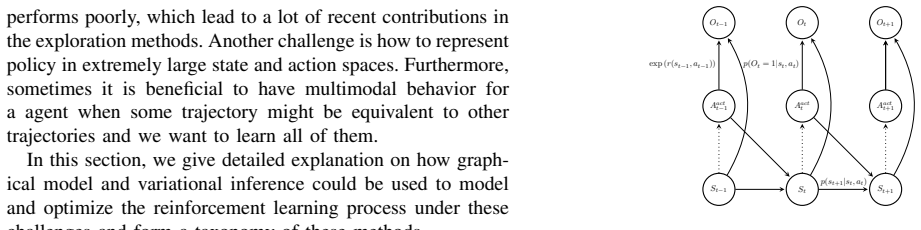
The central mechanism is an auxiliary optimality variable $O_t$ with likelihood $p(O_t=1|s_t,a_t)=\exp(r(s_t,a_t))$ on shifted rewards, paired with the backward message $\beta(a_t,s_t)=p(O_{t:T}=1|a_t,s_t)p(a_t|s_t)$. The paper derives a recursion for $\beta$ and shows that $\log\beta(a_t,s_t)$ is a value-style quantity whose backup takes a softmax over next states, which is what produces the risk-seeking behavior and, under a variational approximation, the maximum-entropy family of objectives. This mechanism is what carries the directed-graph branch of the taxonomy and links it to both value-based RL and exploration bonuses.
What would settle it
Take a small stochastic MDP with all rewards shifted negative, compute the posterior policy $p(a_t|s_t,O_{t:T}=1)$ from the backward recursion, and compare its induced value function with the true optimal value function found by value iteration; a divergence at any state would falsify the claimed equivalence.
Extended reading notes
Core claim
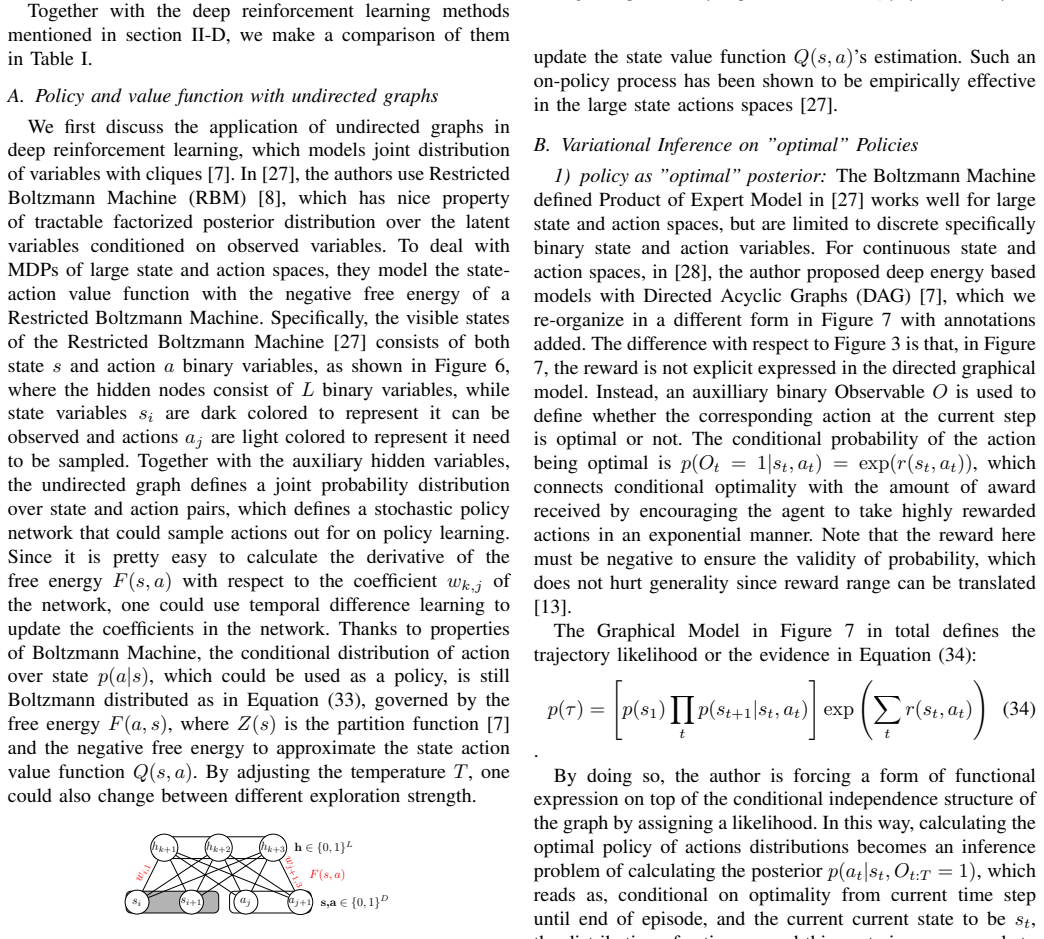
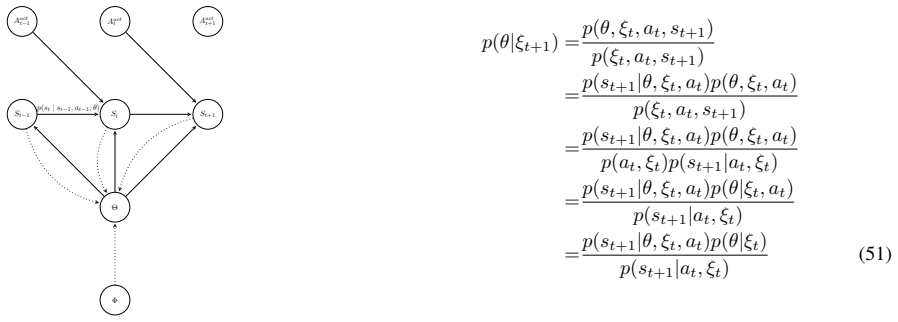
The paper's central claim is that the variety of deep reinforcement learning algorithms can be organized into a small number of graphical-model moves, and that the critical equations of each family can be derived in full. In the undirected-graph branch, the negative free energy of a Restricted Boltzmann Machine stands in for the state-action value function and its conditional distribution over actions serves as the policy. In the directed-graph branch, an auxiliary binary optimality variable $O_t$ with likelihood $p(O_t=1|s_t,a_t)=\exp(r(s_t,a_t))$ turns the optimal policy into the posterior $p(a_t|s_t,O_{t:T}=1)$, and the paper derives the backward-message recursion that computes this posterior and shows its logarithm is a risk-seeking Bellman backup. In the environment-model branch, variational inference targets either the transition distribution or the latent-state posterior, yielding intrinsic rewards and VAE-style ELBO objectives. Across all branches, the paper's contribution is the derivations and the unified picture that connects them.
Load-bearing premise
The load-bearing premise is that optimality can be encoded as $p(O_t=1|s_t,a_t)=\exp(r(s_t,a_t))$ with all rewards negative, so that the optimal policy is exactly the posterior over actions given that all future steps are optimal; if that equivalence fails, the directed-graph derivation does not describe optimal control.
Editorial extensions
If this is right
- Readers can reproduce derivations that previous papers left as exercises, making the tutorial a self-contained bridge for beginners and researchers entering the area.
- The message-passing recursion for the optimal-policy posterior yields a specific Bellman-style backup that is risk-seeking, so the taxonomy predicts when exact control-as-inference will diverge from standard RL.
- Through the variational approximation, maximum-entropy objectives such as reward-plus-entropy arise naturally rather than as heuristics.
- Environment-model variational methods, including intrinsic rewards from conditional mutual information and latent-state tabulation via a VAE-like ELBO, fit into the same inference framework and can be combined with base RL algorithms.
Reading between the lines
- If the taxonomy is right, a natural testable extension would be to derive new algorithms by swapping graph structure, such as adding memory or hierarchical variables, and reading off the resulting Bellman or ELBO update.
- The exponential-tilting assumption suggests a family of alternative optimality likelihoods, for example tempered or bounded reward transforms, that would interpolate between risk-seeking and standard expected-return backups; the paper does not explore this.
- The unified derivations imply that differences among algorithm families may hinge more on which inference approximation is chosen than on the underlying objective, an explicit comparison the paper leaves to future work.
Signed reviews
Editorial analysis
A structured set of objections, weighed in public.
Referee Report
Summary. This paper is a tutorial/survey aiming to connect probabilistic graphical models (PGMs) and variational inference to deep reinforcement learning. It reviews RL basics, provides PGM representations for MDPs and POMDPs, discusses undirected-graph policy models (e.g., restricted Boltzmann machines), develops control-as-inference with an auxiliary optimality variable, derives soft-Q/energy-based policies, and covers variational approaches to environment modeling (VIME and VaST). The stated contribution is to supply detailed derivations for equations that the authors claim are not available in the original references, and to organize these methods into a taxonomy.
Significance. If the derivations were reliable, the paper could serve as a useful complementary tutorial for readers of Levine's control-as-inference tutorial and for the papers on VIME, VaST, and soft Q-learning. The attempt to recast recent deep RL methods as PGMs and to prove auxiliary formulas (e.g., the soft-policy improvement identity) is a legitimate pedagogical contribution. However, the value of the paper rests entirely on the correctness of those derivations, and at present several load-bearing equations are incorrect or malformed as displayed. The paper contains no machine-checked proofs or reproducible code, so the reader must rely on the displayed mathematics.
major comments (4)
- [III-B2, Eq. (36)] The backward-message recursion is the paper's central advertised derivation, but the displayed chain contains a false equality. In passing from the joint conditional p(O_{t+1:T}, s_{t+1}, a_{t+1} | s_t, a_t) to the product p(O_{t+1:T}|s_{t+1},a_{t+1}) p(s_{t+1}|s_t,a_t), the factor p(a_{t+1}|s_{t+1}) is silently dropped. This factor is present in Figure 7 and in the definition of beta in Eq. (35). The final line of Eq. (36) can be recovered only if the a_{t+1} integral is retained and beta(s_{t+1}) is understood to include p(a_{t+1}|s_{t+1}); as printed, an intermediate equality is false. Because this recursion is offered as the derivation 'not available in [13]', the error directly undermines the paper's central pedagogical claim.
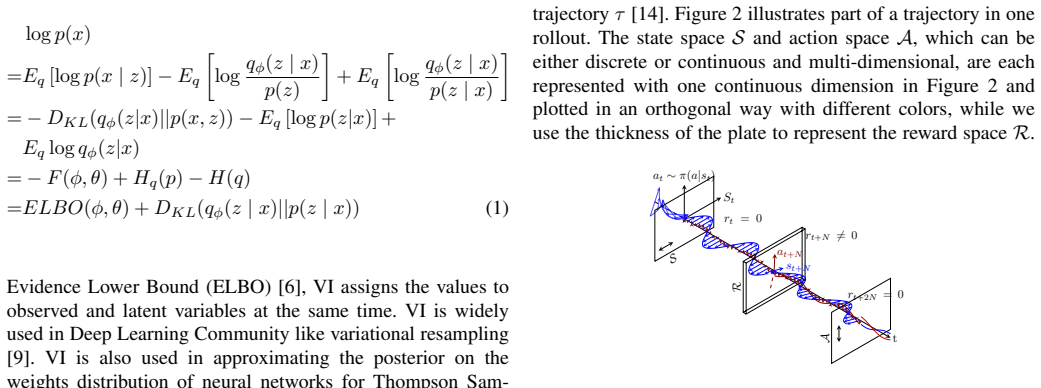
- [I-B, Eq. (1)] The ELBO identity, which the paper presents as a contribution, is garbled. The chain includes terms such as -D_KL(q_phi(z|x) || p(x,z)) and H_q(p) that are not defined, and the expression '-F(phi,theta)+H_q(p)-H(q)' is not a transparent consequence of the previous line. The standard identity log p(x) = ELBO(phi,theta) + D_KL(q_phi(z|x) || p(z|x)) should be written out with the usual definitions of the ELBO and of the free energy. As a foundational section of a tutorial, the present display will mislead readers.
- [III-B1, Eq. (34)] The trajectory likelihood in Eq. (34) omits the action prior p(a_t|s_t) that appears in Eq. (35) and in Figure 7. If p(a_t|s_t) is intended to be uniform, that should be stated explicitly; otherwise the 'evidence' is inconsistent with the posterior computation that follows. Since the equivalence between control and inference rests on this likelihood, the omission is load-bearing.
- [III-B, text before Eq. (35)] The exponential-tilting likelihood p(O_t=1|s_t,a_t)=exp(r(s_t,a_t)) and the identification of the optimal policy with the posterior p(a_t|s_t,O_{t:T}=1) are imported from [13] without derivation. In a paper that advertises itself as a 'self-inclusive tutorial', this is a missing derivation; at minimum, the assumptions (bounded, negative rewards; uniform action prior) should be stated before Eq. (34) is used.
minor comments (4)
- [II-A, Eq. (7) and text after Eq. (8)] In Eq. (7), the conditioning should be S_t=s, not 'forall S_t=s'; after Eq. (8), the line 'Aact_{t+i} ~ pi(a|S_{t+i+1})' should read 'S_{t+i}'.
- [III-B5, Eq. (48)] The displayed line involving the log-partition function is malformed; it should read log[ exp(Q(s,a)) / (int exp(Q(s,a')) da') ] - log int exp(Q(s,a')) da' in the intermediate line, before the final D_KL expression. As printed, the line does not parse.
- [Table I] The table caption and column meanings are unclear: the 'var' column mixes 'na', conditional densities, and unspecified symbols, and the 'P' and 'standalone' columns are not explained in the text.
- [III-C2, Eq. (54)] The factorized variational posterior q(S_{0:T}|O_{0:T}) = prod_t q_phi(S_t|O_{t-k:t}) is stated without discussing the edge cases at t<k or the treatment of the final time step; this should be clarified for a tutorial.
Circularity Check
No circularity: the tutorial's derivations are self-contained expansions of standard definitions, and the self-citations are peripheral framing rather than load-bearing evidence.
full rationale
This is a tutorial and survey, not an empirical paper: it makes no predictions and fits no parameters, so the classic circularity patterns (fitted input called prediction, defined quantity used to predict itself) do not apply. The central derivation chain in Section III-B imports the control-as-inference construction p(O_t=1|s_t,a_t)=exp(r(s_t,a_t)) from Levine's external tutorial [13] and from the deep energy-based policy paper [28]; this is an acknowledged modeling assumption rather than a conclusion derived from the paper's own inputs, and it is not circular because it does not presuppose the soft Bellman result it is used to obtain. The paper's own derivations, such as the policy-gradient identity in Equations (25)-(29), the ELBO decomposition in Equations (43)-(45), and the VIME conditional-mutual-information identity in Equations (49)-(50), expand standard definitions and do not reduce to their own conclusions by construction. The paper does cite several works by its own authors ([3], [9], [14], [22], [25]), but these are descriptive examples from the survey portions (AutoML, variational resampling, multi-goal RL, recommender systems, Bayesian optimization) and none of them carries the weight of the variational-inference or graphical-model derivations. There is no invoked uniqueness theorem, no ansatz hidden behind a self-citation, and no renamed empirical pattern presented as a new unification. A separate mathematical concern exists: the displayed recursion in Equation (36) appears to omit the action factor p(a_{t+1}|s_{t+1}) in an intermediate factorization; that is a correctness issue in the exposition, not a circularity, because it does not make the conclusion equivalent to the premise. Overall, the paper is not circular.
Assumptions & free parameters
assumptions (4)
- standard math Standard probability theory and graphical model semantics, including d-separation and conditional independence, are assumed.
- domain assumption The environment is a Markov decision process with transition distribution p(s_{t+1}|s_t,a_t) and reward distribution p(r_t|s_t,a_t).
- domain assumption The optimal policy can be expressed as the posterior over actions given an auxiliary optimality variable O_t with p(O_t=1|s_t,a_t)=exp(r(s_t,a_t)), requiring rewards to be negative.
- domain assumption The variational family q_phi(z|x) is expressive enough to approximate the true posterior (e.g., the policy network class).
Cite this review
Pith. "Pith review of Tutorial and Survey on Probabilistic Graphical Model and Variational Inference in Deep Reinforcement Learning." pith.science (2026). https://pith.science/paper/LYIPUVHP
@misc{pith2026190809381,
  author       = {Pith},
  title        = {Pith review of: Tutorial and Survey on Probabilistic Graphical Model and Variational Inference in Deep Reinforcement Learning},
  year         = {2026},
  howpublished = {\url{https://pith.science/paper/LYIPUVHP}},
  note         = {Machine review of arXiv:1908.09381}
}
read the original abstract
Aiming at a comprehensive and concise tutorial survey, recap of variational inference and reinforcement learning with Probabilistic Graphical Models are given with detailed derivations. Reviews and comparisons on recent advances in deep reinforcement learning are made from various aspects. We offer detailed derivations to a taxonomy of Probabilistic Graphical Model and Variational Inference methods in deep reinforcement learning, which serves as a complementary material on top of the original contributions.
Figures

Figures from the paper (6 more)

Reference graph
Works this paper leans on
-
[13]
Reinforcement learning and control as probabilistic infer- ence: Tutorial and review,
S. Levine, “Reinforcement learning and control as probabilistic infer- ence: Tutorial and review,” arXiv preprint arXiv:1805.00909 , 2018
arXiv 2018
-
[1]
Human-level control through deep reinforcement learning,
V . Mnih, K. Kavukcuoglu, D. Silver, A. A. Rusu, J. Veness, M. G. Bellemare, A. Graves, M. Riedmiller, A. K. Fidjeland, G. Ostrovski et al. , “Human-level control through deep reinforcement learning,” Nature, vol. 518, no. 7540, p. 529, 2015
2015
-
[2]
Trust region policy optimization,
J. Schulman, S. Levine, P. Abbeel, M. Jordan, and P. Moritz, “Trust region policy optimization,” in International conference on machine learning, 2015, pp. 1889–1897
work page 2015
-
[3]
X. Sun, J. Lin, and B. Bischl, “Reinbo: Machine learning pipeline search and configuration with bayesian optimization embedded reinforcement learning,” 2019
work page 2019
-
[4]
Vime: Variational information maximizing exploration,
R. Houthooft, X. Chen, Y . Duan, J. Schulman, F. De Turck, and P. Abbeel, “Vime: Variational information maximizing exploration,” in Advances in Neural Information Processing Systems , 2016, pp. 1109– 1117
work page 2016
-
[5]
Efficient Model-Based Deep Reinforcement Learning with Variational State Tabulation
D. Corneil, W. Gerstner, and J. Brea, “Efficient model-based deep reinforcement learning with variational state tabulation,” arXiv preprint arXiv:1802.04325, 2018
work page Pith review arXiv 2018
-
[6]
Variational inference: A review for statisticians,
D. M. Blei, A. Kucukelbir, and J. D. McAuliffe, “Variational inference: A review for statisticians,” Journal of the American Statistical Associa- tion, vol. 112, no. 518, pp. 859–877, 2017
work page 2017
-
[7]
C. M. Bishop, Pattern recognition and machine learning . springer, 2006
2006
Show all 32 references
-
[8]
Training restricted boltzmann machines: An introduction,
A. Fischer and C. Igel, “Training restricted boltzmann machines: An introduction,” Pattern Recognition, vol. 47, pp. 25–39, 01 2014
2014
-
[9]
Variational resampling based assessment of deep neural networks under distribution shift,
X. Sun, A. Gossmann, Y . Wang, and B. Bischl, “Variational resampling based assessment of deep neural networks under distribution shift,” 2019
2019
-
[10]
Weight uncertainty in neural networks,
C. Blundell, J. Cornebise, K. Kavukcuoglu, and D. Wierstra, “Weight uncertainty in neural networks,” arXiv preprint arXiv:1505.05424, 2015
2015 arXiv
-
[11]
Auto-encoding variational bayes,
D. P. Kingma and M. Welling, “Auto-encoding variational bayes,” arXiv preprint arXiv:1312.6114, 2013
2013 arXiv
-
[12]
R. S. Sutton, A. G. Barto et al., Introduction to reinforcement learning. MIT press Cambridge, 1998, vol. 2, no. 4
1998
-
[14]
Maximum entropy-regularized multi- goal reinforcement learning,
R. Zhao, X. Sun, and V . Tresp, “Maximum entropy-regularized multi- goal reinforcement learning,” arXiv preprint arXiv:1905.08786 , 2019
1905 arXiv
-
[15]
Planning and acting in partially observable stochastic domains,
L. P. Kaelbling, M. L. Littman, and A. R. Cassandra, “Planning and acting in partially observable stochastic domains,”Artificial i ntelligence, vol. 101, no. 1-2, pp. 99–134, 1998
1998
-
[16]
Deep reinforcement learning with double q-learning,
H. Van Hasselt, A. Guez, and D. Silver, “Deep reinforcement learning with double q-learning,” in Thirtieth AAAI conference on artificial intelligence, 2016
2016
-
[17]
Continuous control with deep reinforcement learning,
T. P. Lillicrap, J. J. Hunt, A. Pritzel, N. Heess, T. Erez, Y . Tassa, D. Silver, and D. Wierstra, “Continuous control with deep reinforcement learning,” arXiv preprint arXiv:1509.02971 , 2015
2015 arXiv
-
[18]
Deterministic policy gradient algorithms,
D. Silver, G. Lever, N. Heess, T. Degris, D. Wierstra, and M. Riedmiller, “Deterministic policy gradient algorithms,” 2014
2014
-
[19]
Asynchronous methods for deep rein- forcement learning,
V . Mnih, A. P. Badia, M. Mirza, A. Graves, T. Lillicrap, T. Harley, D. Silver, and K. Kavukcuoglu, “Asynchronous methods for deep rein- forcement learning,” in International conference on machine learning , 2016, pp. 1928–1937
2016
-
[20]
Prox- imal policy optimization algorithms,
J. Schulman, F. Wolski, P. Dhariwal, A. Radford, and O. Klimov, “Prox- imal policy optimization algorithms,” arXiv preprint arXiv:1707.06347, 2017
2017 arXiv
-
[21]
Universal value func- tion approximators,
T. Schaul, D. Horgan, K. Gregor, and D. Silver, “Universal value func- tion approximators,” in International Conference on Machine Learning , 2015, pp. 1312–1320
2015
-
[22]
A lesson learned from pmf based approach for semantic recommender system,
N. Kushwaha, X. Sun, B. Singh, and O. Vyas, “A lesson learned from pmf based approach for semantic recommender system,” Journal of Intelligent Information Systems , vol. 50, no. 3, pp. 441–453, 2018
2018
-
[23]
Hindsight expe- rience replay,
M. Andrychowicz, F. Wolski, A. Ray, J. Schneider, R. Fong, P. Welinder, B. McGrew, J. Tobin, O. P. Abbeel, and W. Zaremba, “Hindsight expe- rience replay,” in Advances in Neural Information Processing Systems , 2017, pp. 5048–5058
2017
-
[24]
Prioritized experience replay,
T. Schaul, J. Quan, I. Antonoglou, and D. Silver, “Prioritized experience replay,” arXiv preprint arXiv:1511.05952 , 2015
2015 arXiv
-
[25]
High dimensional restrictive federated model selection with multi-objective bayesian optimization over shifted distributions,
X. Sun, A. Bommert, F. Pfisterer, J. Rahnenf ¨uhrer, M. Lang, and B. Bischl, “High dimensional restrictive federated model selection with multi-objective bayesian optimization over shifted distributions,” arXiv preprint arXiv:1902.08999, 2019
1902 arXiv
-
[26]
Approximately optimal approximate rein- forcement learning,
S. Kakade and J. Langford, “Approximately optimal approximate rein- forcement learning,” in ICML, vol. 2, 2002, pp. 267–274
2002
-
[27]
Reinforcement learning with factored states and actions,
B. Sallans and G. E. Hinton, “Reinforcement learning with factored states and actions,” Journal of Machine Learning Research , vol. 5, no. Aug, pp. 1063–1088, 2004
2004
-
[28]
Reinforcement learning with deep energy-based policies,
T. Haarnoja, H. Tang, P. Abbeel, and S. Levine, “Reinforcement learning with deep energy-based policies,” in Proceedings of the 34th Interna- tional Conference on Machine Learning-Volume 70. JMLR. org, 2017, pp. 1352–1361
2017
-
[29]
Soft actor-critic: Off- policy maximum entropy deep reinforcement learning with a stochastic actor,
T. Haarnoja, A. Zhou, P. Abbeel, and S. Levine, “Soft actor-critic: Off- policy maximum entropy deep reinforcement learning with a stochastic actor,” arXiv preprint arXiv:1801.01290 , 2018
2018 arXiv
-
[30]
Planning to be surprised: Op- timal bayesian exploration in dynamic environments,
Y . Sun, F. Gomez, and J. Schmidhuber, “Planning to be surprised: Op- timal bayesian exploration in dynamic environments,” in International Conference on Artificial General Intelligence . Springer, 2011, pp. 41– 51
2011
-
[31]
Tutorial on variational autoencoders,
C. Doersch, “Tutorial on variational autoencoders,” arXiv preprint arXiv:1606.05908, 2016
2016 arXiv
-
[32]
The concrete distribution: A continuous relaxation of discrete random variables,
C. J. Maddison, A. Mnih, and Y . W. Teh, “The concrete distribution: A continuous relaxation of discrete random variables,” arXiv preprint arXiv:1611.00712, 2016
2016 arXiv
Reviewed August 14, 2026 · model on record in the stance chip above.
Discussion (0). Continue with ORCID to comment.