REVIEW 1 major objections 5 minor 1 cited by
Spontaneous scalarization of charged black holes in the Scalar-Vector-Tensor theory
T0 review · 1 major / 5 minor · reviewed 2026-08-14 · deepseek-v4-flash
Pith's one-line read In the f4 scalar-vector-tensor model, the double-dual Riemann coupling destabilizes the constant-scalar Reissner-Nordström solution, and the stable scalarized endpoint can carry charge-to-mass ratio greater than one.
desk verdict A solid extension of scalarization to the f4 L F F coupling with overcharged solutions; the main gap is that the end-state claim rests on scalar-only stability. read the letter →
The pith
A machine-rendered reading of the paper's core claim, the machinery that carries it, and where it could break.
The reading
What carries the argument
The central object is the invariant $L^{\mu\nu\alpha\beta}F_{\mu\nu}F_{\alpha\beta}$, where $L^{\mu\nu\alpha\beta}=\frac{1}{4}\epsilon^{\mu\nu\rho\sigma}\epsilon^{\alpha\beta\gamma\delta}R_{\rho\sigma\gamma\delta}$ is the double-dual Riemann tensor and $F_{\mu\nu}$ is the electromagnetic field strength. On the Reissner-Nordström background this combination is positive outside the horizon and proportional to $Q^2(1-f)/r^6$, giving the scalar field an effective negative mass squared near the horizon when $H''(0)>0$. In the nonlinear scalarized regime, the same coupling enters the equations of motion for the metric, vector, and scalar fields; the exponential form $H(\Phi)=\frac{\eta}{2}(1-e^{-\Phi^2})$ is crucial because $H''(\Phi)$ becomes negative for $|\Phi|>1/\sqrt{2}$, which flips the effective potential positive and stabilizes the nodeless solution.
What would settle it
Perform a linear perturbation analysis including metric and vector modes around the nodeless exponential scalarized solution constructed from Eqs. (28)-(30); a mode with $\omega^2<0$ would refute the endpoint claim. Alternatively, a full nonlinear evolution of a sufficiently charged Reissner-Nordström black hole in this theory that fails to settle on the scalarized solution would settle the question.
Extended reading notes
Core claim
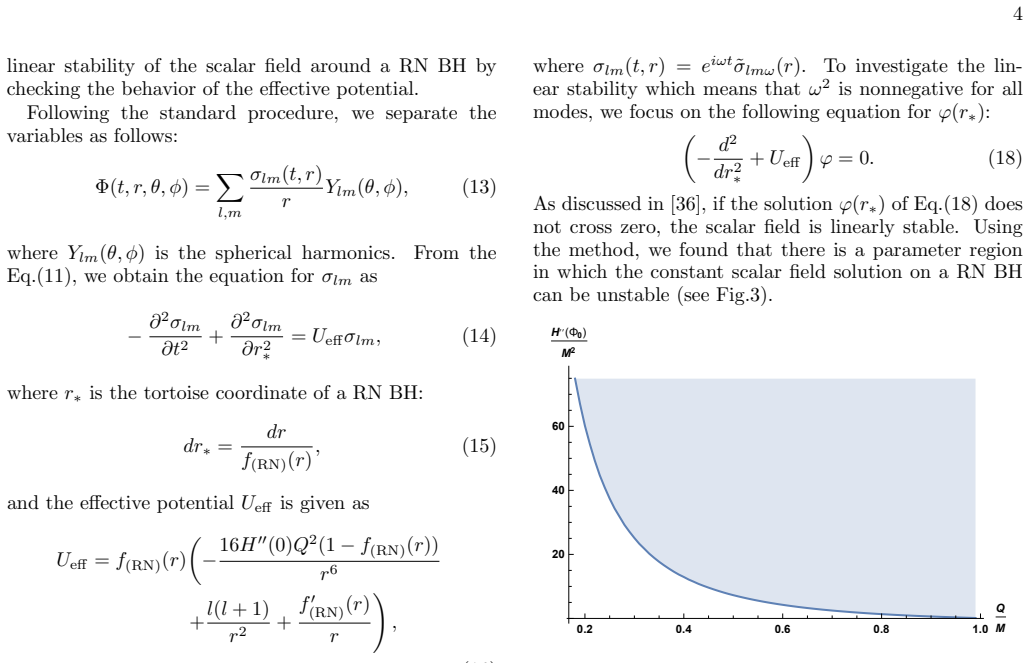
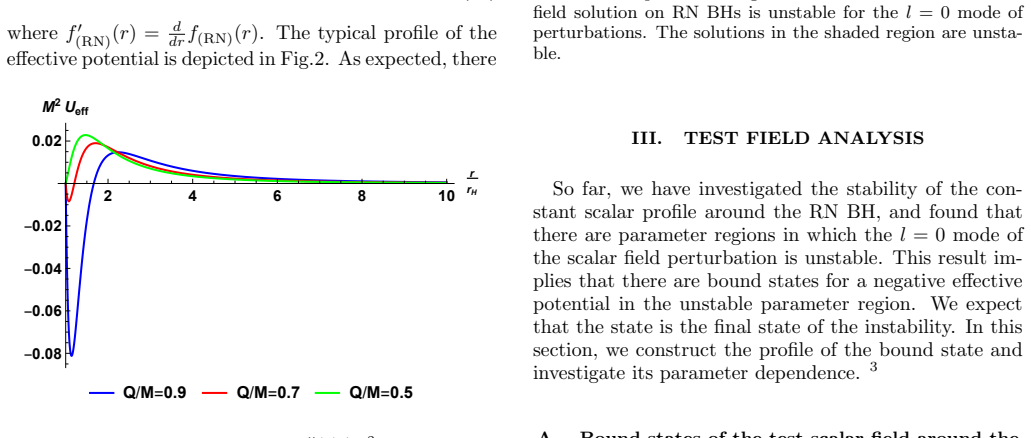
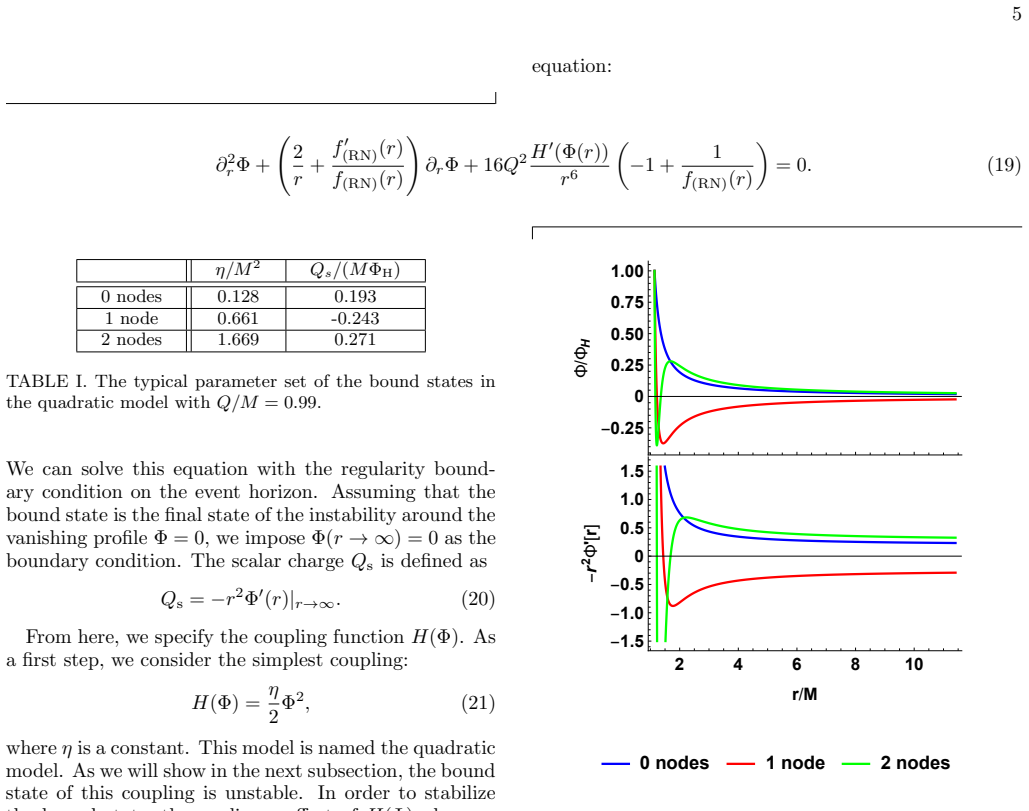
Within the f4 model defined by $S=\int d^4x\sqrt{-g}\left(\frac{1}{16\pi G}R-\frac{1}{2}\nabla_\mu\Phi\nabla^\mu\Phi-\frac{1}{4}F_{\mu\nu}F^{\mu\nu}+H(\Phi)L^{\mu\nu\alpha\beta}F_{\mu\nu}F_{\alpha\beta}\right)$, with $H(0)=H'(0)=0$, the Reissner-Nordström solution with $\Phi=0$ is not the whole story. Around RN, $L^{\mu\nu\alpha\beta}F_{\mu\nu}F_{\alpha\beta}=16Q^2(1-f)/r^6$ is positive outside the horizon, so the scalar perturbation has effective mass squared $m_{\rm eff}^2=-H''(0)L^{\mu\nu\alpha\beta}F_{\mu\nu}F_{\alpha\beta}$; when $H''(0)>0$ this is negative and the $l=0$ mode becomes tachyonic for $Q/M$ above a threshold. The paper constructs static, spherically symmetric scalarized solutions by solving Eqs. (28)-(30) with the vector field determined by Eq. (31). These solutions carry mass $M$, electric charge $Q$, and scalar charge $Q_s$; in both the quadratic and exponential models the nodeless branch reaches $Q/M>1$, meaning the scalarized black hole is overcharged. Stability is checked only for scalar-field perturbations; within that check, the exponential model has an everywhere positive effective potential for the nodeless solution, so the paper concludes this scalarized black hole can be the end state of scalarization.
Load-bearing premise
The endpoint claim assumes the full coupled metric-vector-scalar perturbations around the scalarized solution are stable, while the paper checks only scalar-field perturbations.
Editorial extensions
If this is right
- In this theory the usual no-hair expectation fails: a charged black hole with large enough $Q/M$ or coupling spontaneously acquires a scalar profile.
- The scalarized solutions can be overcharged, with $Q/M>1$, so the f4 model predicts a class of black holes outside the extremal Reissner-Nordström bound.
- In the exponential model the nodeless scalarized solution is stable against radial scalar perturbations, so it is a viable final state of the instability; the quadratic model is not.
- Because the triggering invariant vanishes in flat spacetime, scalarization here requires a curved background, unlike scalarization through $F^{\mu\nu}F_{\mu\nu}$.
- The scalar charge $Q_s$ can be of order one, making the asymptotic metric differ measurably from the Reissner-Nordström metric.
Reading between the lines
- A natural next step is to include metric and vector perturbations around the scalarized solutions; if any coupled mode is unstable, the endpoint claim would need revision.
- Overcharged scalarized black holes, if stable in the full theory, would sit above the extremal charge bound and could serve as testbeds for weak cosmic censorship in modified gravity.
- The same coupling should act around a rotating black hole immersed in an external magnetic field, an environment the paper mentions as the likely astrophysical setting for this scalarization.
- The critical line of maximum $Q/M$ could be mapped numerically and compared with the extremal condition (39), which would tell whether overcharged solutions approach extremality or stay bounded away from it.
Signed reviews
Editorial analysis
A structured set of objections, weighed in public.
Referee Report
Summary. The paper investigates spontaneous scalarization of charged black holes in a scalar-vector-tensor theory with the nonminimal coupling H(Φ)L^{μναβ}F_{μν}F_{αβ}. It first derives a no-hair condition for the constant-scalar Reissner-Nordström solution and shows that for H''(0)>0 the scalar field can develop a tachyonic instability, with the threshold computed via the zero-mode method. It then constructs test-field bound states for quadratic and exponential forms of H(Φ), finding that the quadratic bound state is radially unstable while the exponential nodeless bound state can have a positive effective potential. Finally, it constructs fully backreacted scalarized black hole solutions and reports that they can have Q/M > 1 (overcharged), and that in the exponential model the nodeless solution has a positive scalar effective potential, leading the authors to conclude that it can be the endpoint of scalarization.
Significance. The paper presents a new mechanism for black hole scalarization in an SVT theory, and the derived instability threshold follows directly from the equations of motion without fitted parameters. The overcharging result, if confirmed, is a novel feature of the f4 model. The zero-mode stability method is applied consistently and the numerical solutions appear to satisfy the stated equations and boundary conditions. However, the central final-state claim is currently supported only by a scalar-perturbation analysis; the full coupled stability remains an open issue, which tempers the significance of the conclusion.
major comments (1)
- [Sec. IV B, Eq. (42)] The stability analysis of the scalarized solutions considers only scalar-field perturbations around the fixed background, as the text states: 'Here, we only consider the stability against the perturbation of the scalar field.' In the action (1), the scalar field is nonminimally coupled to both the metric and the electromagnetic field strength through H(Φ)L^{μναβ}F_{μν}F_{αβ}; at first order, a scalar perturbation sources metric and vector perturbations. Positivity of U_eff in Eq. (42) therefore does not rule out coupled instabilities, and Appendix C's justification of the test-field limit only covers small G, not the strongly backreacted solutions of Sec. IV. The conclusion that 'the scalarized BH solution in the exponential model can be the end state of scalarization' is accordingly not established by the analysis presented. I recommend either performing a full linear stability analysis including metric and vector perturbations, or revising the conclusion to state that these are candidate end states.
minor comments (5)
- [Sec. II B] The phrase 'the scalar field must be constant under the RH BH' should read 'RN BH'.
- [Sec. III A] The statement 'for each electric charge Q, there is a solution' is imprecise because the solution is also characterized by the number of nodes, and in the quadratic model the overall normalization is arbitrary.
- [Sec. IV A, Tables III and IV] The numerical solutions leading to the overcharging claim would be more convincing with a brief description of the numerical method, grid resolution, and estimated errors.
- [Fig. 3] The vertical axis label uses 'H''(Φ0)' while the text discusses 'H''(0)'; please unify the notation.
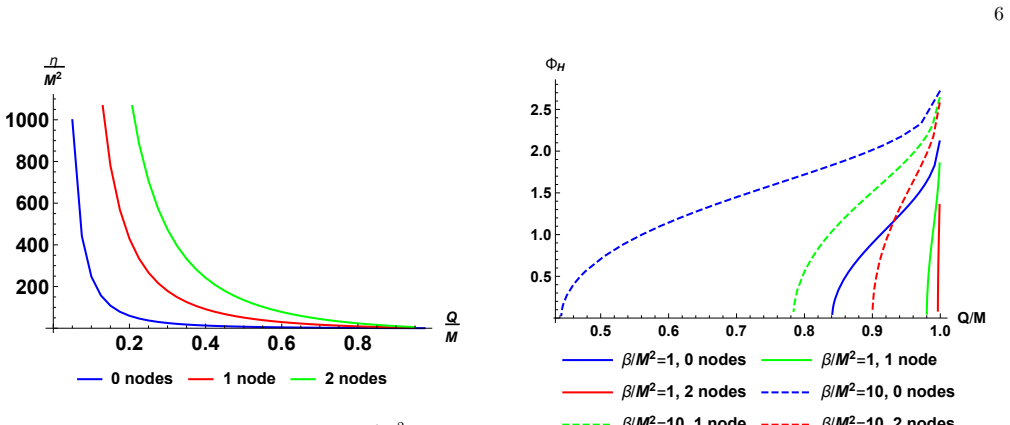
- [Sec. III A, Figs. 5 and 7] The statement that the critical line 'almost coincides' with the line of Fig. 3 is qualitative; a quantitative comparison would strengthen the claim.
Circularity Check
No circular derivation; instability, bound states, and scalarized solutions are computed from the action, with the only self-citation non-load-bearing.
full rationale
The derivation is self-contained. The action (1) fixes the model through H(Φ) with H(0)=H'(0)=0; H''(0)>0 then gives the tachyonic effective mass in Eq. (12) directly from the linearized scalar equation, so the instability region in Fig. 3 is a computed consequence, not a fitted output. The bound-state solutions in Sec. III solve the test-field equation (19) with the same H(Φ), and the threshold coinciding with the instability line is a consistency check (for the quadratic model the zero-node bound state and the zero mode of Eq. (18) are the same linear problem), not an independent prediction. The scalarized solutions in Sec. IV are obtained by solving the full ODEs (28)-(30) with boundary conditions; the overcharging Q/M>1 is read off from the asymptotic coefficients, so it is emergent. The stability conclusion for the exponential model rests on the explicit positivity of the effective potential (42) for the nodeless solution, which is checked numerically. A limitation is that only scalar-field perturbations are treated (Sec. IV B: 'Here, we only consider the stability against the perturbation of the scalar field'), so the final-state claim is not fully proven, but this is an incompleteness, not a circular reduction. The only self-citation, footnote 3's use of [26] as an analogy for test-field behavior, is not load-bearing: the paper gives its own small-G justification in Appendix C and its own stability computation for the constructed solutions.
Assumptions & free parameters
free parameters (3)
- η (scalarization coupling constant)
- Q/M or Q/r_H (electric charge parameter)
- Φ_H (horizon value of scalar field in exponential bound states)
assumptions (3)
- domain assumption Spacetime is static, spherically symmetric, and asymptotically flat, with scalar and vector fields sharing the spacetime symmetries.
- domain assumption Stability of scalarized solutions can be assessed by scalar-field perturbations on a fixed background.
- ad hoc to paper The quadratic and exponential forms of H(Φ) are representative scalarization couplings.
Cite this review
Pith. "Pith review of Spontaneous scalarization of charged black holes in the Scalar-Vector-Tensor theory." pith.science (2026). https://pith.science/paper/BTCXGGQC
@misc{pith2026190809394,
  author       = {Pith},
  title        = {Pith review of: Spontaneous scalarization of charged black holes in the Scalar-Vector-Tensor theory},
  year         = {2026},
  howpublished = {\url{https://pith.science/paper/BTCXGGQC}},
  note         = {Machine review of arXiv:1908.09394}
}
abstract
We present spontaneous scalarization of charged black holes (BHs) which is induced by the coupling of the scalar field to the electromagnetic field strength and the double-dual Riemann tensor $L^{\mu\nu\alpha\beta}F_{\mu\nu}F_{\alpha\beta}$ in a scalar-vector-tensor theory. In our model, the scalarization can be realized under the curved background with a non-trivial electromagnetic field, such as Reissner-Nordstr$\ddot{\rm o}$m Black Holes (RN BHs). Firstly, we investigate the stability of the constant scalar field around RN BHs in the model, and show that the scalar field can suffer a tachyonic instability. Secondly, the bound state solution of the test scalar field around a RN BH and its stability are discussed. Finally, we construct scalarized BH solutions, and investigate their stability.
Figures

Figures from the paper (10 more)


Forward citations
Cited by 1 Pith paper
-
Compact Objects in Einstein-scalar-Gauss-Bonnet Theory and beyond
A review of compact-object solutions in Einstein-scalar-Gauss-Bonnet and Horndeski theories, emphasizing scalarized black holes, traversable wormholes, and bubble-like particle solutions.
Reference graph
Works this paper leans on
-
[8]
f3(X) vanishes at X = 0. Here,Gi andfi are functions of the SVT theory, andF = FµνFµν, ˜F = ˜FµνFµν (see AppendixA).Fµν and ˜Fµν are the field strength of the vector field, and its dual field (i.e. Fµν =∇µAν−∇νAµ, ˜Fµν = 1 2ϵµνρσFρσ). X is a kinetic arXiv:1908.09394v2 [gr-qc] 9 Nov 2019 2 term of the scalar field Φ (i.e. X =− 1 2∇µΦ∇µΦ). Un- der these assumpt...
arXiv 1908
-
[9]
The quadratic model In the quadratic model, the equation of motion for the scalar field becomes linear, and the normalization factor of the field is irrelevant as long as the backreaction can be ignored. We found that for each electric charge Q, there is a solution which is characterized by the number of nodes. The typical profiles of the scalar field are dep...
-
[10]
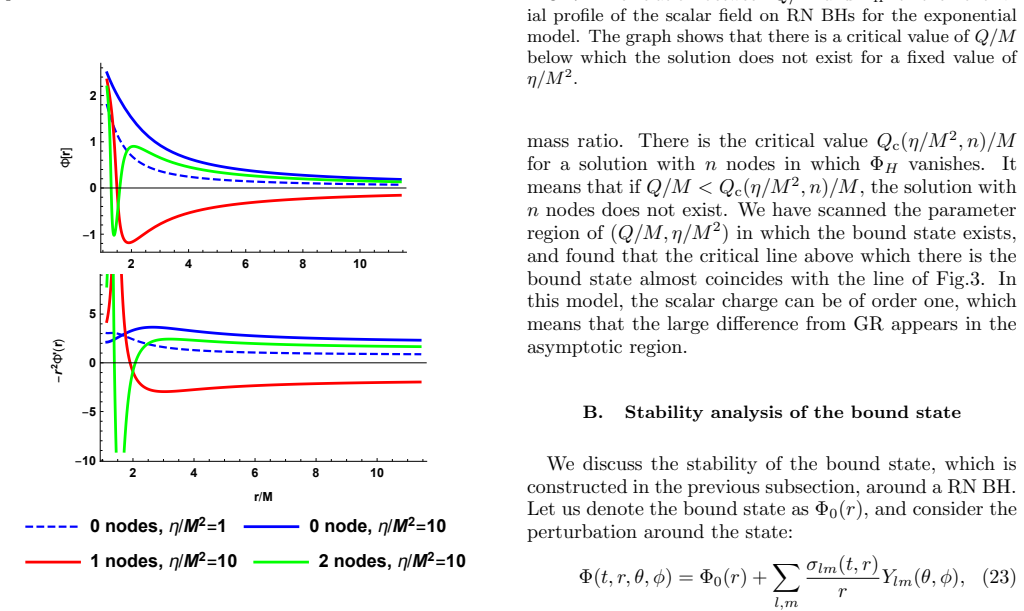
The exponential model In the exponential model, the equation of motion for the scalar field is nonlinear, and the relevant free param- eters are η/M2,Q/M,ΦH, where ΦH is the value of the scalar field on the event horizon. The typical profile of the scalar field is depicted in Fig.6, and the corresponding parameter sets are summarized in Table.II For fixed cou-...
-
[11]
Therefore, the bound state with H(Φ) = η 2 Φ2 is unstable against the radial perturbations
The quadratic model In the quadratic model, the effective potential is the same as one of the perturbations around the constant scalar field, and hence the stability condition remains the same. Therefore, the bound state with H(Φ) = η 2 Φ2 is unstable against the radial perturbations
-
[12]
The positive effective potential 2 4 6 8 10 r/M -0.10 -0.05 0.05 Ueff Exp
The exponential model In the exponential model, the effective potential of the radial perturbation around the bound state on the RN BH is shown in Fig.8. The positive effective potential 2 4 6 8 10 r/M -0.10 -0.05 0.05 Ueff Exp. model,0 nodes Exp. model,1 node Quadratic model,0 nodes FIG. 8. The effective potential for Q/M = 0.99,η/M 2 = 1. The blue line cor...
-
[13]
These solutions can be overcharged
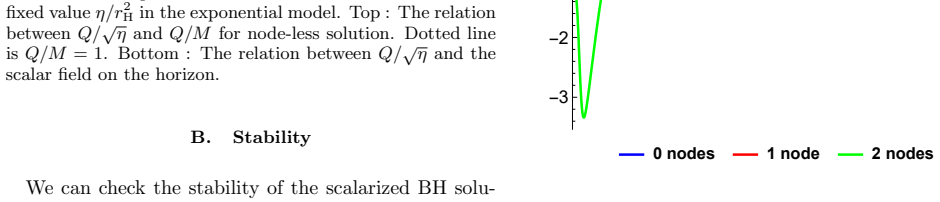
The quadratic model The typical profile of the fields is depicted in Fig.9, and the parameters of the solutions are summarized in Table.III. These solutions can be overcharged. We found that the 0 nodes solution has the biggest Q/M for fixed η/M2 andQ/√η. Since nodeless solutions are more likely to be stable, we focus on nodeless solutions. The rela- tion be...
-
[14]
The exponential model The typical behavior of the fields is depicted in Fig.11. These behaviors are almost the same as the quadratic -0.25 0 0.25 0.50 0.75 1.00 Φ(r) 5 10 15 20 0.5 0.6 0.7 0.8 0.9 r/rH r(1-b[r])/2 0 nodes,η/r H2=1.0 1 node,η/r H2=1.0 2 nodes,η/r H2=1.0 0 nodes,η/r H2=0.1 FIG. 11. The typical behavior of the scalarized BH solutions with Q/r...
work page 2015
-
[15]
The spacetime is spherically symmetric and static spacetime with the asymptotic flatness
Show all 54 references
-
[16]
F , ˜F and the gradient of the scalar field vanish in the asymptotic region
-
[17]
The scalar and vector fields have the same symme- tries with the metric
-
[18]
The norm of the Noether current JΦµJµ Φ is finite on and outside the BH horizon
-
[19]
The theory has the canonical kinetic term of the scalar field X⊂f2(X,F, ˜F,Y )
-
[20]
The functions Gi=3,4,5(X), fi=3,4(X) and ˜f3(X) are analytic at X = 0
-
[21]
f2(X,F, ˜F,Y ) is analytic at X = 0, Y = 0, F = 0, and ˜F = 0
-
[22]
Since we assume that the action does not have a cos- mological constant, f2(0, 0, 0, 0, 0) = 0, and f2 vanishes at the infinity
f3(X) vanishes at X = 0. Since we assume that the action does not have a cos- mological constant, f2(0, 0, 0, 0, 0) = 0, and f2 vanishes at the infinity. The no-hair theorem states that under the above conditions, BHs can not have a nontrivial pro- file of the scalar field and ar...
-
[23]
J. D. Bekenstein, Phys. Rev. D 5, 1239 (1972). doi:10.1103/PhysRevD.5.1239
1972 doi
-
[24]
J. D. Bekenstein, Phys. Rev. D 51, no. 12, R6608 (1995). doi:10.1103/PhysRevD.51.R6608
1995 doi
-
[25]
C. A. R. Herdeiro and E. Radu, Phys. Rev. Lett. 112, 221101 (2014) doi:10.1103/PhysRevLett.112.221101 [arXiv:1403.2757 [gr-qc]]
2014 arXiv
-
[26]
Herdeiro, E
C. Herdeiro, E. Radu and H. R ˜Aonarsson, Class. Quant. Grav. 33, no. 15, 154001 (2016) doi:10.1088/0264- 9381/33/15/154001 [arXiv:1603.02687 [gr-qc]]
2016 arXiv
-
[27]
B. P. Abbott et al. [LIGO Scientific and Virgo Collab- orations], Phys. Rev. Lett. 116, no. 6, 061102 (2016) doi:10.1103/PhysRevLett.116.061102 [arXiv:1602.03837 [gr-qc]]
2016 arXiv
-
[28]
Akiyama et al
K. Akiyama et al. [Event Horizon Telescope Col- laboration], Astrophys. J. 875, no. 1, L1 (2019) doi:10.3847/2041-8213/ab0ec7 [arXiv:1906.11238 [astro- ph.GA]]
2019 arXiv
-
[29]
Hui and A
L. Hui and A. Nicolis, Phys. Rev. Lett. 109, 051304 (2012) doi:10.1103/PhysRevLett.109.051304 [arXiv:1201.1508 [astro-ph.CO]]
2012 arXiv
-
[30]
Heisenberg, JCAP 1810, no
L. Heisenberg, JCAP 1810, no. 10, 054 (2018) doi:10.1088/1475-7516/2018/10/054 [arXiv:1801.01523 [gr-qc]]
2018 arXiv
-
[31]
Heisenberg, Phys
L. Heisenberg, Phys. Rept. 796, 1 (2019) doi:10.1016/j.physrep.2018.11.006 [arXiv:1807.01725 [gr-qc]]
2019 arXiv
-
[32]
G. W. Horndeski, Int. J. Theor. Phys. 10, 363 (1974). doi:10.1007/BF01807638
1974 doi
-
[33]
Kobayashi, M
T. Kobayashi, M. Yamaguchi and J. Yokoyama, Prog. Theor. Phys. 126, 511 (2011) doi:10.1143/PTP.126.511 [arXiv:1105.5723 [hep-th]]
2011 arXiv
-
[34]
Kobayashi, Rept
T. Kobayashi, Rept. Prog. Phys. 82, no. 8, 086901 (2019) doi:10.1088/1361-6633/ab2429 [arXiv:1901.07183 [gr-qc]]
2019 arXiv
-
[35]
R. P. Woodard, Scholarpedia 10, no. 8, 32243 (2015) doi:10.4249/scholarpedia.32243 [arXiv:1506.02210 [hep- th]]
2015 arXiv
-
[36]
Hui and A
L. Hui and A. Nicolis, Phys. Rev. Lett. 110, 241104 (2013) doi:10.1103/PhysRevLett.110.241104 [arXiv:1202.1296 [hep-th]]
2013 arXiv
-
[37]
Babichev, C
E. Babichev, C. Charmousis and A. Lehebel, Class. Quant. Grav. 33, no. 15, 154002 (2016) doi:10.1088/0264-9381/33/15/154002 [arXiv:1604.06402 [gr-qc]]
2016 arXiv
-
[38]
Heisenberg and S
L. Heisenberg and S. Tsujikawa, Phys. Lett. B 780, 638 (2018) doi:10.1016/j.physletb.2018.03.059 [arXiv:1802.07035 [gr-qc]]
2018 arXiv
-
[39]
Damour and G
T. Damour and G. Esposito-Farese, Phys. Rev. Lett. 70, 2220 (1993). doi:10.1103/PhysRevLett.70.2220
1993 doi
-
[40]
Damour and G
T. Damour and G. Esposito-Farese, Phys. Rev. D 54, 1474 (1996) doi:10.1103/PhysRevD.54.1474 [gr- qc/9602056]
1996
-
[41]
Harada, Phys
T. Harada, Phys. Rev. D 57, 4802 (1998) doi:10.1103/PhysRevD.57.4802 [gr-qc/9801049]
1998 arXiv
-
[42]
P. C. C. Freire et al. , Mon. Not. Roy. Astron. Soc. 423, 3328 (2012) doi:10.1111/j.1365-2966.2012.21253.x [arXiv:1205.1450 [astro-ph.GA]]
2012
-
[43]
Berti et al
E. Berti et al. , Class. Quant. Grav. 32, 243001 (2015) doi:10.1088/0264-9381/32/24/243001 [arXiv:1501.07274 [gr-qc]]
2015 arXiv
-
[44]
H. O. Silva, J. Sakstein, L. Gualtieri, T. P. Sotiriou and E. Berti, Phys. Rev. Lett. 120, no. 13, 131104 (2018) doi:10.1103/PhysRevLett.120.131104 [arXiv:1711.02080 15 [gr-qc]]
2018 arXiv
-
[45]
Antoniou, A
G. Antoniou, A. Bakopoulos and P. Kanti, Phys. Rev. Lett. 120, no. 13, 131102 (2018) doi:10.1103/PhysRevLett.120.131102 [arXiv:1711.03390 [hep-th]]
2018 arXiv
-
[46]
D. D. Doneva and S. S. Yazadjiev, Phys. Rev. Lett. 120, no. 13, 131103 (2018) doi:10.1103/PhysRevLett.120.131103 [arXiv:1711.01187 [gr-qc]]
2018 arXiv
-
[47]
Antoniou, A
G. Antoniou, A. Bakopoulos and P. Kanti, Phys. Rev. D 97, no. 8, 084037 (2018) doi:10.1103/PhysRevD.97.084037 [arXiv:1711.07431 [hep-th]]
2018 arXiv
-
[48]
Minamitsuji and T
M. Minamitsuji and T. Ikeda, Phys. Rev. D 99, no. 4, 044017 (2019) doi:10.1103/PhysRevD.99.044017 [arXiv:1812.03551 [gr-qc]]
2019 arXiv
-
[49]
H. O. Silva, C. F. B. Macedo, T. P. Sotiriou, L. Gualtieri, J. Sakstein and E. Berti, Phys. Rev. D 99, no. 6, 064011 (2019) doi:10.1103/PhysRevD.99.064011 [arXiv:1812.05590 [gr-qc]]
2019 arXiv
-
[50]
P. V. P. Cunha, C. A. R. Herdeiro and E. Radu, Phys. Rev. Lett. 123, no. 1, 011101 (2019) doi:10.1103/PhysRevLett.123.011101 [arXiv:1904.09997 [gr-qc]]
2019 arXiv
-
[51]
Minamitsuji and T
M. Minamitsuji and T. Ikeda, Phys. Rev. D 99, no. 10, 104069 (2019) doi:10.1103/PhysRevD.99.104069 [arXiv:1904.06572 [gr-qc]]
2019 arXiv
-
[52]
Anson, E
T. Anson, E. Babichev, C. Charmousis and S. Ramazanov, JCAP 1906, no. 06, 023 (2019) doi:10.1088/1475-7516/2019/06/023 [arXiv:1903.02399 [gr-qc]]
2019 arXiv
- [53]
-
[54]
C. A. R. Herdeiro, E. Radu, N. Sanchis-Gual and J. A. Font, Phys. Rev. Lett. 121, no. 10, 101102 (2018) doi:10.1103/PhysRevLett.121.101102 [arXiv:1806.05190 [gr-qc]]
2018 arXiv
-
[55]
P. G. S. Fernandes, C. A. R. Herdeiro, A. M. Pombo, E. Radu and N. Sanchis-Gual, Class. Quant. Grav. 36, no. 13, 134002 (2019) doi:10.1088/1361-6382/ab23a1 [arXiv:1902.05079 [gr-qc]]
2019 arXiv
-
[56]
P. G. S. Fernandes, C. A. R. Herdeiro, A. M. Pombo, E. Radu and N. Sanchis-Gual, arXiv:1908.00037 [gr-qc]
1908 arXiv
-
[57]
I. Z. Stefanov, S. S. Yazadjiev and M. D. Todorov, Mod. Phys. Lett. A 23, 2915 (2008) doi:10.1142/S0217732308028351 [arXiv:0708.4141 [gr-qc]]
2008 arXiv
-
[58]
Kimura, Class
M. Kimura, Class. Quant. Grav. 34, no. 23, 235007 (2017) doi:10.1088/1361-6382/aa903f [arXiv:1706.01447 [gr-qc]]
2017 arXiv
-
[59]
R. M. Wald, Phys. Rev. D 10, 1680 (1974). doi:10.1103/PhysRevD.10.1680
1974 doi
-
[60]
D. A. Rasheed, hep-th/9702087
-
[61]
G. W. Horndeski, Phys. Rev. D 17, 391 (1978). doi:10.1103/PhysRevD.17.391
1978 doi
Reviewed August 14, 2026 · model on record in the stance chip above.
Discussion (0). Continue with ORCID to comment.