REVIEW 4 major objections 4 minor 78 references
Covariant Spectator Theory of $np$ scattering: Deuteron form factors
T0 review · 4 major / 4 minor · reviewed 2026-08-14 · deepseek-v4-flash
Pith's one-line read Model WJC2 with two fitted off-shell nucleon form factors F3 and F4 accounts for all elastic electron-deuteron data and predicts the neutron charge form factor GEn at high momentum transfer.
desk verdict A genuinely new and mostly transparent relativistic deuteron calculation whose advertised precision fit and high-Q GEn prediction are both weaker than the abstract claims. read the letter →
The pith
A machine-rendered reading of the paper's core claim, the machinery that carries it, and where it could break.
The reading
What carries the argument
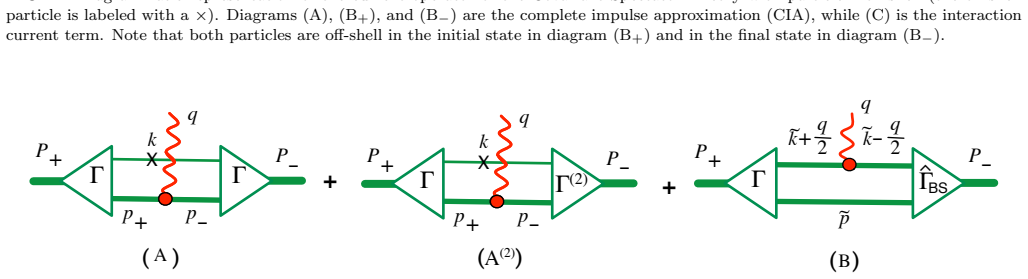
The load-bearing object is the off-shell bound-nucleon electromagnetic current, Eq. (1.13): a one-particle current with four form factors F1, F2, F3, and F4, where F3 and F4 act only when both nucleon legs are off shell through the projection operator Θ(p). The new "principle of balance" pairs the Dirac terms F1 and F3 with Pauli terms F2 and F4, and the functions f0 and g0, fixed by a generalized Ward-Takahashi identity, carry the strong-form-factor dependence. Each deuteron form factor splits into a sum of products F_i($Q^{2}$) D_{X,i}($Q^{2}$) of nucleon form factors with computed body form factors, and those body form factors encode the np dynamics that distinguish WJC2 from WJC1.
What would settle it
Measure elastic electron-deuteron A(Q2) at momentum transfers around Q = 1.5 to 2.5 GeV with sufficient precision to distinguish model 2D from the extrapolated alternatives, and compare the GEn extracted from that A with direct polarized-neutron measurements near Q = 1.5 to 2 GeV; a mismatch beyond combined errors would falsify the claim that F3 and F4 absorb the full off-shell structure.
Extended reading notes
Core claim
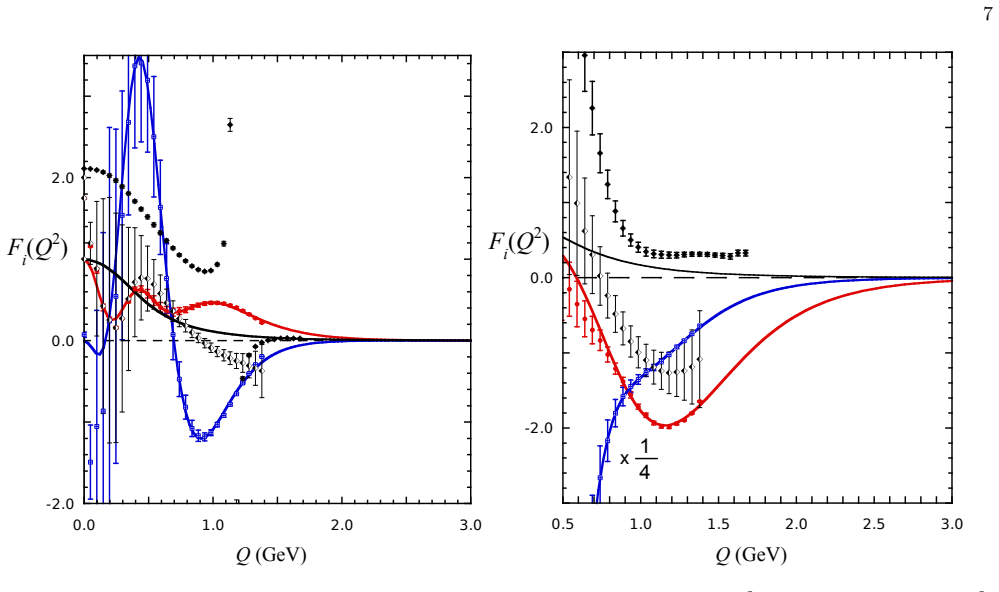
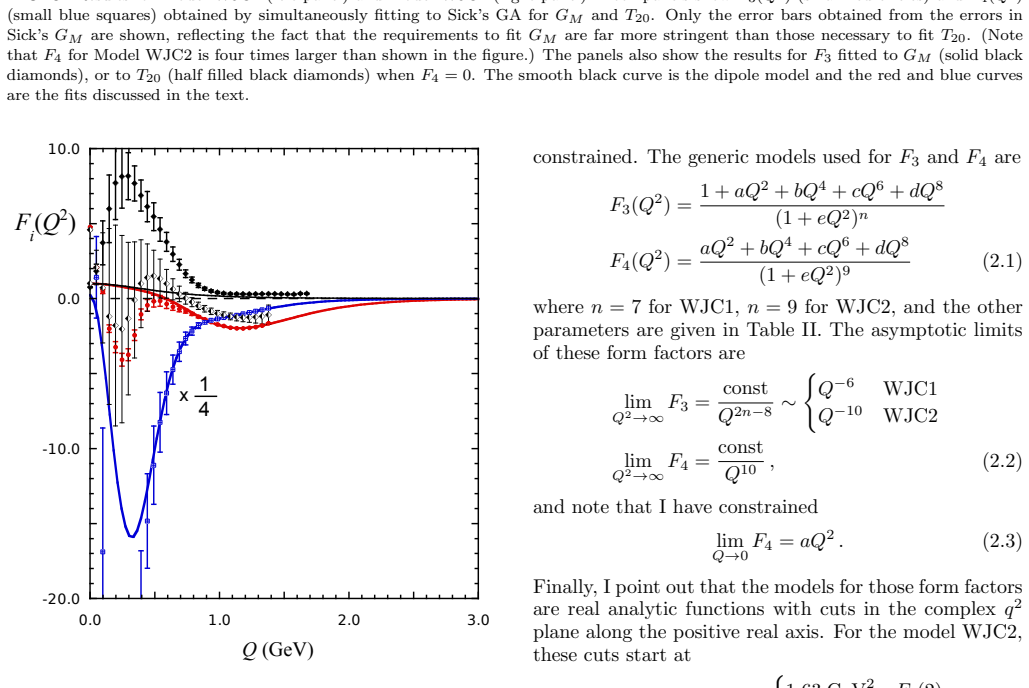
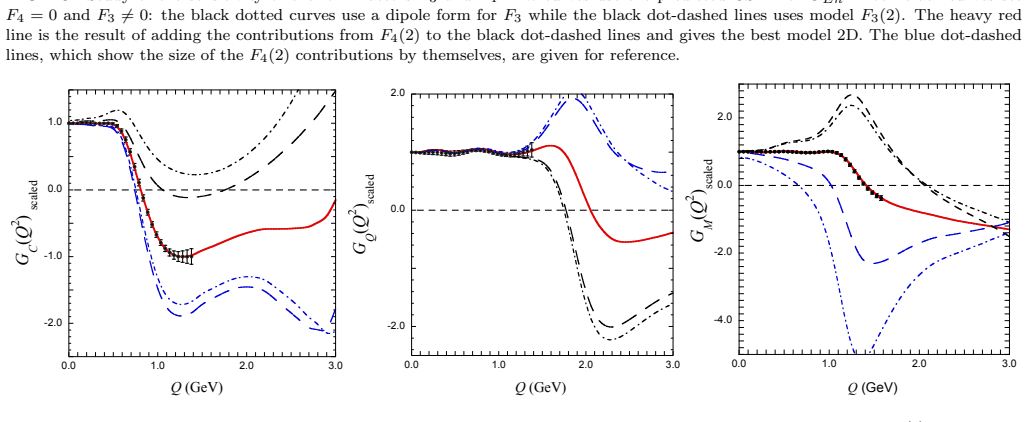
The central discovery advanced is that the deuteron's elastic electromagnetic form factors can be described without adding phenomenological two-body exchange currents beyond those generated by the momentum-dependent kernel, provided the off-shell single-nucleon current is parametrized by the four form factors F1, F2, F3, and F4 of Eq. (1.13). With model WJC2, the two unmeasured off-shell form factors F3 and F4 are determined by simultaneously fitting the magnetic structure function B and the tensor polarization T20; then the charge structure function A uniquely fixes GEn, and the resulting GEn is compatible with direct low-Q2 neutron measurements while extrapolating smoothly to higher Q2. The paper stresses that F4 is required: fits that set F4 = 0 cannot simultaneously reproduce B and T20. Static moments become parameter-free predictions, with the WJC2 magnetic moment agreeing with experiment to 0.07 percent while the quadrupole moment sits about 1.5 percent below experiment.
Load-bearing premise
The result stands or falls on the assumption that the off-shell nucleon current has the exact four-form-factor structure of Eq. (1.13), including F4 paired with F2 by the principle of balance; any additional off-shell transverse terms would be absorbed into the fitted functions and would change the GEn prediction.
Editorial extensions
If this is right
- If the central claim is correct, model 2D gives a near-unity chi2 per datum for the Global Analysis points of GC, GM, GQ, A, and T20, and about 1.13 for B, within the analysed Q range.
- The WJC1 model is effectively excluded, because extracting GEn from its A prediction contradicts direct free-neutron measurements, so further scrutiny concentrates on WJC2.
- A parameter-free prediction for the rescattering term in deuteron electrodisintegration follows once WJC2 is fixed, offering a test of the same current and wave functions outside elastic scattering.
- New measurements of B at higher Q2 should reveal a predicted secondary maximum, which may make that region experimentally accessible.
- Direct measurements of GEn at Q above about 1.4 GeV would provide a sharp confirmation or refutation of the paper's extrapolated prediction.
Reading between the lines
- If the high-Q2 GEn prediction fails, the most likely culprit would be additional off-shell transverse current structures beyond F3 and F4, which the present ansatz would have absorbed into the fitted functions.
- Because the fit target is a global reanalysis rather than the raw published datasets, a different reanalysis could shift F3, F4, and the extracted GEn even if the underlying data stay the same.
- The correspondence drawn between the off-shell form factors and two-pion exchange currents suggests a testable comparison with on-shell-nucleon formulations, where the same physics should reappear as explicit exchange currents.
- A useful extension would be to refit the model to individual datasets separately, isolating which systematic inconsistencies the global analysis smooths out before the F3 and F4 results are accepted at face value.
Signed reviews
Editorial analysis
A structured set of objections, weighed in public.
Referee Report
Summary. This paper presents the fourth-generation Covariant Spectator Theory (CST) calculation of the deuteron electromagnetic form factors, using the WJC1 and WJC2 deuteron wave functions obtained from the 2007 CST fits to np scattering. The calculation includes isoscalar interaction currents generated by the momentum-dependent kernel, and introduces a new off-shell nucleon form factor F4 alongside F3. The author fits F3 and F4 to the Sick Global Analysis (GA) for GM and T20, then extracts GEn from the structure function A, and presents two GEn models (CST1, CST2). The central claims are that model WJC2, with F3 and F4 so adjusted, provides a precision fit (chi2/datum about 1) to all ed elastic scattering data and predicts GEn at high Q2 beyond the measured region. The paper also studies relativistic corrections, static moments, and provides a table of body form factors.
Significance. If the completeness of the off-shell current and the global fit claims were established, this would be a substantial step: it would connect a high-precision NN potential to deuteron electroweak observables in a relativistic framework and yield falsifiable predictions for GEn at Q2 > 2 GeV2 and for a secondary maximum in B. Strengths of the manuscript include the explicit parametrizations, the tabulated body form factors in Table XIV that permit independent re-analysis, the transparent decomposition of contributions, and the candid errata for previous work. However, as discussed below, the paper's own tables contradict the 'all data' claim, and the high-Q GEn prediction rests on an unproved ansatz for the off-shell current; both issues are central to the paper's headline conclusions.
major comments (4)
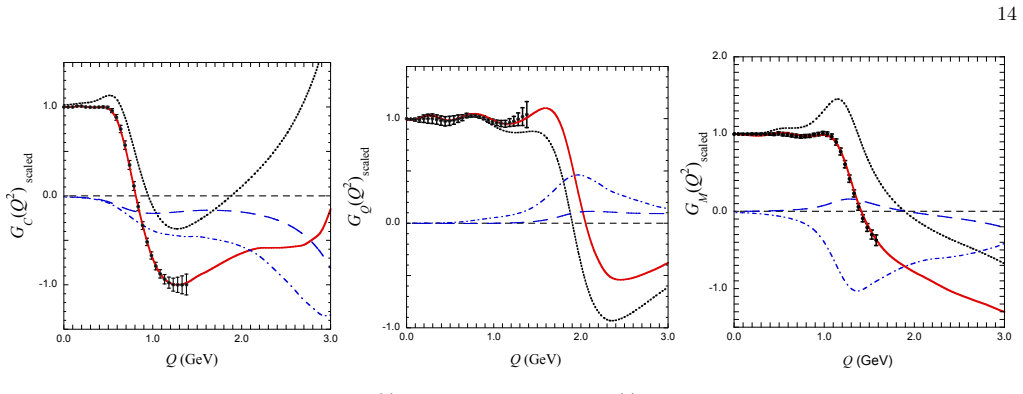
- [Sec. I.D.2-I.D.3, Eq. (1.13)] The off-shell current (1.13) is not derived from current conservation; the paper states in Sec. I.D.3 that 'there are many other off-shell terms that we could add' and that the inclusion of F4 and the common weighting by f0 and g0 are justified by a new 'principle of balance.' Because F3 and F4 are fitted to GM and T20 (Sec. II.B and Appendix C), and GEn is subsequently extracted from A (Appendix D), any omitted transverse off-shell structure would be absorbed into the fitted F3, F4, and the extracted GEn. The high-Q behavior of GEn (model CST1, Fig. 11) is therefore not a unique prediction. Please demonstrate insensitivity by repeating the extraction with a different admissible off-shell Pauli structure (e.g., a separate g0 weight for F4), or derive the basis from a symmetry argument.
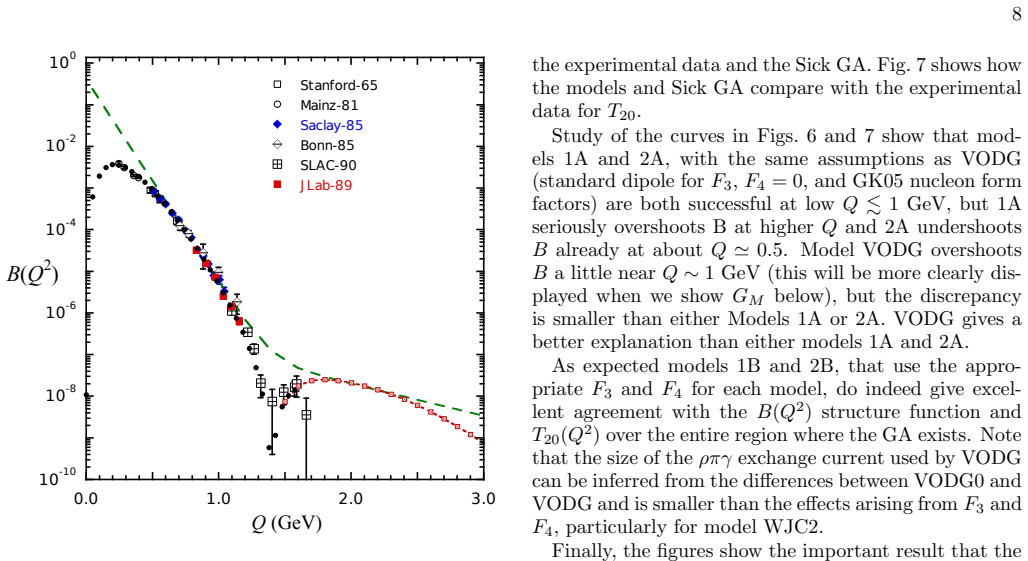
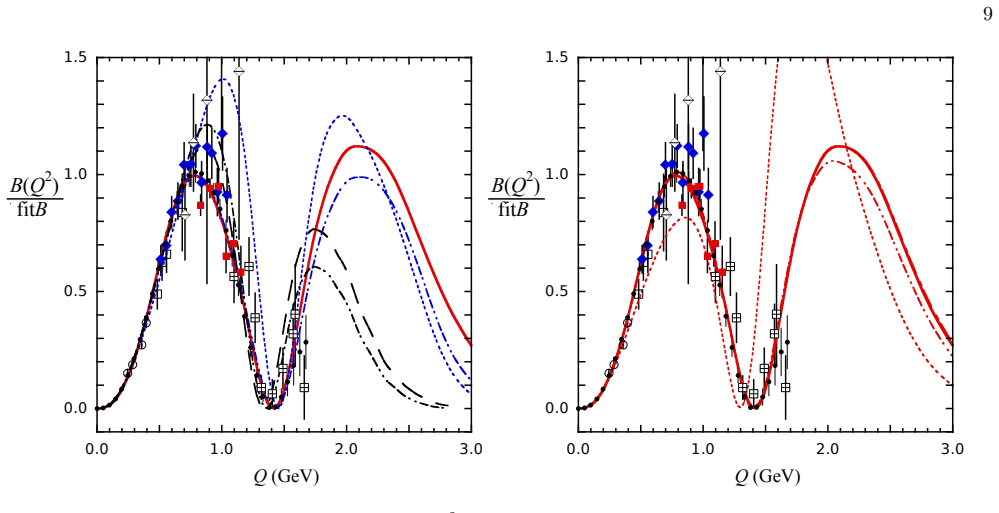
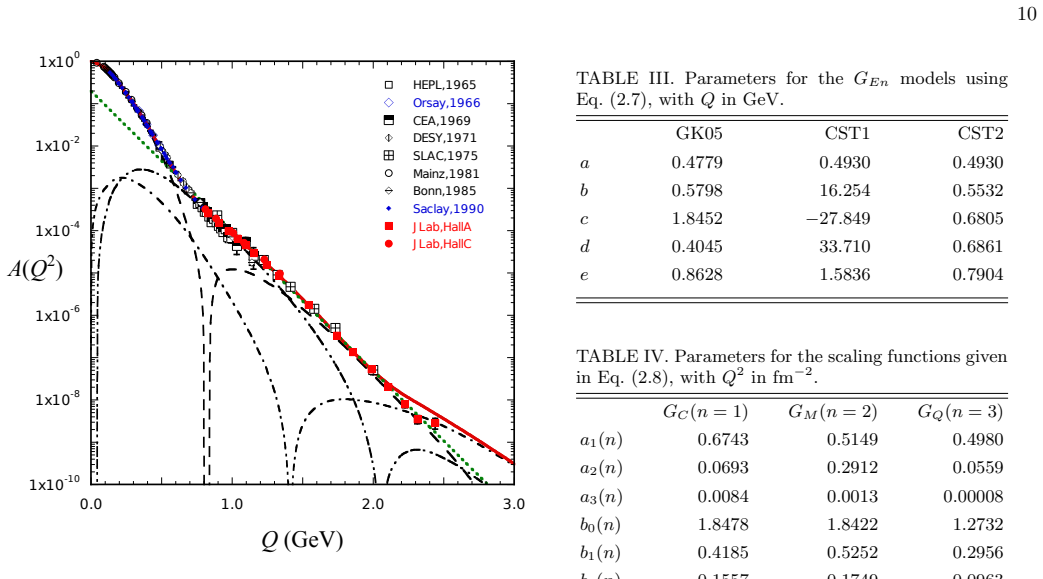
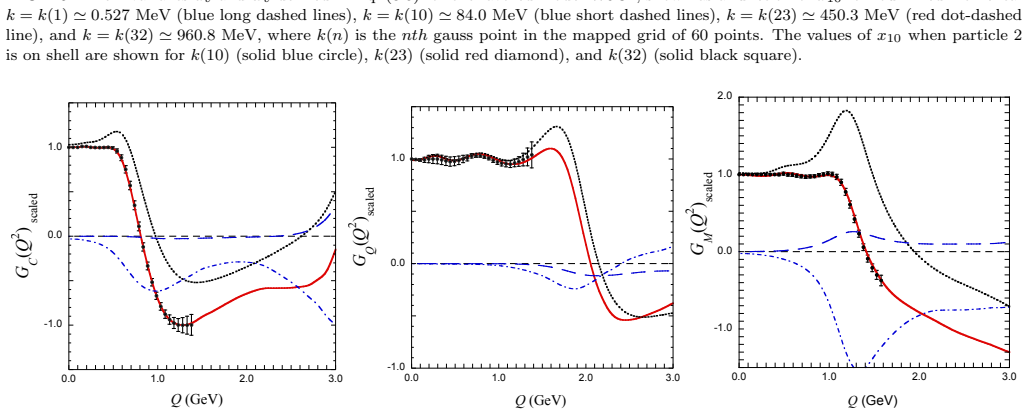
- [Sec. II.D and Tables V-VI] The abstract's claim of a precision fit to 'all ed elastic scattering data' is not supported by the paper's own tables. Table V gives chi2/datum = 116.5 for the five highest A points (Atail) for model 2D, and Sec. II.D reports that no real GEn solution exists for WJC2 at the five highest GA points with Q >= 2.216 GeV. Furthermore, Table VI shows chi2/datum = 3.98 for all published A data, with Bonn-85 at 20.18. The claim should be restricted to Q <= 1.4 GeV (or to the region where the GA fit is performed), and the failure of the A tail should be stated in the abstract and conclusions.
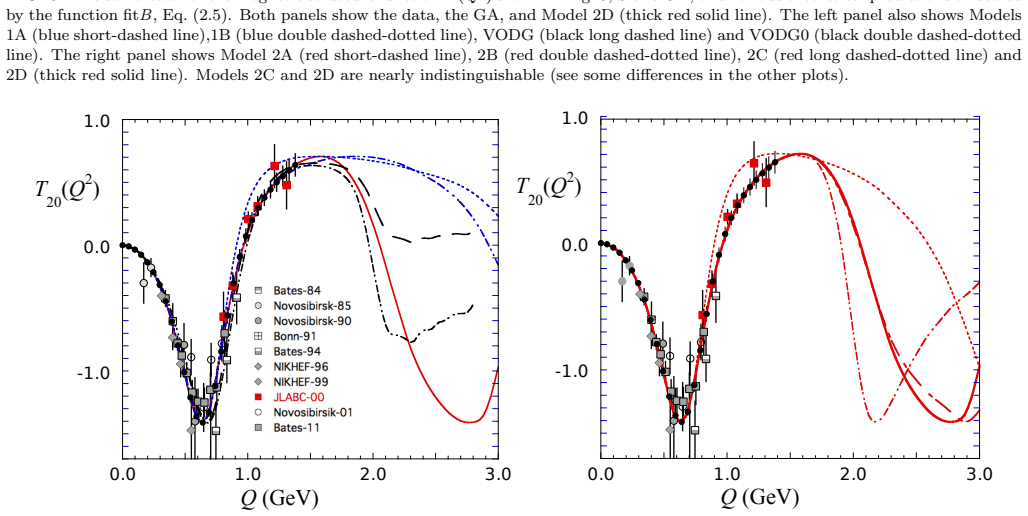
- [Sec. II.C] The agreement of models 1B and 2B with B(Q2) and T20(Q2) in Figs. 6 and 7 is a reproduction of the data to which F3 and F4 were fitted in Sec. II.B, not an independent test. Since Eq. (1.19) makes the deuteron form factors linear in F3 and F4, the fit by construction adjusts the off-shell form factors to make GM and y (hence B and T20) agree with the GA within the body-form-factor model. The only nontrivial check after the two-step fit is the A structure function. The text should state this explicitly and avoid presenting these figures as confirmation of the model.
- [Appendix A.4, Sec. III.C] The calculation discards the four subtracted amplitudes y^{-rho2}_l because they are claimed to be 'numerically so small as to be nearly zero,' but the author states he has not proved the relation y^{-rho2}_l = 0 and merely believes it to be true. Since the off-shell contributions from diagram 2(B) are sizable (Fig. 17), the omission could affect all three form factors at the few-percent level. Please provide a numerical estimate of the discarded amplitudes or a proof of their vanishing before relying on this approximation in the central results.
minor comments (4)
- [Sec. I.A and throughout] Typos: 'fouth generation' should be 'fourth generation'; 'originaly' should be 'originally'; 'Serous misunderstandings' in Sec. III.C should be 'serious misunderstandings'; 'perdiction' in Sec. II.E should be 'prediction'; 'therefor' in Sec. VI.A should be 'therefore'.
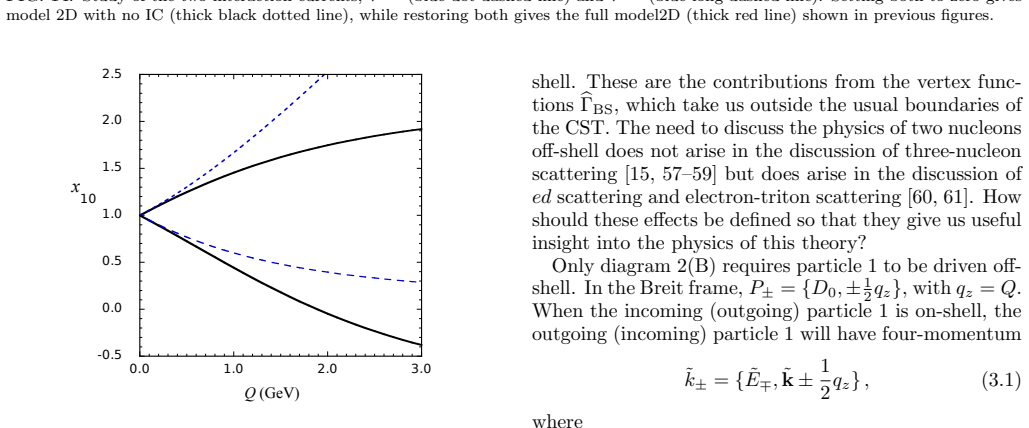
- [Figs. 3-4 captions] The captions read 'x 1 4' without explanation; please clarify that F4 values are multiplied by a factor of 4 for display.
- [Sec. II.B] The sentence 'limited my the measurements of T20' should read 'limited by the measurements of T20.' Since the GA for T20 extends only to Q = 1.379 GeV, the statement that F3 and F4 are undetermined at Q > 1.4 GeV should be stated clearly before the fit description.
- [References] Ref. [17] cites Sick's Global Analysis only as 'private communication.' Since the GA is a central input to the fits, please provide a citable published version or a supplementary data file containing the GA points and errors.
Circularity Check
Fitted F3/F4 and GEn are presented as predictions; the B/T20 and A agreements in the fitted region are algebraic consequences of the fits, and the high-Q GEn claim is an extrapolation of a fitted function.
-
fitted input called prediction
[Sec. II.B-II.C, Eq. (1.19), Appendix C]
"Each red and blue point in the figure is the (simultaneous) solution for F3 and F4 at each GA point, which extend out to Q=7 (fm)^{-1}=1.379 (GeV) ... Once F3 and F4 have been determined, the data (that is, the Sick GA) for B and ~T20 is exactly reproduced, as shown in Sec. IIC."
By Eq. (1.19), GX(Q2)=Σ_{i=1}^4 Fi(Q2)DX,i(Q2), so F3 and F4 enter linearly. Appendix C solves for F3 and F4 algebraically from the GA values of GM and the T20 ratio y (Eqs. C1-C4). The subsequent agreement of models 1B/2B with B and T20 is therefore not an independent test but a restatement of the fitting equations: the fitted region agrees by construction. The section title 'Predictions for the off-shell nucleon form factors' labels these fitted functions as predictions.
-
fitted input called prediction
[Sec. II.D, Appendix D, Eq. (D5), Table V, model CST1]
"The values of GEn required to bring each model into agreement with the GA points for A(Q2) are shown in Fig. 11. ... Model CST1 is a very good representation of the solution obtained from A, while model CST2 follows GK05 up to the highest Q2 points (Mad03,Pla05) and then tracks CST1 at higher Q2."
Appendix D solves the quadratic A=GE^2 C2 + GE C1 + C0 (Eq. D5) for GE at each GA A point, which produces the GEn 'data' shown in Fig. 11. Model CST1 is then fitted to those extracted points using the flexible form Eq. (2.7), and model 2D uses CST1 to reproduce A (Table V gives A χ2/datum = 0.774 for model 2D). The A agreement in the fitted region is therefore enforced by the fit rather than predicted. The claimed prediction of GEn at high Q2 is an extrapolation of that fitted function beyond the region where real solutions exist, not a parameter-free first-principles result.
full rationale
The nuclear-force part of the paper contains substantial independent content: the body form factors follow from the WJC1/WJC2 np-scattering models, the interaction currents are tested against external data through the static moments, and the WJC1 failure is presented as an independent falsification. However, the central 'prediction' language is attached to quantities that are fit inputs. Section II.B determines F3 and F4 from GA GM/T20, Section II.C then shows exact reproduction of B and T20, and Section II.D extracts GEn from GA A and fits CST1 to those values before showing model 2D matches A. Eq. (1.19) and Appendix C make the first reduction explicit; Eq. (D5) in Appendix D makes the second explicit. The high-Q GEn claim in the abstract and conclusions is an extrapolation of the fitted CST1 function, with the paper itself reporting that no real GEn solution exists for the five highest A points for WJC2 (Q ≥ 2.216 GeV) and Table V giving Atail χ2/datum = 116.5. These are partly overstatement and model-dependence concerns rather than hidden circularity in the derivation of the nuclear force, but they do reduce the fitted-region 'agreements' and the high-Q GEn 'prediction' to the fitting procedure itself.
Assumptions & free parameters
free parameters (4)
- F3(2) parameters =
a=1.3508, b=4.0568, d=-137.69, e=0.6131 (Table II)
- F4(2) parameters =
a=-1747.8, b=2395.0, d=-3370.4, e=1.0004 (Table II)
- CST1 GEn parameters =
a=0.4930, b=16.254, c=-27.849, d=33.710, e=1.5836 (Table III)
- Iteration kernel normalization correction =
0.9962 for WJC1 and 0.9954 for WJC2
assumptions (5)
- domain assumption Covariant Spectator Theory with a one-boson-exchange kernel describes np scattering and the deuteron bound state.
- standard math The generalized Ward-Takahashi identity constrains the longitudinal part of the off-shell current, and the solution has the form of Eq. (1.13).
- ad hoc to paper Principle of balance: whenever a Dirac-like charge term is required, a similar Pauli-like term is included.
- ad hoc to paper The subtracted amplitudes y^{-rho2}_l are nearly zero and can be discarded.
- domain assumption Sick's Global Analysis accurately represents the world data for A, B, and T20, including its errors.
invented entities (1)
-
Off-shell nucleon form factor F4(Q2)
independent evidence
Cite this review
Pith. "Pith review of Covariant Spectator Theory of $np$ scattering: Deuteron form factors." pith.science (2026). https://pith.science/paper/2TM52QP7
@misc{pith2026190809421,
  author       = {Pith},
  title        = {Pith review of: Covariant Spectator Theory of $np$ scattering: Deuteron form factors},
  year         = {2026},
  howpublished = {\url{https://pith.science/paper/2TM52QP7}},
  note         = {Machine review of arXiv:1908.09421}
}
abstract
The deuteron form factors are calculated using two model wave functions obtained from the 2007 CST high precision fits to $np$ scattering data. Included in the calculation are a new class of isoscalar $np$ interaction currents which are automatically generated by the nuclear force model used in these fits. If the nuclear model WJC2 is used, a precision fit ($\chi^2$/datum $\eqsim1$) to the Sick Global Analysis (GA) of all $ed$ elastic scattering data can be obtained by adjusting the unknown off-shell nucleon form factors $F_3(Q^2)$ (discussed before) and $F_4(Q^2)$ (introduced in this paper), and predicting the high $Q^2$ behavior of the neutron charge form factor $G_{En}(Q^2)$ well beyond the region where it has been measured directly. Relativistic corrections, isoscalar interaction currents, and off-shell effects are defined, discussed, and their size displayed. A rationale for extending $ed$ elastic scattering measurements to higher $Q^2$ is presented.
Figures

Figures from the paper (22 more)







Reference graph
Works this paper leans on
-
[1]
Form factors and helicity amplitudes The most general form of the covariant deuteron elec- tromagnetic vector current illustrated in Figs 1 and 2 can be expressed in terms of three deuteron form factors ⟨P+λ|Jµ|P−λ′⟩ =−2Dµ { G1ξ∗ λ·ξ′ λ′−G3 (ξ∗ λ·q)(ξ′ λ′·q) 2m2 d } −GM [ ξ′µ λ′(ξ∗ λ·q)−ξ∗µ λ (ξ′ λ′·q) ] , (A1) where the form factors G1, G3, and GM = G2 a...
-
[2]
2 Jn(q) =JA n (q) +J (2) n (q) +JB n (q)
Mathematical form of the current The helicity amplitudes of the current, Jn(q), are the sum of the three types of contributions shown in Fig. 2 Jn(q) =JA n (q) +J (2) n (q) +JB n (q). (A8) The JA n and J (2) n contributions were combined in Eq. (3.28) of Ref. II; here I find it convenient to write them as two separate terms. Including the (B) diagrams from...
-
[3]
Relativistic effects due to shifts in the arguments of the wave functions The wave functions and vertex functions (referred to collectively as wave functions in the following discussion) that enter into the relativistic formulae have arguments shifted by the relativistic kinematics. It is of considerable interest in itself to study the size of these affects...
-
[4]
For recent discussion of the decompo- sition of Ψ, see Appendix A of Ref
Calculation of the off-shell invariant functions The wave and vertex functions can be expanded into scalar functions. For recent discussion of the decompo- sition of Ψ, see Appendix A of Ref. II and Sec. III of Ref. [14]. The wave function Ψ can be expressed in terms of four scalar functions: the two familiar nonrelativistic S and D-state wave functions,u ...
-
[5]
(A25) This can be derived directly by transforming ˜k± 0 and ˜E± in Eq
=X± 10(˜k,x± 10) √ m2 + [R± B(˜k,x± 10)]2. (A25) This can be derived directly by transforming ˜k± 0 and ˜E± in Eq. (A18) to the rest frame and requiring the trans- formation of x± 10→X± 10 to maintain the equation. Note that settingx± 10 = 1 in (A25) and using the relation (A22) gives the result X± 10(˜k, 1) = 1. It is satisfying to observe that nonrelati...
-
[6]
The Relativistic Few Body Problem. 1. Two- Body Equations,
F. Gross, “The Relativistic Few Body Problem. 1. Two- Body Equations,” Phys. Rev. C 26, 2203 (1982)
work page 1982
-
[7]
For a discussion of the phase i𝓁, see Eq
Wave functions momentum space To prepare for the discussion of the nonrelativistic form factor, I write the nonrelativistic wave functions in the 30 form Z𝓁m(r) = i𝓁z𝓁(r) r Y𝓁m(ˆr) Z𝓁m(k) =z𝓁(k)Y𝓁m(ˆk) (B1) where z𝓁 a generic name for the radial wave functions, u(𝓁 = 0) or w(𝓁 = 2), and Y𝓁m is the spherical harmonic with relations ∫ dΩˆrY𝓁m(ˆr)Y∗ 𝓁′m′(ˆr)...
-
[8]
For convenience I give the derivation of the momentum space expression, which is not widely known
Derivation of the charge form factor in momentum space The nonrelativistic charge form factor is GNR C = ∫ ∞ 0 dr [ u2(r) +w2(r) ] j0(τ0) (B7) whereτ0 = 1 2Qr. For convenience I give the derivation of the momentum space expression, which is not widely known. Each factor can be most easily be transformed to momentum space by first restoring the missing angu...
Show all 78 references
-
[9]
corrections
n = 2 (J 0 +−) n = 3+ (J + +0) n = 3− (J− 0−) a+ (EkQ− 2kCzD0)/(2md) 1√ 2 (kx−iky) 1√ 2 (kx−iky) ( EkQ− 2kCzD0)/(2md) → (E+Q− (2kz +Q)D0)/(2md) → (E+Q− (2kz +Q)D0)/(2md) a− −(EkQ + 2kCzD0)/(2md) 1√ 2 (kx +iky) −(EkQ + 2kCzD0)/(2md) 1√ 2 (kx +iky) →− (E+Q + (2kz +Q)D0)/(2md) →−...
-
[10]
2(B) are la- beled with a tilda to distinguish them from momenta in Fig
= P±·~k± md = 1 2md [2x± 10D0 ˜E±∓ ˜k±zQ] →x± 10m + x± 10 2m [ ˜k2 ⊥ + ˜k2 ±z + 1 8Q2 ] ∓ ˜k±zQ 4m = x± 10m + 1 2m [ x± 10˜k2± 1 2 ˜kzQ(2x± 10− 1) + 1 16(5x± 10− 4)Q2 ] m,md→∞ , (A19) where [recalling that the momenta in Fig. 2(B) are la- beled with a tilda to distinguish them...
-
[11]
(C3) should read ~Z± = ~Z− (Ek−k0)~Zk0
Eq. (C3) should read ~Z± = ~Z− (Ek−k0)~Zk0
-
[12]
(B1): • the coefficient of the D+D− term should be divided by an additional factor of 2 • the coefficient of the C+C− term should be divided by an additional factor of 2m2
Eq. (B1): • the coefficient of the D+D− term should be divided by an additional factor of 2 • the coefficient of the C+C− term should be divided by an additional factor of 2m2
-
[13]
Eq. (B2): • in the coefficient of C+A−, the term −2b0a+b+ should be replaced by −2b0a−b+ • a closing parentheses, ), is missing from the coefficient of the C+D− term; it belongs just before−z+, so that the coefficient of b0 in- cludes the b+ and a+ terms but not the z+ term • a simi...
-
[14]
Eq. (B.7): • the HI terms are divided by m4 (not m2) • in the coefficient of the ~F+~F− term replace (2X4−X5) by (X4−X5) and in the coefficient of the ~H+~H− term replace X1X5 byX1(X5 + X4)
-
[15]
Eq. (B10): • the GK2 terms should be divided by m2 • divide the entire trace by an extra factor of 2m (so the coefficient in front is ζB/(4m2), not ζB/(2m) These errors arose when the original Mathematica for- mula were transcribed into text. Fortunately, all of the results of R...
-
[16]
Covariant Spectator Theory of np scattering: Isoscalar interaction currents,
F. Gross, “Covariant Spectator Theory of np scattering: Isoscalar interaction currents,” Phys. Rev. C 89, no. 6, 064001 (2014). Referred to as Ref. I
2014
-
[17]
Covariant Spectator Theory of np scattering: Deuteron magnetic moment
F. Gross, “Covariant Spectator Theory of np scattering: Deuteron magnetic moment” Phys. Rev. C 89, no. 6, 064002 (2014). Referred to as Ref. II
2014
-
[18]
Covariant Spectator Theory of np scattering: Deuteron Quadrupole Moment
F. Gross, “Covariant Spectator Theory of np scattering: Deuteron Quadrupole Moment” Phys. Rev. C 91, no. 1, 014005 (2015). Referred to as Ref. III
2015
-
[19]
Three-dimensional covariant integral equa- tions for low-energy systems,
F. Gross, “Three-dimensional covariant integral equa- tions for low-energy systems,” Phys. Rev. 186, 1448 (1969)
1969
-
[20]
A New Theory of Nuclear Forces. 1. Relativis- tic Origin of the Repulsive Core,
F. Gross, “A New Theory of Nuclear Forces. 1. Relativis- tic Origin of the Repulsive Core,” Phys. Rev. D 10, 223 (1974)
1974
-
[21]
J. W. Van Orden, N. Devine and F. Gross, Phys. Rev. Lett. 75, 4369 (1995). doi:10.1103/PhysRevLett.75.4369
1995 doi
-
[22]
Gross, J
F. Gross, J. W. Van Orden and K. Holinde, Phys. Rev. C 45, 2094 (1992)
1992
-
[23]
Garcon and J
M. Garcon and J. W. Van Orden, Adv. Nucl. Phys. 26, 293 (2001) [nucl-th/0102049]
2001 arXiv
-
[24]
R. A. Gilman and F. Gross, J. Phys. G 28, R37 (2002)
2002
-
[25]
L. E. Marcucci et al. , J. Phys. G 43, 023002 (2016) doi:10.1088/0954-3899/43/2/023002 [arXiv:1504.05063 [nucl-th]]
2016 arXiv
-
[26]
M. T. Pena, F. Gross and Y. Surya, Phys. Rev. C 54, 2235 (1996) doi:10.1103/PhysRevC.54.2235 [nucl- th/9605041]
1996
-
[27]
Gross and A
F. Gross and A. Stadler, “Covariant spectator theory of np scattering: Phase shifts obtained from Phys. Rev. C 78, 014005 (2008)
2008
-
[28]
Covariant spectator theory of np scattering: Effective range expansions and relativis- tic deuteron wave functions,
F. Gross and A. Stadler, “Covariant spectator theory of np scattering: Effective range expansions and relativis- tic deuteron wave functions,” Phys. Rev. C 82, 034004 (2010)
2010
-
[29]
Stadler and F
A. Stadler and F. Gross, Phys. Rev. Lett. 78, 26 (1997) doi:10.1103/PhysRevLett.78.26 [nucl-th/9607012]
1997 arXiv
-
[30]
Gross and D
F. Gross and D. O. Riska, Phys. Rev. C 36, 1928 (1987)
1987
-
[31]
Sick, Prog
I. Sick, Prog. Part. Nucl. Phys. 47, 245 (2001), and pri- vate communication
2001
-
[32]
E. L. Lomon, Phys. Rev. C 66, 045501 (2002) doi:10.1103/PhysRevC.66.045501 [nucl-th/0203081]
2002 arXiv
-
[33]
Cardarelli, I
F. Cardarelli, I. L. Grach, I. Narodetsky, G. Salme and S. Simula, Phys. Lett. B 359, 1 (1995) doi:10.1016/0370- 2693(95)01058-X [nucl-th/9509004]
1995 arXiv
-
[34]
C. D. Buchanan and M. R. Yearian, Phys. Rev. Lett. 15, 303 (1965)
1965
-
[35]
G. G. Simon, C. Schmitt and V. H. Walther, Nucl. Phys. A 364, 285 (1981)
1981
-
[36]
Auffret et al., Phys
S. Auffret et al., Phys. Rev. Lett. 54, 649 (1985)
1985
-
[37]
Cramer et al., Z
R. Cramer et al., Z. Phys. C 29, 513 (1985)
1985
-
[38]
R. G. Arnold et al., Phys. Rev. Lett. 58, 1723 (1987)
1987
-
[39]
P. E. Bosted et al., Phys. Rev. C 42, 38 (1990)
1990
-
[40]
Suleiman, Measurements of the Electric and Magnetic Elastic Structure Functions of the Deuteron at Large Mo- mentum Transfers, Ph.D
R. Suleiman, Measurements of the Electric and Magnetic Elastic Structure Functions of the Deuteron at Large Mo- mentum Transfers, Ph.D. Thesis, Kent State University, 36 December 1999
1999
-
[41]
G. G. Petratos, Nucl. Phys. A 663, 357 (2000)
2000
-
[42]
M. E. Schulze et al. , Phys. Rev. Lett. 52, 597 (1984). doi:10.1103/PhysRevLett.52.597
1984 doi
-
[43]
V. F. Dmitriev et al. , Phys. Lett. 157B, 143 (1985). doi:10.1016/0370-2693(85)91534-5
1985 doi
-
[44]
B. B. Wojtsekhowski B B et al. , JETP Lett. 43 733 (1986)
1986
-
[45]
R. A. Gilman et al. , Phys. Rev. Lett. 65, 1733 (1990). doi:10.1103/PhysRevLett.65.1733
1990 doi
- [46]
- [47]
- [48]
-
[49]
Ferro-Luzzi et al., Phys
M. Ferro-Luzzi et al., Phys. Rev. Lett. 77, 2630 (1996). doi:10.1103/PhysRevLett.77.2630
1996 doi
-
[50]
Bouwhuis et al
M. Bouwhuis et al. , Phys. Rev. Lett. 82, 3755 (1999) doi:10.1103/PhysRevLett.82.3755 [nucl-ex/9810004]
1999 arXiv
-
[51]
Abbott et al
D. Abbott et al. [JLAB t(20) Collaboration], Phys. Rev. Lett. 84, 5053 (2000) doi:10.1103/PhysRevLett.84.5053 [nucl-ex/0001006]
2000 arXiv
-
[52]
D. M. Nikolenko et al. , Nucl. Phys. A 684, 525 (2001). doi:10.1016/S0375-9474(01)00373-6
2001 doi
-
[53]
Zhang et al
C. Zhang et al. , Phys. Rev. Lett. 107, 252501 (2011). doi:10.1103/PhysRevLett.107.252501
2011 doi
-
[54]
Benaksas, D
D. Benaksas, D. Drickey and D. Frerejacque, Phys. Rev. 148, 1327 (1966). doi:10.1103/PhysRev.148.1327
1966 doi
-
[55]
J. E. Elias, J. I. Friedman, G. C. Hartmann, H. W. Kendall, P. N. Kirk, M. R. Sogard, L. P. Van Speybroeck and J. K. De Pagter, Phys. Rev. 177, 2075 (1969). doi:10.1103/PhysRev.177.2075
1969 doi
-
[56]
Galster, H
S. Galster, H. Klein, J. Moritz, K. H. Schmidt, D. We- gener and J. Bleckwenn, Nucl. Phys. B 32, 221 (1971). doi:10.1016/0550-3213(71)90068-X
1971 doi
-
[57]
R. G. Arnold et al. , Phys. Rev. Lett. 35, 776 (1975). doi:10.1103/PhysRevLett.35.776
1975 doi
-
[58]
Platchkov et al
S. Platchkov et al. , Nucl. Phys. A 510, 740 (1990). doi:10.1016/0375-9474(90)90358-S
1990 doi
-
[59]
L. C. Alexa et al. [Jefferson Lab Hall A Col- laboration], Phys. Rev. Lett. 82, 1374 (1999) doi:10.1103/PhysRevLett.82.1374 [nucl-ex/9812002]
1999 arXiv
-
[60]
Abbott et al
D. Abbott et al. [Jefferson Lab t(20) Collab- oration], Phys. Rev. Lett. 82, 1379 (1999) doi:10.1103/PhysRevLett.82.1379 [nucl-ex/9810017]
1999 arXiv
-
[61]
Eden et al
T. Eden et al. , Phys. Rev. C 50, no. 4, R1749 (1994). doi:10.1103/PhysRevC.50.R1749
1994 doi
- [62]
-
[63]
Ostrick et al
M. Ostrick et al. , Phys. Rev. Lett. 83, 276 (1999). doi:10.1103/PhysRevLett.83.276
1999 doi
-
[64]
D. I. Glazier et al. , Eur. Phys. J. A 24, 101 (2005) doi:10.1140/epja/i2004-10115-8 [nucl-ex/0410026]
2005 arXiv
-
[65]
Madey et al
R. Madey et al. [E93-038 Collaboration], Phys. Rev. Lett. 91, 122002 (2003) doi:10.1103/PhysRevLett.91.122002 [nucl-ex/0308007]
2003 arXiv
-
[66]
Plaster et al
B. Plaster et al. [Jefferson Laboratory E93-038 Collaboration], Phys. Rev. C 73, 025205 (2006) doi:10.1103/PhysRevC.73.025205 [nucl-ex/0511025]
2006 arXiv
-
[67]
Passchier et al
I. Passchier et al. , Phys. Rev. Lett. 82, 4988 (1999) doi:10.1103/PhysRevLett.82.4988 [nucl-ex/9907012]
1999 arXiv
-
[68]
Zhu et al
H. Zhu et al. [E93026 Collaboration], Phys. Rev. Lett.87, 081801 (2001) doi:10.1103/PhysRevLett.87.081801 [nucl- ex/0105001]
2001
-
[69]
Warren et al
G. Warren et al. [Jefferson Lab E93-026 Col- laboration], Phys. Rev. Lett. 92, 042301 (2004) doi:10.1103/PhysRevLett.92.042301 [nucl-ex/0308021]
2004 arXiv
-
[70]
C. F. Perdrisat, V. Punjabi and M. Vander- haeghen, Prog. Part. Nucl. Phys. 59, 694 (2007) doi:10.1016/j.ppnp.2007.05.001 [hep-ph/0612014]
2007 arXiv
- [71]
-
[72]
Stadler and F
A. Stadler and F. Gross, AIP Conf. Proc. 334, 867 (1995). doi:10.1063/1.48120
1995 doi
-
[73]
Stadler, F
A. Stadler, F. Gross and M. Frank, Phys. Rev. C 56, 2396 (1997) doi:10.1103/PhysRevC.56.2396 [nucl- th/9703043]
1997
-
[74]
S. A. Pinto, A. Stadler and F. Gross, Phys. Rev. C 79, 054006 (2009) doi:10.1103/PhysRevC.79.054006 [arXiv:0901.4313 [nucl-th]]
2009 arXiv
-
[75]
S. A. Pinto, A. Stadler and F. Gross, Phys. Rev. C 81, 014007 (2010) doi:10.1103/PhysRevC.81.014007 [arXiv:0911.1473 [nucl-th]]
2010 arXiv
-
[76]
B. M. Casper and F. Gross, Phys. Rev. 155, 1607 (1967)
1967
-
[77]
Sick and D
I. Sick and D. Trautmann, Nucl. Phys. A637, 559 (1998). doi:10.1016/S0375-9474(98)00334-0
1998 doi
-
[78]
Adam, Jr., F
J. Adam, Jr., F. Gross, S. Jeschonnek, P. Ulmer and J. W. Van Orden, Phys. Rev. C 66, 044003 (2002) [nucl- th/0204068]
2002
Reviewed August 14, 2026 · model on record in the stance chip above.
Discussion (0). Continue with ORCID to comment.