REVIEW 4 major objections 5 minor 58 references
Excitons in InP, GaP, GaInP quantum dots: Insights from time-dependent density functional theory
T0 review · 4 major / 5 minor · reviewed 2026-08-14 · deepseek-v4-flash
Pith's one-line read This paper predicts that gallium phosphide quantum dots undergo a LUMO symmetry crossover at about 1.5 nm diameter, sharply enhancing their band-edge absorption.
desk verdict Solid TDDFT roadmap with a testable GaP LUMO crossover prediction, but the crossover's level ordering is uncalibrated and the paper needs fit error bars, alloy-convergence checks, and a bit more restraint in the claims. read the letter →
The pith
A machine-rendered reading of the paper's core claim, the machinery that carries it, and where it could break.
The reading
What carries the argument
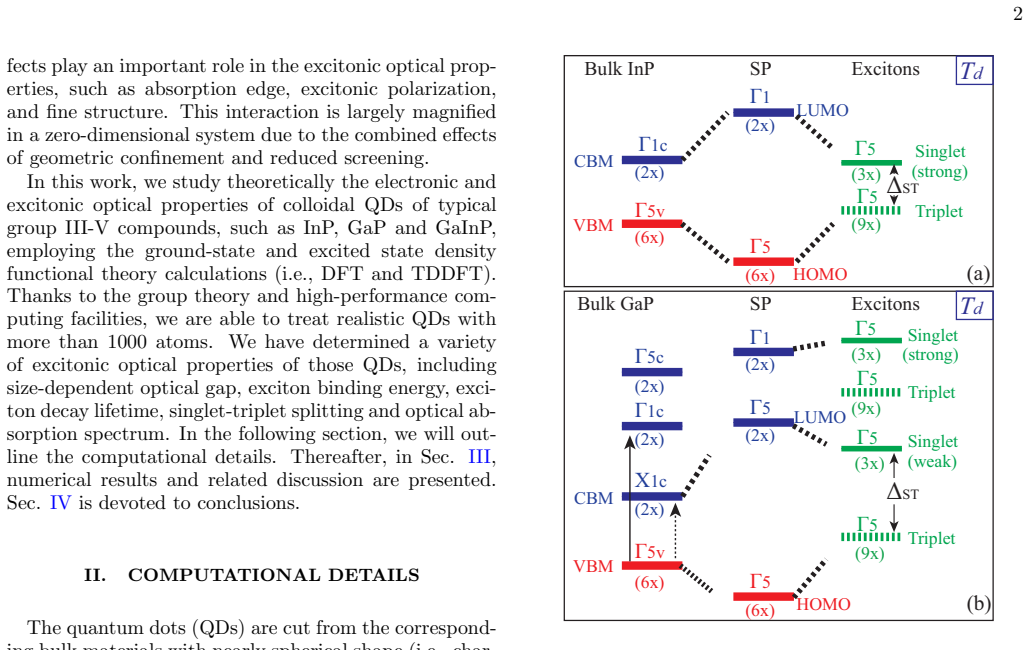
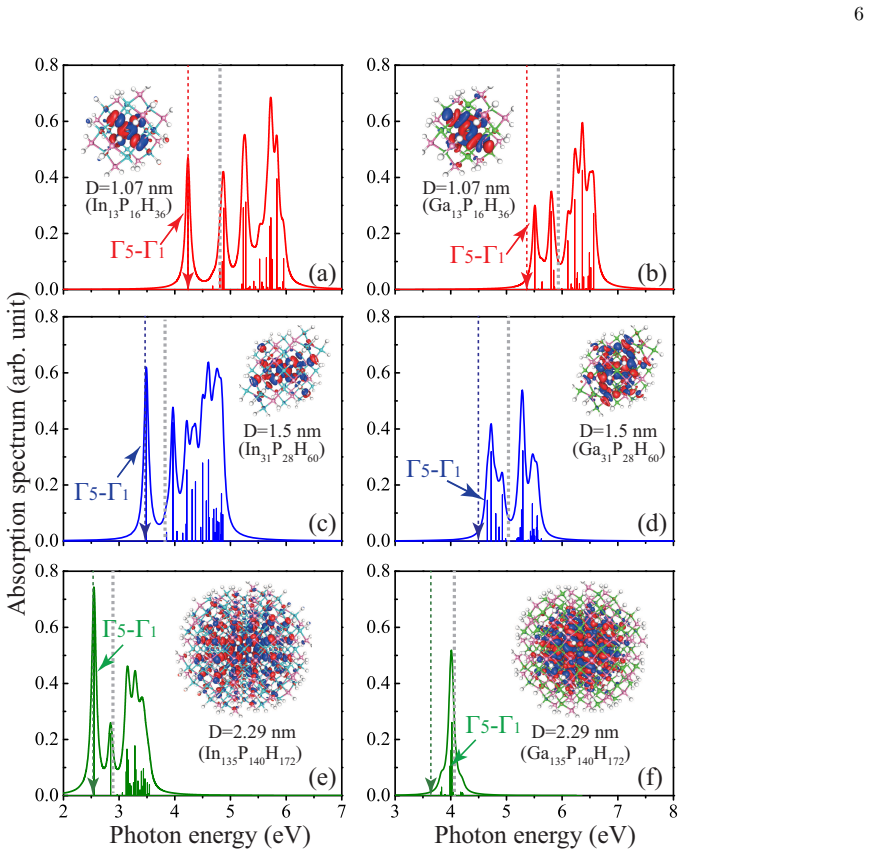
The carrying mechanism is the size-dependent ordering of the conduction-band states under quantum confinement in an atomistic model with tetrahedral symmetry. The paper computes single-particle states with a hybrid exchange-correlation functional and then adds excitonic effects through linear-response time-dependent density functional theory, using pseudohydrogen atoms with modified nuclear charges to passivate the surface. The decisive object is the symmetry of the LUMO state: as the dot shrinks, the $\Gamma_1$-like state is pulled below the $\Gamma_5$-like state, and this level crossing at about 1.5 nm diameter for GaP reorganizes the exciton manifold, enlarges the singlet-triplet splitting, and increases the oscillator strength of the lowest allowed transition.
What would settle it
Measure the absorption onset and oscillator strength of monodisperse, size-selected GaP quantum dots with diameters from about 1.2 to 2.0 nm. The crossover prediction requires a sharp jump in band-edge absorption intensity and singlet-triplet splitting as the diameter falls below roughly 1.5 nm; a smooth, featureless size dependence across that range would rule it out.
Extended reading notes
Core claim
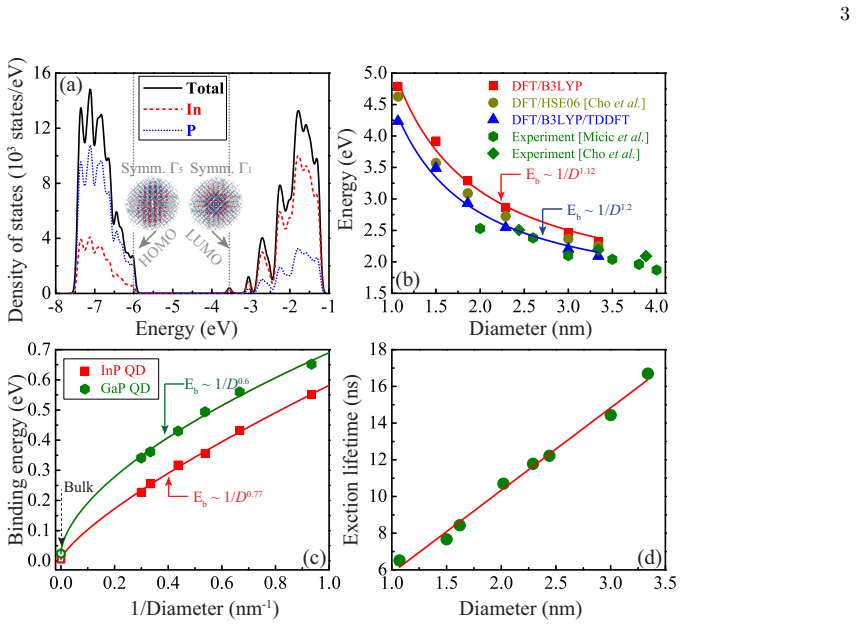
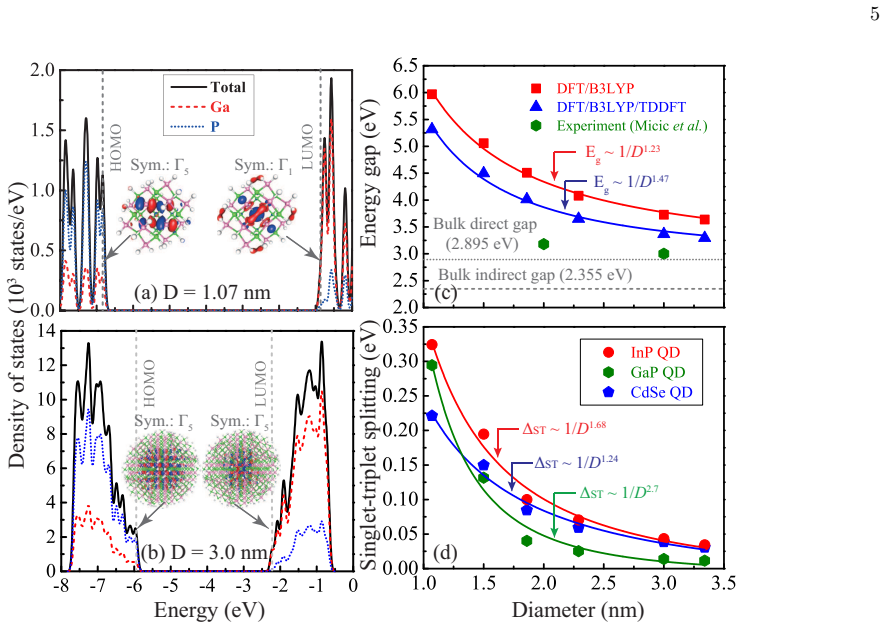
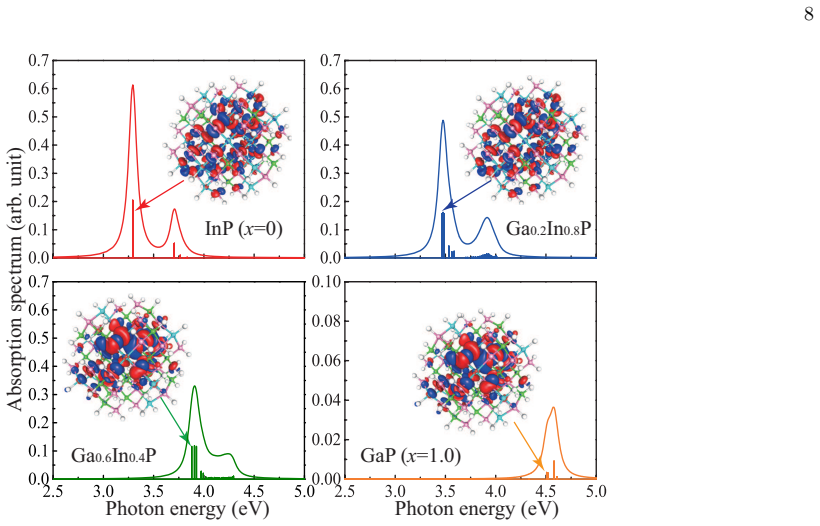
The central discovery is a predicted electronic-state crossover in GaP quantum dots. In bulk GaP the conduction-band minimum sits at the X point, but in a confined dot the lowest unoccupied state is not simply the folded bulk minimum. The calculations show that for dots larger than about 1.5 nm this LUMO has $\Gamma_5$ symmetry, while for smaller dots it becomes $\Gamma_1$-like, the same symmetry as the InP conduction minimum at the zone center. Because the HOMO is always $\Gamma_5$-like, the crossover changes the band-edge transition from a $\Gamma_5\to\Gamma_5$ transition with weak oscillator strength to a $\Gamma_5\to\Gamma_1$ transition with much stronger absorption. The paper further claims that the optical gap of InP dots scales as an inverse power of diameter with exponent near 1.2, that exciton binding energies scale as $D^{-0.77}$, and that radiative lifetimes increase linearly with size, and that in GaInP alloy dots the linear composition rule for lattice constants holds with a small, positive, size-dependent bowing parameter.
Load-bearing premise
The whole prediction rests on the assumption that replacing the real surface ligands with pseudohydrogen atoms of modified nuclear charge reproduces the near-band-edge electronic structure of actual colloidal dots closely enough that the computed gaps, lifetimes, and especially the GaP crossover diameter near 1.5 nm survive in synthesized dots.
Editorial extensions
If this is right
- For InP quantum dots, the nearly linear inverse-diameter scaling of the optical gap gives a simple design rule for tuning emission color by size.
- GaP dots below about 1.5 nm should show a sharp increase in band-edge absorption intensity and a larger singlet-triplet splitting, providing a spectroscopy-visible signature of the predicted crossover.
- The linear growth of radiative exciton lifetime with dot size implies that larger InP dots emit more slowly, which matters for LED efficiency and lifetime engineering.
- GaInP alloy dots obey the linear lattice-constant rule and have a small, positive bowing, so composition can tune the gap predictably even in ultra-small dots.
- Excitonic corrections leave the scaling exponents nearly unchanged, so single-particle calculations already capture the main size trends for these III-V dots.
Reading between the lines
- If the GaP crossover is real, the same physics may appear in other indirect-gap III-V nanocrystals; the crossover diameter should depend on the position of the conduction-band valleys and could be shifted by strain or by shell material, a testable prediction beyond the paper.
- The crossover prediction could be checked immediately by measuring excitation or absorption spectra of size-selected GaP dots across the 1.2-2.0 nm range; the paper's surface model predicts a threshold, so a null result would indicate that real ligands alter the level ordering.
- The linear lifetime scaling found here may be a general feature of strongly confined direct-gap dots, not just InP; comparing with CdSe dots of identical shape would separate material-specific from universal confinement effects.
- Because the paper averages over ten random alloy configurations, the bowing parameters carry configurational variance; a follow-up could report the spread to show when the parabolic fit is meaningful.
Signed reviews
Editorial analysis
A structured set of objections, weighed in public.
Referee Report
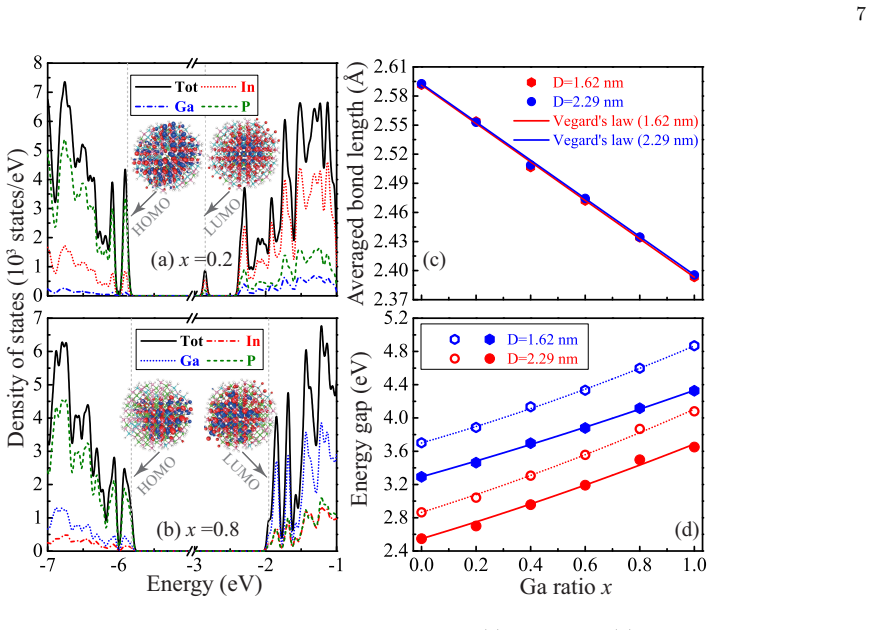
Summary. The paper reports large-scale DFT and TDDFT calculations of the electronic and excitonic optical properties of InP, GaP, and GaInP colloidal quantum dots with up to ~1100 atoms. Using PBE for geometry, B3LYP for single-particle states, and linear-response TDDFT for excitonic effects, the authors compute size-dependent optical gaps, exciton binding energies, radiative lifetimes, singlet-triplet splittings, and absorption spectra. The main findings are: (i) InP QD optical gaps scale nearly linearly with inverse diameter and agree well with experiment; (ii) the radiative lifetime increases linearly with dot size; (iii) for GaP QDs, the LUMO symmetry is predicted to switch from Γ5-like at larger diameters to Γ1-like below about 1.5 nm, accompanied by enhanced band-edge absorption; and (iv) GaInP alloy QDs obey Vegard's law down to ultra-small sizes, with a positive, size-dependent bowing parameter dominated by volume deformation. The paper frames these as first-principles predictions that can guide spectroscopic studies of III-V QDs.
Significance. If the central predictions hold, the paper provides valuable quantitative guidance for III-V QD optoelectronics, particularly the falsifiable GaP LUMO-crossover signature near 1.5 nm and the linear size dependence of the InP radiative lifetime. The use of a hybrid functional with TDDFT on dots of up to 1100 atoms is a strength, as is the systematic comparison among InP, GaP, and their alloy. The bowing decomposition following Bernard and Zunger is also a useful contribution. However, the quantitative claims are weakened by the absence of error bars on all fitted exponents and bowing parameters, by the uncalibrated GaP conduction-band level ordering that underpins the crossover prediction, and by the thoroughness of the alloy configurational averaging. These issues currently limit the strength of the conclusions.
major comments (4)
- [Sec. III A and III B, Eqs. (1) and (2)] The predicted Γ5→Γ1 LUMO crossover near D = 1.5 nm is a central claim, but the relative energy of the two conduction-band states (Γ5-like versus Γ1-like) is never calibrated against any GaP-specific reference. The paper itself reports in Sec. III B (Fig. 3(c)) that the calculated GaP optical gap is 'significantly larger' than the available experimental data, and in Sec. III A that exciton binding energies are 'significantly smaller' than experiment. These discrepancies imply that the computed conduction-state ladder for GaP has no confirmed absolute or relative accuracy. A shift of a few tenths of an eV in the relative Γ5/Γ1 ordering, well within the expected error of B3LYP on a passivated cluster of 65–100 atoms, would move the crossover diameter by several tenths of a nanometer or even suppress the crossover entirely. Please provide a sensitivity analysis (for example, varying the relative offset, testing a second hybrid functional, or comparing with a bulk GaP band-structure benchmark) and discuss the resulting uncertainty in the crossover diameter.
- [Sec. III C, Fig. 5(d) and Eq. (3)] The fits for the size-scaling exponents and prefactors (Cg = 1.12 and 1.2 for InP; exponents 1.23 and 1.47 for GaP; β = 0.77 for InP exciton binding energy; exponents for the singlet-triplet splittings in Fig. 3(d)) are reported without any statistical measures such as error bars, confidence intervals, number of fit points, or residuals. This is load-bearing because the comparisons to effective-mass theory (Cg = 2) and to empirical pseudopotential results (Cg = 1.36) rest entirely on these fitted values. Please report the fitting details and the associated uncertainties, and discuss how the systematic error of the pseudohydrogen surface model affects the fitted exponents.
- [Fig. 1 caption and Sec. III B] The alloy gap bowing is computed from an average over only ten random configurations per composition, with no convergence test with respect to the number of configurations and no error bars on the averaged gaps. In addition, the decomposition in Eq. (3) yields b = b_vd + b_ce + b_sr = 0.30 eV, while the text states that the parabolic fit of Fig. 5(d) gives about 0.22 eV; this 0.08 eV discrepancy is not explained and undermines the claim that the sum 'well reproduces' the fitted bowing. Please provide a configurational convergence study, error propagation on the averaged gaps and bowing, and an explicit reconciliation of the two values.
- [Sec. II] Spin-orbit coupling is neglected throughout, yet the paper reports quantitative values for radiative lifetimes (e.g., τ_GaP = 5.86 μs and τ_InP = 7.66 ns at D = 1.5 nm), singlet-triplet splittings, and oscillator strengths. For InP and GaP the valence-band spin-orbit splitting is of order 0.1 eV, which is comparable to or larger than several of the reported fine-structure splittings. While the LUMO crossover itself is a conduction-band phenomenon, the exciton manifold, lifetimes, and absorption intensities will be affected. Please estimate the impact of spin-orbit coupling on the reported quantitative predictions, or state explicitly that the fine-structure energies and lifetimes are expected to change once it is included.
minor comments (5)
- [Sec. II] The text writes 'Turbolmole' but the program is TURBOMOLE, as in Ref. 32.
- [Fig. 2(c)] The axis label 'Exction lifetime (ns)' in the figure panel contains a typo; it should read 'Exciton lifetime (ns)'.
- [Sec. III C] The phrase 'Vergard's law' appears in the first paragraph of Sec. III C; it should be 'Vegard's law'.
- [Sec. II] The radiative lifetime formula uses a refractive index n, but the numerical values used for InP, GaP, and CdSe are never specified. Please state the n values used in the calculations.
- [Sec. III B] The comparison with GaP experiments in Fig. 3(c) is brief; please provide a few sentences describing the sample quality, size distribution, and any thermal corrections used to interpret the high-temperature (≈400°C) data.
Circularity Check
No significant circularity; central predictions are first-principles DFT/TDDFT results with external benchmarks.
full rationale
The paper's central results are direct first-principles DFT/TDDFT calculations, not outputs of fitted inputs. The InP optical gaps are benchmarked against external experimental data (Micic et al., Cho et al.), and the CdSe exciton-binding scaling reproduces the experimentally determined scaling law, providing independent falsifiability. The GaP LUMO crossover from Γ5-like to Γ1-like symmetry is read directly from the computed single-particle level ordering at DFT/B3LYP level (Sec. III B, Fig. 3), and is not obtained from any fitting procedure; the scaling laws such as Eg ∝ 1/D^1.23 are post-hoc fits to the computed data and do not feed back into the electronic-structure calculation. The pseudohydrogen passivation charges (1.25 and 0.75) are a modeling choice taken from prior method practice, not fitted to the experimental InP/GaP data used for comparison; the paper even acknowledges that the GaP optical gap is significantly larger than experiment and attributes this to measurement conditions. The bowing decomposition uses Vegard's law to construct fixed-geometry dots, but Vegard's law is first independently validated against the computed relaxed bond lengths in Fig. 5(c), so the conclusion that volume deformation dominates is not assumed by construction. The self-citations (refs 27, 28, 58) support auxiliary statements about size-dependent deformation potentials and are not the logical source of the paper's central predictions. No load-bearing step reduces by definition or by self-citation to its own inputs.
Assumptions & free parameters
free parameters (3)
- Pseudohydrogen nuclear charges =
1.25 (cations), 0.75 (anions)
- Refractive index n in lifetime formula
- Lorentzian broadening =
0.05 eV
assumptions (5)
- domain assumption The empirical scaling form Eg = Eg,bulk + Cg/D^α (Eq. 1) is an adequate representation of the size dependence of the gap, binding energy, and singlet-triplet splitting.
- domain assumption Neglecting spin-orbit coupling does not change the symmetry ordering or the computed excitonic properties.
- domain assumption The pseudohydrogen-passivated, bare (ligand-free) quantum dot is a sufficient model for experimentally synthesized colloidal quantum dots, including core/shell dots.
- domain assumption Ten random cation configurations are sufficient to average the alloy properties of GaInP quantum dots.
- domain assumption The B3LYP hybrid functional and def2-SVP basis set provide quantitatively accurate single-particle gaps and wave functions for these quantum dots.
Cite this review
Pith. "Pith review of Excitons in InP, GaP, GaInP quantum dots: Insights from time-dependent density functional theory." pith.science (2026). https://pith.science/paper/SA3I2ZQI
@misc{pith2026190809430,
  author       = {Pith},
  title        = {Pith review of: Excitons in InP, GaP, GaInP quantum dots: Insights from time-dependent density functional theory},
  year         = {2026},
  howpublished = {\url{https://pith.science/paper/SA3I2ZQI}},
  note         = {Machine review of arXiv:1908.09430}
}
abstract
Colloidal quantum dots (QDs) of group III-V are considered as promising candidates for next-generation environmentally friendly light emitting devices, yet there appears to be only limited understanding of the underlying electronic and excitonic properties. Using large-scale density functional theory with the hybrid B3LYP functional solving the single-particle states and time-dependent density functional theory accounting for the many-body excitonic effects, we have identified the structural, electronic and excitonic optical properties of InP, GaP and GaInP QDs containing up to a thousand atoms or more. The calculated optical gap of InP QD appears in excellent agreement with available experiments, and it scales nearly linearly with the inverse diameter. The radiative exciton decay lifetime is found to increase surprisingly linearly with increasing the dot size. For GaP QDs, we predict an unusual electronic state crossover at diameter around 1.5 nm whereby the nature of the lowest unoccupied molecular orbital (LUMO) state switches its symmetry from $\Gamma_{5}$-like at larger diameter to $\Gamma_{1}$-like at smaller diameter. After the crossover, the absorption intensity of the band-edge exciton states is significantly enhanced. Finally, we find that Vegard's law holds very well for GaInP random alloyed quantum dots down to ultra-small sizes with less than a hundred atoms. The obtained energy gap bowing parameter of this common-cation compound in QD regime appears positive, size-dependent and much smaller than its bulk parentage. The volume deformation, dominating over the charge exchange and structure relaxation effects, is mainly responsible for the QD energy gap bowing. The present work provides a road map for a variety of electronic and optical properties of colloidal QDs in group III-V that can guide spectroscopic studies.
Figures
Figures from the paper (3 more)
Reference graph
Works this paper leans on
-
[1]
author author B. S. \ Mashford , author M. Stevenson , author Z. Popovic , author C. Hamilton , author Z. Zhou , author C. Breen , author J. Steckel , author V. Bulovic , author S. Bawendi , Moungi. ang Coe-Sullivan , \ and\ author P. T. \ Kazlas ,\ 10.1038/nphoton.2013.70 journal journal Nature Photon. \ volume 7 ,\ pages 407 ( year 2013 ) NoStop
-
[2]
author author X. Dai , author Z. Zhang , author Y. Jin , author Y. Niu , author H. Cao , author X. Liang , author L. Chen , author J. Wang , \ and\ author X. Peng ,\ 10.1038/nature13829 journal journal Nature \ volume 515 ,\ pages 96 ( year 2014 ) NoStop
-
[3]
author author S. Chen , author W. Cao , author T. Liu , author S.-W. \ Tsang , author Y. Yang , author X. Yan , \ and\ author L. Qian ,\ 10.1038/s41467-019-08749-2 journal journal Nature Comm. \ volume 10 ,\ pages 765 ( year 2019 ) NoStop
-
[4]
author author H. Shen , author Q. Gao , author Y. Zhang , author Y. Lin , author Q. Lin , author Z. Li , author L. Chen , author Z. Zeng , author X. Li , author Y. Jia , author S. Wang , author Z. Du , author L. S. \ Li , \ and\ author Z. Zhang ,\ 10.1038/s41566-019-0364-z journal journal Nature Photon. \ volume 13 ,\ pages 192 ( year 2019 ) NoStop
-
[5]
author author J. Owen \ and\ author L. Brus ,\ 10.1021/jacs.7b05267 journal journal J. Am. Chem. Soc. \ volume 139 ,\ pages 10939 ( year 2017 ) NoStop
-
[6]
author author J. Lim , author M. Park , author W. K. \ Bae , author D. Lee , author S. Lee , author C. Lee , \ and\ author K. Char ,\ 10.1021/nn403594j journal journal ACS Nano \ volume 7 ,\ pages 9019 ( year 2013 ) NoStop
-
[7]
author author J.-H. \ Jo , author J.-H. \ Kim , author K.-H. \ Lee , author C.-Y. \ Han , author E.-P. \ Jang , author Y. R. \ Do , \ and\ author H. Yang ,\ 10.1364/OL.41.003984 journal journal Opt. Lett. \ volume 41 ,\ pages 3984 ( year 2016 ) NoStop
-
[8]
author author J. Jang , author W. Liu , author J. S. \ Son , \ and\ author D. V. \ Talapin ,\ 10.1021/nl403889u journal journal Nano Lett. \ volume 14 ,\ pages 653 ( year 2014 ) NoStop
Show all 58 references
-
[9]
author author D. J. \ Bharali , author D. W. \ Lucey , author H. Jayakumar , author H. E. \ Pudavar , \ and\ author P. N. \ Prasad ,\ 10.1021/ja051455x journal journal J. Am. Chem. Soc. \ volume 127 ,\ pages 11364 ( year 2005 ) NoStop
-
[10]
author author O. T. \ Bruns , author T. S. \ Bischof , author D. K. \ Harris , author D. Franke , author Y. Shi , author L. Riedemann , author A. Bartelt , author F. B. \ Jaworski , author J. A. \ Carr , author C. J. \ Rowlands , author O. Wilson , Mark W. B.and Chen , author ...
-
[11]
Chibli , author L
author author H. Chibli , author L. Carlini , author S. Park , author N. M. \ Dimitrijevic , \ and\ author J. L. \ Nadeau ,\ 10.1039/C1NR10131E journal journal Nanoscale \ volume 3 ,\ pages 2552 ( year 2011 ) NoStop
2011 doi
-
[12]
Lin , author Q
author author G. Lin , author Q. Ouyang , author R. Hu , author Z. Ding , author J. Tian , author F. Yin , author G. Xu , author Q. Chen , author X. Wang , \ and\ author K.-T. \ Yong ,\ https://doi.org/10.1016/j.nano.2014.10.002 journal journal Nanomedicine \ volume 11 ,\ page...
2014 doi
-
[13]
Kornienko , author D
author author N. Kornienko , author D. D. \ Whitmore , author Y. Yu , author S. R. \ Leone , \ and\ author P. Yang ,\ 10.1021/nn507335j journal journal ACS Nano \ volume 9 ,\ pages 3951 ( year 2015 ) NoStop
2015 doi
-
[14]
Sun , author C
author author J. Sun , author C. Liu , \ and\ author P. Yang ,\ 10.1021/ja2083398 journal journal J. Am. Chem. Soc. \ volume 133 ,\ pages 19306 ( year 2011 ) NoStop
2011 doi
-
[15]
Lavina , author E
author author B. Lavina , author E. Kim , author H. Cynn , author P. F. \ Weck , author K. Seaborg , author E. Siska , author Y. Meng , \ and\ author W. Evans ,\ 10.1021/acs.inorgchem.7b02478 journal journal Inorg. Chem. \ volume 57 ,\ pages 2432 ( year 2018 ) NoStop
-
[16]
Srivastava , author V
author author V. Srivastava , author V. Kamysbayev , author L. Hong , author E. Dunietz , author R. F. \ Klie , \ and\ author D. V. \ Talapin ,\ 10.1021/jacs.8b06971 journal journal J. Am. Chem. Soc. \ volume 140 ,\ pages 12144 ( year 2018 a ) NoStop
-
[17]
Ramasamy , author N
author author P. Ramasamy , author N. Kim , author Y.-S. \ Kang , author O. Ramirez , \ and\ author J.-S. \ Lee ,\ 10.1021/acs.chemmater.7b02204 journal journal Chem. Mater. \ volume 29 ,\ pages 6893 ( year 2017 ) NoStop
2017 doi
-
[18]
Srivastava , author E
author author V. Srivastava , author E. Dunietz , author V. Kamysbayev , author J. S. \ Anderson , \ and\ author D. V. \ Talapin ,\ 10.1021/acs.chemmater.8b01137 journal journal Chem. Mater. \ volume 30 ,\ pages 3623 ( year 2018 b ) NoStop
-
[19]
author author D. K. \ Franke , Daniel.and Harris , author O. Chen , author O. T. \ Bruns , author J. A. \ Carr , author M. W. B. \ Wilson , \ and\ author M. G. \ Bawendi ,\ 10.1038/ncomms12749 journal journal Nature Commu. \ volume 7 ,\ pages 12749 ( year 2016 ) NoStop
-
[20]
Xu , author Y
author author Z. Xu , author Y. Li , author J. Li , author C. Pu , author J. Zhou , author L. Lv , \ and\ author X. Peng ,\ 10.1021/acs.chemmater.9b02292 journal journal Chem. Mater. \ volume 31 ,\ pages 5331 ( year 2019 ) NoStop
2019 doi
-
[21]
author author Y. M. \ Niquet , author C. Delerue , author G. Allan , \ and\ author M. Lannoo ,\ 10.1103/PhysRevB.62.5109 journal journal Phys. Rev. B \ volume 62 ,\ pages 5109 NoStop
-
[22]
Zielinski ,\ 10.1103/PhysRevB.86.115424 journal journal Phys
author author M. Zielinski ,\ 10.1103/PhysRevB.86.115424 journal journal Phys. Rev. B \ volume 86 ,\ pages 115424 ( year 2012 ) NoStop
2012 doi
-
[23]
Lee , author L
author author S. Lee , author L. J\"onsson , author J. W. \ Wilkins , author G. W. \ Bryant , \ and\ author G. Klimeck ,\ 10.1103/PhysRevB.63.195318 journal journal Phys. Rev. B \ volume 63 ,\ pages 195318 ( year 2001 ) NoStop
2001 doi
-
[24]
\ Wang \ and\ author A
author author L.-W. \ Wang \ and\ author A. Zunger ,\ 10.1103/PhysRevB.53.9579 journal journal Phys. Rev. B \ volume 53 ,\ pages 9579 ( year 1996 ) NoStop
1996 doi
-
[25]
Franceschetti , author H
author author A. Franceschetti , author H. Fu , author L. W. \ Wang , \ and\ author A. Zunger ,\ @noop journal journal Phys. Rev. B \ volume 60 ,\ pages 1819 ( year 1999 ) NoStop
1999
-
[26]
Baskoutas \ and\ author G
author author S. Baskoutas \ and\ author G. Bester ,\ 10.1021/jp101921g journal journal J. Phys. Chem. C \ volume 114 ,\ pages 9301 ( year 2010 ) NoStop
2010 doi
-
[27]
Zeng , author C
author author Z. Zeng , author C. S. \ Garoufalis , author S. Baskoutas , \ and\ author G. Bester ,\ 10.1103/PhysRevB.87.125302 journal journal Phys. Rev. B \ volume 87 ,\ pages 125302 ( year 2013 ) NoStop
2013 doi
-
[28]
Zeng , author C
author author Z. Zeng , author C. S. \ Garoufalis , author S. Baskoutas , author Y. Jia , \ and\ author G. Bester ,\ 10.1103/PhysRevB.98.235410 journal journal Phys. Rev. B \ volume 98 ,\ pages 235410 ( year 2018 ) NoStop
2018 doi
-
[29]
author author O. I. \ Micic , author H. M. \ Cheong , author H. Fu , author A. Zunger , author J. R. \ Sprague , author A. Mascarenhas , \ and\ author A. J. \ Nozik ,\ 10.1021/jp9704731 journal journal J. Phys. Chem. B \ volume 101 ,\ pages 4904 ( year 1997 ) NoStop
-
[30]
Micic \ and\ author A
author author O. Micic \ and\ author A. Nozik ,\ https://doi.org/10.1016/0022-2313(96)00047-6 journal journal J. Lumin. \ volume 70 ,\ pages 95 ( year 1996 ) NoStop
1996 doi
-
[31]
Cho , author H
author author E. Cho , author H. Jang , author J. Lee , \ and\ author E. Jang ,\ 10.1088/0957-4484/24/21/215201 journal journal Nanotechnology \ volume 24 ,\ pages 215201 ( year 2013 ) NoStop
2013 doi
-
[32]
\ NoStop
@noop title TURBOMOLE V7.3 2018 , a development of University of Karlsruhe and Forschungszentrum Karlsruhe GmbH , 1989-2007, TURBOMOLE GmbH , since 2007; available from \\ http://www.turbomole.com . \ NoStop
2018
-
[33]
author author J. P. \ Perdew , author K. Burke , \ and\ author M. Ernzerhof ,\ 10.1103/PhysRevLett.77.3865 journal journal Phys. Rev. Lett. \ volume 77 ,\ pages 3865 ( year 1996 ) NoStop
1996 doi
-
[34]
author author P. J. \ Stephens , author F. J. \ Devlin , author C. F. \ Chabalowski , \ and\ author M. J. \ Frisch ,\ 10.1021/j100096a001 journal journal J. Phys. Chem. \ volume 98 ,\ pages 11623 ( year 1994 ) NoStop
1994 doi
-
[35]
Weigend \ and\ author R
author author F. Weigend \ and\ author R. Ahlrichs ,\ 10.1039/B508541A journal journal Phys. Chem. Chem. Phys. \ volume 7 ,\ pages 3297 ( year 2005 ) NoStop
2005 doi
-
[36]
Weigend ,\ 10.1039/B515623H journal journal Phys
author author F. Weigend ,\ 10.1039/B515623H journal journal Phys. Chem. Chem. Phys. \ volume 8 ,\ pages 1057 ( year 2006 ) NoStop
2006 doi
-
[37]
author author D. L. \ Dexter ,\ @noop title Solid State Physics \ ( publisher Academic, New York ,\ year 1958 ) NoStop
1958
-
[38]
Zhang , author J.-W
author author L. Zhang , author J.-W. \ Luo , author A. Franceschetti , \ and\ author A. Zunger ,\ 10.1103/PhysRevB.84.075404 journal journal Phys. Rev. B \ volume 84 ,\ pages 075404 ( year 2011 ) NoStop
2011 doi
-
[39]
Mathieu , author Y
author author H. Mathieu , author Y. Chen , author J. Camassel , author J. Allegre , \ and\ author D. S. \ Robertson ,\ 10.1103/PhysRevB.32.4042 journal journal Phys. Rev. B \ volume 32 ,\ pages 4042 ( year 1985 ) NoStop
1985 doi
-
[40]
author author L. E. \ Brus ,\ @noop journal journal J. Chem. Phys. \ volume 80 ,\ pages 4403 ( year 1984 ) NoStop
1984
-
[41]
author author K. K. \ Nanda , author F. E. \ Kruis , \ and\ author H. Fissan ,\ 10.1021/nl0100318 journal journal Nano Lett. \ volume 1 ,\ pages 605 ( year 2001 ) NoStop
2001 doi
-
[42]
Fu \ and\ author A
author author H. Fu \ and\ author A. Zunger ,\ 10.1103/PhysRevB.56.1496 journal journal Phys. Rev. B \ volume 56 ,\ pages 1496 ( year 1997 ) NoStop
1997 doi
-
[43]
Narayanaswamy , author L
author author A. Narayanaswamy , author L. F. \ Feiner , author A. Meijerink , \ and\ author P. J. \ van der Zaag ,\ 10.1021/nn9004507 journal journal ACS Nano \ volume 3 ,\ pages 2539 ( year 2009 ) NoStop
2009 doi
-
[44]
author author J. K. V. I. \ Park , Young-Shin. Lim ,\ 10.1038/s41563-018-0254-7 journal journal Nature Mater. \ volume 18 ,\ pages 249 ( year 2019 ) NoStop
2019 doi
-
[45]
author author R. W. \ Meulenberg , author J. R. \ Lee , author A. Wolcott , author J. Z. \ Zhang , author L. J. \ Terminello , \ and\ author T. van Buuren ,\ 10.1021/nn8006916 journal journal ACS Nano \ volume 3 ,\ pages 325 ( year 2009 ) NoStop
-
[46]
Gao \ and\ author X
author author Y. Gao \ and\ author X. Peng ,\ 10.1021/jacs.5b01314 journal journal J. Am. Chem. Soc. \ volume 137 ,\ pages 4230 ( year 2015 ) NoStop
2015 doi
-
[47]
author author R. G. \ Humphreys , author U. R\"ossler , \ and\ author M. Cardona ,\ 10.1103/PhysRevB.18.5590 journal journal Phys. Rev. B \ volume 18 ,\ pages 5590 ( year 1978 ) NoStop
1978 doi
-
[48]
author author D. F. \ Nelson , author L. F. \ Johnson , \ and\ author M. Gershenzon ,\ 10.1103/PhysRev.135.A1399 journal journal Phys. Rev. \ volume 135 ,\ pages A1399 ( year 1964 ) NoStop
1964 doi
-
[49]
\ Kim , author Y.-w
author author Y.-H. \ Kim , author Y.-w. \ Jun , author B.-H. \ Jun , author S.-M. \ Lee , \ and\ author J. Cheon ,\ 10.1021/ja027575b journal journal J. Am. Chem. Soc. \ volume 124 ,\ pages 13656 ( year 2002 ) NoStop
2002 doi
-
[50]
Kher \ and\ author R
author author S. Kher \ and\ author R. Wells ,\ 10.1021/cm00047a027 journal journal Chem. Mater. \ volume 6 ,\ pages 2056 ( year 1994 ) NoStop
1994 doi
-
[51]
Gao , author J
author author S. Gao , author J. Lu , author N. Chen , author Y. Zhao , \ and\ author Y. Xie ,\ 10.1039/B210164E journal journal Chem. Commun. \ ,\ pages 3064 ( year 2002 ) NoStop
2002 doi
-
[52]
author author F. S. \ Manciu , author Y. Sahoo , author D. J. \ MacRae , author M. Furis , author B. D. \ McCombe , \ and\ author P. N. \ Prasad ,\ 10.1063/1.1580635 journal journal Appl. Phys. Lett. \ volume 82 ,\ pages 4059 ( year 2003 ) NoStop
-
[53]
Kim , author K
author author S. Kim , author K. Lee , author S. Kim , author O.-P. \ Kwon , author J. H. \ Heo , author S. H. \ Im , author S. Jeong , author D. C. \ Lee , \ and\ author S.-W. \ Kim ,\ 10.1039/C4RA10115D journal journal RSC Adv. \ volume 5 ,\ pages 2466 ( year 2015 ) NoStop
-
[54]
Kamal , author T
author author C. Kamal , author T. K. \ Ghanty , author A. Banerjee , \ and\ author A. Chakrabarti ,\ 10.1063/1.3055279 journal journal J. Chem. Phys. \ volume 130 ,\ pages 024308 ( year 2009 ) NoStop
2009 doi
-
[55]
author author K. D. \ Wegner , author S. Pouget , author W. L. \ Ling , author M. Carrière , \ and\ author P. Reiss ,\ 10.1039/C8CC09740B journal journal Chem. Commun. \ volume 55 ,\ pages 1663 ( year 2019 ) NoStop
2019 doi
-
[56]
Merle , author D
author author P. Merle , author D. Auvergne , author H. Mathieu , \ and\ author J. Chevallier ,\ 10.1103/PhysRevB.15.2032 journal journal Phys. Rev. B \ volume 15 ,\ pages 2032 ( year 1977 ) NoStop
1977 doi
-
[57]
author author J. E. \ Bernard \ and\ author A. Zunger ,\ 10.1103/PhysRevB.34.5992 journal journal Phys. Rev. B \ volume 34 ,\ pages 5992 ( year 1986 ) NoStop
1986 doi
-
[58]
Zeng , author C
author author Z. Zeng , author C. S. \ Garoufalis , author S. Baskoutas , \ and\ author G. Bester ,\ 10.1063/1.4914473 journal journal J. Chem. Phys. \ volume 142 ,\ pages 114305 ( year 2015 ) NoStop
2015 doi
Reviewed August 14, 2026 · model on record in the stance chip above.
Discussion (0). Continue with ORCID to comment.