REVIEW 3 major objections 6 minor 51 references
Symmetry-Protected Topological Triangular Weyl Complex
T0 review · 3 major / 6 minor · reviewed 2026-08-14 · deepseek-v4-flash
Pith's one-line read In inversion-breaking trigonal and hexagonal lattices, screw symmetry forces single and double Weyl phonons into a triangular complex whose surface arcs span the whole Brillouin zone.
desk verdict A genuinely new triangular Weyl complex in phonons, with a clean bulk symmetry argument for alpha-quartz, but the flashy surface-arc claims rest on a Wannier model that the main text barely documents. read the letter →
The pith
A machine-rendered reading of the paper's core claim, the machinery that carries it, and where it could break.
The reading
What carries the argument
The load-bearing object is the nonsymmorphic screw rotation $\tilde{C}_{3z}=\{C_{3z}\,|\,(0,0,c/3)\}$ combined with time-reversal symmetry $T$, acting on a two-band effective Hamiltonian $H(\mathbf{q})=d(\mathbf{q})\sigma_+ + d(\mathbf{q})^*\sigma_- + f(\mathbf{q})\sigma_z$ referenced to the Weyl-point frequency. The symmetry constraint $\tilde{C}_{3z}H(\mathbf{q})\tilde{C}_{3z}^{-1}=H(R_{3z}\mathbf{q})$ fixes how $d(\mathbf{q})$ can depend on $q_\pm=q_x\pm iq_y$: at $K$ or $H$, the lowest allowed order is linear, $d(\mathbf{q})=a_+q_+ + a_-q_-$, giving a single Weyl point with Chern number $\pm1$; at $\Gamma$ or $A$, the additional constraint from $\tilde{C}_{3z}T$ forces the quadratic form $d(\mathbf{q})=b_+q_+^2 + b_-q_-^2$, giving a double Weyl point with Chern number $\pm2$. The same effective Hamiltonian is then realized in $\alpha$-SiO2 from a Wannier-interpolated tight-binding phonon Hamiltonian built from second-order interatomic force constants, and surface states are extracted with the iterative Green's function method.
What would settle it
A direct test would be a high-resolution measurement of the 16-19 THz optical phonon branches of $\alpha$-SiO$_2$ along the $\Gamma$-$K$ and $\Gamma$-$A$ lines, for example by inelastic X-ray or neutron scattering. If the crossing at $K$ is not linear, or if the dispersion around $\Gamma$ is not quadratic in the $k_x$-$k_y$ plane and linear along $k_z$, then the claimed single and double Weyl phonons are not realized. Equivalently, a Wilson-loop calculation on an independently converged phonon model that gives Chern numbers other than $\pm1$ at $K/H$ and $\pm2$ at $\Gamma/A$ would refute the triangular complex.
Extended reading notes
Core claim
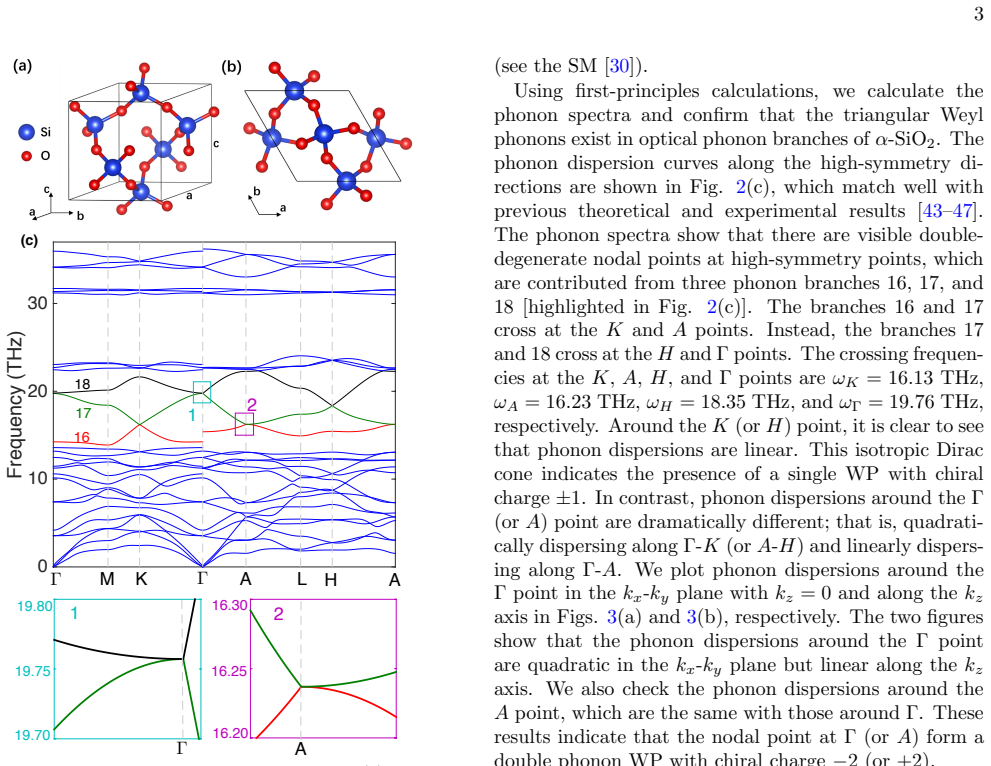
The central discovery is a symmetry-enforced coexistence of two kinds of Weyl phonons: single Weyl phonons with linear dispersion and chiral charge $C = -1$ at the $K$ and $H$ points, and double Weyl phonons with quadratic in-plane dispersion and chiral charge $C = +2$ at the $\Gamma$ and $A$ points. In $\alpha$-SiO$_2$ these four high-symmetry points split the three optical branches 16, 17, and 18 into two triangular complexes, one with a $C=+2$ source at $A$ and $C=-1$ sinks at $K$, the other with opposite charges at $\Gamma$ and $H$. The paper verifies the chiral charges with Wilson-loop calculations and shows by iterative Green's function calculations that the phonon surface arcs on both (001) and (010) surfaces start at the double Weyl projection and end at the single Weyl projections. Because the Weyl points are pinned to high-symmetry points by the screw symmetry, the arcs cross each half of the surface Brillouin zone and therefore span the entire first surface Brillouin zone.
Load-bearing premise
The load-bearing premise is that the Wannier-interpolated phonon Hamiltonian built from second-order interatomic force constants faithfully represents the real $\alpha$-SiO$_2$ phonon spectrum over the whole Brillouin zone, so the predicted surface arcs are real and not artifacts of that interpolation.
Editorial extensions
If this is right
- Any trigonal or hexagonal noncentrosymmetric material with the same screw-rotation and time-reversal symmetries should host the triangular Weyl complex, so alpha-SiO2 is a first example rather than an isolated case.
- Because the surface arcs span the entire first surface Brillouin zone, the topological phonon surface states provide a complete one-way propagation channel across the iso-frequency surface.
- The absence of trivial bulk states at the iso-frequency surface means the surface arcs can in principle be detected by surface-sensitive probes without a bulk background.
- The same symmetry mechanism should generate triangular Weyl complexes in photonic and phononic crystals, and the reasoning carries over to fermionic systems with identical space-group symmetries.
Reading between the lines
- Editorial inference: the symmetry analysis yields a screening recipe: for any noncentrosymmetric trigonal or hexagonal crystal, compute the phonon Chern numbers at Gamma, A, K, and H from first-principles force constants to identify new triangular Weyl materials, no new experiment required.
- Editorial inference: because the complex has zero total chiral charge only as a whole, the minimal topologically neutral unit in these space groups is a triangle rather than a pair; other polygons mixing Weyl points of unequal Chern numbers may be constructible under screw rotations of higher order.
- Editorial inference: the only-nontrivial-surface-states property suggests a concrete application as a topological phonon waveguide; a finite-element simulation of a phononic crystal engineered with the same screw symmetry would provide a direct test of the surface-arc geometry.
Signed reviews
Editorial analysis
A structured set of objections, weighed in public.
Referee Report
Summary. The manuscript proposes a symmetry-based classification of a 'triangular Weyl complex' in phonon spectra of non-centrosymmetric trigonal or hexagonal crystals. Using a two-band effective Hamiltonian constrained by screw rotation C3z and time reversal (Eqs. (1)-(6)), it argues that single Weyl phonons with linear dispersion appear at K/H points and double Weyl phonons with quadratic dispersion appear at Γ/A points. First-principles phonon calculations for α-SiO2 (space group P3_221, No. 154) identify crossings of branches 16/17 at K and A and of branches 17/18 at H and Γ; Wilson-loop and Berry-curvature analysis assigns chiral charges C=∓1 and C=±2. The authors then construct a Wannier-interpolated tight-binding Hamiltonian from second-order force constants and use iterative Green's functions to compute surface LDOS, claiming that two surface arcs connect the double-Weyl projection to two single-Weyl projections and that these arcs span the entire surface Brillouin-zone, with no trivial bulk states at the chosen iso-frequency. A hexagonal-lattice candidate, YPt2B, and the list of possible space groups are relegated to the Supplemental Material.
Significance. If the surface-state results are correct, the paper reports a genuinely novel phenomenon: a local Weyl complex in which one double Weyl point and two single Weyl points of opposite chirality coexist, while the global Nielsen-Ninomiya sum rule is still satisfied. The symmetry analysis is clean, parameter-free, and internally consistent, and the bulk α-SiO2 phonon spectra match earlier theoretical and experimental results, which gives confidence in the first-principles part. The paper would be of interest to the topological-phonon and bosonic-topology communities. However, the most distinctive claims in the abstract and conclusion, namely the surface-arc connectivity, the full-BZ span of the arcs, and the absence of trivial bulk states at the iso-frequency, rest on numerical details that are not presented in the main text and therefore cannot currently be verified.
major comments (3)
- [Fig. 4 and the paragraph beginning 'To illustrate this'] The two most distinctive claims, that the phonon surface arcs connect the double-Weyl projection to two single-Weyl projections and that there are only nontrivial surface states at the iso-frequency, are obtained from a Wannier-interpolated tight-binding Hamiltonian and iterative Green's functions, but the main text gives no construction details: no Wannier spread or truncation radius, no number of Wannier functions, no interpolation error, no comparison of the Wannier-interpolated bulk bands with the VASP/finite-displacement phonon bands along generic paths, no surface Green's-function k-point sampling, and no convergence tests. As presented, one cannot exclude the possibility that the arcs in Fig. 4(c,d) are numerical artifacts of the interpolation or of the Green's-function implementation. Please provide these details and include an overlay of the Wannier-interpolated and first-principles bulk bands over a substantial portion of the Brillouin-zone, including around Γ, A, K, and H.
- [Fig. 4 and the computational-methods paragraph] The paper does not specify how the iterative Green's-function method of Refs. [48,50], which is an electronic-structure technique, is adapted to phonons; in particular, the form of the retarded phonon Green's function (e.g., G(ω)=(ω^2−D+i0^+)^−1), the eigenvector phase convention, and the construction of the semi-infinite surface self-energy are not described. Additionally, α-SiO2 is polar, and the nonanalytical term correction mentioned in the main text is needed for the long-range dipole-dipole interaction and the direction-dependent q→0 limit. A short-ranged Wannier model built from finite-displacement force constants cannot reproduce this long-range contribution unless it is separately subtracted and re-added. The manuscript does not state how this was handled, and the surface arcs near the Γ and A projections could be affected.
- [Iso-frequency discussion after Fig. 4] The abstract and conclusion claim that there are only nontrivial surface states across the iso-frequency surface. This claim cannot be checked from the presented data: the iso-frequency maps in Fig. 4(c,d) are shown at a single frequency and are not overlaid with the projected bulk continuum, and the LDOS panels in Fig. 4(a,b) follow selected high-symmetry lines only. Please provide complete surface-BZ iso-frequency maps with the bulk projection shaded, and state the frequency range over which the 'only surface states' statement holds, since the wording suggests a much broader claim than a single iso-frequency slice.
minor comments (6)
- [Wilson-loop paragraph following Fig. 3] The sentence 'There are six K points in the first BZ and each K point is shared by three neighbor Wigner-Seitz cells in momentum space' is ambiguous: while the six corners of the hexagonal BZ are counted, each is shared by three neighboring BZs, so the effective number of K points per primitive cell is two. Please rephrase to make the fractional counting explicit and to clarify that the total chiral charge of the full BZ is zero while the local complex has unequal numbers of opposite-chirality WPs.
- [Fig. 4] The LDOS panels in Fig. 4(a,b) lack a color bar and the surface features are not annotated; please add a color bar and mark the surface branches so that the reader can distinguish them from the projected bulk continuum.
- [Wilson-loop paragraph following Fig. 3] The Wilson-loop spectra used to assign the Chern numbers are only described verbally; please include the actual Wilson-loop spectra for loops around K and A (and around H and Γ) in the main text or in the Supplemental Material so that the C=∓1 and C=±2 assignments can be verified.
- [After Eq. (5)] The derivation of Eq. (5) using the product operator C3zT should state explicitly the anti-unitary action of time reversal and the complex conjugation of d(q); without this the symmetry constraint is not fully checkable from the main text.
- [Conclusion] The statement that 'the longest phonon arcs can provide entire modes of topological phonon surface states in a robust nontrivial one-way phonon propagation channel' is speculative; no group-velocity or transport calculation is presented, so this sentence should be moved to an outlook or supported by additional calculations.
- [Ref. [30]] The reference to the Supplemental Material contains two typos: 'computional' should be 'computational' and 'inlcudes' should be 'includes'.
Circularity Check
No circularity found: the symmetry argument is first-principles with symbolic coefficients, the topology is confirmed by Wilson-loop charges, and the surface-state calculation is an independent numerical consequence rather than a fitted re-statement.
full rationale
The central claim of a triangular Weyl complex is grounded in a symmetry analysis of the screw rotational operator (Eqs. 1–6), where the effective-Hamiltonian coefficients are left symbolic and are constrained by symmetry, not fitted to the target result. The ab initio phonon spectra in Fig. 2(c) provide independent input, and the Wilson-loop calculation in Fig. 3(c) independently determines the chiral charges at the K and A points. The surface arcs in Fig. 4 are obtained from a Wannier-interpolated phonon Hamiltonian and iterative Green's function method; this is a numerical prediction from the bulk force constants and bulk topology, not a parameter fit to the arcs or to the claimed connectivity. The bulk-edge correspondence plus the computed charges C = +2 at the A point and C = −1 at the K points forces the observed arc connectivity, so the surface states are a consequence of, not an input to, the bulk calculation. The self-citations (Refs. 13, 17, 22) appear only in introductory surveys of topological quasiparticles and are not load-bearing for the derivation. The lack of detailed Wannier-construction parameters and convergence checks in the main text is a reproducibility and correctness concern, not evidence of circularity. Overall, the derivation is self-contained against independent first-principles data and does not reduce to its inputs by construction.
Assumptions & free parameters
assumptions (6)
- domain assumption The phonon system is governed by a Hermitian harmonic dynamical matrix and can be treated as a noninteracting bosonic band structure.
- domain assumption Time-reversal symmetry is preserved in the phonon spectra of alpha-SiO2.
- domain assumption alpha-SiO2 realizes space group P3221 with screw rotation C3z and without inversion.
- ad hoc to paper The two crossing phonon branches can be isolated into a 2x2 effective Hamiltonian with all other branches neglected.
- standard math Nielsen-Ninomiya no-go theorem applies to phonon Weyl points, requiring total chiral charge in the BZ to vanish.
- domain assumption DFT with PBE functional and finite-displacement supercell force constants gives reliable phonon frequencies near the crossings.
Cite this review
Pith. "Pith review of Symmetry-Protected Topological Triangular Weyl Complex." pith.science (2026). https://pith.science/paper/MXOCKPCO
@misc{pith2026190809447,
  author       = {Pith},
  title        = {Pith review of: Symmetry-Protected Topological Triangular Weyl Complex},
  year         = {2026},
  howpublished = {\url{https://pith.science/paper/MXOCKPCO}},
  note         = {Machine review of arXiv:1908.09447}
}
read the original abstract
Weyl points are often believed to appear in pairs with opposite chirality. In this work, we show by first-principles calculations and symmetry analysis that single Weyl phonons with linear dispersion and double Weyl phonons with quadratic dispersion are simultaneously present between two specific phonon branches in realistic materials with trigonal or hexagonal lattices. These phonon Weyl points are guaranteed to locate at high-symmetry points due to the screw rotational symmetry, forming a unique triangular Weyl complex. In sharp contrast to conventional Weyl systems with surface arcs terminated at the projections of a pair of Weyl points with opposite chirality, the phonon surface arcs of the unconventional triangular Weyl complex connect the projections of one double Weyl point and two single Weyl points. Importantly, the phonon surface arcs originating from the triangular Weyl complex are extremely long and span the entire surface Brillouin-zone. Furthermore, there are only nontrivial phonon surface states across the iso-frequency surface, which facilitates their detection in experiments and further applications. Our work not only offers the promising triangular phonon Weyl complex but also provides guidance for exploring triangular Weyl bosons in both phononic and photonic systems.
Figures


Reference graph
Works this paper leans on
-
[1]
M. Z. Hasan and C. L. Kane, Rev. Mod. Phys. 82, 3045 (2010)
2010
-
[2]
Qi and S.-C
X.-L. Qi and S.-C. Zhang, Rev. Mod. Phys. 83, 1057 (2011)
2011
-
[3]
source” point, whereas the sin- gle phonon WPs with C =−1 at the K point can be viewed as the “sink
is a partial translation vector. In a periodic system, the eigenvalues of ˜C3z can be expressed as ˜Eµ =Eµe−ikzc/3 (see the Supplemental Material (SM) [30]), where Eµ =ei2πµ/3 (µ = 0, 1, 2) are the rotational eigenvalues ofC3z. If two phonon branches are very close in a frequency at Kwp on a screw axis, we can use a 2×2 effective Hamiltonian to describe th...
-
[4]
N. P. Armitage, E. J. Mele, and A. Vishwanath, Rev. Mod. Phys. 90, 015001 (2018)
2018
-
[5]
X. Wan, A. M. Turner, A. Vishwanath, and S. Y. Savrasov, Phys. Rev. B 83, 205101 (2011)
2011
-
[6]
H. Weng, C. Fang, Z. Fang, B. A. Bernevig, and X. Dai, Phys. Rev. X 5, 011029 (2015)
2015
-
[7]
B. Bradlyn, J. Cano, Z. Wang, M. G. Vergniory, C. Felser, R. J. Cava, and B. A. Bernevig, Science 353, 6299 (2016)
work page 2016
-
[8]
Z. Zhu, G. W. Winkler, Q. Wu, J. Li, and A. A. Soluyanov, Phys. Rev. X 6, 031003 (2016)
2016
Show all 51 references
-
[9]
B. Q. Lv, Z.-L. Feng, Q.-N. Xu, X. Gao, J.-Z. Ma, L.-Y. Kong, P. Richard, Y.-B. Huang, V. N. Strocov, C. Fang, et al., Nature 546, 627 (2017)
2017
-
[10]
G. W. Winkler, S. Singh, and A. A. Soluyanov, Chin. Phys. B 28, 077303 (2019)
2019
-
[11]
Z. Wang, D. Gresch, A. A. Soluyanov, W. Xie, S. Kush- waha, X. Dai, M. Troyer, R. J. Cava, and B. A. Bernevig, Phys. Rev. Lett. 117, 056805 (2016)
2016
-
[12]
Aut` es, D
G. Aut` es, D. Gresch, M. Troyer, A. A. Soluyanov, and O. V. Yazyev, Phys. Rev. Lett. 117, 066402 (2016)
2016
-
[13]
Z. Wang, M. G. Vergniory, S. Kushwaha, M. Hirschberger, E. V. Chulkov, A. Ernst, N. P. Ong, R. J. Cava, and B. A. Bernevig, Phys. Rev. Lett. 117, 236401 (2016)
2016
-
[14]
R. Wang, Y. J. Jin, J. Z. Zhao, Z. J. Chen, Y. J. Zhao, and H. Xu, Phys. Rev. B 97, 195157 (2018)
2018
-
[15]
Zhang, Z
T. Zhang, Z. Song, A. Alexandradinata, H. Weng, C. Fang, L. Lu, and Z. Fang, Phys. Rev. Lett. 120, 016401 (2018)
2018
-
[16]
H. Miao, T. T. Zhang, L. Wang, D. Meyers, A. H. Said, Y. L. Wang, Y. G. Shi, H. M. Weng, Z. Fang, and M. P. M. Dean, Phys. Rev. Lett. 121, 035302 (2018)
2018
-
[17]
Y. Liu, Y. Xu, S.-C. Zhang, and W. Duan, Phys. Rev. B 96, 064106 (2017)
2017
-
[18]
Y. Jin, R. Wang, and H. Xu, Nano Lett. 18, 7755 (2018)
2018
-
[19]
Y. Liu, Y. Xu, and W. Duan, Nat. Sci. Rev.5, 314 (2018)
2018
-
[20]
Stenull, C
O. Stenull, C. L. Kane, and T. C. Lubensky, Phys. Rev. Lett. 117, 068001 (2016)
2016
-
[21]
J. Li, Q. Xie, S. Ullah, R. Li, H. Ma, D. Li, Y. Li, and X.-Q. Chen, Phys. Rev. B 97, 054305 (2018)
2018
-
[22]
Singh, Q
S. Singh, Q. Wu, C. Yue, A. H. Romero, and A. A. Soluyanov, Phys. Rev. Materials 2, 114204 (2018)
2018
-
[23]
Y. J. Jin, Z. J. Chen, B. W. Xia, Y. J. Zhao, R. Wang, and H. Xu, Phys. Rev. B 98, 220103 (2018)
2018
-
[24]
Q. Xie, J. Li, S. Ullah, R. Li, L. Wang, D. Li, Y. Li, S. Yunoki, and X.-Q. Chen, Phys. Rev. B 99, 174306 (2019)
2019
-
[25]
B. Xie, H. Liu, H. Cheng, Z. Liu, S. Chen, and J. Tian, Phys. Rev. Lett. 122, 104302 (2019)
2019
-
[26]
H. B. Nielsen and M. Ninomiya, Nucl. Phys. B 185, 20 (1981)
1981
-
[27]
H. B. Nielsen and M. Ninomiya, Nucl. Phys. B 193, 173 (1981)
1981
-
[28]
C. Fang, M. J. Gilbert, X. Dai, and B. A. Bernevig, Phys. Rev. Lett. 108, 266802 (2012)
2012
-
[29]
Chang, S.-Y
G. Chang, S.-Y. Xu, B. J. Wieder, D. S. Sanchez, S.-M. Huang, I. Belopolski, T.-R. Chang, S. Zhang, A. Bansil, H. Lin, et al., Phys. Rev. Lett. 119, 206401 (2017)
2017
-
[30]
P. Tang, Q. Zhou, and S.-C. Zhang, Phys. Rev. Lett. 119, 206402 (2017)
2017
-
[31]
See Supplemental Material at [url] for the computional method, the detailed symmetry and effective model anal- ysis, the summary of space groups with the triangular Weyl complex, and the results of YPt 2B, which inlcudes Refs. [31–37]
-
[32]
Kohn and L
W. Kohn and L. J. Sham, Phys. Rev. 140, A1133 (1965)
1965
-
[33]
J. P. Perdew, K. Burke, and M. Ernzerhof, Phys. Rev. Lett. 77, 3865 (1996)
1996
-
[34]
J. P. Perdew, K. Burke, and M. Ernzerhof, Phys. Rev. Lett. 78, 1396 (1997)
1997
-
[35]
Kresse and D
G. Kresse and D. Joubert, Phys. Rev. B 59, 1758 (1999)
1999
-
[36]
D. M. Ceperley and B. J. Alder, Phys. Rev. Lett. 45, 566 (1980)
1980
-
[37]
H. J. Monkhorst and J. D. Pack, Phys. Rev. B 13, 5188 (1976)
1976
-
[38]
M. Dias, O. Sologub, L. Pereira, and A. Gon¸ calves, J. Alloy. Comp. 438, 62 (2007)
2007
-
[39]
Kresse and J
G. Kresse and J. Furthm¨ uller, Phys. Rev. B 54, 11169 (1996)
1996
-
[40]
Togo and I
A. Togo and I. Tanaka, Scr. Mater. 108, 1 (2015)
2015
-
[41]
R. M. Pick, M. H. Cohen, and R. M. Martin, Phys. Rev. B 1, 910 (1970)
1970
-
[42]
C. J. Winta, S. Gewinner, W. Sch¨ ollkopf, M. Wolf, and A. Paarmann, Phys. Rev. B 97, 094108 (2018)
2018
-
[43]
Gonze, D
X. Gonze, D. C. Allan, and M. P. Teter, Phys. Rev. Lett. 68, 3603 (1992)
1992
-
[44]
Mizokami, A
K. Mizokami, A. Togo, and I. Tanaka, Phys. Rev. B 97, 224306 (2018)
2018
-
[45]
Gonze, J.-C
X. Gonze, J.-C. Charlier, D. Allan, and M. Teter, Phys. Rev. B 50, 13035 (1994)
1994
-
[46]
I. P. Swainson and M. T. Dove, J. Phys.: Condensed Matter 7, 1771 (1995)
1995
-
[47]
Choudhury and S
N. Choudhury and S. L. Chaplot, Phys. Rev. B 73, 094304 (2006)
2006
-
[48]
Dorner, H
B. Dorner, H. Grimm, and H. Rzany, J. Phys. C: Solid State Phys. 13, 6607 (1980)
1980
-
[49]
Q. Wu, S. Zhang, H.-F. Song, M. Troyer, and A. A. Soluyanov, Comput. Phys. Commun. 224, 405 (2018)
2018
-
[50]
R. Yu, X. L. Qi, A. Bernevig, Z. Fang, and X. Dai, Phys. Rev. B 84, 075119 (2011)
2011
-
[51]
M. P. L. Sancho, J. M. L. Sancho, and J. Rubio, J. Phys. F: Metal Phys. 14, 1205 (1984)
1984
Reviewed August 14, 2026 · model on record in the stance chip above.
Discussion (0). Continue with ORCID to comment.