REVIEW 3 major objections 7 minor 45 references
Successive Point-of-Interest Recommendation with Local Differential Privacy
T0 review · 3 major / 7 minor · reviewed 2026-08-14 · deepseek-v4-flash
Pith's one-line read Jointly factorizing user-POI visit counts and noisy POI-to-POI transitions improves next-POI recommendation accuracy under local differential privacy.
desk verdict SPIREL is a useful engineering contribution in private successive POI recommendation, but the Step 1 privacy analysis is wrong: the one-hot transition report is 2ε1-LDP, not ε1-LDP, so the paper's equal-ε comparison to SD-PL is not apples-to-apples and the 'stronger privacy' claim is unsupported. read the letter →
The pith
A machine-rendered reading of the paper's core claim, the machinery that carries it, and where it could break.
The reading
What carries the argument
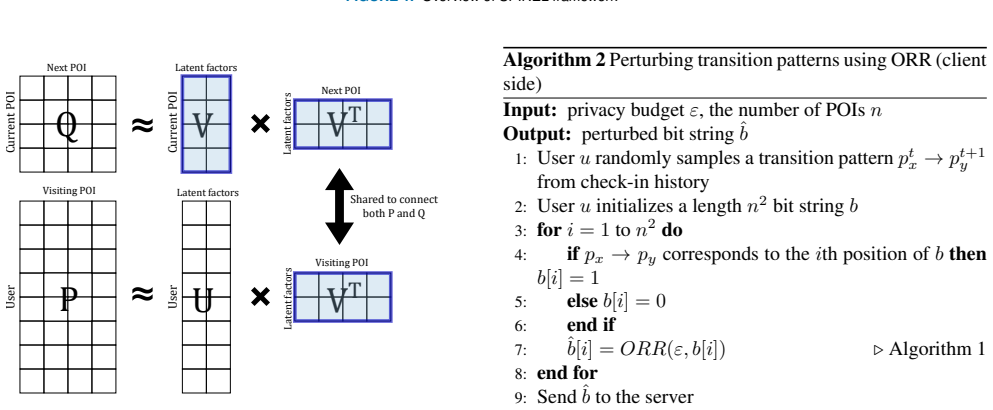
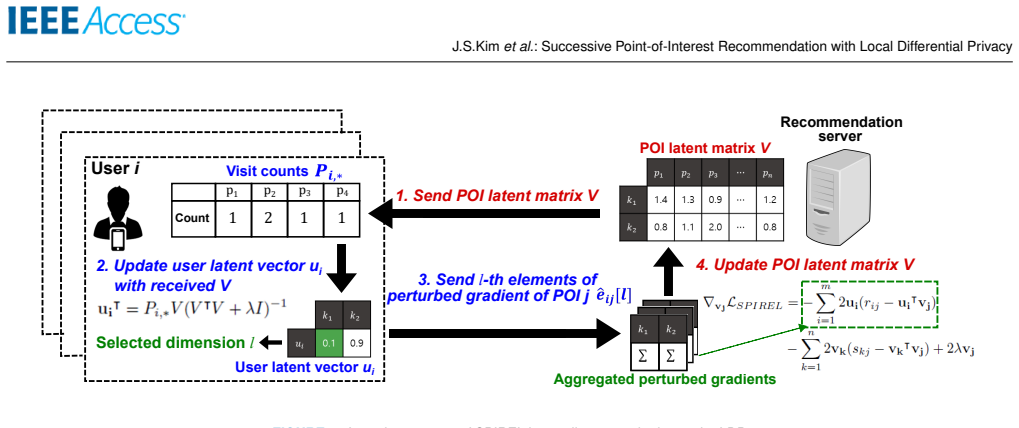
The central object is the shared POI latent matrix $V$, factorized in both the user-POI term and the POI-POI term. The POI-POI matrix $Q$ is built by having each user sample one consecutive transition, randomize it with optimized randomized response, and letting the server debias the aggregate; the result is turned into a confidence score $1+\sigma(Q[i][j])$ so that negative debiased counts remain usable. The user profile vectors are updated locally by ALS using a precomputed $V(V^\top V+\lambda I)^{-1}$, while the POI profiles are updated by the server with SGD on aggregated perturbed gradients, with users partitioned so that each participates in one learning iteration. The mechanism that carries the argument is the ranking score $u_i^\top v_k + v_j^\top v_k$: the first term is personal preference, and the second term transfers the noisy aggregate transition knowledge into each recommendation.
What would settle it
Train SPIREL with the same privacy budget and pipeline but replace the true transition data in $Q$ with random or shuffled transitions; if hit rate and mean reciprocal rank stay the same, the transition term is contributing nothing and the reported gains come from elsewhere. A second check is to remove the $v_j^\top v_k$ term from the ranking score while still training on $Q$; if performance does not drop, the transfer mechanism itself is not the carrier of the improvement.
Extended reading notes
Core claim
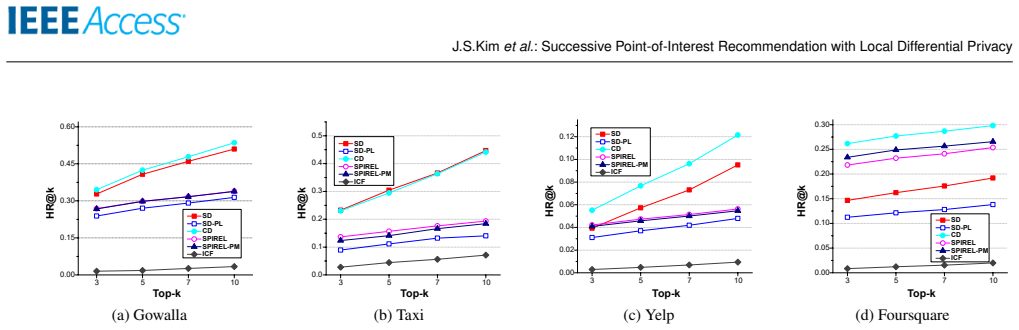
On the paper's own terms, the discovery is that a single POI latent matrix $V$ can carry both static and dynamic knowledge. The objective function $\mathcal{L}_{\mathrm{SPIREL}} = \|P - U V^\top\|^2 + \|Q - V V^\top\|^2 + \lambda(\|U\|^2 + \|V\|^2)$ forces $V$ to explain both the users' visit-count preferences and the first-order Markov transition patterns between consecutive POIs, where $Q$ is built from one perturbed transition sampled per user and mapped through a sigmoid confidence score. With the learned factors, the preference of user $i$ currently at POI $j$ for next POI $k$ is $u_i^\top v_k + v_j^\top v_k$, so the ranking can be computed locally. The authors claim this integrated learning is what makes the private framework outperform the single-domain private baseline by on average 41.56% in HR@k and 38.84% in MRR across the four datasets, and the whole pipeline is $\epsilon$-LDP by sequential composition because each user sends only perturbed bits and one perturbed gradient entry per iteration.
Load-bearing premise
Everything rests on the empirical assumption that a noisy, user-agnostic aggregate of one sampled transition per user carries information about an individual's next POI choice, so that sharing $V$ between the two factorizations improves the ranking $u_i^\top v_k + v_j^\top v_k$.
Editorial extensions
If this is right
- A privacy-preserving successive POI recommender can be built without a trusted server, without raw check-in collection, and without users disclosing their current location.
- On very sparse check-in datasets, noisy population-level transition knowledge can compensate for missing individual visit history well enough to beat a non-private single-domain recommender.
- The framework is modular in its privacy mechanisms: replacing the gradient perturbation with the piecewise mechanism yields comparable results, so future higher-accuracy LDP mechanisms can be dropped in without redesigning the model.
- Privacy-budget allocation and POI-domain size interact: small POI domains favor spending budget on gradient perturbation, while sparse large domains favor spending it on transition patterns.
- The server-side cost scales with $O(mn^2)$ for building the transition matrix, so the number of POIs is the main scaling bottleneck.
Reading between the lines
- A natural extension is to let each user report more than one sampled transition under a split privacy budget; the current design deliberately uses one sample per user, so the marginal value of additional samples is a testable question the paper leaves open.
- The same shared-latent construction could carry over to private sequential recommendation in other implicit-feedback domains, such as app usage or purchase sequences, where a global transition matrix can be factorized with the user-item matrix while raw events stay on-device.
- The confidence mapping from debiased transition counts to $1+\sigma(\cdot)$ is a design choice; comparing it with logarithmic or linear confidence scores would reveal how much of the reported gain comes from the mapping rather than from sharing the latent POI matrix.
Signed reviews
Editorial analysis
A structured set of objections, weighed in public.
Referee Report
Summary. The paper proposes SPIREL, a local-differential-privacy (LDP) framework for successive point-of-interest (POI) recommendation. Each user samples one consecutive POI-POI transition from his or her check-in history, encodes it as a one-hot bit string of length n^2, and perturbs it with optimized randomized response; the server aggregates the noisy strings into a POI-POI matrix Q and converts the estimated counts into sigmoid confidence scores. SPIREL jointly factorizes the user-POI visit-count matrix P and the POI-POI matrix Q with a shared POI latent matrix V by minimizing ||P - U V^T||^2 + ||Q - V V^T||^2 plus regularization. Users update their latent vectors locally via ALS, while each user contributes one perturbed gradient coordinate for one randomly selected POI; the server aggregates these noisy gradients and updates V with Adam. The next-POI score is u_i^T v_k + v_j^T v_k, so users do not need to disclose their current location. Experiments on Gowalla, Taxi, Yelp, and Foursquare compare SPIREL with a single-domain baseline, a private single-domain baseline (SD-PL), a non-private cross-domain version, a piecewise-mechanism variant, and item-based collaborative filtering, using HR@k and MRR.
Significance. If the privacy accounting is corrected, the transfer-learning idea is a plausible contribution: SPIREL appears to be the first LDP successive-POI recommender that combines user-POI and POI-POI relationships, and it has the practical advantage that users can receive recommendations without sending their current location. The paper gives a complete algorithmic description and evaluates on four public datasets, and the private-vs-private comparison consistently favors SPIREL. However, the central privacy analysis currently overstates the guarantee: the one-hot transition report is 2*epsilon1-LDP, not epsilon1-LDP, so the total privacy cost is epsilon+epsilon1 rather than epsilon. The experimental comparison to SD-PL at equal nominal epsilon is therefore inequitable, and the headline claim of "stronger privacy protection" is not supported. The manuscript is not circular: Q is constructed from training check-ins, which is standard training data usage, and the cited LDP mechanisms are by other groups.
major comments (3)
- [Section IV-F.1, Algorithms 1-2] The claim that the one-hot ORR reporting step satisfies epsilon1-LDP is incorrect. For the ORR mechanism of Algorithm 1, p = e^epsilon1 / (1 + e^epsilon1) and q = 1 / (1 + e^epsilon1). For two distinct transition patterns a and b, consider an output in which bit a is 1 and bit b is 0. The likelihood ratio is Pr[output | input = a] / Pr[output | input = b] = [p(1 - q)] / [q(1 - p)] = e^(2*epsilon1). Changing the sampled transition flips two coordinates of the one-hot n^2-bit vector, each contributing a factor e^epsilon1. Therefore Algorithm 2 is 2*epsilon1-LDP, not epsilon1-LDP. Combined with the gradient perturbation in Step 3, the full protocol guarantees 2*epsilon1 + epsilon2-LDP, which equals epsilon + epsilon1-LDP under the stated split epsilon1 + epsilon2 = epsilon. This is a formal error in the core privacy analysis, not a wording issue, and it invalidates the abstract's claim of "stronger privacy protection" relative to SD-PL at the same nominal epsilon.
- [Section V-B.1, Figs. 5-6] Because of the privacy-accounting error above, the reported average improvements of 41.56% in HR@k and 38.84% in MRR of SPIREL over SD-PL are not a clean test of the modeling contribution: SPIREL at nominal epsilon consumes epsilon + epsilon1 of true privacy budget while SD-PL consumes epsilon. The authors should either correct the transition-reporting mechanism to genuinely achieve epsilon1-LDP (for example, by using generalized randomized response over the n^2-sized domain) or rerun SD-PL with budget epsilon + epsilon1, and then compare the methods at equal true privacy loss. Without this, the observed gains may partly reflect additional privacy budget rather than the benefit of transferring the POI-POI knowledge.
- [Section IV-A and Eq. (5)] The transfer-learning assumption is load-bearing: the paper provides no theoretical argument that the global, user-independent transition-frequency matrix Q, estimated from one sampled transition per user, carries information that improves an individual's next-POI ranking u_i^T v_k + v_j^T v_k. The entire advantage over SD-PL rests on this empirical assumption. I recommend adding an ablation in which Q is replaced by a non-informative or random matrix, and comparing with non-private sequential recommenders (e.g., FPMC or PRME) to calibrate whether the benefit is real and practically meaningful. The current evaluation only measures SPIREL against self-created baselines and one private baseline, which limits external validity.
minor comments (7)
- [Section V-B.2 and Fig. 12 captions] There are typos: "Foursuqare" in Section V-B.2 should be "Foursquare," and the caption of Figure 12 contains "T raining time" and "Mean traning time."
- [Section IV-E] The phrase "matrix conversion" should be "matrix inversion" when referring to (V^T V + lambda I)^{-1}.
- [Section II-A, Eq. (2)] Equation (2) uses the notation "v_i" in the gradient with respect to the user profile vector; this should be v_j to match the sum over items, and the subscript in the gradient notation should be consistent.
- [Section IV-F.1] The sentence "each bit is relevant to the independent transition pattern" is misleading: independence of the identities of the patterns does not imply independence of the privacy loss when the input is a one-hot vector. Section IV-F.1 should be revised along with the corrected privacy analysis.
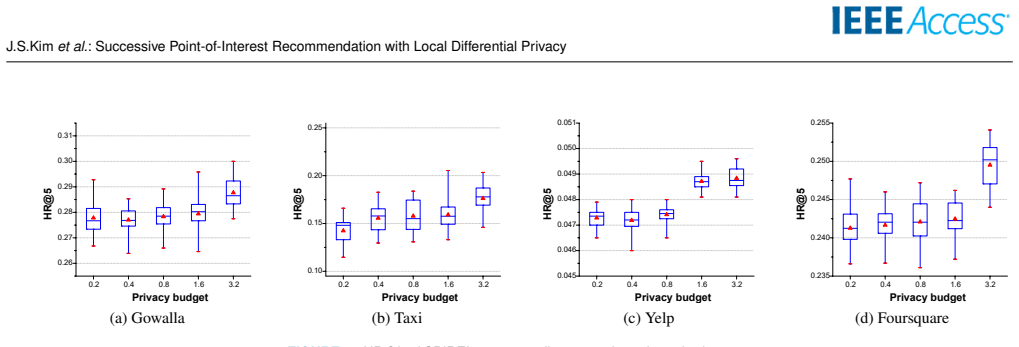
- [Section V-A.4 and Fig. 9] The default equal privacy-budget allocation 5:5 is used for the headline comparisons, but Figure 9 shows that the best allocation ratio is dataset-dependent. The authors should either justify the fixed default or report results at each dataset's optimal ratio.
- [Section V-B, Figs. 5-6] Although the experiments are averaged over 50 runs, Figures 5 and 6 show only point values without error bars or standard deviations; adding these would strengthen the claim that the differences between methods are meaningful.
- [Section VI, reference [45]] The text cites "Gao et al." for the method that uses Factorization Machines, but reference [45] lists C. Chen, J. Zhou, B. Wu, et al.; the citation should be corrected to match the reference entry.
Circularity Check
No circularity: SPIREL's ranking is learned from training data and evaluated on held-out last check-ins, with no parameter fit to the test labels.
full rationale
The claimed derivation chain is not circular. The auxiliary POI-POI matrix Q is constructed from each user's sampled transition pattern (Algorithm 2), perturbed under ORR and aggregated (Algorithm 3); the user-POI matrix P is constructed from visit counts. The objective function (Eq. 5) is a design choice that jointly factorizes these two training-derived matrices, and the ranking score (Eq. 12) is the inner-product composition of the learned latent factors. No parameter in this chain is fitted to the held-out last check-ins used for HR@k and MRR: the held-out labels enter only at evaluation, and the model parameters are learned from the remaining check-ins. The cited LDP mechanisms ([10], [13], [25], [30]) are by other research groups, so there is no load-bearing self-citation. The privacy analysis's claim that Step 1 is ε1-LDP (Section IV-F.1) may be incorrect—for a one-hot bit string the ORR likelihood ratio is e^{2ε1} per pair of outputs—but that is a privacy-accounting and correctness issue, not a circularity of the recommendation derivation. The performance gains are therefore empirically contingent results, not consequences of the inputs by construction.
Assumptions & free parameters
free parameters (6)
- privacy budget allocation ratio epsilon1:epsilon2 =
1:1 by default; tuned to 9:1 or 1:9 per dataset in Section V-B3
- learning rate gamma =
0.01 for SPIREL/SPIREL-PM/CD, 0.001 for SD/SD-PL
- maximum iterations =
20 by default, tested 5-40
- profile dimension d =
40
- clipping bound for gradients =
[-1, 1]
- regularization lambda =
1e-4
assumptions (5)
- domain assumption The next POI depends only on the current POI (first-order Markov chain).
- domain assumption A single shared latent POI matrix V can bridge the user-POI and POI-POI domains.
- domain assumption An observed transition, even if fake due to noise, indicates 'more preferable' than non-observed feedback.
- standard math The closed-form ALS updates and SGD are standard and converge for the fixed-point of the objective.
- domain assumption The ORR scheme [25] and the Nguyen et al. mechanism [10] satisfy the stated epsilon-LDP guarantees.
Cite this review
Pith. "Pith review of Successive Point-of-Interest Recommendation with Local Differential Privacy." pith.science (2026). https://pith.science/paper/LTFLBB6I
@misc{pith2026190809485,
  author       = {Pith},
  title        = {Pith review of: Successive Point-of-Interest Recommendation with Local Differential Privacy},
  year         = {2026},
  howpublished = {\url{https://pith.science/paper/LTFLBB6I}},
  note         = {Machine review of arXiv:1908.09485}
}
read the original abstract
A point-of-interest (POI) recommendation system performs an important role in location-based services because it can help people to explore new locations and promote advertisers to launch advertisements at appropriate locations. The existing POI recommendation systems require raw check-in history of users, which might cause location privacy violations. Although there have been several matrix factorization (MF) based privacy-preserving recommendation systems, they can only focus on user-POI relationships without considering the human movements in check-in history. To tackle this problem, we design a successive POI recommendation framework with local differential privacy, named SPIREL. SPIREL uses two types of information derived from the check-in history as input for the factorization: a transition pattern between two POIs and the visit counts of POIs. We propose a novel objective function for learning the user-POI and POI-POI relationships simultaneously. We further integrate local differential privacy mechanisms in our proposed framework to prevent potential location privacy breaches. Experiments using four public datasets demonstrate that SPIREL achieves better POI recommendation quality while accomplishing stronger privacy protection.
Figures


Figures from the paper (10 more)




Reference graph
Works this paper leans on
-
[1]
Where you like to go next: Successive point-of-interest recommendation,
C. Cheng, H. Yang, M. R. Lyu, and I. King, “Where you like to go next: Successive point-of-interest recommendation,” in IJCAI, pp. 2605–2611, 2013
work page 2013
-
[2]
Personalized point-of-interest recommendation by mining users’ preference transition,
X. Liu, Y . Liu, K. Aberer, and C. Miao, “Personalized point-of-interest recommendation by mining users’ preference transition,” in ACM CIKM, pp. 733–738, 2013
work page 2013
-
[3]
Geomf: joint geographical modeling and matrix factorization for point-of-interest recom- mendation,
D. Lian, C. Zhao, X. Xie, G. Sun, E. Chen, and Y . Rui, “Geomf: joint geographical modeling and matrix factorization for point-of-interest recom- mendation,” in ACM SIGKDD, pp. 831–840, 2014
work page 2014
-
[4]
Content-aware hierar- chical point-of-interest embedding model for successive POI recommenda- tion.,
B. Chang, Y . Park, D. Park, S. Kim, and J. Kang, “Content-aware hierar- chical point-of-interest embedding model for successive POI recommenda- tion.,” in IJCAI, pp. 3301–3307, 2018
work page 2018
-
[5]
Unique in the crowd: The privacy bounds of human mobility,
Y .-A. De Montjoye, C. A. Hidalgo, M. Verleysen, and V . D. Blondel, “Unique in the crowd: The privacy bounds of human mobility,” Scientific reports, vol. 3, pp. 1–5, 2013
work page 2013
-
[6]
G. Jung, H. Lee, A. Kim, and U. Lee, “Too much information: assessing privacy risks of contact trace data disclosure on people with covid-19 in south korea,” Frontiers in public health, vol. 8, pp. 1–13, 2020
work page 2020
-
[7]
Rappor: Randomized aggregat- able privacy-preserving ordinal response,
Ú. Erlingsson, V . Pihur, and A. Korolova, “Rappor: Randomized aggregat- able privacy-preserving ordinal response,” in ACM CCS, pp. 1054–1067, 2014
work page 2014
-
[8]
Learning with privacy at scale,
Differential Privacy Team, “Learning with privacy at scale,” Apple Machine Learning Journal, vol. 1, no. 8, pp. 1–25, 2017
work page 2017
Show all 45 references
-
[9]
Collecting telemetry data privately,
B. Ding, J. Kulkarni, and S. Yekhanin, “Collecting telemetry data privately,” in NIPS, pp. 3571–3580, 2017
2017
-
[10]
Collecting and analyzing data from smart device users with local differential privacy,
T. T. Nguyên, X. Xiao, Y . Yang, S. C. Hui, H. Shin, and J. Shin, “Collecting and analyzing data from smart device users with local differential privacy,” arXiv preprint arXiv:1606.05053, 2016
2016 arXiv
-
[11]
Differentially private matrix factorization,
J. Hua, C. Xia, and S. Zhong, “Differentially private matrix factorization,” in IJCAI, pp. 1763–1770, 2015
2015
-
[12]
Probabilistic ma- trix factorization with personalized differential privacy,
S. Zhang, L. Liu, Z. Chen, and H. Zhong, “Probabilistic ma- trix factorization with personalized differential privacy,” arXiv preprint arXiv:1810.08509, 2018
2018 arXiv
-
[13]
Privacy enhanced matrix factor- ization for recommendation with local differential privacy,
H. Shin, S. Kim, J. Shin, and X. Xiao, “Privacy enhanced matrix factor- ization for recommendation with local differential privacy,” IEEE TKDE, vol. 30, no. 9, pp. 1770–1782, 2018
2018
-
[14]
Matrix factorization techniques for recommender systems,
Y . Koren, R. Bell, and C. V olinsky, “Matrix factorization techniques for recommender systems,” Computer, no. 8, pp. 30–37, 2009
2009
-
[15]
Faster and cheaper: Parallelizing large-scale matrix factorization on gpus,
W. Tan, L. Cao, and L. Fong, “Faster and cheaper: Parallelizing large-scale matrix factorization on gpus,” in HPDC, pp. 219–230, 2016. VOLUME x, 20xx 15 J.S.Kim et al.: Successive Point-of-Interest Recommendation with Local Differential Privacy
2016
-
[16]
Cross domain recommender sys- tems: A systematic literature review,
M. M. Khan, R. Ibrahim, and I. Ghani, “Cross domain recommender sys- tems: A systematic literature review,” ACM Computing Surveys (CSUR), vol. 50, no. 3, pp. 1–34, 2017
2017
-
[17]
Transfer learning in collaborative filtering for sparsity reduction,
W. Pan, E. W. Xiang, N. N. Liu, and Q. Yang, “Transfer learning in collaborative filtering for sparsity reduction,” in AAAI, pp. 230–235, 2010
2010
-
[18]
Transfer learning to predict missing ratings via heterogeneous user feedbacks,
W. Pan, N. N. Liu, E. W. Xiang, and Q. Yang, “Transfer learning to predict missing ratings via heterogeneous user feedbacks,” in AAAI, pp. 2318– 2323, 2011
2011
-
[19]
Transfer learning in heterogeneous collaborative filtering domains,
W. Pan and Q. Yang, “Transfer learning in heterogeneous collaborative filtering domains,” Artificial intelligence, vol. 197, pp. 39–55, 2013
2013
-
[20]
Local privacy and statistical minimax rates,
J. C. Duchi, M. I. Jordan, and M. J. Wainwright, “Local privacy and statistical minimax rates,” in IEEE FOCS, pp. 429–438, 2013
2013
-
[21]
Calibrating noise to sensitivity in private data analysis,
C. Dwork, F. McSherry, K. Nissim, and A. Smith, “Calibrating noise to sensitivity in private data analysis,” in Theory of cryptography conference, pp. 265–284, 2006
2006
-
[22]
Privacy integrated queries: an extensible platform for privacy-preserving data analysis,
F. D. McSherry, “Privacy integrated queries: an extensible platform for privacy-preserving data analysis,” in ACM SIGMOD, pp. 19–30, 2009
2009
-
[23]
Deep learning with differential privacy,
M. Abadi, A. Chu, I. Goodfellow, H. B. McMahan, I. Mironov, K. Talwar, and L. Zhang, “Deep learning with differential privacy,” in ACM CCS, pp. 308–318, 2016
2016
-
[24]
Randomized response: A survey technique for eliminating evasive answer bias,
S. L. Warner, “Randomized response: A survey technique for eliminating evasive answer bias,” Journal of the American Statistical Association, vol. 60, no. 309, pp. 63–69, 1965
1965
-
[25]
Locally differentially private protocols for frequency estimation,
T. Wang, J. Blocki, N. Li, and S. Jha, “Locally differentially private protocols for frequency estimation,” in USENIX Security Symposium, pp. 729–745, 2017
2017
-
[26]
Hadamard response: Estimating distributions privately, efficiently, and with little communication,
J. Acharya, Z. Sun, and H. Zhang, “Hadamard response: Estimating distributions privately, efficiently, and with little communication,” in PMLR, pp. 1120–1129, 2019
2019
-
[27]
Learning new words from keystroke data with local differential privacy,
S. Kim, H. Shin, C. H. Baek, S. Kim, and J. Shin, “Learning new words from keystroke data with local differential privacy,” IEEE TKDE, vol. 32, no. 7, pp. 479–491, 2018
2018
-
[28]
Bpr: Bayesian personalized ranking from implicit feedback,
S. Rendle, C. Freudenthaler, Z. Gantner, and L. Schmidt-Thieme, “Bpr: Bayesian personalized ranking from implicit feedback,” arXiv preprint arXiv:1205.2618, 2012
2012 arXiv
-
[29]
Collaborative filtering for implicit feedback datasets,
Y . Hu, Y . Koren, and C. V olinsky, “Collaborative filtering for implicit feedback datasets,” in IEEE ICDM, pp. 263–272, 2008
2008
-
[30]
Collecting and analyzing multidimensional data with local differential privacy,
N. Wang, X. Xiao, Y . Yang, J. Zhao, S. C. Hui, H. Shin, J. Shin, and G. Yu, “Collecting and analyzing multidimensional data with local differential privacy,” in IEEE ICDE, pp. 638–649, 2019
2019
-
[31]
Privacy aware learning,
J. C. Duchi, M. I. Jordan, and M. J. Wainwright, “Privacy aware learning,” Journal of the ACM (JACM), vol. 61, no. 6, pp. 1–57, 2014
2014
-
[32]
Efficient mini-batch training for stochastic optimization,
M. Li, T. Zhang, Y . Chen, and A. J. Smola, “Efficient mini-batch training for stochastic optimization,” in ACM SIGKDD, pp. 661–670, 2014
2014
-
[33]
Adaptive subgradient methods for online learning and stochastic optimization,
J. Duchi, E. Hazan, and Y . Singer, “Adaptive subgradient methods for online learning and stochastic optimization,” Journal of machine learning research, vol. 12, no. Jul, pp. 2121–2159, 2011
2011
-
[34]
Neural networks for machine learning lecture 6a: overview of mini-batch gradient descent,
G. Hinton, N. Srivastava, and K. Swersky, “Neural networks for machine learning lecture 6a: overview of mini-batch gradient descent,” University of Toronto, Technical Report, vol. 14, no. 8, pp. 8–31, 2012
2012
-
[35]
Adam: A method for stochastic optimization,
D. P. Kingma and J. Ba, “Adam: A method for stochastic optimization,” arXiv preprint arXiv:1412.6980, 2014
2014 arXiv
-
[36]
Adapting to user interest drift for poi recommendation,
H. Yin, X. Zhou, B. Cui, H. Wang, K. Zheng, and Q. V . H. Nguyen, “Adapting to user interest drift for poi recommendation,” IEEE TKDE, vol. 28, no. 10, pp. 2566–2581, 2016
2016
-
[37]
Locally differentially private item- based collaborative filtering,
T. Guo, J. Luo, K. Dong, and M. Yang, “Locally differentially private item- based collaborative filtering,” Information Sciences, vol. 502, pp. 220–246, 2019
2019
-
[38]
Privtrie: Effective frequent term discovery under local differential privacy,
N. Wang, X. Xiao, Y . Yang, T. D. Hoang, H. Shin, J. Shin, and G. Yu, “Privtrie: Effective frequent term discovery under local differential privacy,” in IEEE ICDE, pp. 821–832, 2018
2018
-
[39]
Factorizing person- alized markov chains for next-basket recommendation,
S. Rendle, C. Freudenthaler, and L. Schmidt-Thieme, “Factorizing person- alized markov chains for next-basket recommendation,” in WWW, pp. 811– 820, 2010
2010
-
[40]
Personalized ranking metric embedding for next new poi recommendation,
S. Feng, X. Li, Y . Zeng, G. Cong, and Y . M. Chee, “Personalized ranking metric embedding for next new poi recommendation,” in IJCAI, pp. 2069– 2075, 2015
2015
-
[41]
Lglmf: local geographical based logistic matrix factor- ization model for poi recommendation,
H. A. Rahmani, M. Aliannejadi, S. Ahmadian, M. Baratchi, M. Afsharchi, and F. Crestani, “Lglmf: local geographical based logistic matrix factor- ization model for poi recommendation,” in Asia Information Retrieval Symposium, pp. 66–78, 2019
2019
-
[42]
Building a rappor with the un- known: Privacy-preserving learning of associations and data dictionaries,
G. Fanti, V . Pihur, and Ú. Erlingsson, “Building a rappor with the un- known: Privacy-preserving learning of associations and data dictionaries,” Proceedings on Privacy Enhancing Technologies, vol. 2016, no. 3, pp. 41– 61, 2016
2016
-
[43]
Differentially private sequential data publication via variable-length n-grams,
R. Chen, G. Acs, and C. Castelluccia, “Differentially private sequential data publication via variable-length n-grams,” in ACM CCS, pp. 638–649, 2012
2012
-
[44]
“When and Where Do You Want to Hide?
M. Asada, M. Yoshikawa, and Y . Cao, ““When and Where Do You Want to Hide?”–Recommendation of Location Privacy Preferences with Local Differential Privacy,” in IFIP Annual Conference on Data and Applications Security and Privacy, pp. 164–176, 2019
2019
-
[45]
Practical privacy preserving poi recommendation,
C. Chen, J. Zhou, B. Wu, W. Fang, L. Wang, Y . Qi, and X. Zheng, “Practical privacy preserving poi recommendation,” ACM Transactions on Intelligent Systems and Technology (TIST), vol. 11, no. 5, pp. 1–20, 2020. JONG SEON KIM received his B.S. degree in computer science from Ko...
2020
Reviewed August 14, 2026 · model on record in the stance chip above.
Discussion (0). Continue with ORCID to comment.