REVIEW 3 major objections 6 minor 55 references
High-$K$ multi-particle bands and pairing reduction in $^{254}$No
T0 review · 3 major / 6 minor · reviewed 2026-08-14 · deepseek-v4-flash
Pith's one-line read A cranked shell model with exact pairing blocking reproduces the high-K rotational bands of 254No and explains their faster rotation as pairing reduction from Pauli blocking.
desk verdict First PNC-CSM study of the two-particle high-K bands in 254No; gives a plausible pairing-reduction picture, but the quantitative chain from a ~4.5% pairing-gap drop to a ~25% moment-of-inertia rise is asserted, not demonstrated. read the letter →
The pith
A machine-rendered reading of the paper's core claim, the machinery that carries it, and where it could break.
The reading
What carries the argument
The central object is the cranked shell model Hamiltonian $H_{\rm CSM} = H_{\rm Nilsson} - \omega J_x + H_P^{(0)} + H_P^{(2)}$, solved by direct diagonalization in a truncated many-particle configuration space in which particle number is conserved and Pauli blocking is treated exactly. The pairing gap $\tilde{\Delta}$, defined from the expectation value of the pairing Hamiltonian, is the diagnostic that connects the blocked configuration to the moment of inertia. The high-order deformation $\varepsilon_6 = 0.042$ is a load-bearing input: without it the single-particle ordering puts the $8^-$ state below the $3^+$ state, contradicting experiment, whereas with it the $Z = 100$ and $N = 152$ deformed shell gaps are enlarged and the $3^+$ state becomes the lowest two-particle state.
What would settle it
A definitive placement of the disputed high-spin transitions in the $K^\pi = 8^-/10^+$ region would settle the matter: the two competing level schemes give different $J^{(1)}$ trends, and the calculation matches the neutron configuration only if the extension is included. More generally, a high-$K$ band whose blocked orbitals sit far from the Fermi surface should show a measurably smaller pairing reduction; if its $J^{(1)}$ still rises by about 25%, the Pauli-blocking explanation would fail.
Extended reading notes
Core claim
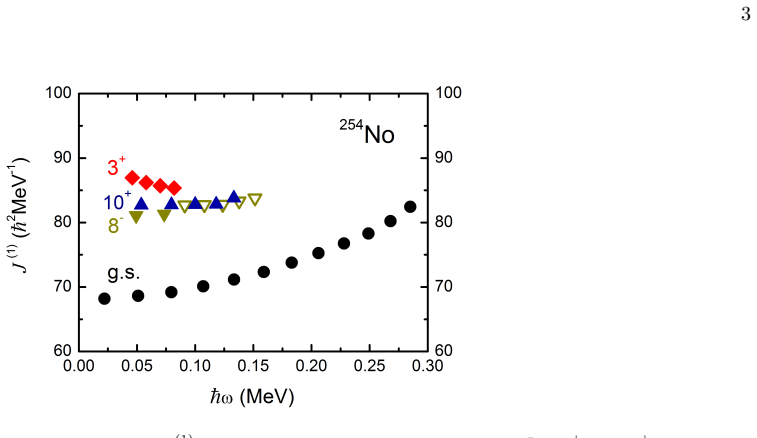
The paper establishes that the observed rotational bands built on the two-particle $K^\pi = 3^+$, $8^-$, and $10^+$ states in $^{254}$No are quantitatively reproduced by a cranked shell model with monopole and quadrupole pairing treated by a particle-number-conserving diagonalization, provided the high-order deformation $\varepsilon_6 = 0.042$ is included. The central physical finding is that the 20--25% rise of the kinematic moment of inertia $J^{(1)}$ of these bands relative to the ground-state band is caused by pairing reduction: the two unpaired nucleons block orbitals near the Fermi surface, lowering the pairing gap by about 4--5% at the bandhead and by roughly 5--8% at $\hbar\omega = 0.3$ MeV for the two-particle bands, whereas the ground-state band loses about 20% of its pairing over the same frequency range. This different frequency dependence explains why the high-$K$ bands stay flat while the ground-state band rises smoothly.
Load-bearing premise
The calculation assumes that the effective pairing strengths $G_0 = 0.25$ MeV and $G_2 = 0.02$ MeV, fixed from odd-even differences in moment of inertia in the $A \sim 250$ region, remain valid for the pair-broken high-$K$ bands and for the modified Nilsson single-particle scheme; if that transferability fails, the computed $J^{(1)}$ rise and its pairing-reduction interpretation lose quantitative support.
Editorial extensions
If this is right
- The rotational behavior of high-$K$ bands in the transfermium region can be understood within the same mean-field-plus-pairing framework used for lighter nuclei, without calling on new degrees of freedom.
- The seniority-dependent pairing reduction of roughly 4--5% at the bandhead is enough to produce the observed ~25% increase in $J^{(1)}$, establishing a quantitative link between blocked orbitals and nuclear rigidity.
- Including $\varepsilon_6$ deformation is not a refinement but a requirement: without it the single-particle order reverses the $3^+$ and $8^-$ states and disagrees with experiment.
- The flat $J^{(1)}$ of the $8^-$ and $10^+$ bands, in contrast to the smoothly rising ground-state band, is a direct consequence of the much weaker frequency dependence of pairing in the pair-broken bands (~5--8% versus ~20% at $\hbar\omega = 0.3$ MeV).
- The $K^\pi = 10^+$ band is not a pure two-particle configuration; its calculated wave function mixes in the $\nu\,9/2^-[734] \otimes \nu\,1/2^-[761]$ configuration, producing a hump near $\hbar\omega \approx 0.2$ MeV.
Reading between the lines
- If the pairing-reduction mechanism is general, then the analogous high-$K$ bands in neighbouring even-even nuclei such as $^{252}$No and $^{250}$Fm should show a similar 20--25% $J^{(1)}$ rise whose magnitude tracks the proximity of the blocked orbitals to the Fermi surface; this correlation can be checked against existing data.
- The strong sensitivity of the bandhead ordering to $\varepsilon_6$ implies that high-$K$ spectroscopy in this mass region could serve as a precision probe of hexadecapole-type deformation, complementing ground-state observables.
- The paper's success with fixed pairing strengths suggests that the effective pairing interaction is only weakly renormalized by blocking two particles; an independent calculation of the seniority-two pairing gap would test this transferability without relying on fits to moments of inertia.
Signed reviews
Editorial analysis
A structured set of objections, weighed in public.
Referee Report
Summary. The paper applies the cranked shell model with particle-number-conserving (PNC-CSM) pairing to two-particle high-K bands in 254No, namely the K^pi = 3^+, 8^- and 10^+ bands. It computes excitation energies, kinematic moments of inertia J^(1), and pairing gaps as functions of rotational frequency, including the effect of the hexadecapole-type deformation epsilon_6. The authors report good overall reproduction of the experimental excitation energies and moments of inertia, and attribute the observed 20-25% rise of J^(1) in the high-K bands relative to the ground-state band to a pairing reduction caused by Pauli blocking of the unpaired particles.
Significance. If the central attribution holds, the paper would support the view that high-K rotational bands in the transfermium region can be described within a mean-field-plus-pairing framework without invoking new degrees of freedom. The paper is the first PNC-CSM treatment of these specific bands, and it provides a useful multiplet of predictions compared against several other models. Its strengths include a clearly stated Hamiltonian and diagonalization procedure, an explicit no-pairing control calculation, and a systematic comparison of the epsilon_6 effect on single-particle levels and excitation energies. However, the quantitative connection between the computed ~4.2-4.8% bandhead pairing-gap reduction and the ~25% J^(1) rise is not demonstrated, and the calibrated pairing strengths are transferred from ground-state odd-even moment-of-inertia differences without a robustness check. These points need to be addressed before the central claim is fully supported.
major comments (3)
- [Sec. VI, Eq. (6)] The central attribution is asserted but not quantitatively established. The paper reports R_tau(nu=2) of about 4.2-4.8% for the bandhead pairing gaps of the high-K bands and then states that this 'contributes to the ~25% increases of J^(1)'. No relation between the pairing gap and the kinematic moment of inertia is derived or cited, so the reader cannot see how a ~4.5% gap reduction produces a ~25% J^(1) rise. Please either provide a quantitative demonstration (for example, J^(1) computed with only the seniority-induced gap reduction, or an analytic relation between Delta and J^(1)) or explicitly downgrade the conclusion to a qualitative mechanism.
- [Sec. II, pairing strengths] The effective pairing strengths G0 = 0.25 MeV and G2 = 0.02 MeV are determined from odd-even differences in moment of inertia in the mass region and are then applied unchanged to proton and neutron seniority-two bands. The magnitude of the computed high-K J^(1) rise depends on these strengths, and the no-pairing control in Sec. V only shows that pairing is necessary for the rise; it does not show that the calibrated values produce the correct magnitude in the pair-broken bands. Please add a sensitivity study of J^(1) versus G0 and G2 (or another explicit justification of transferability), since this is the main quantitative input behind the pairing-reduction claim.
- [Secs. IV and V, Table I and Fig. 4(d)] The K^pi = 10+ band is one of the three bands used to support the central claim, but its calculated excitation energy is 2.526 MeV versus the experimental 2.013 MeV, i.e. 0.513 MeV too high, and in Sec. V the authors state that the nu 9/2-[734] x nu 11/2-[725] configuration is 'less pure' and attribute a hump at hbar-omega ~ 0.2 MeV to another configuration. This significantly weakens the quantitative support from this band. Please discuss how the bandhead error and configuration mixing affect the reliability of the computed 10+ J^(1), or base the central conclusion primarily on the better-determined 3+ and 8- bands.
minor comments (6)
- [Sec. III] The sentence 'It can be see that' should read 'It can be seen that'.
- [Sec. V] The phrase 'The 3+ state is of particular interesting' should be 'of particular interest'.
- [Sec. VII] In the summary, 'achievi ed' should be 'achieved'.
- [Sec. VI, Eq. (5)] The pairing gap is defined with the monopole strength G0 even though HP includes the quadrupole pairing term with strength G2; a sentence explaining this definition would avoid confusion.
- [Figs. 1 and 4] The open symbols corresponding to the disputed K^pi = 8^-/10+ transitions are described in the captions, but the legends could be clearer about which data set each symbol belongs to, given the conflicting level schemes in Refs. [10] and [11].
- [Sec. IV, Table I] The predicted K^pi = 14+ four-particle state at 2.991 MeV is described as reproducing the experimental data 'very well', while the experimental four-particle isomer is only constrained to E > 2.5 MeV and its spin-parity is not firmly established; a more cautious wording would be appropriate.
Circularity Check
No significant circularity: the high-K J(1) rise is a calculated consequence of the PNC-CSM with pairing strengths calibrated to odd-even MoI differences, and the attribution to pairing reduction is supported by a no-pairing control.
full rationale
The paper's central claim is that the 20-25% rise in J(1) for the two-particle K^pi=3+,8-,10+ bands relative to the ground-state band is caused by pairing reduction from Pauli blocking. The effective pairing strengths G0=0.25 MeV and G2=0.02 MeV are fixed in Sec. II by the odd-even differences in moment of inertia in the A~250 mass region; this is a calibration to a related but distinct observable, not a fit to the high-K band data. The high-K band MoI values are then obtained by diagonalizing the cranked Hamiltonian in a truncated Fock space, with the pairing gap computed from the resulting wave function. The decisive control is the calculation without pairing in Sec. V, which shows essentially flat and equal J(1) for all bands, demonstrating that the rise disappears when pairing is removed. The conclusion therefore does not reduce by construction to the fitted parameters. The Nilsson parameters are taken from prior work, including Ref. [22] by overlapping authors, but this is an ordinary parameter transfer and is not used as a uniqueness theorem or to forbid alternatives; the paper also cites independent parameterizations. Configuration ambiguities and the overestimation of the 10+ band energy are explicitly acknowledged, which further indicates that the results are not forced. No equation is equivalent to another by definition, and no predicted quantity is a renamed fit input.
Assumptions & free parameters
free parameters (4)
- G0 monopole pairing strength =
0.25 MeV
- G2 quadrupole pairing strength =
0.02 MeV
- Nilsson kappa/mu adjustments =
not specified
- Deformation parameters =
epsilon_2=0.26, epsilon_4=0.02, epsilon_6=0.042
assumptions (5)
- domain assumption Nilsson model with optimized kappa/mu and epsilon_6=0.042 gives a reliable single-particle level order near the Fermi surface of 254No.
- standard math Gallagher-Moszkowski rules select the lower member of each K doublet.
- domain assumption Truncated CMPC space of dimension about 1000 is sufficient for yrast and low-lying multi-particle states.
- domain assumption Residual spin-spin interaction can be neglected.
- ad hoc to paper Pairing strengths fitted to odd-even MoI differences apply equally to protons and neutrons and to high-K pair-broken bands.
Cite this review
Pith. "Pith review of High-$K$ multi-particle bands and pairing reduction in $^{254}$No." pith.science (2026). https://pith.science/paper/UM4O4JDM
@misc{pith2026190809525,
  author       = {Pith},
  title        = {Pith review of: High-$K$ multi-particle bands and pairing reduction in $^254$No},
  year         = {2026},
  howpublished = {\url{https://pith.science/paper/UM4O4JDM}},
  note         = {Machine review of arXiv:1908.09525}
}
abstract
The multi-particle states and rotational properties of two-particle bands in $^{254}$No are investigated by the cranked shell model (CSM) with pairing correlations treated by a particle-number conserving (PNC) method. For the first time, the rotational bands on top of two-particle $K^{\pi}=3^+,8^-$ and $10^+$ states and the pairing reduction are studied theoretically in $^{254}$No. The experimental excitation energies and moments of inertia for the multi-particle state are reproduced well by the calculation. Better agreement with the data are achieved by including the high-order deformation $\varepsilon_{6}$ which leads to enlarged $Z=100$ and $N=152$ deformed shell gaps. The rise of the $J^{(1)}$ in these two-particle bands compared with the ground-state band is attributed to the pairing reduction due to the Pauli blocking effects.
Figures


Figures from the paper (2 more)


Reference graph
Works this paper leans on
-
[1]
R. D. Herzberg and P. T. Greenlees, Prog. Part. Nucl. Phys.61, 674 (2008)
work page 2008
- [2]
-
[3]
P. Reiter, T. L. Khoo, C. J. Lister, D. Seweryniak, I. Ahmad, M. Alcorta, M. P. Carpenter, J. A. Cizewski, C. N. Davids, G. Gervais, J. P. Greene, W. F. Henning, R. V. F. Janssens, T. Lauritsen, S. Siem, A. A. Sonzogni, D. Sullivan, J. Uusitalo, I. Wiedenhöver, N. Amzal, P. A. Butler, A. J. Chewter, K. Y. Ding, N. Fotiades, J. D. Fox, P. T. Greenlees, R.-...
work page 1999
-
[4]
P. Reiter, T. L. Khoo, T. Lauritsen, C. J. Lister, D. Seweryniak, A. A. Sonzogni, I. Ahmad, N. Amzal, P. Bhattacharyya, P. A. Butler, M. P. Carpenter, A. J. Chewter, J. A. Cizewski, C. N. Davids, K. Y. Ding, N. Fotiades, J. P. Greene, P. T. Greenlees, A. Heinz, W. F. Henning, R.-D. Herzberg, R. V. F. Janssens, G. D. Jones, F. G. Kondev, W. Korten, M. Lein...
work page 2000
-
[5]
M. Leino, H. Kankaanpää, R.-D. Herzberg, A. Chewter, F. Heßberger, Y. Le Coz, F. Becker, P. Butler, J. Cocks, O. Dor- vaux, K. Eskola, J. Gerl, P. Greenlees, K. Helariutta, M. Houry, G. Jones, P. Jones, R. Julin, S. Juutinen, H. Kettunen, T. Khoo, A. Kleinböhl, W. Korten, P. Kuusiniemi, R. Lucas, M. Muikku, P. Nieminen, R. Page, P. Rahkila, P. Reiter, A. ...
work page 1999
-
[6]
A. Ghiorso, K. Eskola, P. Eskola, and M. Nurmia, Phys. Rev. C7, 2032 (1973)
work page 1973
-
[7]
S. Eeckhaudt, P. T. Greenlees, N. Amzal, J. E. Bastin, E. Bouchez, P. A. Butler, A. Chatillon, K. Eskola, J. Gerl, T. Grahn, A. Görgen, R. D. Herzberg, F. P. Hessberger, A. Hürstel, P. J. C. Ikin, G. D. Jones, P. Jones, R. Julin, S. Juutinen, H. Kettunen, T. L. Khoo, W. Korten, P. Kuusiniemi, Y. L. Coz, M. Leino, A. P. Leppänen, P. Nieminen, J. Pakarinen,...
work page 2005
-
[8]
S. K. Tandel, T. L. Khoo, D. Seweryniak, G. Mukherjee, I. Ahmad, B. Back, R. Blinstrup, M. P. Carpenter, J. Chapman, P. Chowdhury, C. N. Davids, A. A. Hecht, A. Heinz, P. Ikin, R. V. F. Janssens, F. G. Kondev, T. Lauritsen, C. J. Lister, E. F. Moore, D. Peterson, P. Reiter, U. S. Tandel, X. Wang, and S. Zhu, Phys. Rev. Lett.97, 082502 (2006)
work page 2006
Show all 55 references
-
[9]
Herzberg, P
R.-D. Herzberg, P. T. Greenlees, P. A. Butler, G. D. Jones, M. Venhart, I. G. Darby, S. Eeckhaudt, K. Eskola, T. Grahn, C. Gray-Jones, F. P. Hessberger, P. Jones, R. Julin, S. Juutinen, S. Ketelhut, W. Korten, M. Leino, A.-P. Leppänen, S. Moon, M. Nyman, R. D. Page, J. Pakarin...
2006
-
[10]
F. P. Heßberger, S. Antalic, B. Sulignano, D. Ackermann, S. Heinz, S. Hofmann, B. Kindler, J. Khuyagbaatar, I. Ko- jouharov, P. Kuusiniemi, M. Leino, B. Lommel, R. Mann, K. Nishio, A. G. Popeko, Š. Šáro, B. Streicher, J. Uusitalo, M. Venhart, and A. V. Yeremin, Eur. Phys. J. A...
2010
-
[11]
Clark, K
R. Clark, K. Gregorich, J. Berryman, M. Ali, J. Allmond, C. Beausang, M. Cromaz, M. Deleplanque, I. Dragojević, J. Dvorak, P. Ellison, P. Fallon, M. Garcia, J. Gates, S. Gros, H. Jeppesen, D. Kaji, I. Lee, A. Macchiavelli, K. Morimoto, H. Nitsche, S. Paschalis, M. Petri, L. St...
2010
-
[12]
H. M. David, J. Chen, D. Seweryniak, F. G. Kondev, J. M. Gates, K. E. Gregorich, I. Ahmad, M. Albers, M. Alcorta, B. B. Back, B. Baartman, P. F. Bertone, L. A. Bernstein, C. M. Campbell, M. P. Carpenter, C. J. Chiara, R. M. Clark, M. Cromaz, D. T. Doherty, G. D. Dracoulis, N. ...
2015
-
[13]
Chatillon, C
A. Chatillon, C. Theisen, E. Bouchez, P. A. Butler, E. Clément, O. Dorvaux, S. Eeckhaudt, B. J. P. Gall, A. Görgen, T. Grahn, P. T. Greenlees, R.-D. Herzberg, F. Heßberger, A. Hürstel, G. D. Jones, P. Jones, R. Julin, S. Juutinen, H. Kettunen, F. Khalfallah, W. Korten, Y. Le C...
2007
-
[14]
Ketelhut, P
S. Ketelhut, P. T. Greenlees, D. Ackermann, S. Antalic, E. Clément, I. G. Darby, O. Dorvaux, A. Drouart, S. Eeckhaudt, B. J. P. Gall, A. Görgen, T. Grahn, C. Gray-Jones, K. Hauschild, R.-D. Herzberg, F. P. Heßberger, U. Jakobsson, G. D. Jones, P. Jones, R. Julin, S. Juutinen, ...
2009
-
[15]
He, Z.-Z
X.-T. He, Z.-Z. Ren, S.-X. Liu, and E.-G. Zhao, Nucl. Phys. A817, 45 (2009)
2009
-
[16]
Li and X.-T
Y.-C. Li and X.-T. He, Sci. China: Phys., Mech. Astron.59, 672011 (2016)
2016
-
[17]
http://www.nndc.bnl.gov/nndc/ensdf/
-
[18]
Ren, Phys
Z. Ren, Phys. Rev. C65, 051304(R) (2002)
2002
-
[19]
Zhang, J
Z.-H. Zhang, J. Meng, E.-G. Zhao, and S.-G. Zhou, Phys. Rev. C87, 054308 (2013)
2013
-
[20]
H. L. Liu, F. R. Xu, and P. M. Walker, Phys. Rev. C86, 011301(R) (2012)
2012
-
[21]
Y. Shi, J. Dobaczewski, and P. T. Greenlees, Phys. Rev. C89, 034309 (2014)
2014
-
[22]
Zhang, X.-T
Z.-H. Zhang, X.-T. He, J.-Y. Zeng, E.-G. Zhao, and S.-G. Zhou, Phys. Rev. C85, 014324 (2012)
2012
-
[23]
X. Meng, B. Lu, and S. Zhou, Sci. China-Phys. Mech. Astron.63, 212011 (2020)
2020
-
[24]
Al-Khudair, G.-L
F. Al-Khudair, G.-L. Long, and Y. Sun, Phys. Rev. C79, 034320 (2009)
2009
-
[25]
He and Z.-Z
X.-T. He and Z.-Z. Ren, Int. J Mod. Phys. E17, 208 (2008)
2008
-
[26]
T. M. Shneidman, G. G. Adamian, N. V. Antonenko, and R. V. Jolos, Phys. Rev. C74, 034316 (2006)
2006
-
[27]
Ren, D.-H
Z. Ren, D.-H. Chen, F. Tai, H. Y. Zhang, and W. Q. Shen, Phys. Rev. C67, 064302 (2003)
2003
-
[28]
A. V. Afanasjev, T. L. Khoo, S. Frauendorf, G. A. Lalazissis, and I. Ahmad, Phys. Rev. C67, 24309 (2003)
2003
-
[29]
Laftchiev, D
H. Laftchiev, D. Samsœn, P. Quentin, and J. Piperova, Eur. Phys. J. A12, 155 (2001)
2001
-
[30]
J. L. Egido and L. M. Robledo, Phys. Rev. Lett.85, 1198 (2000)
2000
-
[31]
Duguet, P
T. Duguet, P. Bonche, and P. Heenen, Nucl. Phys. A679, 427 (2001)
2001
-
[32]
H. L. Liu, F. R. Xu, P. M. Walker, and C. A. Bertulani, Phys. Rev. C83, 011303(R) (2011)
2011
-
[33]
R. V. Jolos, L. A. Malov, N. Y. Shirikova, and A. V. Sushkov, J. Phys. G Nucl. Part. Phys.38, 115103 (2011)
2011
-
[34]
J. Y. Zeng and T. S. Cheng, Nucl. Phys. A405, 1 (1983)
1983
-
[35]
C. S. Wu and J. Y. Zeng, Phys. Rev. C39, 666 (1989)
1989
-
[36]
J. Y. Zeng, T. H. Jin, and Z. J. Zhao, Phys. Rev. C50, 1388 (1994)
1994
-
[37]
X. B. Xin, S. X. Liu, Y. A. Lei, and J. Y. Zeng, Phys. Rev. C62, 067303 (2000)
2000
-
[38]
He and Y.-C
X.-T. He and Y.-C. Li, Phys. Rev. C98, 064314 (2018)
2018
-
[39]
X. M. Fu, F. R. Xu, J. C. Pei, C. F. Jiao, Y. Shi, Z. H. Zhang, and Y. A. Lei, Phys Rev C87, 044319 (2013)
2013
-
[40]
X. M. Fu, F. R. Xu, C. F. Jiao, W. Y. Liang, J. C. Pei, and H. L. Liu, Phys. Rev. C89, 054301 (2014)
2014
-
[41]
Zhang, J.-Y
Z.-H. Zhang, J.-Y. Zeng, E.-G. Zhao, and S.-G. Zhou, Phys. Rev. C83, 011304(R) (2011)
2011
-
[42]
Möller and J
P. Möller and J. Nix, At. Data and Nucl. Data Tables59, 185 (1995)
1995
-
[43]
Patyk and A
Z. Patyk and A. Sobiczewski, Nucl. Phys. A533, 132 (1991)
1991
-
[44]
P. T. Greenlees, R.-D. Herzberg, S. Ketelhut, P. A. Butler, P. Chowdhury, T. Grahn, C. Gray-Jones, G. D. Jones, P. Jones, R.Julin, S.Juutinen, T.-L.Khoo, M.Leino, S.Moon, M.Nyman, J.Pakarinen, P.Rahkila, D.Rostron, J.Sarén, C.Scholey, J. Sorri, S. K. Tandel, J. Uusitalo, and M...
2008
-
[45]
F. R. Xu, E. G. Zhao, R. Wyss, and P. M. Walker, Phys. Rev. Lett.92, 252501 (2004)
2004
-
[46]
V. G. Soloviev, A. V. Shushkov, and N. Y. Shirikova, Sov. J. Nucl. Phys.54, 1232 (1991)
1991
-
[47]
S. P. Ivanova, A. L. Komov, L. A. Malov, and V. Soloviev, Sov. J. Part. Nucl.7, 175 (1976)
1976
-
[48]
C. J. Gallagher, Phys. Rev.126, 1525 (1962)
1962
-
[49]
Sulignano, C
B. Sulignano, C. Theisen, J.-P. Delaroche, M. Girod, J. Ljungvall, D. Ackermann, S. Antalic, O. Dorvaux, A. Drouart, B. Gall, A. Görgen, P. T. Greenlees, K. Hauschild, R.-D. Herzberg, F. P. Heßberger, U. Jakobsson, P. Jones, R. Julin, S. Juutinen, S. Ketelhut, W. Korten, M. Le...
2012
-
[50]
S. S. Hota, S. K. Tandel, P. Chowdhury, I. Ahmad, M. P. Carpenter, C. J. Chiara, J. P. Greene, C. R. Hoffman, E. G. Jackson, R. V. F. Janssens, B. P. Kay, T. L. Khoo, F. G. Kondev, S. Lakshmi, S. Lalkovski, T. Lauritsen, C. J. Lister, E. A. McCutchan, K. Moran, D. Peterson, U. ...
2016
-
[51]
Hara and Y
K. Hara and Y. Sun, Int. J. Mod. Phys. E04, 637 (1995)
1995
-
[52]
R. R. Chasman, I. Ahmad, A. M. Friedman, and J. R. Erskine, Rev. Mod. Phys.49, 833 (1977)
1977
-
[53]
G. D. Dracoulis, F. G. Kondev, and P. M. Walker, Phys. Lett. B419, 7 (1998)
1998
-
[54]
Y. R. Shimizu, J. D. Garrett, R. A. Broglia, M. Gallardo, and E. Vigezzi, Rev. Mod. Phys.61, 131 (1989)
1989
-
[55]
X. Wu, Z. H. Zhang, J. Y. Zeng, and Y. A. Lei, Phys. Rev. C83, 034323 (2011)
2011
Reviewed August 14, 2026 · model on record in the stance chip above.
Discussion (0). Continue with ORCID to comment.