REVIEW 4 major objections 4 minor 33 references
Edge-following topological states
T0 review · 4 major / 4 minor · reviewed 2026-08-14 · deepseek-v4-flash
Pith's one-line read Chern insulator edge states are proved to follow boundaries around corners and imperfections, with currents quantized to the Chern number.
desk verdict Solid K-theory for rational-slope corners; arbitrary-imperfection claim rests on an unproved deformation step. read the letter →
The pith
A machine-rendered reading of the paper's core claim, the machinery that carries it, and where it could break.
The reading
What carries the argument
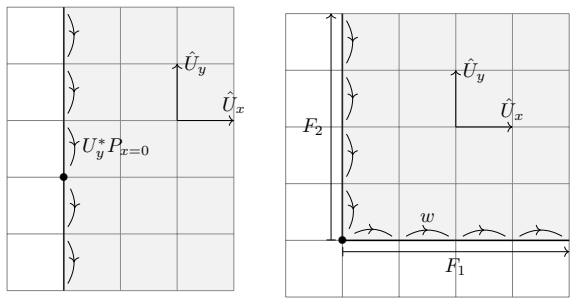
The central object is the edge-travelling operator $w = \hat{U}_{a_2}P_{F_1} + \hat{U}_{a_1}^*P_{F_2}$: a unitary acting on the one-dimensional boundary Hilbert space spanned by the two faces $F_1,F_2$, moving a particle one step anticlockwise around the corner. It represents the generator of $K_1(I)$, the K-theory of the commutator ideal in the quarter-plane Toeplitz algebra $C^*_r(S)$ generated by truncated translations. The load-bearing identity is $\mathrm{Exp}[b]=[w]$ in the six-term K-theory long exact sequence for the extension $0\to I\to C^*_r(S)\to C^*_r(\mathbb{Z}^2)\to 0$, where $b$ is the Bott projection whose class carries the Chern number. The cyclic 1-cocycles $\xi_i(a,a')=\tau_{F_i}(a\,\partial_i a')$, built from a trace-per-unit-length along face $F_i$ and a boundary-momentum derivation, evaluate to $\langle[\xi_i],[w]\rangle=(-1)^{i+1}$, which yields the integer quantization of the face currents.
What would settle it
Compute K1(C*_r(N2^⌝)) directly for the staircase quarter-plane by exhibiting an explicit homotopy of the operator w' (Eq. 14) to the identity in the unitization: if no such homotopy exists, K1 is nonzero and the claimed Exp[b]=[w⌝] is not the whole story. Numerically, diagonalize a finite k=1 Chern insulator on a staircase-corner lattice and measure the transverse current on each face away from the corner; the claim predicts exactly one unit of anticlockwise current per face and gap-filling states that round the corner, so observing backscattering, a non-integer face current, or a spectral gap that survives the truncation would refute it.
Extended reading notes
Core claim
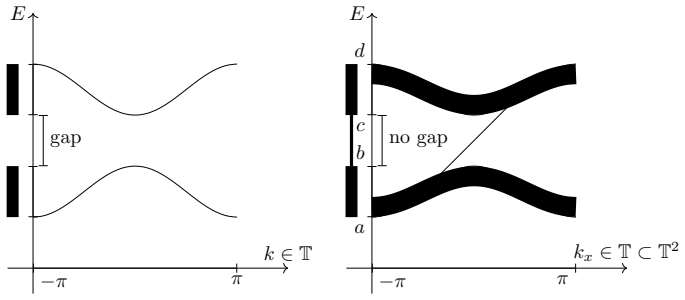
The central claim is that for any Chern insulator on the Z2 lattice, with spectral projection satisfying [P_-] = (1−k)[1] + k[b] in K0(C*_r(Z2)), and for any 'quarter-plane' lattice region S whose boundary consists of two rational-slope rays possibly with finite imperfections near the corner, the extension 0→I→C*_r(S)→C*_r(Z2)→0 has exponential map taking the Bott generator to the edge-travelling operator: Exp[b]=[w] with K1(I)≅Z[w]. Hence Exp[P_-]=k[w] is nonzero for k≠0, which forces any lift of the spectral projection to have gap-filling spectrum; physically the edge states fill the bulk gap and propagate anticlockwise along the boundary. When the boundary is bumpy, w is replaced by a bumpy edge-travelling operator w⌝ with the same K-theory class and the same pairing with the cyclic 1-cocycles, so the boundary current along each face is quantized to k units (up to orientation).
Load-bearing premise
The proof for imperfect boundaries assumes that the unitary deformation that trivializes the edge-travelling operator in the perfect quarter-plane also works for the shifted, bumped quarter-plane (and, for irrational slopes, that suitable approximate boundary translation operators with traces exist), so if that deformation does not lift, the nonvanishing exponential map would fail.
Editorial extensions
If this is right
- Any Chern insulator truncated to a rational-slope quarter-plane, with or without finite boundary bumps, has bulk-gap-filling spectrum and k units of boundary current along each face.
- The protection is topological: the current quantization and corner-following behaviour survive arbitrary imperfections confined to a finite region near the corner.
- For irrational-slope faces, concave corners, and the quantum Hall effect with magnetic translations, the same exponential map Exp[b]=[w] holds, so corner-following edge states persist in those settings as well.
- The explicit edge-travelling operator gives a K-theory index representative that underlies coarse-index computations for differential-operator Chern insulators in the companion paper.
- No perturbation by boundary terms from the commutator ideal can remove the gap-filling spectrum; only changing the bulk Chern number k would remove it.
Reading between the lines
- This suggests that the quantized corner current is a genuine finite-system observable: measuring the current on a face sufficiently far from an imperfect corner should yield the integer k with corner-localized deviations, a prediction testable in existing photonic, acoustic, and mechanical Chern-insulator experiments.
- Because the argument uses only the semigroup structure of the truncated translations, the same edge-following exponential map should hold for any 2D tight-binding model with a well-defined Chern number, including Floquet and metamaterial analogues, provided the truncated translations generate the same Toeplitz-type algebra.
- A direct finite-size extension of the pairing formula would be to compute the trace-per-unit-length pairing on a finite staircase lattice and verify that deviations from integer quantization decay away from the corner; this is an immediate numerical analogue of Eq. (23).
Signed reviews
Editorial analysis
A structured set of objections, weighed in public.
Referee Report
Summary. The manuscript develops a C*-algebraic framework for boundary states of Chern insulators on Z2 lattices with quarter-plane geometries. The main mathematical object is the quarter-plane Toeplitz algebra C*_r(S) associated with a subsemigroup S = C ∩ Z2, together with the ideal I generated by the two face projections. The author computes the K-theory long exact sequence for the extension 0→I→C*_r(S)→C*_r(Z2)→0 in three settings: rational-slope cones (Theorem 3.14), a staircase-truncated quarter-plane (Theorem 3.6), and irrational-slope cones (Proposition 5.1), and sketches the generalization to finite boundary imperfections. In each case the exponential map sends the bulk Bott class [b] to the class of an 'edge-travelling operator' w that translates anticlockwise along the boundary, from which the author obtains gap-filling spectra for the truncated Hamiltonian and, via cyclic 1-cocycles on I, quantized boundary currents of magnitude k. The abstract claims that edge states 'swerve around arbitrary-angled corners and geometric imperfections'.
Significance. If the proofs are completed, the paper would establish a substantial extension of the bulk-boundary correspondence for Chern insulators from half-plane geometries to quarter-planes with rational and irrational slopes and finite boundary imperfections. The explicit construction of the edge-travelling operator and the associated cyclic cocycle pairing (Eq. (23)) gives a concrete, checkable formula for the quantized boundary current. The use of semigroup C*-algebra K-theory (Cuntz [5] and Park [12,25]) is appropriate, and the rational-slope computation is carried out in detail with naturality of the six-term sequence. The paper is also honest in flagging the deferred arguments in the irrational case. However, the manuscript is not yet a complete proof of the advertised claim: the key trivialization step for bumpy boundaries is asserted rather than proved, and the irrational-slope current quantization is deferred to the companion paper [20].
major comments (4)
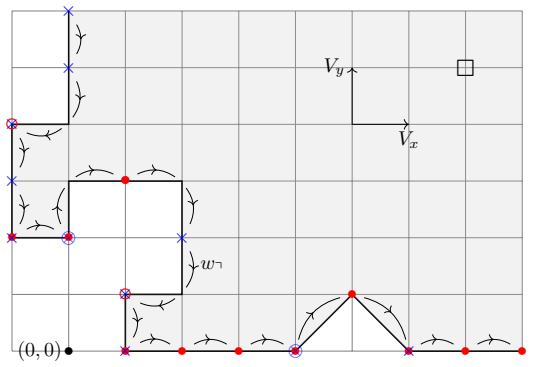
- [Section 3.2, Eq. (14)–Theorem 3.6] The proof that K1(C*_r(N2_lrcorner)) = 0 is missing. The text after Eq. (14) asserts that the deformation in C*_r(N2) that trivializes w, 'now performed on the shifted quarter-plane with corner at (1,1)', will turn w'_lrcorner into the identity. But N2_lrcorner = N2 \ {(0,0)} is not the shifted quarter-plane (1,1)+N2; it contains the positive axes and omits only the origin, and the generators V_x, V_y are compressions to this punctured set. A homotopy of unitaries in C*_r(N2) or in C*_r((1,1)+N2) does not obviously lift to C*_r(N2_lrcorner). Since exactness of the six-term sequence in Theorem 3.6 and hence the equality Exp[b] = [w_lrcorner] depend on K1(C*_r(N2_lrcorner)) = 0, this is a load-bearing gap and needs a complete argument.
- [Sections 3.2.1 and 3.3.1] The generalization to arbitrary finite boundary imperfections is asserted rather than proved. Section 3.2.1 states that 'Lemmas 3.3, 3.4, 3.5, and the computations leading to Theorem 3.6 continue to hold' for imperfect quarter-planes, and Section 3.3.1 similarly concludes that the exponential map takes [b] to [w_lrcorner] for a bumpy rational-slope boundary. No deformation trivializing the edge-travelling operator is exhibited in these settings, and the precise structure of the ideals I_lrcorner_1 and I_lrcorner_2 is not verified beyond a sketch. These statements carry the abstract's 'geometric imperfections' claim, so they must be proved in the present paper or supported by a precise citation.
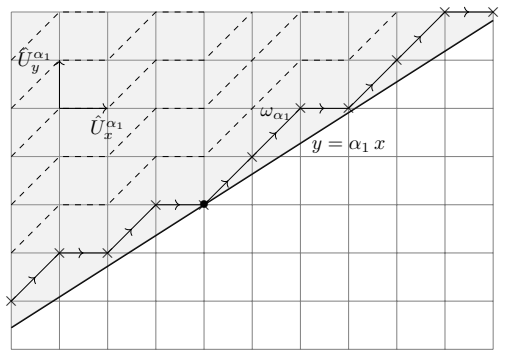
- [Section 5.1] For irrational slopes, Proposition 5.1 is not fully proved in the manuscript. The generator w of K1(I) is defined as a lift of (omega_alpha1, omega*_alpha2), but the operators omega_alphai are introduced only 'on physical grounds' as approximate boundary translations, and their existence is deferred to the companion paper [20]. Moreover, the trace needed to define the cyclic cocycles and to compute the boundary current is not constructed in the irrational case; the text says that an alternative approach is carried out in [20, §4, §6]. Since the abstract promises 'arbitrary-angled corners', this deferral is a substantive gap in the main claim.
- [Section 3.2, Lemma 3.4] The proof that I_lrcorner_1 ∩ I_lrcorner_2 = K(ell^2(N2_lrcorner)) is only sketched. The reverse inclusion is justified by a norm-approximation by finite linear combinations of terms of the form A p_F1 A' or B p_F2 B', but it is not demonstrated that the approximant can be chosen to lie in the intersection of the two ideals while retaining that form. This computation feeds into Eq. (10) and the determination of K0(I_lrcorner), so it should be written out in full or replaced by a reference to a complete argument.
minor comments (4)
- [Section 4.1, Eq. (21)] Please define the notation |a_i| explicitly as the Euclidean length of the asymptotic generator a_i, since the normalization 1/|a_i| in the trace tau_{F_i} depends on it.
- [Section 5.1] The phrase 'This veracity of this construction' should read 'The veracity of this construction', and there is a duplicated 'on' in the phrase 'a trace on on alpha_i' in the same section.
- [Section 5.3] The statement that the twisted case 'carries over in an almost identical way' is an unproved claim; it should be marked as a conjecture or supported by a computation.
- [Section 3.1] The parenthetical phrase 'with the "lrcorner" decorations dropped' is unclear; the reader should be told precisely which generators and ideals of C*_r(N2) correspond to those of the staircase algebra.
Circularity Check
No substantive circularity: the rational-slope boundary K-theory derivation is self-contained, and the only self-citation affects the irrational-slope outline rather than the core computation.
full rationale
The main derivation (Sections 2-4) is a direct K-theory computation: Exp[P_-] = k[w] is obtained from six-term exact sequences for the C*-algebra extensions, relying on independent external results of Cuntz [5], Douglas-Howe [7], and Park [12,25]. No parameter is fitted, and no projection class is normalized to force the conclusion. The cyclic 1-cocycle pairing in Section 4.1 is a genuine computation from the trace-per-unit-length tau_{F_i}; the resulting pairing is +/-1 and is independent of the Chern number k, so it is not a renamed input. The only self-citation that plays a proof role is [20] (Ludewig-Thiang), invoked in Section 5.1 for the existence of approximate boundary-translation generators omega_{alpha_i} in the irrational-slope case; this affects the outlined generalisation, not the rational-slope core, so at most it is a minor self-citation rather than a circular reduction. The most serious weakness is a rigor gap, not circularity: Section 3.2 asserts that w'_downright trivialises in K_1(C*_r(N2_downright)) only by analogy with the shifted quarter-plane ('The same deformation now performed on the shifted quarter-plane with corner at (1,1) will have the effect of turning w'_downright into the identity operator'), and Section 3.2.1 asserts that Lemmas 3.3-3.5 extend to arbitrary imperfections without supplying the deformation. If that deformation fails, Exp[b] = [w_downright] would not follow; but this is an omitted proof / correctness risk, not a by-construction circularity.
Assumptions & free parameters
assumptions (5)
- standard math Cuntz's computations of K-theory for finitely generated rational-slope semigroup C*-algebras (Lemmas 7.3.2, 7.3.6, 7.3.8, 7.3.9, Theorem 7.3.11 of [5])
- standard math Park, Ji-Kaminker, and Jiang results for Toeplitz algebras on cones and half-planes with irrational slopes (K1(J_alpha_i)=Z, K0(C*_r(S)) computations)
- standard math Hayashi's short exact sequence for concave quarter-plane Toeplitz algebras [11]
- domain assumption Tight-binding bulk Hamiltonian with finite-range hopping and a spectral gap, Eq. (1), with Chern number k characterized by [P_-]=(1-k)[1]+k[b]
- domain assumption Truncation of translation operators to a quarter-plane Hilbert space correctly models the material boundary, with boundary conditions encoded by the face projections PF_i
Cite this review
Pith. "Pith review of Edge-following topological states." pith.science (2026). https://pith.science/paper/TMCV62MB
@misc{pith2026190809559,
  author       = {Pith},
  title        = {Pith review of: Edge-following topological states},
  year         = {2026},
  howpublished = {\url{https://pith.science/paper/TMCV62MB}},
  note         = {Machine review of arXiv:1908.09559}
}
read the original abstract
We prove that Chern insulators have topologically protected edge states which not only propagate unidirectionally along a straight line boundary, but also swerve around arbitrary-angled corners and geometric imperfections of the material boundary. This is a physical manifestation of the index theory of certain semigroup operator algebras.
Figures

Figures from the paper (4 more)


Reference graph
Works this paper leans on
-
[5]
Cuntz.: Semigroup C∗-algebras and toric varieties
J. Cuntz.: Semigroup C∗-algebras and toric varieties. In: J. Cuntz, S. Echterhoff, X. Li, G. Yu (eds.) K-theory for Group C∗-Algebras and Semi- group C∗-Algebras (Birk¨ auser, 2017), 297–306
work page 2017
-
[20]
M. Ludewig, G.C. Thiang.: Cobordism invariance of topological edg e- following states. arXiv:2001.08339 [math-ph]
arXiv 2001
-
[1]
Bellissard.: K-theory of C∗-algebras in solid state physics
J. Bellissard.: K-theory of C∗-algebras in solid state physics. Statistical mechanics and field theory: mathematical aspects (Springer, Ber lin, Heidel- berg, 1986), 99–156
work page 1986
-
[2]
J. Bellissard, A. van Elst, H. Schulz-Baldes.: The noncommutative geometry of the quantum Hall effect. J. Math. Phys. 35(10) 5373–5451 (1994)
work page 1994
-
[3]
L.A. Coburn, R.G. Douglas.: C∗-algebras of operators on a half-space I. Publ. Math. Inst. Hautes ´Etudes Sci. 40 69–79 (1971)
work page 1971
-
[4]
Connes.: Non-commutative differential geometry
A. Connes.: Non-commutative differential geometry. Publ. Math . Inst. Hautes ´Etudes Sci. 62 41–144(1985)
work page 1985
-
[6]
Ding et al.: Experimental Demonstration of Acoustic Chern Ins ulators
Y. Ding et al.: Experimental Demonstration of Acoustic Chern Ins ulators. Phys. Rev. Lett. 122 014302 (2019)
work page 2019
-
[7]
R.G. Douglas, R. Howe.: On the C∗-algebra of Toeplitz operators on the quarter-plane. Trans. Amer. Math. Soc. 158(1) 203–217 (1971)
work page 1971
Show all 33 references
-
[8]
Fr¨ olich, G.M
J. Fr¨ olich, G.M. Graf, J. Walcher.: On the Extended Nature of Ed ge States of Quantum Hall Hamiltonians. Ann. Henri Poincar´ e 1(3) 405–442 (2000) 25
2000
-
[9]
parity anomaly
F.D.M. Haldane.: Model for a quantum Hall effect without Landau lev - els: Condensed-matter realization of the “parity anomaly”. Phys. Rev. Lett. 61(18) 2015 (1988)
1988
-
[10]
Hayashi.: Topological invariants and corner states for Hamilt onians on a three-dimensional lattice
S. Hayashi.: Topological invariants and corner states for Hamilt onians on a three-dimensional lattice. Commun. Math. Phys. 364 343–356 (2018)
2018
-
[11]
Hayashi.: Toeplitz operators on concave corners and topolo gically pro- tected corner states
S. Hayashi.: Toeplitz operators on concave corners and topolo gically pro- tected corner states. Lett. Math. Phys. 109(10) 2223–2254 (2019)
2019
-
[12]
R. Ji, J. Kaminker.: The K-theory of Toeplitz extensions. J. Operator Theory 19(2) 347–354 (1988)
1988
-
[13]
Jiang.: On Fredholm operators in quarter-plane Toeplitz algeb ras
X. Jiang.: On Fredholm operators in quarter-plane Toeplitz algeb ras. Proc. Amer. Math. Soc. 123(9) 2823–2830 (1995)
1995
-
[14]
Jotzu et al:
G. Jotzu et al:. Experimental realization of the topological Halda ne model with ultracold fermions. Nature 515 237–240 (2014)
2014
-
[15]
Kellendonk, T
J. Kellendonk, T. Richter, H. Schulz-Baldes.: Edge current cha nnels and Chern numbers in the integer quantum Hall effect. Rev. Math. Phys . 14(01) 87–119 (2002)
2002
-
[16]
Klembt et al.: Exciton-polariton topological insulator
S. Klembt et al.: Exciton-polariton topological insulator. Nature 562 552– 556 (2018)
2018
-
[17]
Loring.: The torus and noncommutative topology
T.A. Loring.: The torus and noncommutative topology. PhD thes is, Univ. California, Berkeley (1986)
1986
-
[18]
L. Lu, J.D. Joannopoulos, M. Soljaˇ ci´ c.: Topological photonics. Nature Pho- tonics 8 821–829 (2014)
2014
-
[19]
Ludewig, G.C
M. Ludewig, G.C. Thiang.: Good Wannier bases in Hilbert modules associated to topological insulators. J. Math. Phys. 61 061902 (2020). arXiv:1904.13051 [math-ph]
2020 arXiv
-
[21]
Mathai, G.C
V. Mathai, G.C. Thiang.: Topological phases on the hyperbolic plan e: fractional bulk-boundary correpondence. Adv. Theor. Math. P hys. 23(3) 803–840 (2019). arXiv:1712.02952 [cond-mat.str-el]
2019 arXiv
-
[22]
Nash et al.: Topological mechanics of gyroscopic metamater ials
L.M. Nash et al.: Topological mechanics of gyroscopic metamater ials. Proc. Natl. Acad. Sciences. 47 14496–14500 (2015)
2015
-
[23]
Neeb.: Toric varieties and algebraic monoids
K.-H. Neeb.: Toric varieties and algebraic monoids. Sem. Sophus L ie 2 159–187 (1992)
1992
-
[24]
Park.: The index theory of Toeplitz operators on the skew qu arter-plane
E. Park.: The index theory of Toeplitz operators on the skew qu arter-plane. PhD thesis, Stony Brook Univ. (1988) 26
1988
-
[25]
Park.: Index theory and Toeplitz algebras on certain cones in Z2
E. Park.: Index theory and Toeplitz algebras on certain cones in Z2. J. Operator Theory 23(1) 125–146 (1990)
1990
-
[26]
E. Park, C. Schochet.: On the K-theory of quarter-plane Toeplitz algebras. Int. J. Math. 2(02) 195–204 (1991)
1991
-
[27]
Prodan, H
E. Prodan, H. Schulz-Baldes.: Bulk and boundary invariants for complex topological insulators. Math. Phys. Studies. Springer, Berlin, 201 6
-
[28]
Rechtsman et al.: Photonic Floquet topological insulators
M.C. Rechtsman et al.: Photonic Floquet topological insulators. N ature 496 196–200 (2013)
2013
-
[29]
Roe.: Partitioning non-compact manifolds and the dual Toeplit z prob- lem
J. Roe.: Partitioning non-compact manifolds and the dual Toeplit z prob- lem. In: Operator Algebras and Applications, D. Evans and M. Takes aki eds. (Cambridge Univ. Press 1989), 187–228
1989
-
[30]
Rørdam, F
M. Rørdam, F. Larsen, F. Larsen, N. Laustsen.: An introduct ion to K- theory for C∗-algebras. Vol. 49. Cambridge Univ. Press, 2000
2000
-
[31]
Rieffel.: C∗-algebras associated with irrational rotations
M. Rieffel.: C∗-algebras associated with irrational rotations. Pacific J. Math. 93(2) 415–429 (1981)
1981
-
[32]
S¨ usstrunk, S.D
R. S¨ usstrunk, S.D. Huber.: Observation of phononic helical ed ge states in a mechanical topological insulator. Science 349 47–50 (2015)
2015
-
[33]
Wegge-Olsen.: K-theory and C∗-algebras: A Friendly Approach
N.E. Wegge-Olsen.: K-theory and C∗-algebras: A Friendly Approach. Ox- ford Univ. Press, 1993 27
1993
Reviewed August 14, 2026 · model on record in the stance chip above.
Discussion (0). Continue with ORCID to comment.