REVIEW 4 major objections 6 minor 23 references
Open Set Recognition Through Deep Neural Network Uncertainty: Does Out-of-Distribution Detection Require Generative Classifiers?
T0 review · 4 major / 6 minor · reviewed 2026-08-14 · deepseek-v4-flash
Pith's one-line read Latent distances beat predictive uncertainty for out-of-distribution detection
desk verdict Useful empirical comparison, but the paper's own Table 1 contradicts its claims that EVT always beats predictive entropy and that generative decoders always help. read the letter →
The pith
A machine-rendered reading of the paper's core claim, the machinery that carries it, and where it could break.
The reading
What carries the argument
The load-bearing mechanism is per-class Weibull tail fitting on the latent approximate posterior. For each training class, after sampling $z\sim q_\theta(z|x)$ for correctly classified training inputs, the model computes the class's mean latent vector $\bar{S}_c$, fits a Weibull distribution to the cosine distances $\|S_c - \bar{S}_c\|$ with a tail size of 5 percent of training examples per class, and rejects a new input when the Weibull CDF value at its distance to any class mean exceeds a task prior $\Omega_t$. The joint generative variant adds a decoder $p_\varphi(x|z)$ to the variational classifier, trained with the $\beta$-VAE-style ELBO in equation (1), so the latent space is shaped by both label and data reconstruction. This mechanism converts epistemic uncertainty from a soft signal into a hard boundary on where the model can be trusted.
What would settle it
A reader could falsify the mechanism by taking a trained model from the paper's setup, computing latent codes for an out-of-distribution dataset, and checking whether the empirical tail of the cosine distances matches the fitted Weibull distribution: if many out-of-distribution points fall inside the fitted per-class high-density region, the open-space bound is not doing the work the paper assigns it.
Extended reading notes
Core claim
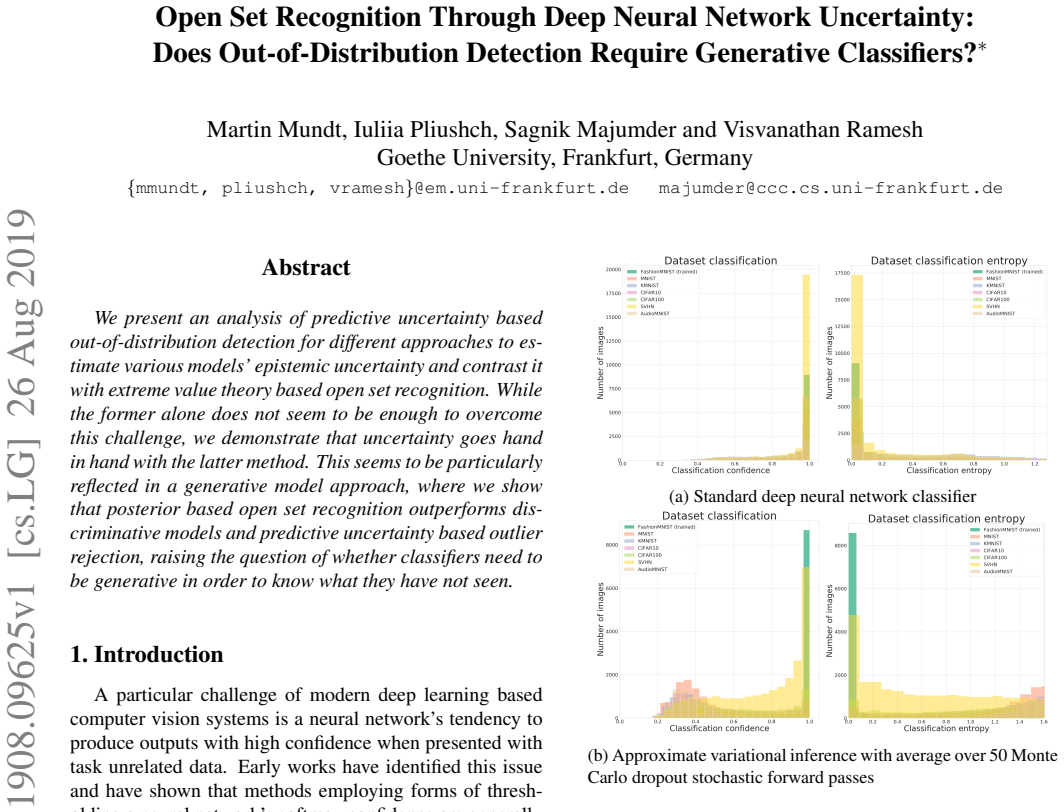
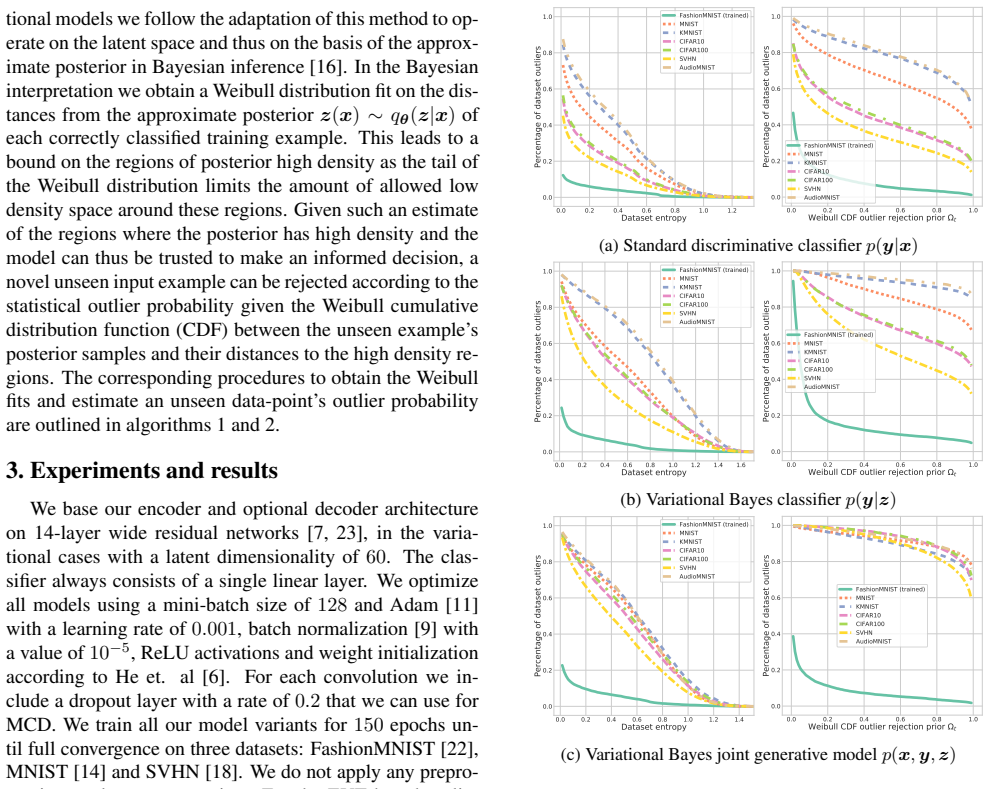
On FashionMNIST-, MNIST-, and SVHN-trained 14-layer wide residual networks, the authors find that predictive entropy, including entropy from variational inference and Monte Carlo dropout, leaves out-of-distribution datasets heavily overlapping with in-distribution data. Latent EVT meta-recognition—fitting a Weibull distribution to the cosine distances between each correctly classified training example's approximate-posterior sample and its class's latent mean, then rejecting any input whose Weibull CDF exceeds a threshold—removes most of this overlap. Adding a probabilistic decoder to learn the joint model $p(x,y,z)=p(y|z)p(x|z)p(z)$ improves the EVT rejection further, reaching near-perfect outlier detection on most cross-dataset pairs while preserving accuracy; the decoder is what the authors point to as the reason the latent space carries information about the data distribution.
Load-bearing premise
The central bet is that, for each class, the distances of correctly classified training examples to their class's average latent representation follow a Weibull tail, and this tail marks the boundary beyond which inputs should be rejected; the paper itself notes that the supporting experiments are small-scale and larger evaluation is still needed.
Editorial extensions
If this is right
- Entropy of the predictive distribution, even averaged over 100 posterior samples or 50 Monte Carlo dropout passes, is not a reliable enough signal to reject unseen datasets on these tasks.
- Latent-space Weibull rejection raises outlier detection rates substantially over entropy thresholds for all three model families.
- A variational classifier that also models the input distribution with a decoder outperforms the discriminative variational classifier under latent EVT rejection on most tested dataset pairs.
- With Monte Carlo dropout added to the generative model, out-of-distribution rejection becomes near-perfect for several cross-dataset pairs in the paper's experiments.
- The rejection threshold $\Omega_t$ is easier to set for the generative model because its rejection rate stays more stable across a wide range of priors.
Reading between the lines
- A direct comparison the paper leaves untested is a likelihood-only variational autoencoder with the same per-class Weibull calibration; the paper excludes such models by citing earlier failures, so the question of whether the joint training is essential remains open.
- The Weibull tail assumption is testable per class on any trained model by checking quantile-quantile plots of the empirical distance tail against the fitted distribution; the paper does not report such a diagnostic.
- Because the paper evaluates on 32x32 resized images and relatively small datasets, the next test is whether the same latent-EVT gap persists on larger, natural-image benchmarks at native resolution, where latent structure is less separable.
Signed reviews
Editorial analysis
A structured set of objections, weighed in public.
Referee Report
Summary. The paper presents an empirical comparison of three classifier families for out-of-distribution detection: a standard discriminative network, a variational discriminative classifier, and a variational joint generative classifier. For each model, the authors compare outlier rejection based on predictive entropy with rejection based on extreme value theory applied to distances from class-conditional latent means, following their earlier open-set recognition procedure. Experiments are run on three training distributions (FashionMNIST, MNIST, SVHN) and evaluated on seven datasets, with and without Monte Carlo dropout. The central claims are that EVT-based latent rejection outperforms predictive-entropy rejection in all cases and that the joint generative model further improves latent EVT, leading the authors to ask whether classifiers need to be generative in order to recognize what they have not seen.
Significance. If the claims were fully supported, the paper would be a valuable empirical contribution: it would show that latent-space Weibull rejection on a variational classifier can be more reliable than predictive entropy, and that adding a decoder can improve open-set recognition. The study is reasonably broad in its evaluation, including non-image AudioMNIST, and it systematically varies the training distribution. The paper also has strengths in transparency: the evaluation threshold is explicitly defined (95% of in-distribution validation data), and the comparison includes Monte Carlo dropout as an additional epistemic-uncertainty mechanism. However, the headline generalizations are contradicted by the paper's own Table 1 in important settings, and the absence of repeated-seed statistics makes it impossible to separate genuine effects from noise. The topic is timely and the central question is interesting, but the evidence in the current manuscript is not yet sufficient to support the stated conclusions.
major comments (4)
- [Section 3.1 and Table 1] The blanket statement in Section 3.1 that 'the EVT approach ... outperforms OOD detection with prediction uncertainty in all cases' is contradicted by Table 1. For the MNIST-trained variational generative model on SVHN, entropy detection is 96.53% while latent EVT detection is 96.29%; for the MNIST-trained standard discriminative classifier on CIFAR10, entropy is 91.06% while latent EVT is 87.62%. The related claim that the joint generative model 'further improves' latent EVT is also contradicted: on MNIST-trained models, the variational discriminative latent detector outperforms the variational generative latent detector on 5 of 6 OOD sets (e.g., FashionMNIST 99.86 vs 96.60, CIFAR10 99.98 vs 99.81, SVHN 97.70 vs 96.29). These are not external-baseline quibbles; they are internal counterexamples to the paper's universal claims and should be analyzed explicitly.
- [Section 3, Experiments] All results appear to come from a single run, and no error bars, standard deviations, or repeated-seed experiments are reported. Several of the comparisons that support or contradict the central claims differ by less than one percentage point (e.g., 96.53 vs 96.29 for the MNIST-trained variational generative model on SVHN), so the rankings may be within run-to-run noise. Since the paper's main conclusions depend on these small differences, the absence of variance estimates is load-bearing. Please report means and standard deviations over at least three to five seeds and re-evaluate the universal claims in light of the resulting confidence intervals.
- [Equation (1)] Equation (1) as printed is L = E_q[log p_phi(x|z) + log p_xi(y|z)] - KL(q_theta(z|x) || p(z)), yet the text states that 'beta is an additional parameter that weighs the contribution of the Kullback-Leibler divergence' and cites the beta-VAE. The displayed objective does not contain beta. Either the beta is missing from the equation, or the model is not the beta-VAE-style objective described in the text. Please correct the equation and state the actual beta value used in the experiments.
- [Section 3.1 and Table 1] The comparison is limited to predictive entropy versus the authors' own latent EVT procedure. Standard out-of-distribution baselines available at the time of the paper (e.g., softmax confidence thresholding, ODIN, or Mahalanobis distance) are not evaluated, and results are reported only at a single 95%-inlier operating point rather than as full ROC/AUPR curves. To support the title-level conclusion about what OOD detection 'requires,' the paper should at least include a standard softmax-confidence baseline and report AUROC or a similar threshold-free metric.
minor comments (6)
- [Introduction] There is a typo in the first paragraph: 'necesssarily' should be 'necessarily.'
- [Section 3.1] The text says 'additionally' in 'additionally the KMNIST'; this should be 'additionally, the KMNIST.'
- [Algorithm 1] The tail-size parameter is denoted eta in the algorithm and described as 5% in the main text, but the paper does not state whether this value was chosen a priori or tuned. Please clarify.
- [Table 1] The table is difficult to read because the training dataset appears in the first column but is repeated for each model variant, and the column header 'Latent' is not defined in the caption. Please define 'Latent' as the EVT-based rejection rate and restructure the table to make the model variant and training distribution unambiguous.
- [Section 2] The exclusion of likelihood-only VAEs is justified only by citing Nalisnick et al. [17] after the fact. Since the paper's central question concerns generative classifiers, a direct small experiment on a likelihood-only VAE would strengthen the argument.
- [Reproducibility] No code or trained model checkpoints are provided, which makes it difficult to reproduce the EVT calibration procedures in Algorithms 1 and 2, especially because the method is carried over from the authors' prior work [16].
Circularity Check
No significant circularity: the paper is an empirical benchmark whose claims are not forced by construction or by self-citation chains.
full rationale
The paper is an empirical comparison of predictive-entropy and EVT-based out-of-distribution detection across three model classes. No equation-level reduction is present: the EVT Weibull-tail procedure is adapted from the authors' prior work [16], but it is used here as a benchmarked algorithm rather than as a premise that logically entails the paper's conclusions. The rejection thresholds are calibrated on the trained dataset's validation portion, not on the out-of-distribution test sets, so the reported detection rates are not fitted to the quantities they predict. The exclusion of likelihood-only generative models rests on the independent external result of Nalisnick et al. [17], not on the authors' own work. The central claims are empirical generalizations, and while some statements in Section 3.1 are contradicted by the paper's own Table 1 (e.g., the claim that EVT outperforms predictive entropy in all cases), that is a correctness or precision issue, not circularity. No load-bearing self-citation chain, ansatz-smuggling, or renaming of a known result is evident; the derivation chain is self-contained as an experimental study.
Assumptions & free parameters
free parameters (4)
- beta (KL weight in Equation 1) =
not reported
- tail-size eta =
5% of training examples per class
- rejection prior Omega_t =
calibrated per task to keep 95% of validation inliers
- latent dimensionality =
60
assumptions (5)
- domain assumption A Weibull tail fit to per-class latent distances is a valid model of open-space risk
- domain assumption Only correctly classified training examples define each class's posterior region
- domain assumption Variational posterior samples and Monte Carlo dropout approximate epistemic uncertainty
- domain assumption The beta-VAE-style ELBO in Equation 1 is an appropriate training objective
- domain assumption The model trained for 150 epochs has converged
Cite this review
Pith. "Pith review of Open Set Recognition Through Deep Neural Network Uncertainty: Does Out-of-Distribution Detection Require Generative Classifiers?." pith.science (2026). https://pith.science/paper/EVZWZKRL
@misc{pith2026190809625,
  author       = {Pith},
  title        = {Pith review of: Open Set Recognition Through Deep Neural Network Uncertainty: Does Out-of-Distribution Detection Require Generative Classifiers?},
  year         = {2026},
  howpublished = {\url{https://pith.science/paper/EVZWZKRL}},
  note         = {Machine review of arXiv:1908.09625}
}
read the original abstract
We present an analysis of predictive uncertainty based out-of-distribution detection for different approaches to estimate various models' epistemic uncertainty and contrast it with extreme value theory based open set recognition. While the former alone does not seem to be enough to overcome this challenge, we demonstrate that uncertainty goes hand in hand with the latter method. This seems to be particularly reflected in a generative model approach, where we show that posterior based open set recognition outperforms discriminative models and predictive uncertainty based outlier rejection, raising the question of whether classifiers need to be generative in order to know what they have not seen.
Figures

Reference graph
Works this paper leans on
- [1]
-
[2]
A. Bendale and T. E. Boult. Towards Open Set Deep Net- works. Computer Vision and Pattern Recognition (CVPR) , 2016
work page 2016
-
[3]
T. E. Boult, S. Cruz, A. Dhamija, M. Gunther, J. Henrydoss, and W. Scheirer. Learning and the Unknown : Surveying Steps Toward Open World Recognition. AAAI Conference on Artificial Intelligence (AAAI), 2019
work page 2019
-
[4]
T. Clanuwat, M. Bober-Irizar, A. Kitamoto, A. Lamb, K. Yamamoto, and D. Ha. Deep Learning for Classical Japanese Literature. Neural Information Processing Systems (NeurIPS), Workshop on Machine Learning for Creativity and Design, 2018
work page 2018
- [5]
-
[6]
K. He, X. Zhang, S. Ren, and J. Sun. Delving deep into rectifiers: Surpassing human-level performance on imagenet classification. International Conference on Computer Vision (ICCV), 2015
work page 2015
-
[7]
K. He, X. Zhang, S. Ren, and J. Sun. Deep Residual Learn- ing for Image Recognition. Computer Vision and Pattern Recognition (CVPR), 2016
work page 2016
-
[8]
I. Higgins, L. Matthey, A. Pal, C. Burgess, X. Glorot, M. Botvinick, S. Mohamed, and A. Lerchner. beta-V AE: Learning Basic Visual Concepts with a Constrained Vari- ational Framework. International Conference on Learning Representations (ICLR), 2017
work page 2017
Show all 23 references
-
[9]
Ioffe and C
S. Ioffe and C. Szegedy. Batch Normalization: Accelerat- ing Deep Network Training by Reducing Internal Covari- ate Shift. International Conference on Machine Learning (ICML), 2015
2015
-
[10]
Kendall and Y
A. Kendall and Y . Gal. What Uncertainties Do We Need in Bayesian Deep Learning for Computer Vision? Neural Information Processing Systems (NeurIPS), 2017
2017
-
[11]
D. P. Kingma and J. L. Ba. Adam: a Method for Stochastic Optimization. International Conference on Learning Repre- sentations (ICLR), 2015
2015
-
[12]
D. P. Kingma and M. Welling. Auto-Encoding Variational Bayes. International Conference on Learning Representa- tions (ICLR), 2013
2013
-
[13]
Krizhevsky
A. Krizhevsky. Learning Multiple Layers of Features from Tiny Images. Technical report, Toronto, 2009
2009
-
[14]
LeCun, L
Y . LeCun, L. Bottou, Y . Bengio, and P. Haffner. Gradient- based learning applied to document recognition. Proceed- ings of the IEEE, 86(11):2278–2323, 1998
1998
-
[15]
Matan, R
O. Matan, R. Kiang, C. E. Stenard, and B. E. Boser. Hand- written Character Recognition Using Neural Network Ar- chitectures. 4th USPS Advanced Technology Conference , 2(5):1003–1011, 1990
1990
-
[16]
Mundt, S
M. Mundt, S. Majumder, I. Pliushch, and V . Ramesh. Uni- fied Probabilistic Deep Continual Learning through Genera- tive Replay and Open Set Recognition.arXiv preprint arXiv: 1905.12019, 2019
1905 arXiv
-
[17]
Nalisnick, A
E. Nalisnick, A. Matsukawa, Y . W. Teh, D. Gorur, and B. Lakshminarayanan. Do Deep Generative Models Know What They Don’t Know? International Conference on Learning Representations (ICLR), 2019
2019
-
[18]
Netzer, T
Y . Netzer, T. Wang, A. Coates, A. Bissacco, B. Wu, and A. Y . Ng. Reading Digits in Natural Images with Unsupervised Feature Learning. Neural Information Processing Systems (NeurIPS), Workshop on Deep Learning and Unsupervised Feature Learning, 2011
2011
-
[19]
Ovadia, E
Y . Ovadia, E. Fertig, J. Ren, Z. Nado, D. Sculley, S. Nowozin, J. V . Dillon, B. Lakshminarayanan, and J. Snoek. Can You Trust Your Model’s Uncertainty? Eval- uating Predictive Uncertainty Under Dataset Shift. arXiv preprint arXiv: 1906.02530, 2019
1906 arXiv
-
[20]
Srivastava, G
N. Srivastava, G. E. Hinton, A. Krizhevsky, I. Sutskever, and R. Salakhutdinov. Dropout : A Simple Way to Prevent Neu- ral Networks from Overfitting. Journal of Machine Learning Research (JMRL), 15:1929–1958, 2014
1929
-
[21]
M. R. P. Thomas, J. Ahrens, and I. Tashev. Probability Mod- els For Open Set Recognition. IEEE Transactions on Pattern Analysis and Machine Intelligence, 2014
2014
-
[22]
H. Xiao, K. Rasul, and R. V ollgraf. Fashion-MNIST: a Novel Image Dataset for Benchmarking Machine Learning Algo- rithms. arXiv preprint arXiv: 1708.07747, 2017
2017 arXiv
-
[23]
Zagoruyko and N
S. Zagoruyko and N. Komodakis. Wide Residual Networks. British Machine Vision Conference (BMVC), 2016. 5
2016
Reviewed August 14, 2026 · model on record in the stance chip above.
Discussion (0). Continue with ORCID to comment.