REVIEW 4 major objections 5 minor 1 cited by
Dynamics of Charged and Rotating NUT Black Holes in Rastall Gravity
T0 review · 4 major / 5 minor · reviewed 2026-08-14 · deepseek-v4-flash
Pith's one-line read A new Kerr-Newman-NUT black hole solution in Rastall gravity is constructed, and its NUT parameter is shown to shift horizons, thermodynamic stability, and circular orbits.
desk verdict The paper constructs a new Kerr-Newman-NUT-Rastall metric but never checks that it solves the field equations; everything downstream is conditional on an unverified claim. read the letter →
The pith
A machine-rendered reading of the paper's core claim, the machinery that carries it, and where it could break.
The reading
What carries the argument
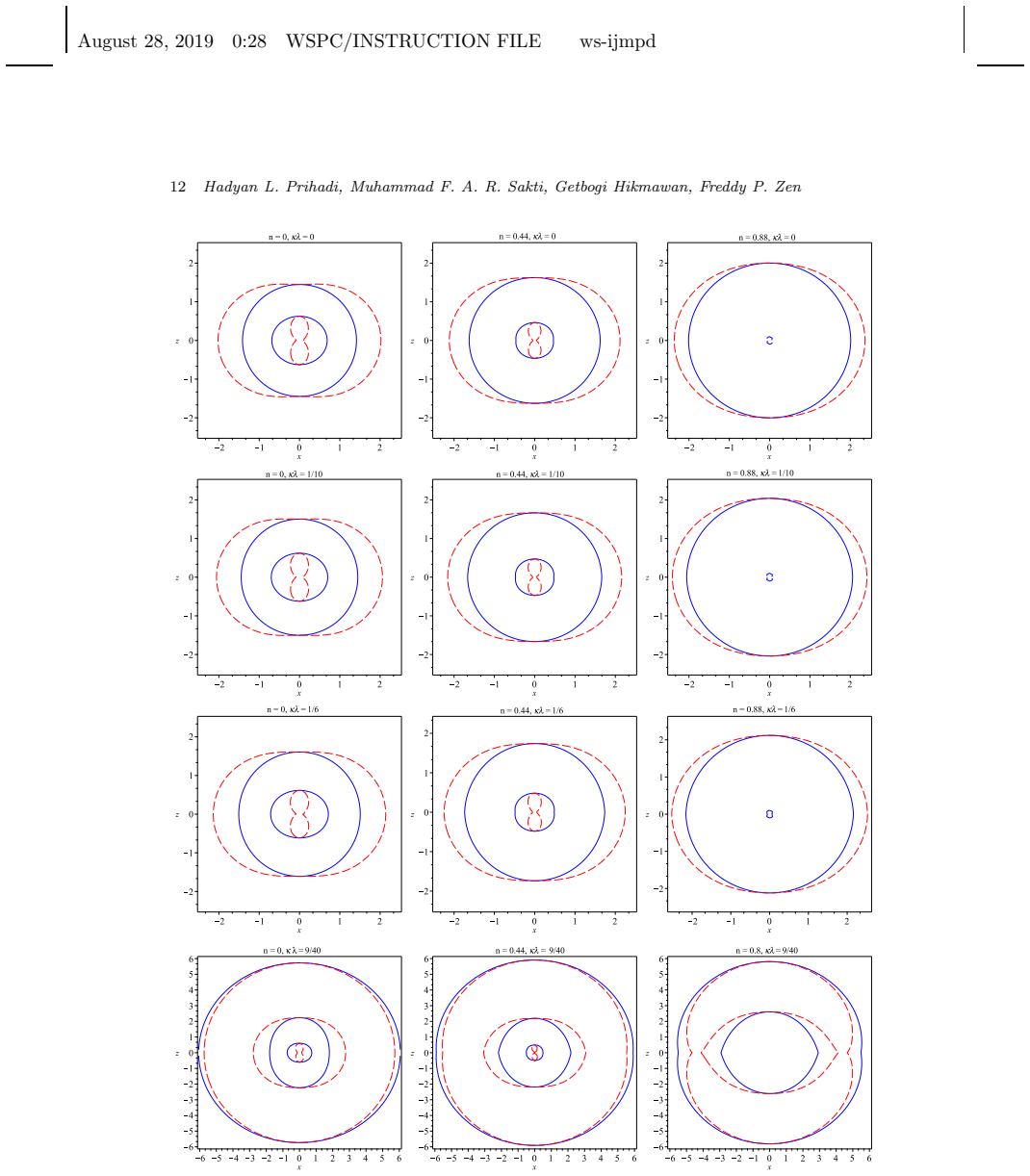
The load-bearing mechanism is the Newman-Janis algorithm with complex coordinate shifts $\tilde{u}=u-ia\cos\theta+2in\ln\sin\theta$, $\tilde{r}=r+ia\cos\theta-in$, and $\tilde{M}=M+in$, which inject both rotation $a$ and the NUT twist $n$ into the static seed and produce the KNN-R metric in Boyer-Lindquist coordinates. The horizon and ergosurface are controlled by the zeros of $\Delta$ and $g_{tt}$, while the equatorial geodesic analysis is carried by the effective potential $V_{\rm eff}$ derived from the Hamiltonian. The thermodynamic results rest on the slowly rotating horizon area $A_H\simeq 4\pi(r_+^2+n^2)$, from which entropy, temperature, and heat capacity are obtained.
What would settle it
Compute the tensor $G_{\mu\nu}+\kappa\lambda R g_{\mu\nu}-\kappa T_{\mu\nu}$ for the KNN-R metric of Eq. (41) with the electromagnetic-plus-quintessence energy-momentum tensor; if any component fails to vanish identically for general nonzero $\lambda$ and $N_s$, the metric is not a solution of the Einstein-Rastall equations. A cheaper check is to verify whether the complexified energy-momentum tensor still satisfies $\nabla_\mu T^{\mu\nu}=\lambda\nabla^\nu R$ and the symmetry conditions $T^t_t=T^r_r$, $T^\theta_\theta=T^\phi_\phi$ that the static seed required.
Extended reading notes
Core claim
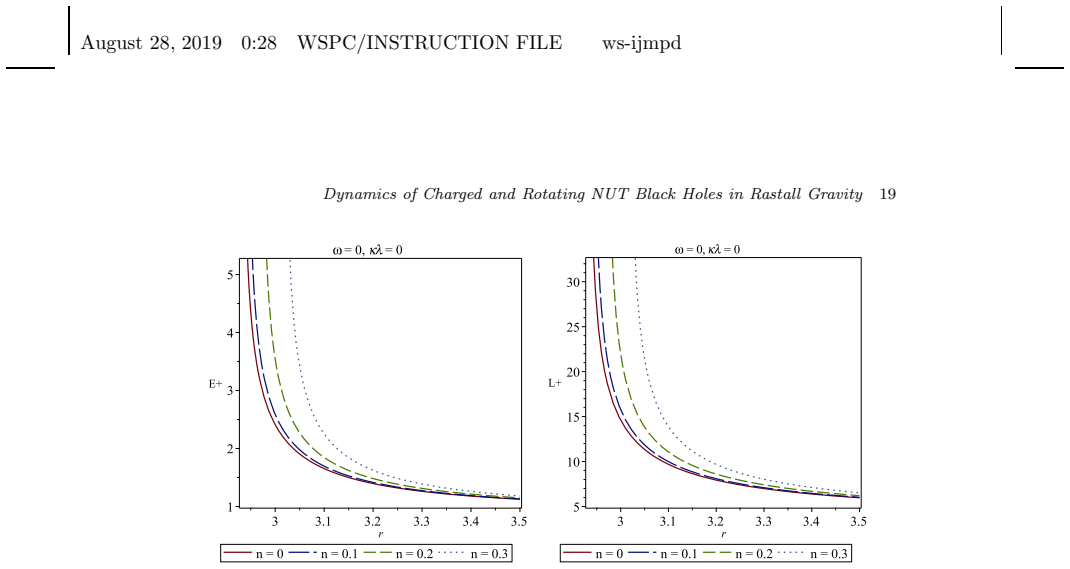
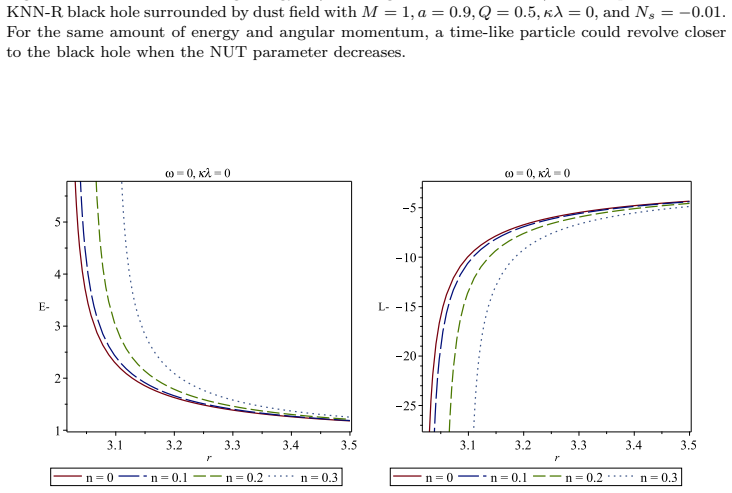
The paper's central discovery is the Kerr-Newman-NUT-Rastall (KNN-R) solution, its Eq. (41), obtained by applying the Newman-Janis algorithm to the static spherically symmetric charged black hole with quintessential matter in Rastall gravity. The metric has Boyer-Lindquist form with a generalized function $\Delta(r,\theta)=r^2+a^2-n^2-2Mr+Q^2-N_s\Sigma^{(2-\zeta)/2}$, where the extra $N_s$ term encodes the quintessence and Rastall corrections. Because $\Delta$ depends on $\theta$ through $\Sigma=(r^2+(a\cos\theta-n)^2)$, the horizon is not spherical, and it can have inner, outer, and cosmological branches. The paper reports that the NUT parameter $n$ slightly increases the horizon radius, increases the static radius limit for time-like circular orbits, increases the null circular orbit radius, and, in the numerical plots, decreases the innermost stable circular orbit radius. In the slowly rotating limit, it also computes Bekenstein-Hawking entropy, Hawking temperature, and heat capacity, identifying regions of thermodynamic stability as functions of NUT and Rastall parameters.
Load-bearing premise
The whole analysis rests on the assumption that the Newman-Janis algorithm, a complex-coordinate recipe for adding rotation to a static metric, applied to the static charged quintessence seed yields a metric that actually satisfies the Einstein-Rastall field equations; the paper does not substitute the final metric back into those equations to verify this.
Editorial extensions
If this is right
- For fixed mass, charge, and rotation, increasing the NUT parameter enlarges the outer horizon, so NUT acts like an additional source of gravitational strength.
- The angle-dependent horizon means the black hole silhouette and ergoregion are not spherically symmetric, which would affect shadow and accretion-disk modeling.
- Thermodynamic stability regions shift with both the Rastall and NUT parameters, since the heat capacity can change sign as the outer horizon radius varies.
- The static radius limit and null circular orbit move outward with NUT, while the innermost stable circular orbit moves inward in the plotted cases, changing the predicted inner edge of an accretion disk.
Reading between the lines
- If the KNN-R metric genuinely satisfies the Einstein-Rastall equations, the same Newman-Janis construction could be applied to other static Rastall seeds (for example, different equations of state) to generate a family of rotating NUT solutions; the paper does not attempt this.
- The angle-dependent horizon should leave a distinctive imprint on the black hole shadow: a horizon that bulges at the poles would produce a non-circular shadow, a testable prediction the paper does not carry out.
- A direct substitution of Eq. (41) into the field equations $G_{\mu\nu}+\kappa\lambda R g_{\mu\nu}=\kappa T_{\mu\nu}$ would settle whether the Newman-Janis procedure preserves the Rastall field equations for non-vacuum sources; the paper does not display that check.
- The slowly rotating thermodynamic derivation assumes $a\ll n$ to drop the $\theta$-dependence; extending to arbitrary rotation would require a horizon-averaged temperature and could modify the stability diagram.
Signed reviews
Editorial analysis
A structured set of objections, weighed in public.
Referee Report
Summary. The paper proposes a 'Kerr-Newman-NUT-Rastall' (KNN-R) black hole metric, Eq. (41), constructed by applying the Newman-Janis algorithm to a static, spherically symmetric charged quintessence solution in Rastall gravity. The authors then analyze the resulting geometry: horizons and ergoregions, ZAMO angular velocity, Bekenstein-Hawking thermodynamics under a slowly-rotating approximation, and equatorial circular orbits including the static radius, null circular orbit, and ISCO. The central claim is that Eq. (41) is an exact solution of the Einstein-Rastall field equations, Eq. (2), and that all subsequent dynamical results follow from it.
Significance. If Eq. (41) were a genuine solution, the paper would provide a broad family of rotating charged NUT black holes with quintessence in Rastall gravity, together with a useful catalog of horizon, thermodynamic, and geodesic quantities. The authors are diligent in presenting explicit formulas, tables, and figures, and the static-sector derivation is clearly laid out. However, the central existence claim is not verified: the rotating metric is never substituted back into Eq. (2), the rotating energy-momentum tensor is never defined, and the Newman-Janis algorithm is assumed to preserve the field equations in a non-vacuum modified-gravity setting. The significance of the paper is therefore entirely conditional on a proof that Eq. (41) satisfies Eq. (2), which the manuscript does not supply.
major comments (4)
- [Section 2.2, Eq. (41)] The central claim that Eq. (41) solves the Einstein-Rastall equations is not demonstrated. The paper applies the Newman-Janis algorithm to the static solution, but no substitution of Eq. (41) into Eq. (2) is presented, no rotating energy-momentum tensor is written down, and the Maxwell equations for the rotating electromagnetic potential are not checked. The complexification rules in Eqs. (33)-(35) are a prescription inherited from vacuum and electrovacuum general relativity; for a non-vacuum modified-gravity source with an anisotropic quintessence part, they do not automatically generate a solution. This is load-bearing because every later result in Sections 3-5 uses Eq. (41) as its starting point.
- [Section 3.1, Eqs. (41)-(42)] The function Delta in Eq. (41) depends on theta through Sigma, so the horizon radius r_+ is a function of theta. In the standard Boyer-Lindquist form of a stationary axisymmetric solution, Delta is a function of r alone; the paper offers only a qualitative statement that the theta dependence arises from surrounding matter and the Rastall parameter, not a derivation. The authors should prove that the surface Delta = 0 is a null hypersurface and that the standard horizon thermodynamics apply to it; otherwise the area and temperature formulas in Section 4 are not justified.
- [Section 4, Eqs. (49)-(57)] The thermodynamic calculation assumes a slowly rotating black hole whose horizon is effectively theta-independent and spherical. However, Eq. (42) gives r_+(theta) whenever N_s is nonzero, and the approximation a << n still retains terms linear in a through the cross term -2an cos(theta) in Sigma. Dropping the theta dependence would require setting a = 0 exactly, or at least a separate justification that the linear terms in a are negligible for the horizon locus and the area element. The area integral in Eq. (49) and the surface gravity in Eq. (52) should be evaluated on the actual surface r = r_+(theta), not on a spherical surface, unless this is explicitly proven.
- [Section 5, Eqs. (65)-(75)] The equatorial circular-orbit analysis imposes theta = pi/2 and dot-theta = 0, but it does not verify that dV_eff/dtheta = 0 at theta = pi/2. For a metric with a NUT parameter and theta-dependent metric functions, this condition is not automatic; if it fails, the orbits in Tables 3 and 4 and Figure 8 are not true equatorial circular geodesics. The paper should either prove that the equatorial plane is totally geodesic for the KNN-R metric or account for the theta-direction force in the effective potential.
minor comments (5)
- [Section 2.1, Eqs. (16)-(17)] The exponent zeta and the quintessence term are written as N_s/r^zeta and later as N_s/Sigma^{zeta/2}; the relation between these expressions and the definition of zeta in Eq. (17) should be stated explicitly to avoid confusion.
- [Section 3, Tables 2 and 3] Some numerical entries in the tables appear suspiciously repeated, for example the values for n = 0.4 and n = 0.6 in Table 3 at kappa-lambda = 1/10; please verify the computations and the precision reported.
- [Section 5.2, Eq. (73)] Equation (73) is extremely long and effectively unreadable in the main text; moving the derivation to an appendix and presenting the final condition in a more compact form would improve clarity.
- [Abstract and Section 5.1] The term 'static radius limit' is used in the abstract and introduction but is only defined in Section 5.1; define it at first use.
- [Throughout] There are numerous minor language and typographical issues, such as 'the dependence of the other ... contained explicitly' and inconsistent use of notation for the Rastall parameter; a careful proofreading pass is needed.
Circularity Check
No circularity found: the KNN-R metric is an explicit Newman-Janis ansatz, and the horizon, thermodynamic, and geodesic results are algebraic consequences of that metric; the unverified field-equation check is a correctness gap, not a circular reduction.
full rationale
Walking the derivation chain, the static seed solution Eq. (16) is obtained by inserting the stated ansatz f(r) = 1 - 2M/r + Q^2/r^2 + h(r) into the Einstein-Rastall field equations (13)-(14) and solving for h(r) and the exponents ζ and Ws. These quantities are algebraic outputs of the differential equations, not fitted to the later horizon, temperature, or ISCO results. The rotating and NUT metric is then generated by an explicit Newman-Janis procedure: the complexification rules (33)-(35) are stated, the transformed function f~(r,theta) is given in Eq. (36), and the final Boyer-Lindquist line element is written as Eq. (41). All subsequent quantities — horizons from Δ = 0, ergosurface from g_tt = 0, ZAMO angular velocity, surface gravity, temperature, heat capacity, static radius, null circular orbit, and ISCO — are computed directly from that line element and the geodesic Lagrangian. None of these later quantities is reinserted into the construction to fix a free parameter, and no predicted result is used to define the input metric. The only overlapping-author citation is Ref. 1, used for the quintessence energy-momentum structure and as the static solution to be generalized; however, Section 2.1 re-derives the static solution and the Rastall-dependent exponents from Eqs. (13)-(14) in the present paper, so the self-citation is corroborative rather than load-bearing. The genuine weakness is that Eq. (41) is never substituted back into Eq. (2), and no rotating effective stress-energy tensor or Maxwell potential for the NJA output is presented; but that is an unverified correctness assumption, not a circularity. An unsupported assertion that the Newman-Janis algorithm produces a solution is not the same as a derivation whose conclusion is assumed among its inputs. Therefore no circular step is identified.
Assumptions & free parameters
free parameters (4)
- kappa lambda (Rastall parameter) =
not fitted; varied (0, 1/10, 1/6, 1/4)
- Ns (quintessence density) =
not fitted; e.g., 0.01, -0.01
- omega (equation-of-state parameter) =
not fitted; 0, 1/3, -1/3, -2/3, -1
- n (NUT parameter) =
not fitted; varied (0 to 1)
assumptions (6)
- domain assumption The Einstein-Rastall field equation G_mu_nu + kappa lambda R g_mu_nu = kappa T_mu_nu (Eq. 2) is the correct equation of motion.
- domain assumption The total energy-momentum tensor is the sum of the electromagnetic and quintessence parts with the forms given in Eqs. (11) and (12).
- domain assumption The static metric function takes the ansatz f(r) = 1 - 2M/r + Q^2/r^2 - Ns/r^zeta with zeta given by Eq. (17).
- ad hoc to paper The Newman-Janis algorithm applied to a static solution yields a valid solution of the Einstein-Rastall field equations.
- domain assumption For thermodynamics, the slowly-rotating limit a << n is valid and removes theta dependence from the horizon.
- domain assumption The Bekenstein-Hawking area-entropy law S = A/4 applies in Rastall gravity.
Cite this review
Pith. "Pith review of Dynamics of Charged and Rotating NUT Black Holes in Rastall Gravity." pith.science (2026). https://pith.science/paper/PDU26J75
@misc{pith2026190809629,
  author       = {Pith},
  title        = {Pith review of: Dynamics of Charged and Rotating NUT Black Holes in Rastall Gravity},
  year         = {2026},
  howpublished = {\url{https://pith.science/paper/PDU26J75}},
  note         = {Machine review of arXiv:1908.09629}
}
read the original abstract
In this work, we generalized the Kerr-Newman-NUT black hole solution in Rastall gravity from Ref. 1. Here we are more focused on the black hole dynamics such as the event horizons, ergosurface, ZAMO, thermodynamic properties, and the equatorial circular orbit around the black hole such as static radius limit, null equatorial circular orbit, and innermost stable circular orbit. We present how the NUT and Rastall parameter affects the dynamic of the black hole.
Figures


Figures from the paper (6 more)



Forward citations
Cited by 1 Pith paper
-
Impact of Rastall gravity on hydrostatic mass of galaxy clusters
Rastall gravity modifies hydrostatic mass estimates of galaxy clusters to produce near-unity slopes when compared to baryonic mass (no dark matter) or lensing mass (with dark matter).
Reference graph
Works this paper leans on
-
[1]
M. F. A. R. Sakti, A. Suroso, F. P. Zen. Kerr-Newman-NUT bla ck hole with quintessen- tial matter in Rastall theory of gravity. arXiv preprint gr- qc/1901.09163 (2019)
arXiv 2019
-
[2]
P. Rastall. Generalization of the Einstein Theory. Phys. Rev. D 6, (1972) 3357
work page 1972
-
[3]
E. J. Copeland, M. Sami, and S. Tsujikawa. Dynamics of dark energy. Int. J. Mod. Phys. D 15, (2006) 1753
work page 2006
-
[4]
V. V. Kiselev. Quintessence and black holes. Class. Quant. Grav. 20, (2003) 1187-1198
work page 2003
-
[5]
S. G. Ghosh. Rotating black hole and quintessence. Eur. Phys. J. C 76, (2016) 222
work page 2016
-
[6]
B. Toshmatov, Z. Stuchl, dan B. Ahmedov. Rotating black ho le solutions with quintessential energy. Eur. Phys. J. Plus 98, (2017) 132
work page 2017
-
[7]
R. Emparan. Black diholes. Phys. Rev. D. 61, (2010) 104009
work page 2010
-
[8]
E. Teo. Black diholes in five dimensions. Phys. Rev. D 68, (2003) 084003
work page 2003
Show all 29 references
-
[9]
B. P. Abbott et al. (LIGO Scientific Collaboration and Virg o Collaboration), Phys. Rev. Lett. 116, (2016) 061102; 241103; 041015; 221101
2016
-
[10]
Akiyama et al (The Event Horizon Telescope Collaborat ion)
K. Akiyama et al (The Event Horizon Telescope Collaborat ion). 2019. First M87 Event Horizon Telescope Results. I. The Shadow of the Supermassiv e Black Hole. Astrophys. J. Lett. 875, L1; First M87 Event Horizon Telescope Results. II. Array an d Instrumen- tation. Astrophys. J...
2019
-
[11]
Heydarzade, H
Y. Heydarzade, H. Moradpour, and F. Darabi. Black Hole So lutions in Rastall Theory. Can. J. Phys. (2017) 95(12): 1253-1256
2017
-
[12]
Kumar and S
R. Kumar and S. G. Ghosh. Rotating black hole in Rastall th eory. Eur. Phys. J. C (2018) 78 9, 750
2018
-
[13]
Hikmawan G, Soda J, Suroso A and Zen F P. Phys. Rev. D (2016) 93 068301
2016
-
[14]
Arianto, F. P. Zen, B. E. Gunara, Triyanta and Supardi, J. High Energy Phys . 09, 048 (2007); A. Suroso and F. P. Zen, Gen. Relativ. Gravit. 45, 799 (2013); A. Suroso and F. P. Zen, Adv. Stud. Theor. Phys. 9, 423 (2015)
2007
-
[15]
Halder, S
S. Halder, S. Bhattacharya, and S. Chakraborty. Wormhol e solutions in Rastall gravity theory. Mod. Phys. Lett. A (2019) 34, 12, 1950095; A. H. Ziaie, H. Moradpour, S. Ghaffari. Gravitational Collapse in Rastall Gravity. Phys. Lett. B (2019) 793, 276; K. Lin, Wei-Liang Qian. Ne...
2019 arXiv
-
[16]
A. H. Taub. Empty Space-Times Admitting a Three Paramete r Group of Motions. Annals of Mathematics (1951) 53, 3 pp 472-490
1951
-
[17]
Newman, L
E. Newman, L. Tamburino, and T. Unti. Empty-space genera lization of the Schwarzschild metric. J. Math. Phys. (1963) 4, 7 p 915-923
1963
-
[18]
Al-Badawi and M
A. Al-Badawi and M. Halilsoy. On the physical meaning of t he NUT parameter. Gen. Rel. Grav. (2006) 38, 1729
2006
-
[19]
Lynden-Bell dan M
D. Lynden-Bell dan M. Nouri-Zonoz. Classical monopoles : Newton, NUT space, gravo- magnetic lensing, and atomic spectra. Rev. Mod. Phys. (1998) 70, 427
1998
-
[20]
H. Erbin. JanisNewman Algorithm: Generating Rotating a nd NUT Charged Black Holes. Universe (2017) 3(1), 19. arXiv preprint gr-qc/1701.00037
2017 arXiv
-
[21]
Muhammad F. A. R. Sakti, A. Suroso, Freddy P. Zen. CFT dual s on extremal rotating NUT black holes. Int. J. Mod. Phys. D (2018) 72, 12, 1850109
2018
-
[22]
Zakria and S
A. Zakria and S. Qaiser. Kerr-Newman-Taub-NUT Black Hol e Tunnelling Radiation. (2018) arXiv preprint gen-ph/1808.01020
2018 arXiv
-
[23]
Mukherjee, S
S. Mukherjee, S. Chakraborty, N. Dadhich. On some novel f eatures of the Kerr- Newman-NUT Spacetime. Eur. Phys. J. C (2019) 79, 161
2019
-
[24]
Cebeci, N
H. Cebeci, N. ¨Ozdemir, S. Sentorun. On the equatorial motion of the charge d test particles in Kerr-Newman-Taub-NUT spacetime and the exist ence of circular orbits. arXiv preprint gr-qc/1702.02760. Gen. Rel. Grav. (2019) 51 , No : 7 , 85
2019 arXiv
-
[25]
Zakria, M
A. Zakria, M. Jamil. Center of Mass Energy of the Collisio n for Two General Geodesic Particles Around a Kerr-Newman-Taub-NUT Black Hole. JHEP ( 2015) 05, 147
2015
-
[26]
P. Pradhan. Circular Geodesics in the Kerr-Newman-Taub -NUT Space-time. Class. Quantum Grav. (2015) 32, 165001
2015
-
[27]
Benavides-Gallego, A
Carlos A. Benavides-Gallego, A. A. Abdujabbarov, C. Bam bi. Rotating and non- linear magnetic-charged black hole surrounded by quintess ence. (2018) arXiv preprint gr-qc/1811.01562
2018 arXiv
-
[28]
Robert M. Wald. The Thermodynamics of Black Holes. arXiv preprint gr-qc/9912119. Living Rev. Rel. (2001) 4:6
2001 arXiv
-
[29]
Toshmatov, S
B. Toshmatov, S. Stuchlik, B. Ahmedov. Rotating black ho le solutions with quintessen- tial energy. Eur. Phys. J. (2017) C 132, 98
2017
Reviewed August 14, 2026 · model on record in the stance chip above.
Discussion (0). Continue with ORCID to comment.