REVIEW 2 major objections 4 minor 23 references
Stable bound orbits around a supersymmetric black lens
T0 review · 2 major / 4 minor · reviewed 2026-08-14 · deepseek-v4-flash
Pith's one-line read This paper shows that a five-dimensional supersymmetric black lens, unlike a higher-dimensional Schwarzschild black hole, admits stable bound orbits of massive and massless test particles.
desk verdict Plausible new example of stable bound orbits around a black lens, but the paper demonstrates only one-dimensional stability and leaves the transverse direction to conjecture. read the letter →
The pith
A machine-rendered reading of the paper's core claim, the machinery that carries it, and where it could break.
The reading
What carries the argument
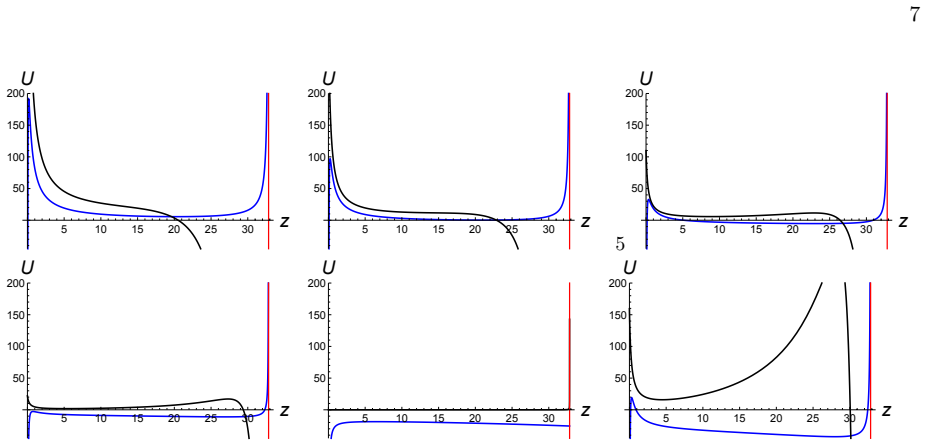
The effective potential $U$ obtained from the Hamiltonian $H=g^{\mu\nu}p_\mu p_\nu+m^2$ after fixing the conserved energies and angular momenta, restricted to the symmetry axis $x=y=0$ of the Gibbons-Hawking metric. The multi-centered Gibbons-Hawking base has $n$ points (nuts), one at the horizon and $n-1$ outside; at each off-horizon center the potential diverges because of the centrifugal force of particles circulating around that center, while near the horizon gravity makes it diverge to $-\infty$. Between these two divergences the potential is forced to have a local minimum, which the paper interprets as a stable bound orbit. The Hessian plotted in Fig. 5 is the second derivative of $U$ with respect to $z$ only.
What would settle it
Compute $\partial^2 U/\partial \theta^2$ at the reported $z$-axis minima for $(k_1,k_2,l_1)=(0,10,1)$ and large $|l_{\phi_1}|$; if that second derivative is negative or zero, the equilibrium is a saddle or ridge and the claimed stable bound orbits do not survive off-axis perturbations. Alternatively, integrate the geodesic equations starting at the minimum with a small $\theta$-velocity: if the particle escapes to infinity or falls into the horizon instead of oscillating near the minimum, the claim fails.
Extended reading notes
Core claim
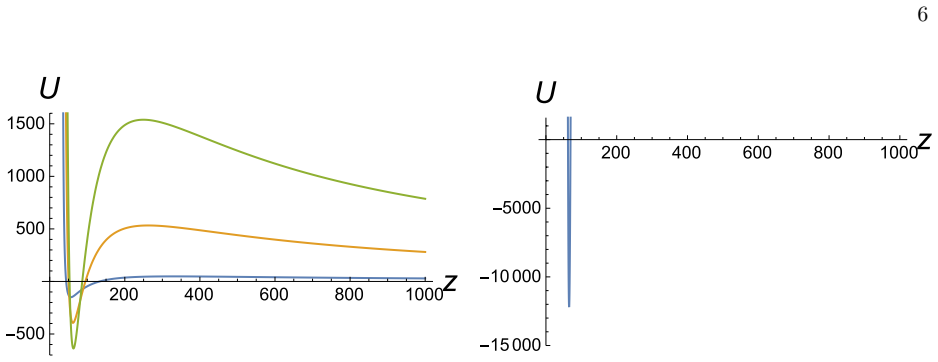
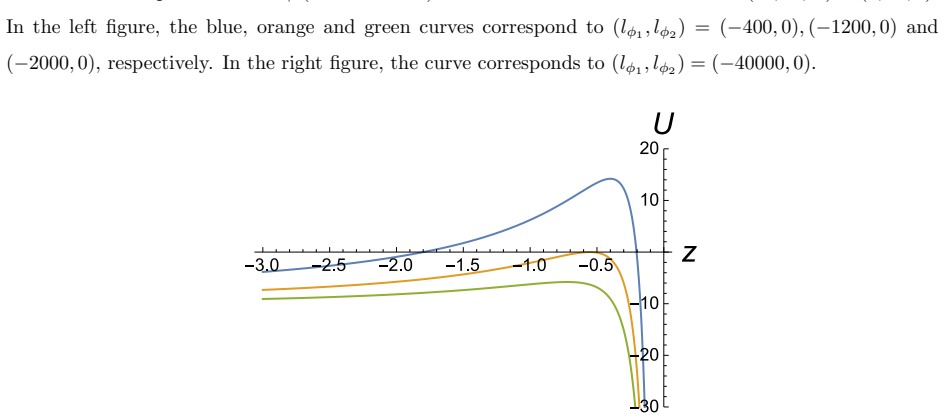
The central claim is that stable bound orbits exist around a supersymmetric black lens, specifically the L(2,1) solution of five-dimensional minimal supergravity, even though no such orbits exist around higher-dimensional Schwarzschild black holes. On the z-axis interval outside the outermost Gibbons-Hawking center, the effective potential U for fixed angular momenta develops a negative local minimum for large |l_phi1|, which the authors identify with stable bound orbits of massive particles; the equation U=0 has two roots z_in < z_out enclosing a region where U<0, so massless particles are stably bound between those radii. On the interval between the horizon and that center, particles whose angular momenta satisfy l_phi1/l_phi2=-2 see a positive local minimum. The evidence is the shape of the effective potential along the axis, obtained numerically for the parameter set (k1,k2,$\ell^1$)=(0,10,1).
Load-bearing premise
The load-bearing premise is that a local minimum of the effective potential along the $z$-axis is enough to guarantee a stable bound orbit; the second derivative in the $\theta$ direction at that minimum is never evaluated.
Editorial extensions
If this is right
- The higher-dimensional rule that spherical horizons have no stable circular orbits does not extend to lens-space horizons.
- For large angular momentum, the stable massless orbits shrink to a thin band whose center approaches the evanescent ergosurface at $z=2z_2$, so stable trapping of zero-energy null particles is a limiting case.
- The same mechanism should operate for $L(n,1)$ lenses with $n\ge 3$: each interval between adjacent centers is expected to contain at least one stable orbit family.
- Evanescent ergosurfaces combined with stable bound orbits of nonzero-energy particles may make the black lens nonlinearly unstable under perturbations, a possibility the paper explicitly raises.
Reading between the lines
- If the missing $\theta$-direction stability check comes out positive, this would be the first demonstration of stable circular orbits around a five-dimensional black hole with lens-space horizon topology; that conclusion goes beyond what the paper itself establishes.
- The same nut-induced centrifugal wells should appear in any multi-centered Gibbons-Hawking spacetime, so stable bound orbits may be a generic feature of supersymmetric microstate geometries rather than a peculiarity of the L(2,1) lens.
- A direct two-dimensional Poincaré section near the reported minimum would show whether the bound motion is regular or whether off-axis orbits escape, a testable extension the paper leaves open.
Editorial analysis
A structured set of objections, weighed in public.
Referee Report
Summary. This paper claims the existence of stable bound orbits for massive and massless test particles in the five-dimensional supersymmetric black lens spacetime with horizon topology L(2,1). Using the known Kunduri-Lucietti/Tomizawa-Nozawa metric, the authors reduce the geodesic Hamiltonian to motion in a two-dimensional effective potential U(z,θ) (Eqs. (18)-(19)) and study U numerically along the z-axis for the parameter choice (k1,k2,l1)=(0,10,1). On the interval I+ (z>z2) they find a negative local minimum for large |l_phi1| (massive case) and a negative region between two zeros (massless case); on I1 (0<z<z2) they find a positive minimum for angular momenta with l_phi1/l_phi2=-2. They conclude that stable bound orbits exist around the black lens, and conjecture the same for L(n,1) without proof.
Significance. If fully established, this result would be a notable addition to higher-dimensional black hole physics: it provides the first example of stable bound orbits around a black lens, complementing the known existence for black rings and contrasting with the absence for higher-dimensional Schwarzschild and spherical supersymmetric black holes. The paper also connects the orbits to evanescent ergosurfaces and potential nonlinear instability. The use of an exact known solution, the explicit effective potential, and the reproducible numerical exploration are strengths. The main missing link is the demonstration of stability in the full two-dimensional configuration space, which is necessary for the central claim.
major comments (2)
- [Effective-potential analysis, Eqs. (18)-(19) and Figs. 3-5] The inference from a one-dimensional local minimum to a stable bound orbit is not yet justified. Since the Hamiltonian (18) describes two-dimensional motion in (z,θ), a stable bound orbit requires U to have a local minimum with respect to both coordinates. The paper verifies only d²U/dz² > 0 at the minima; the curve labeled 'Hessian' in Fig. 5 is the second z-derivative, not the full Hessian, and no ∂²U/∂θ² is reported for the I+ or I1 minima. Without this, the minima could be saddle points in θ, so a small displacement perpendicular to the axis would grow and the orbit would not be stable. This check should be performed numerically for the parameter point (0,10,1) and for the large-|l_phi1| cases in Fig. 3, or the claim should be weakened to 'stable with respect to z-perturbations on the axis.' The closing paragraph on L(n,1) explicitly assumes, rather than demonstrates, the local minimum in the normal direction, which shows that the authors are aware that this is an additional requirement.
- [Massless bound orbits on I+, Fig. 3] The claim that there are stable bound orbits of massless particles in the range z_in ≤ z ≤ z_out of Fig. 3 relies on U < 0 in that interval with U = 0 at the endpoints. Even if this yields a well for the one-dimensional problem, the same θ-stability gap applies. Moreover, the statement that for large |l_phi1| the width Δz → 0 and hence there are stable circular orbits of massless particles needs a careful definition: in this non-separable two-dimensional configuration space, a 'circular orbit' should be defined with respect to the full phase space, and its stability in θ should be demonstrated rather than inferred from the narrowing of the z-interval.
minor comments (4)
- [Fig. 5 caption] The caption says the black graph is the 'Hessian divided by 10^3', but the text describes it as the Hessian; please clarify that this is only the second derivative with respect to z, not the full Hessian matrix.
- [Fig. 4 caption and text] The text lists the green curve in Fig. 4 as (l_phi1,l_phi2)=(0,30), while the caption lists it as (0,12); please correct this inconsistency.
- [General text] There are several typographical issues: 'Futhermore' should be 'Furthermore', 'minimums' should be 'minima', and the sentence 'as closer to the horizon, the strong effect of the gravitational force causes the potential to diverge' is awkward and should be rephrased.
- [References] References [12] and [13] are the same paper (Gibbons and Herdeiro); please avoid the duplicate citation or label it appropriately.
Circularity Check
No significant circularity: the effective potential is derived from an independently known metric and numerically evaluated; the main weakness is a missing θ-direction stability check, which is a correctness gap rather than an input-output equivalence.
full rationale
The paper's derivation chain is self-contained in the relevant sense. It takes the supersymmetric black lens metric from the published literature (Kunduri-Lucietti [21] and Tomizawa-Nozawa [22]; the latter is an author self-citation, but the same metric is independently established in [21] and the present paper only uses it as input), writes the geodesic Hamiltonian in the constants-of-motion form (17)-(19), and numerically evaluates the resulting effective potential U on the z-axis for a concrete parameter set (k1,k2,l1)=(0,10,1). The conclusion 'there are stable bound orbits' is inferred from negative local minima in U(z) on I+ and a positive minimum on I1 (Figs. 3-5). No parameter is fitted to the conclusion; the local minima are computed consequences of the chosen metric parameters, not inputs renamed as outputs. The black-ring results [18-20] are cited as motivation, not as load-bearing proof. The most serious concern is not circularity: a local minimum along z does not by itself establish a minimum in the θ direction, since ∂²U/∂θ² is never evaluated and the graph labeled 'Hessian' in Fig. 5 only shows z-direction curvature. This is a correctness gap in extending the one-dimensional-axis result to a genuinely stable bound orbit in the full 2D configuration space, and the paper itself only assumes, rather than proves, the normal-direction minimum in the speculative L(n,1) paragraph. But this gap is not an input-output equivalence, a fitted-input-as-prediction, or a self-citation chain forcing the conclusion. The evanescent-ergosurface discussion involving Ref. [24] is also not circular. Thus the appropriate finding is no significant circularity, score 0.
Assumptions & free parameters
assumptions (2)
- domain assumption The metric (1)-(10) with parameters satisfying (11)-(16) is a valid supersymmetric black lens solution with horizon topology L(2,1).
- standard math The Hamiltonian H = g^{mu nu} p_mu p_nu + m^2 describes the motion of test particles in this spacetime, and bound orbits correspond to local minima of the effective potential U.
Cite this review
Pith. "Pith review of Stable bound orbits around a supersymmetric black lens." pith.science (2026). https://pith.science/paper/4LBHQJWE
@misc{pith2026190809749,
  author       = {Pith},
  title        = {Pith review of: Stable bound orbits around a supersymmetric black lens},
  year         = {2026},
  howpublished = {\url{https://pith.science/paper/4LBHQJWE}},
  note         = {Machine review of arXiv:1908.09749}
}
read the original abstract
In higher-dimensional Schwarzschild black hole spacetimes, there are no stable bound orbits of particles. In contrast to this, it is shown that there are stable bound orbits in a five-dimensional black lens spacetime.
Figures

Figures from the paper (1 more)
Reference graph
Works this paper leans on
-
[1]
Uniqueness theorem for 5-dimensional black holes with two axial Killing fields,
S. Hollands and S. Yazadjiev, “Uniqueness theorem for 5-dimensional black holes with two axial Killing fields,” Commun. Math. Phys. 283, 749 (2008) [arXiv:0707.2775 [gr-qc]]
arXiv 2008
-
[2]
Further restrictions on the topology of stationary black holes in five dimensions,
S. Hollands, J. Holland and A. Ishibashi, “Further restrictions on the topology of stationary black holes in five dimensions,” Annales Henri Poincare 12, 279 (2011) [arXiv:1002.0490 [gr-qc]]
arXiv 2011
-
[3]
On the Topology and area of higher dimensional black holes,
M. l. Cai and G. J. Galloway, “On the Topology and area of higher dimensional black holes,” Class. Quant. Grav. 18, 2707 (2001) [hep-th/0102149]
arXiv 2001
-
[4]
A Generalization of Hawking’s black hole topology theorem to higher dimensions,
G. J. Galloway and R. Schoen, “A Generalization of Hawking’s black hole topology theorem to higher dimensions,” Commun. Math. Phys. 266, 571 (2006) [gr-qc/0509107]
arXiv 2006
-
[5]
Schwarzschild field in n dimensions and the dimensionality of space problem,
F. R. Tangherlini, “Schwarzschild field in n dimensions and the dimensionality of space problem,” Nuovo Cim. 27, 636 (1963)
work page 1963
-
[6]
Black Holes in Higher Dimensional Space-Times,
R. C. Myers and M. J. Perry, “Black Holes in Higher Dimensional Space-Times,” Annals Phys. 172, 304 (1986)
work page 1986
-
[7]
D-branes and spinning black holes,
J. C. Breckenridge, R. C. Myers, A. W. Peet and C. Vafa, “D-branes and spinning black holes,” Phys. Lett. B 391, 93 (1997) [hep-th/9602065]
arXiv 1997
-
[8]
Complete integrability of geodesic motion in general Kerr-NUT-AdS spacetimes,
D. N. Page, D. Kubiznak, M. Vasudevan and P. Krtous, “Complete integrability of geodesic motion in general Kerr-NUT-AdS spacetimes,” Phys. Rev. Lett. 98, 061102 (2007) [hep-th/0611083]
arXiv 2007
Show all 23 references
-
[9]
Particle and light motion in a space-time of a five-dimensional rotating black hole,
V. P. Frolov and D. Stojkovic, “Particle and light motion in a space-time of a five-dimensional rotating black hole,” Phys. Rev. D 68, 064011 (2003) [gr-qc/0301016]
2003 arXiv
-
[10]
Separability of Hamilton-Jacobi and Klein-Gordon Equations in General Kerr-NUT-AdS Spacetimes,
V. P. Frolov, P. Krtous and D. Kubiznak, “Separability of Hamilton-Jacobi and Klein-Gordon Equations in General Kerr-NUT-AdS Spacetimes,” JHEP 0702, 005 (2007) [hep-th/0611245]
2007 arXiv
-
[11]
Geodesic stability, Lyapunov exponents and quasinormal modes,
V. Cardoso, A. S. Miranda, E. Berti, H. Witek and V. T. Zanchin, “Geodesic stability, Lyapunov exponents and quasinormal modes,” Phys. Rev. D 79, 064016 (2009) [arXiv:0812.1806 [hep-th]]
2009 arXiv
-
[13]
Supersymmetric rotating black holes and causality violation,
G. W. Gibbons and C. A. R. Herdeiro, “Supersymmetric rotating black holes and causality violation,” Class. Quant. Grav. 16, 3619 (1999) [hep-th/9906098]
1999 arXiv
-
[14]
Supersymmetric rotating black hole spacetime tested by geodesics,
V. Diemer and J. Kunz, “Supersymmetric rotating black hole spacetime tested by geodesics,” Phys. Rev. D 89, 084001 (2014) [arXiv:1312.6540 [gr-qc]]
2014 arXiv
-
[15]
A Rotating black ring solution in five-dimensions,
R. Emparan and H. S. Reall, “A Rotating black ring solution in five-dimensions,” Phys. Rev. Lett. 88, 101101 (2002) [hep-th/0110260]
2002 arXiv
-
[16]
Black ring with two angular momenta,
A. A. Pomeransky and R. A. Sen’kov, “Black ring with two angular momenta,” hep-th/0612005
-
[17]
A Supersymmetric black ring,
H. Elvang, R. Emparan, D. Mateos and H. S. Reall, “A Supersymmetric black ring,” Phys. Rev. Lett. 93, 211302 (2004) [hep-th/0407065]. 10
2004 arXiv
-
[18]
Stable Bound Orbits around Black Rings,
T. Igata, H. Ishihara and Y. Takamori, “Stable Bound Orbits around Black Rings,” Phys. Rev. D 82, 101501 (2010) [arXiv:1006.3129 [hep-th]]
2010 arXiv
-
[19]
Chaos in Geodesic Motion around a Black Ring,
T. Igata, H. Ishihara and Y. Takamori, “Chaos in Geodesic Motion around a Black Ring,” Phys. Rev. D 83, 047501 (2011) [arXiv:1012.5725 [hep-th]]
2011 arXiv
-
[20]
Stable Bound Orbits of Massless Particles around a Black Ring,
T. Igata, H. Ishihara and Y. Takamori, “Stable Bound Orbits of Massless Particles around a Black Ring,” Phys. Rev. D 87, 104005 (2013) [arXiv:1302.0291 [hep-th]]
2013 arXiv
-
[21]
Supersymmetric Black Holes with Lens-Space Topology,
H. K. Kunduri and J. Lucietti, “Supersymmetric Black Holes with Lens-Space Topology,” Phys. Rev. Lett. 113, 211101 (2014) [arXiv:1408.6083 [hep-th]]
2014 arXiv
-
[22]
Supersymmetric black lenses in five dimensions,
S. Tomizawa and M. Nozawa, “Supersymmetric black lenses in five dimensions,” Phys. Rev. D 94, 044037 (2016) [arXiv:1606.06643 [hep-th]]
2016 arXiv
-
[23]
Gravitational Multi-Instantons,
G. W. Gibbons and S. W. Hawking, “Gravitational Multi-Instantons,” Phys. Lett. 78B, 430 (1978)
1978
-
[24]
Instability of supersymmetric microstate geometries,
F. C. Eperon, H. S. Reall and J. E. Santos, “Instability of supersymmetric microstate geometries,” JHEP 1610, 031 (2016) [arXiv:1607.06828 [hep-th]]
2016 arXiv
Reviewed August 14, 2026 · model on record in the stance chip above.
Discussion (0). Continue with ORCID to comment.