REVIEW 6 major objections 5 minor 49 references
Multi-Path Learnable Wavelet Neural Network for Image Classification
T0 review · 6 major / 5 minor · reviewed 2026-08-14 · deepseek-v4-flash
Pith's one-line read A multi-path wavelet neural network with learnable wavelet parameters classifies images at competitive accuracy using only 264,000 trainable parameters and no data augmentation.
desk verdict The paper's learnable-wavelet idea has a fine core, but the reported results don't survive internal consistency checks: the same 8-path, 264K-parameter MNIST configuration gets 0.89% error in Table 1 and 0.27% in Table 2, and the parameter count doesn't add up. read the letter →
The pith
A machine-rendered reading of the paper's core claim, the machinery that carries it, and where it could break.
The reading
What carries the argument
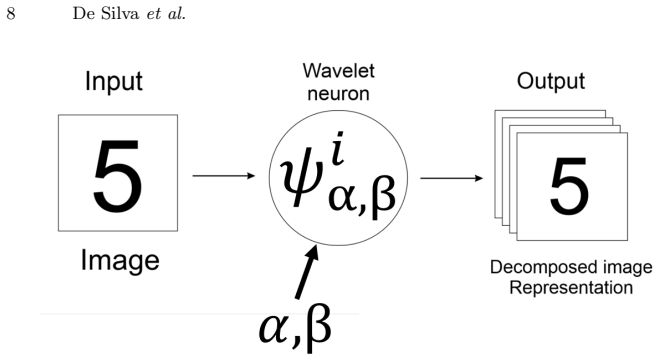
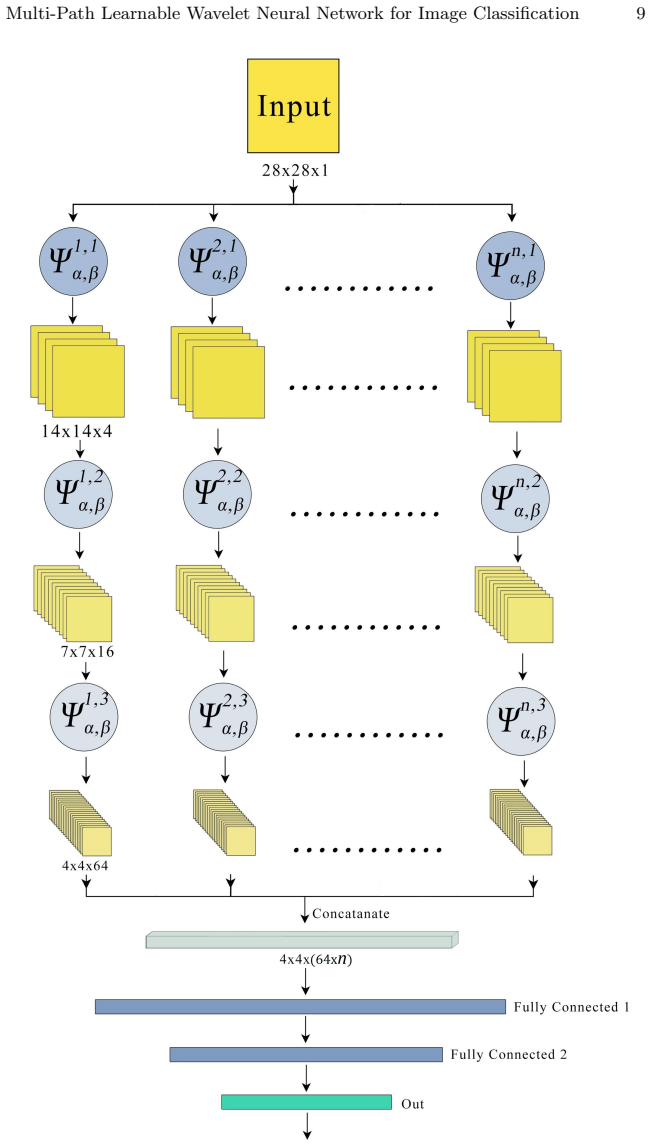
The load-bearing object is the parameterized length-6 scaling filter. The coefficients $h(n)$ are constrained to satisfy the quadrature-mirror conditions—sum $\sqrt{2}$, unit norm, and orthogonality—and are rewritten in terms of two learnable angles $\alpha$ and $\beta$, so a small, differentiable set of parameters determines the whole wavelet system. A wavelet neuron applies the corresponding 2D discrete wavelet transform to an $n\times n\times d$ input and produces an $n/2\times n/2\times 4d$ output; stacking three neurons gives one path, and the winning architecture uses eight parallel paths. The two angles per neuron are the only trainable parameters in the decomposition stage, with all other parameters residing in the two fully connected layers.
What would settle it
Retrain AlexNet, VGG16, ResNet-110, and DenseNet on CIFAR-10 with the same no-augmentation pipeline used here and compare against the table's 94.19%, 92.45%, 91.57%, and 93.95% figures. If the baselines differ materially, the 'outperforms all' conclusion does not survive. Independently, re-running the eight-path network on CIFAR-10 and checking whether 94.87% accuracy reproduces would test the method itself.
Extended reading notes
Core claim
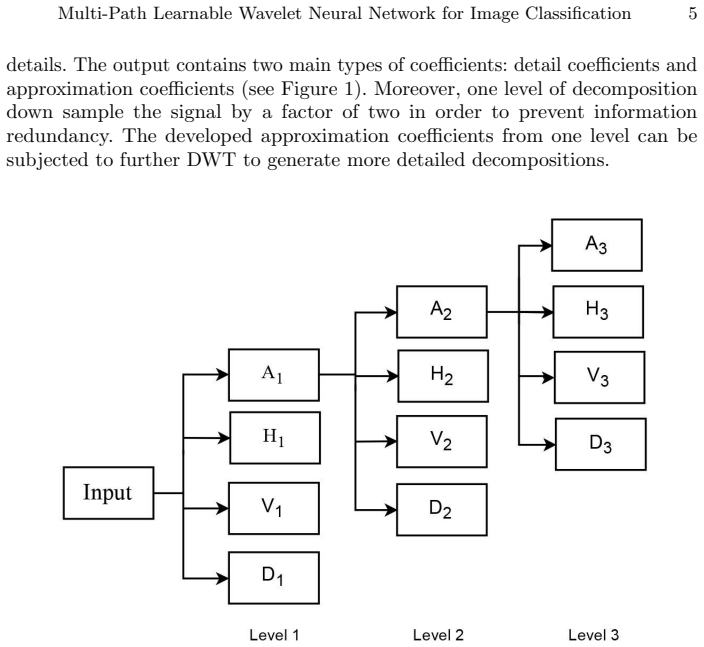
The central claim is that learnable wavelet decompositions can replace convolutional feature extraction without sacrificing classification accuracy. A length-6 scaling filter sequence $h(0),\ldots,h(5)$ is expressed through two angular parameters $\alpha$ and $\beta$, and each wavelet neuron applies the resulting 2D discrete wavelet transform to an input, outputting one approximation and three detail coefficient maps at half resolution. Three such neurons stacked form a path, and the selected architecture runs eight paths in parallel, concatenates the final coefficient maps, and passes them to two fully connected layers of 32 units each. The authors report 0.27% error on MNIST, 94.87% accuracy on CIFAR-10, 81.22% on CIFAR-100, and 97.51% on SVHN with 264K parameters, which they interpret as evidence that drastically smaller networks can remain competitive with influential deep models.
Load-bearing premise
The comparison with baseline deep models assumes that the quoted baseline accuracies were obtained under the same training protocol as the proposed network, especially no data augmentation on MNIST, CIFAR-10, and CIFAR-100; if that assumption fails, the reported advantage may be an artifact of comparison rather than of architecture.
Editorial extensions
If this is right
- If the result reproduces, a convolutional-free feature extractor built from learnable wavelets can reach competitive accuracy on small and medium image benchmarks with far fewer trainable parameters.
- Because each wavelet neuron adds only two learnable parameters, widening a network with more parallel paths increases capacity without proportionally increasing the parameter count.
- The two-angle parameterization gives a recipe for making other fixed filterbanks learnable, as long as the coefficient sequence satisfies the stated conditions.
- The reported 264K-parameter model would be inexpensive to deploy on memory-limited hardware, a direct corollary of the parameter counts the paper reports.
Reading between the lines
- An ablation that freezes $\alpha$ and $\beta$ and trains only the fully connected layers would quantify how much of the accuracy actually comes from learning the wavelet parameters.
- The same differentiable parameterization could be applied to regression or segmentation tasks, since the transform is not classification-specific.
- Because the model trains on a Jetson TX2, the architecture is in principle edge-deployable; benchmarking inference speed and memory would test that promise directly.
- One could initialize different paths with different $\alpha$ and $\beta$ values and inspect whether they specialize to distinct frequency bands, connecting the approach to multi-scale analysis.
Signed reviews
Editorial analysis
A structured set of objections, weighed in public.
Referee Report
Summary. The paper proposes a multi-path wavelet neural network with learnable filter parameters for image classification. Each path consists of three levels of 2D discrete wavelet transform using length-6 filters parameterized by two angles α and β, followed by two fully connected layers. Several configurations are evaluated on MNIST; the 8-path, 264K-parameter variant is selected and tested on CIFAR-10, CIFAR-100, and SVHN. The authors report near state-of-the-art accuracy with far fewer parameters than conventional deep models and claim to outperform the compared baselines without data augmentation (except SVHN).
Significance. If the results were reproducible and the parameter counts accurate, this would be a valuable exploration of learnable wavelets as a parameter-efficient alternative to convolutional filters. The idea is interesting and the parameter-savings claim is appealing. However, as written, the manuscript contains internal inconsistencies in its own headline numbers, unverifiable baseline accuracies, and no derivation of the learning rule for the wavelet parameters, so the contribution cannot be assessed from the submitted text.
major comments (6)
- [Section 4.1, Tables 1 and 2] The same 8-path, 264K-parameter architecture is reported with a 0.89% error rate on MNIST in Table 1 but a 0.27% error rate (0.29% in the text) in Table 2, with no change in training procedure described. This unexplained three-fold performance gap makes the headline result unsupported.
- [Section 3.4 and Table 1] The reported parameter count of 264K is inconsistent with the architecture description. With 8 paths, each containing 3 wavelet neurons, an MNIST input of 28x28x1 produces either 4608 features (if only the final decomposition level is used) or 17,152 features (if all three levels are concatenated). Two fully connected layers of 32 units then require approximately 148K or 549K parameters, respectively, not 264K; for CIFAR inputs of 32x32x3 the required count is even larger. The paper does not clarify which concatenation scheme is used or how 264K is obtained.
- [Section 4.2, Table 3] Several baseline accuracies do not match the cited sources. For example, AlexNet [19] is credited with 94.19% on CIFAR-10, but the cited paper reports ImageNet results, not CIFAR-10, and typical CIFAR-10 AlexNet implementations with data augmentation attain lower accuracy. Similarly, FitNet [45] is credited with 94.61%, whereas the original FitNets paper reports about 91.6% on CIFAR-10. Without consistent and verifiable training protocols for the baselines, the claimed superiority over them is not established.
- [Section 3.3] The paper states that α and β are updated with backpropagation but provides no derivation of the gradients through the wavelet decomposition, including the downsampling steps and the nonlinear dependence of h(n) on α and β in Eq. (17). A concrete gradient computation is necessary to support the central claim that the wavelet filter angles are learnable.
- [Section 5 and Table 2] The conclusion asserts that the network 'has been able to outperform all the compared deep learning models,' but Table 2 shows that DropConnect [38] achieves a lower MNIST error rate (0.21% vs the reported 0.27%/0.29%), and the text in Section 4.2 acknowledges that the MNIST result is second best. The conclusion is thus internally contradictory.
- [Section 3.3, Eqs. (16) and (17)] The orthonormality claim for the length-6 coefficients is not established. Eq. (16) lists only three conditions, but a quadrature mirror filter of length 6 must also satisfy the shift-orthogonality condition for k=2, e.g., h(0)h(4)+h(1)h(5)=0. The paper neither verifies that Eq. (17) satisfies this condition nor states that it is not required, leaving the theoretical basis of the wavelet system incomplete.
minor comments (5)
- [Section 2, paragraph 5] The phrase 'preprocesses the data in th wavelet domain' contains a typo; it should be 'in the wavelet domain.'
- [Table 3] The VGG16 CIFAR-10 entry is written as '92.45' without a percent sign, and the table's formatting is inconsistent with the other entries.
- [Section 4.1] The training description lacks the number of epochs, batch size, and the exact learning-rate decay schedule, which prevents replication.
- [References and Section 4.1] The SVHN dataset is cited as [43] in Section 4.1, but reference [43] is the DenseNet paper; SVHN is described in reference [41].
- [Section 3.4] The method of concatenating feature maps from the wavelet paths is not specified precisely, in particular whether all decomposition levels are concatenated or only the final level; this ambiguity contributes to the parameter-count problem.
Circularity Check
No circularity: the reported results are empirical training outcomes and the learnable wavelet parameters are fitted by backpropagation, not derived from the target outputs.
full rationale
The paper makes no first-principles prediction that reduces by construction to its inputs. The learnable wavelet parameters α and β are introduced as free parameters in Eq. (17) after imposing standard scaling-filter conditions, and they are updated by backpropagation; this is ordinary model fitting, not a definition that presupposes the classification result. The architecture with 8 parallel paths is selected using MNIST results in Table 1 and then evaluated on the same datasets in Tables 2-4, which is model selection and could raise reproducibility concerns, but it does not make the reported accuracy equal to the selection criterion by construction. The self-cited MMEE-AlexNet and NEE-AlexNet baselines are comparisons, not load-bearing support for the central claim, and no uniqueness theorem is imported from the authors' earlier work. The internally inconsistent MNIST error rates (0.89% vs 0.27% or 0.29%) and the unverified baseline protocol are correctness and evidence-quality problems, not circular reasoning. The stated limitations about computational cost and sigmoid distortion are acknowledged shortcomings and are unrelated to circularity. Thus no specific circular step can be exhibited from the text.
Assumptions & free parameters
free parameters (1)
- Wavelet filter angles alpha and beta =
One pair per wavelet neuron, 48 total for the 8-path network; final learned values are not reported.
assumptions (3)
- ad hoc to paper The length-6 coefficient formulas in Eq. (17) satisfy the quadrature mirror filter conditions in Eq. (16), producing an orthonormal wavelet system.
- domain assumption Backpropagation can propagate gradients through the discrete wavelet transform, including downsampling and the alpha and beta parameterization.
- domain assumption Comparison baselines in Tables 2 to 4 were evaluated under the same protocol as the proposed network, including no data augmentation for MNIST, CIFAR-10, and CIFAR-100.
invented entities (1)
-
Learnable wavelet neuron
Cite this review
Pith. "Pith review of Multi-Path Learnable Wavelet Neural Network for Image Classification." pith.science (2026). https://pith.science/paper/ZTLK5ADF
@misc{pith2026190809775,
  author       = {Pith},
  title        = {Pith review of: Multi-Path Learnable Wavelet Neural Network for Image Classification},
  year         = {2026},
  howpublished = {\url{https://pith.science/paper/ZTLK5ADF}},
  note         = {Machine review of arXiv:1908.09775}
}
read the original abstract
Despite the remarkable success of deep learning in pattern recognition, deep network models face the problem of training a large number of parameters. In this paper, we propose and evaluate a novel multi-path wavelet neural network architecture for image classification with far less number of trainable parameters. The model architecture consists of a multi-path layout with several levels of wavelet decompositions performed in parallel followed by fully connected layers. These decomposition operations comprise wavelet neurons with learnable parameters, which are updated during the training phase using the back-propagation algorithm. We evaluate the performance of the introduced network using common image datasets without data augmentation except for SVHN and compare the results with influential deep learning models. Our findings support the possibility of reducing the number of parameters significantly in deep neural networks without compromising its accuracy.
Figures
Reference graph
Works this paper leans on
-
[19]
Imagenet classification with deep convolutional neural networks
Alex Krizhevsky, Ilya Sutskever, and Geoffrey E Hinton. Imagenet classification with deep convolutional neural networks. In F. Pereira, C. J. C. Burges, L. Bottou, and K. Q. Weinberger, editors, Advances in Neural Information Processing Systems 25, pages 1097–1105. Curran Associates, Inc., 2012
work page 2012
- [45]
-
[38]
Regularization of neural networks using dropconnect
Li Wan, Matthew Zeiler, Sixin Zhang, Yann Le Cun, and Rob Fergus. Regularization of neural networks using dropconnect. In Sanjoy Dasgupta and David McAllester, editors, Proceedings of the 30th International Conference on Machine Learning , volume 28 of Proceedings of Machine Learning Research, pages 1058–1066, Atlanta, Georgia, USA, 17–19 Jun 2013. PMLR
work page 2013
-
[1]
Wavelet neural networks: A practical guide
Antonis Alexandridis and Achilleas Zapranis. Wavelet neural networks: A practical guide. Neural networks : the official journal of the International Neural Network Society, 42:1–27, 2013
work page 2013
-
[2]
Wei Bao, Jun Yue, and Yulei Rao. A deep learning framework for financial time series using stacked autoencoders and long-short term memory. PloS one, 12(7):e0180944, 2017
work page 2017
-
[3]
D. Benaouda, F. Murtagh, J.-L. Starck, and O. Renaud. Wavelet-based nonlinear multiscale decomposition model for electricity load forecasting. Neurocomputing, 70(1):139 – 154, 2006. Neural Networks
work page 2006
-
[4]
Wavelet interpola- tion networks
Christophe Bernard, Stephane Mallat, and Jean jacques Slotine. Wavelet interpola- tion networks. In Preprint, Centre de Mathematiques Appliquees, Ecole Polytechnique, 1999
work page 1999
-
[5]
S Burrus, Ramesh A Gopinath, and Haitao Guo
C. S Burrus, Ramesh A Gopinath, and Haitao Guo. Introduction to wavelets and wavelet transforms : a primer . Upper Saddle River, N.J. : Prentice Hall, 1998. Includes bibliographical references, pages 224-245, 1998. 14 De Silva et al
work page 1998
Show all 49 references
-
[6]
Predicting chaotic time series with wavelet networks
Liangyue Cao, Yiguang Hong, Haiping Fang, and Guowei He. Predicting chaotic time series with wavelet networks. Physica D: Nonlinear Phenomena , 85(1-2):225–238, 1995
1995
-
[7]
Time-series prediction using a local linear wavelet neural network
Yuehui Chen, Bo Yang, and Jiwen Dong. Time-series prediction using a local linear wavelet neural network. Neurocomputing, 69(4-6):449–465, 2006
2006
-
[8]
Deep learning in the wavelet domain
Fergal Cotter and Nick Kingsbury. Deep learning in the wavelet domain. arXiv preprint arXiv:1811.06115, 2018
2018 arXiv
-
[9]
Ten lectures on wavelets, volume 61, Siam, 1992
Ingrid Daubechies. Ten lectures on wavelets, volume 61, Siam, 1992
1992
-
[10]
Wavelet based edge feature enhancement for convolutional neural networks
DDN De Silva, S Fernando, ITS Piyatilake, and AVS Karunarathne. Wavelet based edge feature enhancement for convolutional neural networks. International Conference in Machine Vision , volume 11041, 2018
2018
-
[11]
Wavelet convolutional neural networks for texture classification
Shin Fujieda, Kohei Takayama, and Toshiya Hachisuka. Wavelet convolutional neural networks for texture classification. arXiv preprint arXiv:1707.07394 , 2017
2017 arXiv
-
[12]
Wavelet-based neural network for power disturbance recognition and classification
Zwe-Lee Gaing. Wavelet-based neural network for power disturbance recognition and classification. IEEE transactions on power delivery , 19(4):1560–1568, 2004
2004
-
[13]
Deep wavelet prediction for image super-resolution
Tiantong Guo, Hojjat Seyed Mousavi, Tiep Huu Vu, and Vishal Monga. Deep wavelet prediction for image super-resolution. In The IEEE Conference on Computer Vision and Pattern Recognition (CVPR) Workshops , 2017
2017
-
[14]
Zur Theorie der orthogonalen Funktionensysteme
Alfred Haar. Zur Theorie der orthogonalen Funktionensysteme. Mathematische Annalen, 69(3):331–371, 1910
1910
-
[15]
Deep residual learning for image recognition
Kaiming He, Xiangyu Zhang, Shaoqing Ren, and Jian Sun. Deep residual learning for image recognition. In Proceedings of the IEEE conference on computer vision and pattern recognition, pages 770–778, 2016
2016
-
[16]
Wavelet-srnet: A wavelet- based cnn for multi-scale face super resolution
Huaibo Huang, Ran He, Zhenan Sun, Tieniu Tan, et al. Wavelet-srnet: A wavelet- based cnn for multi-scale face super resolution. In Proceedings of the IEEE Conference on Computer Vision and Pattern Recognition , pages 1689–1697, 2017
2017
-
[17]
Adaptive wavelets for signal classification and compression
Shubha Kadambe and Pramila Srinivasan. Adaptive wavelets for signal classification and compression. AEU - International Journal of Electronics and Communications , 60(1):45 – 55, 2006
2006
-
[18]
Kingma and Jimmy Ba
Diederik P. Kingma and Jimmy Ba. Adam: A method for stochastic optimization. CoRR, abs/1412.6980, 2014
2014 arXiv
-
[20]
MNIST handwritten digit database
Yann LeCun and Corinna Cortes. MNIST handwritten digit database. 2010
2010
-
[21]
Multi-level wavelet-cnn for image restoration
Pengju Liu, Hongzhi Zhang, Kai Zhang, Liang Lin, and Wangmeng Zuo. Multi-level wavelet-cnn for image restoration. arXiv preprint arXiv:1805.07071 , 2018
2018 arXiv
-
[22]
Detailed dense inference with convolutional neural networks via discrete wavelet transform
Lingni Ma, J¨ org St¨ uckler, Tao Wu, and Daniel Cremers. Detailed dense inference with convolutional neural networks via discrete wavelet transform. arXiv preprint arXiv:1808.01834, 2018
2018 arXiv
-
[23]
Elsevier, 1999
St´ ephane Mallat.A wavelet tour of signal processing . Elsevier, 1999
1999
-
[24]
Group invariant scattering.Communications on Pure and Applied Mathematics, 65(10):1331–1398, 2012
St´ ephane Mallat. Group invariant scattering.Communications on Pure and Applied Mathematics, 65(10):1331–1398, 2012
2012
-
[25]
Classification using deep learning neural networks for brain tumors
Heba Mohsen, El-Sayed A El-Dahshan, El-Sayed M El-Horbaty, and Abdel- Badeeh M Salem. Classification using deep learning neural networks for brain tumors. Future Computing and Informatics Journal , 3(1):68–71, 2018
2018
-
[26]
Scaling the scattering transform: Deep hybrid networks
Edouard Oyallon, Eugene Belilovsky, and Sergey Zagoruyko. Scaling the scattering transform: Deep hybrid networks. In International Conference on Computer Vision (ICCV), 2017. Multi-Path Learnable Wavelet Neural Network for Image Classification 15
2017
-
[27]
Y. C. Pati and P. S. Krishnaprasad. Analysis and synthesis of feedforward neural networks using discrete affine wavelet transformations. IEEE Transactions on Neural Networks, 4(1):73–85, Jan 1993
1993
-
[28]
Kamarthi, and Qinglan Gao
Stefan Pittner, Sagar V. Kamarthi, and Qinglan Gao. Wavelet networks for sensor signal classification in flank wear assessment. Journal of Intelligent Manufacturing , 9(4):315–322, Aug 1998
1998
-
[29]
Wavelet neural networks for electricity load forecasting – dealing with border distortion and shift invariance
Mashud Rana and Irena Koprinska. Wavelet neural networks for electricity load forecasting – dealing with border distortion and shift invariance. In Valeri Mladenov, Petia Koprinkova-Hristova, G¨ unther Palm, Alessandro E. P. Villa, Bruno Appollini, and Nikola Kasabov, editors,...
2013
-
[30]
Learning repre- sentations by back-propagating errors
David E Rumelhart, Geoffrey E Hinton, and Ronald J Williams. Learning repre- sentations by back-propagating errors. nature, 323(6088):533, 1986
1986
-
[31]
Sara Sabour, Nicholas Frosst, and Geoffrey E. Hinton. Dynamic routing between capsules. CoRR, abs/1710.09829, 2017
2017 arXiv
-
[32]
Wavelet-enhanced convolutional neural network: a new idea in a deep learning paradigm
Behrouz Alizadeh Savareh, Hassan Emami, Mohamadreza Hajiabadi, Seyed Majid Azimi, and Mahyar Ghafoori. Wavelet-enhanced convolutional neural network: a new idea in a deep learning paradigm. Biomedical Engineering/Biomedizinische Technik, 2018
2018
-
[33]
Very deep convolutional networks for large-scale image recognition
Karen Simonyan and Andrew Zisserman. Very deep convolutional networks for large-scale image recognition. arXiv preprint arXiv:1409.1556 , 2014
2014 arXiv
-
[34]
Scatternet hybrid deep learning (shdl) network for object classification
Amarjot Singh and Nick Kingsbury. Scatternet hybrid deep learning (shdl) network for object classification. In Machine Learning for Signal Processing (MLSP), 2017 IEEE 27th International Workshop on , pages 1–6. IEEE, 2017
2017
-
[35]
Dropout: A simple way to prevent neural networks from overfitting
Nitish Srivastava, Geoffrey Hinton, Alex Krizhevsky, Ilya Sutskever, and Ruslan Salakhutdinov. Dropout: A simple way to prevent neural networks from overfitting. J. Mach. Learn. Res. , 15(1):1929–1958, January 2014
1929
-
[36]
Kemal Kiymik
Abdulhamit Subasi, Ahmet Alkan, Etem Koklukaya, and M. Kemal Kiymik. Wavelet neural network classification of eeg signals by using ar model with mle preprocessing. Neural Netw., 18(7):985–997, September 2005
2005
-
[37]
Rethinking the inception architecture for computer vision
Christian Szegedy, Vincent Vanhoucke, Sergey Ioffe, Jonathon Shlens, and Zbig- niew Wojna. Rethinking the inception architecture for computer vision. CoRR, abs/1512.00567, 2015
2015 arXiv
-
[39]
Zhang and A
Q. Zhang and A. Benveniste. Wavelet networks. IEEE Transactions on Neural Networks, 3(6):889–898, Nov 1992
1992
-
[40]
A study of a new wavelet neural network for deep learning
Zhong Zhang, Yiming Shi, Hiroshi Toda, and Takuma Akiduki. A study of a new wavelet neural network for deep learning. In Wavelet Analysis and Pattern Recognition (ICWAPR), 2017 International Conference on, pages 127–131. IEEE, 2017
2017
-
[41]
Reading digits in natural images with unsupervised feature learning
Netzer, Y., Wang, T., Coates, A., Bissacco, A., Wu, B., Ng, A.Y. Reading digits in natural images with unsupervised feature learning. In NIPS workshop on deep learning and unsupervised feature learning, vol. 2011, p. 5, 2011
2011
-
[42]
Learning multiple layers of features from tiny images, 2009
Alex Krizhevsky, Vinod Nair, and Geoffrey Hinton. Learning multiple layers of features from tiny images, 2009
2009
-
[43]
Huang, Z
G. Huang, Z. Liu, K. Q. Weinberger, and L. van der Maaten. Densely connected convolutional networks. arXiv preprint arXiv:1608.06993 , 2016. 16 De Silva et al
2016 arXiv
-
[44]
M. Lin, Q. Chen, and S. Yan. Network in network. CoRR, vol. abs/1312.4400, 2013
2013 arXiv
-
[46]
I. J. Goodfellow, D. Warde-Farley, M. Mirza, A. Courville, and Y. Bengio. Maxout networks. In International Conference on Machine Learning (ICML) , vol. 28, pp. 1319-1327, 2013
2013
-
[47]
Lecun, L
Y. Lecun, L. Bottou, Y. Bengio, and P. Haffner. Gradient-based learning applied to document recognition. In Proceedings of the IEEE, vol. 86, no. 11, pp. 2278-2324, 1998
1998
-
[48]
Williams and R
T. Williams and R. Li. Advanced Image Classification Using Wavelets and Con- volutional Neural Networks. In 15th IEEE International Conference on Machine Learning and Applications (ICMLA) , pp. 233–239, 2016
2016
-
[49]
S. Said, O. Jemai, S. Hassairi, R. Ejbali, M. Zaied and C. Ben Amar Deep wavelet network for image classification. In 2016 IEEE International Conference on Systems, Man, and Cybernetics (SMC) , pp. 922-927, 2016
2016
Reviewed August 14, 2026 · model on record in the stance chip above.
Discussion (0). Continue with ORCID to comment.