REVIEW 3 major objections 4 minor 1 cited by
Total curvature and the isoperimetric inequality in Cartan-Hadamard manifolds
T0 review · 3 major / 4 minor · reviewed 2026-08-14 · deepseek-v4-flash
Pith's one-line read This paper proves that in a Cartan-Hadamard manifold, the total curvature inequality for convex hypersurfaces implies the isoperimetric inequality, with equality only for Euclidean balls.
desk verdict A serious, important paper: the comparison formula is a genuine new tool, and Theorem 7.1 gives the long-sought reduction of the Cartan–Hadamard conjecture to the total curvature inequality in all dimensions, with only minor presentational gaps. read the letter →
The pith
A machine-rendered reading of the paper's core claim, the machinery that carries it, and where it could break.
The reading
What carries the argument
The workhorse is the comparison formula (Theorems 4.7 and 4.9): for two nested regular level sets $\Gamma$ and $\gamma$ of a $C^{1,1}$ or convex function $u$, the difference $G(\Gamma)-G(\gamma)$ equals an integral over $\Omega \setminus D$ of curvature terms involving the Riemann tensor $R$, the principal curvatures $\kappa_i$ of the level sets, and derivatives of $u$ in a principal frame. The formula is derived from the divergence identity for the cofactor (Newton) operator $T^u$ of the Hessian, combined with Stokes' theorem and a Greene-Wu smoothing limit that lets the formula survive vanishing principal curvatures. When $u$ is a signed distance function, the formula reduces to $G(\Gamma)-G(\gamma) = -\int_{\Omega \setminus D} R_{rnrn} (GK/\kappa_r) \, d\mu$, giving monotonicity of total curvature under inward parallel motion in hyperbolic space; in constant-curvature spaces it yields the quermassintegral identity $G(\Gamma)-G(\gamma) = -K_0 \int_{\Omega \setminus D} \sigma_{n-2}(\kappa) \, d\mu$. This formula is what connects the curvature of the convex hull to the curvature of the original hypersurface.
What would settle it
Compute, for a sequence of convex sets in a Cartan-Hadamard manifold, the product $GK \cdot J$ on the parallel convex hulls appearing in Proposition 6.6; if for some $C^{1,1}$ hypersurface $X$ the product is unbounded while $X \cap X_0$ is a hypersurface, Proposition 6.6 and hence Theorem 7.1 fail at their key step. Alternatively, exhibit a Cartan-Hadamard manifold of dimension $n \geq 4$ where the total curvature inequality (1) holds but there is a bounded set whose perimeter is smaller than that of a Euclidean ball of the same volume; that would directly refute Theorem 7.1.
Extended reading notes
Core claim
The central discovery is Theorem 7.1: if every convex $C^{1,1}$ hypersurface $\Gamma$ in a Cartan-Hadamard manifold satisfies $G(\Gamma) \geq \operatorname{vol}(S^{n-1})$, then every bounded set satisfies the Euclidean isoperimetric inequality, with equality only for Euclidean balls. The proof works through the isoperimetric profile of large geodesic balls: for an isoperimetric region $\Omega$, the boundary $\Gamma$ has convex hull $\Gamma_0$, and the hull-curvature theorem gives $G(\Gamma_0) = G(\Gamma \cap \Gamma_0) \leq G(\Gamma)$. The total curvature inequality forces $\int_{\Gamma \cap \Gamma_0} GK \, d\sigma \geq n\omega_n$, and an arithmetic-geometric mean comparison with the constant mean curvature $H_0$ of the isoperimetric region yields $H_0(\operatorname{vol}(\Omega)) \geq H_0(\operatorname{per}(\Omega))$, which integrates to the Euclidean isoperimetric profile. The equality analysis shows that equality forces the region to be a geodesic ball whose tangent sectional curvatures vanish, hence a Euclidean ball.
Load-bearing premise
The proof's load-bearing premise is the uniform bound (37), $GK(p_\epsilon^\nu) J(p_\epsilon^\nu) \leq C$, on the parallel hypersurfaces of the convex hull, justified by a compressed Riccati-equation argument that assumes a ball of radius $\epsilon$ rolls freely inside the hull and that the Gauss-Kronecker curvature stays bounded; if that bound fails, the dominated-convergence step showing $G((X_0 \setminus X)_\epsilon) \to 0$ breaks down.
Editorial extensions
If this is right
- If the total curvature inequality is proved in any dimension $n \geq 4$, the Cartan-Hadamard conjecture follows in that dimension, since Theorem 7.1 converts the total-curvature inequality into the isoperimetric inequality.
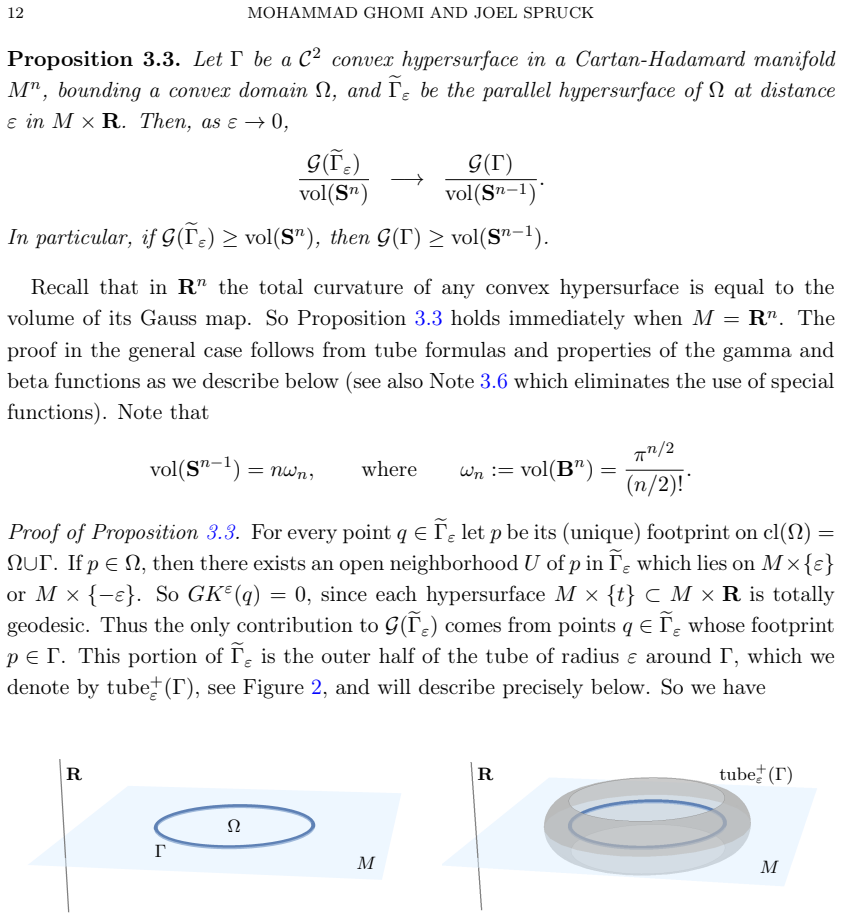
- The total curvature inequality needs only to be checked for $d$-convex hypersurfaces, because Proposition 3.3 and Corollary 3.4 show the convex case can be lifted to a $d$-convex hypersurface in $M \times \mathbb{R}$.
- The comparison formula gives $G(\Gamma) \geq G(\gamma)$ for nested convex hypersurfaces in constant nonpositive curvature and for parallel hypersurfaces in general Cartan-Hadamard manifolds, recovering and extending monotonicity results for total curvature.
- For geodesic spheres in a Cartan-Hadamard manifold with sectional curvature at most $-a \leq 0$, total curvature is bounded below by that of the corresponding hyperbolic sphere, with equality only if the ball is isometric to the hyperbolic one (Corollary 5.5).
- The implication is rigid: equality in the isoperimetric inequality forces the region to be a Euclidean ball, so the Euclidean inequality is the unique extremal case.
Reading between the lines
- The comparison formula is a general-purpose integral identity that could be applied to other curvature integrals, such as higher quermassintegrals, to produce sharp inequalities in nonpositively curved spaces that the paper does not pursue.
- Because Corollary 5.3 already gives monotonicity of total curvature for inward parallel motion before the cut locus, a testable route toward the total curvature problem is to find a smoothing of the distance function that extends this monotonicity past the cut locus; the appendices appear designed for exactly that purpose.
- If the uniform bound (37) is the fragile step, a search for counterexamples to the Cartan-Hadamard conjecture might focus on convex hulls of thin $C^{1,1}$ hypersurfaces where the rolling-ball support is barely present; this is an editorial stress-test suggestion, not a claim of the paper.
Editorial analysis
A structured set of objections, weighed in public.
Referee Report
Summary. The paper develops a comparison formula for the total curvature of level sets of functions on Riemannian manifolds (Theorems 4.7 and 4.9) and applies it to the isoperimetric problem in Cartan-Hadamard manifolds. The main results are: (i) an explicit integral formula expressing the difference of total curvature between two level sets in terms of the Riemann tensor and principal curvatures; (ii) applications of this formula, including monotonicity of total curvature for nested and parallel convex hypersurfaces in hyperbolic space and a sharp lower bound for geodesic spheres; (iii) a proof that the total curvature of the convex hull of a C^{1,1} hypersurface does not exceed the total positive curvature of the hypersurface (Proposition 6.6 and Corollary 6.7); and (iv) Theorem 7.1, which states that if the total curvature inequality (1) holds in a Cartan-Hadamard manifold, then the isoperimetric inequality (2) holds as well, with equality only for Euclidean balls. The paper also contains a number of auxiliary results on the regularity of distance functions, smoothing via inf-convolution, and the cut locus of d-convex hypersurfaces.
Significance. If correct, this is a substantial contribution. The comparison formula is new and quite general, and the applications to hyperbolic geometry and to parallel hypersurfaces are clean. Most importantly, Theorem 7.1 provides a reduction of the Cartan-Hadamard conjecture to the total curvature inequality (Problem 1.1), extending Kleiner's three-dimensional argument to all dimensions; this is a genuine conceptual advance that gives a clear pathway to the conjecture. The proofs are detailed, use no fitted parameters, and include several self-contained developments, such as the regularity and cut-locus lemmas in Appendices A and B, which are of independent interest. The overall structure is coherent and the central implication is plausible, but the proof of Proposition 6.6, which is load-bearing for Theorem 7.1, contains a gap that must be repaired.
major comments (3)
- [§6, Eq. (35)] The change-of-variables formula used in the proof of Proposition 6.6 is not justified and, as written, appears to integrate over the wrong set. The left side is the total curvature of the outer parallel of (X_0\X), while the integral on the right is over (X_0∩X)^ε. The map r_ε is defined by setting p_ν := p^ε_ν and r_ε(p_ν) := p^ε_ν, so the source and target of r_ε are ambiguous; if r_ε is the projection along normal geodesics from X_0^ε to itself, it is the identity map and cannot transform (X_0∩X)^ε into (X_0\X)^ε. Moreover, by Lemma 6.4 normal geodesics emanating from distinct points of X_0 do not intersect, so there is no natural map from (X_0∩X)^ε to (X_0\X)^ε. The equality should presumably be an integral over X_0\X with respect to the area element of X_0 and the Jacobian of the normal exponential map from X_0 to X_0^ε. This step is load-bearing because it underpins the dominated convergence argument that proves G((X_0\X)^ε)→0.
- [§6, Eq. (36)–(37)] The derivation of the uniform bound (37) is not satisfactory as written. The inequality (36) J(p^ε_ν)≤1 is justified by citing the nonexpansiveness of projection onto convex sets [30, Cor. 2.5], but r_ε is not the metric projection onto a convex set; it is a map between parallel hypersurfaces along normal geodesics. In a Cartan-Hadamard manifold the outward normal flow between parallel hypersurfaces can have Jacobian larger than 1 (for example, for geodesic spheres in H^n the radial Jacobian is (sinh(r+ε)/sinh r)^{n-1} > 1 outward). If (36) is not actually needed, it should be removed; if it is used, it must be proved for the specific map r_ε. The subsequent alternative Riccati-equation proof of (37) is a plausible route, but it is compressed and notationally ambiguous: the same symbol ε is used both for the flow parameter and as a fixed endpoint, and it is not clear that the ODE J′=(n−1)HJ and the initial condition J(ε)=1 hold on the entire interval [0,ε]. The statement that GK(ε) is uniformly bounded because a ball of radius ε rolls freely inside X_ε^0 also needs a precise comparison argument with the fixed radius clearly identified. Since the dominated convergence step in Proposition 6.6 depends on (37), this gap must be repaired.
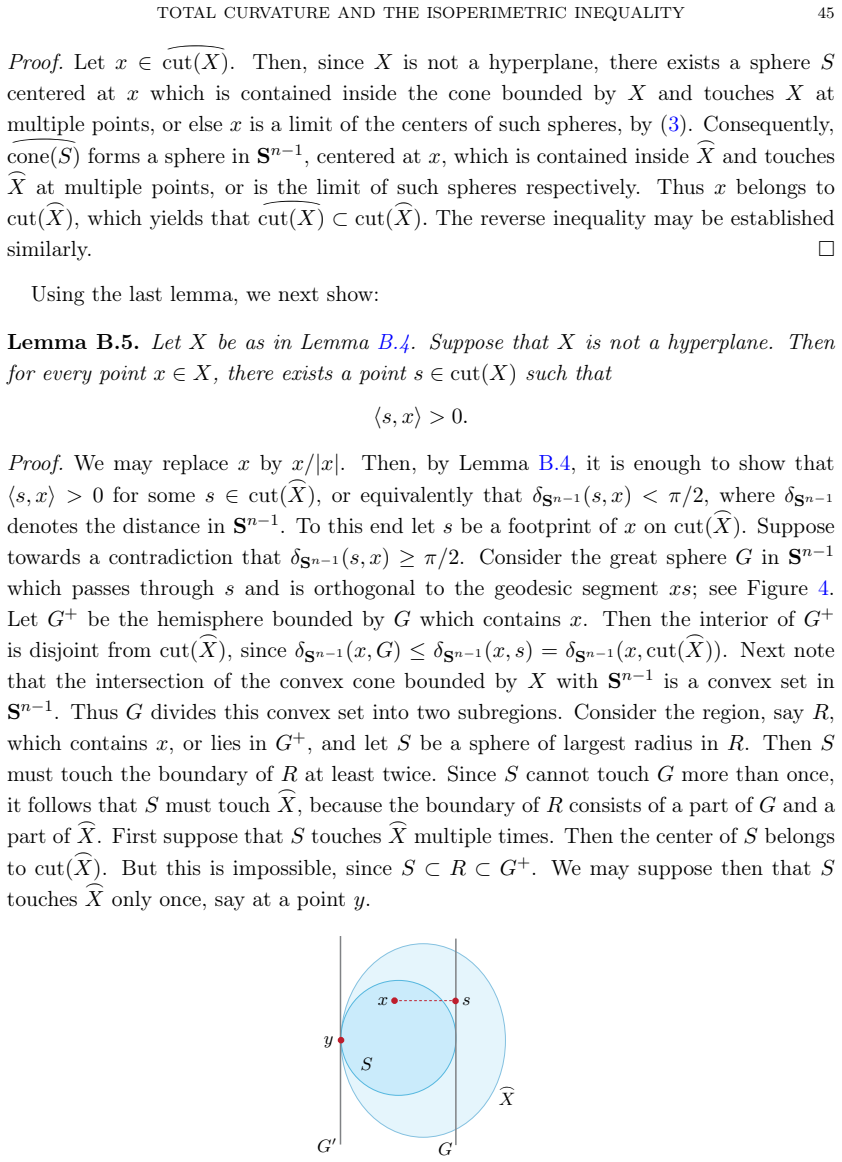
- [§7, equality case in Theorem 7.1] The treatment of the equality case starting after Eq. (49) is highly compressed and needs expansion. In particular, the steps that conclude λ=λ_1, that cut(Γ)=Γ_{λ_1}, and that the cut locus reduces to a single point rely on the finiteness of the (n−2)-Hausdorff measure of the cut locus [94,106] and on the claim that Γ_{λ_1}⊂∂cut(Γ). The passage from R_{ℓnℓn}(λ)=0 for λ<λ to the same identity at λ=λ_1 is not fully justified. Since the equality statement 'only for Euclidean balls' is part of Theorem 7.1, these limiting arguments should be made explicit.
minor comments (4)
- [§4, proof of Theorem 4.9] The limiting passage in the smoothing argument (letting λ→0 and then ε→0, where ε is the parameter in u_ε = u + (ε/2)ρ^2) is not fully detailed; please justify why the boundary terms and the convergence of the integrals are valid in the limit.
- [§3, Proposition 3.3] The notation ~Γ_ε in the statement is not defined until the proof; please define it explicitly in the statement for readability.
- [§6, Lemma 6.5] The lemma states that p^ε is a twice differentiable point of Γ^ε for all ε≥0, but the proof initially says 'for ε sufficiently small' and then argues the estimate can be made independent of p; please clarify the quantifiers and the role of the fixed ε.
- [General] There are numerous typographical errors and minor misprints (e.g., 'hyeprsurfaces' in Corollary 3.4, 'TOT AL CUR V ATURE' in the title, and multiple awkward line breaks in the abstract). A careful proofreading pass is needed.
Circularity Check
No significant circularity: Theorem 7.1 is an explicit conditional whose hypothesis is the total curvature inequality, and the derivation is a genuine chain of independent geometric arguments.
full rationale
The paper's central claim, Theorem 7.1, is explicitly conditional: it assumes the total curvature inequality (1) and derives the isoperimetric inequality (2). Using the stated hypothesis in the proof is not circular, because the conclusion is not assumed and does not appear in the hypothesis. The main new instrument, the comparison formula (Theorems 4.7 and 4.9), is derived from Stokes' theorem, the divergence of the Hessian cofactor, and curvature identities, with no fitted parameters and no definition that secretly encodes the conclusion. The later applications, such as Corollaries 5.2, 5.3, and 5.5, follow from the comparison formula and standard comparison theory. Proposition 6.6 is attributed to Kleiner but is reproved in detail within the paper using Lemmas 6.3 and 6.5, and the subsequent inequality chain in Theorem 7.1 uses only the assumed total curvature inequality plus the prior propositions. The regularity facts cited from [75,135] are external results, and the paper does not invoke a self-citation chain to establish its main premise. The skeptical concern about the uniform bound (37) in Proposition 6.6 is a correctness or rigor issue, not a circularity issue: the bound is asserted and argued, but whether the argument is fully valid does not affect whether the paper derives its conclusion from its hypothesis. Thus no step reduces by construction to its own inputs, and there is no self-citation that carries the load of the central claim.
Assumptions & free parameters
assumptions (5)
- domain assumption Regularity of isoperimetric regions in geodesic balls: Lemma 7.2, including the positive distance between the singular set and the convex hull boundary, is assumed from [75] and [135].
- standard math Federer's characterization of positive reach and the equivalence between reach > 0, C^{1,1} regularity, and C^{1,1} signed distance function (Lemma 2.6) is used throughout.
- domain assumption Greene-Wu smoothing theorem (Proposition 4.8) provides C^infty convex approximations of convex functions.
- domain assumption Viscosity-theory 2-jet approximation (Fleming-Soner, Lemma 6.5) allows construction of C^2 supporting hypersurfaces with matching shape operator at twice-differentiable points of a convex hypersurface.
- standard math Riccati equation for parallel hypersurfaces and tubes in Riemannian manifolds (Gray, [78]) governs the evolution of principal curvatures and Jacobians.
Cite this review
Pith. "Pith review of Total curvature and the isoperimetric inequality in Cartan-Hadamard manifolds." pith.science (2026). https://pith.science/paper/TTIHGG6D
@misc{pith2026190809814,
  author       = {Pith},
  title        = {Pith review of: Total curvature and the isoperimetric inequality in Cartan-Hadamard manifolds},
  year         = {2026},
  howpublished = {\url{https://pith.science/paper/TTIHGG6D}},
  note         = {Machine review of arXiv:1908.09814}
}
read the original abstract
We obtain an explicit formula for comparing total curvature of level sets of functions on Riemannian manifolds, and develop some applications of this result to the isoperimetric problem in spaces of nonpositive curvature.
Figures


Figures from the paper (2 more)

Forward citations
Cited by 1 Pith paper
-
Fundamental tones of clamped plates in nonpositively curved spaces
On negatively curved spaces in dimensions 2 and 3, sufficiently small clamped plates have fundamental tone at least that of a hyperbolic ball of the same volume, yielding a McKean-type spectral gap.
Reference graph
Works this paper leans on
-
[1]
Alexander,Local and global convexity in complete Riemannian manifolds, Pacific J
S. Alexander,Local and global convexity in complete Riemannian manifolds, Pacific J. Math.76 (1978), no. 2, 283–289. MR506131↑27, 28
1978
-
[2]
A. D. Alexandrov,On a class of closed surfaces, Mat. Sbornik4 (1938), 69–77.↑31
1938
-
[3]
Annals [Uchenye Zapiski] Math
, Almost everywhere existence of the second differential of a convex function and some properties of convex surfaces connected with it, Leningrad State Univ. Annals [Uchenye Zapiski] Math. Ser. 6 (1939), 3–35. MR0003051↑27
1939
-
[4]
Andrews, Y
B. Andrews, Y. Hu, and H. Li,Harmonic mean curvature flow and geometric inequalities, Adv. Math. 375 (2020), 107393, 28. MR4170217↑3
2020
-
[5]
G. E. Andrews, R. Askey, and R. Roy,Special functions, Encyclopedia of Mathematics and its Applications, vol. 71, Cambridge University Press, Cambridge, 1999. MR1688958↑13
1999
-
[6]
P. A. Ardoy,Cut and conjugate points of the exponential map, with applications, arXiv preprint arXiv:1411.3933 (2014).↑6
work page Pith review arXiv 2014
-
[7]
Aubin,Problèmes isopérimétriques et espaces de Sobolev, C
T. Aubin,Problèmes isopérimétriques et espaces de Sobolev, C. R. Acad. Sci. Paris Sér. A-B280 (1975), no. 5, Aii, A279–A281. MR0407905↑2, 3
1975
-
[8]
Aubin, O
T. Aubin, O. Druet, and E. Hebey, Best constants in Sobolev inequalities for compact mani- folds of nonpositive curvature, C. R. Acad. Sci. Paris Sér. I Math.326 (1998), no. 9, 1117–1121. MR1647223↑2
1998
Show all 145 references
-
[9]
Azagra and J
D. Azagra and J. Ferrera,Inf-convolution and regularization of convex functions on Riemannian manifolds of nonpositive curvature, Rev. Mat. Complut.19 (2006), no. 2, 323–345. MR2241434 ↑38, 39, 40
2006
-
[10]
, Regularization by sup-inf convolutions on Riemannian manifolds: an extension of Lasry- Lions theorem to manifolds of bounded curvature, J. Math. Anal. Appl.423 (2015), no. 2, 994–
2015
-
[11]
Ballmann, Lectures on spaces of nonpositive curvature, DMV Seminar, vol
W. Ballmann, Lectures on spaces of nonpositive curvature, DMV Seminar, vol. 25, Birkhäuser Verlag, Basel, 1995. With an appendix by Misha Brin. MR1377265↑9, 10
1995
-
[12]
, Riccati equation and volume estimates(2016), available atpeople.mpim-bonn.mpg.de/ hwbllmnn/archiv/Volume160309.pdf.↑11
2016
-
[13]
Ballmann, M
W. Ballmann, M. Gromov, and V. Schroeder,Manifolds of nonpositive curvature, Progress in Mathematics, vol. 61, Birkhäuser Boston, Inc., Boston, MA, 1985. MR823981↑2, 9
1985
-
[14]
Bandle,Isoperimetric inequalities and applications, Monographs and Studies in Mathematics, vol
C. Bandle,Isoperimetric inequalities and applications, Monographs and Studies in Mathematics, vol. 7, Pitman (Advanced Publishing Program), Boston, Mass.-London, 1980. MR572958↑3
1980
-
[15]
, Dido’s problem and its impact on modern mathematics, Notices Amer. Math. Soc. 64 (2017), no. 9, 980–984. MR3699773↑2 50 MOHAMMAD GHOMI AND JOEL SPRUCK
2017
-
[16]
Bangert, Analytische Eigenschaften konvexer Funktionen auf Riemannschen Mannig- faltigkeiten, J
V. Bangert, Analytische Eigenschaften konvexer Funktionen auf Riemannschen Mannig- faltigkeiten, J. Reine Angew. Math.307/308 (1979), 309–324. MR534228↑27
1979
-
[17]
H. H. Bauschke and P. L. Combettes,Convex analysis and monotone operator theory in Hilbert spaces, Second, CMS Books in Mathematics/Ouvrages de Mathématiques de la SMC, Springer, Cham, 2017. With a foreword by Hédy Attouch. MR3616647↑37, 38
2017
-
[18]
Bačák,Convex analysis and optimization in Hadamard spaces, De Gruyter Series in Nonlinear Analysis and Applications, vol
M. Bačák,Convex analysis and optimization in Hadamard spaces, De Gruyter Series in Nonlinear Analysis and Applications, vol. 22, De Gruyter, Berlin, 2014. MR3241330↑9, 38, 39
2014
-
[19]
E. F. Beckenbach and T. Radó,Subharmonic functions and surfaces of negative curvature, Trans. Amer. Math. Soc.35 (1933), no. 3, 662–674. MR1501708↑2
1933
-
[20]
Bérard, G
P. Bérard, G. Besson, and S. Gallot,Sur une inégalité isopérimétrique qui généralise celle de Paul Lévy-Gromov, Invent. Math.80 (1985), no. 2, 295–308. MR788412↑33
1985
-
[21]
Berger,A panoramic view of Riemannian geometry, Springer-Verlag, Berlin, 2003
M. Berger,A panoramic view of Riemannian geometry, Springer-Verlag, Berlin, 2003. MR2002701 ↑2, 3, 33
2003
-
[22]
Bernard,Existence ofC 1,1 critical sub-solutions of the Hamilton-Jacobi equation on compact manifolds, Ann
P. Bernard,Existence ofC 1,1 critical sub-solutions of the Hamilton-Jacobi equation on compact manifolds, Ann. Sci. École Norm. Sup. (4)40 (2007), no. 3, 445–452. MR2493387↑38
2007
-
[23]
R. L. Bishop and B. O’Neill,Manifolds of negative curvature, Trans. Amer. Math. Soc.145 (1969), 1–49. MR0251664↑9, 28
1969
-
[24]
Blå sjö, The isoperimetric problem, Amer
V. Blå sjö, The isoperimetric problem, Amer. Math. Monthly 112 (2005), no. 6, 526–566. MR2142606↑2
2005
-
[25]
Blaschke,Kreis und Kugel, Walter de Gruyter & Co., Berlin, 1956
W. Blaschke,Kreis und Kugel, Walter de Gruyter & Co., Berlin, 1956. 2te Aufl. MR17,1123d↑7
1956
-
[26]
Bol, Isoperimetrische Ungleichungen für Bereiche auf Flächen, Jber
G. Bol, Isoperimetrische Ungleichungen für Bereiche auf Flächen, Jber. Deutsch. Math. Verein. 51 (1941), 219–257. MR0018858↑3
1941
-
[27]
Borbély,On the total curvature of convex hypersurfaces in hyperbolic spaces, Proc
A. Borbély,On the total curvature of convex hypersurfaces in hyperbolic spaces, Proc. Amer. Math. Soc. 130 (2002), no. 3, 849–854. MR1866041↑2, 24
2002
-
[28]
London Math
, Volume estimate via total curvature in hyperbolic spaces, Bull. London Math. Soc. 35 (2003), no. 2, 255–260. MR1952404↑2
2003
-
[29]
A. A. Borisenko and V. Miquel, Total curvatures of convex hypersurfaces in hyperbolic space, Illinois J. Math.43 (1999), no. 1, 61–78. MR1665641↑10
1999
-
[30]
M. R. Bridson and A. Haefliger,Metric spaces of non-positive curvature, Grundlehren der Mathe- matischen Wissenschaften [Fundamental Principles of Mathematical Sciences], vol. 319, Springer- Verlag, Berlin, 1999. MR1744486↑9, 30
1999
-
[31]
J. N. Brooks and J. B. Strantzen,Blaschke’s rolling theorem inRn, Mem. Amer. Math. Soc.80 (1989), no. 405, vi+101. MR974998↑7
1989
-
[32]
Yu. D. Burago and V. A. Zalgaller, Geometricheskie neravenstva, “Nauka” Leningrad. Otdel., Leningrad, 1980. MR602952↑2
1980
-
[33]
285, Springer-Verlag, Berlin, 1988
, Geometric inequalities, Grundlehren der Mathematischen Wissenschaften [Fundamental Principles of Mathematical Sciences], vol. 285, Springer-Verlag, Berlin, 1988. Translated from the 1980 Russian original by A. B. Sosinski˘ ı, Springer Series in Soviet Mathematics. MR936419↑2, 3
1988
-
[34]
Caffarelli, L
L. Caffarelli, L. Nirenberg, and J. Spruck,The Dirichlet problem for nonlinear second-order elliptic equations. III. Functions of the eigenvalues of the Hessian, Acta Math.155 (1985), no. 3-4, 261–
1985
-
[35]
Cannarsa and C
P. Cannarsa and C. Sinestrari,Semiconcave functions, Hamilton-Jacobi equations, and optimal control, Progress in Nonlinear Differential Equations and their Applications, vol. 58, Birkhäuser Boston, Inc., Boston, MA, 2004. MR2041617↑4, 8, 27, 38, 40, 41
2004
-
[36]
Cao and J
J. Cao and J. F. Escobar,A new 3-dimensional curvature integral formula for PL-manifolds of non-positive curvature, Comm. Anal. Geom.11 (2003), no. 3, 489–551. MR2015755↑2, 24
2003
-
[37]
T. E. Cecil and S.-s. Chern (eds.), Tight and taut submanifolds, Mathematical Sciences Re- search Institute Publications, vol. 32, Cambridge University Press, Cambridge, 1997. MR1486867 (98f:53001)↑32
1997
-
[38]
Chavel,Eigenvalues in Riemannian geometry, Pure and Applied Mathematics, vol
I. Chavel,Eigenvalues in Riemannian geometry, Pure and Applied Mathematics, vol. 115, Aca- demic Press, Inc., Orlando, FL, 1984. Including a chapter by Burton Randol, With an appendix by Jozef Dodziuk. MR768584↑3 TOTAL CUR V ATURE AND THE ISOPERIMETRIC INEQUALITY 51
1984
-
[39]
145, Cambridge Uni- versity Press, Cambridge, 2001
, Isoperimetric inequalities, Cambridge Tracts in Mathematics, vol. 145, Cambridge Uni- versity Press, Cambridge, 2001. Differential geometric and analytic perspectives. MR1849187↑2, 3, 33
2001
-
[40]
Chazal and R
F. Chazal and R. Soufflet,Stability and finiteness properties of medial axis and skeleton, J. Dynam. Control Systems 10 (2004), no. 2, 149–170. MR2051964↑6
2004
-
[41]
Cheeger and D
J. Cheeger and D. Gromoll,On the structure of complete manifolds of nonnegative curvature, Ann. of Math. (2)96 (1972), 413–443. MR0309010↑27
1972
-
[42]
Chen and L
B.-Y. Chen and L. Vanhecke,Differential geometry of geodesic spheres, J. Reine Angew. Math. 325 (1981), 28–67. MR618545↑23
1981
-
[43]
Chern and R
S.-s. Chern and R. K. Lashof,On the total curvature of immersed manifolds, Amer. J. Math.79 (1957), 306–318. MR0084811↑32
1957
-
[44]
II, Michigan Math
, On the total curvature of immersed manifolds. II, Michigan Math. J. 5 (1958), 5–12. MR0097834↑32
1958
-
[45]
J. Choe, M. Ghomi, and M. Ritoré,Total positive curvature of hypersurfaces with convex boundary, J. Differential Geom.72 (2006), no. 1, 129–147. MR2215458 (2007a:53076)↑31
2006
-
[46]
, The relative isoperimetric inequality outside convex domains inRn, Calc. Var. Partial Differential Equations29 (2007), no. 4, 421–429. MR2329803↑31
2007
-
[47]
Choe and M
J. Choe and M. Ritoré,The relative isoperimetric inequality in Cartan-Hadamard 3-manifolds, J. Reine Angew. Math.605 (2007), 179–191. MR2338131↑34
2007
-
[48]
Chung, A
F. Chung, A. Grigor′yan, and S.-T. Yau, Higher eigenvalues and isoperimetric inequalities on Riemannian manifolds and graphs, Comm. Anal. Geom.8 (2000), no. 5, 969–1026. MR1846124 ↑3
2000
-
[49]
F. H. Clarke, R. J. Stern, and P. R. Wolenski,Proximal smoothness and the lower-C 2 property, J. Convex Anal. 2 (1995), no. 1-2, 117–144. MR1363364↑8
1995
-
[50]
C. B. Croke,A sharp four-dimensional isoperimetric inequality, Comment. Math. Helv.59 (1984), no. 2, 187–192. MR749103↑2
1984
-
[51]
R. J. Currier,On hypersurfaces of hyperbolic space infinitesimally supported by horospheres, Trans. Amer. Math. Soc.313 (1989), no. 1, 419–431. MR935532↑10
1989
-
[52]
Damon, The global medial structure of regions inR3, Geom
J. Damon, The global medial structure of regions inR3, Geom. Topol. 10 (2006), 2385–2429. MR2284061 (2007j:53006)↑6
2006
-
[53]
B. V. Dekster,Monotonicity of integral Gauss curvature, J. Differential Geom.16 (1981), no. 2, 281–291. MR638793↑2, 24
1981
-
[54]
,Inequalities of Gauss-Bonnet type for a convex domain, Proc. Amer. Math. Soc.86(1982), no. 4, 632–637. MR674095↑2
1982
-
[55]
M. C. Delfour and J.-P. Zolésio,Shapes and geometries, Second, Advances in Design and Control, vol. 22, Society for Industrial and Applied Mathematics (SIAM), Philadelphia, PA, 2011. Metrics, analysis, differential calculus, and optimization. MR2731611↑8, 9
2011
-
[56]
M. P. do Carmo,Riemannian geometry, Mathematics: Theory & Applications, Birkhäuser Boston Inc., Boston, MA, 1992. Translated from the second Portuguese edition by Francis Flaherty. MR1138207 (92i:53001)↑25
1992
-
[57]
Druet,Sharp local isoperimetric inequalities involving the scalar curvature, Proc
O. Druet,Sharp local isoperimetric inequalities involving the scalar curvature, Proc. Amer. Math. Soc. 130 (2002), no. 8, 2351–2361. MR1897460↑2
2002
-
[58]
semanticscholar.org/ad32/0bbe353be1d5ae528c58012afd9788e59a67.pdf.↑2, 3
, Isoperimetric inequalities on nonpositively curved spaces (2010), available at pdfs. semanticscholar.org/ad32/0bbe353be1d5ae528c58012afd9788e59a67.pdf.↑2, 3
2010
-
[59]
Druet and E
O. Druet and E. Hebey,The AB program in geometric analysis: sharp Sobolev inequalities and related problems, Mem. Amer. Math. Soc.160 (2002), no. 761, viii+98. MR1938183↑2, 3
2002
-
[60]
Dugundji,Topology, Allyn and Bacon, Inc., Boston, Mass., 1966
J. Dugundji,Topology, Allyn and Bacon, Inc., Boston, Mass., 1966. MR0193606↑4
1966
-
[61]
MR3409135↑27
L.C.EvansandR.F.Gariepy, Measure theory and fine properties of functions,Revised,Textbooks in Mathematics, CRC Press, Boca Raton, FL, 2015. MR3409135↑27
2015
-
[62]
G. Faber,Beweis, dass unter allen homogenen membranen von gleicher fläche und gleicher span- nung die kreisförmige den tiefsten grundton gibt,Sitzungsber.Bayer.Akad.Wiss.München,Math.- Phys. Kl (1923), 169–172.↑3 52 MOHAMMAD GHOMI AND JOEL SPRUCK
1923
-
[63]
Fathi, Regularity of C 1 solutions of the Hamilton-Jacobi equation, Ann
A. Fathi, Regularity of C 1 solutions of the Hamilton-Jacobi equation, Ann. Fac. Sci. Toulouse Math. (6) 12 (2003), no. 4, 479–516. MR2060597↑38, 40
2003
-
[64]
Federer,Curvature measures, Trans
H. Federer,Curvature measures, Trans. Amer. Math. Soc.93 (1959), 418–491. MR0110078 (22 #961)↑6, 8
1959
-
[65]
MR0257325↑34
, Geometric measure theory, Die Grundlehren der mathematischen Wissenschaften, Band 153, Springer-Verlag New York Inc., New York, 1969. MR0257325↑34
1969
-
[66]
Federer and W
H. Federer and W. H. Fleming,Normal and integral currents, Ann. of Math. (2)72 (1960), 458–
1960
-
[67]
W. H. Fleming and H. M. Soner,Controlled Markov processes and viscosity solutions, Second, Stochastic Modelling and Applied Probability, vol. 25, Springer, New York, 2006. MR2179357 ↑28, 29
2006
-
[68]
P. T. Fletcher, J. Moeller, J. M. Phillips, and S. Venkatasubramanian,Horoball hulls and extents in positive definite space, Algorithms and data structures, 2011, pp. 386–398. MR2863152↑10
2011
-
[69]
R. L. Foote,Regularity of the distance function, Proc. Amer. Math. Soc.92 (1984), no. 1, 153–155. MR749908↑6, 13
1984
-
[70]
J. H. G. Fu,An extension of Alexandrov’s theorem on second derivatives of convex functions, Adv. Math. 228 (2011), no. 4, 2258–2267. MR2836120↑27
2011
-
[71]
Ge and Z
J. Ge and Z. Tang,Geometry of isoparametric hypersurfaces in Riemannian manifolds, Asian J. Math. 18 (2014), no. 1, 117–125. MR3215342↑11, 13
2014
-
[72]
Ghomi, Strictly convex submanifolds and hypersurfaces of positive curvature, J
M. Ghomi, Strictly convex submanifolds and hypersurfaces of positive curvature, J. Differential Geom. 57 (2001), no. 2, 239–271. MR1879227↑6
2001
-
[73]
Ghomi and R
M. Ghomi and R. Howard,Tangent cones and regularity of real hypersurfaces, J. Reine Angew. Math. 697 (2014), 221–247. MR3281655↑7, 43, 44
2014
-
[74]
Giusti, Minimal surfaces and functions of bounded variation, Monographs in Mathematics, vol
E. Giusti, Minimal surfaces and functions of bounded variation, Monographs in Mathematics, vol. 80, Birkhäuser Verlag, Basel, 1984. MR775682↑33
1984
-
[75]
Gonzalez, U
E. Gonzalez, U. Massari, and I. Tamanini,On the regularity of boundaries of sets minimizing perimeter with a volume constraint, Indiana Univ. Math. J.32 (1983), no. 1, 25–37. MR684753 ↑33
1983
-
[76]
Gonzalez, U
E. Gonzalez, U. Massari, and I. Tamanini, Minimal boundaries enclosing a given volume , Manuscripta Math. 34 (1981), no. 2-3, 381–395. MR620458↑33
1981
-
[77]
Gray,The volume of a small geodesic ball of a Riemannian manifold, Michigan Math
A. Gray,The volume of a small geodesic ball of a Riemannian manifold, Michigan Math. J.20 (1973), 329–344 (1974). MR0339002↑23
1973
-
[78]
221, Birkhäuser Verlag, Basel, 2004
, Tubes, Second, Progress in Mathematics, vol. 221, Birkhäuser Verlag, Basel, 2004. With a preface by Vicente Miquel. MR2024928↑11, 13, 14, 29, 31, 36
2004
-
[79]
R. E. Greene and H. Wu,On the subharmonicity and plurisubharmonicity of geodesically convex functions, Indiana Univ. Math. J.22 (1972/73), 641–653. MR0422686↑21
1972
-
[80]
, Integrals of subharmonic functions on manifolds of nonnegative curvature, Invent. Math. 27 (1974), 265–298. MR0382723↑21
1974
-
[81]
3-4, 209–245
,C∞ convex functions and manifolds of positive curvature, Acta Math.137 (1976), no. 3-4, 209–245. MR0458336↑21
1976
-
[82]
Gromov,Structures métriques pour les variétés riemanniennes, Textes Mathématiques [Math- ematical Texts], vol
M. Gromov,Structures métriques pour les variétés riemanniennes, Textes Mathématiques [Math- ematical Texts], vol. 1, CEDIC, Paris, 1981. Edited by J. Lafontaine and P. Pansu. MR682063 ↑2
1981
-
[83]
, Sign and geometric meaning of curvature, Rend. Sem. Mat. Fis. Milano61 (1991), 9–123 (1994). MR1297501↑9
1991
-
[84]
MR2000d:53065↑2, 3
, Metric structures for Riemannian and non-Riemannian spaces, Birkhäuser Boston Inc., Boston, MA, 1999. MR2000d:53065↑2, 3
1999
-
[85]
Harvey and H B
F R. Harvey and H B. Lawson Jr,Notes on the differentiation of quasi-convex functions, arXiv preprint arXiv:1309.1772 (2013).↑27
2013 arXiv
-
[86]
Hass,Isoperimetric regions in nonpositively curved manifolds, arXiv preprint arXiv:1604.02768 (2016).↑2 TOTAL CUR V ATURE AND THE ISOPERIMETRIC INEQUALITY 53
J. Hass,Isoperimetric regions in nonpositively curved manifolds, arXiv preprint arXiv:1604.02768 (2016).↑2 TOTAL CUR V ATURE AND THE ISOPERIMETRIC INEQUALITY 53
2016 arXiv
-
[87]
Hebey and F
E. Hebey and F. Robert,Sobolev spaces on manifolds, Handbook of global analysis, 2008, pp. 375– 415, 1213. MR2389638↑2
2008
-
[88]
Heintze and H.-C
E. Heintze and H.-C. Im Hof,Geometry of horospheres, J. Differential Geom.12 (1977), no. 4, 481–491 (1978). MR512919↑10
1977
-
[89]
Henrot, Extremum problems for eigenvalues of elliptic operators, Frontiers in Mathematics, Birkhäuser Verlag, Basel, 2006
A. Henrot, Extremum problems for eigenvalues of elliptic operators, Frontiers in Mathematics, Birkhäuser Verlag, Basel, 2006. MR2251558↑3
2006
-
[90]
Hoffman and J
D. Hoffman and J. Spruck,Sobolev and isoperimetric inequalities for Riemannian submanifolds, Comm. Pure Appl. Math.27 (1974), 715–727. MR0365424↑3
1974
-
[91]
Howard,Blaschke’s rolling theorem for manifolds with boundary, Manuscripta Math.99 (1999), no
R. Howard,Blaschke’s rolling theorem for manifolds with boundary, Manuscripta Math.99 (1999), no. 4, 471–483. MR1713810↑35
1999
-
[92]
Howards, M
H. Howards, M. Hutchings, and F. Morgan,The isoperimetric problem on surfaces, Amer. Math. Monthly 106 (1999), no. 5, 430–439. MR1699261↑2
1999
-
[93]
Hsiang, On soap bubbles and isoperimetric regions in noncompact symmetric spaces
W.-Y. Hsiang, On soap bubbles and isoperimetric regions in noncompact symmetric spaces. I, Tohoku Math. J. (2)44 (1992), no. 2, 151–175. MR1161609↑34
1992
-
[94]
Itoh and M
J.-i. Itoh and M. Tanaka,The Lipschitz continuity of the distance function to the cut locus, Trans. Amer. Math. Soc.353 (2001), no. 1, 21–40. MR1695025↑37
2001
-
[95]
Izumiya,Horospherical geometry in the hyperbolic space, Noncommutativity and singularities, 2009, pp
S. Izumiya,Horospherical geometry in the hyperbolic space, Noncommutativity and singularities, 2009, pp. 31–49. MR2463489↑10
2009
-
[96]
Jost, Riemannian geometry and geometric analysis, Seventh, Universitext, Springer, Cham,
J. Jost, Riemannian geometry and geometric analysis, Seventh, Universitext, Springer, Cham,
-
[97]
Kapovitch and A
V. Kapovitch and A. Lytchak, Remarks on manifolds with two sided curvature bounds, arXiv preprint arXiv:2101.03050 (2021).↑43
2021 arXiv
-
[98]
Karcher, Schnittort und konvexe Mengen in vollständigen Riemannschen Mannigfaltigkeiten, Math
H. Karcher, Schnittort und konvexe Mengen in vollständigen Riemannschen Mannigfaltigkeiten, Math. Ann. 177 (1968), 105–121. MR0226542↑27, 28
1968
-
[99]
, Riemannian comparison constructions, Global differential geometry, 1989, pp. 170–222. MR1013810↑9, 11, 25
1989
-
[100]
Kleiner, An isoperimetric comparison theorem, Invent
B. Kleiner, An isoperimetric comparison theorem, Invent. Math. 108 (1992), no. 1, 37–47. MR1156385↑2, 3, 26, 30, 31, 33
1992
-
[101]
Kloeckner and G
B. Kloeckner and G. Kuperberg, The cartan-hadamard conjecture and the little prince, arXiv preprint arXiv:1303.3115v3 (2017).↑2, 3
2017 arXiv
-
[102]
Krahn, Über eine von Rayleigh formulierte Minimaleigenschaft des Kreises, Math
E. Krahn, Über eine von Rayleigh formulierte Minimaleigenschaft des Kreises, Math. Ann. 94 (1925), no. 1, 97–100. MR1512244↑3
1925
-
[103]
, Über minimaleigenschaften der kugel in drei und mehr dimensionen, Acta Comm. Univ. Dorpat. A9 (1926), 1–44.↑3
1926
-
[104]
Kristály,Sharp Morrey-Sobolev inequalities on complete Riemannian manifolds, Potential Anal
A. Kristály,Sharp Morrey-Sobolev inequalities on complete Riemannian manifolds, Potential Anal. 42 (2015), no. 1, 141–154. MR3297990↑3
2015
-
[105]
, New geometric aspects of Moser-Trudinger inequalities on Riemannian manifolds: the non-compact case, J. Funct. Anal.276 (2019), no. 8, 2359–2396. MR3926120↑2, 3
2019
-
[106]
Li and L
Y. Li and L. Nirenberg,The distance function to the boundary, Finsler geometry, and the singular set of viscosity solutions of some Hamilton-Jacobi equations, Comm. Pure Appl. Math.58 (2005), no. 1, 85–146. MR2094267↑6, 37
2005
-
[107]
Lurie,Lecture notes on hadamard spaces, available atwww.math.harvard.edu/~lurie/papers/ hadamard.pdf.↑9
J. Lurie,Lecture notes on hadamard spaces, available atwww.math.harvard.edu/~lurie/papers/ hadamard.pdf.↑9
-
[108]
Maggi,Sets of finite perimeter and geometric variational problems, Cambridge Studies in Ad- vanced Mathematics, vol
F. Maggi,Sets of finite perimeter and geometric variational problems, Cambridge Studies in Ad- vanced Mathematics, vol. 135, Cambridge University Press, Cambridge, 2012. An introduction to geometric measure theory. MR2976521↑35
2012
-
[109]
Mahmoudi, R
F. Mahmoudi, R. Mazzeo, and F. Pacard,Constant mean curvature hypersurfaces condensing on a submanifold, Geom. Funct. Anal.16 (2006), no. 4, 924–958. MR2255386↑11
2006
-
[110]
Mantegazza and A
C. Mantegazza and A. C. Mennucci,Hamilton-Jacobi equations and distance functions on Rie- mannian manifolds, Appl. Math. Optim.47 (2003), no. 1, 1–25. MR1941909↑4, 6, 8
2003
-
[111]
J. N. Mather,Distance from a submanifold in Euclidean space, Singularities, Part 2 (Arcata, Calif., 1981), 1983, pp. 199–216. MR713249 (85b:58021)↑6 54 MOHAMMAD GHOMI AND JOEL SPRUCK
1981
-
[112]
V. D. Milman and G. Schechtman,Asymptotic theory of finite-dimensional normed spaces, Lecture Notes in Mathematics, vol. 1200, Springer-Verlag, Berlin, 1986. With an appendix by M. Gromov. MR856576↑3
1986
-
[113]
Morgan, Regularity of isoperimetric hypersurfaces in Riemannian manifolds, Trans
F. Morgan, Regularity of isoperimetric hypersurfaces in Riemannian manifolds, Trans. Amer. Math. Soc. 355 (2003), no. 12, 5041–5052. MR1997594↑33, 34
2003
-
[114]
Morgan and D
F. Morgan and D. L. Johnson,Some sharp isoperimetric theorems for Riemannian manifolds, Indiana Univ. Math. J.49 (2000), no. 3, 1017–1041. MR1803220↑2, 3
2000
-
[115]
Nardulli and L
S. Nardulli and L. E. Osorio Acevedo,Sharp Isoperimetric Inequalities for Small Volumes in Com- plete Noncompact Riemannian Manifolds of Bounded Geometry Involving the Scalar Curvature, International Mathematics Research Notices (201806), available athttp://oup.prod.sis.lan/ i...
-
[116]
Nirenberg,Rigidity of a class of closed surfaces, Nonlinear problems (proc
L. Nirenberg,Rigidity of a class of closed surfaces, Nonlinear problems (proc. sympos., madison, wis., 1962), 1963, pp. 177–193. MR0150705 (27 #697)↑31
1962
-
[117]
Osserman,The isoperimetric inequality, Bull
R. Osserman,The isoperimetric inequality, Bull. Amer. Math. Soc.84 (1978), no. 6, 1182–1238. MR500557↑2, 3
1978
-
[118]
L. E. Payne, Isoperimetric inequalities and their applications, SIAM Rev. 9 (1967), 453–488. MR0218975↑3
1967
-
[119]
Pólya and G
G. Pólya and G. Szegö,Isoperimetric Inequalities in Mathematical Physics, Annals of Mathematics Studies, no. 27, Princeton University Press, Princeton, N. J., 1951. MR0043486↑3
1951
-
[120]
J. W. S. Rayleigh Baron,The Theory of Sound, Dover Publications, New York, N. Y., 1945. 2d ed. MR0016009↑3
1945
-
[121]
R. C. Reilly,On the Hessian of a function and the curvatures of its graph, Michigan Math. J.20 (1973), 373–383. MR0334045↑14
1973
-
[122]
, Applications of the Hessian operator in a Riemannian manifold, Indiana Univ. Math. J. 26 (1977), no. 3, 459–472. MR0474149↑14
1977
-
[123]
Ritoré,Continuity of the isoperimetric profile of a complete Riemannian manifold under sec- tional curvature conditions, Rev
M. Ritoré,Continuity of the isoperimetric profile of a complete Riemannian manifold under sec- tional curvature conditions, Rev. Mat. Iberoam.33 (2017), no. 1, 239–250. MR3615450↑34
2017
-
[124]
Ritoré and C
M. Ritoré and C. Sinestrari,Mean curvature flow and isoperimetric inequalities, Advanced Courses in Mathematics. CRM Barcelona, Birkhäuser Verlag, Basel, 2010. Edited by Vicente Miquel and Joan Porti. MR2590630↑2, 33
2010
-
[125]
R. T. Rockafellar and R. J.-B. Wets,Variational analysis, Grundlehren der Mathematischen Wis- senschaften [Fundamental Principles of Mathematical Sciences], vol. 317, Springer-Verlag, Berlin,
-
[126]
Ros, The isoperimetric problem, Global theory of minimal surfaces, 2005, pp
A. Ros, The isoperimetric problem, Global theory of minimal surfaces, 2005, pp. 175–209. MR2167260↑33
2005
-
[127]
Sakai,Riemannian geometry, Translations of Mathematical Monographs, vol
T. Sakai,Riemannian geometry, Translations of Mathematical Monographs, vol. 149, American Mathematical Society, Providence, RI, 1996. Translated from the 1992 Japanese original by the author. MR1390760↑9, 32
1996
-
[128]
Schneider,Convex bodies: the Brunn-Minkowski theory, expanded, Encyclopedia of Mathemat- ics and its Applications, vol
R. Schneider,Convex bodies: the Brunn-Minkowski theory, expanded, Encyclopedia of Mathemat- ics and its Applications, vol. 151, Cambridge University Press, Cambridge, 2014. MR3155183↑23, 27, 37, 41
2014
-
[129]
, Curvatures of typical convex bodies—the complete picture, Proc. Amer. Math. Soc.143 (2015), no. 1, 387–393. MR3272763↑28
2015
-
[130]
Schroeder and M
V. Schroeder and M. Strake,Local rigidity of symmetric spaces of nonpositive curvature, Proc. Amer. Math. Soc.106 (1989), no. 2, 481–487. MR929404↑2, 24
1989
-
[131]
Schulze,Nonlinear evolution by mean curvature and isoperimetric inequalities, J
F. Schulze,Nonlinear evolution by mean curvature and isoperimetric inequalities, J. Differential Geom. 79 (2008), no. 2, 197–241. MR2420018↑2
2008
-
[132]
, Optimal isoperimetric inequalities for surfaces in any codimension in cartan-hadamard manifolds, arXiv preprint arXiv:1802.00226 (2018).↑2
2018 arXiv
-
[133]
Shiga, Hadamard manifolds, Geometry of geodesics and related topics (Tokyo, 1982), 1984, pp
K. Shiga, Hadamard manifolds, Geometry of geodesics and related topics (Tokyo, 1982), 1984, pp. 239–281. MR758657↑9 TOTAL CUR V ATURE AND THE ISOPERIMETRIC INEQUALITY 55
1982
-
[134]
Simon, Lectures on geometric measure theory, Proceedings of the Centre for Mathematical Analysis, Australian National University, vol
L. Simon, Lectures on geometric measure theory, Proceedings of the Centre for Mathematical Analysis, Australian National University, vol. 3, Australian National University, Centre for Math- ematical Analysis, Canberra, 1983. MR756417↑34
1983
-
[135]
Stredulinsky and W
E. Stredulinsky and W. P. Ziemer,Area minimizing sets subject to a volume constraint in a convex set, J. Geom. Anal.7 (1997), no. 4, 653–677. MR1669207↑33
1997
-
[136]
Thäle, 50 years sets with positive reach—a survey, Surv
C. Thäle, 50 years sets with positive reach—a survey, Surv. Math. Appl. 3 (2008), 123–165. MR2443192 (2009m:28017)↑6
2008
-
[137]
Treibergs,Inequalities that imply the isoperimetric inequality(2002), available at www.math
A. Treibergs,Inequalities that imply the isoperimetric inequality(2002), available at www.math. utah.edu/~treiberg/isoperim/isop.pdf.↑3
2002
-
[138]
N. S. Trudinger, Isoperimetric inequalities for quermassintegrals, Ann. Inst. H. Poincaré Anal. Non Linéaire 11 (1994), no. 4, 411–425. MR1287239↑23
1994
-
[139]
Udrişte,Convex functions and optimization methods on Riemannian manifolds, Mathematics and its Applications, vol
C. Udrişte,Convex functions and optimization methods on Riemannian manifolds, Mathematics and its Applications, vol. 297, Kluwer Academic Publishers Group, Dordrecht, 1994. MR1326607 ↑9
1994
-
[140]
F. W. Warner,Extensions of the Rauch comparison theorem to submanifolds, Trans. Amer. Math. Soc. 122 (1966), 341–356. MR200873↑28, 29
1966
-
[141]
Weil,Sur les surfaces a courbure negative, CR Acad
A. Weil,Sur les surfaces a courbure negative, CR Acad. Sci. Paris182 (1926), no. 2, 1069–71.↑2
1926
-
[142]
T. J. Willmore and B. A. Saleemi,The total absolute curvature of immersed manifolds, J. London Math. Soc. 41 (1966), 153–160. MR185553↑2
1966
-
[143]
Xu, Harmonic mean curvature flow in riemannian manifolds and ricci flow on noncompact manifolds., Ph.D
G. Xu, Harmonic mean curvature flow in riemannian manifolds and ricci flow on noncompact manifolds., Ph.D. Thesis, 2010.↑3
2010
-
[144]
S. T. Yau,Isoperimetric constants and the first eigenvalue of a compact Riemannian manifold, Ann. Sci. École Norm. Sup. (4)8 (1975), no. 4, 487–507. MR0397619↑3 School of Mathematics, Georgia Institute of Technology, Atlanta, GA 30332 Email address: ghomi@math.gatech.edu URL: w...
1975
-
[1024]
MR3278185↑38, 40, 41
Reviewed August 14, 2026 · model on record in the stance chip above.
Discussion (0). Continue with ORCID to comment.