REVIEW 1 major objections 5 minor 58 references
Singular continuous Cantor spectrum for magnetic quantum walks
T0 review · 1 major / 5 minor · reviewed 2026-08-14 · deepseek-v4-flash
Pith's one-line read For irrational magnetic flux, the two-dimensional Hadamard quantum walk has purely singular continuous Cantor spectrum, with no eigenvalues for any flux.
desk verdict Strong new result on magnetic quantum walk spectrum; the Cantor spectrum via rotation algebra is clean, but the no-point-spectrum proof has a patchable gap in the finite-volume argument. read the letter →
The pith
A machine-rendered reading of the paper's core claim, the machinery that carries it, and where it could break.
The reading
What carries the argument
The central object is the element $w_\Phi\in M_2(A_\Phi)$: the matrix rotation algebra $A_\Phi$ is generated by two unitaries $u,v$ with $uv=e^{-i\Phi}vu$, and $w_\Phi$ encodes the magnetic walk before choosing a representation. For irrational $\Phi/(2\pi)$, $A_\Phi$ is simple, so all representations are faithful and spectrum-preserving; one representation sends $w_\Phi$ to the two-dimensional walk $W_\Phi$ on $\ell^2(\mathbb{Z}^2)\otimes\mathbb{C}^2$, another to the one-dimensional unitary critical almost-Mathieu operator, which transfers the Cantor result. For the eigenvalue half, the load-bearing mechanism is the identity $N(\theta)=k(\theta)$ between the spectral distribution function and the integrated density of states, combined with finite-volume restrictions $W_L$ built by inserting off-diagonal coins on a boundary layer; this makes each interior solution determined by boundary values, giving $\dim\ker(W_L-e^{i\theta})=O(L)$ and hence continuity of $k$ by the Delyon–Souillard argument.
What would settle it
Look for a quasi-energy $\theta$ and a sequence of boxes $\Lambda_L$ for which $\dim\ker(W_L-e^{i\theta})$ grows like $|\Lambda_L|$ rather than $O(L)$; equivalently, detect a jump in the spectral distribution function $N(\theta)$, since Theorem IV.4 identifies $N$ with a continuous integrated density of states.
Extended reading notes
Core claim
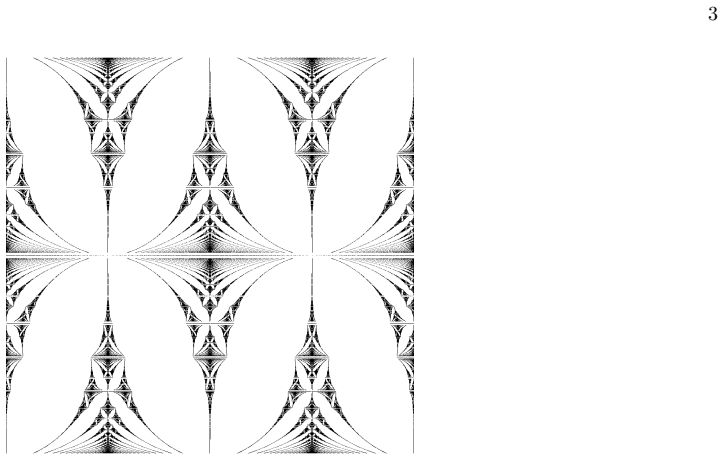
The central claim is Theorem II.3: for $\Phi/(2\pi)$ irrational, $\sigma(W_\Phi)$ is a closed, perfect, nowhere dense subset of the unit circle with zero arc-length measure, and $\sigma_{\mathrm{pp}}(W_\Phi)=\emptyset$ for every flux. Consequently, for irrational flux the spectrum is purely singular continuous. To prove the Cantor part, the authors exhibit $W_\Phi$ and the one-dimensional unitary critical almost-Mathieu operator as images of one element $w_\Phi\in M_2(A_\Phi)$ under two representations of the irrational rotation algebra; since $A_\Phi$ is simple for irrational rotations, both representations preserve spectra. To prove the absence of point spectrum, they show that the spectral distribution function $N(\theta)=\tau_2(E_\theta)$ equals the integrated density of states $k(\theta)$, whose continuity follows from a Delyon–Souillard argument adapted to unitary walks by decoupling finite boxes with off-diagonal coins; inside a box, generalized eigenfunctions are determined by $O(L)$ boundary values, so eigenvalue multiplicities are $o(|\Lambda|)$.
Load-bearing premise
The proof that there is no point spectrum relies on finite-volume eigenfunctions of the decoupled walk being uniquely determined by their values on a boundary set of size $O(L)$; this determinism breaks down if the coins are purely diagonal or purely off-diagonal, because then some spin components cannot be recovered recursively.
Editorial extensions
If this is right
- For irrational flux, the magnetic walk has purely singular continuous spectrum: zero Lebesgue measure rules out absolutely continuous components, and the empty pure point spectrum rules out eigenvalues.
- The spectrum is a zero-measure Cantor set, so the quasi-energy band structure is a fractal with no isolated levels, matching the butterfly picture familiar from rational flux approximations.
- Because $W_\Phi$ and the one-dimensional unitary critical almost-Mathieu operator share the same element of the rotation algebra, every spectral feature proved for one model transfers to the other for irrational flux.
- By the RAGE theorem in the unitary setting, singular continuous spectrum implies that no initial state is localized, so the quasi-periodic magnetic field does not produce Anderson localization.
- The no-point-spectrum conclusion is stable under changing the coins as long as they are neither purely diagonal nor purely off-diagonal; only the Cantor part is specific to the Hadamard coin.
Reading between the lines
- The simplicity argument suggests that Cantor spectrum should persist for other position-independent SU(2) coins, since only faithfulness of the rotation-algebra representation is used; the Hadamard restriction in the proof looks like a convenience rather than a necessity.
- The identity $N(\theta)=k(\theta)$ opens a route to quantitative spectral statements: one-dimensional transfer-matrix estimates for the critical almost-Mathieu operator might imply Hölder continuity of the density of states for the magnetic walk.
- A direct numerical check of the finite-volume multiplicity bound $\dim\ker(W_L-e^{i\theta})=O(L)$ for large $L$ would test the argument; a faster growth would indicate that the Delyon–Souillard step is not capturing the true spectral measure.
Signed reviews
Editorial analysis
A structured set of objections, weighed in public.
Referee Report
Summary. The paper studies the two-dimensional magnetic quantum walk W_Phi defined in (6), obtained by minimally coupling the Hadamard walk to a homogeneous magnetic flux Phi. The main result (Theorem II.3) states that for irrational Phi/(2pi) the spectrum is a zero-measure Cantor set (part 1) and that for all Phi the pure point spectrum is empty (part 2); hence for irrational flux the spectrum is purely singular continuous (Corollary II.4). Part 1 is proved by identifying W_Phi and the one-dimensional unitary critical almost-Mathieu operator as images of the same element of the rotation algebra under two representations, whose spectra coincide by simplicity of the irrational rotation algebra. Part 2 is approached by comparing the spectral distribution function of W_Phi with the integrated density of states of finite-volume truncations; the latter is shown continuous by a Delyon-Souillard-type argument, and equality of the two functions is shown by Fourier transform.
Significance. If the result holds, it is a valuable contribution to the spectral theory of quantum walks: it establishes a sharp rational/irrational flux dichotomy and identifies the irrational-flux spectrum as purely singular continuous, which is physically meaningful because it excludes both localization and absolutely continuous transport. The proof strategy is elegant and mostly transparent: the Cantor-spectrum part is a parameter-free algebraic argument using simplicity of the rotation algebra and the cited theorem [36], while the no-point-spectrum part introduces a comparison between the spectral distribution function and the density of states, adapting the Delyon-Souillard mechanism to unitary operators. The paper is honest about the restriction to Hadamard coins for the Cantor part and notes the greater generality of the no-point-spectrum argument. However, one load-bearing step in the proof of Theorem II.3(2) is incomplete as written, so the manuscript requires revision before it is fully rigorous.
major comments (1)
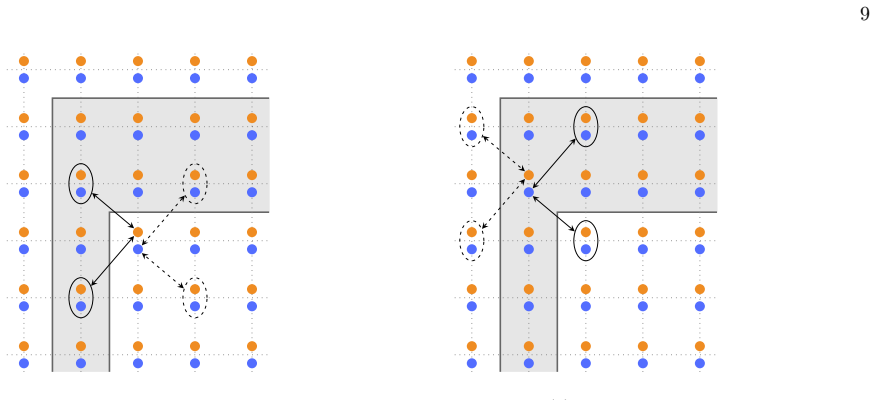
- [Section IV, Proposition IV.7 and its proof, equations (36)-(41)] The eigenvalue counting measure in the density of states is built from W_L = P_L W_d P*_L, where W_d is the decoupled walk of Lemma IV.5. However, the determinism argument in the proof of Proposition IV.7 is carried out for a walk of the form (1), i.e. for W, with equations (37)-(39) describing the action of W. Lemma IV.5 states that W_d differs from W on (Delta Lambda)^2, and this set contains the boundary strips used in the algorithm: in particular, sites with x1=-L and x1=-L+1 are within distance 2 of the left edge of Delta Lambda, and sites with x2=L and x2=L-1 are within distance 2 of the upper edge of Delta Lambda. At those sites the eigenvalue equation W_L psi = z psi is not the equation (37) used to determine psi(x,+), and the paper does not show that W_d coincides with W there. Consequently the inequality dim ker(W_L - e^{i theta}) <= 2|(36)| in (40) is not established as written. Since this bound is the input to the Delyon-Souillard argument in (41), the proof of absence of point spectrum (Theorem II.3(2)) is incomplete. The gap appears patchable: including the O(L) sites of Lambda cap (Delta Lambda)^2 in the boundary data would still yield an O(L) bound, but the manuscript must be revised to make this explicit.
minor comments (5)
- [Section II.B, equations (8), (14), (15)] With the definitions pi_1(u)|x> = |x+1> and pi_1(v)|x> = e^{i(x Phi + theta)}|x>, one obtains uv = e^{i Phi} vu, not uv = e^{-i Phi} vu as in (8). Thus pi_1 is a representation of A_{-Phi} rather than A_Phi as stated. The spectral conclusion is unaffected because A_Phi is isomorphic to A_{-Phi} and the automorphism u -> u*, v -> v* conjugates w_Phi to sigma_1 w_Phi sigma_1, but the text should be corrected or clarified.
- [Section IV, Proposition IV.7] The assumption 'the coins C_j are either not completely diagonal or not completely off-diagonal' is ambiguous. The proof of the first case requires for each j that C_j is not completely diagonal, so that the coefficients c^j_{12} and c^j_{21} are nonzero; the second case requires for each j that C_j is not completely off-diagonal, so that c^j_{11} and c^j_{22} are nonzero. For the magnetic walk this is satisfied, but the proposition should state the hypothesis precisely.
- [Section IV, proof of Proposition IV.7, sentence containing (35)] The statement that continuity of k follows from the pointwise vanishing of tr(chi_{e^{i theta}}(W_L))/|Lambda_L| in (35) is not correct in general: a weak limit of measures can have an atom even if each approximating measure has zero mass at that exact point. The paper cites the Delyon-Souillard argument, which indeed gives the needed control on small arcs, but the first sentence should be rephrased to indicate that the full argument from [33] is being invoked rather than the pointwise criterion alone.
- [Section IV, Proposition IV.9] Weak convergence of dk_L to dN directly yields equality k(theta)=N(theta) only at continuity points of N. Since k is continuous by Proposition IV.7, equality on the dense set of continuity points is sufficient to conclude N=k and hence that N is continuous, but the proof should say this explicitly rather than assert equality for all theta without qualification.
- [Throughout] There are several small typographical and grammatical issues, including 'the spectrum of of W_Phi' before equation (24) and in the introduction, 'Moreover replace S_alpha' in the proof of Lemma IV.5, and 'There is an additional challenge present here when compared to the Hamiltonian case.' These should be cleaned up in revision.
Circularity Check
No significant circularity: the spectral claims are deduced from external published results, with no fitted input, renamed conclusion, or load-bearing self-citation.
full rationale
The paper derives two main claims: Cantor spectrum for irrational flux and absence of pure point spectrum for any field. The Cantor part rests on Theorem III.1, quoted as '[36, Thm.1.1c]: Let Φ/(2π) be irrational. Then, the spectrum of ~W_Φ is a zero measure Cantor set for all θ,' together with the rotation-algebra argument that W_Φ and ~W_Φ are images of the same element w_Φ under representations of a simple C*-algebra, so spectra coincide by Proposition III.2. Reference [36] is an independent published theorem about the unitary critical almost-Mathieu operator; although co-authored by J. Fillman, a co-author of the present paper, it does not presuppose the results of this paper, so this is normal self-citation rather than load-bearing circularity. The pure-point part is proved by identifying the spectral distribution function with the integrated density of states (Proposition IV.9) and showing the latter is continuous via the Delyon–Souillard argument (Proposition IV.7), with the dimension bound dim(ker(W_L − e^{iθ})) ≤ 2|(36)| obtained by an explicit determinism algorithm for generalized eigenfunctions. No parameter is fitted to the target spectrum, no prediction is statistically forced, and no conclusion is renamed as an input. The skeptical concern that the determinism algorithm is stated for W rather than the decoupled finite-volume W_L is a potential correctness gap in the proof as written, not a circularity: it does not make the conclusion equivalent to an input by construction. Accordingly, no circular step meets the required evidentiary standard, and the honest finding is no significant circularity.
Assumptions & free parameters
assumptions (5)
- standard math Rieffel: the rotation C*-algebra A_Phi is simple for Phi/(2pi) irrational.
- standard math Fillman-Ong-Zhang Theorem III.1: the unitary critical almost Mathieu operator has zero-measure Cantor spectrum for irrational Phi.
- standard math Shubin's results on the discrete magnetic Laplacian: trivial center of the von Neumann algebra, uniqueness of the trace, and kernel covariance used in Lemma IV.2.
- standard math Delyon-Souillard: for finite-difference operators the integrated density of states is continuous, adapted here to unitary truncated walks.
- domain assumption The discrete minimal coupling construction of [22] defines W_Phi as a unitary magnetic walk and guarantees the coins are neither purely diagonal nor purely off-diagonal.
Cite this review
Pith. "Pith review of Singular continuous Cantor spectrum for magnetic quantum walks." pith.science (2026). https://pith.science/paper/KJ3U6TTA
@misc{pith2026190809924,
  author       = {Pith},
  title        = {Pith review of: Singular continuous Cantor spectrum for magnetic quantum walks},
  year         = {2026},
  howpublished = {\url{https://pith.science/paper/KJ3U6TTA}},
  note         = {Machine review of arXiv:1908.09924}
}
abstract
In this note, we consider a physical system given by a two-dimensional quantum walk in an external magnetic field. In this setup, we show that both the topological structure as well as its type depend sensitively on the value of the magnetic flux $\Phi$: while for $\Phi/(2{\pi})$ rational the spectrum is known to consist of bands, we show that for $\Phi/(2{\pi})$ irrational the spectrum is a zero-measure Cantor set and the spectral measures have no pure point part.
Figures
Reference graph
Works this paper leans on
-
[36]
J. Fillman. Ballistic transport for limit-periodic jacobi matrices with applications to quantum many-body problems. Commun. Math. Phys. , 350:1275–1297, 2017.arXiv:1603.01173
work page Pith review arXiv 2017
-
[21]
C. Cedzich, T. Geib, F. A. Grünbaum, C. Stahl, L. Velázquez, A. H. Werner, and R. F. Werner. Quantum walks: Schur functions meet symmetry protected topological phases. 2019.arXiv:1903.07494
arXiv 2019
-
[1]
For Φ/(2π) /∈ Q the spectrum ofWΦ is a zero-measure Cantor set
-
[2]
upwards” instead of “downwards
For any magnetic field the pure point spectrum ofWΦ is empty. The zero-measure statement in the theorem refers to the arc-length measure on the circle. When we say that a subset K of the circle is a Cantor set, we mean thatK is a closed, perfect, nowhere dense subset of the circle in the standard topology thereupon. Together, these results imply the follow...
-
[3]
Y. Aharonov, L. Davidovich, and N. Zagury. Quantum random walks.Phys. Rev. A , 48(2):1687, 1993
work page 1993
-
[4]
Bound Molecules in an Interacting Quantum Walk
A. Ahlbrecht, A. Alberti, D. Meschede, V. B. Scholz, A. H. Werner, and R. F. Werner. Molecular binding in interacting quantum walks. New J. Phys. , 14:073050, 2012. arXiv:1105.1051
work page Pith review arXiv 2012
-
[5]
A. Ahlbrecht, C. Cedzich, R. Matjeschk, V. Scholz, A. H. Werner, and R. F. Werner. Asymptotic behavior of quantum walks with spatio-temporal coin fluctuations.Quantum Inf. Process., 11:1219–1249, 2012.arXiv:1201.4839
arXiv 2012
-
[6]
A. Ahlbrecht, V. B. Scholz, and A. H. Werner. Disordered quantum walks in one lattice dimension.J. Math. Phys. , 52:102201, 2011. arXiv:1101.2298
arXiv 2011
Show all 58 references
-
[7]
Ahlbrecht, H
A. Ahlbrecht, H. Vogts, A. H. Werner, and R. F. Werner. Asymptotic evolution of quantum walks with random coin.J. Math. Phys., 52:042201, 2011. arXiv:1009.2019
2011 arXiv
-
[8]
Ambainis
A. Ambainis. Quantum walks and their algorithmic applications. Int. J. Quantum Inf. , 1(04):507–518, 2003. arXiv:quant-ph/0403120
2003 arXiv
-
[9]
Ambainis, E
A. Ambainis, E. Bach, A. Nayak, and A. V. Watrous. One-dimensional quantum walks. InProc. STOC ’01, pages 37–49, New York, 2001. ACM
2001
-
[10]
Applebaum
D. Applebaum. Probability Measures on Compact Lie Groups . Springer International Publishing, 2014
2014
-
[11]
Avila and S
A. Avila and S. Jitomirskaya. The ten Martini problem.Ann. Math., pages 303–342, 2009
2009
-
[12]
Avila, S
A. Avila, S. Jitomirskaya, and C. Marx. Spectral theory of extended harper’s model and a question by Erdos and Szekeres. Invent. Math., 210:293–339, 2017.arXiv:1602.05111
2017 arXiv
-
[13]
S. D. Berry and J. B. Wang. Two-particle quantum walks: Entanglement and graph isomorphism testing.Phys. Rev. A , 83(4):042317, 2011. arXiv:1002.3003
2011 arXiv
-
[14]
Bourgain, F
J. Bourgain, F. A. Grünbaum, L. Velázquez, and J. Wilkening. Quantum recurrence of a subspace and operator-valued Schur functions. Commun. Math. Phys. , 329:1031–1067, 2014.arXiv:1302.7286
2014 arXiv
-
[15]
Bratteli and D
O. Bratteli and D. W. Robinson. Operator Algebras and Quantum Statistical Mechanics 1 . Texts and Monographs in Physics. Springer, second edition, 1987
1987
-
[16]
E. Brown. Bloch electrons in a uniform magnetic field.Phys. Rev., 133(4A):A1038, 1964
1964
-
[17]
Cantero, F
M.-J. Cantero, F. A. Grünbaum, L. Moral, and L. Velázquez. Matrix-valued Szegő polynomials and quantum random walks. Commun. Pure Appl. Math. , 63:464–507, 2010.arXiv:0901.2244
2010 arXiv
-
[18]
Cantero, F
M.-J. Cantero, F. A. Grünbaum, L. Moral, and L. Velázquez. The CGMV method for quantum walks.Quantum Inf. Process., 11:1149–1192, 2012
2012
-
[19]
Quantum Walks in Grenoble
C. Cedzich. Quantum walks in electric fields, 2012. Talk given at the workshop “Quantum Walks in Grenoble”
2012
-
[20]
Cedzich, T
C. Cedzich, T. Geib, F. A. Grünbaum, C. Stahl, A. H. Werner, and R. F. Werner. The topological classification of one-dimensional symmetric quantum walks.Ann. Inst. Henri Poincaré , 19(2):325–383, 2018.arXiv:1611.04439
2018 arXiv
-
[22]
Cedzich, T
C. Cedzich, T. Geib, C. Stahl, L. Velázquez, A. H. Werner, and R. F. Werner. Complete homotopy invariants for translation invariant symmetric quantum walks on a chain.Quantum, 2:95, 2018. arXiv:1804.04520
2018 arXiv
-
[23]
Cedzich, T
C. Cedzich, T. Geib, P. Tieben, and R. F. Werner. Rational magnetic fields on the lattice: Regrouping invariance. In preparation
-
[24]
Quantumwalksinexternalgaugefields
C.Cedzich, T.Geib, A.H.Werner, andR.F.Werner. Quantumwalksinexternalgaugefields. J. Math. Phys., 60(1):012107,
-
[25]
Cedzich, F
C. Cedzich, F. A. Grünbaum, C. Stahl, A. H. Werner, and R. F. Werner. Bulk-edge correspondence of one-dimensional quantum walks. J. Phys. A: Math. Theor. , 49(21):21LT01, 2016.arXiv:1502.02592
2016 arXiv
-
[26]
Cedzich, F
C. Cedzich, F. A. Grünbaum, L. Velázquez, A. H. Werner, and R. F. Werner. A quantum dynamical approach to matrix Khrushchev’s formulas.Commun. Pure Appl. Math. , 69(5):909–957, 2016.arXiv:1405.0985
2016 arXiv
-
[27]
Cedzich, T
C. Cedzich, T. Rybár, A. H. Werner, A. Alberti, M. Genske, and R. F. Werner. Propagation of quantum walks in electric fields.Phys. Rev. Lett., 111:160601, Oct 2013.arXiv:1302.2081. 11
2013 arXiv
-
[28]
Cedzich and A
C. Cedzich and A. H. Werner. Anderson localization for electric quantum walks and skew-shift CMV matrices. 2019. arXiv:1906.11931
2019 arXiv
-
[29]
A. M. Childs. Universal computation by quantum walk.Phys. Rev. Lett., 102(18):180501, 2009. arXiv:0806.1972
2009 arXiv
-
[30]
A. M. Childs, R. Cleve, E. Deotto, E. Farhi, S. Gutmann, and D. A. Spielman. Exponential algorithmic speedup by a quantum walk. InProc. STOC ’03, pages 59–68. ACM, 2003.arXiv:quant-ph/0209131
2003 arXiv
-
[31]
Cycon, R
H. Cycon, R. G. Froese, W. Kirsch, and B. Simon.Schrödinger operators, with applications to quantum mechanics and global geometry. Theoretical and Mathematical Physics. Springer, Berlin, 1987
1987
-
[32]
Damanik, J
D. Damanik, J. Erickson, J. Fillman, G. Hinkle, and A. Vu. Quantum intermittency for sparse CMV matrices with an application to quantum walks on the half-line.J. Approx. Th. , 208:59–84, 2016.arXiv:1507.02041
2016 arXiv
-
[33]
Damanik, J
D. Damanik, J. Fillman, and D. Ong. Spreading estimates for quantum walks on the integer lattice via power-law bounds on transfer matrices. J. Math. Pures. Appl. , 105:293–341, 2016.arXiv:1505.07292
2016 arXiv
-
[34]
Dynamicsofunitaryoperators
D.Damanik, J.Fillman, andR.Vance. Dynamicsofunitaryoperators. J. Fract. Geom., 1:391–425, 2014.arXiv:1308.1811
2014 arXiv
-
[35]
Delyon and B
F. Delyon and B. Souillard. Remark on the continuity of the density of states of ergodic finite difference operators. Commun. Math. Phys. , 94(2):289–291, 1984
1984
-
[37]
Fillman and D
J. Fillman and D. Ong. Purely singular continuous spectrum for limit-periodic cmv operators with applications to quantum walks. J. Funct. Anal., 272:5107–5143, 2017.arXiv:1610.06159
2017 arXiv
-
[38]
Fillman, D
J. Fillman, D. C. Ong, and Z. Zhang. Spectral characteristics of the unitary critical almost-Mathieu operator.Commun. Math. Phys., pages 1–37, 2016.arXiv:1512.07641
2016 arXiv
-
[39]
P. A. Grillet.Abstract algebra, volume 242. Springer Science & Business Media, 2007
2007
-
[40]
Grimmett, S
G. Grimmett, S. Janson, and P. F. Scudo. Weak limits for quantum random walks. Phys. Rev. E , 69:026119, 2004. arXiv:quant-ph/0309135
2004 arXiv
-
[41]
F. A. Grünbaum, L. Velázquez, A. H. Werner, and R. F. Werner. Recurrence for discrete time unitary evolutions.Commun. Math. Phys., 320:543–569, 2013.arXiv:1202.3903
2013 arXiv
-
[42]
D. R. Hofstadter. Energy levels and wave functions of Bloch electrons in rational and irrational magnetic fields.Phys. Rev. B, 14:2239–2249, Sep 1976
1976
-
[43]
Jitomirskaya
S. Jitomirskaya. Metal-insulator transition for the almost Mathieu operator. Ann. Math. , 150:1159–1175, 1999. arXiv:math/9911265
1999 arXiv
-
[44]
A. Joye. Random time-dependent quantum walks. Communications in Mathematical Physics , 307(1):65, Jul 2011. arXiv:1010.4006
2011 arXiv
-
[45]
A. Joye. Dynamical localization for d-dimensional random quantum walks.Quantum Inf. Process. , 11:1251–1269, 2012. arXiv:1201.4759
2012 arXiv
-
[46]
Joye and M
A. Joye and M. Merkli. Dynamical localization of quantum walks in random environments.J. Stat. Phys. , 140(6):1–29,
-
[47]
P. L. Krapivsky, J. M. Luck, and K. Mallick. Interacting quantum walkers: two-body bosonic and fermionic bound states. J. Phys. A: Math. Theor. , 48(47):475301, 2015. arXiv:1507.01363
2015 arXiv
-
[48]
R. B. Laughlin. Quantized Hall conductivity in two dimensions.Phys. Rev. B , 23(10):5632, 1981
1981
-
[49]
Linden and J
N. Linden and J. Sharam. Inhomogeneous quantum walks.Phys. Rev. A , 80(5):052327, 2009. arXiv:0906.3692
2009 arXiv
-
[50]
N. B. Lovett, S. Cooper, M. Everitt, M. Trevers, and V. Kendon. Universal quantum computation using the discrete-time quantum walk. Phys. Rev. A , 81:042330, 2010. arXiv:0910.1024
2010 arXiv
-
[51]
Marx and S
C. Marx and S. Jitomirskaya. Dynamics and spectral theory of quasi-periodic Schrödinger-type operators.Ergod. Theory Dyn. Syst., 37:2353–2393, 2017.arXiv:1503.05740
2017 arXiv
-
[52]
L. A. Pastur. Spectral properties of disordered systems in the one-body approximation.Commun. Math. Phys., 75(2):179– 196, 1980
1980
-
[53]
Portugal
R. Portugal. Quantum Walks and Search Algorithms . Springer, 2018
2018
-
[54]
Rieffel.C ∗-algebras associated with irrational rotations.Pac
M. Rieffel.C ∗-algebras associated with irrational rotations.Pac. J. Math. , 93(2):415–429, 1981
1981
-
[55]
Shikano and H
Y. Shikano and H. Katsura. Localization and fractality in inhomogeneous quantum walks with self-duality.Phys. Rev. E , 82(3):031122, 2010. arXiv:1004.5394
2010 arXiv
-
[56]
Shikano and H
Y. Shikano and H. Katsura. Notes on inhomogeneous quantum walks. AIP Conf. Proc. , 1363(1):151–154, 2011. arXiv:1104.2010
2011 arXiv
-
[57]
M. Shubin. Discrete magnetic laplacian.Commun. Math. Phys. , 164(2):259–275, 1994
1994
-
[58]
D. J. Thouless, M. Kohmoto, M. P. Nightingale, and M. Den Nijs. Quantized Hall conductance in a two-dimensional periodic potential. Phys. Rev. Lett., 49(6):405, 1982
1982
Reviewed August 14, 2026 · model on record in the stance chip above.
Discussion (0). Continue with ORCID to comment.