REVIEW 2 major objections 4 minor 29 references
Stochastic Optimization for Non-convex Inf-Projection Problems
T0 review · 2 major / 4 minor · reviewed 2026-08-14 · deepseek-v4-flash
Pith's one-line read This paper provides the first comprehensive stochastic convergence analysis for non-convex inf-projection problems, proving that its MSPG and St-SPG algorithms reach a (nearly) ε-stationary point of the target function with total…
desk verdict Solid framework for stochastic inf-projection problems, but the stationarity measure omits active constraint normals, so the stated convergence guarantee needs either X=R^d or a normal-cone-corrected measure. read the letter →
The pith
A machine-rendered reading of the paper's core claim, the machinery that carries it, and where it could break.
The reading
What carries the argument
The load-bearing object is the inf-projection structure itself: because $h$ is uniformly convex, the inner minimizer $y^*(x)=\arg\min_y [h(y)-\langle y,\ell(x)\rangle]$ is unique, and under standard variational-analysis regularity the target subdifferential collapses to $\partial F(x)=\partial g(x)-\nabla\ell(x)^\top y^*(x)$. The paper's bridging lemmas convert whatever stationarity measure the algorithm actually controls—$\operatorname{dist}(0,\partial f(x,y))$ for MSPG, or subproblem residuals $\|x_k-v_k\|$ and $\|y_k-u_k\|$ for St-SPG—into $\operatorname{dist}(0,\partial F(x))$, using the duality that $\nabla h^*$ is $(L_{h^*},v)$-H\"older continuous exactly when $h$ is $p$-uniformly convex with $v=1/(p-1)$. That exponent $v$ is why every complexity bound in the paper has the form $O(1/\epsilon^{4/v})$.
What would settle it
Take $X=[0,1]$, $g(x)=0$, $h(y)=y^2/2$, and $\ell(x)=x$, so $y^*(x)=x$ and $F(x)=-x^2/2$. The constrained minimizer is $x=1$, where $\partial F(1)=\{-1\}$ and the boundary-free distance is $\operatorname{dist}(0,\partial F(1))=1$, even though $x=1$ is stationary in the constrained sense because the normal cone $N_X(1)=[0,\infty)$ contains $-1$. Checking this boundary case settles whether the paper's stationarity measure is adequate for constrained problems.
Extended reading notes
Core claim
The central claim is that stochastic first-order methods can converge to a stationary point of the inf-projected objective $F(x)=g(x)+\min_y[h(y)-\langle y,\ell(x)\rangle]$ itself, not merely to a stationary point of the joint function $f(x,y)$. Under smoothness and bounded-variance assumptions, MSPG achieves $\mathbb{E}[\operatorname{dist}(0,\partial F(x_\tau))^2]\le O(1/T^v)$ when $g$ and $\ell$ are smooth, giving $T=O(1/\epsilon^{2/v})$ iterations and total cost $O(1/\epsilon^{4/v})$ for an $\epsilon$-stationary point. When $g$ and $\ell$ are convex but possibly nonsmooth, St-SPG treats each stage as a strongly convex proximal subproblem in $x$ and $y$, and the paper's Corollaries 4 and 5 show the same $O(1/\epsilon^{4/v})$ total complexity, returning a nearly stationary point when $g$ is nonsmooth. The argument works by bridging two levels of stationarity: the algorithm controls either $\operatorname{dist}(0,\partial f(x_\tau,y_\tau))$ or subproblem residuals $\|x_k-v_k\|$ and $\|y_k-u_k\|$, and Lemmas 3 and 4 convert those quantities into $\operatorname{dist}(0,\partial F(x))$ using H\"older continuity of $\nabla h^*$ and Lipschitz properties of $\ell$.
Load-bearing premise
The load-bearing premise is that the constraint set $X$ never actively constrains the solution: the proofs use equality-style first-order optimality and define stationarity without a boundary term, so if $X$ has a boundary the stated convergence to $\operatorname{dist}(0,\partial F(x))\le\epsilon$ may not certify a constrained stationary point.
Editorial extensions
If this is right
- For smooth $g$ and $\ell$, MSPG reaches $\mathbb{E}[\operatorname{dist}(0,\partial F(x_\tau))]\le\epsilon$ with total cost $O(1/\epsilon^{4/v})$; when $h$ is strongly convex ($v=1$) this becomes $O(1/\epsilon^4)$.
- For convex nonsmooth $g$ and $\ell$, St-SPG attains the same total complexity, and in the nonsmooth-$g$ case it returns a point within distance $O(\epsilon^{1/v})$ of an $\epsilon$-stationary point.
- The inf-projection formulation is usable when $h^*(\ell(x))$ is non-decomposable, because an unbiased stochastic gradient of the joint function costs one sample of $\ell(x)$ rather than a gradient of the composition $h^*(\ell(x))$.
- The stagewise framework is modular: the inner SPG solver can be swapped for other stochastic algorithms for strongly convex subproblems without changing the stationarity-bridging argument.
- For variance-based regularization, the inf-projection formulation introduces only a one-dimensional dual variable $y$, avoiding the $n$-dimensional distribution variable that makes min-max formulations scale poorly with sample size.
Reading between the lines
- Inference: if a normal-cone term were added to the stationarity measure and to the first-order optimality equality in the proof, the same two-step bridge would likely extend to arbitrary convex compact sets $X$; the current analysis is cleanest when $X=\mathbb{R}^d$ or when iterates stay in the interior.
- Inference: the one-sample stochastic gradient trick for variance regularization should generalize to any objective containing functions of the empirical mean, such as $\mathbb{E}[\ell]^2$ or higher powers, because the dual variable $y$ carries the mean and no $n$-dimensional distribution is needed.
- Inference: users of the nonsmooth case should remember the guarantee is 'nearly' stationary: the returned point itself may be only $O(\epsilon^{1/v})$ away from an $\epsilon$-stationary point, so comparing algorithms on raw gradient norms at the returned point will be pessimistic unless that offset is accounted for.
- Inference: a direct stress test of the boundary caveat is to run St-SPG on a biconvex problem whose optimum lies on the boundary of $X$; the current theorem predicts the reported $\operatorname{dist}(0,\partial F(x))$ may fail to certify constrained stationarity there.
Signed reviews
Editorial analysis
A structured set of objections, weighed in public.
Referee Report
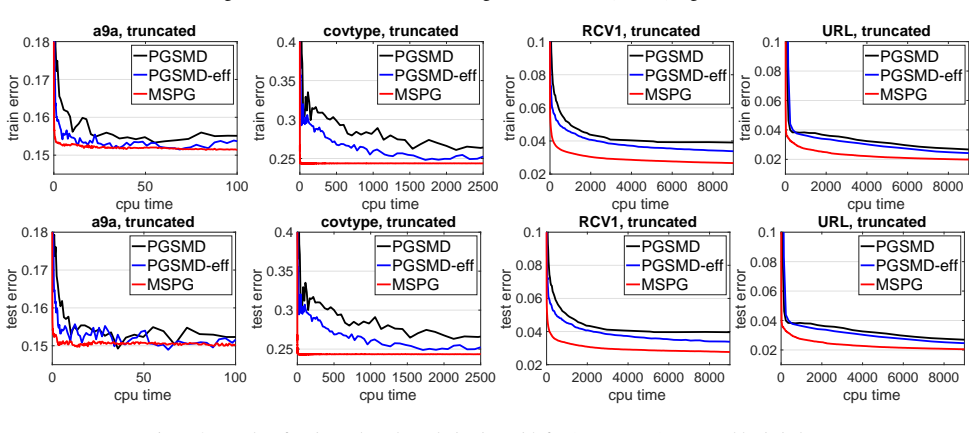
Summary. The paper considers non-convex and possibly non-smooth inf-projection problems of the form min_{x∈X} F(x) = g(x) + min_{y∈dom(h)} [h(y) - ⟨y, l(x)⟩], where X is a closed convex set. It proposes two stochastic algorithms: MSPG for the case where g and l are smooth but not necessarily convex, and St-SPG for cases where g or l are convex but possibly non-smooth, under monotonicity conditions on h*. The central theoretical claim is that these algorithms find an ε-stationary point of F measured by dist(0, ∂F(x)), with total iteration complexity O(1/ε^{4/v}) under the smoothness and uniform-convexity conditions summarized in Table 1. The paper also applies the inf-projection formulation to variance-based regularization and presents experiments comparing the proposed algorithms with min-max baselines.
Significance. If the stated convergence results are correct, this would be the first comprehensive stochastic convergence guarantee for non-convex inf-projection minimization measured directly in dist(0, ∂F(x)). The paper is largely self-contained: Proposition 2 on the SPG subproblem is re-derived in the appendix rather than merely cited, and the convergence rates are derived rather than fitted. The variance-based regularization experiments provide a useful empirical demonstration, and the complexity rates O(1/ε^{4/v}) are plausible and interesting. However, the stationarity measure used in the theorems omits the normal cone of the constraint set X, and this gap is load-bearing for the main claims.
major comments (2)
- [Definition 1; Lemmas 3–4; Theorems 2 and Corollaries 4–5] The stationarity measure dist(0, ∂F(x)) in Definition 1 is the unconstrained subdifferential of F and does not include the normal cone N_X(x), even though Problem (1) constrains x to a closed convex set X and Algorithms 1–3 project onto X. For boundary points, the correct constrained stationarity condition is dist(0, ∂F(x) + N_X(x)) ≤ ε. The gap is not merely cosmetic: it falsifies the theorems as stated. Take X=[0,1], g=0, h(y)=y²/2 + I_{[-B,B]}(y) with B>1, and l(x)=x. Then F(x)= -x²/2 on [0,1], and the global minimizer is x=1 with dist(0,∂F(1))=1. Starting from x₁=y₁=1, both the x- and y-updates of MSPG stay at 1, so every output has dist(0,∂F(x_τ))=1, contradicting the claim of Theorem 2 that E[dist(0,∂F(x_τ))] ≤ ε. Lemma 3 bounds the unconstrained gradient of F, but it does not control the constrained stationarity of F+I_X; the same issue propagates through Lemma 4 and Corollaries 4–5.
- [Appendix B.3, Lemma 4] The first-order optimality condition for v_k is written as the equality 0 = ∇g(v_k) - ∇l(x_k)^T y_k + γ(v_k - x_k). This equality is valid only if v_k lies in the relative interior of X or if X=R^d. If v_k is on the boundary of X, the optimality condition must include a normal-cone term n ∈ N_X(v_k). The subsequent bounds on ‖∇F(x_k)‖ and dist(0,∂F(v_k)) therefore do not follow for a general closed convex constraint set. Since these bounds feed directly into Corollaries 4 and 5, the stated convergence to ε-stationary points of the constrained problem is not established.
minor comments (4)
- [Theorem 3] In the displayed statement, the inner-iteration budgets are mislabeled: it reads T_y^k = k/γ + 1 and T_t^k = k/µ + 1, but the proof and the constants in the displayed bounds require T_x^k = k/γ + 1 and T_y^k = k/µ + 1.
- [Lemma 4, Part I] In the derivation after 'Since ρ = ...', the second term involving G_l^v should be G_l^v ((1+v)/(2v))^v L_{h*} ‖x_{k+1} - x_k‖^v rather than ‖u_k - y_k‖^v; the final displayed bound with coefficient G_l^{v+1} is consistent with this correction.
- [Lemma 4, Part II and Corollary 5] The symbol z_k in the last displayed bound of Lemma 4, Part II should be v_k, since the proof bounds ‖x_{k+1} - v_k‖. Also, Corollary 5 writes dist(0, ∇F(v_τ)) although g is non-smooth; the subdifferential notation dist(0, ∂F(v_τ)) is appropriate.
- [References and notation] Rockafellar and Wets is cited as both 1998 and 2009; one entry should be removed or unified. In Section 5, hyper-parameter ranges such as λ ∈ {10^{-5}:2} are written in nonstandard set notation; interval or power-of-ten notation would be clearer.
Circularity Check
No significant circularity: convergence rates are derived, not fitted; the one self-citation (Xu et al. 2018a) is re-proved in the appendix and is not load-bearing.
full rationale
The paper's central claims are the iteration complexities for MSPG and St-SPG in finding an epsilon-stationary point of the inf-projection objective F(x). These are obtained through explicit proofs: Proposition 1 is derived from the first-order optimality conditions of the MSPG updates together with smoothness and Young's inequality; Proposition 2 is initially attributed to Xu et al. 2018a, but the full proof is reproduced in Appendix B.2 with Lemma 5 from Zhao & Zhang (2015), so the self-citation is accompanied by an independent derivation and is not load-bearing. Lemma 3 and Lemma 4 connect dist(0, partial F) to subproblem optimality via standard variational-analysis arguments (Rockafellar & Wets 2009) and uniform convexity inequalities; Theorem 3's bounds on ||x_k - v_k|| and ||x_{k+1} - x_k|| are obtained by telescoping f(x_k,y_k) - f(x_{k+1},y_{k+1}) and applying Assumption 1(v). No parameter is fitted to a subset of data and then renamed a prediction, no uniqueness claim is imported solely from the authors' prior work, and no ansatz is smuggled in by citation. The only substantive concern is a correctness-level gap: Lemma 4's first-order optimality equalities omit normal-cone terms when X has a boundary, and Definition 1 measures stationarity without N_X(x); however, this is an assumption/validity issue, not circularity. Accordingly, the circularity burden is low: the derivation chain is self-contained apart from a minor, non-load-bearing self-citation.
Assumptions & free parameters
assumptions (5)
- domain assumption h(y)-<y,l(x)> is level-bounded in y uniformly in x, so the chain rule partial F(x)=nabla g(x)-nabla l(x)^T y*(x) holds via Rockafellar and Wets Theorem 10.58.
- domain assumption h is uniformly convex, equivalently h* has (L_h*,v)-Holder continuous gradient, and the inner minimizer y*(x) is unique.
- domain assumption Bounded variance assumptions in Assumption 1(ii)-(iv) and the boundedness of ||y_k|| and E||l(x_{k+1};xi)||^2 in Theorem 3.
- domain assumption Convexity of g and l in Section 4, and smoothness of g and l in Section 3, as summarized in Table 1.
- ad hoc to paper The iterates and subproblem solutions lie in the interior of X, or X=R^d, so normal cone terms can be omitted from first-order optimality conditions.
Cite this review
Pith. "Pith review of Stochastic Optimization for Non-convex Inf-Projection Problems." pith.science (2026). https://pith.science/paper/OVMRJQOC
@misc{pith2026190809941,
  author       = {Pith},
  title        = {Pith review of: Stochastic Optimization for Non-convex Inf-Projection Problems},
  year         = {2026},
  howpublished = {\url{https://pith.science/paper/OVMRJQOC}},
  note         = {Machine review of arXiv:1908.09941}
}
read the original abstract
In this paper, we study a family of non-convex and possibly non-smooth inf-projection minimization problems, where the target objective function is equal to minimization of a joint function over another variable. This problem include difference of convex (DC) functions and a family of bi-convex functions as special cases. We develop stochastic algorithms and establish their first-order convergence for finding a (nearly) stationary solution of the target non-convex function under different conditions of the component functions. To the best of our knowledge, this is the first work that comprehensively studies stochastic optimization of non-convex inf-projection minimization problems with provable convergence guarantee. Our algorithms enable efficient stochastic optimization of a family of non-decomposable DC functions and a family of bi-convex functions. To demonstrate the power of the proposed algorithms we consider an important application in variance-based regularization. Experiments verify the effectiveness of our inf-projection based formulation and the proposed stochastic algorithm in comparison with previous stochastic algorithms based on the min-max formulation for achieving the same effect.
Figures

Reference graph
Works this paper leans on
-
[1]
Proximal alternating linearized minimization for nonconvex and nonsmooth problems
Bolte, J., Sabach, S., and Teboulle, M. Proximal alternating linearized minimization for nonconvex and nonsmooth problems. Math. Program., 146 0 (1-2): 0 459--494, August 2014. ISSN 0025-5610
work page 2014
-
[2]
and Vandenberghe, L
Boyd, S. and Vandenberghe, L. Convex Optimization. Cambridge University Press, 2004
2004
-
[3]
Universal Stagewise Learning for Non-Convex Problems with Convergence on Averaged Solutions
Chen, Z., Yang, T., Yi, J., Zhou, B., and Chen, E. Universal stagewise learning for non-convex problems with convergence on averaged solutions. CoRR, /abs/1808.06296, 2018
work page Pith review arXiv 2018
-
[4]
Davis, D. and Drusvyatskiy, D. Stochastic model-based minimization of weakly convex functions. CoRR, abs/1803.06523, 2018 a
arXiv 2018
-
[5]
Davis, D. and Drusvyatskiy, D. Stochastic subgradient method converges at the rate o(k^ -1/4 ) on weakly convex functions. CoRR, /abs/1802.02988, 2018 b
arXiv 2018
-
[6]
Davis, D. and Grimmer, B. Proximally guided stochastic subgradient method for nonsmooth, nonconvex problems. arXiv preprint arXiv:1707.03505, 2017
arXiv 2017
-
[7]
Davis, D., Edmunds, B., and Udell, M. The sound of apalm clapping: Faster nonsmooth nonconvex optimization with stochastic asynchronous palm. In Advances in Neural Information Processing Systems, pp.\ 226--234, 2016
work page 2016
-
[8]
SPRING: A fast stochastic proximal alternating method for non-smooth non-convex optimization
Driggs, D., Tang, J., Davies, M., and Sch \"o nlieb, C.-B. Spring: A fast stochastic proximal alternating method for non-smooth non-convex optimization. arXiv preprint arXiv:2002.12266, 2020
work page Pith review arXiv 2002
Show all 29 references
-
[9]
Mini-batch stochastic approximation methods for nonconvex stochastic composite optimization
Ghadimi, S., Lan, G., and Zhang, H. Mini-batch stochastic approximation methods for nonconvex stochastic composite optimization. Math. Program., 155 0 (1-2): 0 267--305, 2016
2016
-
[10]
Biconvex sets and optimization with biconvex functions: a survey and extensions
Gorski, J., Pfeuffer, F., and Klamroth, K. Biconvex sets and optimization with biconvex functions: a survey and extensions. Mathematical Methods of Operations Research, 66 0 (3): 0 373--407, Dec 2007
2007
-
[11]
A unified algorithmic framework for block-structured optimization involving big data: With applications in machine learning and signal processing
Hong, M., Razaviyayn, M., Luo, Z.-Q., and Pang, J.-S. A unified algorithmic framework for block-structured optimization involving big data: With applications in machine learning and signal processing. IEEE Signal Processing Magazine, 33 0 (1): 0 57--77, 2015
2015
-
[12]
C., and Sugiyama, M
Kiryo, R., Niu, G., du Plessis, M. C., and Sugiyama, M. Positive-unlabeled learning with non-negative risk estimator. In Guyon, I., Luxburg, U. V., Bengio, S., Wallach, H., Fergus, R., Vishwanathan, S., and Garnett, R. (eds.), Advances in Neural Information Processing Systems ...
2017
-
[13]
P., Packer, B., and Koller, D
Kumar, M. P., Packer, B., and Koller, D. Self-paced learning for latent variable models. In Neural Information Processing Systems 23, pp.\ 1189--1197, 2010
2010
-
[14]
and Pontil, M
Maurer, A. and Pontil, M. Empirical bernstein bounds and sample variance penalization. arXiv preprint arXiv:0907.3740, 2009
2009 arXiv
-
[15]
and Duchi, J
Namkoong, H. and Duchi, J. C. Stochastic gradient methods for distributionally robust optimization with f-divergences. In Advances in Neural Information Processing Systems (NIPS), pp.\ 2208--2216, 2016
2016
-
[16]
and Duchi, J
Namkoong, H. and Duchi, J. C. Variance-based regularization with convex objectives. In Advances in Neural Information Processing Systems (NIPS), pp.\ 2975--2984, 2017
2017
-
[17]
Universal gradient methods for convex optimization problems
Nesterov, Y. Universal gradient methods for convex optimization problems. Mathematical Programming, 152 0 (1): 0 381--404, Aug 2015. ISSN 1436-4646. doi:10.1007/s10107-014-0790-0. URL https://doi.org/10.1007/s10107-014-0790-0
2015 doi
-
[18]
and Suzuki, T
Nitanda, A. and Suzuki, T. Stochastic difference of convex algorithm and its application to training deep boltzmann machines. In Artificial Intelligence and Statistics, pp.\ 470--478, 2017
2017
-
[19]
Non-convex min-max optimization: Provable algorithms and applications in machine learning
Rafique, H., Liu, M., Lin, Q., and Yang, T. Non-convex min-max optimization: Provable algorithms and applications in machine learning. CoRR, abs/1810.02060, 2018
2018 arXiv
-
[20]
and Wets, R
Rockafellar, R. and Wets, R. J.-B. Variational Analysis. Springer Verlag, Heidelberg, Berlin, New York, 1998
1998
-
[21]
Rockafellar, R. T. and Wets, R. J.-B. Variational analysis, volume 317. Springer Science & Business Media, 2009
2009
-
[22]
K., Castillo, C
Shah, S., Yadav, A. K., Castillo, C. D., Jacobs, D. W., Studer, C., and Goldstein, T. Biconvex relaxation for semidefinite programming in computer vision. In ECCV (6) , volume 9910 of Lecture Notes in Computer Science, pp.\ 717--735. Springer, 2016
2016
-
[23]
and Singer, Y
Shalev-Shwartz, S. and Singer, Y. On the equivalence of weak learnability and linear separability: New relaxations and efficient boosting algorithms. Machine learning, 80 0 (2-3): 0 141--163, 2010
2010
-
[24]
Thi, H. A. L., Le, H. M., Phan, D. N., and Tran, B. Stochastic DCA for the large-sum of non-convex functions problem and its application to group variable selection in classification. In Precup, D. and Teh, Y. W. (eds.), Proceedings of the 34th International Conference on Mach...
2017
-
[25]
and Yin, W
Xu, Y. and Yin, W. A block coordinate descent method for regularized multiconvex optimization with applications to nonnegative tensor factorization and completion. SIAM Journal on imaging sciences, 6 0 (3): 0 1758--1789, 2013
2013
-
[26]
Stochastic optimization for dc functions and non-smooth non-convex regularizers with non-asymptotic convergence
Xu, Y., Qi, Q., Lin, Q., Jin, R., and Yang, T. Stochastic optimization for dc functions and non-smooth non-convex regularizers with non-asymptotic convergence. arXiv preprint arXiv:1811.11829, 2018 a
2018 arXiv
-
[27]
Learning with non-convex truncated losses by SGD
Xu, Y., Zhu, S., Yang, S., Zhang, C., Jin, R., and Yang, T. Learning with non-convex truncated losses by SGD . CoRR, abs/1805.07880, 2018 b . URL http://arxiv.org/abs/1805.07880
2018 arXiv
-
[28]
Stochastic proximal gradient methods for non-smooth non-convex regularized problems
Xu, Y., Jin, R., and Yang, T. Stochastic proximal gradient methods for non-smooth non-convex regularized problems. CoRR, abs/1902.07672, 2019
1902 arXiv
-
[29]
and Zhang, T
Zhao, P. and Zhang, T. Stochastic optimization with importance sampling for regularized loss minimization. In Proceedings of the 32nd International Conference on Machine Learning (ICML), pp.\ 1--9, 2015
2015
Reviewed August 14, 2026 · model on record in the stance chip above.
Discussion (0). Continue with ORCID to comment.