REVIEW 2 major objections 4 minor 1 cited by
Exact hydrodynamic attractor of an ultrarelativistic gas of hard spheres
T0 review · 2 major / 4 minor · reviewed 2026-08-14 · deepseek-v4-flash
Pith's one-line read For a hard-sphere gas under Bjorken flow, the hydrodynamic attractor is exact and its gradient expansion converges.
desk verdict The Israel-Stewart convergence result is solid and novel; the full-Boltzmann attractor claim is supported only for a single equilibrium initial condition, so the abstract overstates it. read the letter →
The pith
A machine-rendered reading of the paper's core claim, the machinery that carries it, and where it could break.
The reading
What carries the argument
The load-bearing object is the Knudsen number of the hard-sphere gas. Binary collisions conserve particle number, so $n(\tau)=n_0\tau_0/\tau$ exactly, and with a constant total cross section the mean free path $l_{\rm mfp}=1/(n\sigma_T)$ grows linearly with $\tau$; because the macroscopic gradient scale in Bjorken flow is also $\tau$, $Kn$ is a constant fixed by initial conditions. This converts the Israel-Stewart equation for the shear correction into an autonomous ODE in $\chi$ alone, solvable in closed form, and the late-time fixed point is the exact attractor whose power series in $Kn$ is the convergent gradient expansion. For the microscopic comparison, the same attractor is obtained by solving the full nonlinear Boltzmann equation numerically in Milne coordinates until all dimensionless moments saturate, since a constant Knudsen number forces the attractor to be constant.
What would settle it
Run a high-precision numerical solution of the full nonlinear Boltzmann equation for the same hard-sphere gas at a fixed Knudsen number but with initial times spread over a wide range, adjusting the initial density and cross section to keep $Kn = 1/(n_0\tau_0\sigma_T)$ fixed, and read off the late-time value of $\pi/(\epsilon+P)$; if that value depends on $\tau_0$, the claimed attractor is not a function of $Kn$ alone.
Extended reading notes
Core claim
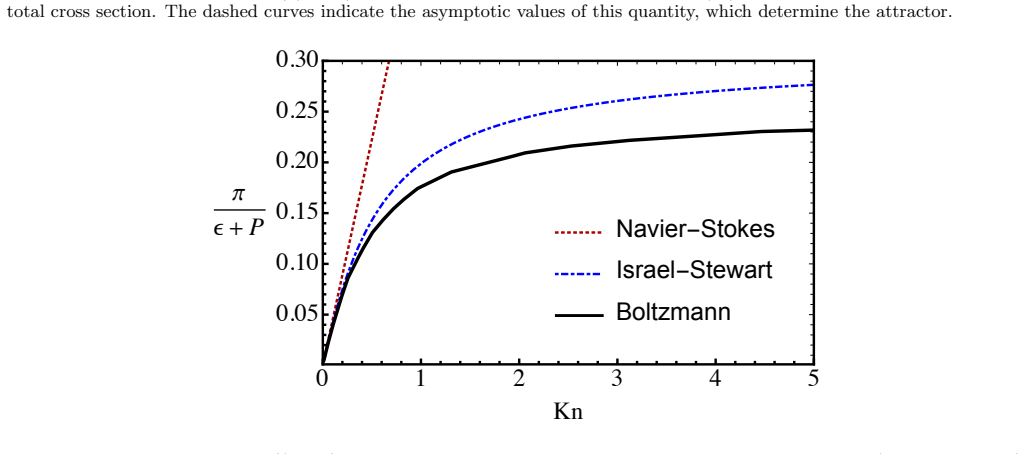
The paper's central discovery is that particle-number conservation in a hard-sphere gas under Bjorken flow makes the Knudsen number constant, $Kn = l_{\rm mfp}/\tau = 1/(n_0 \tau_0 \sigma_T)$, rather than time dependent as in previously studied conformal systems. With the shear viscosity and relaxation time written as $\eta = a T/\sigma_T$, $\tau_\pi = b\eta/(4P)$, and $\tau_{\pi\pi}=3\lambda\tau_\pi$, the Israel-Stewart equation for $\chi=\pi/(4P)$ becomes an autonomous first-order ODE whose general solution is analytic, and whose late-time fixed point, $\chi_{\rm att}=A - \frac{3}{8}\frac{4+ab\lambda Kn}{ab Kn}$ with $A$ the square root in Eq. (11), is the attractor. The gradient expansion of $\chi_{\rm att}$ in powers of $Kn$ converges absolutely for $|Kn| < 3/(2a\sqrt{b})$ (with the 14-moment values $a=4/3$, $b=5$ giving radius $\approx 0.5$), the first proven convergence in an expanding system. The paper then extracts the same attractor from a numerical solution of the full nonlinear Boltzmann equation and shows that the Israel-Stewart and Boltzmann attractors agree to within 20% even when the Knudsen number is large.
Load-bearing premise
The construction rests on the modeling assumption that the collision cross section is independent of energy, so the mean free path is set by the particle density and the Knudsen number stays constant; if the cross section depends on energy, as in conformal or QCD-like matter, the Knudsen number becomes time dependent and the exact solution and convergence proof no longer apply.
Editorial extensions
If this is right
- In this hard-sphere gas the gradient expansion converges absolutely for $|Kn| < 3/(2a\sqrt{b})$, so a convergent hydrodynamic series is possible even in a rapidly expanding system.
- The exact attractor of the full nonlinear Boltzmann equation is a function of the Knudsen number alone and is independent of the initial preparation, extending attractor results beyond the relaxation-time approximation.
- Israel-Stewart theory reproduces the exact Boltzmann attractor to within 20% even at large Knudsen numbers, supporting the use of viscous hydrodynamics far from equilibrium in heavy-ion collision modeling.
- The zeroth-order slow-roll approximation gives the exact attractor in this system, so the closed form replaces the need for higher-order gradient corrections.
Reading between the lines
- An immediate extension the authors do not make: for an energy-dependent cross section the Knudsen number varies with time, so the exact ODE reduction is lost; this paper therefore predicts that conformal-like gases should retain the previously seen divergent gradient behavior under Bjorken flow.
- Because the closed-form attractor depends only on $Kn$, it can serve as a benchmark: any approximate hydrodynamic closure aiming at far-from-equilibrium validity should reproduce Eq. (12) for this system rather than only the Navier-Stokes limit.
- One could probe the analytic structure of $\chi_{\rm att}$ as a function of complex $Kn$; the finite convergence radius suggests singularities at complex values, and locating the analogous singularities in the Boltzmann attractor might diagnose the onset of non-hydrodynamic transient modes.
Editorial analysis
A structured set of objections, weighed in public.
Referee Report
Summary. The paper studies an ultrarelativistic gas of hard spheres undergoing Bjorken flow, with particle number conservation and a constant total cross section. It shows that the Knudsen number is constant, which makes the Israel-Stewart viscous hydrodynamic equations analytically solvable. The resulting late-time attractor for the shear-stress ratio chi (Eq. 12) is shown to have a gradient expansion that converges absolutely in a finite range of Knudsen numbers (Eq. 14, with radius |Kn| < 3/(2 a sqrt(b)) for lambda = 0). The paper also extracts a late-time constant value of chi from numerical solutions of the full nonlinear Boltzmann equation for several cross sections, identifies this as the exact Boltzmann attractor, and compares it with the Israel-Stewart attractor, finding agreement within 20% even at large Knudsen numbers.
Significance. If the claims hold, this is a significant contribution: it provides the first example of a convergent gradient expansion in a relativistically expanding system and an exact analytical attractor for an Israel-Stewart theory, which is a valuable benchmark for far-from-equilibrium hydrodynamics. The analytical derivation is transparent and the convergence radius is correctly identified from the branch points of the solution. The comparison with the full Boltzmann equation, if the attractor claim is justified, would be an important test of hydrodynamic attractor universality. However, as discussed below, the Boltzmann-side claim currently lacks a basin-of-attraction test, so the significance is somewhat contingent.
major comments (2)
- [Section 4, Fig. 1 and Fig. 2] The claim that the late-time constant chi extracted from the Boltzmann equation is the 'exact hydrodynamic attractor' is not supported by the numerical evidence. All simulations shown in Fig. 1 start from the same equilibrium distribution (tau0 = 0.1 fm, T = 0.5 GeV, vanishing chemical potential); the only variation is the total cross section, and the scaling check with tau0 = 1 fm and a smaller cross section preserves the same equilibrium initial conditions. These runs show that the late-time value depends only on Kn for this particular family of initial conditions, but they do not establish that the limit is independent of the initial momentum-space distribution. The argument in the text that 'any dimensionless quantity constructed using moments of the Boltzmann distribution must asymptote to a constant' only shows approach to a fixed point along a trajectory, not uniqueness across initial conditions. Because Kn is constant, the collision rate is a fixed fraction of the expansion rate, so there is no automatic mechanism that erases the memory of the initial momentum-space anisotropy at large Kn. To support the headline claim, the authors should either perform additional numerical experiments with different initial momentum-space distributions (e.g., anisotropic distributions, different chemical potentials) and demonstrate the same late-time chi, or explicitly soften the claim to a late-time fixed point for equilibrium initial conditions.
- [Abstract and Section 1] The abstract states that 'in this example the gradient expansion converges' without qualification, but the convergence proof in Section 3 applies only to the Israel-Stewart truncation of the gradient expansion, specifically to the solution of Eq. (9). Section 4 correctly notes that the gradient expansion for the full nonlinear Boltzmann equation remains an open question and even demonstrates divergence in the relaxation-time-approximation toy model. The abstract should be reworded to attribute the convergent series to the Israel-Stewart theory, otherwise it overstates the scope of the result and could mislead readers into thinking the convergence holds for the full Boltzmann equation.
minor comments (4)
- [Section 4, numerical method] The numerical Boltzmann solver is described only by reference to Ref. [53]; no resolution checks (grid size, particle number, time-step convergence) or numerical error estimates are provided. Since the 'exact Boltzmann attractor' rests entirely on these numerics, a brief convergence test or a statement of numerical uncertainty would strengthen the presentation.
- [Eq. (18) and surrounding text] The spelling 'Mandelstan' should be 'Mandelstam'.
- [Fig. 1 caption] The caption says the dashed curves indicate the asymptotic values that determine the attractor; it would be clearer to state explicitly that these runs all use equilibrium initial conditions, since that is the basis of the attractor extraction.
- [Conclusions] The phrase 'deviations ... remain 20% at best' is ambiguous; 'never exceed 20%' would be clearer.
Circularity Check
No significant circularity; the Israel-Stewart attractor is an exact solution of the stated equations and the Boltzmann comparison is an independent numerical benchmark.
full rationale
The central derivation chain is not circular. Equation (9) is the Israel-Stewart dynamical equation with transport coefficients (8); because the Knudsen number is constant, Eq. (10) is obtained by direct analytic solution, and Eq. (12) is the late-time fixed point of that equation. No parameter in Eq. (12) is fitted to the target late-time value of chi: the constants a, b, and lambda are inputs from the 14-moment approximation, and the convergence radius quoted after Eq. (14) follows from explicit evaluation of the series coefficients. The Boltzmann-equation attractor is extracted from a numerical solution of the full nonlinear Boltzmann equation (16)-(18), with an independent benchmark against previous RTA/Boltzmann calculations, and the reported 20% agreement between the Israel-Stewart and Boltzmann attractors is a comparison of two independently computed curves rather than a fit. The main limitations are that the numerical Boltzmann runs all start from the same equilibrium initial distribution, so initial-condition independence and basin-of-attraction are not demonstrated, and that the gradient-series divergence shown in the RTA model is explicitly acknowledged not to prove divergence for the full collision kernel. These are evidential gaps in the strength of the 'exact attractor' claim, not reductions of the claimed result to its own inputs. The self-citations that appear, such as Refs. [42-44] for transport coefficients and Ref. [7] for the RTA method, are not load-bearing circularity because the cited results are independently derived kinetic-theory results or are used only for an illustrative side remark.
Assumptions & free parameters
free parameters (3)
- a (shear viscosity coefficient) =
4/3
- b (relaxation time coefficient) =
5
- lambda (tau_pi_pi coefficient) =
10/21
assumptions (3)
- domain assumption The gas consists of classical ultrarelativistic hard spheres with binary collisions and conserved particle number, giving n(τ)τ = const and l_mfp = 1/(n σ_T) with σ_T constant.
- domain assumption The Israel-Stewart-like second-order equation (7), with transport coefficients (8), is a valid hydrodynamic description of this gas.
- domain assumption The numerical particle method of Xu and Greiner (Ref. [53]) provides a sufficiently accurate solution of the nonlinear Boltzmann equation (16).
Cite this review
Pith. "Pith review of Exact hydrodynamic attractor of an ultrarelativistic gas of hard spheres." pith.science (2026). https://pith.science/paper/7FIJZ3XM
@misc{pith2026190809957,
  author       = {Pith},
  title        = {Pith review of: Exact hydrodynamic attractor of an ultrarelativistic gas of hard spheres},
  year         = {2026},
  howpublished = {\url{https://pith.science/paper/7FIJZ3XM}},
  note         = {Machine review of arXiv:1908.09957}
}
read the original abstract
We derive the general analytical solution of the viscous hydrodynamic equations for an ultrarelativistic gas of hard spheres undergoing Bjorken expansion, taking into account effects from particle number conservation, and use it to analytically determine its attractor at late times. Differently than all the cases considered before involving rapidly expanding fluids, in this example the gradient expansion converges. We exactly determine the hydrodynamic attractor of this system when its microscopic dynamics is modeled by the Boltzmann equation with a fully nonlinear collision kernel. The exact late time attractor of this system can be reasonably described by hydrodynamics even when the gradients are large.
Figures

Forward citations
Cited by 1 Pith paper
-
Constraint on initial conditions of one-dimensional expanding fluids from nonlinear causality
Nonlinear causality constrains one-dimensional Bjorken-expanding viscous fluids to small inverse Reynolds numbers, giving minimum initial times of about 0.5 to 1 fm and maximum initial energy densities of about 5 to 3...
Reference graph
Works this paper leans on
-
[1]
Introduction. Hydrodynamics is an effective theory describing the dynamics of a many-body system at times and distances that are considerably larger than any microscopic scale. Such a separation of scales is commonly characterized by a dimensionless quantity called the Knudsen number, Kn = 𝓁/L, where 𝓁 is the relevant microscopic scale, and L is a macrosco...
-
[2]
General properties. We consider a homogeneous ultrarelativistic gas of hard spheres in Milne coordinates xµ = arXiv:1908.09957v2 [nucl-th] 8 Apr 2020 2 (τ,x,y,ς ) with line element (we set ℏ =c =kB = 1) ds2 =gµνdxµdxν =dτ 2− ( dx2 +dy2 +τ 2dς 2) , (1) whereτ = √ t2−z2 andς = tanh−1(z/t). We further assume that the system is invariant under reflections arou...
arXiv 1908
-
[3]
Analytical solution of viscous hydrodynamics. We start our analysis by investigating the hydrodynamic regime of Israel-Stewart-like theories [40–42] derived from the Boltzmann equation. In Bjorken flow, energy and momentum conservation,∇µTµν = 0, is encoded in a single equation for the energy density, 1 ε dε dτ + 4 3τ = 4χ 3τ, (6) 1 We remark in passing th...
-
[4]
Hydrodynamic attractor of the Boltzmann equation. In this section we obtain the attractor of an ultrarelativistic gas of hard spheres now from a microscopic perspective using the Boltzmann equation [50]. For Bjorken flow described in Milne coordinates (1), the contribution from the Christoffel symbols cancel exactly, and the Boltzmann equation becomes [38, ...
-
[5]
Conclusions. In this work we provided a comprehensive analysis of the far-from-equilibrium dynamics of an ultra- relativistic gas of hard spheres, described by the full Boltzmann equation, undergoing Bjorken flow. We demonstrated that the Israel-Stewart hydrodynamic equations, derived from the Boltzmann equation, can be solved analytically in this case. We...
work page 2019
-
[6]
S. Chapman and T. G. Cowling, The mathematical theory of non-uniform gases, 3rd edition (Cambridge University Press, Cambridge, 1970)
work page 1970
-
[7]
Cercignani, Mathematical Methods in Kinetic Theory (Springer, US, 1990)
C. Cercignani, Mathematical Methods in Kinetic Theory (Springer, US, 1990). 7
work page 1990
-
[8]
L. D. Landau and E. M. Lifshitz, Fluid Mechanics - Volume 6 (Corse of Theoretical Physics) (Pergamon Press, 1987)
work page 1987
Show all 60 references
-
[9]
M. P. Heller, R. A. Janik, and P. Witaszczyk, Phys. Rev. Lett. 110, 211602 (2013), 1302.0697
2013 arXiv
-
[10]
M. P. Heller and M. Spalinski, Phys. Rev. Lett. 115, 072501 (2015), 1503.07514
2015 arXiv
-
[11]
Buchel, M
A. Buchel, M. P. Heller, and J. Noronha, Phys. Rev. D94, 106011 (2016), 1603.05344
2016 arXiv
-
[12]
G. S. Denicol and J. Noronha (2016), 1608.07869
2016 arXiv
-
[13]
M. P. Heller, A. Kurkela, M. Spaliski, and V. Svensson, Phys. Rev. D97, 091503 (2018), 1609.04803
2018 arXiv
- [14]
- [15]
-
[16]
Strickland, J
M. Strickland, J. Noronha, and G. Denicol, Phys. Rev. D97, 036020 (2018), 1709.06644
2018 arXiv
-
[17]
Romatschke, JHEP 12, 079 (2017), 1710.03234
P. Romatschke, JHEP 12, 079 (2017), 1710.03234
2017 arXiv
-
[18]
Florkowski, M
W. Florkowski, M. P. Heller, and M. Spalinski, Rept. Prog. Phys. 81, 046001 (2018), 1707.02282
2018 arXiv
-
[19]
F. S. Bemfica, M. M. Disconzi, and J. Noronha, Phys. Rev. D98, 104064 (2018), 1708.06255
2018 arXiv
-
[20]
G. S. Denicol and J. Noronha, Phys. Rev. D97, 056021 (2018), 1711.01657
2018 arXiv
-
[21]
Behtash, C
A. Behtash, C. N. Cruz-Camacho, and M. Martinez, Phys. Rev. D97, 044041 (2018), 1711.01745
2018 arXiv
- [22]
-
[23]
Casalderrey-Solana, N
J. Casalderrey-Solana, N. I. Gushterov, and B. Meiring, JHEP 04, 042 (2018), 1712.02772
2018 arXiv
-
[24]
M. P. Heller and V. Svensson, Phys. Rev. D98, 054016 (2018), 1802.08225
2018 arXiv
- [25]
-
[26]
G. S. Denicol and J. Noronha, Phys. Rev. D99, 116004 (2019), 1804.04771
2019 arXiv
-
[27]
Casalderrey-Solana, C
J. Casalderrey-Solana, C. P. Herzog, and B. Meiring, JHEP 01, 181 (2019), 1810.02314
2019 arXiv
- [28]
-
[29]
Behtash, S
A. Behtash, S. Kamata, M. Martinez, and H. Shi, Phys. Rev. D99, 116012 (2019), 1901.08632
2019 arXiv
-
[30]
Strickland, JHEP 12, 128 (2018), 1809.01200
M. Strickland, JHEP 12, 128 (2018), 1809.01200
2018 arXiv
- [31]
-
[32]
Jaiswal, C
S. Jaiswal, C. Chattopadhyay, A. Jaiswal, S. Pal, and U. Heinz (2019), 1907.07965
2019 arXiv
- [33]
-
[34]
J. D. Bjorken, Phys. Rev. D27, 140 (1983)
1983
-
[35]
S. S. Gubser, Phys. Rev. D82, 085027 (2010), 1006.0006
2010 arXiv
- [36]
-
[37]
Noronha-Hostler, J
J. Noronha-Hostler, J. Noronha, and M. Gyulassy, Phys. Rev. C93, 024909 (2016), 1508.02455
2016 arXiv
- [38]
-
[39]
R. D. Weller and P. Romatschke, Phys. Lett. B774, 351 (2017), 1701.07145
2017 arXiv
-
[40]
Aidala et al
C. Aidala et al. (PHENIX), Nature Phys. 15, 214 (2019), 1805.02973
2019
-
[41]
Baier, P
R. Baier, P. Romatschke, D. T. Son, A. O. Starinets, and M. A. Stephanov, JHEP 04, 100 (2008), 0712.2451
2008 arXiv
-
[42]
Marrochio, J
H. Marrochio, J. Noronha, G. S. Denicol, M. Luzum, S. Jeon, and C. Gale, Phys. Rev. C91, 014903 (2015), 1307.6130
2015 arXiv
-
[43]
G. S. Denicol, U. W. Heinz, M. Martinez, J. Noronha, and M. Strickland, Phys. Rev. Lett. 113, 202301 (2014), 1408.5646
2014 arXiv
-
[44]
G. S. Denicol, U. W. Heinz, M. Martinez, J. Noronha, and M. Strickland, Phys. Rev. D90, 125026 (2014), 1408.7048
2014 arXiv
-
[45]
Israel and J
W. Israel and J. M. Stewart, Ann. Phys. 118, 341 (1979)
1979
- [46]
-
[47]
G. S. Denicol, H. Niemi, E. Molnar, and D. H. Rischke, Phys. Rev. D85, 114047 (2012), [Erratum: Phys. Rev.D91,no.3,039902(2015)], 1202.4551
2012 arXiv
-
[48]
G. S. Denicol, E. Molnar, H. Niemi, and D. H. Rischke, Eur. Phys. J. A48, 170 (2012), 1206.1554
2012 arXiv
-
[49]
G. S. Denicol, S. Jeon, and C. Gale, Phys. Rev. C90, 024912 (2014), 1403.0962
2014 arXiv
- [50]
-
[51]
Grozdanov, P
S. Grozdanov, P. K. Kovtun, A. O. Starinets, and P. Tadi, Phys. Rev. Lett. 122, 251601 (2019), 1904.01018
2019 arXiv
-
[52]
Grozdanov, P
S. Grozdanov, P. K. Kovtun, A. O. Starinets, and P. Tadic (2019), 1904.12862
2019 arXiv
-
[53]
J. A. McLennan, Physics of Fluids 8, 1580 (1965)
1965
-
[54]
Santos, J
A. Santos, J. J. Brey, and J. W. Dufty, Phys. Rev. Lett. 56, 1571 (1986), URL https://link.aps.org/doi/10.1103/ PhysRevLett.56.1571
1986
-
[55]
S. R. D. Groot, Relativistic Kinetic Theory. Principles and Applications (Amsterdam, Netherlands: North-holland ( 1980) 417p, 1980)
1980
-
[56]
Bazow, G
D. Bazow, G. S. Denicol, U. Heinz, M. Martinez, and J. Noronha, Phys. Rev. Lett. 116, 022301 (2016), 1507.07834
2016 arXiv
-
[57]
Bazow, G
D. Bazow, G. S. Denicol, U. Heinz, M. Martinez, and J. Noronha, Phys. Rev. D94, 125006 (2016), 1607.05245
2016 arXiv
- [58]
-
[59]
A. El, Z. Xu, and C. Greiner, Phys. Rev. C81, 041901 (2010), 0907.4500
2010 arXiv
-
[60]
Romatschke and U
P. Romatschke and U. Romatschke, Relativistic Fluid Dynamics In and Out of Equilibrium , Cambridge Monographs on Mathematical Physics (Cambridge University Press, 2019), ISBN 9781108483681, 9781108750028, 1712.05815, URL https://www.cambridge.org/academic/subjects/physics/theo...
2019 arXiv
Reviewed August 14, 2026 · model on record in the stance chip above.
Discussion (0). Continue with ORCID to comment.